Wednesday, January 9, 2008

CARLOS SAURA'S FLAMENCO TRILOGY - ECLIPSE SERIES 6


Over the past couple of months, Criterion has been doing their level best to elevate how traditional, performance-based dance is represented in the DVD field. First with their release of Martha Graham: Dance on Film, and now their bundling of Carlos Saura's Flamenco Trilogy as the sixth entry in their Eclipse Series, the studio is giving home viewers the chance to see that there is more to cutting a rug than can be seen on "Dancing with the Stars."

Made between 1981 and 1983, the three films here are invaluable and supremely entertaining chronicles of a dancing style that is integral to Spain's artistic identity. Carlos Saura was an early pioneer of the Spanish Neorealist movement in the 1960s, and his illustrious career continues to this day. The Flamenco Trilogy is probably his best known work.

The first in the series is Blood Wedding (1981; 71 minutes), and it establishes the technique and tone of this set of films. Shot in a style that blurs the lines between documentary and performance, Saura chronicles the day of one dance company, from arrival through the preparation of stage make-up, the warm-up routine, and then a full rehearsal of the flamenco ballet Blood Wedding. The performance is a traditional operatic tale. On the wedding day of one couple, it is discovered that the bride has been having an affair with a married man. Uncovered by the cheater's spurned wife, the lovers flee, pursued by the woman's jilted fiancée. A knife fight leads to one inevitable outcome. The dance troupe performs the play for Saura's camera, captured from multiple angles, and though Saura jumps between them, most of the shots are long and focused, maintaining the feel of a seamless, uninterrupted performance. The dancers are accompanied by a live band and singers, all of whom move in and out of the action, serving as members of the wedding party.

By filming in the rehearsal studio rather than on a stage, Saura maintains an intimacy that isn't possible when shooting over an audience's heads in a theatre. He also pulls the viewer into the dance experience via the everyday details he captures backstage. More importantly, he makes the troupe's leader, Antonio Gades, who also choreographed the flamenco and adapted it from a story by Federico Garcia Lorca, our main character. While Gades silently applies make-up, Saura overlays a recording of him explaining his life and how he ended up becoming a dancer. This gives us a personal connection to Gades, even when he plays Leonardo, the dastardly adulterer in Blood Wedding.

Like all dancers, the flamenco performers have tremendous control over their bodies. Though some of the movements seem familiar to anyone who has seen straight-up ballet, in this context, they seem more forceful and violent to me. Confident kicks punctuate many moves, the hard-soled shoes of the dancers resounding loudly on the wooden floor. They mime holding babies and riding horses, but the scene that really got me was the duel between Leonardo and the cuckold Groom (Juan Antonio Jimenez). Using prop knives, they dance the back-and-forth hack-and-slash in slow motion, turning their muscles to molasses, bringing out the bloodlust with an intense vigor that would not be visible at normal speed. In a weird way, the more in control the dancers are, the more able they are to show how out of control the fighters are. It has a tremendous impact.
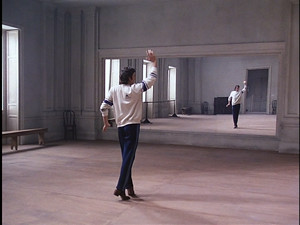
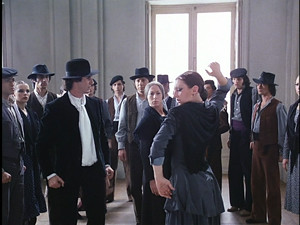

Rather than just repeat the same approach when Saura and Gades teamed up again in 1983, Carmen (101 minutes) shifts from the documentary approach to something more resembling a traditional melodrama. In a way, it's almost like we are seeing the fictionalized version of the first movie. We still have Gades and his troupe, and the movie opens with a rehearsal for his new ballet. Gades is trying to create a new Carmen dance piece using the famous Georges Bizet opera while also going back to the original Prosper Merimee novel. We see him trying out steps, hashing over the music, and most important, worrying over who his lead will be. He decides to cast a wide net and visit regional dance schools to find a new Carmen.

And this he does, meeting a dancer whose real name is Carmen. Played by Laura del Sol, Carmen is sensual, voluptuous, headstrong, and a little bit of a mess. Antonio rejects her at first, but he can't get her out of his head. Once she's on board, the production begins to take shape. Full dance rehearsals are interspersed with the backstage drama that erupts when Antonio becomes obsessed with his new dancer. His life is starting to resemble the ballet he is trying to perform.

In Blood Wedding, we see the real life aspect of performance, and we also get the feeling that for the participants, dancing is their life. Carmen pushes the same concept to its next logical step, ironically using fiction to show us that dancers are their dance. Unfortunately, Carmen is a tad less effective than the preceding film, largely because the melodrama is undercooked. The dance numbers are still incredible, especially a wonderful face-off between Carmen and the older dancer she replaced (Cristina Hoyos), and the cliché story elements they relate are forgivable because the canvas is meant to be larger. The scenes of Antonio struggling with his muse are no different than anything we've seen before and at their best are merely functionary stopgaps between the bigger music. It doesn't stop Carmen from being a good movie (and Saura was certainly more successful than Robert Altman would be years later, applying the same technique for his ballet film The Company), but in comparison to its siblings, it's the runt of the litter for me.


The third collaboration of Saura and Gades came three years after Carmen. El amor brujo (Love, the Magician) (1986; 103 minutes) continues to advance the melding of movie and performance, this time dropping the pretense of a staged production almost completely. The opening crane shots lead us into a soundstage, showing us the cracks between warehouse and movie set, but once the camera settles into the gypsy village where Manuel de Falla's drama will play out, the reality of the dance will be the only reality.

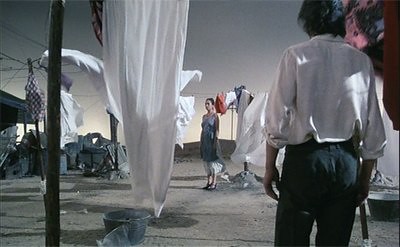
Not that it's a realistic presentation, mind you. Saura isn't returning to his Neorealist roots; rather, he's indulging in the illusion of movies, creating the façade for Gades and company to perform in front of. Though the village itself is built to look real, Saura's backgrounds are the wide walls of the soundstage, and he uses his sky as an expressionistic canvas, changing the colors to fit the mood of the scene, from white to blue to a lusty pink.

El amor brujo is the story of a love triangle in a gypsy village. As children, Carmelo was in love with Candela, but the day she became betrothed to Jose, his heart broke. As an older man, Carmelo (Gades) can only watch as his beloved (Hoyos) marries the carousing cad (Jimenez) her father picked out for her. Even after the deal is sealed, Jose keeps stepping out with Lucia (del Sol), whose wanton ways lead him into a knife fight to defend her honor. In the rumble, Jose is killed and Carmelo is sent to jail. He returns to his village four years later to find Candela haunted by her husband's ghost, and Carmelo has to figure out how to break this bond so he can finally realize his own passions for her.

El amor brujo is the perfect stylistic conclusion to this trilogy, an expert coupling of flamenco and cinema. Both mediums are suited to grand gestures, both are confined to the limits of their stage, be it the physical boards of a traditional dance theatre or the borders of a movie screen. Over the course of the Flamenco Trilogy, Carlos Saura maneuvers around the various layers of performance, looking at the real mechanics and the driving force of artistic expression before finally settling into the full, illusory reality of the performance itself.

And yet, even with all of these other things going on, the dancing remains the most important. This is why any complaints about the melodramatic backstage elements in Carmen are ultimately moot. It's the flamenco we're really watching these films for, the fiery and passionate dancing. As collaborators, Carlos Saura and Antonio Gades, the film director and the choreographer, play to each other's strengths, preserving the integrity of the flamenco while applying cinematic technique. It's never as simple as setting up a camera and shooting the ballet straight on, but something more, putting the spectator into the action and letting us feel the reverberations.


Originally written October 16, 2007. For technical specs and special features, read the full article at DVD Talk.

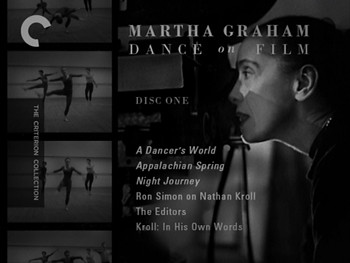
MARTHA GRAHAM: DANCE ON FILM - #406


Dance is an art form I've always meant to learn more about. Ever since my first year in college when, in a near simultaneous intersection of events, a date took me to a dance recital on campus and I developed a crush on a pretty dance major who lived upstairs from me in the dorm (she didn't perform at that recital, which would have made for a far more dramatic anecdote). Through the years, I've dipped my toe in once or twice, including seeing live ballet. I was impressed with the athleticism on display in ways I've never been touched by professional sports, intrigued by the idea of one's body as a tool of expression. Yet, I've never gone full bore into studying the craft. (You can actually read about my own attempts to recently learn dance at Confessions of a Pop Fan, here, here, and here.)

I explain this by way of indicating that when it comes to my approaching Criterion's new DVD Martha Graham: Dance on Film, I do so pretty much as a neophyte. Though I knew who Martha Graham was before viewing this double-disc set, it was only a passing knowledge, a name dropped in various contexts, the answer to a trivia question. Ever one for a cinematic adventure, however, I took this review opportunity as my chance to finally expand my understanding of the person behind the name.

Martha Graham: Dance on Film is a collection of three programs the legendary choreographer made with producer Nathan Kroll for public television between 1957 and 1961, when Graham was already in her sixties. Luckily for people like me, the very first program, A Dancer's World (31 minutes), was actually designed to be an introduction to Graham and her work. Sitting backstage, applying her make-up for a performance, Graham speaks to the audience about different aspects of the art, which are then illustrated in specially choreographed numbers performed by her world famous dance troupe.

Taking A Dancer's World alongside Martha Graham: The Dancer Revealed (54 minutes), the 1994 American Masters episode included on DVD 2 as a bonus feature, I felt like I had a good foundation laid down for me to better understand what I would be viewing in the other two performance pieces. As it turns out, I was more familiar with Martha Graham's pioneering work in interpretive dance than I had thought. As a pop culture junkie, I had seen her influence all over classic musicals, MTV videos, and even regularly parodied in comedy shows. If you've seen a comic actor do a flailing dance in his or her routine, chances are it's Graham who is being skewered.

The Martha Graham style uses movement to express emotion and abstraction to tell a story. Spasmodic gestures, limbs bent at right angles, swift rising and falling--these are all elements instantly recognizable as Graham choreography. Yet, there is also much more to it than that, a synthesis of setting and music, both acting as props to support the dancer rather than being separate elements. Graham dancers aren't as concerned about working with the beat of the music or following the melody as other troupes might be, the orchestration seems to work like that of a silent film, providing background but not integrated wholly into the action.


The second and third films on Martha Graham: Dance on Film - Criterion Collection are documents of two of her signature pieces. Appalachian Spring (32 minutes) is the story of a pioneer wedding on the American prairie. Dance is used to emphasize the ritual and ceremony of a religious union, as well as showing the demonstrative aspects of personal worship. Working with the stark sets of her regular designer, Isamu Noguchi, and buoyed by Aaron Copland's original score, Graham and her company create a full narrative, complete with multiple characters and a beginning, middle, and end of the story. I can't profess to understand it all in its entirety. In fact, the bonus feature put together by dance expert Deborah Jowitt, a thirteen-and-a-half minute comparison of the 1958 Appalachian Spring with a performance from the mid-1940s showed me how much I really didn't get upon first viewing. Showing the clips from the same portions of the two performances, Jowitt explains how subtle changes in the choreography alter the meaning of the piece. Also, since the earlier performance was shot by one camera from one angle in a theatre, she notes how the editing and the framing changes the viewer's perception of a piece by focusing the eye on particular elements of the action rather than taking in the entire stage at once. It made me wish that Jowitt had recorded full commentaries for the three films so I could learn even more about what I was seeing.

Still, even without that detailed of an explanation, I was captivated by Appalachian Spring and the final piece, Night Journey (29 minutes), a retelling of Jocasta's death from Sophocles' Oedipus. The combination of costume, music, and movement may be mysterious and difficult to penetrate fully, but that doesn't make it boring. In fact, it's the desire to decode what Graham is doing, along with the power of her artistry and craft, that will keep you watching. The performances aren't stodgy or outdated, but as alive and fresh as all good art is supposed to be.


Originally written September 22, 2007. For technical specs and special features, read the full article at DVD Talk. As it turns out, the DVD Talk review is also linked to on the Criterion page for this release. Go, me!
Monday, January 7, 2008

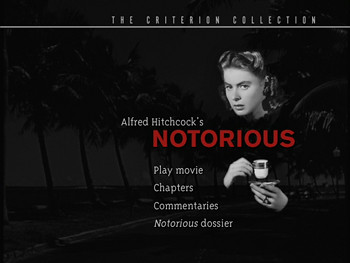
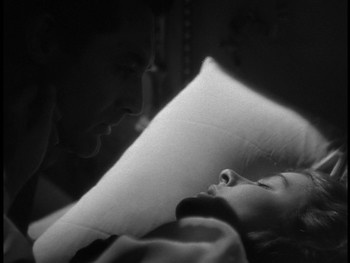
NOTORIOUS - #137

"This is a very strange love affair."

"Why?"

"Maybe because you don't love me."


I adore Alfred Hitchcock's Notorious for how it so consistently flummoxes all expectations.

Cary Grant and Ingrid Bergman starring in a film together in 1946, at the height of their fame, should have been the romantic cinematic event of the year. Audiences even today have certain expectations when they hear of the coupling. Yet, for most of Notorious, Hitchcock spends the film doing an end run around those expectations. He knows what we want to believe, and he let's us know that he knows, but instead of gratifying our desires, he chooses to make us wait.

Honestly, that doesn't make Notorious all that different from most of Hitch's filmography. Though most people think of the director's title "Master of Suspense" in terms of the chills and the shocks he peppers through his movies, it's a title that is deserved for other reasons, as well. That suspense is the suspension of our yearnings, drawing out our satisfaction like a delicious tease. His mis en scene is cut for seduction. It's why so many of his movies end with a big kiss. He's put us through hell for the preceding two hours waiting for it.

This is most evident in Notorious, where the love affair is kept in check for the first reel, finally unleashed, and then immediately pocketed again. For most of the film, Cary Grant plays a real son of a bitch. He's cold and he's cruel, and very un-Cary Grant-like. It makes Ingrid Bergman uneasy, and it makes us uneasy, too. We can tell she loves him, and we're pretty sure he still loves her, so why doesn't he just do something about it?!

In the film, Ingrid Bergman plays Alicia Huberman. Alicia is a notorious woman. While that word probably makes us think of a criminal when heard today, when a woman was notorious in 1946, it wasn't very gangsta. It's a reputation thing, you understand. Ms. Huberman is known to enjoy a drink or two in the company of men. By comparison, the fact that her father has been convicted as a Nazi spy is positively tame. It almost restores a little honor to her public image.

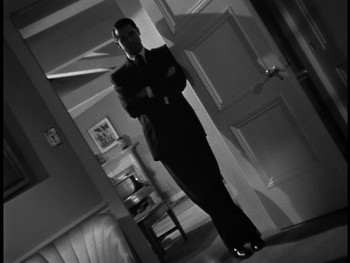
Cary Grant is T.R. Devlin, emphasis on "Devil." The two meet at Alicia's hedonistic blowout following dear ol' dad's sentencing. She likes him at first, but that's before she knows what he does for a living. Devlin is a government agent, and he has a proposition for Alicia--come work for the U.S. and reinvigorate some of her good name. Their wiretaps tell them that she is a patriot and did not condone her father's actions. They want to put her on assignment in Brazil hunting down her father's contacts. The way Devlin gets her to do it, it's almost like blackmail. It's certainly more bullying than your usual rah-rah sign-up speech. It gets through to her, though, and she decides to do it, seeing it as an opportunity to turn over a new leaf.

It's a bit of a character conundrum, since she's presented herself up until now as a wanton woman who cares not for serious things. Clearly, that image was a front, a way to shield herself from the disappointment of her immigrant father. (Mother has departed this Earth, her natural-born U.S. citizenship intact.) If the most important man in her life has betrayed her so, then better to block out all possibilities of any further caring relationships. Her way of flirting with Devlin is to inform him that the only reason she likes the sappy lovesong playing on the hi-fi is because it's such blatant hooey. Here may be the source of her notorious reputation, when her opening line in a romance is to inform the suitor that romance need never come into it. Such talk from the star of Casablanca, whose affectionate glance was worth all of Europe!


Most of the delayed gratification in Notorious comes from waiting for the fronts to crack. While Alicia pretends not to believe in love, so does Devlin like to pretend he is a hard individual. His is a professional demeanor, keep a distance, he's here for the job. There is no mistaking the white knight, however. He's very protective of Alicia in his way, lending that sympathetic ear like any decent fellow stuck babysitting the drunk girl at a party. He could take advantage, but he's trying not to. When he finally does kiss Alicia, it's only to repay her for taunting him.

That kiss unleashes a lot, too. From the moment they first lock lips, they can barely stay separated. They appear uncomfortable if their mouths are more than six inches apart, inhaling each other's exhales. Which is all by design. Hitchcock has been laying it on thick just so he can take a heavy hammer to it.

The job the government boys have for Alicia is sending her to cozy up to one of the ringleaders of the undercover Nazis down there in Rio. Send the whore to do a whore's job, essentially. Their callous attitude about what they are asking her to do is part of the male double-standard. They are more than willing to take advantage of a woman, and then they'll blame her when they get away with it. It's also the attitude of boys playing at being soldiers. If they're going to send other boys off to die, what's a woman's virtue in the bargain?

Of course, this is like a knife in the gut for Devlin. The blade gets twisted further when it's revealed the target that Alicia is supposed to seduce is Alex Sebastian (Claude Rains), a man who was once in love with her. No one ever asks if she was in love with him, as well. Does it matter? In Devlin's mind, he's sending the woman he loves into the arms of a former lover. That's gotta hurt a jealous ego.

Ironically, when Devlin returns to Alicia's apartment to tell her what is going down, she has adopted the domestic duties of a wife. She cooked dinner (albeit poorly), is wearing an apron, even refers to herself as "mama." The woman whom Devlin scoffed at when she swore to give up partying is going to prove to him she can be a wife and a mother. They punish her for being a tramp, and now they punish her for trying to go straight.

It's really a crossroads for Devlin. Send her to Sebastian or don't send her? Love of a woman or your love for your country? A product of his time, he wants to be a hero, and so he chooses that his country is more important. A lot of men in wartime movies had a bit of a martyr complex, and Devlin carries that into the post-War period, but he's not too happy about it. So, to cope, he swings all the way to the opposite side, reverting to the cold jerk that Alicia first met. To drive the point home, he hits her below the belt and makes a nasty comment about her character. It's unfair, particularly given what she is about to do in order to facilitate his martyr complex. Which of them is making the real sacrifice?

As a good friend of mine once said to me, it doesn't matter how bad it gets for everyone else, women always have it a little worse.


There is certainly a lot of complex psychology going on here. Moviegoers heading out to see Notorious would have been going in order to see its stars in many a passionate embrace, yet Alfred Hitchcock keeps inserting himself between them and pushing them apart--and for very dark, painful reasons, at that. The sexual tension doesn't dissipate by being shattered, it only multiplies, each new piece growing to the size of the original. Every time Alicia and Devlin meet to exchange information, it's so devastatingly present, they can barely look at each other. They want to be as close as they once were, you can feel how badly they want to rip each other's clothes off, yet it can't happen. In fact, when they have to kiss in order to fake out Sebastian, who has now become Alicia's suspicious, jealous husband, it's something they can barely put back in the bottle. Yes, just like what had spilled out of the champagne bottle, the Maguffin of Notorious, in Sebastian's secret cellar just moments before.

And yes, Alicia and Sebastian get married. That's how far she is willing to go, that's how much the traditional romantic roles are subverted. It's tougher for her, too, because Alicia is not so good at disguising her feelings. She asks Devlin multiple times to make a choice, upbraiding him for not defending her honor. Every time she brings it up, too, we're on her side. Just how hard would it be, Cary Grant? I mean, really!

Which is really the defied expectation that fascinates me most about Notorious. In what other movie are we meant to not like Cary Grant? It's really tough accepting his choosing the job over the lady, particularly since he is such a prick about it. It's not an entirely new concept in romantic fiction. Jane Austen and the Bronte Sisters regularly cast the standoffish jerk as their top candidate for love, somehow redeeming him by the end and proving that he was the right choice all along. In those instances, however, the characters are new, and they don't carry the baggage of being Cary Grant, Hollywood's top leading man. The director and his actor had discovered once before that pushing the Cary Grant persona too close to the dark edge was a difficult prospect. Their 1941 collaboration, Suspicion, originally had Grant's character trying to kill his wife by poisoning her, but ultimately, the film was rewritten to make it so that the suspicion was no more than that, because the public didn't want a Cary Grant that was a murderer.

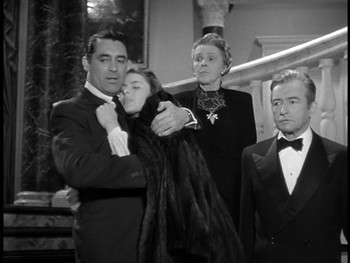
Thus, it's probably not a coincidence that Devlin's redemption uses the same elements as Suspicion, only inverted. Fans of the earlier film will recall the actor walking up a flight of stairs with a well-lit glass of poisoned milk. (There is even a visual allusion to that glass in the hangover remedy Devlin makes for Alicia after that first party.) In Notorious, it's Alicia's Nazi husband that is poisoning her drinks, and Cary Grant runs up the stairs not to finish her off, but to carry her to safety. Taking us back to the busted domestic scene at Alicia's apartment, he all but scoops her up in his arms and carries her back over the threshold of her marriage to Sebastian. Had it not been integral to the plot for the pair not to give up the game just yet, Hitch probably would have had him do so. Instead, he settles for her having to lean on him to walk. It's Devlin reclaiming his manhood in all of its chivalrous glory. It's all well and good to go off and defend your country, but you must take care of what you've left at home at the same time.


If I can make this about me for a moment (and I can), part of what lead me to return to Notorious this early in the run of reviews I'm writing exclusively for this blog is that I have a certain attraction to heroes that don't seem like heroes. This pertains to both the fiction I enjoy consuming and that I enjoy writing--though I've discovered in the latter category that this can come up even when it's not the author's inention. Almost all of my books have, at some time or other, received criticism for having protagonists who don't always make the right choice and thus some find their likeability a bit strained (and the strain is not always fairly come by, either). What interests me is that I never set out to write a complete bastard as my main character, nor did I even consciously think of the characters as flawed. I just always saw them for who they were and let them make their choices accordingly.

Now, maybe as their papa, I'm more willing to keep my eyes on the fact that some kind of redemption is on its way, but it does cause me to wonder what the difference is between a character who makes the wrong choice without knowing it, and someone like T.R. Devlin in Notorious who makes the wrong choice with full knowledge of its wrongness. Granted, there are noble intentions behind it, but at the same time, the way Ben Hecht writes Devlin, he doesn't have the character try to ease any of the blows he delivers on Alicia.

Part of this certainly comes out of a need to keep her alert and not have her distracted by going soft and gooey with romance. To me, his harsh words and sour manner are intended to remind her that this is dangerous stuff, there will be no playing around. But it's a tightrope that the writer has to walk (and the director and star; I know I shifted from them to Hecht here, but I had to give him his credit somewhere). Without the noble goal, at least a couple of the three writers who worked on Suspicion couldn't make it work, and perhaps that's the dangerous element of having flawed characters in literary fiction: the reader doesn't quite know where the hero is going the way they do in a genre star-vehicle, and may not have enough faith to follow him there.

I've been thinking about this dilemma a lot, because I have been working on a comic book script that tackles the same concept. I want a hero who doesn't appear to be acting like a hero for most of the story, who chooses a stony professionalism in order to manipulate the woman who should be the love interest into doing what is required of her. It remains to be seen if I can pull off the intentional jerk better than I do my usual accidental jerkface males, but I'm going to try. Notorious' ability to give the ladies--and some dudes like me--the vapors when the hero does finally reveal his true feelings is the highest I can aspire to, and it's a tall order. Fingers crossed.


Note: This movie is currently out of print from Criterion, and thus may be hard to find cheaply. It has some pretty awesome extras, however, and is worth the trouble and extra dollars.

Sunday, January 6, 2008

THE NAKED PREY - #415


When I was a boy, I read a lot of survival stories intended for young men, tales that were meant to show the thrill of exploration and adventure while also showing the often-harrowing consequences of such adventure. There were a variety of frontiers and timeframes that were regularly covered, with the most common being the colonizing of the Americas and Manifest Destiny, frozen tundras, rainforests, and mountain climbing. Jack London is probably the shining example of this tradition, with his narratives of rugged men in harsh environments and how they managed to adapt. London's identification with nature was so strong that many of his stories crossed from being about the men to the animals themselves.

Cornel Wilde's 1966 film The Naked Prey feels like one of those old adventure stories for me. Set in Africa in the nineteenth century, it's a tale of a jungle safari gone wrong, a downward slope of events predicated on an imperialist's lack of respect for the people or the land he is invading. Wilde plays "Man," the manager of an ivory expedition who is stuck guiding a ruthless capitalist (Gert Van Den Bergh) who wants things done his way or not at all. When the group happens upon elephants, he fires his gun indiscriminately, not caring whether the target actually has ivory tusks to offer or not. Likewise, when the safari meets a welcoming party from the tribesmen who actually live on the land they are hunting, the financier refuses to pay tribute to their king (Morrison Gampu).

This second slight proves to be the company's downfall. The tribesmen return, lead by a determined warrior (Ken Gampu), and take the men their prisoner. As restitution, they take the lives of the hunting party in brutal, torturous manners, letting the entire tribe participate and performing the acts of cruelty as entertainment for the king. Wilde is saved for the final sport, stripped of his clothing and forced to run for his life. The bulk of The Naked Prey is this chase, with Wilde's representative Man barely staying ahead of his pursuers, living by his wits and fighting to stay alive.

The Naked Prey is based on the real-life encounter of an American trapper being pursued by Blackfoot Indians after insulting them in a similar fashion. I can't attest to the accuracy of the story once it has been transplanted to Africa, but Wilde does strive for a sense of unflinching realism in The Naked Prey. Though the picture looks like a Wonderful World of Disney production at its start, it's not long before we realize that this has not been sanitized for Sunday night television viewing. The violence that man inflicts upon man in this movie is quite extreme. Though 1966 standards forced Wilde to keep a lot of the bloodshed off screen, there is never any question about what is actually happening. The actor/director/producer also uses the animal inhabitants of the African jungle as both a counterpoint to show the inhumanity of the situation and as a realistic reminder that the jungle is neither a forgiving nor an easy place to survive. In fact, survival is the only true imperative. You're either predator or prey.

To show this, Wilde not only shot his film in South Africa, but he uses real footage of animals being hunted and killed, as well as photographing jungle predators killing and feasting on smaller animals. It's not footage for the squeamish, but without it, The Naked Prey would seem a lot less plausible.


Naturally, by modern standards, we could lean toward judging The Naked Prey more harshly for its depiction of the noble white hunter running afoul of evil black savages. I think, however, that would be unfair to Cornell Wilde. If this were his intention, there are a lot of other choices he could have made in making the movie. It would have been cheaper, for instance, to shoot on a backlot using traditional Hollywood actors rather than traveling to Africa and using African actors. He also had ethnomusicologist Andrew Tracey recreate African music and employ field recordings when scoring the picture.

Even beyond that, however, I don't feel it was Wilde's intention to portray the indigenous people as ignorant savages. He doesn't show them as sadistic or maniacal the way Mel Gibson did, for instance, in Apocalypto, a film that owes a heavy debt to The Naked Prey. On the contrary, it's the white hunters who prove themselves to be far less "civilized" than they think they are. The leader of the safari--whom Wilde works hard to distinguish in attitude and demeanor from "Man"--not only wants to pillage the land for its ivory, but when he is through, he's thinking of joining the slave trade. It's his self-serving behavior and his inability to respect the local customs that causes the trouble, so Wilde is clearly progressive enough not to see the whites as victims of anything other than their own hubris.

I also think that it would be wrong to say that the hunt causes Wilde's character to become less civilized, to become less like a man and more like a beast. Maybe he becomes less "domesticated," more primal. The African tribes are a civilization, too, it's just a matter of the outer trappings and the conveniences available separating one society from another. The plight of Man is survival, and that means staying alive in the harsher environment, finding sustenance and avoiding more natural threats, not just staying ahead of his pursuers. It seems to be Wilde's intention to say that Man can get through anything as long as he manages to maintain some level of dignity and compassion. Thus, after slavers attack a village, Man saves a little girl (Bella Randles) and then she returns the favor. Individuals looking out for one another, and in turn learning from each other.

In the end, too, Wilde reminds us that the tribesman also have their dignity, that they are still people, their code is just different than ours. The last look exchanged between Man and Ken Gampu is one of respect. Not only does the warrior respect the white man for outrunning him, but he also finally gets the respect he was not given at the start of the picture. In its way, The Naked Prey is showing that the last vestige of any human is to stand tall in the face of hardship.

Which is what I think all of those adventure stories of my youth also were trying to teach me. I am not ever likely to shoot an elephant, nor am I probably even going to visit Mt. Everest, much less try to climb it; nevertheless, there is something to be learned from those who do, even when their exploits might be exaggerated for the sake of entertainment. Because regardless of what political baggage The Naked Prey may arrive with, its main intention is still to get our hearts racing and to fire up our imaginations. On that front, there is no debate: The Naked Prey can still keep up the pace.


For technical specs and special features, read the full article at DVD Talk.
Friday, January 4, 2008

BRUTE FORCE - #383


Last time, I reviewed Criterion's release of Jules Dassin's 1948 cop movie The Naked City, a pro-law film that not only showed that crime didn't pay, but that order was essential to the healthy life of a community. People did bad things, but eventually the system would catch them. There was always hope for a better tomorrow.

It's hard to believe that only a year before, Dassin made Brute Force, a dark prison drama riddled through with a distrust of authority and an overwhelming sense of despair. Men might band together and dream of a kinder world, but as long as the few were in control of the many, they would never achieve it. The situation "inside" was utterly hopeless, and the love and happiness they remembered from the "outside" was never to be regained--if it was even there to begin with.

Like most prison movies, Brute Force centers around one specific gang. You can rest easy, though, because the men of cell R17 aren't the worst of the worst. It's amazing how prison pictures immediately make us sympathize with the inmates and hate the guards. In this case, the guys are all charming fellows with a clear sense of camaraderie and honor. Some of them even have a good excuse for what they did to get tossed in the clink. Their ringleader, the iron-jawed Joe Collins (Burt Lancaster, in his second movie), might have been a hood when he was a free man, but he was also in love with a sweet, ailing woman (Ann Blyth) who adored him. Word that she is dying from cancer has made life in prison even more unbearable for Joe. He has to get out to see her.

Only, Joe has permanently locked horns with the sadistic head guard, Captain Munsey, played with vicious relish by Hume Cronyn. At the start of the picture, R17 is saying good-bye to one of their own. A hearse carries the body away while Joe stands with Munsey in the drizzling rain, forced to watch his friend disappear. Even worse, Munsey has used an informer to finger Joe for the crime, only letting him out of solitary to watch the corpse leave the compound the only way anyone ever gets out. That's how bad a guy Munsey is. He'll kill your best pal and blame you for it. I doubt the cut of Munsey's pristinely tailored uniform was a coincidence. In 1947, memories of the Nazis and Fascists would have still been fresh, and Munsey's pathological attention to crushing the spirits of the men in his charge via an unbending devotion to order was surely meant to be evocative of the atrocities that had just passed. In one subtle and delightful turn of character, Cronyn cleans up the desk in the Warden's office, putting every piece of paper and writing tool in its proper place while delivering Munsey's philosophy about ruling via force of will. If there were trains running through the prison, Munsey would be sure they ran on time.

There is also a touch of socialism in Brute Force, probably not too far-fetched a reading given some of Dassin's political leanings. He would leave the country in a few years under the suspicion of communism, and Brute Force could be a reaction to the smell of McCarthyism on the horizon. Munsey puts all of his prisoners to work in various departments within the prison. The most dreaded is the drainpipe, a tunnel with seemingly no end and no known function that has taken the lives of many workers. All the men within the prison submit to hard labor for very little reward. They eat mush in the cafeteria while Munsey gets bacon for breakfast; they watch Fred MacMurray movies by way of entertainment, whereas he listens to Wagner on his own hi-fi. It's clear who gathers the spoils. It's up to the men to stick together, to watch out for each other if they want to keep from being eaten by the machine. You don't even want to know what they do with informers (or would that be collaborators?).


Regardless of whatever political reading your want to give Brute Force, the film is still a rough and tumble prison noir with a heart that pumps with the blood of tough men who can't escape a past that dooms them or the memory of the women they'd do anything for. The early part of the movie shows us how they function in jail and gives us flashbacks to how they got there. Suicide, broken parole promises, and political posturing stack up on Joe and his boys to the degree that they just can't take it anymore, and they plan a daring escape. The plan is to open up the prison gates, creating a pathway to freedom for the entire inmate population, and then...well, more than once they say it's every man for himself. So much for that brotherhood.

This daring escape isn't as glorious as in other prison break movies or even the kind of precise procedural operation that French directors like Becker and Bresson would make so compelling. It's a free-for-fall of violence. The movie was written by Richard Brooks, who would later go on to direct his scripts himself, and who could be counted on to go for the hard option rather than the soft. The melee that erupts in the prison yard is about as bleak as it gets, full of every cruel irony in the book. The final lines of the picture, uttered by the caring but ineffectual prison doctor (Art Smith), may be the most nihilistic farewell in all of noir. It's no surprise they are spoken by an alcoholic, a man who is trapped in a prison of his own making, spending more time medicating himself than he does healing the men in his care. He's learned to abandon all hope the hard way. The ultimate irony is that he has yet to give up trying to fix things. Some poor Sisyphus has to keep pushing that rock up the hill. In a gesture of contrition, showing the poor doc that maybe there is more than what can be contained behind bars, Dassin pulls his camera out of the prison window for our only real-time glimpse of the world beyond since the establishing shots that led us inside. It's not just a figment of the men's nostalgia, life does exist on the outside.

For Brooks' tough, pulpy script, Dassin and cinematographer William Daniels adopt a gristly camera style that is somewhat of a precursor to their Neorealist style that would light up the screen in The Naked City. The black-and-white photography captures the dank confines of the individual cells (six men to each!) and contrasts it with the sterility of the cafeteria and of Munsey's abode. We also see the dirt and the slime of the drainpipe, showing us how far Joe and his men have been pushed down. They are literally in the bowels of the earth, and the stench of the mud and decay almost comes through the screen. What the filmmakers have at their disposal that was not available in their on-the-spot New York film is the ability to play with light in a confined space. The moody shadows of noir come into play here, especially after the prison goes dark for the night. A blinking light from outside their window flashes on R17 from dusk till dawn, an obnoxious taunt to Burt Lancaster. He can never forget this is Hell, because someone keeps flipping the manhole cover that leads back to Earth.

All in all, Brute Force is another winner for Dassin. A multi-textured picture, it has footholds in several genres--film noir, jailbreak movies, political allegories--and it makes a strong bid for classic status in each. It's a cynical parable about the prisons that society builds for men, and the ones men build for themselves. You wouldn't expect a film this old with a title like Brute Force to still hit with this brutal of a wallop, but Jules Dassin and Richard Brooks were more than up for the task.


Originally written April 9, 2007. For technical specs and special features, read the full article at DVD Talk.
Thursday, January 3, 2008

THE NAKED CITY - #380

"While you're thinkin' up a nice story about what didn't happen, supposin' you tell us what did."


Though the 1948 film version of The Naked City is regularly listed on the classic rosters of film noir, in many ways, I would argue for it being almost an anti-noir, Jules Dassin's clean-up on aisle hardboiled. While notably trading the impressionistic shadows that were a hallmark of the genre with the documentary look of Neorealism (swapping, in effect, the Germans for the Italians), he also extracts the dark cynicism from the crime picture, creating instead a police procedural where the good guys are clearly defined and the bad guys unambiguously punished. Though Dassin still had a few noirish tricks up his sleeve (Night & the City and Rififi were yet to come), he practically invented a whole other animal with The Naked City, eventually spawning the television show of the same name and paving the way for other day-in-the-life cop shows like Dragnet and the contemporary Law & Order franchise, as well as films like Mervyn LeRoy's The FBI Story.

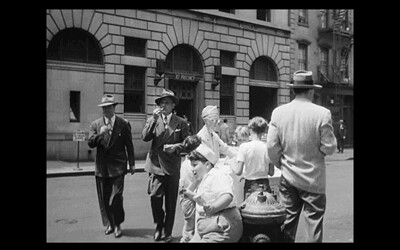
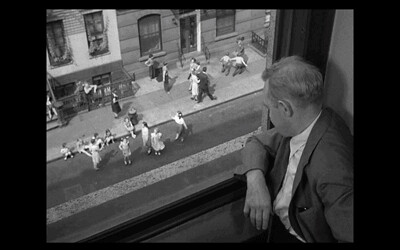
The concept seems ridiculously simple now. Shoot on the streets of New York, in real locations, and follow the investigation of one crime from the discovery of the body through to the apprehension of the murderers. The lead officers establish the unshakable paradigm of the seasoned veteran and the well-meaning rookie: the wonderfully nonchalant Det. Lt. Muldoon (Barry Fitzgerald, The Quiet Man) and the do-gooder family man Jimmy Halloran (Don Taylor, The Flying Leathernecks). Though these two men will essentially be our guides through the complicated case, the camera will actually drift from them to follow the cops on the street tailing suspects, the crime labs going over the evidence, and, in a true stroke of genius, the citizens of the city itself.


Even though The Naked City takes place over several days, Dassin and his screenwriters (Albert Maltz and Malvin Wald) framed the story like it was one day, opening the picture as the sun is setting and night life is entering into full swing. Led by a lively narrator (Mark Hellinger, the movie's producer, speaking as himself), the camera visits people on the night shift and in swank society parties, eavesdropping on the thoughts that drive their evening out or that keep them company as they slog through their tasks. We also see two seemingly random and unconnected crimes, but from a distance, so that we only know what happened but not to who or by whom. On into the next day, as we travel to work with Halloran and listen in on conversations on the subway, New York itself remains a breathing, pulsing element of the story. Often, Dassin's footage is just of crowd scenes, probably shot on the fly, and he would dub in conversations later, layering the dialogue over the image even when the extras weren't talking. While I am sure this was an economical decision, it actually works as an artistic one, adding to the overall feeling that all life in New York is connected. It doesn't matter who is talking, the metropolis is engaged in one ongoing discourse. (The way Dassin weaved through his crowds, jumping from one person to the next, I couldn't help thinking of Wim Wenders' eavesdropping angels in Wings of Desire.)

Some of the plot business in The Naked City comes off as a little dry, but the story is of such a classic model, it's always going to work on some level. As the police officers check out the angles on each clue, they end up finding more clues, gathering details until the various disparate pieces move together and make a complete report of what happened. Some of the work is tedious, hopping from one pawn shop to the next, from one textile merchant to another, but Dassin also takes us on rooftops to talk to construction workers and into tiny, ramshackle diners in search of witnesses. Where the movie starts to hum, however, is in the interrogation room. Muldoon sees right through the lying con man Frank Niles (Howard Duff, All My Sons) and pities his naïve fiancée Ruth (Dorothy Hart, I Was a Communist for the FBI) , and the old detective plays both of them like his own personal marionettes, letting them tell their lies and then tripping them up with the things they don't know he knows. Barry Fitzgerald is the prototypical police trickster, acting as if he's not too with it or maybe even doesn't care, lulling his targets into underestimating him so that he can strike when they least expect it. It's the most flashy element of a movie that otherwise takes some of the glamour out of police work.

Don Taylor is a good foil for Fitzgerald. Looking like a 1940s Luke Wilson, he rushes around digging for information, eager to make it all fit and haul the bad guys in. He's a little bit stiff and a whole lot milquetoast, but he stands as the model of good next to the characters he's bringing to justice. As Niles, Howard Duff is nervous and twitchy while Taylor is confident and solid; where the killer (Ted de Korsia, The Lady from Shanghai) is selfish and dirty, the detective gives of himself and always fights clean.

In the end, though, as the sun goes down on The Naked City yet again, it's driven home that the true story is of the place itself, of the bustling lives that move through the streets and the push and pull between those that break from the social contract and the men who put them back in line. In style, structure, and technique, The Naked City must have seemed revolutionary in 1948. Television has made the movie seem a little old hat by endlessly recycling the formula Dassin and the writers created, but The Naked City will always remain an icon. No one can ever forget the famous last lines from Hallinger's narration: "There are eight million stories in the Naked City...and this was one of them."

Or more accurately, The Naked City was the first, and when it comes down to it, probably still the best--whether it's one of eight hundred, eight million, or even eight billion.


Originally written March 14, 2007. For technical specs and special features, read the full article at DVD Talk.
Tuesday, January 1, 2008

ACE IN THE HOLE - #396


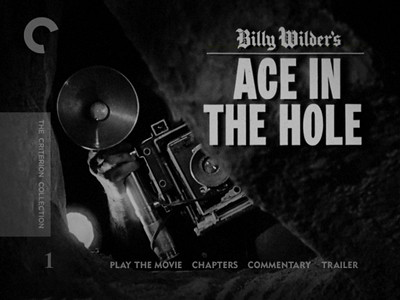
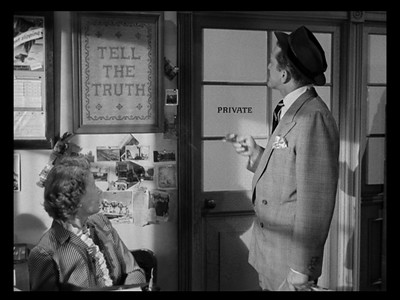
When the writers for DVD Talk put their heads together to decide what their Top 20 DVDs of 2007 were, the one that came up most often was Billy Wilder's lost masterpiece Ace in the Hole. No surprise, then, that it was a hotly sought-after item back in the summer when it was up for review, and since I hadn't been the lucky so-and-so that had scored the assignment, I jumped at the chance to write the blurb for the countdown. As such:

"Billy Wilder's cynical, noirish tale of a big-city newspaper reporter (Kirk Douglas) manipulating the news for a small-town rag has been a sort of holy grail for film fans for decades now. Lambasted on its release in 1951, it's been out of circulation almost completely since, never released on home video and only rarely showing up on cable TV. So, it's no surprise that when this lost classic finally got a proper re-release, it would end up on the Criterion label and receive an awesome two-disc collection to reward us all for being patient. With a package designed to mimic a newspaper and packed with illuminating extras, Ace in the Hole is the DVD that got the most of us excited around these parts. Snappy dialogue, excellent performances, and a compelling plot that was ahead of its time and still socially relevant today, the movie more than lives up to its mythical reputation."


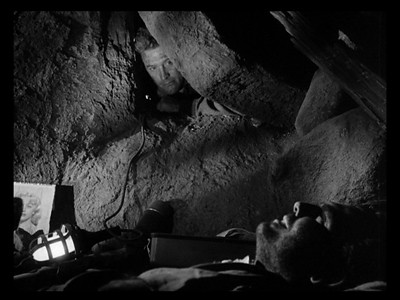
I hesitate to really call Ace in the Hole noir. Noirish, I guess, is passable. Though it does bear some similarities to the harsh world of film noir and its stylistic use of light and shadow, Wilder's evisceration of sensationalistic media and the audience that loves every over-blown, dirty minute of it is about as far from the normal city streets and petty crime of noir as you can get. Those shadows really only come out when Douglas is down in the cave, a metaphorical representation of the darkness of men's souls. A good man is trapped down in there, the trusting husband and loving son, Leo Minosa (Richard Benedict), being crushed to death by the weight of exploitation and the public's appetite for tragedy. There is a reason Kirk Douglas' Chuck Tatum can't get through to Leo and can only see him from a small hole on the outside. There is something that will always separate guys like him from men like that.

Wilder must have had some kind of crystal ball when he wrote the movie with Lesser Samuels and Walter Newman. (It really was Billy's picture all the way. He also produced.) A remake of Ace in the Hole today wouldn't have to alter the story much. Tatum wouldn't work for a small-town newspaper anymore, he'd probably work for some crappy local TV station. Create a disaster-related logo and add a news crawl, and there'd be no difference between the media circus as depicted in 1951 and the kind of bottom-feeding we saw on cable news all through 2007 and I am sure will again in 2008.


Leo and his parents really do seem like the only good left in a world gone nuts. Though the Big Carnival--as the film is alternately called--is kicked into gear by Big Slick from NYC, the first gawkers on the scene are Ma and Pa America, a nuclear family who alter the map of their vacation to come see the man buried under a mountain. Wilder makes them as bland and average as possible, easily interchangeable with any other everyman. Pa isn't some dumb loser, but a man who is at least successful enough in his business (insurance salesman, somewhat poetically) to be able to afford a mobile camper and a car to pull it with. It would be easy to sit in our chairs at home and say, "Hey, look at the dumb yokels getting off on another guy's misery," but we're the ones watching the yokels, and does that not make us complicit in the exploitation? You can make the gesture of downloading Sting's charity single, but if you actually like the song, you grabbed it for reasons that aren't completely selfless, and even you, yes, profit from the pain. Shake it more than once, as my dad would say, and you're playing with it.

On the noir front, I suppose you could say that Chuck Tatum is a noir hero in exile. Though a newspaper reporter, he isn't that far afield of the crook on the lam, run out of town for the things he did, not able to show his face lest his neck get chopped. A hood would have to buy his way back into the good graces of a mob boss with the missing jewels or large sums of money, Tatum needs a juicy story to get back on a major metropolitan paper. His misdeeds were lying and adultery, messing with the boss' livelihood and then fooling around with his wife. Trade one gang for another, back-alley thugs for newshounds, but the crime is the same.

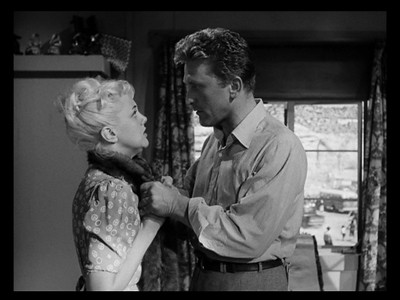
So is the inevitability of the past catching up with you, of wherever you go, you're still going to find yourself. As a prowling leopard, Tatum certainly hasn't changed his spots. He is still willing to fudge the facts and alter the situation to make Leo's story work better. He tells himself he's not lying, and he didn't create the situation, but he has done whatever he can to prolong it. More days underground for Leo means more headlines for Tatum. Likewise, it puts more money in the family business that Leo was running, an out of the way trading post (read: souvenir shop and diner) in New Mexico. Leo's wife of five years, Lorraine (Jan Sterling), has had the itch to wander for a while, but now that the cash is rolling in, she'll stick around. She'll also do it for Chuck. Again, the reporter has learned nothing at all.

At least not yet.


"Cynical" is probably the most commonly used adjective when describing Ace in the Hole, and I can't decide if that's wholly accurate or not. Is cynicism merely realism in disguise, or is it that realism is cynicism when she puts on her make-up? Wilder's opinion of humanity is at an all-time low in Ace in the Hole, he sees the mob as one giant, uncaring animal; however, his opinion of the individual is rather high. For all of his selfishness in commandeering Leo's accident for his own purposes, Tatum isn't so lost that he doesn't eventually realize what he's done. Sure, it takes Leo's death to wake him up, but at the same time, he could have covered his tracks, let the responsibility fall elsewhere. Instead, he makes a last-minute scramble to set things right. Thus, Wilder believes that each and every one of us can find the good within ourselves, he's just not sure it matters when facing a crowd hungry for doom. Tatum tells the truth, but no one wants to hear it. It's far less interesting, and accepting reality also means accepting their own role in the affair.

As the individual who tries to stand up, Tatum pays the ultimate price. Yet, his desire to do right takes him back to the one place where he knows truth matters. For all of its vilification of the hoi polloi, Ace in the Hole does end up vindicating the uncommon morality that can still exist inside the common man. Tatum returns to the one man whom he knows has kept his head through this whole thing, and who sees through the spectacle that the reporter has kicked up. Jacob Q. Boot (Porter Hall) was the man who hired Chuck Tatum when no one else would, and he was the guy who called him on his bunk as soon as he saw the Big Carnival getting out of hand. Boot is the guy who wears both a belt and suspenders. It's not that he's convinced that either can't handle the task they were made for, but he can't see why when you know that one thing is right, you shouldn't double-up and be extra sure. By starting where he began, and by taking us back to Boot, Wilder is giving us hope. Cooler heads can prevail, and they will stand strong even when the rest have scuttled back to whence they came.

Ace in the Hole, a noir that isn't a noir, the cynical movie with love and hope in its heart. I guess it's no wonder that it scared its audience the first time. Billy Wilder gets a little too close to the truth that's in all of us, our contradictions and our maladies. He's the Jacob Q. Boot of this world, and he's sticking that boot right up our collective behinds.