Showing posts with label vilgot sjöman. Show all posts

Sunday, June 28, 2009

I AM CURIOUS - BLUE - #181


A couple of years ago, I reviewed the re-release of Bob Dylan: Don't Look Back, the influential and iconic chronicle of his 1965 British tour. The new boxed set was called the 65 Tour Deluxe Edition and it featured a new film by director D.A. Pennebaker called Bob Dylan 65 Revisited. Essentially, Pennebaker did look back, digging into his archives and pulling out unseen footage from the same trip and making a new movie out of it. While exciting at the time I first watched it, this new documentary doesn't really measure up to its more famous older brother. Fine, sure, as a DVD extra, but given that I can't remember hardly anything about it, there is no way it stands alone as a companion or as a sequel or anything of the kind. Really, it's just scraps, and trying to determine whether or not they deserved to be scraps is a little too much like trying to get the egg back into its shell after the omelet has already been seasoned. Though I haven't watched it yet, I understand that the Maysles pulling a similar move with The Beales of Grey Gardens has yielded similar results. Whatever instincts led them the right way the first time should have been trusted.

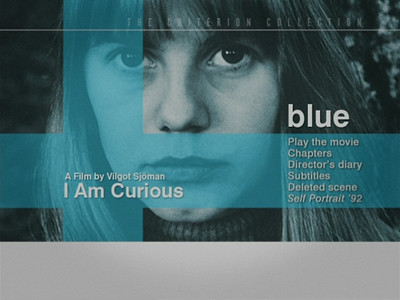
Though Vilgot Sjöman put his two versions of I Am Curious together at the same time, turning one four-hour film into two films half that size, it's obvious that Yellow [review here] got all the best bits, and Blue the leftovers. Maybe I'd think differently if I had seen them in the other order, Blue would be the trailblazer and Yellow the mentally deficient little brother running to catch up, but I doubt it. I Am Curious - Blue doesn't just lack the surprise of Yellow, but the structure and the purpose, as well. These are the scraps.
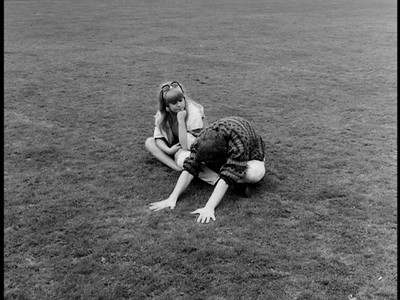


Continuing to borrow from Godard's playbook, Sjöman opens I Am Curious - Blue with talking head interviews with women discussing their sex lives and what gives them pleasure, bringing to mind the relationship talk of Masculin féminin. These are part of the interviews that our heroine, Lena Nyman, began in Yellow, though now rather than just asking about class issues, she will talk about sex and religion, as well. Blue relies more heavily on these public studies, sending Lena on a road trip where she meets new lovers and new interview subjects. We learn a little more about her history--what bearded creep of a college professor did she screw? who did her mother screw and where did she go?--and we see her fall into the same intellectual traps she had supposedly already learned her lesson from. Yet, while Yellow had a point, Blue does not.

In fact, I'd say Blue almost goes out of its way not to make a point, but only if I were feeling more kind. The passion for genuine information, no matter how misguided or rhetorical, has been replaced by an off-putting smugness. Lena's sense of rightness borders on entitlement, and it is hard to swallow after her failed quest in Yellow. Haven't we watched a character arc already where her liberal naïveté comes down with a case of scabies? Well, Sjöman is attempting to turn back the clock, seemingly weaving around the scenes in his other movie, even taking us back to the casting of Lena and Börje. The latter never really adopts his character in Blue, he's always the actor, timid and lecherous, never the Crown Prince or the boyfriend. Like everything else, the metafictional elements, the movie behind the movie/within the movie, has over ripened. We've been here, and coming back to it teaches us nothing new. Neither do meeting the swinging couple who gave Lena her scabies or the constant references to the "Socialist Itch" make up for the fact that we end up in exactly the same place we ended up last time, but lacking the same emotional investment. What with Börje being a non character, and Lena's new relationships fleeting, and her epiphany of failure being so effective in Yellow, what here are we meant to glom on to? Especially when the more fun stuff, like playing with on-screen text, is all but absent.
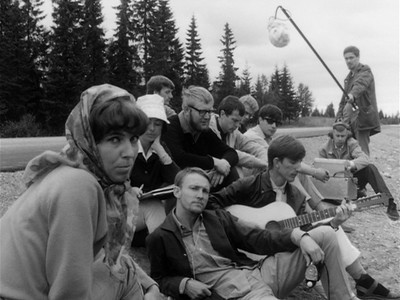


I Am Curious - Blue actually stops dead more than once. A scene where Lena debates Christian morality goes on way too long and its ideas are pretty worn out for 2009. A tryst between Lena and creep-beard professor (Hands Hellberg) at the top of a phallic tower, its elevator car rising up and down in time with their pelvic thrusts, is vulgar in its obviousness, both for the comic editing and for the blunt satire of the old liberal being impotent. No surprise, then, that he resorts to violence later. Maybe had Sjöman given more time to the story of Lena's abandonment by her mother and the possible reunion, there would have been a better emotional counterpoint to stack against this disconnect from her "intellectual father." It would have also played nicely with Lena befriending the young single mother, Sonja Lindgren. Instead, it's a footnote that becomes an easy out with an ending that is too lazy to even be manipulative.

Rather than the color differentiation in the titles, Vilgot Sjöman could have played off of I Am Curious a little more, make the titles fit together. Like, given how this one was so much of the same, it could have been a duo of I Am Curious and But Not Surprised. Or, I am Curious and But Not Very Interesting. I Am Shamefully Predictable. I Am Too Shallow for Two Movies. I Have Already Found Out Everything I Will Ever Find.

I Am Curious but I Am Out of Ideas.


Wednesday, June 24, 2009

I AM CURIOUS - YELLOW - #180


The I Am Curious set has been sitting in the "next" position in my queue for a while, having come up in the sequential numbering of my personal viewing (in other words, the first 178 down with no gaps) after I covered My Life as a Dog fifteen months ago. It came to mind again after my review of In the Realm of the Senses, this movie's scandalous reputation seeming to make it a good match for Oshima's porno. I particularly considered it as a good choice after some of the mail I got regarding my opinions about Senses, partially because I expected I Am Curious to be another tempest in a teapot. My personal prudishness and my belief that it would be boring, that age would have rotted its teeth, were the main reasons I kept working around it, and maybe it was time to confront that head on.

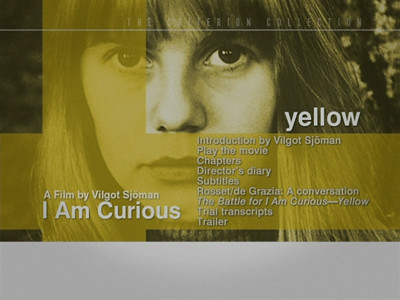
So, I start here with the first in the set, I Am Curious - Yellow.


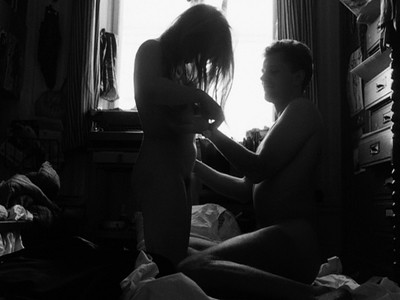
Swedish director Vilgot Sjöman's 1967 film is infamous for the protracted legal battle that its American distributor undertook in order to exhibit the picture, using I Am Curious - Yellow as his bludgeon to whack at U.S. obscenity laws. His crusade failed, then it succeeded on appeal, and then he pushed it too far and got close to a draw, but ultimately lost, and the result is that I Am Curious remained contraband. It's a film known more for its reputation than its content, and watching it now forty years on, the explicitness is incredibly tame (particularly compared to the smut of Oshima). The sex scenes comprise only a small part of the running time, and the details we see are far from gynecological. I Am Curious - Yellow isn't even about sex, it's about so much more, and the what sex there is serves a purpose. The long-dead controversy has done Sjöman's work quite a disservice.

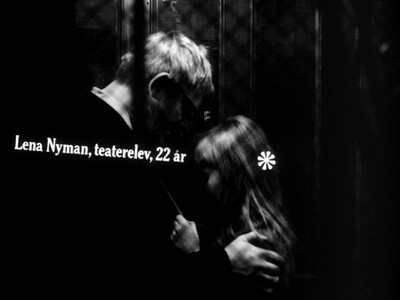
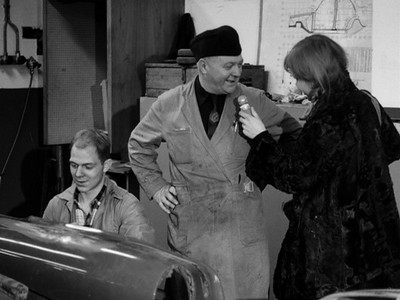
I Am Curious - Yellow is a fun, adventurous film, the Swedish extension of the French new wave, a self-reflexive slice of agitprop that would rest comfortably on a shelf next to Godard's La Chinoise in the way it satirizes trendy young idealists while also giving tribute to their marvelously misguided ideals. The focus of Sjöman's movie is Lena, a girl of 22 playing herself between the blurred lines of fact and fiction. I am sure the question of how much of I Am Curious - Yellow was documentary added to its shock value. Sjöman appears as himself making the film, and though some of the early shots are obviously staged, they are quickly offset by clips of Lena taking to the streets and interviewing her fellow citizens about the class system in Sweden. When Sjöman unceremoniously slips from this to scenes of narrative fiction, the change is imperceptible. It's only later when the film crew returns that we have cause to question what we have been seeing, when we finally see the jealous director choreographing Lena's life and demanding she redo some of her lines.


Sjöman constructs his film by balancing it between various conflicting ideals, not just fact and fiction. There is the argument of class, the haves and the have-nots, the young and the old, conservative and liberal--there is even an implicit disparity between director and star. One scene has them questioning who is using the other more. Is it Sjöman for wanting Lena to star in his film and share his bed, or is it Lena for using her sexual wiles to get the lead? It's an interpersonal clash, and also one between art and commerce that brings to mind the similar portrayal of a young woman in a money-oriented world in Steven Soderbergh's latest, The Girlfriend Experience. This dynamic is also mirrored in the lover Lena eventually takes. Depending on what point of the story we are in, Börje Ahlstedt either works in men's wear retail, sells cars, or is the last crown prince of Sweden. A divergent scene shows he and Lena ushering his father out of the castle, putting an end to the monarchy. Leading up to this, they have public sex in front of the royal palace as a barely adult guard watches. The commentary is clear. Such disrespect!

This collection of background elements makes I Am Curious - Yellow as much a portrait of the changing face of Sweden as it is of Lena. The socialist nation was at a crossroads, the youth questioning the success of the ideology as they embraced the newfound freedom that would come to define the decade. Lena is the liberated 1960s woman, free with her body, demanding of her rights, and politically motivated. She is concerned with justice and nonviolence, equal pay for equal work, and global consciousness. She wants the U.S. out of Vietnam and urges her fellow Swedes to stop taking holidays in Spain until Franco is deposed. Her father (Peter Lindgren) went to fight against Franco, but chickened out and ran back home. Ashamed for him, Lena keeps a running tally of the days he has been AWOL in her bedroom under a portrait of the Spanish dictator, surrounded by images of concentration camps and U.S. atrocities in East Asia. It's under this morbid collage that she has sex with Börje, informing him that he's her 24th lover--though the first nineteen didn't count because they were no fun. So far, that is the only price she has had to pay for her convictions; it's easy to have such strident beliefs when faced with so little opposition.


Börje isn't the smartest match for Lena. He's dishonest and unfaithful, with conservative political leanings. He has no problem with class imbalance, nor does he feel women should make as much money as men. He's all sweetness when he wants something, but he's also forceful, almost brutal, when he wants it a certain way. In other words, he's the living embodiment of the real world, as opposed to Lena's hippy-dippy idealistic one. When she retreats to her own personal commune, where she eats tiny vegetarian meals and indulges in topless yoga, he comes crashing back into her life, shattering the peace, and ultimately making her forsake her beliefs. In one comically irreverent scene, Lena apologizes to Martin Luther King, Jr., who appears in footage Sjöman had filmed the year before, telling him she is sorry, but she is going to get violent all over Börje's cheating ass. This scene is sandwiched between multiple come-ons from men passing her on the road and Lena binging on cake. The girl is a mess.


She's also a pleasure to watch. Lena Nyman does more than play herself here, she manages a complete screen character that I couldn't help but root for despite her naïveté. It made me all the more sad when Börje's abuse pushes her to forsake the little life she's cultivated for herself, and even worse when she relies on his masculine posturing. The actor gets into a tussle with the director, even attempts to hijack his control of the movie--which is really grabbing control of Lena. At one point she had gotten away from both of them, but she's back up for grabs. Her father, her director, and her co-star are all disappointments to her, as modern life apparently was for many a young Swede coming of age back then. The social experiment wasn't all it was cracked up to be, the progression wasn't progressive enough, and too many people--particularly the older ones like her dad, but the younger generation, too--were content to carry on with the status quo. The reward for those who would ask for more? VD!

For all the points he is trying to make, for all the cinematic and philosophical balls Vilgot Sjöman is juggling in I Am Curious - Yellow, he never lets the film get bogged down. His technique is facile, moving between the verite and the more formalistic scenes with determination and control. He does occasionally make a clumsy cut from one element to the next, but his style and the soul of his piece remain potent, unlike say the unmannered clutter of Dusan Makavejev's WR: Mysteries of the Organism. Sjöman's playful experimentation with sound and words on the screen recall Godard's pranks, while his sense of confined drama recalls Ingmar Bergman--whom Sjöman quotes at the outset of the movie. Given that he directed Ingmar Bergman Makes a Movie several years before I Am Curious, I think we can safely surmise that Sjöman picked up a few tricks from his countryman.


In the introduction Sjöman recorded for this disc, he explains how I Am Curious arose out of his discontent with the strictures of the Swedish studio system. He somehow convinced a producer to give him some film, some money, and the freedom to shoot whatever came to him. There was no supervision and no script. Eventually, his initial efforts proved not to be enough, and he had to return to the well for more film. Once he was done, however, he had enough footage to make two separate but compatible movies, extending the experiment further by taking Yellow in one direction, and then Blue in another (the colors being the same as on the Swedish flag). I am sorry I took so long to get around to checking out I Am Curious - Yellow, because I was definitely pleased with what I found waiting for me; whether its sibling will offer the same pleasures is a question that will have to wait just a little longer for its answer. [And here it is...the review of Blue.]