Showing posts with label larisa shepitko. Show all posts

Sunday, August 10, 2008

LARISA SHEPITKO: THE ASCENT - ECLIPSE SERIES 11


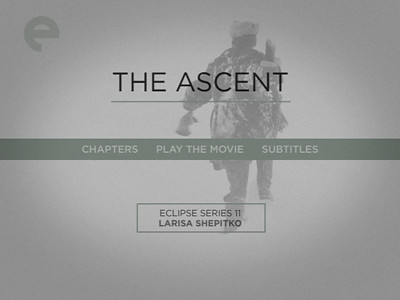
Larisa Shepitko's fourth and final film, 1977's The Ascent (Voskhozhdeniye), is a bleak trek across the frozen Byelorussian landscape during WWII. Set in the small Eastern European country just north of the Ukraine, it details the ravages its people suffered under the German invasion and their perseverance in the face of crisis and tragedy.

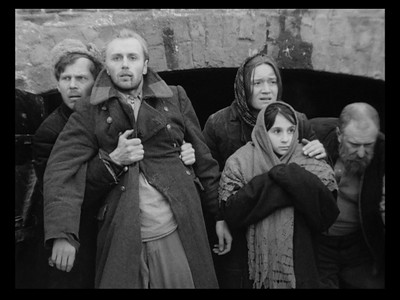
Two young soldiers break from their squad to find food for the civilians they are escorting to the next safe encampment. Rybak (Vladimir Gostyukhin) is a grizzled trooper who speaks like a veteran, whereas his companion, Sotnikov (Boris Plotnikov), is fresh-faced, fair-haired, and seemingly out of his depth. As they hike through the snowy wilderness, they encounter collaborators, enemy gunmen, and innocent bystanders, and each of these meetings will eventually have their consequences. Sotnikov gets shot in the leg, and the search for shelter in which to thaw out and recuperate pushes them farther from their goal and gets them deeper into trouble. They are eventually captured, along with Demchika (Lyudmila Polyakova), the mother of three whose shack they tried to hide in. Soon, they find themselves in a Sartrean prison alongside the old man (Sergei Yakovlev) they met two nights prior, a supposed collaborator whose life they spared, as well as a young Jewish girl, Basya (Victoria Goldentul), who has refused to name the people who had been hiding her.
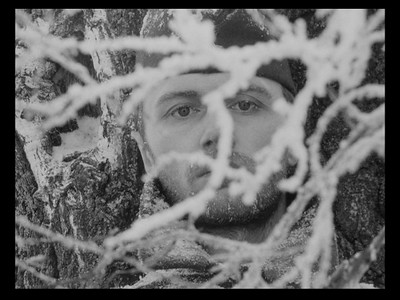


Trapped in this dank cellar, with Sotnikov having been tortured and barely hanging on, all five prisoners begin to question how they ended up there and what it would take to survive. Each is faced with a choice, and as secrets are revealed, it's discovered that some have already made just as crucial choices before arriving here. Both the old man and the girl let out information that could hurt them, and Rybak, who has proven to have much less fortitude than his stoic companion has displayed or his own earlier boasts would have suggested, has even had an offer to save his skin by joining the other side. The local commissar, Portnov (Anatoli Solonitsyn), is looking to earn points with his new German bosses, turning his back on the people who knew him. Sotnikov was a classmate of his, and Basya had him as a choirmaster. There is even a suggestion that they could save themselves by exposing his true identity, and that is why he is so hungry to attain Sotnikov's real name.

Yet, to give up his real name would be to give up who he really is, something Sotnikov would never do. Shepitko and co-writer Yuri Klepikov, adapting a novel by Vasili Bykov, are clear on what it would mean to put your own self-interest ahead of the good of others. No life touched by Sotnikov or Rybak, no matter how innocent, remains unscathed. (Even sparing the old man ultimately earns him condemnation.) One stays more true to who one is by sticking to one's principles, and as Rybak lets go of his integrity, he becomes less of a man, ironically less capable of even being able to save himself. He has fantasies of running for it, of risking being gunned down, and he can't make himself do it, even after he has promised Sotnikov that he will only become a collaborator in order to escape and take the country back. Even if a peasant woman hadn't called Rybak a "Judas," his positioning in relation to the near angelic Sotnikov would be clear. Like the Biblical traitor, Rybak is left to question the price he received and whether it's worth what he gave up for it; unlike the Judas of old, however, Shepitko won't let him escape his true punishment easily.
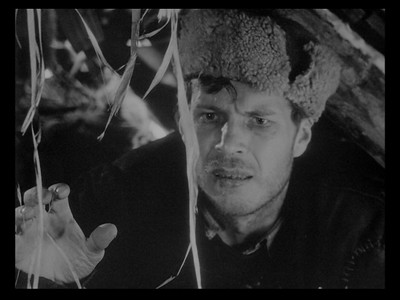


Given this Biblical allusion, The Ascent could be seen as a rather subversive film. I am always amazed how Russian filmmakers were able to slide their messages past the Communist censors. On one level, The Ascent affirms the struggle of the proletariat against a corrupt world, but like Eisenstein's historical epics, what might appear to be pro-Soviet rhetoric could also be read as a subtle indictment of the same. Replace the Nazis with Stalinist agents, and the message against collaboration with one's enemy is not nearly as "Red" as the first blush would suggest.

The struggle of the two men to survive and the journey they undertake also reminds me of the work of Andrzej Wajda. Like Wajda, Larisa Shepitko is interested in how these extreme situations of war affect the individual. Just like in Wings, her camera is constantly searching for the humanity in her characters, regardless of how vile they may be. Even Portnov gets a couple of her many lingering close-ups, silently contemplating his actions, framed only by his conscience. The characters are obviously more important to her than the action of a typical war picture. The one full-on fight is shown at the beginning of the movie, obscured by the opening credits, whereas there is nothing to get in the way in the final scenes, as each of the condemned gets one last look into the lens. Shepitko shows them as standing strong, neither breaking down nor even flinching. That fate is saved for the pathetic Rybak, whose final cries of anguish end the film, sounding as sad and useless as everything else he has done up until that point.

The Ascent became an international sensation when it was released, winning the Golden Bear at the 1977 Berlin Film Festival. Sadly, it was to be Larisa Shepitko's last completed project. She died in 1979 in a car crash on the way to the set for what was to be her next movie. Though it wasn't intended to be her final cinematic statement, The Ascent stands tall as such. The reverberations you will feel as the picture closes won't fade anytime soon, a testament to the incisive eye of a gifted filmmaker and her own testament to the capacity of the individual to persevere.


Saturday, August 9, 2008

LARISA SHEPITKO: WINGS - ECLIPSE SERIES 11


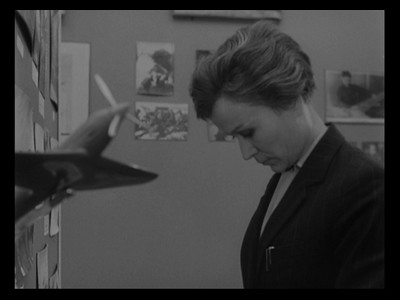
There is a scene near the end of Larisa Shepitko's first professional film, Krylya, a.k.a. Wings, where her subject, Nadezhda Petrukhina (Maya Bulgakova), is waiting to meet with her friend in the museum where he works as a director. She happens to be sitting by an exhibit celebrating Russian pilots from WWII, including the Women's Air Corps, of which she was a member. The tour guide, not realizing the actual woman is in the room, points out a photo of Nadya to a group of children, and a little girl asks whether or not she died in the war. Though this is a question whose answer Nadya knows better than anyone, it gives her pause. Looking at the larger picture of who she is now, maybe she didn't survive the war after all.

Wings is a quiet film, shot by Shepitko and cinematographer Igor Slabnevich with a keenly observant eye. Released in 1966, it's a movie of profound beauty, moving effortlessly from cramped, rundown interiors to wide open public spaces and somehow making its protagonist look small in either of them. In its first half hour, Wings seems to be about nothing, more a string of non-events than a plot-driven happening. Then, as these events gather in number, Shepitko reveals that her movie, co-written by Valentin Yezhov (Siberiade) and Natalya Ryazantseva (The Scarlet Flower), is a portrait of loss and alienation. If it's aimless, it's because its protagonist doesn't know what to do with herself, she is not living the life she imagined she would live.


Following an injury, Nadya's decorated service as a pilot ended, as did her romance to another pilot, Mitya (Leonid Dyachkov), who did not make it out of battle. Two decades later, Nadya now lives an ordinary life as the headmistress of a high school. It's not a satisfying occupation for her. She is unable to get through to her students, who have a different view of duty and obedience than she did at their age. Likewise, she is estranged from her own daughter, Tanya (Zhanna Bolotova), whose point of view is so far removed from her mother's, the young woman actively avoids her. It's not a generation gap that separates them so much as an intraversable canyon.

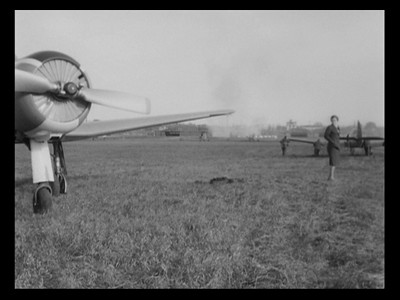
Not that Nadya is an easy person to get close to even without the age difference. She is at once exacting, insisting that her standards be met, and distracted, her mind always elsewhere, often in the skies, remembering once again what it's like to fly. She regularly visits the air field and her old friends, trying to get some kind of contact buzz from their escapades above the clouds. Nadya's dogmatic views about duty are somewhat ironic, as she is always in motion, abandoning tasks before they are finished and moving on to the next thing, or quite often, nothing at all, just moving on. This actually gives Wings a sense of momentum. Shepitko's camera is rarely settled in place. Even if Nadya isn't moving, the director is cutting to various details, dialing in closer to see a nervous twitch or how she shuffles her feet. As a woman in her 40s, Nadya is expected to be still, but she wants to be free to fly.


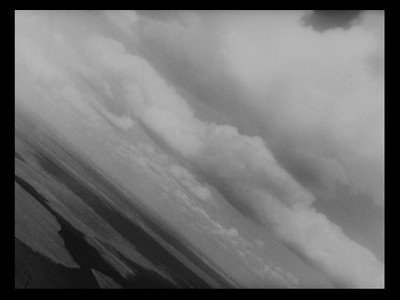
The nostalgic flashbacks and fantasy flights that Nadya takes are given a feeling of otherness by being framed largely as point-of-view shots. Our entire vision of Mitya, for instance, is seen through his lover's eyes. So, too, do the imaginary clouds pass like we are in the pilot's seat ourselves. In these scenes, the camera is still moving, but almost as if it has come unmoored, like it has taken flight, as well. Shepitko also uses freeze frames in the flashbacks to halt them, to remind us that they are frozen in time, before moving on again to the next memory, almost like some frames are missing from the reels of film in Nadya's mind.

Around the time of Nadya's trip to the museum, there is a subtle shift in her character. Just as the "plot" sneaks up on us, so does this transformation. You don't see glaciers move or flowers grow, they just suddenly are different than you last remembered. Maya Bulgakova spends the early part of the film hunched over. Her movements are jerky and anxious. As she begins to realize that she can be happy again, to try to bring the joys of youth back into her present, her movements get more fluid. So, too, does she go from barely speaking to becoming increasingly talkative. In one of the only real conversations she has in the film, she sits with another woman her age, Shura (Rima Nikitina-Markova), and reminisces about being young and how people thought she would be an artist. The two sing and dance in Shura's café, and Nadya actually smiles. Unfortunately, the men staring at them through the window remind her that she is still on the ground.


This is not the escape Nadezhda Petrukhina requires, either; that is saved for the final surprising and elegiac moments of Wings. It's a tremendous release for a movie that has up until then been entirely about restraint. Larisa Shepitko's portrayal of a teacher who has seen better days shares thematic shelf space with Ingmar Bergman's Wild Strawberries and Anthony Asquith's The Browning Version. Her quiet and precise directorial style, though, will remind some of her compatriot Andrei Tarkovsky, who was her classmate at film school. Yet, she has a more self-assured sense of humanity than Tarkovsky, and her point-of-view is decidedly feminine when compared to the Bergman or Asquith pictures. Her heroine is less expressive than the male teachers, less prone to monologue, and given Nadya's pilot background, more inclined toward action--usually a more male trait, to be sure, but given that Nadya didn't really choose her career, hers is again more of a feminine problem in that less options were likely available to her. Her time for reflection is over, and so she instead seizes opportunity, and rather than accept her fate, soars above it. One can't help but see this as Larisa Shepitko's own feminist statement of intent, using a woman of an older generation to shed the shackles of the past and rocket ahead into a brighter future.