Showing posts with label gilbert and sullivan. Show all posts

Wednesday, March 23, 2011

THE MIKADO (Blu-Ray) - #559


It surprises me that more Gilbert and Sullivan musicals haven't been adapted to film, but as Geoffrey O'Brien's liner notes to the new Criterion Blu-Ray of The Mikado inform us, this 1939 adaptation was the duo's first time on the silver screen, and there hasn't really been much more since. Mike Leigh's Topsy-Turvy, which is being released in conjunction with this under a separate cover [review], is the only comparable, substantial portrayal of Gilbert and Sullivan in cinema. Fittingly, Leigh's movie detailed the creation of the first-ever stage production of The Mikado and showed the backstage shenanigans at the Savoy, where the D'Oyly Carte Opera Company performed. Thus, the extended pedigree is intact: this late-'40s feature was an official production of the Opera Company, then run by Rupert D'Oyly Carte, son to Richard, the man who had commissioned The Mikado, who was one of the characters portrayed in Topsy-Turvy. This movie is part of the family business and a stepping stone between the truth and its fictional recreation. Sorting out the lineage is a plot bendy enough for Gilbert and Sullivan themselves!

This three-strip Technicolor production was directed by Victor Schertzinger, a composer who had also made a name for himself in the motion picture business (his next film was Road to Singapore with Crosby and Hope). Though his take on The Mikado was apparently criticized for being too "stagey," I actually found it to be an interesting melding of two theatrical disciplines. Sure, his Mikado has a lot of starch in its collar, but I like how he had the actors perform as they would when strutting the boards, even while he takes advantage of the larger sets and multiple camera angles. The way he arranges his actors and how they move in that space may be theatrical, but Schertzinger's work in the editing room was definitely cinematic. (By contrast, look at the short 1926 film showing the actual stage performers working in costume at the Savoy, which is presented as a bonus feature on the disc. The stage set is shot from the middle distance, the camera in a fixed position on the main floor.)
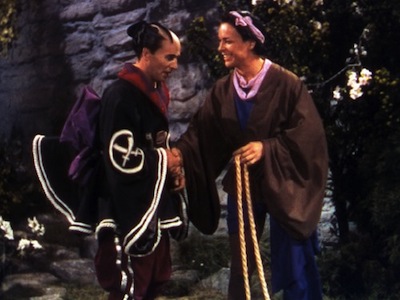


Given the strange, farcical plot of The Mikado, I think this may have been a good decision. Had the same story been undertaken using more standard film language, it would have seemed even more odd than it already does. As a Gilbert and Sullivan neophyte, I was amazed by the dark and twisted substance of the operetta's narrative. In a nutshell, the son of the Japanese Emperor is told he is going to marry an older woman of his father's court, the mustachioed Katisha (Constance Willis). Rather than submit, the boy (played by Kenny Baker) runs away. He hides out in a town called Titipu, where flirting is punishable by death. He poses as a minstrel and goes by the name Nanki-Poo and falls for the pretty Yum-Yum (Jean Colin) upon first seeing her.

Too bad for Nanki-Poo, but Yum-Yum is engaged to Ko-Ko (Martyn Green, a D'Oyly Carte alum), who himself has been condemned to execution for flirting with his fiancée. I don't know why Nanki-Poo gets away with his flirting, because even Ko-Ko is aware of it, but he does. The tale is a tangled mess, and I suppose the convolutions of this plot are best left where they are. Ko-Ko is given a reprieve under some weird statute that makes a man his own judge and executioner, and since he can't decapitate himself, he can stick around and marry Yum-Yum. Except then the Emperor, a.k.a. the Mikado (John Barclay), gets upset that the no one's head has been cut off for a while, so he tells Ko-Ko to get chopping or lose his job. Since Ko-Ko is the only man on death row in Titipu, he's back at square one, until he discovers Nanki-Poo is so distraught over Yum-Yum that he wants to kill himself. Ko-Ko makes him a deal that if he consents to be his stand-in on the block...well, things continue to grow more gnarled from there. Life and death and love and everything after hang in the balance.
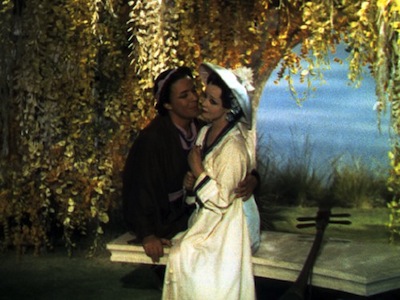


This kind of up-and-down storytelling, full of reversals and re-reversals and flips and flops, was what was referred to as the "topsy-turvy" style and, amusingly, was just what W.S. Gilbert was trying to get away from when he started out on his Japanese story. I can see why audiences liked it, however, it definitely keeps the action moving between songs, of which there are many, including famous numbers like "Three Little Maids from School." Most of the songs are jaunty and full of wordplay, a few are a little heavier, punctuating moments of romantic gravitas. Given how the story here never stops twisting, I'm a little surprised that The Mikado doesn't move faster. I can only imagine it with some kind of screwball Howard Hawks pacing; I guarantee no one watching would ever get bored if it had been run through at the same speed as His Girl Friday.

Still, this presentation of The Mikado is one of those interesting historical excavations that has earned Criterion so many fans. Where else would I ever see the 1939 production of The Mikado, of all things, and where would I ever see it quite like this? The Blu-Ray package offers yet another remarkable restoration. The color image is astounding, full of beautiful texture and lovely variations of tone. There are multiple matte painting backdrops that have a soft, pastel-like hue that look just amazing in high-definition. Likewise, the mono soundtrack has been scrubbed to perfection. The music sounds perfect.


In addition to the silent film promoting the earlier D'Oyle Carte staging of The Mikado, the bonus section features scholarly interviews and a deleted scene, Ko-Ko's song "I've Got a Little List." It's theorized that it was either cut for the political jabs the number takes at recent newsworthy figures (it was updated to include Hitler, a lookalike of whom appears on screen in full Japanese costume) or a racial slur that is usually dropped in modern productions. It's interesting to note that Schertzinger takes advantage of recorded sound to make an audio joke during "List," which I assume was an invention for the cinema.

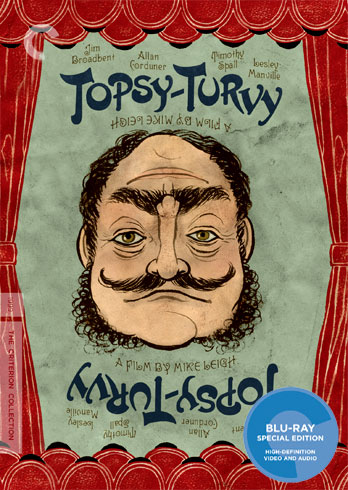
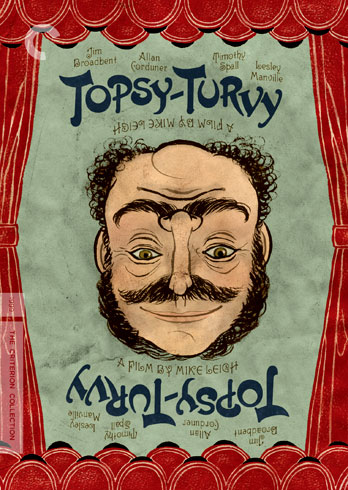
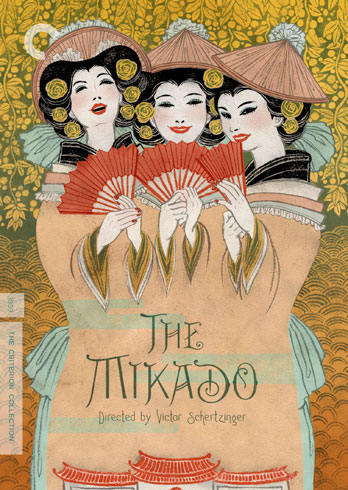
Tying this release of The Mikado to Topsy-Turvy is a new interview with Mike Leigh. Also, Criterion had New York-based artist Yuko Shimizu, perhaps best known for illustrating the covers to the literary-based comic book series The Unwritten, draw both covers. Shimizu's art definitely has a style fitting the material, and you should definitely take some time scanning the portfolio at yukoart.com. I am also including some of my favorite pieces below.

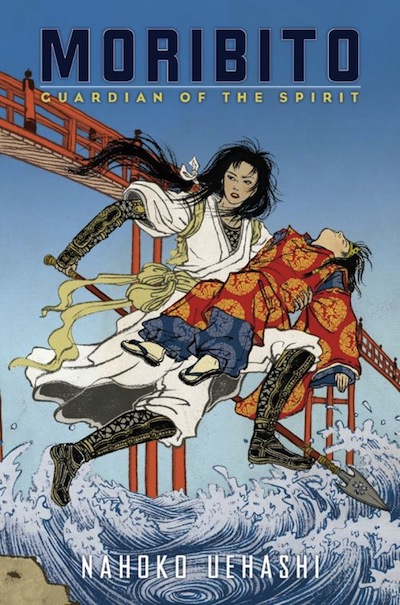
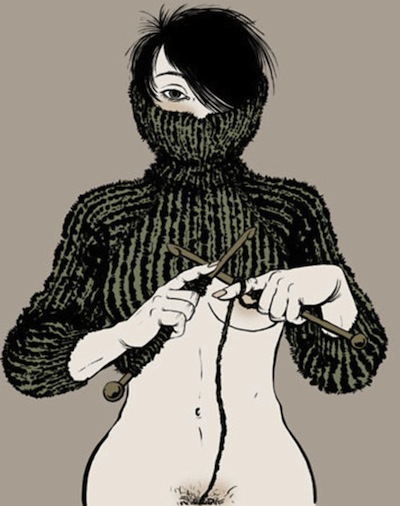


This disc was provided by the Criterion Collection for purposes of review.

Tuesday, March 15, 2011

TOPSY-TURVY (Blu-Ray) - #558


In 1885, the writing team of Gilbert and Sullivan were at the peak of success. Even their admittedly mediocre show, Princess Ida, which had just premiered at the Savoy Theatre in London, was predicted to be a smash, despite chafing reviews that called the pair on the proverbial carpet for the repetition in both Gilbert's comical lyrics and Sullivan's orchestral melodies. As a pair, they could seemingly do no wrong.

Mike Leigh's 1999 film Topsy-Turvy peeks in on the famous theatrical legends just as Ida is taking its creative toll on the duo. Arthur Sullivan, played by Allan Corduner, is overworked and unsatisfied, and for the sake of his health, he leaves for the South of France. Upon returning, he rejects his partner's new libretto, instead swearing to write his own grand opera where his music will not be outdone by the singing. Taken aback, W.S. Gilbert, portrayed with panache by Jim Broadbent, can't help but take it personally. He has been laboring on a musical in which a magical potion transforms the citizens of a European mountain town into whatever they wish to be. Sullivan's rejection of this fanciful notion seems little more than a rejection of him personally.

The comedic switch-up in this lost idea was an old stand-by for Gilbert and Sullivan, and it is a perfect example of their "topsy-turvy" style. In their musicals, everything gets turned upside down. Expectations are raised, and then flipped, to the point that the flipping had become what was expected. This is what Sullivan wants taken out of their future work. He wants to portray human drama rather than stick to formula. This doesn't just worry his writing partner, but also the owners of the Savoy (Ron Cook and Wendy Nottingham), who have the team under contract. Art and commerce, the eternal struggle! Could Sullivan turning his own artistic endeavors topsy-turvy spell the end of everything?


As it turns out, no, it doesn't, and the result is the major thrust of Leigh's movie. Topsy-Turvy is the story of the creation of The Mikado [an early film version of the play is also coming from Criterion this month, read my review here]. When Sullivan's wife, Kitty (Leslie Manville, so good in Leigh's most recent film Another Year [review]), drags him to a Japanese exhibition, the lyricist is inspired by the things he sees. He starts writing a new comic opera about a Japanese executioner, and suddenly a whole new ball is rolling. Leigh's film, which he both wrote and directed, chronicles all the backstage planning, all the bruised egos and the hard work and the dangerous peccadilloes, that keep a theatre company running. Topsy-Turvy is an elegantly crafted ensemble piece, with enough side plots to give each important performer their due and allow the actors to establish believable and complete characters, but never so much that any one can derail the main story. It's an often-brittle tale, examining the insecurities of performing life. The very need for acceptance and validation is pretty much its own guarantee that there will never be enough of either, not even when you're on top of the world. That, in its own way, is topsy-turvy, as well.


Mike Leigh and his production team meticulously re-create the Savoy and its lavish stage productions. In addition to songs from The Mikado, which are sprinkled throughout the narrative at key moments, we also get glimpses of Princess Ida and The Sorcerer, both to show the Gilbert and Sullivan style and also, in the case of the latter, to show the magic they created, both as acts of fiction and in the act of creating that fiction. Though Leigh is often known for his far more serious human comedies, the kind of thing that Sullivan could have probably appreciated and Gilbert might have dubbed boring, Topsy-Turvy is more expansive and fancy than his modern kitchen-sink style. Dick Pope's photography has a sophisticated sweep that frees it from the theatre's proscenium arch and transforms stage craft into cinema craft. We are never stuck on the boards, we are with the audience and the crew and the performers all at the same time.

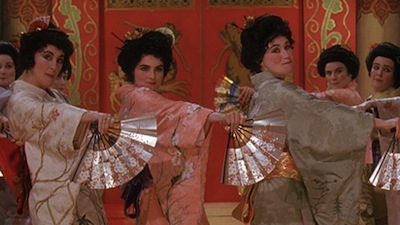
I guess in a way we could also call the film's extravagant style "topsy-turvy" in that it does turn our expectations of a Mike Leigh movie on their heads--and with rather successful results. The attention to detail that Leigh takes is essential to his story. In his own subtle switch-up, once The Mikado is underway, the roles reverse, and while Sullivan contentedly trucks along with the new material, Gilbert gets serious about creating something authentic. While the music and even the lyrics are very British, Gilbert wants everything else to be true to the source. He rejects choreographed kitsch and tries to mimic what he sees in kabuki theatre and real Japanese life (albeit the lives of the immigrants visiting his country). Costumes are all based on traditional sketches, and even slimming undergarments are banned because it would change the natural shape of a kimono. As Broadbent plays him, Gilbert goes from the typical humorous blowhard to an artist of great intensity. My favorite moments are when the writer comes off the cuff with a clever joke and chuckles to himself about it: the self-satisfaction of one's own humor.

The whole approach of Topsy-Turvy is subtle and generally light as air. The intricacies of the story structure aren't immediately obvious. Leigh's anecdotal technique keeps an even pace, letting each backstage story play out, hitting the punchlines (which are uniformly funny), and then moving on. This makes it a little surprising when the film springs a heavy denouement on the audience. Despite all the laughs that Leigh has gathered along the way, he has also slowly exposed the darker sacrifice of artistic obsession. In their pursuit of acclaim and adulation, the troupe not only demands a lot of themselves, but also the people around them. Both Gilbert and Sullivan have chosen the ephemeral muse over the permanence of family, and what that means for the women in their lives comes out in different, yet equally heartbreaking ways. Manville gets a powerful scene where she describes her own surreal version of a Gilbert and Sullivan production, while Shirley Henderson, playing an actress who longs for Gilbert's approval, gets one last monologue and the movie's final song. She sings "The Sun Whose Rays Are All Ablaze," a solo ballad from The Mikado that, though quiet and plaintive, rings out as an insistent declaration of her determination to tell her own story.

Tomorrow, she will sing the song again. And there will be another production to follow. Even Kitty asks Gilbert what comes next, though The Mikado has only just premiered. The quest for originality demands its own repetition. Topsy one day, turvy the next.


The new Criterion Blu-Ray of Topsy-Turvy packs an incredible level of detail into its 1.78:1 transfer. Dick Pope stages many intricate shots of the theatrical production within the film, shooting from the theatre balcony, or sometimes right in the thick of the chorus, and in either case the image goes deep and the individual flourishes all get their proper clarity. Colors are rich and vibrant, with excellent skin tones that become all the more apparent as the stage actors wash away their make-up and we see the difference between artifice and naturalism up close. There are no hints of digital noise reduction, nor are there any other tell-tale signs of technological manipulation. The image is clean and vibrant throughout.

Criterion has packed a bunch of extras onto this new release, starting with their usual booklet, which features photos, credits, and an essay by Amy Taubin. There is also an explanation of the artistic technique that Yuko Shimizu used in creating the cover; interesting to note that, judging by the Criterion website, the Blu-Ray cover is printed with the image oriented one way and the standard DVD has it printed the other way. Chapter listings are printed on the inside front cover of the case.


Other extras include an audio commentary, deleted scenes, and a conversation between Leigh and his musical director. The Blu-Ray has them on one disc, the standard DVD on two.

Perhaps most pleasing of all of these is a the short film, A Sense of History (1992; 26 minutes; presented in HD), written by and starring Jim Broadbent, directed by Mike Leigh. Broadbent stars as the Earl of Leete. Mostly a one-man show, it features the Earl leading a camera crew around his family's opulent estate, which has been in the clan for over 900 years. As he conducts the tour, talk turns wistful and nostalgic, and soon the family history turns dark and the personal history gets darker. It's all told with the same matter-of-fact, upper-crust sense of self. There is no real reflection, no remorse: just the facts of privilege. It's an excellent piece of work, smartly and subtly packing a lot into a very short time span.


For a complete rundown on the special features, read the full review at DVDTalk.