Showing posts with label kubrick. Show all posts

Sunday, June 16, 2019

COLUMBIA NOIR: MURDER BY CONTRACT/HUMAN DESIRE/DRIVE A CROOKED ROAD/NIGHTFALL - CRITERION CHANNEL


I am continuing to work my way through the Criterion Channel’s “Columbia Noir” bundle, a collection of crime and melodrama spanning three decades of the Columbia studio. You can see my first group review here; it appears this collection will be off the Channel at the end of the month, so hurry if any of these sound like your thing.


Murder by Contract: This raw 1958 hitman picture from Irving Lerner is considered a B-movie classic, lauded by Martin Scorsese and others for its rough-hewn, independent style. It’s a bit like Allen Baron’s Blast of Silence [review] in that what it lacks in polish, it makes up for in earnestness.

Vince Edwards, who played Val in Kubrick’s The Killing but was probably best known as TV’s Dr. Ben Casey, stars as Claude, a self-motivated would-be contract killer looking to earn enough cash to buy a house on a lake far away from the grind. Claude’s m.o. is that he uses his brains rather than weapons, avoiding any pitfalls that might lead to the police tracking him down. After a few successful jobs, he is sent to Los Angeles to take out a nightclub performer (Billie Williams) about to testify against a colleague of Claude’s boss. With the trial a few days away, Claude decides to soak up Hollywood...only to find the time wasted when the girl proves harder to kill than he thought.


It’s funny to watch Murder by Contract now, as it’s hard not to think about the HBO show Barry, in which Bill Hader plays an assassin who tries to leave the life to become an actor. Too bad Murder by Contract has none of Barry’s wit, character, or even action. This is all pretty standard stuff, obviously done on the cheap, with little editing or rewriting applied to Ben Simcoe’s sloppy script. The narrative meanders, and Edwards appears committed to the role but incapable of delivering what that commitment requires.


Human Desire: Master director Fritz Lang had scored a noir hit with The Big Heat, also for Columbia, in 1953, and Human Desire sees him reuniting his principal cast a year later for another go. This time, Lang is adapting La bête humaine, the Emile Zola novel that also inspired Jean Renoir’s excellent 1938 drama of the same name [review]. Glenn Ford takes over the Jean Gabin role, playing Jeff, a fresh discharge from the Korean War returning to the small town where he grew up to pick up where he left off. Jeff is looking to resume his quiet life as a train conductor, renting a room in a house with his co-worker, the man’s wife, and the growing daughter who has eyes for the levelheaded boarder.

Enter temptation. On a random trip, Jeff crosses paths with Vicki Buckley (Gloria Grahame), who lays on the charm. Little does Jeff know that Vicki’s flirting is to distract Jeff from finding the body of the man her jealous husband, Carl (Broderick Crawford), just killed. As Jeff is drawn into Gloria’s web, he soon ends up covering for her misdeeds and heading toward the inevitable: he’ll have to kill the husband if he wants the wife all to himself.

Stylistically, Human Desire has more in common with Lang’s 1952 steamer Clash By Night than it does The Big Heat. The title says it all: this is a plot about base emotions and internal struggle. Grahame sizzles as the manipulative femme fatale, playing off nicely with Jeff’s more earthy paramour, the innocent who can see no wrong in the man she loves (a noir trope). Ford conjures some of that grinding anger that worked so well for him in Gilda [review], but the real star here is Broderick Crawford, who portrays Carl as scheming and black-hearted, but also nervous and insecure. He makes the violent creep almost sympathetic.


Drive a Crooked Road: Okay, now this is more like it. This 1954 crime piece from director Richard Quine (Sex and the Single Girl [review]) is sharply written and unflinching in its dark cynicism. Mickey Rooney plays Eddie Shannon, a natural wunderkind with a car engine who also likes to race from time to time, but always comes in second. Ribbed at work for being short, and self-conscious about the scar on his face, Eddie is a lonely guy just getting by.

Enter into his life Barbara Mathews (Dianne Foster, The Last Hurrah), a Beverly Hills swell with a car that needs his special touch. When Barbara takes Eddie outside the garage, however, it’s she who will be applying her own special touch. Barbara is a unique kind of femme fatale--she plays the part of the loving, open girlfriend so convincingly, there isn’t even a hint that Eddie is being played. Rather, it’s guys in Barbara’s social circle who eventually approach Eddie, looking for a driver who can navigate the winding California roads.


Quine makes great use of the landscape, from beach to mountain to the almost space-age confines of Eddie’s dealership. There’s a sparkle to it all that hypnotizes our protagonist, and though Eddie is an A-grade patsy, Rooney brings empathy to the role. You really feel sorry for the guy, and Foster is such a warm presence, so kind, it feels like a double betrayal when it goes wrong. These factors give special stakes to Drive a Crooked Road’s finale, affecting who we root for and why in a way that has more emotional truth than the standard noir payoff.

To see Mickey Rooney in a similar role, and also just to see another quality film noir, also seek out Quicksand from 1950.


Nightfall: Jacques Tourneur could bring style to any genre, be it horror like I Walked With a Zombie [review] or the quintessential noir Out of the Past. While his 1956 Los Angeles crime picture Nightfall does not necessarily rise to the level of that classic Robert Mitchum collaboration, it’s still a solid chase picture in its own right.

Aldo Ray (Miss Sadie Thompson [review]) plays Jim, a Navy vet built like a quarterback with a cool, gentle demeanor. Jim is hiding out in Los Angeles, where he is being watched by several pairs of eyes. Most notably, by two crooks, John (Brian Keith, The Parent Trap; The Pleasure Seekers [review]) and Red (Rudy Bond, On the Waterfront), bank robbers who ran across Jim in Wyoming while on the run. That tussle left one man dead and a bag of money went missing--money the pair of hoods believe Jim is hiding.


It just so happens the night they catch up with Jim is also the night he meets Marie (Anne Bancroft, The Graduate [review]), a lonely model who lucks out by meeting the one gentleman in Hollywood. Or so she thinks. Her chance encounter puts her in danger once Jim gives the bad guys the slip, and the two of them end up in a race to get out of town and find the cash.

Tourneur, working with a script by Stirling Silliphant (In the Heat of the Night [review]), strikes an interesting balance here. The hunt has all the great tension of an urban thriller, while flashbacks to Jim’s story, and really the man himself, have the easygoing calm of a farmland drama. The blonde patsy is not your typical noir hero. His voice is soft, his vocation is art, his origins are rural; he’s a light fish swimming in a dark pond. That means when we shift to Jim’s terrain for Nightfall’s snowbound climax, things get a little quieter than we are used to in a noir showdown, but Tourneur and Silliphant are letting the characters dictate the action, bringing the hunter and the hunted full circle to have an ending that perfectly suits who they are.


Monday, September 10, 2018

THE TREE OF LIFE (Theatrical Cut) - #942

This review was originally written for the theatrical release of the film and published on DVDTalk.com in 2011.


Writing about Terrence Malick's new movie, The Tree of Life, is a bit like trying to describe a particular segment of a backwoods stream--a beautifully lit and photographed segment of stream, mind you, but a stream nonetheless. The task is like living out the old Heraclitus quote about how you can never step in the same river twice. The water moves too fast, by the time you dip your toes in, it has moved on.

I also struggle with writing about it, because to do so, I feel like I will break the spell it has cast over me. The Tree of Life hasn't left my thoughts since I left the theatre. To do so is to also pretend that I got it, which I don't think I did--at least not entirely. My impressions at this point are shallow. To stick with the river analogy, I am maybe in up to my ankles, I have yet to get to the deep middle.


Though, ironically, it's the middle of the movie that is easiest to grasp. The front and the back are what make The Tree of Life a mesmerizing conundrum. It's as if Malick took the first and last reels of 2001, cut them up, reassembled them randomly, and then grafted them on to a story about a family in the 1950s. The O'Briens (played with alternating fury and vulnerability by Brad Pitt and Jessica Chastain) have three boys whom they are trying to steer through early life. Their parenting is a bit all over the place, balancing religion with an appreciation for art (or, specifically, music) and a Protestant work ethic with a laissez-faire day-to-day playfulness. The three kids run free with other neighborhood boys, causing trouble, testing the limits of their own perceived invulnerability. The two parents pull at them, particularly trying to mold the eldest, Jack (Hunter McCracken), into the man they want him to be. Both want their offspring to end up on the straight and narrow, but in that endeavor, one is strict where the other is lean.

Malick doesn't tell his story in any linear, sequential, or conventional manner. He prefers relaying information in short puffs of cinematic smoke. Small gestures stand in for greater events, and suggestion is preferable to explicitly laying out any greater meaning or intention. An individual moment as trivial as walking down the street might be shown in three different ways, from three different angles, at three different speeds. In this way, the real story blooms into being, revealing that Malick kept a tight grip on his narrative seedlings in the early portion of the film and is only letting things take shape after he has properly nurtured them. Family life for the O'Briens goes from idyllic to troublesome. Carefree romps in the woods turn to deadly games and dangerous dares. Malick also teases us with tragedy that is to come, one that nestles somewhere in the middle of his timeline. In a few brief scenes, we see Sean Penn playing Jack as an older man, contending with his past. As an adult, he is out of step with his environment, no longer at harmony.

Those scenes with Penn mark a fascinating change for Malick, who for the first time films modern cityscapes rather than the nature scenes he is most known for (the wheat fields of Days of Heaven [review], the Asian-Pacific jungle of The Thin Red Line). He and cinematographer Emmanuel Lubezki (Burn After Reading [review], Children of Men [review]) shoot the towering skyscrapers the same way they would shoot a forest of redwoods--in awe of their majesty and from the vantage point of a puny human who is but a speck on the timeline by comparison. The Tree of Life is full of Malick's trademark visual poetry. The camera is rarely at rest. Instead, it circles and tracks and zooms; the whole of existence is constantly in movement.


If, as many would posit, the overall theme of Terrence Malick's filmography is the interconnectedness of all life, then some of the outlying sequences start to make sense. The director takes the viewer through time and space, to the farthest reaches of both, threading a slender line through various modes of existence. In some of his technique, one can see Stan Brakhage; in other spots, particularly the introduction of neon tracers as we enter the concrete jungle, Wong Kar-Wai (The Gradmaster [review]; In the Mood for Love [review]). There is also a touch of Alejandro González Iñárritu (Birdman [review]; Babel [review]) in the metaphysical final act--though in this, it is the master taking the pupil to school, showing Iñárritu how to evoke providence via simplicity rather than self-importance. (Hint: You look outside, not inside.) (Also, one could easily argue that Malick could school Wong Kar-Wai in aesthetic technique; as much as I love Kar-Wai's movies, one assumes the Chinese director was influenced by the American one, not necessarily vice versa.) It all comes together rather amazingly, though upon first viewing, I can't entirely decide if I'm just impressed that it ended up anywhere at all. My gut reaction is that Malick is saying something profound about grief, symmetry, and the eternal endurance of the human spirit, but there are so many pieces to put together here, I don't feel confident that I have it after just a single sampling. The Tree of Life demands more time, a commodity I will happily give in exchange for a chance to see its dreamy images again.

The Tree of Life is sure to be a movie that is hotly debated for some time to come. The first thing anyone heard about the movie coming out of Cannes last month was how it was both booed and cheered, by some reports in equal measure, with others suggesting the response skewed to one particular side. (The Tree of Life eventually took the festival's top prize.) Those with a predisposition for Malick will go see the film regardless, and I have no idea how to assess what a newcomer to the man's work will make of this ambitious endeavor. Part of me worries that The Tree of Life is almost too sincere for most audiences, be it the common man or the critical establishment. Too many are quick to reject honest sentimentality. (He's carrying a Bible! Run!) Good or bad, Malick means everything this film is trying to say. It's a deliberate, deeply felt artistic expression of the like few filmmakers are capable of. At least try to meet it on its own terms before you judge. It would be easy to fold your arms against it or to embrace it wholeheartedly because of the name above the title; instead, walk in with your hands at your sides, and let the film lift them all on its own.


Tuesday, November 29, 2016

ONE-EYED JACKS - #844


In the lore of One-Eyed Jacks, it’s said that Marlon Brando’s character Rio was supposed to be Billy the Kid, and was even identified as such up through a draft of the screenplay by the great Sam Peckinpah. The only problem was that, in historical contexts, Billy the Kid was inarguably a bad guy, and Marlon Brando never plays the bad guy. And so it was that the character’s name was changed, paving the gray way on a gray road where the bank robbing, lying Rio could be the hero of his own story.

A pretty good story it is, though a cynical one. Even in western terms, it takes a healthy dose of existential awareness to draft Rio as a hero. An anti-hero, maybe, despite the fact that he seems to stand for less than even Brando’s Johnny in the The Wild One [review], who you may recall was ready to rebel against anything you’ve got. But One-Eyed Jacks was Marlon’s show, and he fired not only Peckinpah but also Stanley Kubrick, who was set to direct the picture, and stepped behind the camera himself, enlisting Paths of Glory-screenwriter [review] and RamblingRose-author Calder Willingham to give him the morally ambiguous western he sought. An extended production followed, and a delayed release, and an eventual studio re-edit to get this thing out in 1961, allegedly excising some three hours of equivocation and nuance. Brando disowned it; your mileage may vary.


One-Eyed Jacks is a solid western, and a dark precursor to the revisionist history to come for the genre as the studio system crumbled and cinema evolved. Set in Mexico and California, One-Eyed Jacks has a decidedly Latino presence, and a pronounced racism to match (and that’s without considering whether or not Brando is intended to be a Mexican). The whites in the movie mingle with the people of color, but they don’t view them as equals. Not even Dad Longworth (regular Brando sideman Karl Malden), who married a Mexican woman (Katy Jurado, Under the Volcano [review]) and plays step-dad to her daughter Louisa (Pina Pellicer), is all that convincing as a progressive dude. Not with the way he orders his wife around. Not with how he reacts to Louisa’s dalliance with Rio, the man he betrayed once upon a time. It’s tough to tell if the character is named “Dad” ironically or appropriately. As Rio’s father figure of record, Dad has a lot to answer for.


It’s the older man’s betrayal that sets the plot of One-Eyed Jacks into motion. After the pair rob a bank in Mexico, only to be chased down by federales, Dad takes advantage of Rio’s sense of honor and hangs him out to dry. Five years later, Rio escapes from prison and goes looking for the man who betrayed him. The search leads him to Bob (Ben Johnson, The Last Picture Show [review]), who is planning to rob the bank in the California hamlet where Dad has taken up residency and assumed the role of sheriff. If Rio helps Bob, he can also take his revenge. As it turns out, though, the job is not a simple smash and grab. The gang first settles in town, mingling with the locals while Rio makes a fake peace with his enemy--and woos the man’s stepdaughter. Then things go wrong, and everyone turns on each other.


Comparisons have been drawn between One-Eyed Jacks and film noir, and there are certainly thematic similarities. Plot-wise, one could compare this to Robert Siodmak’s Criss Cross, with Brando taking Burt Lancaster’s role of the gangster who took the metaphorical bullet for the team and Dad playing the classic noir fall guy who looks to leave his past behind and set up a new, straight life away from his previous misdeeds. As any student of noir knows, however, the past never stays buried. The only problem is, Rio is not a clean crook whom you can root for the way Lancaster is in Criss Cross or Robert Mitchum in Out of the Past. Brando plays the outlaw with a quiet menace, his smirk ready to turn to a sneer at a moment’s notice, and real nasty mean streak simmering behind those piercing eyes. He appears to always be thinking more than he’s saying, and yet his expression is inscrutable. Is he pondering philosophy or simply dreaming of tearing the wings off of flies? Ironically, Rio is the worst to women, whom he outright lies to in order to get what he wants, but yet who also serve as his Achilles heel. He can’t stand to see them abused, and so he stands up for any female he sees getting pushed around, including an intense brawl with the eternally creepy Timothy Carey (The Killing). The anger blinds Rio to consequences. It brings to mind a rival to Brando’s The Wild One character in terms of teenage angst; Rio’s pathological need to act out has a similar cartoonish quality to James Dean going gonzo over being called “chicken” in Rebel Without a Cause.


Of course, we also can’t dismiss the other men in the movie in any easy fashion, which at least gives Rio some moral ground. Everyone here has troublesome motivations. Some are cut and dried, like Bob, who is just racist and cruel, or Slim Pickens’ Deputy Lou, the comical “good guy” who is really a sexual predator obsessed with his namesake, Louisa. (The humiliation he suffers at the hands of Rio is borderline grotesque, and yet all too fitting.) Dad ends up being the most complicated. On one hand, he is a father looking to care for his family and a lawman with an eye on his community; on the other, he’s a petty cheat suffering a terrible case of imposter’s syndrome. Malden’s clear eyes show conflict...and fury. His showdown with Rio will have to be primal. Biblical.


These characterizations are the notable standout in terms of One-Eyed Jacks being a “different” kind of western. Unlike the more convention-busting cowboy pictures that were soon to come, One-Eyed Jacks largely looks and feels like a traditional western. As an actor, Brando may be an entirely unique presence, but as a director, he is beholden to the trappings of the genre. In both look and plot, this is no different than a big-budget Hollywood western of previous decades. It’s more Vera Cruz [review] than The Hired Hand or McCabe and Mrs. Miller [review]. Which isn’t a knock. I really loved One-Eyed Jacks, and can only appreciate how even though Brando put on a familiar cloak, he used it to smuggle in a subversive message. The languid pace of some of the more typically California scenes, and the wounding and redemptive healing process Rio suffers through, predict some of the aesthetics and tropes of spaghetti westerns, the next big thing in horse operas.

Which is probably why the movie garnered such champions as Martin Scorsese and Steven Spielberg, who contributed to the restoration of One-Eyed Jacks that made this splendid re-release possible. As Marlon Brando’s sole directorial effort, it perfectly encapsulates his position as a movie star, one foot in the old studio system, one foot in the new cinema school, but his head entirely in the clouds, above it all, pursuing his own dream.


This disc was provided by the Criterion Collection for purposes of review.

Monday, May 6, 2013

SIDELINE: MORE REVIEWS FOR 4/13

Ah, it's that time of year where I start running behind, isn't it?

Well, here are the reviews for other movies from April...


IN THEATRES...

* The Angels' Share, a heartwarming Ken Loach dramedy about a whisky heist. Let me in on that action!

* The Place Beyond the Pines, an unwieldy family story from the director of Blue Valentine. Are literary pretensions and a strong cast enough to overcome a director's indulgences?

* Room 237, like a collapsing wormhole of internet crazy, a tape loop of nonsense about Stanley Kubrick's The Shining.

* To the Wonder, the latest from Terrence Malick is beautiful and emotionally provocative.

* Trance, wherein Danny Boyle uses Rosario Dawson's private parts to try to hypnotize you into believing that he's not just pulling the same old bullshit.


My Oregonian columns...

* April 5: two festivals come to town: the Polyester Pulp series of 1970s crime films and the disjointed Beer and Music Fest. Plus, Thale, a creepy Scandinavian folk tale turned into a creepy modern movie.

* April 12: the environmental documentary Trashed, featuring the very serious face of Jeremy Irons; Elliott Gould and Christopher Plummer in weird and grisly The Silent Partner; and, hey, another environmental disaster in the schlocky 100 Degress Below Zero.

* April 19: Two recent French films, Women on the Sixth Floor and Tomboy, and two 1950s classics, The Little Fugitive and Imitation of Life.

* April 26: Emily Mortimer in the historical drama Leonie, an indie debut called Everything Went Down, and Peter Gabriel in concert.


ON BD/DVD...

* 28 Hotel Rooms, an indie romance with an interesting story structure.

* The Devil and Miss Jones, a delightful class comedy from 1941, starring the wonderful Jean Arthur.

* Hemingway & Gellhorn, literary legacies desecrated, good actors embarrassing themselves, and a myriad of other reasons why this is one of the worst movies I've seen in a long time.

* A Message to Garcia, a poor presentation of an otherwise decent early Barbara Stanwyck vehicle.

* Not Fade Away, a rock 'n' roll drama from Sopranos-creator David Chace.

* Once More, with Feeling! a middling Stanley Donen effort from 1959.

* The Sun Shines Bright, John Ford's friendly portrait of a Kentucky judge and his community ca. 1905. If you can look past some of the troublesome racial elements, the film actually has a surprising message of unity.

* Tatsumi, the animated biography of influential manga creator Yoshihiro Tatsumi


Sunday, March 31, 2013

THE GAME (Blu-Ray) - #627


"Does this thing end?"

Michael Douglas, playing investment banker Nicholas Van Orton, asks the question midway through a rigorous test to determine whether he is suitable to participate in the elaborate scenario that is the singular plot point of David Fincher's 1997 movie The Game. It's a question he will ask again as the film wears on, one of many echoes and repeats that occur throughout the motion picture.

More important than the question, however, is what is going on and how he asks it. Van Orton has been watching a series of filmed images with subliminal messages buried in them, a horrifying montage certainly meant to recall a similar B-roll shown to young Alex in Kubrick's A Clockwork Orange*. Fed up with the grotesquerie, the man stands and turns into the blinding light, bathed in the flickering images as they emanate from the projector, staring deep into the lens. It's as if he is asking the movie itself when it will stop.


Or letting it absorb him. Because, for whatever else it is, The Game is a tribute to the art of cinema. It is a romp through motion picture technique, bringing the visceral experience that movies attempt to re-create to its protagonist, establishing its own meta reality, a wheel within a reel. Nicholas Van Orton will soon find himself in his own version of North by Northwest, part of an unstoppable action scenario, though this time by way of the convoluted grifts in con men movies. The staging of each incident would be impossible in real life. Or so we tell ourselves. Isn't the biggest con of a movie like The Grifters or The Sting or The Brothers Bloom [review] that we end up accepting that these schemes work? It's the promise of all good movies: for the two hours we sit in the dark, we are made to believe.

Nicholas Van Orton is kind of your typical protagonist for this kind of story, the imaginary rich man bored with his routine and too disconnected to know it. Divorced, isolated, all work and no play. His brother Conrad (Sean Penn) is his predictable opposite, a "free spirit" whose life choices have had other consequences (drugs, legal trouble, etc.). It's Conrad who buys Nicholas a session with Consumer Recreational Services. This clandestine business, conducted behind smoked glass, provides specialized experiences for each of its clients. What Nicholas will soon be in for is an elaborate set-up, a running adrenaline-junkie dramatization of a wronged man scenario. Nicholas is barely in the game before he loses track of what is real and what isn't. Is he really playing a part in an out-sized fiction, or is he being scammed? Hospitals, cops, attack dogs, guns, car crashes, private eyes, pretty girls, keys with no locks, a mausoleum in Mexico--all of these puzzle pieces could either add up to the greatest thing that's ever happened to Nicholas, or it could just be a backdoor to ruining his reputation and siphoning off his money.


The excess on display is its own gag. At one point, Nicholas loses a shoe and comments, "There goes $1,000." When the waitress, Christine (Deborah Kara Unger), clarifies that his footwear costs a cool grand, he quips, "That one did." The economic divide between them--and really between Nicholas and everyone else--is one Fincher never lets us forget. His lifestyle is ridiculous, as is his endless pursuit of more. This is the underlying critique of The Game, and it won't be the last time Fincher puts the boot into greedy corporate stooges. (See also: the character assassination of Mark Zuckerberg in The Social Network [review]; the villainous bankers in The Girl with the Dragon Tattoo.) This skewering seems even more prescient now, or at least no less relevant, given the current ongoing, worldwide economic crises. Nicholas Van Orton is reckless with how he spends his money and lacks empathy when his actions cost others. The fact that the film's criticism of his behavior doesn't maintain its sharpness is perhaps why many find The Game unsatisfying. Nothing bad actually happens to Van Orton, and his sins are washed away right alongside his daddy issues in the movie's finale.

The thing is, the moneyman's existential story arc is secondary to the plot. Van Orton learning to live in the moment and to be more self-sufficient (I'm surprised we don't actually get to see him change a tire by the time credits role) is merely the excuse that allows Fincher and screenwriters John Brancato and Michael Ferris to do all the other stuff.** It's like one of the characters explains, "Discovering the object of the game is the object of the game." Any greater meaning is unnecessary. The whole idea here is to keep us guessing, keep us watching, and keep us asking what happens next.


Which is what makes The Game such a rollicking success. For as obvious as Fincher's technique can often be--and pause during literally any point in The Game and you can't help but admire how beautifully Harris Savides (Somewhere [review]; Margot at the Wedding [review]) shoots this thing--the magic trick here is the sleight of hand by which the expert filmmaking disappears. The music, the editing, the excellent performances from the movie's cast--all of these things blur together and fade into the background. Fincher doesn't give you time to ponder how it's all fitting together, you're too busy trying to keep up. He is the cinematic con man, and we are his marks, and the only way the ruse will work is if we don't ever question its veracity.

Thus, it doesn't really matter if, in a way, there is no "there" there. The Game has shallow characters and a hollow center, but the pleasure that comes from watching the wheels spin round and round means that none of that matters. Hell, even the end, with a promise of canoodling at the airport, offers romance without any of the weighty details. Fincher could have just as easily cut to Deborah Kara Unger and Michael Douglas rolling into an upper berth as their train passed through a tunnel. The Game is, indeed, that obvious--and also that entertaining.


* The piano trills throughout the movie, provided by composer Howard Shore, kept making me think of another Kubrick film about deception, Eyes Wide Shut. Any actual reference point to that movie would be impossible, however, since it was still two years away when The Game was released.

** There apparently were many other writers who doctored the script, which isn't surprising. Brancato and Ferris, as a team, are responsible for quite a few stinkers, including De Palma's Femme Fatale, The Net, and Catwoman. These writers could use a helping hand or two.


Saturday, November 3, 2012

SIDELINE: MORE REVIEWS FOR 10/12

My reviews of non-Criterion movies through October.


IN THEATRES...

* Argo, Ben Affleck takes a true story about a fake movie and turns it into genuine cinema.

* Bill W., a documentary about the man behind Alcoholics Anonymous

* Chicken with Plums, Vincent Paronnaud and Marjane Satrapi's disappointing follow-up to Persepolis. 

* Flight, starring Denzel Washington and directed by Robert Zemeckis. Apparently even turkeys can fly upside down.

* Seven Pyschopaths, the comedy is dark and funny, the action appropriately visceral, but the second film from the director of In Bruges isn't as smart as it thinks it is.

* Sinister, half a good horror movie, half a bad one, and the better half doesn't make it worth the time.

* If you live in Portland is to attend the Alfred Hitchcock festival at Cinema 21. Here is what I wrote up for the Mercury.


ON BD/DVD...

* Bird of Paradise, a pre-Code picture from King Vidor, indulging in island fantasy cliches.

* Black Sunday, Mario Bava's 1960 horror debut is spooky and sexy.

* Chained, Jennifer Lynch's psychological horror movie doesn't quite link up.

* Cinderella, Disney's animated fairy tale comes to Blu-Ray. It looks marvelous, even if it is one of the studio's more middling efforts.

* Confessions of an Opium Eater, in which Vincent Price goes on a trip through Chinatown.

* Detachment, an arty drama about teachers overstuffs the lesson plan, but Adrien Brody and thre rest of the cast are great.

* Fear and Desire, the "lost" first film of Stanley Kubrick.

* Mad Men: Season Five, the best show on television keeps getting better.

* The Penalty, a potent silent film starring Lon Chaney as a double-amputee bent on revenge.

* Shut Up and Play the Hits, the documentary about LCD Soundsystem's last gig; features the full three-hour concert.

* Three Secrets, Robert Wise's 1950 melodrama about a trio of women who may or may not be the mother of a young boy stranded on a mountain.

* The Woodmans, a moving documentary about late photographer Francesca Woodman and the effect her suicide has had on her family.


Sunday, March 18, 2012

NIKKATSU NOIR: CRUEL GUN STORY - ECLIPSE SERIES 17


"It's a fine line between a stray dog and a lone wolf."


Cruel Gun Story is a weird, bald-faced title, one that gives central position to the weapon and may lead us to assume that the fate of the characters involved will be directly tied to a particular firearm, something like Kurosawa's Stray Dog or Robert Altman's short-lived 1980s television show Gun. In truth, it must be something in the translation, or maybe a case of a title testing well and being applied haphazardly to a script, because the only gun to get any singular attention here is the one bought by Joe Shishido. It's an automatic rifle that was taken off an American G.I. and it comes with a warning: if you aim it, be prepared to kill; one pull of the trigger, and the target will have seven holes in his chest. Many men fall by ending up on the wrong side of its muzzle.

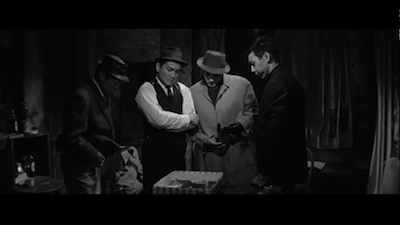
Cruel Gun Story was made in 1964 by director Takumi Furukawa (Season of the Sun), and it borrows its premise from Stanley Kubrick's hard-bitten noir The Killing. Four guys working for the mob are set up to rob an armored car carrying loot from a racetrack. The heist will be led by Togawa (Shishido), a convict fresh out of prison. He was serving a bid for crippling a careless truck driver who had run over his sister Rie (Chieko Matsubara, Tokyo Drifter [review]). Togawa wants to go straight, but the big score promised by this job could mean an operation to save Rie's legs. Though the doctors tell him it's futile, Togawa is a man who goes against destiny.


Joining him for the robbery is his old ally Shirai (Yuji Odaka), whom Togawa trusts implicitly, and two hoods forced on them by their backers. One is a punchy ex-boxer (Shobun Inoue), the other a junkie gambler (Saburo Hiromatsu, Take Aim at the Police Van [review]). The job is simplicity itself: divert the truck from its routine, and the guards will make a stupid mistake. It's Criss Cross married to The Italian Job: use a roadblock to send the vehicle down the wrong path, load it into a bigger truck, and take it away.
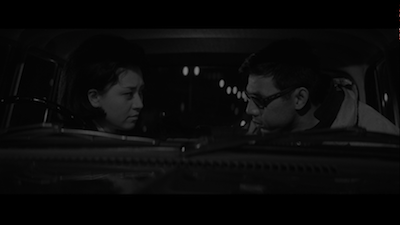

Of course, nothing ever goes as planned, and not only do the guys get the truck, but they end up kidnapping the two guards. They also are on their way to a several double-crosses, both within their ranks and beyond them. The crooked lawyer who hired them and the mob boss who put him up to it never intended to split the money with Togawa's gang, and the lawyer even has some ideas about setting up his own organization. The body count is going to get fairly high--there are two massive shootouts before Cruel Gun Story is through--and naturally there is an ironic twist of fate just waiting to happen.


The action in Cruel Gun Story is exciting, and the narrative keeps cracking at a quick pace, preventing the film from ever settling too long. There are a few logic problems in the story--when Togawa is about to get the shaft, it never makes sense that he's willing to go to a hotel for the night and leave the others back at the hideout with the loot--and though it's neat to see the heist planning in the ideal form (how Togawa imagines it will go), the actual theft doesn't divert enough from the fantasy to really justify that early run-through. Those nitpicks aside, Furukawa has put together a stylish, tough-minded crime movie with a subtle layer of social commentary. All of the crooks have some kind of difficulty, either personal or socio-economic, compelling them to take this drastic action, and the implication is that post-War Japan doesn't offer them an alternative to solve their problems. It's telling that all of their hiding places are buildings that have been ruined by occupying American soldiers, and the one guy who has been making a clean living, Togawa's friend Takizawa (Tamio Kawachi, Black Sun [review]), does so by running a jazz bar catering to black American soldiers. Even the greater cosmic forces have a Western face. Rie is in a Christian hospital, and in one of Cruel Gun Story's most potent scenes, Togawa rejects God for being callous and unforgiving.


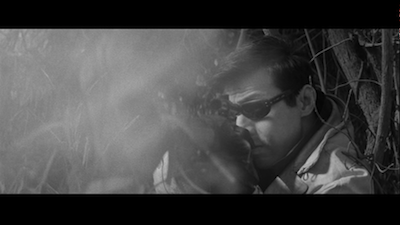
These are desperate times, and as the saying goes, desperate measures are called for. Shishido is perfecting the tough-guy swagger that he is best known for (he rarely takes off those sunglasses), but he also plays Togawa as conflicted and vulnerable. He doesn't want to pull this robbery. His instincts tell him it's the wrong thing to be doing and he's doing it with the wrong people; yet, he blames himself for Rie losing her legs because he sent her out to the store the night she was struck down. In a sense, she's like the maguffin of his particular story, though the reward is emotional rather than monetary. It makes Togawa's choice to go after the boss' own flesh and blood, the thing he cares about the most,  all the more chilling. He knows exactly what kind of damage that will do.


Cruel Gun Story isn't without its levity, either. It's hilarious how much these guys beat up on each other as a standard course of business. There was actually supposed to be a fifth robber (Hiroshi Kondo), but after Togawa and Shirai pretend to be rival gang members and beat the crap out of him, he folds. They also rumble with the boxer and pull a drive-by on the gambler, all to test their mettle. And any time someone talks back to Togawa, he pastes them hard on the mouth. All the guys bounce back, though, even if the furniture does not.

The final act of Cruel Gun Story shows Togawa trying to salvage things and get back at the men who betrayed him. It's violent and smart and not without its bittersweet ironies. The final shot definitely owes a tip of the cap to the ending of The Killing, but not before one last dirty twist on the part of the filmmakers, giving Togawa one further disappointment to chew on. The last act of violence perpetrated in the movie is done because someone mistakes him for being their mutual enemy, suggesting that in a world that's gone this wrong, the ultimate cruelty is for a man to become everything he hates.