Showing posts with label Ken Loach. Show all posts

Saturday, May 9, 2020

WUTHERING HEIGHTS (2011) - CRITERION CHANNEL

This review originally written for DVDTalk.com in 2011.


Leading British arthouse film director Andrea Arnold (Red Road [review], Fish Tank [review]) has taken one of literature's most famous romances and scrubbed it of its poetic declarations and gloomy portents, revealing a tattered, brutal tale of cruelty and the privilege of class that has been lurking underneath all the heavy breathing and emo expressionism.

Arnold's interpretation of Wuthering Heights maintains the 19th-century timeframe and Southern England locale of Emily Brontë's novel, but her presentation of the Earnshaw estate is neither fancy nor pretty. There are no white curtains come alive in the wind, no pleasantries or politeness. It's muddy and dark and bare. The story is basically split into two halves. In the first half, the head of the Earnshaw clan (Paul Hilton) brings home a young ruffian (Solomon Glave) he found in the streets. Thinking he will do the boy a favor by raising him as his own, he dubs the child Heathcliff and forcibly baptizes him into his family and religion. This breeds resentment with his eldest son, Hindley (Lee Shaw), and awakens something else entirely in his daughter Catherine (Shannon Beer). The relationship between the two adolescents is one of sexual discovery, even if they aren't immediately clear on exactly what they are discovering.


When Earnshaw dies, leaving Hindley in charge, things take a turn for the worse. Hindley becomes more openly hostile and expressive in his racism. Though Brontë described Heathcliff as darker skinned, the prejudice against him was primarily because he was a gypsy; Arnold has decided to cast Heathcliff as a black male, adding a more pronounced and identifiable sting to Hindley's hatred. Feeling ostracized in the community, Heathcliff leaves to make his way in the city.


Heathcliff's return to Yorkshire as a grown man is the start of Wuthering Heights' second half. Played now by James Howson, a first-time actor (like much of the young cast), Heathcliff comes back to find the farm in a state of disrepair under Hindley, and Cathy (Skins-star Kaya Scodelario) has married the son on a prosperous neighboring farm (James Northcote). Seeing his plans for revenge and redemption scarpered, Heathcliff chooses instead to hang around, slowly twisting the emotional knife in his tormentors while also trying to rekindle lost passions. Such things can, of course, only end in tragedy.

Andrea Arnold's take on the material exposes the Heathcliff/Cathy relationship as less a great love affair and more an obsession over a lingering compulsion. Cathy, played with eager naivete by Beer and haughty privilege by Scodelario, is drawn to Heathcliff because he is forbidden fruit. He is a bit of a bad boy, prone to verbal outbursts full of colorful, anachronistic street slang, but she also toys with him, both as a teen and as a woman. This makes Heathcliff grow increasingly bitter. Both Howson and Glave are a bit blank onscreen, their only apparent emotion being the slowly boiling anger and resentment that understandably make them want to lash out. Earnshaw adopted Heathcliff hoping to make him one of his own, and in that he succeeded. His natural children are petty and mean, no matter how many class pretensions they claim. Hindley is a hooligan, Cathy is practically an 1800s version of a chav.


This latest rendition of Wuthering Heights was shot by Robbie Ryan, who worked with Arnold on her previous movies; more recently, he's lensed both Ken Loach's The Angels' Share [review] and Sally Potter's Ginger & Rosa [review]. Ryan brings a street-level verité to what is traditionally a fancier story. The camera follows the characters on loose feet. Jittery handheld and voyeuristic close-ups lend the film an immediacy costume dramas often lack, plucking Wuthering Heights out of the past and placing it in the now. Though Ryan and Arnold linger on different aspects of the natural surroundings, they never chase the magic hour or seek out the more conventional beauty of the countryside. They instead prefer nature in all its harshness--mud, waste, death.

The elements are a living presence in Wuthering Heights. The wind and the rain drive the narrative and its characters, reforming the people as much as the weather also alters the landscape. A sudden storm accompanies a conflagration of emotion, leaving a lingering feeling that the soil will never dry, nor will the extreme impulses of the battered lovers ever cool. This, of course, only adds to the tragedy of Wuthering Heights: Heathcliff and Cathy can never win, they are subject to the natural order, and its inevitable consequences, as much as anyone--or anything--else.


Sunday, August 21, 2016

A TASTE OF HONEY - #829


“I dreamt about you last night, and I fell out of bed twice....”

Morrissey or Shelagh Delaney?

As most fans of the Smiths know, it’s both. Though, those with a big nose who know, know that the lyricist ripped it from the playwright, just as Moz lifted much from Delaney’s texts and nodded to her often. The above lyric is from A Taste of Honey and was embedded in the early Smiths track “Reel Around the Fountain;”  another song from the same period, “This Night Has Opened My Eyes,” not only borrows more lines from Honey, but the plot as well. Morrissey makes no secret of this. On the contrary, his sampling from Delaney, as well as putting her picture on album and singles covers (Louder than Bombs and “Girlfriend in a Coma”) helped drive many a dark youngster to her work. I read the original A Taste of Honey stageplay in high school, and finally found the film version many years later. The vocabulary theft made me predisposed to be a fan.


Shelagh Delaney on "Girlfriend in a Coma"


Rita Tushingham on the Sandie Shaw/Smiths EP

The movie adaptation of A Taste of Honey was released in 1961. Directed by Tony Richardson, it is considered part of Britain’s “kitchen sink” movement, so named not because the filmmakers in that school threw “everything but...” into their cinema, but rather they showed us how folks lived, kitchen sinks and all. Examining the working class citizens as they struggled to get by and potentially change their lives, Criterion fans can see the storytelling style in films as different as This Sporting Life [review], Billy Liar [review], and Victim [review], or even later, we can see how it influenced Ken Loach (Kes [review]) and Mike Leigh.


One hallmark of the kitchen sink films was the appearance of the angry young man (Harris in This Sporting Life, McDowell in If.... [review]--both in films by Lindsay Anderson, whom Shelagh Delaney collaborated with on The White Bus [review]). This makes A Taste of Honey a bit of a stylistic revolutionary, as its protagonist is an angry young woman. Starring Rita Tushingham (Doctor Zhivago, Girl with Green Eyes), A Taste of Honey tells the story of Jo, a teenager frustrated with her life of squalor and limited prospects. Jo lives alone with her mother, Helen (Dora Bryan), a woman with many lovers but never two shillings to rub together. This means the pair moves a lot, running out on one landlord after another. They also squabble constantly, tearing one another down, breaking up and making up because, begrudgingly, they are all they’ve really got.

This changes when Helen meets Peter (Robert Stephens) and decides to remarry. Though Jo is reluctant to finally let go of the apron strings, Peter is a much younger man than his new bride and not interested in having a grown daughter. So, Jo moves out on her own, getting a job in a shoe shop and a new roommate of her own. Also, she’s gotten pregnant by a sailor who has since left to sail the seas.


An unmarried teenager having a child all by her lonesome would have been social scandal enough, but Delaney--who co-wrote the screenplay with Richardson--was a progressive writer whose vision took in all aspects of life in urban Manchester. Jo’s lover, Jimmy (Paul Danquah), is a black man, and her roommate, Geoffrey (Murray Melvin), is gay. These facts are both approached delicately. No one comments on Jimmy and Jo being together, but the color of his skin is a factor in Jo’s anxiety about the impending birth. For instance, should she even want to take Geoffrey up on his offer to marry, people will know he’s not the father when they see the child. That’s if the gossips and wags buy their relationship to begin with. Though no one but Jo ever confronts Geoffrey outright about his sexuality, everyone looks at him sideways. They all sense the truth.

Which is always fascinating to see in an older film, since anyone with parents and grandparents born in “the good old days” knows that some members of those generations often tend to pretend that gays and lesbians weren’t around until that demonic disco music magically spawned them. But that’s what art is for--and history books--to show us what many would rather we not see. There’s a reason A Taste of Honey opens with a censorship board certificate indicating it’s only suitable for viewers over the age of 16. Much of the dialogue is frank about things that just weren’t acceptable: sex out of wedlock, abortion, alcoholism. Yet, Delaney avoids pushing a message. She and Richardson just want to show life as they’ve witnessed it and let the audience empathize or reject on their own.


Though Tony Richardson’s generation of filmmakers is often referred to as the British New Wave, their early work has little of the experimentalism inherent in the movies of their French contemporaries laboring under the same name. Rather, the Brits had more in common with the Italians in that realism was more important than style. Hence the director and his cinematographer Walter Lassally (who went on to shoot many of James Ivory’s lesser pictures) filming in the streets of Manchester, inside real apartments, and walking the boardwalk by the seaside. This was an existence that could not be re-created in a studio without adding a touch of glitz, so better to go where it was actually happening. The excursions out into public have an air of documentary, including a trip to the country where the child-like Geoffrey and Jo frolic with elementary school-aged kids. The mountainside expanse emphasizes how small they really are in the grand scheme of the universe (“I’m not happy and I’m not sad”), and the company they keep exposes just how young they are, too. Neither is really in a place where they should be having kids of their own.


It’s a great sequence, actually, with Geoffrey trying to prove he can be the husband and father Jo needs by awkwardly kissing her. The “traditional” roles are reversed with these two. Geoffrey probably feels too much, while Jo doesn’t quite know how to access all that is going on in her head and her heart. Back at their flat, Geoffrey cooks and cleans, while Jo goes out and earns a wage. One assumes it will all go wrong for these two, that somehow tragedy awaits, but A Taste of Honey sidesteps our expectations. Sure, it ends on a down beat, and everything isn’t necessarily okay, but we do leave with the sense that it will be. Lessons are being learned, and these characters will all carry on and get along in some fashion. Some ties bind so tightly, they will never be broken.


Criterion’s new restoration is, I believe, the first time A Taste of Honey has been available on disc in the States. The image quality is remarkable: crisp and clear, with strong blacks and an excellent level of detail. Supplements include interviews old and new, including vintage clips with Richardson and Delaney, and new chats with Rita Tushingham and Murray Melvin.

We also get a 1956 short film collaboration between Richardson and Lassally, co-directed by Karel Reisz (The French Lieutenant’s Woman). Made as part of the Free Cinema Collective that Richardson and Reisz formed with Lindsay Anderson, Mama Don’t Allow is a 22-minute documentary that displays the realist roots that Richardson and Co. grew from. Set inside and outside a jazz bar, with cutaways to some of the attendees preparing for an evening on the town, it’s a simple portrait of a particular nightlife. With a live soundtrack by the Chris Barber Jazz Band, including Lonnie Donegan, a.k.a. the King of Skiffle, a successful British rock musician that influenced the Beatles, Mama Don’t Allow is a winning snapshot of a specific scene, giving us a look at music and youth culture before the advent of rock ’n’ roll.


The screengrabs here are from an earlier DVD given away free with the Sunday Telegraph fifteen years ago and not from the Criterion Blu-ray.

This disc provided by the Criterion Collection for purposes of review.


Monday, May 6, 2013

SIDELINE: MORE REVIEWS FOR 4/13

Ah, it's that time of year where I start running behind, isn't it?

Well, here are the reviews for other movies from April...


IN THEATRES...

* The Angels' Share, a heartwarming Ken Loach dramedy about a whisky heist. Let me in on that action!

* The Place Beyond the Pines, an unwieldy family story from the director of Blue Valentine. Are literary pretensions and a strong cast enough to overcome a director's indulgences?

* Room 237, like a collapsing wormhole of internet crazy, a tape loop of nonsense about Stanley Kubrick's The Shining.

* To the Wonder, the latest from Terrence Malick is beautiful and emotionally provocative.

* Trance, wherein Danny Boyle uses Rosario Dawson's private parts to try to hypnotize you into believing that he's not just pulling the same old bullshit.


My Oregonian columns...

* April 5: two festivals come to town: the Polyester Pulp series of 1970s crime films and the disjointed Beer and Music Fest. Plus, Thale, a creepy Scandinavian folk tale turned into a creepy modern movie.

* April 12: the environmental documentary Trashed, featuring the very serious face of Jeremy Irons; Elliott Gould and Christopher Plummer in weird and grisly The Silent Partner; and, hey, another environmental disaster in the schlocky 100 Degress Below Zero.

* April 19: Two recent French films, Women on the Sixth Floor and Tomboy, and two 1950s classics, The Little Fugitive and Imitation of Life.

* April 26: Emily Mortimer in the historical drama Leonie, an indie debut called Everything Went Down, and Peter Gabriel in concert.


ON BD/DVD...

* 28 Hotel Rooms, an indie romance with an interesting story structure.

* The Devil and Miss Jones, a delightful class comedy from 1941, starring the wonderful Jean Arthur.

* Hemingway & Gellhorn, literary legacies desecrated, good actors embarrassing themselves, and a myriad of other reasons why this is one of the worst movies I've seen in a long time.

* A Message to Garcia, a poor presentation of an otherwise decent early Barbara Stanwyck vehicle.

* Not Fade Away, a rock 'n' roll drama from Sopranos-creator David Chace.

* Once More, with Feeling! a middling Stanley Donen effort from 1959.

* The Sun Shines Bright, John Ford's friendly portrait of a Kentucky judge and his community ca. 1905. If you can look past some of the troublesome racial elements, the film actually has a surprising message of unity.

* Tatsumi, the animated biography of influential manga creator Yoshihiro Tatsumi


Sunday, May 1, 2011

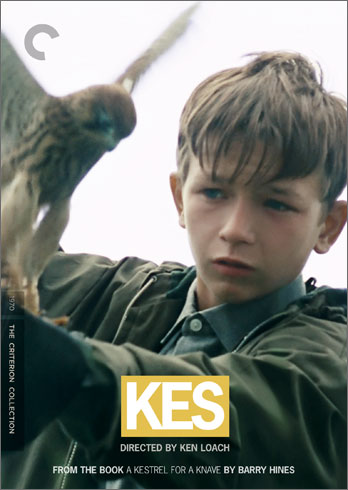
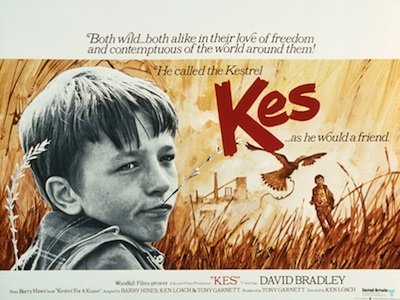
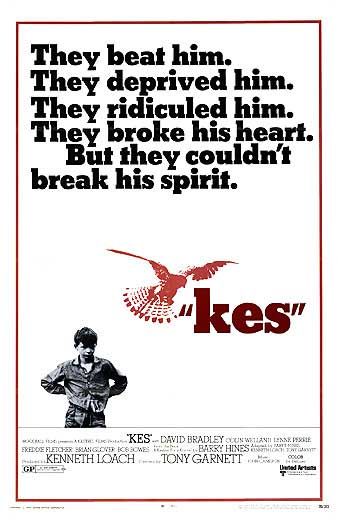
KES (Blu-Ray) - #561


Neorealist cinema first became a thing in post-War Italy, when socially conscious artists picked up movie cameras to make films that accurately reflected their experience. The goal was to shoot simply and with non-professional actors and to tell common stories that weren't necessarily conventional stories, at least not in terms of how fictional films were usually categorized. Ever since, "Neorealism" has been the go-to descriptive for any movie that attempts to mimic the rhythms of the everyday, to tell tales of regular people contending with their very real environments.

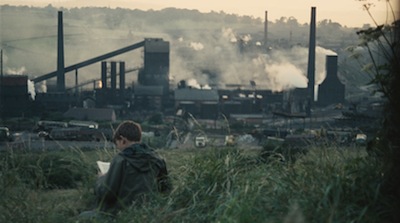
For as much as the tag can be applied with cavalier frequency, including by myself, I can't think of a film that deserves to sit alongside the original Italian masters more than Kes. The simple, yet affecting, second film by English writer/director Ken Loach is affectless in its careful portrayal of one working-class boy's struggles to find a small sliver of happiness and belonging in a gray, overcast existence. Released in 1970, and adapted from a book by Barry Hines (who also contributed to the screenplay), Kes sheds the spotlight on Billy (David Bradley), a fifteen-year-old struggling to make his way in the world.

Billy lives with his mother (Lynne Perrie) and an older brother named Jud (Freddie Fletcher). His father has long since taken off, and so Billy is left to fend for himself. Mother has many boyfriends and likes to go out to the pub; Jud works in the mines and gambles on horses and is generally a prick. (His name out loud sounds like "Jude," and we are likely supposed to think of Judas the betrayer.) Billy doesn't really fit in at school, though it's hard to tell how much he removes himself purposely. His sadistic soccer coach, for instance, doesn't believe that Billy can't afford gym clothes; he thinks the boy plays the poverty card in order to get out of participating. (The game that follows is embarrassing, with the preening teacher living out some delusional glory by besting his juniors; the locker room shower scene that follows that is uncomfortable and sad.) Likewise, the news agent that Billy delivers papers for is right to treat the boy as a thief. Even if he doesn't steal from the store, he is out there nicking things when it's convenient.


One of the items Billy steals is a book on falconry. He does so after he finds a kestrel nest on a neighboring farm. He reads up on how to take care of and train a bird, and then he catches one of the hatchlings. Over the coming weeks, Billy sticks to the new task like he's never stuck to anything, training the kestrel--whom he has nicknamed Kes--to trust him and return to his arm even when allowed to fly free. Pretty soon, Billy is able to confidently speak on the subject of falconry, catching the attention of his teacher (Colin Welland), who is impressed with the boy's initiative. As a viewer, I kept yearning for the teacher to say something to Billy about getting a job working with animals. Billy is about to leave school and join the workforce. There is even an awkward interview with a guidance counselor (Bernard Atha) where Billy never once mentions Kes. In our minds, this is his way out of Northern England and the poverty that is all around him; I suppose for Billy, though, it's his private happiness, and its specialness must be guarded as closely as the bird itself. The boy respects that which can't be tamed.

David Bradley makes an impressive debut as Billy. From a talent standpoint, Loach finding him is no less auspicious than Francois Truffaut drafting Jean-Pierre Léaud for The 400 Blows. Bradley gives a performance that is completely free of self-consciousness or clichéd actorly mannerisms. He is completely comfortable onscreen, and even when charged with doing nothing, there is an inner life evident in the boy's eyes. To misjudge and assume that there is nothing more there than immediately evident is to be no better than the people all around Billy who think he will never amount to anything. Sure, they may be proven right, they may get him to actually believe it, but let's cross our fingers that the cruel ending of Kes is enough to stoke the fires within the teen, to give him the push he needs to get out of this dead end.


Ken Loach films Kes from an observational standpoint. The camera is not intrusive, he mainly hangs back and stays out of the way. If the action gets confusing, he lets it stay that way. In life, fights don't get edited so we can see the blows being traded. This allows for a more sympathetic picture to emerge from the everyday chaos. The director even gives time to the other members of Billy's family, including a telling night out on the town. While Billy stays home and studies his new hobby, his mother and brother engage in a bizarre ritual, competing for attention amongst the other drinkers. It borders on flirtation, really. As the older woman insists she can't trust a man again, Jud's interruptions make you wonder if he'd rather be the only object of her affection. This makes sense when we see how he resents her for doting on Billy.

Kes is, at times, rather bleak, and it definitely doesn't flinch from the harsh realities of Billy's childhood. I have to wonder if this is why we don't regularly see Kes associated with other coming-of-age films aimed at younger viewers. I could see this as a double-feature with White Mane [review], for instance. Stories about young boys and their special animals were a favorite of mine growing up, and I certainly would have enjoyed Kes. Most kids have a pretty solid grasp on mortality, and the heavier themes here shouldn't be that hard for early adolescents and even older elementary-aged children to process. Maybe now that it's out on DVD and Blu-Ray, it will have the opportunity to be discovered by a whole new generation. I certainly hope so. If nothing else, it's a new discovery for me!


The Kes - Criterion Collection Blu-Ray comes with many bonus features, though the most fascinating to Loach fans may be the 1966 television feature Cathy Come Home, an early endeavor of the director's (running time: 77 minutes). Cathy Come Home tells the story of the downward slide of a young couple, from courtship to marriage to the troubles of starting a family. When the husband gets injured and several kids come along, finances grow thin. Homelessness and squatting are options, as are joining trailer park-type "caravans" and eventual government dormitories. Loach tells the story in a scattershot format, showing segments of time in quick, short scenes, moving forward quickly to show how fast things can get out of control. The grainy black-and-white and location shooting, and the pseudo-documentary style, complete with interviews from voices of authority, add to the political thrust of the film. Myths of the housing problem are busted, and tough topics challenged. It's maybe a little long, but such was the nature of the problem, it was a long tumble to the bottom that tore families apart and stacked the obstacles against those struggling. It also seems a little heavy handed today. Still, despite its faults and the fact that it's dated, Cathy Come Home is a fascinating, raw experiment all the same.


For a complete rundown on the special features, read the full review at DVDTalk.