Showing posts with label music. Show all posts

Saturday, April 9, 2022

THE LAST WALTZ - #1118


I used to have a Thanksgiving ritual involving The Last Waltz. I am not unique in this. If you google “Thanksgiving movie,” Martin Scorsese's 1978 documentary is pretty much the first thing to pop up. And I didn't even invent my ritual, I stepped into it.


Years ago when I still lived in Portland, OR, I would spend most holidays on my own. It started when I was originally a comic book editor and was essentially looking for any time where I might have peace. Holidays proved a good option. Everyone's attention was focused elsewhere, and so I could be by myself, uninterrupted. This meant dodging invitations and making excuses to family, but it was worth it if it meant I could stay home and get drunk with my cat and marathon movies all day. It wasn't me being antisocial so much as being pro-Me. Ron Swanson would understand. 


When I had moved into the upper Northwest in the early '00s, it put me within blocks of a place called The Stepping Stone Café. They were open for the holiday breakfast shift, and I would take myself down there and grab a seat at the counter, order a fat stack of pancakes they called “Mancakes”--no joke, the triple stack was over six-inches thick and the size of the whole plate--and just gorge myself. Most of the time my actual holiday meal later would be something like a turkey sandwich with cranberry, or whatever diminutive version of a Thanksgiving spread I could find in the store that was easy to prepare, so I could eat as much as I wanted for breakfast, I didn't have to keep room. Not to mention this would be the base I would pour whiskey on for the next 10-12 hours.


Those Thanksgiving mornings, the Stepping Stone would play The Last Waltz. Now, if you haven't seen it--or even if you had and your memory is just poor because you got totally blotto after doing so--you might be wondering how a documentary showcasing the final concert of 1970s roots rockers The Band is a Thanksgiving film. The answer is simple: they recorded the show on Thanksgiving. And guitarist/singer Robbie Robertson at one point thanks the audience for spending the day with them. Pretty straightforward.


You could tell the staff at the Stepping Stone knew the movie by heart, and they each had their moment where you could see them paying attention. Like if it were me I'd perk up when Neil Diamond came on, and I'd take a bathroom break when it was Van Morrison, who looks and sounds like a troll, let's be honest. (It's okay to hate him now, right? His caustic old age has vindicated me, yeah?) Whatever chunk I'd see was the chunk I'd see, it was not planned, it was reliant on when they hit play versus when I arrived. That was my exposure to The Last Waltz. Playing the soundtrack in the background as I type, I can actually smell the maple syrup.


For those not really in the know, stumbling on this review wondering if this Criterion disc is worth picking up or if you should rent/stream the film somewhere, The Last Waltz is a combination concert film and denouement. Scorsese interlaces interviews with members of the group with performance footage. The songs we hear are not just from The Band, but their collaborations with famous guests like the aforementioned Diamond and Morrison, Neil Young, Joni Mitchell, Ringo Starr, Emmylou Harris, Bob Dylan, and many more. It's a celebration not just of this particular combo, but of a certain era of rock-and-roll. Scorsese's cut is joyful and funny, and slyly introspective, cherry-picking moments that reveal what the music has meant and what is passing.


Of course, having established themselves as the backing section when Dylan went electric, whatever these guys did would get attention, particularly from the peers who agreed to pop up for this farewell. Not to mention the clutch of solid records and handful of genuine hits--“Up On Cripple Creek,” “The Weight,” “Ophelia,” etc.--that followed, legitimizing them as a songwriting force in their own right. This set is all killer and no filler.


That said, I, for one, agree with drummer/singer Levon Helm that there is too much Robertson. But I also got a shitty email once from Robbie Robertson so maybe I am biased. I was trying to get him to write an introduction for a comic book I was editing called Skinwalker that I felt he'd have an affinity for. He declined via his assistant, whom he instructed to mansplain what a skinwalker was. Which clearly showed he hadn't even looked at the comic. Call me Team Levon.


Come on, though, let's be fair, when you think of The Band, the first voice you hear in your head is Levon Helm. His verse on “The Weight”? Top of the heap!


And then the next voice you'll hear is that of bassist Rick Danko. So Robbie Robertston isn't even top 2.


Team Levon.


Funny thing, I am not entirely sure I had ever watched the full run of The Last Waltz in one go before this Criterion edition. I may have only just seen pieces at The Stepping Stone, despite owning a previous release as part of a Scorsese boxed set. The Band isn't really the sort of thing I listen to on the regular; I've never owned their music as a piece of physical media beyond that DVD and now this Blu-Ray. But I saw random 45 minute hunks of it so many Thanksgivings in a row, it feels like it's in my bloodstream, and I love it regardless of my personal fandom otherwise. Granted, the picture and sound here are both so sweet, it does feel like the first time regardless. Technology has a weird way of making the familiar seem revelatory.


2014 was the last year I was in Portland, though I did visit the city for the Thanksgiving weekend a couple of years back and made my way from my hotel to that old cafe to get my Mancakes and my dose of Levon, Rick, Garth, and the rest (including Robbie). Even if I am a guy not often prone to nostalgia, it still felt pretty good. No idea if they were playing the same copy of The Last Waltz that I had seen so many years prior or if they will now upgrade to a Criterion disc, maybe even 4K who knows--it doesn't really matter. The first time or the fifth time or the time that feels like a second first, it's all of a piece, it's ingrained now, the maple syrup always tastes good. 


This disc provided by the Criterion Collection for purposes of review.


Friday, January 14, 2022

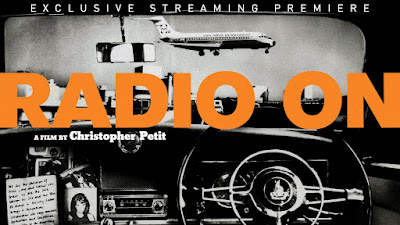
RADIO ON - CRITERION CHANNEL

This review originally written for DVDTalk.com in 2007.


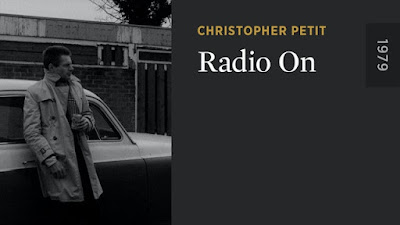
Christopher Petit's 1979 independent feature, Radio On, is a brittle portrait of the despair and ennui of 1970s Britain. Rather than indulge in chronicling any particular scene from the time or resort to the usual ripped-from-the-headlines tactics, Petit instead chooses to follow one man over the course of a few days as a portrayal of the feelings of hopelessness many were experiencing. With bleak black-and-white cinematography by Martin Schäfer, who regularly worked with Wim Wenders (one of the producers on the film), Radio On offers a Britain that is perpetually gray. Come, Armageddon, come.


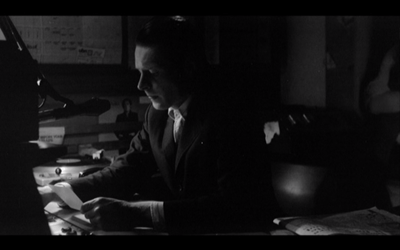
Robert (David Beames) is an all-night DJ in a factory who spends his own boring nights trying to alleviate the tedium of workers on the graveyard shift. He sets aside their banal requests and plays his own choices in hopes of giving them "something better." When his brother mysteriously dies, Robert goes on a road trip to Bristol in search of answers about what happened. Only those aren't the answers he really wants. The questions that loom over him are more existential. Though he never says so out loud, Robert is really searching for some kind of meaning in his dull existence.


Along the way, he meets other people who have been set adrift. There is the Scottish soldier (Andrew Byatt) whose pain at losing his friend on a tour of duty in Ireland has left him emotionally crippled and defensive. Then there is the pair of German women, one who hates all men and the other who is trying to find her ex-husband and reclaim custody of their daughter. Like Robert, these people feel that something has been taken from them, that their life is absurd and pointless. As the grieving mother explains, she feels homesick in England, stranded in a world where no one speaks the language she was born into. For her it may be a literal language barrier, but she might as well be speaking metaphorically. Robert borrows her phrase book and tries out different sayings in both English and German, and she kindly corrects his pronunciation. It doesn't matter that they are saying the same things, the sound of it will never match up.


If there is anything that provides comfort in Radio On, it's music. The DVD box quite loudly trumpets the soundtrack, listing the bands and the songs featured. The tracks are so important, Petit even lists them in the opening credits, rather than sticking them at the end like we're used to. The chosen cuts fit perfectly, the disaffected tones of the music emerging from the ashes of punk echoing the disaffection of Petit's script. Featured here are David Bowie, Kraftwerk, Robert Fripp, Ian Dury, Lene Lovich, Devo, and more. Regardless of what Robert is doing, he always returns to the music, turning on the radio in the car or playing a jukebox in a diner. It comforts him, acts as a friend when he has no one else to share the moment with.


At the same time, music also provides a bridge between people. The last message Robert received from his brother was a birthday present of an envelope full of Kraftwerk tapes. On the road, when he meets Just Like Eddie (Sting) at a gas station, they find common ground by singing Eddie Cochran songs, whereas when the soldier rejects what Robert puts on the stereo, you know their relationship will quickly end.


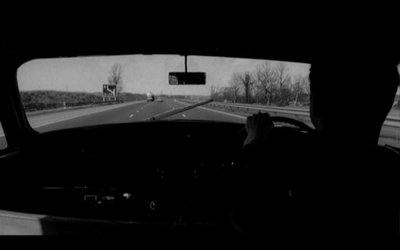
Petit builds Radio On out of lengthy, languorous shots, letting the landscape pass without comment, the periods of time where there is no dialogue stretching as far as the patches of road traversed. Schäfer keeps his camera at a distance rather than going in for the traditional close-ups, favoring two-person shots over cutting back and forth in the rare conversations. The viewer is kept far enough away as to feel that he or she is on the outside looking in, not unlike how Robert feels. We're the foreigners in his existence. Robert may not be engaged in what is happening, but there is turmoil, poverty, and moral decay all around him. The same radio that provides him with music also delivers the news of society's ills. These problems don't touch him, but they contribute to the dread that permeates the air.


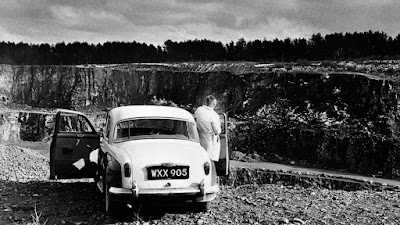
By the end of Radio On, Robert has driven as far as he can go--quite literally. Parked on the edge of a deep hole, his car dies. Rather than fight against it, he opens his car doors and cranks up the Kraftwerk, the last gift from his brother and the DJ's last gift to the world he knew. He walks away from the site and starts walking back toward civilization. What he will find there is the Rorschach test Petit gives to his audience. What do you see in the ill-defined shapes of Robert's future? Has he rediscovered hope, or does the final shot of a train departing mean it's too late, any chance for humanity has already left the station?


Sunday, August 15, 2021

ORIGINAL CAST ALBUM: "COMPANY" - #1090


In these days of heightened media awareness and manufactured access, it would be easy to lose Original Cast Album: “Company” in the mix. Or even be cynical about it. The idea of a documentary crew being in a recording session for the official soundtrack of a Broadway musical, or frankly any recording session, is not at all revolutionary. It’s the stuff that many a DVD extra is made of. One doesn’t have to reach back too long to remember a time in the ’00s when a bonus DVD packaged with a new CD showing the “making of” was a bit of a thing. Even if both CDs and DVDs sound like antique objects anymore.


We are so used to Electronic Press Kits and staged peeks behind the curtain, we are immune to them; they are forced publicity efforts, with any potential tension approved by the studio providing just enough seasoning to make it interesting before everyone agrees they had the best time ever. There is no such denouement for D.A. Pennebaker’s scintillating 1970 documentary Original Cast Album: “Company.” No apologies or resolution, just relief and accomplishment. 


Originally planned as a pilot episode for a series, and clocking in at a scant 53 minutes, Original Cast Album: “Company” is bursting with drama and effort and all the anxiety and triumph both things engender. Taking place mostly in two rooms and almost entirely over one night, Pennebaker--best known for profiling Bob Dylan in Don’t Look Back [review]--sets up in the studio where, as the title suggests, the Broadway cast of Stephen Sondheim’s Company are laying down the musical’s tracks for posterity. The cast features personalities known (Disney stalwart Dean Jones, legendary performer Elaine Stritch) and unknown (not sure who that is on timpani, but they get an anonymous shout out). As take after take winds on, energies wind down, people become exhausted and the mood becomes fraught. But everyone carries on.


Which is really what is fascinating about Original Cast Album: “Company.” This thing they are doing is a job as much as it is an art. People clock in and perform a task, and despite the egos involved, appear for the most part to be willing to do it together, a cast of craftsmen endeavoring for a common goal. It’s a helluva thing. The other night I saw the L.A. Philharmonic perform with H.E.R., a show in which the orchestra also served as an opening act. There were some folks in the audience who apparently thought the classical music was there to provide accompaniment to their conversation, and all I could think was, “Don’t you see? There is a stage full of people down there using specific man-made objects to create one sound. Isn’t that awesome?” It’s hard not to look at this, especially in the group numbers when everyone is adding their part to the big sound, and think the same.


Much is made of Sondheim’s perfectionist muttering, but really, you can see a desire to get it right in just about everyone else. They are striving, judging, worrying--everyone wants the same perfection. Most famous, of course, is Stritch pushing herself to the limit to put Company’s showstopper, “Ladies Who Lunch,” on tape. The mind boggles as to why the producers saved that until the end of the session, when the actress is spent. It’s painful to watch Stritch wrestle with her own demons, and the mounting tension when she’s just not getting it.


Modern documentarians, eager to promote the product, would put a narrative on this. They’d cut away to commentators and one-on-one interviews, but outside of one short confessional by Sondheim, Pennabaker keeps Original Cast Album: “Company” in the action. We will hear the song more than once because it took more than once to get the best take. That’s the whole point of being there. This is why Original Cast Album: “Company” has stayed in the collective unconsciousness, and why the comedy series "Documentary Now!" took the film on for their episode “Original Cast Album: Co-Op.” Penned by John Mulaney, Fred Armisen, and Seth Meyers, the program has been included on this release. Watching it again, seeing the parody back-to-back with its inspiration, I actually had the same appreciation for the cast and crew behind the homage. It, too, must have required a lot of hard work and a group passion to make the imitation so exact and the comedy so sharp. 


So here it is, to be discovered anew. Original Cast Album: “Company” has been lovingly restored and spruced up with deep-diving supplements. It's a snapshot of a moment in time for these particular artists, but also for Broadway and the recording industry, for a way of doing things that doesn't necessarily happen anymore and a way of seeing how those things are done that rarely aligns with the spotlight.


This disc provided by the Criterion Collection for purposes of review.

Sunday, May 9, 2021

TRANCES - #689


I watch a lot of concert films and music documentaries and found over the years, it doesn’t matter the band or genre, if the story is compelling and the filmmaking quality, I can get into it. 


This hypothesis holds true with the 1981 film Trances, a record of the Moroccan band Nass El Ghiwane from director Ahmed El Maanouni. Nass El Ghiwane is a quartet that draws on a variety of influences, including Western instrumentation, but with their roots in local trance music. Their songs have more drone than melody, and their poetic lyrics and updated arrangements of classic Moroccan songs draw on homegrown legends and history, with a focus on the political and the spiritual. 


That’s a pretty wild bouillabaisse on paper, for sure, but it’s not so hard to grasp once you see and hear the band work--which is right from the jump. Trances does what the best music documentaries do and puts the band out front. At least half of Maanouni’s edit is performance, giving the unfamiliar a true sense of what Nass El Ghiwane are like while also showing how they affect audiences. True fans are also likely to be pleased, as the camera captures the group at their peak.


While the music itself is plenty easy to understand, Maanouni expands his lens to capture the conditions of their home country and also a bit of their day to day. Nass El Ghiwane have many of the same concerns as any subject of a VH-1 “Behind the Music,” including creative vision, audience reception, and money. They also have familiar personnel dynamics, particularly between two of its founding members, Larbi Batma and Omar Sayed. The former is earnest, passionate, and caught up in creative impulses, and the latter is always there to poke a sardonic hole in whatever he is saying. More than one scene shows Larbi storming off after Omar refuses to take him seriously, followed by Omar laughing and telling his bandmates a story that illustrates why he is giving Larbi a hard time. It’s like watching Jason Lee drive Billy Crudup off his rocker in Almost Famous.


At the same time, Larbi’s seriousness is given its due. Nass El Ghiwane’s lyrics cover themes of oppression and struggle, while the transcendent nature of the music gives the audience a form of release. In Western terms, it allows them to rock out, though in the actual context of the music, the trance the songs inspire are more akin to the kind of letting go one gets from electronic dance music or gospel. 


Regardless of how you interpret it, though, the experience will be familiar to anyone who has gone to a concert and just let go. Again, that is the beauty of Trances, it tells a relatable story via a universal language. 


This movie is also available as part of the first set from Martin Scorsese's World Cinema Project.

Note: This disc provided by the Criterion Collection for purposes of review.

Sunday, February 2, 2020

PARIS BLUES - CRITERION CHANNEL

This review was originally written for DVDTalk.com in 2014.


Martin Ritt's 1961 jazz-infused drama Paris Blues is one of those films that, once you've seen it, you're kind of shocked that people don't talk about it more. A joint vehicle for Sidney Poitier and Paul Newman, Paris Blues is a Kazan-like social narrative that juxtaposes new Hollywood method with old Hollywood romanticism and somehow let's both win without compromising either.

Newman stars as Ram Bowen, a trumpet player with a moody demeanor worthy of his groaning pun of a name (say it out loud and then say, "Rimbaud"). He is the toast of Paris' side-street jazz scene, blowing nightly with his band, working alongside his cohort and musical arranger, Eddie Cook (Poitier). Eddie is practical and level-headed, a smooth balance to Ram's jagged edges. The ex-pat Americans have a good thing going in France. Ram even has a no-strings love affair with a chanteuse (Barbara Laage) who doesn't mind feeding him after gigs.


Yet, the boys have ambition, too. Ram is working on a magnum opus, his "Paris Blues," and he hopes to get some weight behind it by giving the sheet music to Wild Man Moore, a trumpeting legend who has just landed in the city as part of a European tour. Moore is played by none other than Louis Armstrong, just to give you an idea of Paris Blues' musical bonafides. The original scorce was also composed by Duke Ellington, who was nominated for an Oscar. Ritt isn't fooling around.

Yet, he's also not limiting his story--which was written by four different scribes from a novel by Harold Flender--to just difficult men in smoky bars. When Ram goes to the train station to meet Moore, he also meets a pair of young American women in town to see the sights. One white (Lillian, played by Joanne Woodward) and one black (Connie, as portrayed by Diahann Carroll). To give you an idea of how progressive Paris Blues was for the time, despite the eventual romantic pairing being just as you suspect, Ram at first flirts with Connie without race even being mentioned. (And who wouldn't. Have you ever seen Diahann Carroll?!) Lillian is more his match, however, in that she's been around the block and has an admirable patience. The single mother has dealt with her fair share of troublemakers, Ram's temperament suits her. It's going to take some effort to get him to value anyone over his music, though.


Which he sort of will come to do over the time he and Lillian spend together in Paris. For the next several days, both pairs of lovers will try to fashion their affections into some kind of common ground. Lillian sees the possibility of something more with Ram. Connie would love for Eddie to come back to the States, but he's frank about his reasons for living overseas: America is racist. She argues it's gotten better in the five years since he left; he counters that it's still not good enough.

Paris Blues is very frank about its politics, but not in a way that makes it seem like a polemic just for the sake of it. The topics broached in the narrative emerge naturally. These are things the characters would care about, they deal with life as it would genuinely affect them. For as traditionally structured as much of the writing is, Paris Blues treats all aspects of these folks' existence in the same realistic manner. It's never said, but we know that Ram and Lillian are having sex. Ram's guitar player (French cinema legend Serge Reggiani, Casque d'Or) is also a drug addict, a fact Ram confronts head on (as befitting a ram, natch). Race, sex, drugs, art--this is important stuff. Ritt manages to make all these things come off as both matter of fact and yet also important. Hell, look closely at the opening montage, you'll see a gay couple tucked away in Ram and Eddie's audience.


But forget all that. The sights! Paris Blues was actually shot on the Seine! And the music! Louis Armstrong struts into Ram's club to challenge him to the jazz equivalent of a rap battle. The only comparable jazz-scene movie of the period is Basil Dearden's All Night Long [review], released a year after Paris Blues. This flick is the real deal.

You also get an acting quartet that was at the height of their considerable powers. Apparently at one point this was going to be a movie for Marlon Brando and Marilyn Monroe. As wonderful as that is to imagine, you can't beat the chemistry of longtime paramours Newman and Woodward. They are the exception to the accepted rule that real lovers don't work on screen. Poitier and Carroll are wonderful, too--though much less showy. They are the practical couple, the counterpoint to the crazy Caucasians!

Final word: Paris Blues is a damn entertaining drama. It's romantic and toe-tapping and thought provoking. It deserves to sit next to Ritt and Newman's more famous collaborations, like Hud and The Long, Hot Summer. It's just that good.


Wednesday, January 1, 2020

UNTIL THE END OF THE WORLD - #1007


I couldn’t have picked a more fitting movie to watch at the close of 2019, nor could I have timed it better. It was an accident that U2 and the movie’s credits kicked in around 11:57 p.m. Had I not watched “The Song,” Uli M. Schueppel’s documentary on Nick Cave and the Bad Seeds’ contribution to the Until the End of the World soundtrack, before jumping from disc 1 to disc 2 or taken various other pauses, the timing would have been different. The song and the credits would not have concluded just as midnight ticked over to a new decade. Wim Wenders’ characters celebrate the move from 1999 to 2000; I move from 2019 to 2020.

And it’s not a real stretch to suggest we have as much existential angst now as Wenders imagined we would at the turn of the millennium. Released in 1991, Wenders took a gamble basing his artsy sci-fi road picture only eight years in the future. He was potentially building an expiration date into his own move. Yet, looking back, he accurately predicted the way technology would change and what would concern us, even if the look of his future was just a little more clunky than what turned out. Internet privacy, personal communicators, high definition, GPS, VR, digital preservatio, and digital escapism--all these things are at the fingertips and the forefront of the mind in Until the End of the World. To Wenders, technology was getting better, but also taking over in unforeseen ways.


It’s worth watching the director’s introduction to the movie to hear how long it took to get Until the End of the World onto the screen, how much longer it took to get to this version--final cut nearly twice the length as what initial audiences witnessed in theaters and on home video--and how the virtual world he shows then represented the cutting edge of technology. Amusingly, the filmmaker’s final product horrified the people who had loaned him their high-definition capabilities, as he used their inventions not to enhance and increase the clarity of images, but to tear them apart. But what better metaphor for technology’s propensity to overtake our humanity? It breaks everything down into pixels and data, abstracting the original, and the more removed it becomes from that initial experience, the more we seemingly want it.


Until the End of the World is a movie that has always fascinated me. I had listened to its now classic soundtrack album hundreds of times before I ever got to watch the movie itself. Elvis Costello, Nick Cave, Julee Cruise, R.E.M., Neneh Cherry, Depeche Mode--Wenders was in my zone. (Recently reissued on double-vinyl, I’m listening to it now, and the compilation still delights.) Eventually I caught the movie on VHS and was enthralled by its unwieldy, ambitious narrative. Even then, there were rumors of longer versions. The United States had a 158-minute version, but Europe got 20 minutes more, and Japan somehow got nearly an extra 100. Wenders’ original cut was anywhere between 12 hours and 20 depending on what you read, but his preferred version, as seen here, is 287 minutes--or nearly five hours. This longer version, or some semblance of it, has been promised on DVD since the early 2000s. Remember when Anchor Bay supposedly was going to release it? (Remember Anchor Bay?!)


That sounds like a lot of math, but it’s a classic cinema tragedy. From von Stroheim to Welles to Tati, there are persistent tales of directors whose mad visions were undercut by business concerns. These “lost” cuts become fabled, and it’s always a gamble of whether or not what was intended ends up being what was best. You could have Ridley Scott finally getting to finish Blade Runner properly or the rediscovery of Peter Bogdanovich’s At Long Last Love, or you could get Francis Ford Coppola’s endless tinkering of Apocalypse Now and Oliver Stone’s exhaustive mining of Alexander [review].

Wim Wenders is somewhere in the middle. Until the End of the World is not a masterpiece, but it’s an impressive look at a celluloid Icarus almost making it to the sun. It is at times almost too playful with tonality, while later maybe becoming too ponderous, too in love with its own ideas. Not everything works, and the narrative structure is perhaps more befitting a novel than a film. Criterion smartly splits Until the End of the World across two discs to go with what is a very natural intermission. Part 1 is the international chase and long-term courtship of Sam Farber (William Hurt, Broadcast News [review]) and Claire Tourneur (Solveig Dommartin, Wings of Desire [review]), a con man/scientist and a morally questionable party girl, respectively. It treks across Europe, Asia, and the U.S. before sending the characters toward their final destination, breaking for Part 2 just as they leave San Francisco for Australia.


Part 2 is more serious and heavy, trading the madcap physical chase in for a more intellectual pursuit. Sam has been on the run from the law. He is wanted for industrial espionage and the stolen technology he is carrying. When Claire finds him, he is traveling around the world recording messages from family members using special glasses that will record not just the video and audio, but the experience of seeing the event, the waves that connect the eye and the brain. The intent is to capture something that can be re-created in the brains of blind people, to let them “see” again. Sam’s father, Henry (Max Von Sydow, The Seventh Seal [review]), started the experiment, and had to go into hiding rather than let government or corporate interests take over. He’s built a lab in the Australian outback, and his number-one test subject is to be his wife and Sam’s mother, Edith (Jeanne Moreau, The Lovers [review]).


The Australian half is all about trying to make the tech work and to understand the consequences and implications. It’s a struggle of fathers and sons, but also men and women, and ultimately played out against the backdrop of total annihilation. This whole time, an Indian nuclear satellite has been falling from the sky, and there is a full expectation that it will signal the end of the planet. In this pocket of waiting, a community forms; yet, as they wait, there is a bigger question of what will happen if the prediction is false.

That’s a pretty simplistic breakdown of Until the End of the World. As suggested above, it’s kind of all over the place. Wenders’ approach changes almost with every locale switch, as the cast expands and he touches on different genres. Is this a caper picture? Is it romance? Is it a literary character study? Science fiction? Family drama? Political?


Of course, Until the End of the World is all of the above. Some of it clicks, some is hokey. The acting can be all over the place. Dommartin is an alluring cipher, defined more by the vision of her presented in the authorial narration than anything she does on screen. Sam Neill (My Brilliant Career) plays a writer who, as her former lover, is writing a book about Claire and, ostensibly, this movie, and he spends much of the running time waxing poetic about Claire’s elusive sensuality. Wenders’ supporting cast is like a tour of the Criterion Collection--from Ozu-stalwart Chishu Ryu to David Gulpilil from Walkabout [review]--but dotted along the globe, embracing different legendary personages wherever his crew lands and integrating them into the outline. The effect, though, can often be of miscommunication, as some of the performances feel lost in translation. Rudiger Volger’s private detective or Chick Ortega’s French hoodlum never seem comfortable working in English and often go too broad and cartoony for the rest of the movie. Would that more of the actors just spoke their own language and subtitles did the rest.


Weirdly, this mish-mash serves William Hurt well. His character arc involves a lot of strange turns as he adapts his personality to fit the moment. As an actor, Hurt is perfectly suited for this. His quirky persona is appropriately malleable, but it’s ultimately that quirk that maintains a thread through every scenario. As an actor, William Hurt was already as weird as the movie was intended to be.

That Until the End of the World takes on so much with such audacity leads me to believe that its detractors will forgive it as much as they dismiss it. You have to appreciate that Wim Wenders went for it as boldly as he did, and as an independent production no less. It’s full of hubris, and thus folly. For those like me that take it on and accept it, however, Until the End of the World can be as addictive and dreamy as Max Von Sydow’s futuristic machine, leading us through the dread of a changing world toward the hope of a better tomorrow. It’s colorful and crazy and deeply satisfying, and pretty much unlike anything else out there. And for that, to borrow from its own poetry: I will love it until the end of the world.


Saturday, November 2, 2019

WHEN WE WERE KINGS - #998


In Zaire, ca. 1974, two fighters arrived from America to participate in Rumble in the Jungle. Former champion Muhammad Ali was looking to take back the title belt by besting then-champion George Foreman. It was a huge event, bringing a worldwide spotlight on Africa that had never really been seen before.

Filmmaker Leon Gast went along for the ride, filming the lead-up to the fight, the celebrations and the preparations, capturing the whole of the experience, not just the main event. More than twenty years later he cut the material together as a documentary feature. When We Were Kings is a historical record. Time and distance has given perspective--as evinced by the contemporary commentators on hand, including Norman Mailer, George Plimpton, and Spike Lee--and in some ways, the story plays out better minus the suspense of who will win. This was a significant moment in time, with both fighters representing something in the cultural landscape.


Here, Ali is seen as the underdog, but also the people’s champion. For Africans, he is a symbol of self-determination and victory. He is friendly and embracing. On the opposite end of the spectrum, Foreman is seen as unapproachable and single-minded. He is the gruff commercialist, even though Ali is all that much better at selling himself. Ali is a folk hero, and the Rumble almost takes on the mythic quality of the individualist toppling the system. It certainly is a David and Goliath moment.


Though, not all is perfect in Africa, and When We Were Kings does not shy away from it. At the time, President Mobutu Sese Seko ruled the country with a false air of democracy. His dictatorial nature and the gulf between leader and followers, rich and poor, hangs over everything. In some way, this all has to please him, too. This makes Ali’s activism all the more inspiring to the people of Zaire. Here is a man who has punched at authority and won.


And to be fair, Foreman probably deserves a little more credit for getting to where he was. When We Were Kings has a definite bias in favor of Ali. Foreman might have fared better under a more sympathetic lens, but it’s not just Gast who is looking at these two men, it’s everyone around them. As the fight is delayed by six weeks due to Foreman suffering an injury during a practice bout, the whole thing turns into a pressure cooker. The winner, we will see, is the man who can handle that stress better. It’s interesting to consider the light-hearted figure George Foreman would later become.

Gast keeps the commentary to a minimum, favoring the necessary over the flowery. Mailer’s explanations of fight technique and his memory of the play-by-play is most essential if you’re not a pugilism aficionado. He and Plimpton were on the scene covering the match for their respective press venues. As a blowhard raconteur, Mailer is perfectly suited to making the large seem relatable.


This is the second Muhammad Ali documentary I watched this year. The other was HBO’s two-part What’s My Name, a career-spanning examination of the man’s journey from Cassius Clay to champion to activist and the cycle of victory and defeat that came to define his later career. The Zaire period was touched on in that film, but When We Were Kings goes much deeper. It makes me wish there were more docs of its kind to fill out the history that What’s My Name establishes--like supplemental footnotes, “for more go here.” Between the two movies, I’ve found an even greater respect for a great man. When We Were Kings is not just about the spectacle of a sports event, but about the business and societal needs that inform it. It’s about an artist trying to maintain his integrity when all around him would exploit him. It’s about the struggle of people of color to find their own way when the greater machine would rather grind them down.


It’s also about a celebration. Ali’s triumph wasn’t entirely his own, but also a triumph for his supporters, admirers, and peers. Hence folks like James Brown, Bill Withers, and BB King heading to Africa to perform at a three-day music festival presented in conjunction with the Rumble. This was documented, as well, and while touched upon in When We Were Kings, Criterion fans are a treated to a second full-length documentary on their discs: the 2008 concert film Soul Power.

Directed by Jeffrey Kusama-Hinte, Soul Power chronicles the efforts to put the show on, while also highlighting the best performances. The bill is a combo of the visiting American acts and the best that Zaire has to offer. For the artists involved, it’s a kind of musical exchange. As Withers notes, the Americans can present how they’ve evolved the African sound their mutual ancestors brought across the ocean, while also witnessing how those sounds continued to evolve on their own in the homeland.

Interestingly, the concert faced some of the same challenges as the boxing match--Mubutu was against it, Foreman’s injury threw off the timing--but is more celebratory by nature. This is the party before the war. You might even consider watching it first, as your own lead into the main event.


This disc provided by the Criterion Collection for purposes of review.
Sunday, December 16, 2018

TRUE STORIES - #951


Somewhere on the road between the early ’80s debut of MTV and the post sex, lies, and videotape Sundance revolution of early ’90s cinema, there is a pit stop: David Byrne’s  True Stories. More than just a vehicle for the Talking Heads’ next album--though there are some clips that were repurposed into genuine music videos--but not as fully realized a narrative as other artists’ self-mythologizing star turns (Prince’s Purple Rain or A Hard Day’s Night [review] and Spice World), True Stories is a genuine oddity. All these years later, revived by the Criterion Collection, released to a new audience, it comes off as a curio from another time, strangely innocent and yet indicative of the decade’s sometimes arch and ironic approach to commercial art.


The story goes that David Byrne was inspired by tabloid headlines, and he wanted to both explore the Americana that often fueled these bizarre tales but also celebrate the Americans that devoured them. True Stories is set in the fictional hamlet of Virgil, deep in the heart of Texas, and with Byrne serving as an observant on-camera narrator, the movie tracks the town’s populace over several days leading up to a celebratory parade and talent show. “Altman-esque” could easily be applied to True Stories; with its large criss-crossing cast and focus on at least one character’s attempt to write a song, it could be viewed as a kind of mini Nashville. I’d wager Byrne took more from his buddies Jonathan Demme and Jim Jarmusch, however; True Stories has the same quirkiness the latter would apply to his movies Mystery Train [review] and Coffee & Cigarettes.


Sadly, I fear I am spending more time talking about what the movie is like because that is really more interesting than what it is. There isn’t a lot to hang your hat on here, even with all the intersecting stories and the collection of wonderful character actors. Spalding Gray shows up as a tech baron who is disconnected from his family and neighbors; Swoosie Kurtz is a rich woman who never leaves her bed; and Jo Harvey Allen (The Homesman) regularly gets some chuckles as the living embodiment of a tabloid, a compulsive liar who connects herself to Elvis Presley, JFK, and just about anything else she can think of. (One of Byrne’s co-writers, Stephen Toblowsky, is also a well-known character actor, having appeared in Spaceballs, Groundhog Day, and countless others.) True Stories checks in on factory workers, bar patrons, and even the children of Virgil, and while one might be worried that an arty New Yorker like Byrne would not be able to resist making fun of Middle America, nothing could be further from the truth. His vision of Texas can certainly be unique to him--the music, the fashion, etc.--but he appears to have genuine affection for the small-town values that keep this community a community. He even dresses in western wear to (awkwardly) fit in.


That said, it’s clear that Byrne wants to make fun of something, but the satire is so scattered, it’s hard to tell what that is. Targets include advertising, religion, dating, popular music--all things that didn’t require the Texas setting to get skewered. Or is it that the individual dreams of the Virgil citizenry will carry on despite the invasion of outside ideas? Given that the climactic song is all about how love is more important than material goods or even freedom, such a theory would not be a stretch. It’s even called “People Like Us,” an inclusive statement, and sung in the movie by John Goodman, the saving grace of True Stories.


Only a few years into his career at the age of 34, True Stories was a pretty substantial role for Goodman. The Big Easy and Raising Arizona would soon follow, and John Goodman would become the John Goodman we all know and love, but the part of Louis Fyne shows the performer as an almost naïve neophyte. Louis works at the microchip manufacturer just like everyone else, and at night he turns his attention to finding love. Goodman plays him as both self-assured and meek, one trait masking the other, and there is a sweetness to the performance that makes it impossible to not want Louis to find what he’s looking for (or maybe for the actor to appear in a revival of Marty). Though more fresh-faced than he’d even appear in his first collaboration with the Coens, all the classic Goodman traits are there: the smile that is both endearing and tricksterish, the expert comedic timing and physical precision, the natural line delivery. His presence on the screen is so amiable, it imbues the rest of True Stories with a similar likeability, meaning that even if David Byrne’s threads never weave into a single tapestry, it’s hard not to still feel good about having spent your time taking a tour through his made-up utopia of would-be normalcy.


Monday, November 26, 2018

PERFORMANCE - FILMSTRUCK

This review was originally written for DVDTalk.com in 2007.


Chas is a brutal enforcer who is really good at his job. Played with a bluntly arched eyebrow by James Fox (recently seen as Mr. Salt in Tim Burton's Charlie & the Chocolate Factory), he works for a homosexual East London crime boss named Harry Flowers (Johnny Shannon). Chas is the guy Harry sends round when he wants to convince other people to his way of thinking, because Chas has a knack for getting his point across. When the thug goes against Harry's instructions and deals with a business matter in a personal way, though, he finds there are some situations he can't talk or shoot his way out of.

On the run, Chas overhears a conversation about a basement apartment that he can con his way into leasing. Things aren't as clear-cut once he is inside the house, however. It turns out that the landlord is a faded pop star named Turner, here played by Mick Jagger. Turner is a recluse, creating a pansexual hideaway with his drugged-up girlfriend Pherber (Anita Pallenberg, the real-life girlfriend to Mick's guitarist, Keith Richards) and a few other androgynous moppets. Before long, it's not clear who is running a con on whom, as Chas is suddenly on the same psychedelic trip as everyone else in the house, searching for Turner's "demon," the artistic muse that once drove him.


Performance was made in 1968 and held back for two years while Warner Bros. tried to figure out what to do with it. Co-directed by two first-time directors, Nicolas Roeg (Walkabout [review], also the D.P.) and writer Donald Cammell (The Argument), Performance is a classic of the trippy midnight movie genre. I'm not normally a fan of Roeg's, I find his weirdness to be meandering and pointless for the most part, but something about the collaboration with Cammell gave their artistic vision a laser-like precision. Performance is really the clash of several genres. Chas' gangster society has tints of kitchen sink drama while also playing with the conventions of classic British crime pictures. Cammell saw a kindred spirit between the swaggering street toughs of old films and the new outlaws of rock 'n' roll. Performance grows from the thesis that if you pushed these cultural rebels toward one another, you'd suddenly have mirror images in the center.

This is something that the directors make great visual use of. For a drug-fuelled movie of the late '60s (Pallenberg openly disperses chunks of magic mushrooms, and there is no mistaking those funny shaped cigarettes), they avoid the usual pictorial cliché of other hallucinogenic flicks. There are no lava lamps or fish-eye lenses. The surreal journey of Performance is an existential one, it's all about identity. The first act sets up a dicey world. Focusing entirely on Chas' brutal routine and flight from the same, it's edited in a choppy fashion, juxtaposing attacker and victim, and messing with time. This is said to be the uncredited work of editor Frank Mazzola, who would go on to make this his signature style and influence the entire video music genre in the process. In this outing, it keeps the action moving while putting the audience on shaky ground. The blood and the sex and the violence come like a rapid assault we are powerless to stop.


Yet, as Turner's introduction approaches in the story, the filmmakers are already inserting him in the mix, giving us quick tastes of what is to come, already breaking down any separation between gangster and idol. This melding begins in earnest once Chas is in Turner's home. Mirror images, double exposures, and other visual tricks are employed to start to suggest that Chas is Turner and Turner is Chas. They even engage in a bit of dress-up, most notably in the "Memo from Turner" music sequence where Chas' earlier drama with Harry is replayed with Jagger in the lead, instructing his underworld minions through song. Here Jagger moves from slinking panther to something more forceful, just as the events leading up to it show James Fox losing his edge and drifting in a narcotic haze.

Where both men end up is the subject of much debate and probably a matter of personal preference, but suffice to say there are curves on the path to complete fusion. Chas needs Turner's house to protect him from those that would do him harm, whereas Turner needs Chas' visceral lifestyle to break him out of the constipated mental funk that has arrested his creative process. Roeg and Cammell may end the movie by showing a lot of doors being closed, but from a plot standpoint, they leave many open to interpretation. Some of you out there may find the trickery maddening, but if you put yourself in Chas' shoes and let Performance slip you a mickey, you might find the experience...well, I wouldn't go so far as to say transformative, but how about inspiring?