Showing posts with label david fincher. Show all posts

Monday, April 26, 2021

MEMORIES OF MURDER - #1073


Let’s consider the title Memories of Murder for a second. Though there is a coda set in 2003 that shows one of the detectives from the main story thinking about the nine unsolved homicides nearly two decades later, writer/director Bong Joon Ho does not frame his serial killer story as a reminiscence. So why call it that? It could just be the fact that Memories of Murder is a film based on true events, and the victims should not be forgotten. It could also be self-reflexive: if this movie is effective, it will have left an impression on an audience that may have otherwise never heard of these killings, and thus they are made to remember the tragedy. 

Not that Memories of Murder is a straight docudrama. Its closest analogue might be David Fincher’s Zodiac in how it transforms history into living cinema. The central case of the drama involves a series of murders in a rural South Korean town, a place that is ill-prepared for the level of violence and sadism they are to be subjected to. Over a short amount of time, multiple women are found dead, having been bound and assaulted. There are few suspects in the area, and they are drilled hard by Inspector Park (Song Kang Ho, Parasite) and Inspector Jo (Kim Roe Ha, Barking Dogs Never Bite). They are quick to judgment and once they have made up their minds about who, they’ll beat them into a confession. 


When their cruelty is exposed, a more experienced detective, Inspector Seo (Kim Sang Kyung) is sent in from Seoul to assist. He quickly takes point, preferring methods to madness. Yet, as the case drags on, it only presents more dead ends even as patterns of behavior emerge, and Seo gets more frustrated and more emotionally involved. Soon, the dynamic begins to shift. He becomes more reckless and violent while Park becomes more considered. The common goal remains, but how they pursue the mission diverges. 

It’s a pretty crafty move on Bong’s part. Genre convention is that these men will find some middle ground in pursuit of their quarry, but to so thoroughly upend their motivations adds a tantalizing element to Memories of Murder, particularly since both Song and Kim are such gifted actors, we can believe both halves of their personality as being equally viable. No man is one thing in Memories of Murder. Not even the killer. He may be unique in his predilections but in everything else, we are led to believe, he is simply ordinary. 

Thus, Bong shows us the effects of violence in the long-term. It can be sobering and life-altering, or it can be destructive, removing one’s sense of purpose as it dismantles one’s faith in the social contract. Just who could be capable of such horrific killings? Unlike your more common serial killer movie, Memories of Murder never really attempts to answer that question. There is a brief reference to the FBI having profilers who work out such details—and the FBI is ultimately turned to for DNA assistance—but there is also an intriguing line drawn between the two countries. America is so big, it needs a whole organization to keep track of all the bad being done; in South Korea, there is a sense that everyone knows everyone else. To accept a rationale for committing serial murder is to accept that maybe you don’t know your neighbor as well as you think you do. 


It’s a lot to think about, and yet Memories of Murder never feels as heavy as its subject. This is down to the characters. In particular, the two local cops are such quirky individuals, they transcend type. Inspector Park, for instance, is a blowhard who claims he can tell a crook just by locking eyes with him. This is, of course, ludicrous, and he never actually proves it, but it also speaks to a certain self-belief, a bravado that allows him to do his job even when duty weighs heavy. Perhaps it’s this that allows Park to let go while Seo digs in harder. 

There’s a humanity to them both, and to their plight, that allows the lack of resolution to be satisfying. Like the officers, we form our own opinions—this has to be the guy!—and wrestle with the contradictions. Instead of understanding the killer, we understand his pursuers. Theirs is the behavior Bong is slyly profiling, letting us into their way of thinking. 


Of course, famously, the real killer continued to elude police and was only discovered in 2019 due to new DNA breakthroughs. I say famously because this happened at the height of a newfound fame for Bong Joon Ho. The arrest corresponded with the international explosion that was Parasite. Suddenly, a movie many of us loved for sixteen years, but one that most of our friends had never heard of much less seen, was now a central focus. And joy, the Criterion Collection was going to release it in the U.S.! It’s a really keen edition, too, with a detailed film transfer that maintains the muted greens and heavy grays of the original presentation. 

And included on the extensive bonus disc to Memories of Murder is a short program where the director discusses the implications of the arrest on how the movie is viewed now, as well as expressing his own conclusions from during filming. Interesting to note that despite what I said above, he very much wanted to profile and understand the killer in order to understand his story. 


Also featured on disc two is Bong Joon Ho’s 1994 student film Incoherence. This is very much a formative effort, presenting three comic vignettes about middle-aged men of a certain repute behaving in prurient behavior. The middle bit is the only one that is genuinely funny, though I am both amazed that small cartons of milk were being delivered to people’s doorsteps and that anyone would choose that for refreshment whilst jogging. The punchline here is easy to predict: these men are all hypocrites who hide behind an intellectual form of morality, but even at its 30-minute running time, everything in Incoherence is too long—especially when it finally delivers on its point in the epilogue.


Note: This disc provided by the Criterion Collection for purposes of review.

Monday, February 18, 2019

LA VERITE - #960


1960’s La vérité is a cracking courtroom drama. Directed by Henri Georges-Clouzot (Diabolique [review]) and starring Brigitte Bardot (Contempt [review]), La vérité builds itself around the testimonies in the case of one Gilbert Tellier (Sami Frey, Band of Outsiders [review]), a music student and up-and-coming orchestra conductor, now deceased. The timeline bounces from the witness box to flashbacks of the real events and back again, creating two narratives: the trial activity and the interpersonal drama that led to the homicide. These dual tracks put the audience in the position of the ultra-jury, our macro view allowing us to judge all the participants and all sides in a way the film’s characters cannot.


Clouzot’s jam-packed courtroom is a living, breathing entity. There are prosecutors and defense attorneys, reporters and jurors, judges and witnesses. In Clouzot’s view, they are all equally important, and how the mass functions creates a miniature society within the larger whole, a shadow community that will make sense of what happens out in the world. The lawyers on both sides--prosecutor Eparvier (Paul Meurisse, Army of Shadows [review]) and defense attorney Guéri (Charles Vanel, the 1934 Les misérables [review])--have their roles and their relationships. The prosecution is stern, the defense disruptive and irreverent. We clock their machinations, and weigh the impact it has on others, including the victim’s mother.


But above all of them--quite literally, she is housed directly over her defense team--is the accused, Dominque Marceau, played with a remarkable emotional breadth by Bardot. Dominque is not contesting the fact that she killed Tellier, the only question is what drove her. Was this a premeditated slaying or a crime of passion? Though witnesses to their tumultuous, unhealthy love affair only really know what parts they were personally privy to, Clouzot’s camera is not bound by their words. The flashbacks form one linear narrative of a provincial girl who loses herself to the temptations of Paris, attracting the attention of many men, but only giving her full self to one. Yet, as the prosecution paints Dominique out to be a cruel hussy destroying a sensitive artist, we see how Tellier was jealous, possessive, and just as cruel himself.


In this day and age, there has been much debate over “victim shaming,” how women who have been victims of assault have their own lives put on trial, suggesting their own moral standards or life choices brought the attack on themselves. This tactic, as we see time and again, is wrong, excusing the criminal with facts that are irrelevant. It’s clear from La vérité that women have been subject to such double standards for a long time. Sure, Dominque is guilty, but is she less deserving of a defense because she is in touch with her sexuality? Her lawyer makes no bones about it: the answer is no. The compelling thing here, however, is that we also must reject the notion that Tellier deserved or asked to be killed. Life is not so clean-cut as that.


The fact that the woman in question is Brigitte Bardot makes it all the more interesting, since most audience members in 1960 came with their own preconceived notions of who she was. From the get-go, La vérité plays on her image as a sex symbol. With her hair up and wearing a black dress that essentially covers her from the neck on down, her first appearance in court still draws leers from the men in the gallery. Likewise, we are invited to gawk at her body in various scenes throughout La vérité. Is Clouzot merely seducing us alongside Tellier, or are we just as bad in demanding that the actress gives us a peek? After her sexy turn in And God Created Woman moviegoers expected to see more of Bardot than most other actresses, and I am sure studios were more than happy to oblige. One could even question if Clouzot is exposing her naked curves in service to the script...or the box office.


I’d like to think the former, because there is very little, if anything, in La vérité that the director has not considered through to the finest details, from the doodles on the defense lawyer’s legal pad to the posters on everyone’s bedroom walls to the layout of Tellier’s apartment building and how it allows Dominque to commit murder undetected (Panic Room-era David Fincher would nod in approval). As I mentioned, the courtroom is filled with spectators, and Clouzot regularly cuts to a wide shot just to remind us of what kind of circus Dominique is being subjected to. Yet, it’s those smaller details, the close-ups on observers and participants, that bring further life to the trial. There is never time to be bored, there is always something happening.


That also gives more evidence to Clouzot’s implication of the audience through decorative choices. As La vérité reaches its emotional crescendo, and Bardot is given an opportunity to tear into Monique’s breakdown, quieting the whole of the courtroom, I am sure that theatres showing La vérité in 1960 were also silent. The final outcome of the film, one could argue, is not the fault of the girl, but of a hypocritical society that fed on her shame and turned her pain into entertainment.

Fun Quiz: Which is more French, the ending of La vérité or the ending of yesterday’s review, Cold Water? Both rely on a note from a doomed young woman, but is one more romantically existential than the other?


This disc was provided by the Criterion Collection for purposes of review.

Saturday, March 12, 2016

SECONDS - #667


“I’ve been assigned to go over the circumstances of your death with you.”

So goes the sales pitch that kicks Seconds into high gear. After watching middle-aged, upper-middle-class businessman Arthur Hamilton (John Randolph) navigate mysterious instructions from long-lost friends, meat packers, and dry cleaners, we finally get to the heart of the matter, the thing that he is being lured toward. The program isn’t something you choose, they choose you, whether you’re looking for it or not. You ready to take that mid-life crisis of yours by the horns? Look no further. You can wake up tomorrow with a new face, a new vocation, and a new identity. The only price is...well, everything.


A predecessor to Fincher’s The Game [review], a close cousin to Orson Welles’ The Trial, John Frankenheimer’s 1966 paranoid freak-out is an enigmatic, intriguing hallucination. It hits the ground with both feet and runs like hell, never worrying too much to stop and explain itself, confident the audience will get on board, banking on our wanting to understand what it all means, putting us in our anti-hero’s shoes by never letting us know more than he does. It’s fascinating and weird and strangely prescient. It wouldn’t shock me at all to find out this was Charlie Kaufman’s favorite film as a child.

After plastic surgery and rehab, and a complete overhaul of his most telling physical features (new teeth, removed fingerprints, etc.), Arthur wakes up as Antiochus Wilson (Rock Hudson, Magnificent Obsession [review]), a painter with a beach house in California. It’s a fresh start where the husband and father is now a single swinging bachelor, primed to pursue his art, no matter how impractical; he just has to go along and get along. Which naturally, he can’t. The new Mr. Wilson can’t quite wrap his head around what happened to him, and he starts trying to scratch at the veneer.


“Rebirth is painful...Is it easier to go forward than go back?”

Released at the center of a cultural revolution, Seconds pursues a question of the times: can the past be assimilated into the future? (The present need not apply.) If Arthur Hamilton has bought into the dream of the establishment, living a life of quiet desperation in the suburbs, then he is part of the old guard, one ill prepared for changes to come. Yet, he’s also one with the means to buy his way out. As Wilson, he is set up with a new bohemian lifestyle, free of responsibility, disconnected from cultural change, even if in some ways he is embracing counter culture. The drunken bacchanal that baptizes him as a member of his new community is at once a throwback to the orgies of Rome and a reflection of the Free Love 1960s. Yet it’s false, the whole experience is, which is what Wilson can’t accept. His partying is a bit like Roger Sterling’s experiments with LSD on Mad Men: he has stepped beyond the point where he could maybe pull it off.


The conundrum here is in which direction Frankenheimer’s critique flows. Is his disdain for the squares or for the hippies? The fact that Seconds exists almost within a void, with little hint as to the time it was actually made, it could be viewed as relevant regardless of where you are standing on the continuum. Wilson could just as easily be any struggling white man trying to outrun obsolescence in 2016. The problem is that once Arthur/Wilson has woken up, as it were, he cannot go back to sleep. You can’t roll back history--even if many today try to pretend them can. To not accept change is to end up back in limbo. In this case, an office job within the program, only escapable by selling someone out to your same fate. To once again invoke Mad Men, Wilson is a little like Don Draper at the end of that series, becoming aware that he must relinquish material things, but in this case, too late to bend this enlightenment to his will or exploit it.


Hudson is perfect for the role of the man lost in the construct of himself, perhaps because he knows the pain of living a false identity all to well, having done it for so long in his real life. The restlessness and self-loathing of Wilson grappling with his fraudulent existence is agonizing. Something was lost in the endeavor to have everything. Hudson lends a heaviness to the performance, and when Wilson begins to self-medicate, the actor makes for a very convincing drunk. It’s one of the funniest scenes in a movie full of black humor, and one of the creepiest when the crowd all turn against him. That drunkenness gives way to a tangible despair, and the self-medication turns to literal medication when Wilson returns to the company. They give him pharmaceuticals to keep him pacified. It’s yet another turn that is all too current and relevant, 50 years later.


Seconds is nothing if not immediate. Even how it was shot was intended to make it seem as if it were happening at the exact moment each viewer witnesses it. Director of photography James Wong Howe (Sweet Smell of Success) uses a stark photographic style, one with a more realistic, unenhanced look we might expect from more contemporary pictures shot on video or digital. He favors extreme close-ups and even over-the-shoulder moves to put us in the thick of it. In the various party scenes, the camera practically gets buried in the revels. And when things get weird, reality warps under fish-eye lenses and tricky perspectives, pushing us away at one moment and pulling us in the next, like we are dangling on a spring. There is an intimacy to our participating in the unraveling that keeps us firmly in Wilson’s shoes. We are trapped in the same horror movie as he is, but with the added enhancement of gothic organ music.


“Just who the hell do you think you are?”

For Wilson, that is an unanswerable question in the end. He is either/or, neither/nor. He surrendered the identity he spent a lifetime building in exchange for an altogether different, artificial construct, and when he fails to maintain it, that is stripped from him, too. It’s a fairly chilling ouroboros: you have to assimilate in order to be different. It’s the illusion of freedom, and there’s nothing really to be done, the more you push against it, the more it dissipates. So it goes, same as it ever was. THE END.


Special thanks to Francis Rizzo III, from whose DVDTalk.com review of the movie I snagged the majority of the above images.

Sunday, March 31, 2013

THE GAME (Blu-Ray) - #627


"Does this thing end?"

Michael Douglas, playing investment banker Nicholas Van Orton, asks the question midway through a rigorous test to determine whether he is suitable to participate in the elaborate scenario that is the singular plot point of David Fincher's 1997 movie The Game. It's a question he will ask again as the film wears on, one of many echoes and repeats that occur throughout the motion picture.

More important than the question, however, is what is going on and how he asks it. Van Orton has been watching a series of filmed images with subliminal messages buried in them, a horrifying montage certainly meant to recall a similar B-roll shown to young Alex in Kubrick's A Clockwork Orange*. Fed up with the grotesquerie, the man stands and turns into the blinding light, bathed in the flickering images as they emanate from the projector, staring deep into the lens. It's as if he is asking the movie itself when it will stop.


Or letting it absorb him. Because, for whatever else it is, The Game is a tribute to the art of cinema. It is a romp through motion picture technique, bringing the visceral experience that movies attempt to re-create to its protagonist, establishing its own meta reality, a wheel within a reel. Nicholas Van Orton will soon find himself in his own version of North by Northwest, part of an unstoppable action scenario, though this time by way of the convoluted grifts in con men movies. The staging of each incident would be impossible in real life. Or so we tell ourselves. Isn't the biggest con of a movie like The Grifters or The Sting or The Brothers Bloom [review] that we end up accepting that these schemes work? It's the promise of all good movies: for the two hours we sit in the dark, we are made to believe.

Nicholas Van Orton is kind of your typical protagonist for this kind of story, the imaginary rich man bored with his routine and too disconnected to know it. Divorced, isolated, all work and no play. His brother Conrad (Sean Penn) is his predictable opposite, a "free spirit" whose life choices have had other consequences (drugs, legal trouble, etc.). It's Conrad who buys Nicholas a session with Consumer Recreational Services. This clandestine business, conducted behind smoked glass, provides specialized experiences for each of its clients. What Nicholas will soon be in for is an elaborate set-up, a running adrenaline-junkie dramatization of a wronged man scenario. Nicholas is barely in the game before he loses track of what is real and what isn't. Is he really playing a part in an out-sized fiction, or is he being scammed? Hospitals, cops, attack dogs, guns, car crashes, private eyes, pretty girls, keys with no locks, a mausoleum in Mexico--all of these puzzle pieces could either add up to the greatest thing that's ever happened to Nicholas, or it could just be a backdoor to ruining his reputation and siphoning off his money.


The excess on display is its own gag. At one point, Nicholas loses a shoe and comments, "There goes $1,000." When the waitress, Christine (Deborah Kara Unger), clarifies that his footwear costs a cool grand, he quips, "That one did." The economic divide between them--and really between Nicholas and everyone else--is one Fincher never lets us forget. His lifestyle is ridiculous, as is his endless pursuit of more. This is the underlying critique of The Game, and it won't be the last time Fincher puts the boot into greedy corporate stooges. (See also: the character assassination of Mark Zuckerberg in The Social Network [review]; the villainous bankers in The Girl with the Dragon Tattoo.) This skewering seems even more prescient now, or at least no less relevant, given the current ongoing, worldwide economic crises. Nicholas Van Orton is reckless with how he spends his money and lacks empathy when his actions cost others. The fact that the film's criticism of his behavior doesn't maintain its sharpness is perhaps why many find The Game unsatisfying. Nothing bad actually happens to Van Orton, and his sins are washed away right alongside his daddy issues in the movie's finale.

The thing is, the moneyman's existential story arc is secondary to the plot. Van Orton learning to live in the moment and to be more self-sufficient (I'm surprised we don't actually get to see him change a tire by the time credits role) is merely the excuse that allows Fincher and screenwriters John Brancato and Michael Ferris to do all the other stuff.** It's like one of the characters explains, "Discovering the object of the game is the object of the game." Any greater meaning is unnecessary. The whole idea here is to keep us guessing, keep us watching, and keep us asking what happens next.


Which is what makes The Game such a rollicking success. For as obvious as Fincher's technique can often be--and pause during literally any point in The Game and you can't help but admire how beautifully Harris Savides (Somewhere [review]; Margot at the Wedding [review]) shoots this thing--the magic trick here is the sleight of hand by which the expert filmmaking disappears. The music, the editing, the excellent performances from the movie's cast--all of these things blur together and fade into the background. Fincher doesn't give you time to ponder how it's all fitting together, you're too busy trying to keep up. He is the cinematic con man, and we are his marks, and the only way the ruse will work is if we don't ever question its veracity.

Thus, it doesn't really matter if, in a way, there is no "there" there. The Game has shallow characters and a hollow center, but the pleasure that comes from watching the wheels spin round and round means that none of that matters. Hell, even the end, with a promise of canoodling at the airport, offers romance without any of the weighty details. Fincher could have just as easily cut to Deborah Kara Unger and Michael Douglas rolling into an upper berth as their train passed through a tunnel. The Game is, indeed, that obvious--and also that entertaining.


* The piano trills throughout the movie, provided by composer Howard Shore, kept making me think of another Kubrick film about deception, Eyes Wide Shut. Any actual reference point to that movie would be impossible, however, since it was still two years away when The Game was released.

** There apparently were many other writers who doctored the script, which isn't surprising. Brancato and Ferris, as a team, are responsible for quite a few stinkers, including De Palma's Femme Fatale, The Net, and Catwoman. These writers could use a helping hand or two.


Thursday, September 30, 2010

SIDELINE: MORE REVIEWS FOR 9/10

One piece of business: I broke my own philosophy and joined a club that would have me as a member...

Online Film Critics Society: Jamie S. Rich: "MEDIA AFFILIATION DVD Talk Criterion Confessions Confessions of a Pop Fan LOCATION Portland, OR ABOUT JAMIE Jamie S. Rich is a novelist ..."

So, yay that!

Now, on to the reviews:

IN THEATRES...


* Henri-Georges Clouzot's Inferno, the amazing tale of a film director and the movie that burned away. For two nights only at the NW Film Center!

* Howl, the story of the Allen Ginsberg poem, with James Franco as Ginsberg. Plus, cartoons.

* I'm Still Here, Joaquin Phoenix takes one to the face.

* Lebanon, a tense Israeli war movie that takes place entirely inside a tank. Trust me, you want to catch this one. It's riveting.

* Let Me In, an exercise in redundancy. I'm debating between "No thanks, I'd rather stay outside," and "Fine, but once you're in, stay in!"

* Machete, Robert Rodriguez's new movie is probably exactly what you think it is.

* The Social Network--Sorkin? Fincher? Me and this movie are totally friends.

* The Town, Ben Affleck has made the best Michael Mann movie this century. (Bring it, nerds!) Check out my friend Plastorm's review, too.

* Wall Street: Money Never Sleeps, though not as incisive as the original, it's pretty good...until Oliver Stone loses his erection. He needs movie viagra.

* A Woman, a Gun and a Noodle Shop, Zhang Yimou's flaccid remake of Blood Simple. And by "flaccid," I mean "limp." Like a noodle. Haw! Get it?

ON DVD/BD...

* Ajami, called the Israeli Pulp Fiction by some, its narrative acrobatics left me a little cold.

* Bored to Death: The Complete First Season, Jason Schwartzman is great in the Jonathan Ames-created TV show. Modern literary rom com mashed-up with the private detective genre.

* The Exploding Girl, a quiet peek into the life of one girl. Starring Zoe Kazan in a career-making performance.


* The Law, this late '50s genre-buster from Jules Dassin is wicked fun. Gina Lollobrigida can pull a knife on me any time.

* Leonard Cohen - Bird On a Wire, the "lost" chronicle of the bard's 1972 concert tour has been found, and it's essential viewing.

* None but the Lonely Heart, an edgy Cary Grant performance makes this Clifford Odets production.

* One Flew Over the Cuckoo's Nest - Collector's Edition, a very cool new packaging of an exceptional movie.

* The Secret in Their Eyes, the literary thriller took this year's Foreign Language Oscar for Argentina, and it's still good on DVD.

* Secretary, a sweet romance in weird kid's clothing. Maggie Gyllenhaal and James Spader are amazing, but this Blu-Ray reissue could have been better.

* Shirin, a fascinating experiment from Iranian director Abbas Kiarostami turns the moviegoing experience around on the audience.

* Soundtrack for a Revolution, a good but unfocused documentary about the music of the Civil Rights movement, with contemporary artists doing new versions of the old songs.

Sunday, May 3, 2009

THE CURIOUS CASE OF BENJAMIN BUTTON - #476


There was no movie in 2008 that I anticipated more than The Curious Case of Benjamin Button. A long gestating project, it had several formidable building blocks that really hit the right spot for me. By the time it came along, I risked drowning in my own excitement, though at least I was able to see it ahead of some of the hype. One perk of reviewing movies is that you get to see them a little earlier, often before the promotion reaches critical mass and threatens to swallow the movie whole. Had I had to wait a few more days, maybe the scales would have tipped; maybe the chatter would have combined with my already epic wishes, and the image I had of the final result would have been insurmountable, regardless of the quality of the movie.

Luckily, that did not happen, and I was as pleased by Benjamin Button as I could ever have hoped to be. At the time, I reviewed it for DVD Talk, and though I gushed, I felt the movie inspired me to write a pretty good piece detailing how the movie spoke to me, how it appealed to the F. Scott Fitzgerald fanboy inside of me. This was written the night of the screening, before it would become hip to dislike Benjamin Button, and the review would become one of my most read pieces (currently #2 in terms of my personal hits on DVD Talk). When I voted in Film Comment's readers poll (I have long since sworn off a critic's top 10 of my own; too many fleas on that dog already), I put it at the top of the list with Wall*E close behind.


Often, if I review something theatrically and then revisit it on DVD, I will write a fresh review from scratch, giving my second-time-around impressions, without going back to the original review. On rare occasions, when I feel my initial reactions are as good as anything I could say a second time, I stick to the first piece. Which isn't to say I didn't take anything more out of the repeat viewing, just that my thoughts were crystal enough or my prose good enough that I am not yet ready to get around to the other side. This time, I will combine a little of both, and I will begin by reprinting my original piece on The Curious Case of Benjamin Button before sharing further ruminations immediately after:

* * * *


F. Scott Fitzgerald is my favorite author. His prose has a wonderful lyricism that shows a real knack for capturing the beauty in the simplest of moments. The way he composes a line can delight in its construction while breaking your heart with its vocabulary. His stories have an outer glitz that serves as a mask to the dark romanticism behind it. He always showed his readers the diamond first, and then the price it cost a man's soul second.

I don't think I've ever seen a film adaptation of Fitzgerald's that has captured that ephemeral quality of his prose--that is, not until I had seen The Curious Case of Benjamin Button. Ironically, the film that pulled off this feat is the one that has the least to do with the actual source material. Outside of the title and the basic concept of a man born old and aging backwards, ending his life as a baby, the film of Benjamin Button takes virtually nothing from Fitzgerald's short story. It does, however, draw on the author's complete works in theme and tone, tackling notions of doomed romance, reinvention, and indulging in the full flavor of life. Hell, even the scenes of drunkenness feel like they could be pulled from any number of Fitzgerald's jazz age stories--or even from his biography.
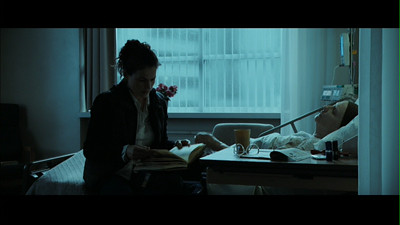
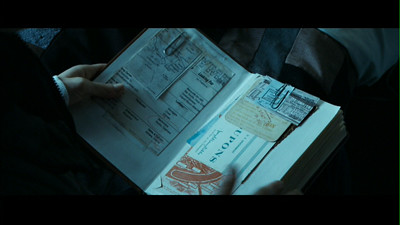


The Curious Case of Benjamin Button was adapted by writer Eric Roth (The Good Shepherd, Munich) and directed by David Fincher (Zodiac, Fight Club), one of our very best contemporary American directors. The filmmakers decide to set the "present" of the story within recent history. As Hurricane Katrina closes in on New Orleans, one of its oldest residents, a dying woman by the name of Daisy (Cate Blanchett), lays in her hospital bed, attended by her daughter (Julia Ormond), who reads to her mother from the diary of a long lost friend named Benjamin Button (Brad Pitt).

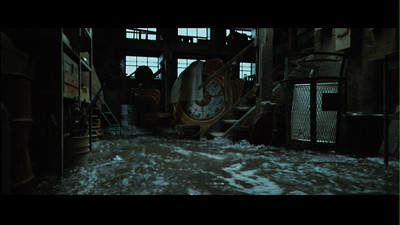
Benjamin's story encompasses the whole of the 20th century. Born on the day World War I ended, we watch Benjamin travel through the Depression, WWII, and even Beatlemania and the 1980s. This is no Forrest Gump journey, however, Fincher doesn't place his character in obvious historical and pop cultural moments; Benjamin's life is one lived out of the public eye, as befits a man who is steadily growing younger by the year. Abandoned by his father, raised under the monument of a train station clock that runs backward (an excellent side story, and a Fitzgeraldian metaphor if ever there was one), Benjamin spends his early years under the care of Queenie (Taraji P. Henson), the caretaker at an old folks' home, before getting young enough to strike out on his own. Booking passage as a worker on a tugboat, Benjamin sets off to see the world, meeting interesting characters wherever he goes, and nursing the love he holds in his heart.
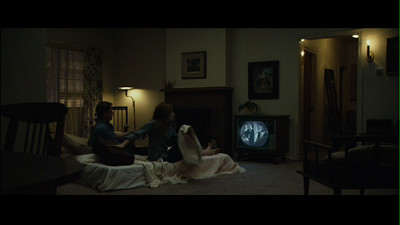


Despite technically being the same age, when Benjamin and Daisy first meet, he is an old man and she is a little girl. Through the years, as their respective ages travel toward a common middle, the pair goes through many reunions, false starts, and misunderstandings before Benjamin finally becomes the man he wants to be and the lovers join at last. Anyone who has read The Great Gatsby will recognize the similarity between this trek and that of the tragic title character from the novel. In fact, the name Daisy--which was not the name of the entirely different romantic interest in the "Benjamin Button" short story--is a nod to Daisy Buchanan, the unattainable object that Jay Gatsby seeks to acquire.
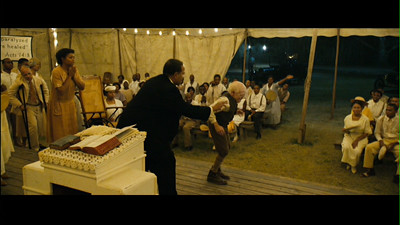


Apparently The Curious Case of Benjamin Button has been in development for nearly fifteen years. (Turns out we were spared a Ron Howard version starring John Travolta; thank God!) I imagine one of the biggest challenges was how to deal with the aging factor. Not only do we need to see old man Benjamin with a wrinkled body proportional in size to a newborn and a young child, but we also have to see him at the various ages of a full-grown man. Likewise, we have to see Daisy getting older while he gets younger. Brad Pitt and Cate Blanchett are required to play both above and below their respective ages, and with the help of make-up and what I assume are some imperceptible digital effects, David Fincher has pulled it off remarkably. Though it's hard to pin them down in the ill-defined years of their 30s and 40s, when the two actors should look most like themselves, the transformation is still rather seamless. Credit is also due to both of the actors, who don't let the make-up do all the work, but who expertly walk in the shoes of different eras while maintaining the core of who they are.

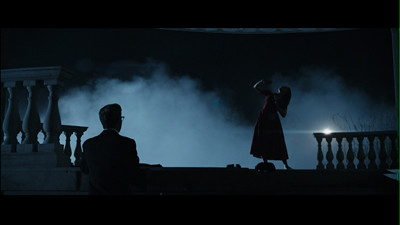
It's not the only visual feat that Fincher pulls off, either. From recreating Depression-era New Orleans to the oceanic battles of World War II and 1950s Paris, the director paints across the screen like a vast canvas. A sunset witnessed by Benjamin and his ailing father (Jason Flemyng) is a gorgeous portrait of light and shadow, of water vs. sky. Equally stunning are images of burning battleships or a dancing Daisy silhouetted in night and fog. It's in these moments that Fincher captures the feeling of Fitzgerald's prose, his pictures evoking the words the way Fitzgerald's words so vividly created pictures. Similarly, the way the director uses classic film styles to reference the memories of characters in the story, including a running gag involving a man being struck by lightning, effectively simulates how Fitzgerald characters might remember times gone by through songs they loved or books they read.


At nearly three hours, The Curious Case of Benjamin Button is as rich as any thick novel covering the full scope of a man's life. (By comparison, Fitzgerald did the same in a much shorter space. The short story "The Curious Case of Benjamin Button" runs twenty-two pages in my The Short Stories of F. Scott Fitzgerald. There's a reason we still regard him as the master of his chosen craft.) The movie is never dull, and it manages to maintain the air of a shared story without ever being overly sentimental, even in its most romantic or emotional moments. With life being lived in reverse, there are also many reversals along the way, with survival and death being constant factors. David Fincher and Eric Roth make some ingenious decisions for how to close out Benjamin's life, and the final montage of memory and the lovely metaphor of an entire century being washed away by the rain takes us to a poignant finish that exposes the whole wonderful narrative design that the filmmakers have been laying out for us.

If The Curious Case of Benjamin Button isn't the best film of 2008, it's very near the top. When it comes time for my biography to be told, I can only hope that I would have spent my time as well as this fictional character, and I can only dare to dream that it might be executed with as much grace and depth as David Fincher has achieved here. An existence well lived, a story well told--surely there is nothing greater than that.

* * * *
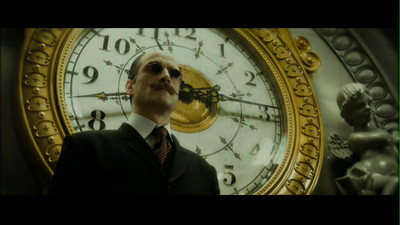


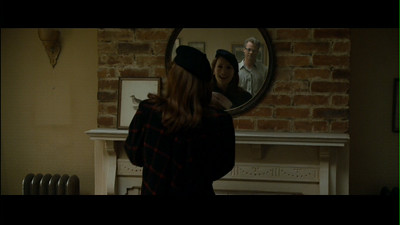
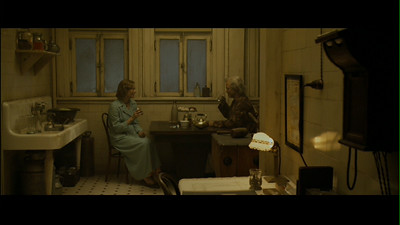
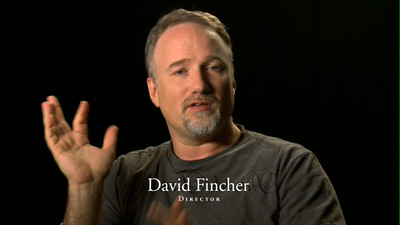
Reading over my review again, I don't feel my interpretation or understanding of the movie has changed, but I do think it has deepened. My first reaction on watching Benjamin Button a second time was how dark the movie is. Death is a constant in Benjamin's story, its grim pallor coloring everything (and note how darkly lit many of the scenes are, even in the pictures here). It begins with the irony of the infant starting life at an old folk's home, learning to accept death as both natural and common. It should be coming for him, it is a byproduct of his condition, but whatever spell has been cast on him has changed how death holds an individual. I guess this morbid theme should have been more obvious to me, as what I thought was an astute observation turned into a "Well, duh" situation the moment I started watching the extensive and fascinating documentary feature on the second disc of this Criterion set. The very first clip is of David Fincher talking about losing his father to cancer and the way his grappling with that became a part of the filming of the movie.

Benjamin's place in the world may have a feel-good "live every moment" lesson at its core, but there is a decidedly more pronounced intelligence than one might find in your standard second-chance post-tragedy picture. The message here is to live every moment, but accept the role age and wisdom plays in each one. If youth is wasted on the young, then don't toss away important things when you're not in a place to understand them fully. Patience is a virtue.
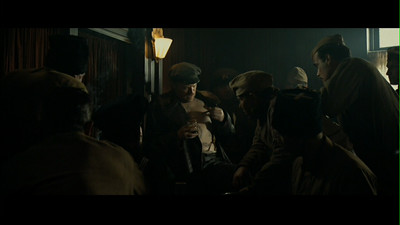


This is most evident in the love story, which is antithetical to the standard tales of young love that is the passionate energy of most romantic movies. Daisy offers herself to Benjamin, but he refuses her advance because it's not right yet, a rebuke she carries with her in a tight little fist in her heart, and that only likely makes sense to her years later when, while convalescing after an accident, she rejects Benjamin, choosing instead to wait until she is herself again. Benjamin wanted her to be strong enough and wise enough to love him with more than an impulsive schoolgirl lust; this carries over into her wanting to love him only when she can be her own self-sufficient person.

Meeting in the middle is less about being physically compatible, but more about being mentally compatible. Like wine, let this romance ferment. The risk, of course, is that they will grow apart, and thought it's a risk all lovers must take, for them it is a fait accompli. As Benjamin was able to be a young man learning from the old, however, Daisy will have the reverse position, being able to learn from him as he grows young. Both are taught to savor the things that matter by seeing the way others are losing their grip on those things. In Daisy's case, it must be more bittersweet for bringing her experience as a mother to taking care of Benjamin as his life ebbs. He is just a baby when he passes, having forgotten all he learned, the complete opposite to the baby daughter Daisy raised, whose every day was a new experience.

It's not a romantic ending, certainly not in terms of their relationship. Benjamin didn't really have mother issues; if he was seeking a mother surrogate to replace Queenie, he didn't realize it. If that was his reason for connecting with Daisy, it was a primal instinct, an act of self-preservation. The saddest scene in the movie is not a physical death, but an emotional one. It's when Benjamin, now in his early 20s, has come to see a middle-aged Daisy one last time, and she ends up going to his hotel room. The compulsion, as one might read it on Cate Blanchett's face, is to feel the passion again, to see if it's still there; the disappointment, again conveyed largely through expression and body language by Blanchett, is that it's not. The romance has died.
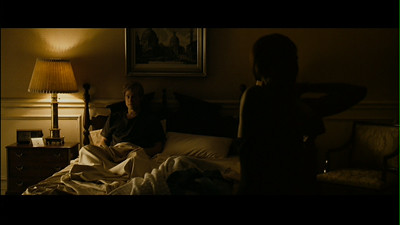


Or again, just matured, transmuted to something else, love of a different bloom. This is really the meaning in the much-maligned metaphor of the hummingbird, which possibly chafes some reviewers because its function is more literary than cinematic, the visual maybe needing a prose back-up to convey its full power. It's not that everything is connected, but that all life is transformative, continuous, the energy goes on. If Captain Mike (Jared Harris) has become a hummingbird after dying in the U-Boat attack, then it's a moment out of Ovid, a story of a single being becoming something else. Perhaps, though, it is also a release, the tattoo that kickstarts the metaphor rising from his chest to carry on with the story. The important element of Mike's explanation of the symbol is that it represents infinity, as indicated by the way its wings form a blurry figure eight. This would mean that the hummingbird at the end is not Daisy's soul or even Benjamin watching over her, as I might have originally argued, but the connection being passed on, the story continuing, the history being rescued from the flood that washes the rest of it away. The story can't disappear, it now belongs to the movie audience.
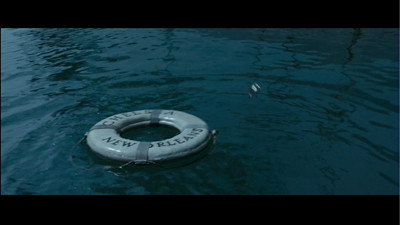


When you boil it down, all of Benjamin's encounters and re-encounters involve stories. Everyone has their own, and Benjamin is the catalyst for each person telling it. In some cases, he is the reason they finish the narrative, such as Tilda Swinton's character finally returning to swim the English Channel (as it were, defying the flood rather than succumbing). Daisy is sharing the tale with her daughter--and truly sharing, the daughter reading it aloud to soothe her dying mother while also taking it into herself. Even when the story can't always be trusted, such as the mixed-up memories of the residents of Queenie's old folks home, they are still part of the mythology. More often than not, those stories are full of hurt and sharing them is part of overcoming; life is all about mourning, the grieving process for what could not be and what we know will come. I think one missed opportunity here was that the man who was always getting hit by lightning should have told eight or nine different versions of the strikes while still claiming to have only been hit seven times. The point being that it would be no less true, not as long as it's true to him. Queenie believed the faith healer helped Benjamin to walk, and that brought her comfort. Nick Carraway felt the same of Jay Gatsby--he is the man he said he was, and thus better than the whole damn lot of them.

You will believe, through the magic of moviemaking, that a man can be born old and die young.


Because then, wouldn't we also have the go-ahead to question the veracity of Benjamin's own story, the diary being read aloud and forming the movie? It, too, could be invention. It's all invention, really. A child aging backwards, a hummingbird in a war zone, seven bolts of lightning. Taking a hold of the story could give one the power to command it, to take over life's quirks and coincidences. Isn't that the point of the story of Daisy's accident, told in an expertly paced, rapid mis-en-scene by Fincher, to say if just one piece could be rearranged, then death could be cheated further?

Which brings me back to story again: you can't die if your narrative is preserved between the covers of a book or on a two-disc DVD set. Watching the talking heads sharing the production tales on disc two definitely gives one some fulfillment in terms of a need for preservation: we were here, we did the work, here is how that happened. The fact that they approached their movie storytelling in such a classic, tried-and-true manner is like the gift they give to us, returning us to what's important about shared experience. The future meets the past, technology enables tradition. Fincher embraces old cinematic and literary styles and integrates them in with his new way of doing things.


When I first saw The Curious Case of Benjamin Button, I saw it with one of my favorite friends and my most ardent collaborator, and by chance, we both rewatched the movie on the same night, too. When we saw each other the next day, we discussed our new impressions, and she mentioned the scene where Benjamin and his father are talking, before Benjamin knows that he is a Button, and the son tells the father that old age isn't so bad, it's nothing to fear, its routine is not crushing. In fact, in narration earlier, he notes that the routine is liberating, clearing the way for the mind to sit and ponder other things (how very Zen!). In the end, it is the simplest truth of all: if you can get through that, you can get through this. If you can survive the teen years and the perils of adult life, you can survive a well-earned retirement. If you can grow up, you can grow old.
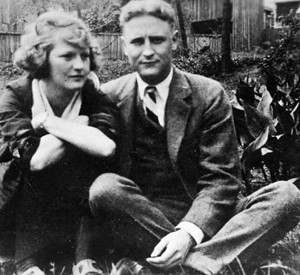


Scott & Zelda Fitzgerald
