Showing posts with label peckinpah. Show all posts

Friday, August 31, 2018

THE OUTRAGE - FILMSTRUCK

This review was originally written for DVDTalk.com in 2009.


Hollywood was all over Akira Kurosawa from the get-go. Not in the "We revere you so much we're going to import your movies" sense, but in the "No good idea is too good for us to think we can do better but most likely ruin" sense. Quite a few of his more famous samurai action pictures have been turned into quite a few westerns with a variety of results. Yes, it's hard to believe, but one of cinema's greatest directors was treated the way Hollywood now treats foreign horror movies: grist for the remake mill. Though I knew that a ton of different productions had ripped off the basic Rashomon concept of one story told from multiple yet conflicting points of view, I didn't know anyone had ever had the cajones to remake the 1950 classic in its entirety. Turns out there was a stage version written by Fay and Michael Kanin, and it was even filmed for television twice (including once by Sidney Lumet) before Martin Ritt decided to turn it into a full-fledged film in 1964. The Outrage placed Rashomon in a remote outpost in the post-Civil War American West, and it's a surprisingly obscure effort given that it's both Ritt's and Paul Newman's follow-up to the Oscar-winning Hud.

Then again, maybe it's not so surprising. When I worked in video retail, a customer once told me that he had a theory that the more stars there are in a movie you've never heard of, the worse that movie is likely to be. In addition to Newman, The Outrage stars Edward G. Robinson, Claire Bloom, William Shatner, and Laurence Harvey. It's not exactly a Cecil B. DeMille Greatest Show on Earth ensemble, but that's a pretty solid roster. Not exactly no-names, though not exactly A-List--just as The Outrage is not exactly awful, but not really a classic either.


The story of The Outrage pretty much follows the Kurosawa model: three men gather in a desolated area and end up discussing four different versions of one terrible story. In this case, Shatner plays a preacher who is waiting for a train at a rundown station in hopes of catching the next trip out of town, his faith in humanity shattered along with his belief in the absolute. Waiting with him is the downtrodden prospector (Howard Da Silva) who wants to convince him not to go and a conniving huckster (Robinson) in hiding lest the people he ripped off find him. The day before there had been a trial for a crime perpetrated against a traveling couple. As the verdict stands, the notorious outlaw Juan Carrasco (Newman) raped Nina Wakefield (Bloom) and murdered her husband, Colonel Wakefield (Harvey). At least, that was how Carrasco told the story, but Mrs. Wakefield had a different version and a medicine man (Paul Fix) who heard the Colonel's dying testimony delivers a third. Though Carrasco's past crimes made him an easy conviction, the truth seems lost somewhere in all the variations.

Turns out, there is a fourth version, one known only by the prospector, who as far as the court knows only found the body, but who in reality tells the preacher and the con man that he saw the whole thing from the bushes. Yet, there are reasons to doubt his version, too, as his self-serving secrecy undermines his credibility. The con man's cynical worldview may be the truest of all, that humans are suckers and liars. It makes a certain level of sense, especially when you consider that each person's scenario is more favorable to them. Each teller of the tale is a winner of sorts in their own version. Yet, that is also the most obvious interpretation, and Kurosawa's Rashomon provokes a much deeper response. Truth is not merely subjective, it is also unknowable. How each of us lives is dictated by how well we can reconcile ourselves with that principle.


Martin Ritt and the Kanins (Michael Kanin is credited with adapted screenplay) don't entirely remove the grander meaning for The Outrage, but their fourth act ends up being a rather fatal misstep that comes across as far less convincing and far more blatant than Kurosawa's Rashomon. While the first three stories, the ones told by the bandit, the wife, and the husband, are fairly accurate to the Japanese film, the prospector's version is portrayed as first a broad Southern melodrama before descending into a slapstick fist fight between Paul Newman and Laurence Harvey. The rape is suddenly treated like a punchline, and the decision to change how the Colonel dies in the prospector's story also makes it seem like a cruel joke, a misfortune perpetrated by the indifference of the universe. If the prospector's tale in the real truth, life would then be a B-movie rather than a human tragedy.

The acting is all very good up until that last story, too, with everyone playing his or her roles with the appropriate gravitas. The switch is so severe for the prospector's story, you almost have to wonder if it was all cooked up following a rather wild party and everyone was too drunk to be operating such heavy machinery. Even Shatner kept most of his hammy tendencies in check, though at times this early performance already shows signs of his trademark delivery (in terms of speaking style, he's kind of the Christopher Walken of his day). I'd actually give the top acting marks to Edward G. Robinson as the sharp-talking roadshow salesman. The veteran actor is the most comfortable up there on the screen of any of them, and his skills as a raconteur serve him well.

I'd have been curious to hear how an older Paul Newman reflected on the time he played a Mexican, with dark make-up and all (what is that? tan-face?). To his credit and the credit of his Actors Studio training, he buries himself in the part with the same amount of respect he would give any other role. Though I suppose some could grumble about his accent and gruff voice he adopts (did he study Treasure of the Sierra Madre in lieu of a dialect coach?), he largely manages to avoid racial caricature. In fact, the writing seems to be informed by an awareness of how the Mexican people might have been viewed at the time and includes allusions to racism and shows Carrasco playing at being a stereotype to lure Col. Wakefield into his trap (indeed, even relying on the white man's greed). Beyond the voice and the make-up, I don't get the sense that Newman would have played it any other way if his character were a white bandit named Carson rather than a Mexican one named Carrasco.


If there is one compelling reason to watch The Outrage, it's the sure-handed direction that Ritt displays for most of the movie, as well as the beautiful photography by James Wong Howe (The Sweet Smell of Success). From the rainy railway station that provides the story frame, the waiting men looking like an early test version of the trio at the station at the start of Sergio Leone's Once Upon a Time in the West, to the open desert and the way the people crowd into the town square to witness Carrasco's trial, Ritt and Howe use the wide open spaces of the West to show how remote this little pocket is, how isolated the pioneer is from polite society. They capture every gorgeous detail, every cactus and every raindrop, using the Panavision process to its full limits. In contrast, the little oasis where the crime goes down is softly lit, like a pocket dimension within the greater frontier. The Outrage is a gorgeous movie, tightly edited by Frank Santillo (who also worked with Sam Peckinpah on his more thoughtful movies), an expertly constructed movie from start to finish.

But a technical triumph is still only as big a victory as the script allows, and alas, there is no way around the pitfalls of The Outrage. While the first sixty minutes are very good, if a bit unnecessary given the existence of the Kurosawa original, the final thirty are a terrible blunder. There is little reason to watch a flawed version of Rashomon when you can just watch Rashomon--and that you can take as the absolute truth in a world of wishy-washy opinions. Anyone who says different is either lying or wasn't really there!


Monday, July 16, 2018

THE LAST HOUSE ON THE LEFT - CRITERION CHANNEL


I’ll admit, until the Criterion Channel paired Wes Craven’s 1972 debut The Last House on the Left with Ingmar Bergman masterpiece The Virgin Spring, I had no idea it was a remake of the Swedish original. Upon learning this, the fact that one of the more influential touchstones in modern horror had been inspired by an allegorical art-house flick suitably intrigued, and I had to give it a try.

The Last House on the Left firmly positions itself between the radical culture of the 1960s and the more straight-laced older generation that would have never allowed such a film to be made and likely still railed against it once it was. Craven at once indicts and satirizes both sides of the divide, while maybe tipping his hand toward the establishment just a teensy bit. He may not approve of all the old folks’ choices, but they at least still had a moral center and can get shit done.

Mari (Sandra Cassell) is the young daughter of an upper middle-class couple. When she and her friend Phyllis (Lucy Grantham) want to go see a rock concert, the parental units aren’t exactly for it, but given that it’s Mari’s birthday, they decide to extend her the trust and let her go out on her own.


Big mistake. On the way, the girls stop to buy some marijuana from the wrong dude. Junior (Marc Sheffler) is really procuring the girls for a trio of fugitives looking to get their murderous jollies. They kidnap the girls and eventually take them to the woods, where they intend to rape and kill them. Ironically, they do so just down the hill from where Mari lives, and where her parents wait with a birthday cake for a party she will never attend. So close, and yet...not.

Craven’s production is a ragged affair, shot on a shoestring and featuring mostly untrained actors. This lends The Last House on the Left a griminess that helps the horror by offsetting some of the writer/director’s more indulgent elements. Namely, the ineffective police officers who serve as comic relief in a movie that maybe shouldn’t be going for laughs. Especially since their presence in the story never really pays off.

Far better are the characters the writer/director takes seriously. He has three main bad guys--David Hess, Fred Lincoln, and Jeramie Rain--all of whom manage a distinct menace, each different from the rest, but all serving their purpose. They very nearly step over the line into broad caricature, but Craven grounds his actors in their particular kinks--Hess’ Krug is a brute, Lincoln’s Weasel is a knife-wielding sadist, and Rain’s Sadie is just plain crazy. The true MVP of The Last House on the Left, however, is Grantham, who as the more worldly best friend tries to steer the violence away from her innocent pal. It’s a smart, tough performance, and one that rings true.


Craven himself tiptoes up to the edge of exploitation in this picture, catering to the grindhouse and drive-in crowds while still trying to adhere to something more substantial. He doesn’t play the assaults as sexy, nor does he linger on the victims’ naked bodies. In a way, his use of the setting--particularly the lake where both girls meet their fate--and contemporary music that celebrates the outlaws reminds me of Sam Peckinpah, specifically Pat Garrett & Billy the Kid. One could even compare the loaded gender politics that often make Peckinpah a bit harder to grapple with.

That all said, The Last House on the Left hasn’t really aged that well. Its queasy shocks don’t quite shock anymore, and Craven never captures the gravitas of his source. The last act turn where the parents have their revenge heats up the proceedings by a couple of degrees, but that’s actually because Craven unleashes a bit more of his gonzo instincts. The talent and the vision is there, it’s just going to require a little more experience and even a little more budget to fully mature.


Tuesday, November 29, 2016

ONE-EYED JACKS - #844


In the lore of One-Eyed Jacks, it’s said that Marlon Brando’s character Rio was supposed to be Billy the Kid, and was even identified as such up through a draft of the screenplay by the great Sam Peckinpah. The only problem was that, in historical contexts, Billy the Kid was inarguably a bad guy, and Marlon Brando never plays the bad guy. And so it was that the character’s name was changed, paving the gray way on a gray road where the bank robbing, lying Rio could be the hero of his own story.

A pretty good story it is, though a cynical one. Even in western terms, it takes a healthy dose of existential awareness to draft Rio as a hero. An anti-hero, maybe, despite the fact that he seems to stand for less than even Brando’s Johnny in the The Wild One [review], who you may recall was ready to rebel against anything you’ve got. But One-Eyed Jacks was Marlon’s show, and he fired not only Peckinpah but also Stanley Kubrick, who was set to direct the picture, and stepped behind the camera himself, enlisting Paths of Glory-screenwriter [review] and RamblingRose-author Calder Willingham to give him the morally ambiguous western he sought. An extended production followed, and a delayed release, and an eventual studio re-edit to get this thing out in 1961, allegedly excising some three hours of equivocation and nuance. Brando disowned it; your mileage may vary.


One-Eyed Jacks is a solid western, and a dark precursor to the revisionist history to come for the genre as the studio system crumbled and cinema evolved. Set in Mexico and California, One-Eyed Jacks has a decidedly Latino presence, and a pronounced racism to match (and that’s without considering whether or not Brando is intended to be a Mexican). The whites in the movie mingle with the people of color, but they don’t view them as equals. Not even Dad Longworth (regular Brando sideman Karl Malden), who married a Mexican woman (Katy Jurado, Under the Volcano [review]) and plays step-dad to her daughter Louisa (Pina Pellicer), is all that convincing as a progressive dude. Not with the way he orders his wife around. Not with how he reacts to Louisa’s dalliance with Rio, the man he betrayed once upon a time. It’s tough to tell if the character is named “Dad” ironically or appropriately. As Rio’s father figure of record, Dad has a lot to answer for.


It’s the older man’s betrayal that sets the plot of One-Eyed Jacks into motion. After the pair rob a bank in Mexico, only to be chased down by federales, Dad takes advantage of Rio’s sense of honor and hangs him out to dry. Five years later, Rio escapes from prison and goes looking for the man who betrayed him. The search leads him to Bob (Ben Johnson, The Last Picture Show [review]), who is planning to rob the bank in the California hamlet where Dad has taken up residency and assumed the role of sheriff. If Rio helps Bob, he can also take his revenge. As it turns out, though, the job is not a simple smash and grab. The gang first settles in town, mingling with the locals while Rio makes a fake peace with his enemy--and woos the man’s stepdaughter. Then things go wrong, and everyone turns on each other.


Comparisons have been drawn between One-Eyed Jacks and film noir, and there are certainly thematic similarities. Plot-wise, one could compare this to Robert Siodmak’s Criss Cross, with Brando taking Burt Lancaster’s role of the gangster who took the metaphorical bullet for the team and Dad playing the classic noir fall guy who looks to leave his past behind and set up a new, straight life away from his previous misdeeds. As any student of noir knows, however, the past never stays buried. The only problem is, Rio is not a clean crook whom you can root for the way Lancaster is in Criss Cross or Robert Mitchum in Out of the Past. Brando plays the outlaw with a quiet menace, his smirk ready to turn to a sneer at a moment’s notice, and real nasty mean streak simmering behind those piercing eyes. He appears to always be thinking more than he’s saying, and yet his expression is inscrutable. Is he pondering philosophy or simply dreaming of tearing the wings off of flies? Ironically, Rio is the worst to women, whom he outright lies to in order to get what he wants, but yet who also serve as his Achilles heel. He can’t stand to see them abused, and so he stands up for any female he sees getting pushed around, including an intense brawl with the eternally creepy Timothy Carey (The Killing). The anger blinds Rio to consequences. It brings to mind a rival to Brando’s The Wild One character in terms of teenage angst; Rio’s pathological need to act out has a similar cartoonish quality to James Dean going gonzo over being called “chicken” in Rebel Without a Cause.


Of course, we also can’t dismiss the other men in the movie in any easy fashion, which at least gives Rio some moral ground. Everyone here has troublesome motivations. Some are cut and dried, like Bob, who is just racist and cruel, or Slim Pickens’ Deputy Lou, the comical “good guy” who is really a sexual predator obsessed with his namesake, Louisa. (The humiliation he suffers at the hands of Rio is borderline grotesque, and yet all too fitting.) Dad ends up being the most complicated. On one hand, he is a father looking to care for his family and a lawman with an eye on his community; on the other, he’s a petty cheat suffering a terrible case of imposter’s syndrome. Malden’s clear eyes show conflict...and fury. His showdown with Rio will have to be primal. Biblical.


These characterizations are the notable standout in terms of One-Eyed Jacks being a “different” kind of western. Unlike the more convention-busting cowboy pictures that were soon to come, One-Eyed Jacks largely looks and feels like a traditional western. As an actor, Brando may be an entirely unique presence, but as a director, he is beholden to the trappings of the genre. In both look and plot, this is no different than a big-budget Hollywood western of previous decades. It’s more Vera Cruz [review] than The Hired Hand or McCabe and Mrs. Miller [review]. Which isn’t a knock. I really loved One-Eyed Jacks, and can only appreciate how even though Brando put on a familiar cloak, he used it to smuggle in a subversive message. The languid pace of some of the more typically California scenes, and the wounding and redemptive healing process Rio suffers through, predict some of the aesthetics and tropes of spaghetti westerns, the next big thing in horse operas.

Which is probably why the movie garnered such champions as Martin Scorsese and Steven Spielberg, who contributed to the restoration of One-Eyed Jacks that made this splendid re-release possible. As Marlon Brando’s sole directorial effort, it perfectly encapsulates his position as a movie star, one foot in the old studio system, one foot in the new cinema school, but his head entirely in the clouds, above it all, pursuing his own dream.


This disc was provided by the Criterion Collection for purposes of review.

Friday, January 31, 2014

THIEF - #691


I am sure back in the day all video store employees had games they played to pass the time when they got bored. When another loop through The Simpsons or Arrested Development DVDs wasn't enough of a distraction, it was necessary to find other things to keep the day from drowning. Where I worked, on particularly slow days, we would each pick out a handful of movies that we had never seen but always wanted to. Once chosen, we would watch the first five or ten minutes and analyze them. I think it was someone's pick of ...And Justice for All that led us to a slow-day revelation. The lengthy opening of Norman Jewison's film is a set-up that has nothing to do with plot, but everything with character. It seemed indicative of what made 1970s American cinema special: the storytelling was the concern, and the filmmaking itself was paramount. No one was worried we wouldn’t know where it was going, or even what might happen next. There was no formula to how the tale was told, just follow the behavior.


Michael Mann's Thief came at the tail end of that era, but it brings up the rear nicely. It opens with an extended heist, dialogue at a minimum, dropping the audience straight into the action. There is a clear line to be drawn between it and Nicolas Winding Refn's Drive [review], one that I would think Refn would acknowledge. Though both openers would, on paper, sound like they are plot mechanicals, the truth is neither has that much importance to the main story. Seeing either Ryan Gosling's driver or James Caan's thief on the job tells us what we need to know about them, how they identify themselves, but not necessarily where the narrative they inhabit might be heading. The particularly key information is in what they do after the crime is done. As Frank, Caan goes to the waterfront and shares a danish with a fisherman, relaxing as the sun rises over the water, calming down from the rush of the robbery. He doesn't introduce himself or give his name, he just is. A thief, and a man.

The whole first half hour or so is just our chance to get to know Frank. It's only in subsequent scenes that we find out he sells cars as a front for his night-time activities, or that he has a thing with the waitress (Tuesday Weld) at his favorite diner. He is a thief first, an individual second, and the evolution of how he is presented to the audience mirrors his personal quest within the film. Stealing diamonds is funding the construction of another life. It will eventually pay for him to be out of the underworld and a citizen in the legitimate world. He's even mapped this out with a collage he made in prison.


Of course, there still emerges an identifiable plot to push Thief along. The first heist and some resulting fallout gets Frank the attention of a local crime boss (Robert Prosky) who wants to bring Frank in under his umbrella. The independent operator is reluctant, and with good reason: just talking to the guy puts him on the radar of law enforcement who previously had no idea he existed. Yet, the promise of a big score means Frank can fast track his transition to the good life, marrying and having a family. He also needs to move fast to get his mentor, Okla (Willie Nelson), out of prison before the old convict's heart condition takes him down for good.


The new boss sets up Frank with a rather large target, and despite the job being complicated, the takeaway will be worth the risk. There are shades of Jean-Pierre Melville in Mann's stoic staging, though Thief also owes plenty to Jules Dassin's Rififi [review], possibly in the same way Refn owes a nod or two to Mann. I’d wager it’s no mere happenstance that Criterion has reissued Dassin’s 1955 caper alongside Thief. The climactic rush to stop a double-cross and keep mother and child out of the combat zone is not an altogether original scenario, but there seems to be at least some eye cast from Mann back to Dassin. Then again, there are lots of genre tropes being employed here. The ending of Thief is also reminiscent of many a western--though Mann's handling of the violence lacks the bloody grace of a Sam Peckinpah, not to mention the restrained tension of traditional shootouts like the climax of High Noon. [review] 

Fans of the Miami Vice TV show or Crime Story [review] are familiar with Mann's affinity for slow-mo paint-splattered showdowns. The violence here is fairly clunky. The aesthetics only call attention to themselves. The years have not been kind, nor is high-definition the filmmaker's friend. It's a little jarring, because everywhere else, the new technology shows how Mann's love of neon was already firmly in place, even at this early stage. The night-time skylines are beautiful, as is the shot of James Caan driving his shiny Cadillac onto the car lot, lit up under a canopy of light bulbs.


This is merely window-dressing, however. All of the macho stuff--the gunfights, the stealing--is superfluous; it all still comes back to character. The best material in Thief is what happens away from the job. Willie Nelson, for instance, shows an incredible depth of emotion in his short appearance, and there are some interesting class issues that emerge as Frank tries to bury his past and present himself as a working stiff looking to make good.

The best bit in the movie, though, is an extended interaction between Caan and Weld. Out on a date, they both decide to put their cards on the table and get real. No more hidden pasts, no more looking the other way. The exchange feels raw and unscripted. No artifice, just two people sharing a back-and-forth. I didn't check the clock, but it goes on for what seems like ten minutes, and the two of them could easily highjack the movie at that point. I'd have been more than happy to have Thief turn into a Before Midnight-style discussion between a gangster and his dame.


Of course, that's the first scene they'd cut today. You can't have a big genre picture with a lot of talking. James Caan would pull Tuesday Weld out of the bar and then there'd be a hard cut to them having sex. And it wouldn't be James Caan, it'd be someone more conventionally handsome and not so abrasive. And Tuesday Weld would be an actress at least ten years his junior. And there'd have to be a pretty awful bad guy and a recognizable rival cop. Stuff that tests well, you know?

Which just makes Thief all the more intriguing, all the more special. The end of an era of adventurous mainstream filmmaking. We still see movies of a similar stripe crop up occasionally--the films of David O. Russell spring to mind--but not even Michael Mann makes them like this anymore. There’s something fresh and unforced about Thief that his quest for perfection would prevent him from ever recapturing. Moments still pop up here and there--who can forget the sitdown between De Niro and Pacino in Heat--but the fresh excitement of Thief is something you only get to have the first time.


This disc was provided by the Criterion Collection for purposes of review.


Saturday, October 1, 2011

SIDELINE: MORE REVIEWS FOR 9/11

A round-up of non-Criterion reviews I wrote this past month:


IN THEATRES...

* 50/50, as unserious as cancer. Or as serious as cancer. Kind of both. Great work from Joseph Gordon-Levitt, Seth Rogen, and an all-around solid cast.

* Attack the Block, the ultimate summer movie shows up just in time for fall. (Unless you were lucky enough to get it in your town earlier, of course...)

* Contagion, in which Steven Soderbergh makes sure you'll never touch yourself again. On the face. ON THE FACE!!! But seriously, this movie is awesome.

* Drive, the best movie Paul Schrader never made. Ryan Gosling stars, all Alain Delon-like, in this violent tour-de-force by Nicolas Winding Refn.

* Gainsbourg: A Heroic Life, a biopic of Serge Gainsbourg from French cartoonist Joan Sfarr. It can't quite sustain its inventiveness, but I liked it all the same.


* Higher Ground, actress Vera Farmiga tackles feminism and faith in her directorial debut.

* The Lion King 3D, an old favorite shown in a bad new light.

* Moneyball, a surprisingly deep drama about the inner workings of baseball. (Note: One of the screenwriters was Aaron Sorkin. Did you know that?)

* Shut Up Little Man! An Audio Misadventure, a fascinating, thought-provoking look at one of the most infamous pre-internet viral sensations.

* Straw Dogs, a competent but pointless remake. Rod Lurie is no Sam Peckinpah. (Hey, I reviewed the original once, too.)

Portland was lucky enough to have Cinema 21 showing the original 3D version of Alfred Hitchcock's Dial M for Murder for a limited engagement. To go along with it, the Portland Mercury asked me to pick some other Hitch films for home viewing, and I did so by taking a tour of his trailers. Read the column online here.

ON DVD/BD...

* Boccaccio '70, four Italian film directors team for a 1962 anthology film telling individual stories of modern romance.


* Breakfast at Tiffany's, the quintessential Audrey Hepburn film is now on Blu-Ray.

* Hung: The Complete Second Season, Thomas Jane returns as everyone's favorite lovelorn hustler.

* If a Tree Falls: A Story of the Earth Liberation Front, a thought-provoking documentary about controversial radicalism.

* The Inspector General, this whitebread Danny Kaye musical is only offensive in how unfunny it is.

* One Minute to Zero, Robert Mitchum makes love to Ann Blyth and hits the snooze button in this Korean War drama.

* Road to Nowhere, Monte Hellman returns to the director's chair for a disjointed potboiler.

Tuesday, August 16, 2011

CUL-DE-SAC (Blu-Ray) - #577


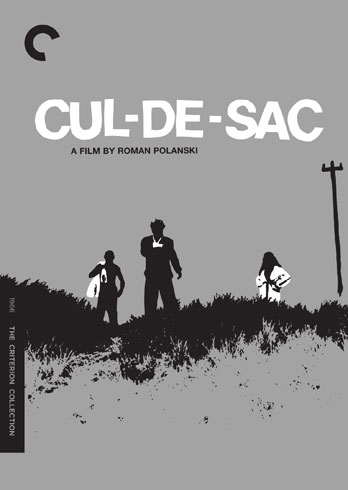
Roman Polanski's 1966 film Cul-de-sac is a darkly comic genre send-up, playfully toying with B-movie conventions while subverting them with Polanski's impish humor. It's like a Peckinpah's Straw Dogs [review] crossed with the old Bogart picture The Desperate Hours, but with Polanski's typically perverse take on sexual politics.
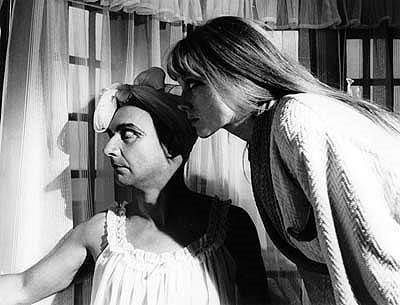
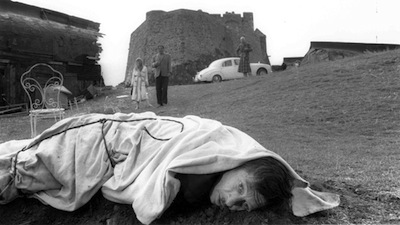
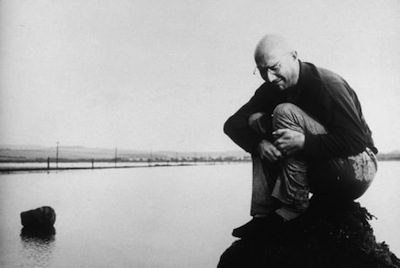
The film opens with two gangsters on the lam in Northern England. A botched job has left the British crook Albie (Jack MacGowan) with a shotgun blast to the gut and his brutish American cohort Dickie (Lionel Stander) with a useless arm. When their stolen car dies in the middle of nowhere, Dickie goes searching for help. The only place for miles is an 11th-century mansion on a hill that looks down on the sea. The residents of this out-of-the-way villa are George (Donald Pleasance), an older war vet, and his young French wife, Teresa (Francoise Dorléac). On his way up the hill, Dickie spies Teresa rolling naked in the sand with a neighbor boy, leading him to draw certain conclusions about her, and his first encounter with the relative newlyweds as a couple in the dead of night interrupts their bedroom playtime. They were goofing around, and George is wearing Teresa's nightgown and he let her put make-up on his face. What was a joke becomes a defining factor in the relationship between the fugitive and his hostages. The burly thug is a true man, and George is his bitch.


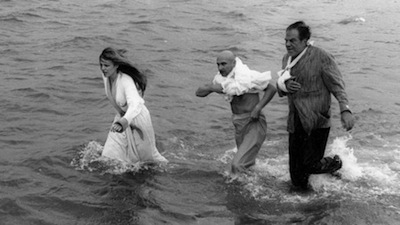
Cul-de-sac plays out over 24 hours, as Dickie waits for his London bosses to pick him up from the isolated locale. The tide comes in shortly after the car stalls, stranding Albie up to his chest in water, and the only way in and out that night is by boat. George caves to the imprisonment, stoking already existing tensions between him and his wife. Eager for the attention of a real man, and determined to start a fight between her husband and their captor, Teresa spends the night drinking homemade vodka with the bad guy, who is, let's be honest, charismatic and gregarious despite his rather abusive nature and poor career choices. This is likely intentional. Polanski--who co-wrote the script with Gérard Brach--is forcing us to like the person that is supposed to be the least likeable one the trio. Teresa is manipulative and dishonest, and George is spineless and fawning. It's not just that he won't stand up to Dickie--who never even really has to pull his gun--but we know that George also kowtows to his wife. Pleasance plays George as slimy and mercurial, physically shrinking from just about any human action. He would have made an excellent Igor to any number of cinematic Dr. Frankensteins.

Roman Polanski can be a polarizing figure, and Cul-de-sac would do little to discourage any viewer that has previously taken issue with his approach to gender divides. Teresa's desire to be dominated by a "real" man and her sexualized behavior (she flirts with almost every male character in the film, and it's to Francoise Dorléac's supreme credit that she somehow makes this woman appear deeper than the writing), and George's cross-dressing buffoonery are certainly provocative elements of an intentionally provocative film. Throughout Dickie's stay on the island, the social order keeps changing. He goes from being drinking buddies with Teresa to climbing in his cups with George, and come morning, the whole dynamic gets upended when George's relatives pay an unexpected visit. Teresa sees an opportunity to take control, and she basically introduces Dickie as their servant. This injects class concerns into the mix, a poisonous stew stirred up further by how the family treats George. I think this lends credence to the argument that Polanski isn't adopting any particular point of view, nor is there a pronounced macho agenda; rather, he is using a familiar hothouse scenario to apply stress to his characters' lives and watch how they react. Ultimately, the plot of Cul-de-sac is a pressure cooker that scorches them all. Anyone expecting good guys or bad guys or any last-minute rescue or triumph is probably right to expect these things under the rules of ordinary crime movies, but Cul-de-sac is not cut from those trappings.


I would contend that the conflicts portrayed in Polanski movies also extend to his aesthetic approach. His movies are at once meticulous and sloppy, tightly wound but also fraying at the edges. Cul-de-sac is a smartly planned drama, with an elegant plot structure and carefully arranged framing, but there is always a little bit of anarchy, be it a blunt editing choice or slapdash overdubbing or a sudden camera move that throws the visual rhythm into disarray. Breakfast with George's family begins as a well-choreographed tableau of social manners and interpersonal rigidity, but the sudden introduction of a shotgun creates a narrative panic. To capture the spontaneous frenzy, cinematographer Gilbert Taylor zooms in unnaturally close on each actor, distorting their features, and breaking the respectful spatial relationships that Polanski has established. The change-up appears almost haphazard and amateurish, but it perfectly illustrates the hysteria of the sequence. The unpredictable introduction of violence would disrupt our lives off screen, so why shouldn't it do so onscreen, as well?

The film eventually returns to its central three as the second night descends, with a climax that shows how far out of control they have gotten and the effects of further compromises and lines being crossed. It could be said that their true natures emerge, that George is a rat and Teresa is empty and Dickie's bluster can only blow for so long. None gets off lightly, regardless. The clash of ideals and wills and the resulting fallout is as natural and inevitable as the tide, which rolls back in on schedule, isolating those that remain even further. In most movies that deal in archetypes, we look for the one that most closely resembles our own nature; in a movie like Cul-de-sac, we leave hoping that we are none of them, and in the worst case scenario, fearing we just might be.


Criterion's Blu-Ray of Cul-de-sac gives viewers a high-definition 1080p image framed at a wide 1.66:1 aspect ratio. The black-and-white picture is sharply realized, with strong darks, lights, and nuanced shades of gray. Though the print still has some surface markings at times, usually in the form of slight scratches in the upper half of the frame, this is rare, and the overall resolution and clarity of image is fantastic, with a subtle grain that maintains the quality of the original film stock without being overly pronounced on modern television sets.

The soundtrack is mixed in mono, uncompressed. It sounds excellent, with full tones and no distortion. Some of the actors tend to mumble and this can be hard to make out, but the shifting volume levels suggest this is intentional, all part of Polanski's off-balance design. Likewise, the wonky Krysztof T. Komeda music takes an appropriate position in each scene, often ironically underscoring the action with his blending of odd electronic noises with more traditional melodies.


For a complete rundown on the special features, read the full review at DVD Talk.


Tuesday, December 29, 2009

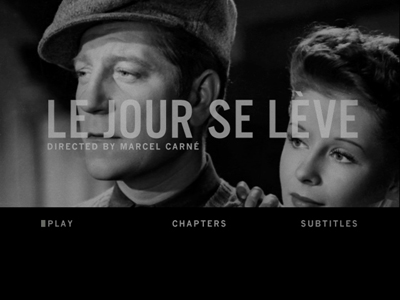
LE JOUR SE LEVE - ESSENTIAL ART HOUSE


A man is shot behind a closed door. He stumbles from the apartment and tumbles down the stairs, passing the only witness, a blind man. Police are summoned. The believed shooter has locked himself in his room at the top of the tenement. By all accounts, he's a good man. No one knows who the dead man is, much less why their neighbor shot him. The only one with all the answers is behind a closed door and not talking.

This is the opening scene and basic set-up of Le jour se lève, Marcel Carné's tense 1939 thriller. The shooter is played by the formidable Jean Gabin, one of the more naturalistic and believable actors of early cinema. His presence is like that of Bogie's, his girth a precursor to Gerard Depardieu. But in truth, he is just Gabin, unlike no other. Perfectly believable as a working-class hero, and the kind of personality that could hold our interest pacing a tiny studio all by his lonesome. Which is essentially what he does in Le jour se lève, though his dark night of the soul is mixed up with memory and regret. The title translates as Daybreak, and Jean's character, Francois, will stay barricaded in his apartment overnight, as the police and the townspeople wait for him to reveal himself. He's locked in his own head at the same time, a victim of stinkin' thinkin' not just tonight, but in all the events leading up to this.


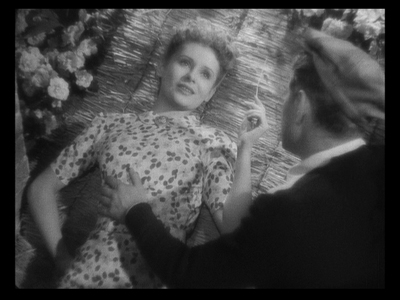
Through a series of flashbacks, Carné and writers Jacques Viot and Jacques Prévert reveal that Francois is caught in two intersecting love triangles. He first falls for the pretty Francoise (Jaqueline Laurent) when she comes to his work to deliver flowers to his boss' wife. Francois labors in a factory where the hazardous conditions are affecting his health; in every way, he is a man with a death sentence hanging over his head even before he becomes a murderer. He and the girl quickly bond, the common name between them working as a starting point for what turns out to be a sweet, intimate relationship. Their scenes together are shot quietly, first by necessity (everyone else in the house is asleep) and then just by nature of the love they share. Carné is a tricky bastard. He knows that if someone whispers, the listener will automatically lean in. Here we fall in love because we can't help but climb into the room with the lovers. Francois and Francoise speak so quietly, we are engaged to be a part of their liaison.


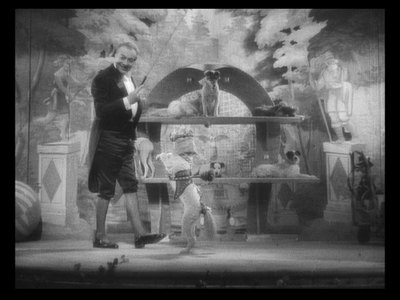
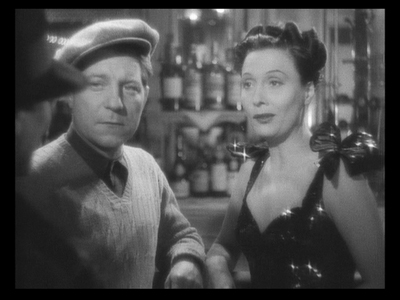
On the night when Francois visits her house, he ends up following Francoise after she leaves him for a prior engagement. She ends up at a small theatre where a dog trainer named Valentin (Jules Berry) is putting on a vaudevillian act where his pooches do ludicrous tricks. It also happens to be the night where Valentin and his pretty assistant Clara (Arletty) are splitting. Clara is a more mature woman than the naïve Francoise, and she sees through Valentin in ways the younger girl is not yet sophisticated enough to manage. Clara also spots the beefy Francois at the bar and quickly attaches herself to him. She becomes his mistress while Francoise remains his chaste girlfriend. Yet, the question is what Francoise's relationship to the slimy con man Valentin is, and whether it's as chaste as her connection to Francois.


It's the untangling of Valentin's lies that eventually gets him shot, the act revealed as the climax of Francois's flashbacks and just prior to the full climax of Le jour se lève. Valentin is a creepy cat, and Jules Berry squeezes every ounce of slime out of the performance as he can. There is a natural division between the men, and though we never see their hands, they would be the telltale sign of how different they are. Valentin's hands would be soft, never having seen hard labor, and Francois's would be rough. Valentin crows about his own intelligence, and the postcards he has sent Francoise from around Europe are meant to suggest that he can offer her a life beyond this remote village. Francois is just a dumb brute by comparison, stuck here for life, no prospect of moving on. Even though Francois sees a paying job as his ticket to personal freedom, the girl may not feel the same. This is the stick Valentin pokes him with, and the true measure of Gabin's performance is how much his understated seething makes us seethe on his behalf. Put that gun in my hand, I'd shoot the huckster, too.


Le jour se lève has a lot going on underneath its melodramatic plot. In addition to the bits about the class distinctions, there is also a lot being said about male aggression. It's kind of like Peckinpah's Straw Dogs in reverse, with the smart guy in the role of antagonist. There are also interesting things to be gleaned about the role of women at the time: how they are perceived, and how those perceptions not only define them, but also how they spur the men in their lives to treat them and/or act on their behalf. Clara is arguably a fallen woman, but she is also a realist. Francois is kind of kidding himself when he tells her he's not the romantic type. He demands a certain honesty from her, waiting to judge her beauty until he sees her without her stage make-up, but he lies to himself. He's an absolute romantic, and he's also a total wuss when it comes to ending their relationship. Clara takes it like a trooper, though that doesn't stop her from being a right bitch. I suppose a lifetime of being thrown over for the innocent girls has given her good reason to debunk the myth of that innocence.


Watching Le jour se lève, I had the feeling that I had seen this all before. Not that I found it derivative, but that some other movie had been derived from it. Turns out there was a good reason I felt this way, I hadn't realized that this was the movie Hollywood remade in 1949 as The Long Night, starring Henry Fonda and Vincent Price and directed by Anatole Litvak. I reviewed that film three years ago as part of Kino's Film Noir: The Dark Side of Hollywood boxed set. It was my favorite of the box, and though my memories of it are fond, Le jour se lève strikes me as the superior picture. More grimy, less hamstrung by production codes when it comes to the finer details of the love affairs. From what I can recall, the broad strokes are the same, though the ending of each version is more befitting the country of origin. Fonda is actually in a similar talent class as Gabin in terms of solitary action and the way he commands a screen. Both movies also have a cinematic realism that is quite effective. We aren't seeing our wronged men making their bad choices on a soundstage. Small town life, particularly as the neighbors spill out to watch the spectacle of the stand-off, is as much a part Jacques Viot's story as anything else.


One fascinating thing about Le jour se lève is how little it actually explains itself. Or, more accurately, how little we are told about the motivations of Francois. He doesn't make any big speeches to Valentin before he kills him, and really, he is reacting more than anything, goaded into proving the power of his might vs. that of Valentin's twisted talk. There is no such antagonizing factor in his final decision, however; it's still just him all alone. My first impulse was to say that he's a man that doesn't allow decisions to be made for him, and so he maintains control by choosing how it will all play out. Thinking about Gabin's face both times he uses a gun, I realized we really have to read his expressions to understand where his real shame lies. He let Valentin poke and prod him into making a mistake, effectively removing the control from him. It's the one decision that we could say he didn't make for himself, and the last scene of the movie is him taking over his own fate once again. The fade-out is on Francois and no one else. There are no parting words. Just the man in his room.


This disc was a Christmas present from my good friend, the writer Christopher McQuain, and thus got immediately bumped up in my post-holiday queue. Thanks, Chris! Check out his top 10 picks for the films that defined the last decade here.

Wednesday, January 28, 2009

KNIFE IN THE WATER - #215


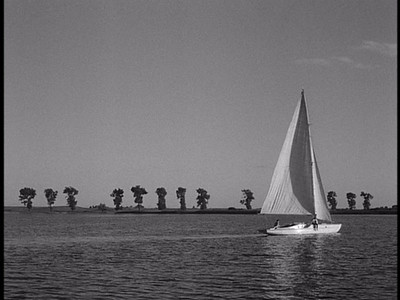
A small sailboat becomes the center of male competition in Roman Polanski's tense 1962 debut, Knife in the Water. When a middle-aged Polish couple heads out for a Sunday on the water, they nearly crash their car trying to avoid a hitchhiker (Zygmunt Malanowicz) whose technique for flagging down rides is to stand in the middle of the road and play chicken with oncoming cars. At first angry, the husband, Andrzej (Leon Niemczyk), curses the nineteen-year-old; yet, he also senses his wife's attraction and sympathy for the boy, so to prove a point, he gives the hitcher a ride and then convinces him to go out on their trip with them.


From the get-go, Andrzej and the boy are at odds. The boy shows off his knife, and Andrzej shows off his boat, knowing the kid doesn't have the skills to handle it. The hitcher and his knife make claims to being tied to the land, where a man lives on his feet and by his hands, where a knife is necessary. A blade is ineffective against water, and Andrzej is convinced the open sea requires more skill and mental tenacity to navigate. It's philosophical and it requires tactical know-how, you can't just hack and slash your way through. He claims the mantle of skipper and orders the boy around. It's the battle of young and old, father and son, a clash of generations.

And yet it's totally childish. The men show off for one another, and what each one does, the other has to try. If Andrzej can captain the boat, the young man wants to do it, too. When the young man plays a game with his knife where he lays his hand flat, splays his fingers, and stabs the blade in between them, Andrzej sheepishly picks the weapon up when the boy is not looking and takes a crack at it himself. When the boy whistles, the older man shushes him, invoking a maritime superstition, but then whistles himself, either forgetting or having now been caught in a lie. When the hitcher makes fun of a tool Andrzej uses to hold a hot metal soup pot, Andrzej goads him into holding it with his bare hands.


One would think the two men are showing off for the benefit of Krystyna (Jolanta Umecka), Andrzej's wife and the woman after which the sailboat has been named. Half the time, though, it doesn't even look like they notice her. Even though it's taken for granted that she is the unnamed prize of this standoff, Polanski and his writers, Jerzy Skolimowski and Jakub Goldberg, understand that most masculine contests are contests of approval. In some way, the youngster wants dear old dad to think he's okay, while pops wants the kid to think he's cool. (Copying his whistling may be an unconscious attempt on Andrzej's part to appear youthful.) There is also a touch of the homoerotic when they play their knife game, with Andrzej submitting to let the other man work the blade through his fingers. Still, they never touch one another, and Polanski smartly withholds any real violence until it really matters; it's almost more pathetic when no one is getting punched in the nose.

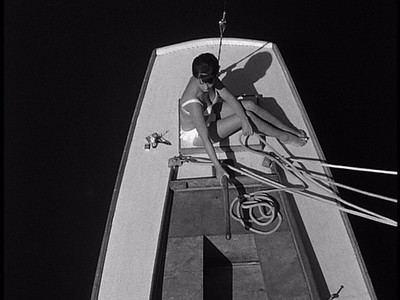
Polanski is also sly enough to underplay Krystyna's role. Her reactions are few and far between, and they mostly are the result of exasperation that the boy doesn't know what to do and her husband won't just get it over with and tell him. From the first time we see Krystyna, however, Polanski locks us into a slow physical seduction. In the car, she has her hair up and wears pointed secretary classes. She is pretty, but she is holding back--not waiting to be unleashed like some sexy librarian stereotype, but instead waiting to reveal herself and her role in all of this. As soon as the group is on the water, Krystyna changes into a skimpy bikini. The male gaze is immediately drawn to her. The boy--and the viewer--is always aware of where she is, and Andrzej--along with, once again, the viewer--is always aware that he's aware. He catches every little look, including the boy sneaking a peek when she is changing, as well as noting every time Krystyna comes to the young man's defense.


The dichotomy here is probably best represented in a scene down in the hull, where the three of them have retreated to wait out a rainstorm. They play pick-up sticks (or jackstraw, as it's called here), and every time someone loses, he or she has to forfeit some personal object. Krystyna gives up a shoe, the young man his belt and then his knife--prompting another contest, a phallocentric knife toss, which Krystyna stops after the boy's second throw, blocking her husband from getting a second try in the contest. She then asks what she must do to get her shoe back. The boy demands a song, an idea Andrzej shoots down. He'd rather listen to the boxing match on the radio. They compromise, and Andrzej puts on an earpiece. His wife sings with a girlish shyness, prompted by the boy, and then in return, he recites a poem for her to regain his belt. Her song is one of troubled love, his poem is about a young man's desires. For his part, Andrzej can only wonder aloud how he missed the announcement of the Polish middleweight champ getting defeated. "How did he get k.o.'d?" he asks, completely oblivious to the irony of the question. How did the inattentive husband get knocked out in his own boat?


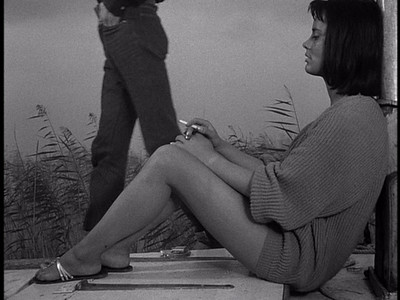
If you consider that the boat is named for Krystyna, it's a none-to-subtle reinforcement of what the battle between the two men is over, and since it's the boat they rely on to get them home, also an indicator of who might be in control. By morning, Krystyna's transformation is complete. The once bundled-up woman now has her hair down, and she sits smoking on the deck, wearing only a long sweater that suggests she may have nothing on underneath (strangely, she's concealing a one-piece bathing suit, which is like the heftier twin of her bikini, a similar style and the same color). She has completely freed herself from the restraints of the land, she is fully sexualized, and it prompts a showdown.

Just as Krystyna finds a certain feminine freedom on the water (a fertility symbol, no less), so too are the men free now of the restraints of polite society. Though there is surprisingly little action in this climactic battle, it does call to mind the animal that was unleashed in Sam Bowden when he lead Max Cady out to sea for their final squaring off in both versions of Cape Fear. One can also imagine Michael Haneke taking notes in preparation for the cat-and-mouse of Funny Games. Yet, Polanski's pitting intelligence against libido calls to mind Peckinpah's Straw Dogs more than Haneke's cruel thriller. When Krystyna finally has her say, she could practically be summing up Peckinpah's conclusion: "You men, you're all the same." Of course, what she does next also has all the ambiguity of Peckinpah's sexual politics, and given Polanski's history and some of his other films, could be as hotly debated.


The choice to place Knife in the Water on a boat also has a visual significance that Polanski and his cinematographer, Jerzy Lipman, exploit to the fullest. The setting is its own contradiction: this trio has both everywhere to go and yet nowhere. On the boat, they are cramped, forced together, and Polanski frames them as such. At the same time, the world all around them is vast and open, and so he and Lipman can pull away to show their isolation on a grander scale. The travelers appear small against the vast sky, and the shore, along with the civilization it supports, far away, mere dots on the horizon. No one else is out there to see what they do to each other. A victim can't be saved, an aggressor won't be punished.

Though commonly classified as a thriller, Knife in the Water is less of a suspense film than it is a terse and cynical drama about marriage. The final scenes reveal what this has all been for. If the pick-up sticks game was the combination, the ending is the lock opening. Polanski chooses not to show us any decisions on the part of the couple, but rather to leave them stuck in between. Do they trust each other anymore? Did they ever? Has this all been a game to add a little spice to the stew? Or is this truly where two people bored with each other end up?


The second disc in the Knife in the Water Criterion set features eight of the short films Polanski made between 1957 and 1962. In them, you can see some of his obsessions and visual tics beginning to emerge. Early themes include crime, desire, and invasion. The earliest and shortest pieces, the completely soundless "Murder" and "Teeth Smile," show a single killing and a peeping tom, respectively. His first film with sound, "Break Up the Dance," features a staged prank where Polanski unleashes the town's delinquents on an unsuspecting school dance and films what happens when the outsiders make their way in. It's like his own initial assault on cinema. He even uses a figure diving into a fountain as the moment to cut the music and remove any pretense of good times at the gathering--water being integral to a lot of his films, including, of course, Knife in the Water and Chinatown. The prosecuting attorney in Polanski's sex scandal in the late 1970s even noted in the recent documentary Roman Polanski: Wanted and Desired that when he watched the director's films to get a sense of the man, the presence of water as the psychological fulcrum in the majority of his stories lent added significance to the fact that the sexual assault happened after Polanski photographed his victim in a jacuzzi.

The titular two men and their wardrobe in "Two Men and a Wardrobe" actually emerge from the ocean carrying their little piece of furniture. It's a dark take on the classic comedic duo paradigm, the men wandering through the city oblivious to the human cruelty that goes on around them. That is, until the mirror their wardrobe holds up to life reflects the wrong image and the city folk turn against them. Unlike, say, Laurel and Hardy, these two don't win in the end, they retreat, the only sign that they maintain their compassion as they return to the drink is they manage not to crush any of the sand turrets a little boy has erected on the beach.


Just as the two men came out of the vast sea, so too did that film take Polanski out of Poland. From there, his films would become more experimental ("The Lamp") and expansive ("When Angels Fall" features an old woman ruminating on the life she's lived, though the film lacks an integrity of point-of-view and Polanski has her remember things she would not have witnessed). To extend the notion of some of these shorts as parables for Polanski and his film career, then we could also see "The Fat and the Lean," with its young man (played by Polanski himself) enslaved to a brutish, corpulent older fellow with the dazzling Parisian skyline always within eyeshot as the Polish filmmaker yearning for a more discerning film industry than his homeland provided. Though, obviously, the short is most likely intended as a political allegory about the abuses of power and the way people begin to accept that abuse as compassion.

The set of shorts ends on a playful note, with Polanski returning to the idea of a comedic duo. "Mammals" follows two bumblers traversing across a snowy landscape. Ostensibly a string of gags, much of its purpose appears to be in allowing the director to experiment with film stock and various effects (the one man's flickering suit is bizarre, almost like a mistake--was it?). Like most of the films here, it is a silent movie. All but two of these selections ("Break up the Dance" and "When Angels Fall") are shot as silent films with only music and sound effects. Polanski didn't think short subjects should have dialogue getting in the way of the storytelling. That's quite a challenge for a rookie filmmaker, but by "Angels" and "The Fat and the Lean," the confidence that would lead to Knife in the Water is firmly in place--and well earned.


Polanski in "The Fat and the Lean"