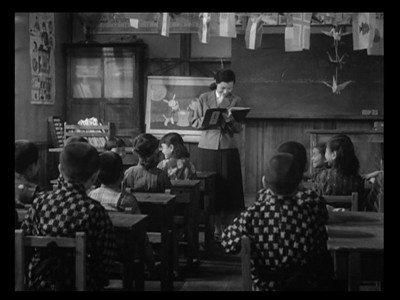
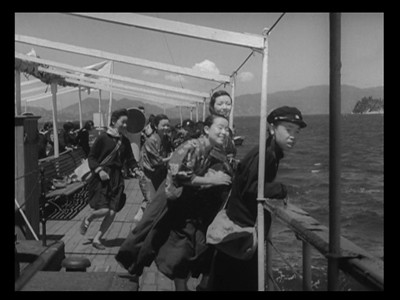
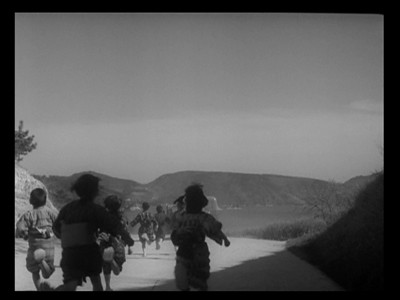
Showing posts with label kinoshita. Show all posts

Monday, September 19, 2016

SILENT OZU - THREE CRIME DRAMAS: DRAGNET GIRL - ECLIPSE SERIES 42


The most straightforward, and yet most complex, entry in the Silent Ozu - Three Crime Dramas set from Criterion’s Eclipse imprint is 1933’s Dragnet Girl, a dual drama about families and relationships and the effect the criminal lifestyle has on the ties that bind.

Joji Oka (No Blood Relation [review]) heads the cast as the charismatic gangster Joji. Formerly a boxer, Joji stepped out of the ring when he fell in love with Tokiko (Mizoguchi and Kinoshita mainstay Kinuya Tanaka, who also appeared in Ozu’s Equinox Flower [review]). Tokiko is a tough cookie in her own right, but she prefers a more domestic crime partnership that doesn’t involve her man getting pummeled on a regular basis. Though Joji has many would-be suitors, Tokiko chasea them all off, thus making it all the more surprising when a nice, quiet girl sneaks in and legit steals Joji’s heart.


Misako (Sumiko Mizukubo, Apart from You [review]) summons the thug to a corner rendezvous to ask him to encourage her little brother, Lefty (Hideo Mitsui), to return to school and give up trying to be a boxer and a crook. He looks up to Joji and would listen. Joji is taken with Misako’s purity and selflessness, and he starts spending his days in the music store where she works, listening to classical records. It’s a far more refined musical excursion than the rowdy nightclubs he usually attends with his gang. To many, Joji is becoming soft. Never mind he’s the guy we saw beat up three bruisers all on his own just a few days before. All it takes is one dame wanting you to settle down...


As the drama ramps up, Dragnet Girl crosses similar territory as Walk Cheerfully [review]. Misako’s positive presence inspires Joji to consider getting clean, and though she initially goes to the record shop with a gun to confront Misako, Tokiko is quickly smitten with her, as well. She thinks about ditching the bad-girl lifestyle modeling herself after her rival. The only one who can’t seem to get Misako’s message of peace is the one she wants to go straight, her little brother, who resists even after his hero threatens him.


Moreso than Walk Cheerfully Ozu toys with the notion of fate in Dragnet Girl. In the psychology of the script, which was written by Tadao Ikeda, the scribe behind Walk Cheerfully and The Only Son [review], working from a story by Ozu himself (hiding behind the pseudonym James Maki), we move closer to the inescapable doom of film noir. Neither Joji nor Tokiko find it easy to make a clean break, and in part because they don’t think they deserve it. Tokiko is offered an ideal marriage by her boss, but can’t see herself stepping into a housewife’s shoes; likewise, Joji must reject Misako in order to “get over her.” When it comes down to it, the only thing that this Japanese Bonnie and Clyde can count on is each other. Whatever their path to get to true love, at least they found it together, and they can get out of it together, too. Embracing a crime trope, Ozu positions them to pull one last heist with the intention of snatching some seed money and getting out of town. It’s a pretty ballsy robbery, with Tokiko leading the charge, and an even more hairy escape when the cops come knocking. Yet, Ozu avoids the expected final shootout, seeking a different solution for his lovers. Punishment offers redemption.


Dragnet Girl actually makes a pretty convincing case for sucking it up and taking your lumps. It doesn’t hurt that the impassioned argument for toughing it out is made by Tokiko. Kinuyo Tanaka has a solid screen presence, and her confident delivery, and the complex emotional swings that get her there, makes for the most convincing acting in the movie. As perfect and angelic as Sumiko Mizukubo is as Kazuko, Tanaka brings her character down to earth, so that she is both sympathetic and relatable. She’s really the only choice for the confused Joji, who frankly comes off as kind of weak-willed and not nearly as tough as he’s intended to be.

But then, Ozu’s women generally have been the ones who have had to carry the heaviest burdens, and who do so with a quiet strength unique to them. In that, Dragnet Girl is part of a long tradition of the filmmaker, even as he would soon leave its genre trappings behind.


Other selections from the Eclipse boxed set Silent Ozu - Three Crime Dramas are reviewed here: That Night's Wife.

Wednesday, January 21, 2015

KINOSHITA AND WORLD WAR II: PORT OF FLOWERS/THE LIVING MAGOROKU - ECLIPSE SERIES 41


The interesting thing about boxed sets sometimes is, if you’re not familiar with a particular filmmaker, they offer a crash course in his or her themes and style. You can build a foundation, either creating a starting point for further exploration (example: other Eclipse bundles like Early Bergman [review] or The First Films of Samuel Fuller [review]) or provide a broad overview, leaving you to fill in the gaps later (The Essential Jacques Demy [review 1, 2, 3, 4, 5, 6]).

With Japanese director Keisuke Kinoshita, my only prior experience had been with Twenty-Four Eyes [review], his 1954 film about a small-town schoolteacher. It was an assured drama lacking in histrionics, focusing instead on the common and, arguably, the banal--though, the “everyday” might be a more accurate term, as the small things are given equal weight to the stuff of bigger film narratives. One can immediately see the roots for that kind of storytelling in Kinoshita’s initial films, collected here under the banner Kinoshita and World War II. Indeed, the five films in this, the forty-first Eclipse collection, were made during and just after the war, and reflect Japanese life as it was being lived at the time.


The lead feature is 1943’s Port of Flowers, a seemingly light-hearted movie about two inept con men descending on an island town in hope of bilking the residents out of their hard-earned money. Shuzo (Eitaro Ozawa, When a Woman Ascends the Stairs [review]) and Tomekichi (Ken Uehara, Mr. Thank You [review]) mistakenly try to pull the same ruse. Having discovered that, at one time, an industrialist tried to build a shipyard in this village, only to have the Great Depression wash his dreams away, both men arrive within hours of each other claiming to be the son no one knew the industrialist had. Rather than blow the scheme, the two crooks pretend to be brothers, finding that the love the village had for their alleged father is so great, they are more than willing to believe anything.

They are also more than willing to drop every yen they have to help make the shipyard a reality, and before the con artists realize, they have more cash than they know what to do with. These small-time operators are not prepared for a big score, and fear that they’ll only mess it up. Add to that the charms of village life, and particularly the island women, and they start to have second thoughts about disappearing with the bounty.


Up until this point, Port of Flowers is fairly innocuous, offering only a slight social critique, particularly in relation to a young woman who had left the island in search of a more cosmopolitan existence, only to be sent back under questionable circumstances. There is also a division made between her brother (Chishu Ryu, Equinox Flower, Late Autumn, etc. [reviews]) and the other villagers, as he was able to go to Tokyo and attend college (an accomplishment the con men can’t even claim). Education is poised against traditional values. In its early stages, I assumed Port of Flowers was heading toward State and Main territory: the self-important city folk would find themselves taken advantage of by the country bumpkins.

That all changes on December 7, 1941. Following the attack on Pearl Harbor and the expansion of the war, a nationalistic surge takes over the town, and the con men find themselves swept up in it. If they can build a ship for real, the country could use it, and they can serve in their own small way.

It’s fascinating to see a story about Japanese patriots during the conflict, particularly as the war was still going while Kinoshita was making his film. Had Port of Flowers been made even a couple of years later, the drama would have a different tenor. As they say, the victors get to write history, and so most Japanese stories that followed show the regret and misgivings that were deemed appropriate in peacetime. Think of how some American pundits reacted to Hayao Miyazaki’s The Wind Rises [review] last year because its main character never questioned how the planes he was building would be used, and then imagine Port of Flowers being released today. Doesn’t it make sense that the Japanese citizenry would want their country to thrive and prosper and ultimately win? It’s no different than what Clint Eastwood was trying to do by leaving the politics out of American Sniper [review], and look how that turned out.


The thing is, there are no politics presented here, no anti-American or European rhetoric, just average folks seeing the direction their nation was heading and trying to do their part. Kinoshita avoids making the movie propaganda in this way, as opposed to say the straight-up rallying in something like Powell and Pressburger’s 49th Parallel [review]. While Kinoshita did have to get the approval of the government censorship board before making Port of Flowers, it doesn’t feel like he was being swayed to deliver a particular message.

Though, if he had to cut some things here or there, that might explain the abruptness of the ending. Without giving too much away, the con men disappear from the island before the ship they caused to be built is launched--and, indeed, on the same day some of the local fishermen are attacked by Allied submarines--without much explanation. We can fill in some of the pieces, but not to any exact detail. It’s almost like a reel, or at least a scene or two, is missing.


But then, if there is anything to quibble over in Port of Flowers, it’s some of  Kinoshita’s clumsy edits. Most noticeable are the times he tries to build tension by quick cuts that are so quick, they are practically subliminal. These mostly involve the local policeman, whom Kinoshita wishes to make an object of fear for his bumbling bad guys. Most of the rest of the movie has a much more patient mis-en-scene, more akin to Ozu, and thus it makes these sudden flashes of Hitchcockian style all the more jarring.


That said, the first-time director shows some flashes of ambition that work quite well. The natural setting, including the realistic sets, and the way Kinoshita handles the countryside, including bad weather, shows a confidence learned from his previous years as an apprentice. There is also one very effective sequence where the old woman Okano (Chieko Higashiyama, Tokyo Story [review]) relates memories of time spent with the real shipbuilder. She tells the story while on a carriage, and the scenery outside changes from the island view to a rear projection of a life she imagines for herself and her lost love in far away locales. It’s a pretty obvious technique to modern eyes, but it creates a dreaminess that perfectly evokes the feeling of having spent decades pining for what might have been. The effect is helped by Higashiyama’s careful performance. It’s a rare moment of vulnerability for a character who otherwise keeps her guard up. She is quite good, as are Ozawa and Uehara. The duo are subtly comic, avoiding going too broad, and thus making the poor intentioned thieves sympathetic rather than pitiable.


Nationalism is far less of a subtle topic in Kinoshita’s follow-up. Made the same year as Port of Flowers, The Living Magoroku is a propagandist fable, the kind of thing that might have run as a short subject between the cartoon and the main feature in wartime Hollywood, but here extended to full length.

The gist is this: in a rural community, the Onagi family maintains the same farmland that their ancestors fought on nearly 400 years prior. The Living Magoroku even opens with a flashback to samurai clashing on the meadow before cutting to modern-day warriors training for combat in the wilderness nearby. Superstition has left the family’s field untouched all this time. They believe that to break the ground would be to violate the spirits of the ancestors who fell there. The clan is currently overseen by its widowed matriarch (Mitsuko Yoshikawa, Apart From You [review]), who also believes she lost her husband at a young age, as the family has lost all of their men, for even thinking of violating the curse. Her own son, Yoshihiro (Yasumi Hara), believes he is suffering from lung disease. Outside influence is pushing him to cultivate the land, but he is scared.


Enter an army doctor (Toshio Hosokawa) and an ambitious sergeant (Uehara). Both are visiting the Onagi homestead for a similar reason. The doctor is looking to buy a vintage sword from the family, as he foolishly sold his own and needs to restore the lost heirloom and his good name; the sergeant believes he also has such a sword and wants it appraised. Between the two of them, they will sway mother and son to do the right thing.

The Living Magoroku was written by Kinoshita, as well as directed, and he attempts to stack the narrative, creating an ensemble of characters with similar goals and faults to match the Japanese climate of the period. The Living Magoroku consistently works on two levels, each chafing against the other, its own narrative locked in conflict. Kinoshita seeks a balance between tradition and necessity, superstition and reason, honor and pragmatism. Much like the educated man was seen as the voice of civilization in Port of Flowers, so too does logic and experience hold sway here. Land, armor, and weaponry are all things to be revered, but the battlefield is not as important as the fields where the citizenry lives and eats. Nor is sacrifice made only on the front lines.


This is the ultimate thrust of The Living Magoroku: each person must do his or her part, even if they don’t like it. Again, consider American drives for tin and rubber, or warnings how “loose lips sink ships,” the person next to you in this theater may be a spy. It’s not at all subtle, neither in its message nor even in its drama. (And, at its worst, the acting can either be stiff or corny in equal measures; at its best, unmannered and naturalistic.) Still, Kinoshita strives to find the humanity in it all. The personal cost can be repaid, and the group effort leads to extensive bonds. The sergeant strives to unite two young lovers who are unable to marry due to the argument over the land, and the doctor not only restores his family name, but he extends that family when it’s all said and done.


Though the writing seems heavy at times, the overall structure of The Living Magoroku is slick, with Kinoshita confining the action to a few small places, and also isolating the timeframe to two separate visits from both the army men. He also shows an increased movement through the scenes, including elegant pans from one happening to another, like moving from the ground up to spy through a window, creating an overall feeling of connectedness and realism. This is one world he’s operating in, one community. Likewise the visual connections between past and present, the objects and artifacts echoing back to those brief battlefield moments reminding us just how present history is in the day-to-day.


This disc was provided by the Criterion Collection for purposes of review. The stills shown are taken from the standard-definition DVD release and not the Blu-ray under discussion.


Wednesday, January 5, 2011

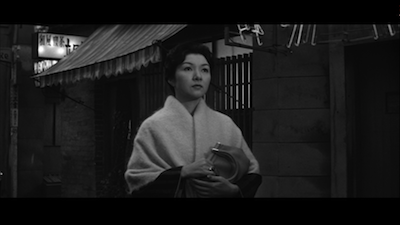
WHEN A WOMAN ASCENDS THE STAIRS - #377


The news went around on Monday that beloved Japanese actress Hideko Takamine had died, having lived a full life. She was 86. Takamine appeared in a staggering number of movies--177, according to IMDB. Her first was in 1929, her last in 1979. I'll admit, I haven't seen most of them. My hat is off to anyone who has. I think I've only seen the ones released by Criterion, with the most memorable for me being Keisuke Kinoshita's Twenty-Four Eyes [review]. In that film, Takamine played a young schoolteacher whose modern ways clashed with the small-town values of the village where she was assigned a school house, and who struggles to take care of the children in her care. It's a performance that is full of heart. Children are supposed to fall in love with their teachers, and as viewers, we fall in love with Takamine.


Hideko Takamine made quite a few movies with Mikio Naruse, including one of his most famous, the 1960 drama When A Woman Ascends the Stairs. As the only film in my library starring Takamine that I hadn't seen, it seemed appropriate to give it a look in honor of the actress' passing. When A Woman Ascends the Stairs is a sad film, though one that is never overly dramatic--even if some of its plot twists are straight soap opera. It also doesn't wallow. Takamine lends her character a plucky spirit that somehow spins all the bad events into a hopeful tapestry celebrating human resilience. The bar hostess Mama Keiko is a long way from the schoolteacher Hisako Oishi is terms of profession, but not in personality or allure. They are almost the same woman, especially as Oishi has seen a few things by the end of Twenty-Four Eyes. Both know heartbreak, but both have the strength to take care of themselves.

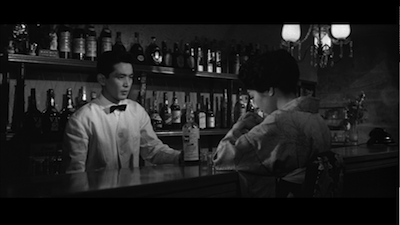
When A Woman Ascends the Stairs is set in the Ginza district, a post-War neighborhood where businessmen congregated to drink and carouse. There, the streets were lined with bars that featured women on staff as "hostesses." Their job was to entertain the customers and encourage them to buy drinks. Some extended their duties to after hours, either selling themselves one night at a time or becoming full-time mistresses.


As far as Keiko is concerned, that extra-curricular "duty" is for the lower-class hostesses. There are three tiers, as she describes it: the bottom resort to going home with clients, the middle take a train home, and the best hostesses can afford a cab. Or at least pretend they can afford it. It's common for women like Keiko to live beyond their means so as to foster the illusion that they are expensive prizes. Keiko's apartment is luxurious for a widow, but it goes with the profession. Her husband was hit by a truck not long after they were married, leaving his young bride to fend for herself. Keiko has been a hostess for five years, having been recruited by Komatsu (Tatsuya Nakadai, who also co-starred with Takamine in The Human Condition [review]) when she was a cashier. Komatsu is still her manager, taking care of accounts at the bar where Keiko oversees the other girls. Her position is why everyone calls her "Mama," including her clients, most of whom want to drink with a pretty woman and tell her about their day.


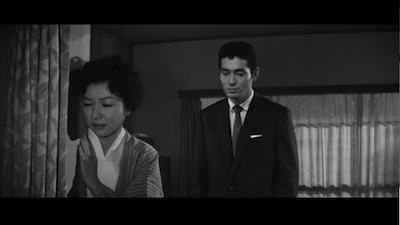
A pretty woman other than their wives, that is. Most of them are married, and most of them are in love with Keiko, though she knows they will never leave their families to give her the life she deserves. That is part of why she stays out of their reach, though one suspects from the get-go that she has more romantic tendencies than she lets on. Komatsu is in love with her, too, but he is either incapable or inept when it comes to showing it. Keiko really loves the banker Fujisaki (Masayuki Mori), one of the only men in her clientele who hasn't tried too hard to push her into something more (we see her refuse out-of-town trips, start-up money for her own bar, and even lunch dates). Not that he's really that good of a guy. I mean, Jesus, he's a banker!


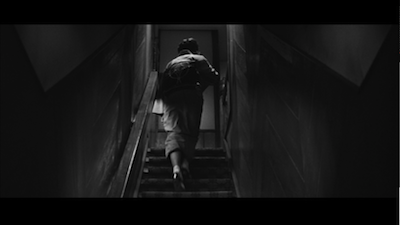
All of this works for Keiko, but it doesn't make her happy. The title When A Woman Ascends the Stairs refers to her nightly journey upstairs to the bar. It's a climb she dreads. She knows this occupation is beneath her, and she doesn't even like alcohol very much. It's a struggle every day to keep from compromising her values. Much of the ins and outs of life in the Ginza are explained to us by Keiko in voiceover. She is a thoughtful woman, prone to otherwise keep what is really going on to herself. She is also crafty, having learned how to dodge men's advances and to lie her way out of scrapes. The bulk of Naruse's movie, shot from a script by producer Ryuzo Kikushima (a regular contributor to Kurosawa films), focuses on the season when life decides to pile on Keiko. An ulcer, a failed business venture, needy family members, multiple proposals--it's more than a lady should be able to take.

Keiko holds on longer than most would. As an actress, Hideko Takamine brings an inner strength that informs Keiko's outer bearing. Back straight, chin-up, smile when appropriate--these are the traits of a good hostess. Your troubles are bundled inside your kimono, the bar is not the place to let them out. This demeanor deteriorates over the course of the story, even as Keiko does her best to avoid traps she sees others fall into. A protégé's desperate actions after she opens her own bar, only to spiral into debt, serve as a cautionary tale. Yet, superstition and plain old bad luck tear at Keiko. As she grows more weary, her mistakes become more grand.


In terms of performance, the most appropriate metaphor I can think of is that Takamine sees Keiko as a porcelain doll, and with each successive scene, invisible hands are chipping away at her painted exterior. Takamine proves exceptionally capable of showing the decline. She has a sweet face and a charming overbite, and though at first her seductive traits may not be obvious, it's an actress' job to be everything to everyone; thus, the role of a woman who morphs into the thing most desired by whomever is looking at her at any given time should be ideal for a performer. Likewise, an actress needs to still be herself when she steps off set, to leave the role behind. One assumes that Takamine's own experience, having been in the business for three decades by the time she made When a Woman Ascends the Stairs, gave her a special connection to Mama.

By the time When a Woman Ascends the Stairs is in its final reel, it's hard to imagine that it can go anywhere positive without selling itself out. We have seen so many things go bust by that point, and the movie has maintained such a sense of internal realism--Masao Tamai photographs Tokyo so that its neon looks gorgeous in black-and-white--it would be impossible to accept that events take too dramatic a turn. Thankfully, Naruse and Kikushima place enough faith in their actress and the level of trust she has earned from their audience in the preceding 105 minutes to know that it's really just reliant on her to pick herself up, dust herself off, and carry on. Even better, Takamine is so good at what she does, she not only makes us believe that Keiko will carry on, but when we hear her final words, the oft-spoken greeting she gives to all of her customers, we accept that she believes them as never before. And somehow, some way, that makes us feel good for her. We want Hideko Takamine to be okay, and she has assured us that, no matter what, she will be.


* Also look for Hideko Takamine in Tokyo Chorus (part of the Eclipse Silent Ozu box) [review].

Friday, August 15, 2008

TWENTY-FOUR EYES - #442


Let's face it. If we were to take a poll to find out what film genre has the greatest tendency for mawkish sentimentality, it would probably be films about the lives of teachers. Whether it be the countless tales of inner-city educators pushing their troubled pupils to be all they can be, or the variations of Mr. Holland lamenting their lost opuses, romanticized versions of a very tough job quite often go for the emotional jugular in the most obvious and direct of ways.

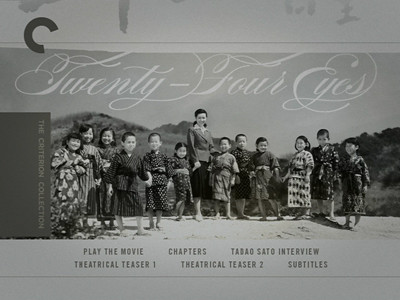
Thus, when a movie like Keisuke Kinoshita's 1954 schoolroom epic Twenty-Four Eyes (Nijushi no hitomi) comes along, it's cause for celebration. As with any abused genre, it's not the form that's bad, just the use of it. Either that, or Twenty-Four Eyes, now coming to DVD in North America for the very first time courtesy of the Criterion Collection, is the exception that proves the rule. Sure, it's ripe with sentimentality, but we need to get over using that as a buzzword for "bad." Humans are sentimental creatures, and we turn to movies to make us feel. Sentimentality done poorly makes us groan, but when done well, it inspires a true gut reaction. If you don't tear up at least a couple of times in Twenty-Four Eyes, you apparently have rocks where the rest of us have brains and hearts.


The focal character in Twenty-Four Eyes is Hisako Oishi, played with a mannered grace and honest tenderness by Hideko Takamine (When a Woman Ascends the Stairs). In 1928, Miss Oishi is sent to a poor seaside village to test out her newly minted teaching license on the first grade class. Seen as a "modern girl" because of her western-style clothes and because she rides a bicycle to work, Hisako is mistrusted by the adults of the town but quickly earns the love and admiration of her twelve students. In their eyes, the twenty-four alluded to in the title, she sees the sparkle of a future full of possibilities, and in her, they see someone who cares whether or not they achieve them. Her last name actually translates as "Big Stone," but because she is short in stature, the kids nickname her "Miss Pebble," unwittingly creating their own Zen koan. In the smallest pebble is the greatest of power.

Twenty-Four Eyes spans nearly twenty years, following the ups and downs of the relationship between Hisako Oishi and her many students. A prank the kids pull on her causes her to tear a tendon and cut her inaugural year short, but the class catches up with her again in sixth grade when they find her at the central school in the next town over. From there, she watches them all graduate into different lifestyles, some going on to high school, some working for their families, and others marching off to war. For her own part, Hisako gets married, has her own children, and lives through WWII and personal loss, only to come full circle and instructing the sons and daughters of her original twelve in the little schoolhouse where it all began.


With a running time of just over two-and-a-half hours, Kinoshita manages to deliver a lot of story without ever getting caught up in overly lengthy tangents. It might have been tempting to follow the little girl whose family goes bankrupt and has to move away, or to see any of the male students lost on the field of battle, but Kinoshita has a keen sense for how people flow in and out of our lives. He sticks with Hisako the entire time, rather than let any of the more romantic characters take him away from her story. In fact, this may be how he avoids falling prey to crass emotional ploys. Seeing a 12-year-old girl reduced to begging in the streets or a big death scene as Allied shells rip up the terrain all around the dying would have forced a sense of loss on us; instead, it's the not knowing that hurts, the drifting away of these characters that we've invested our time in alongside Hisako.

Twenty-Four Eyes was a popular film in Japan when it was released, and it's still considered a national treasure to this day. I imagine for the Japanese it served a similar purpose to what William Wyler's The Best Years of Our Lives did for the American psyche when we were preparing to deal with the end of the war. Kinoshita tackles multiple social issues within his narrative, crafting unadorned portrayals of poverty and the frustrated aspirations of his young stars. (If there was ever a better ensemble of child actors, I'd like to see it.) His is a soft approach, borrowing much from Ozu, and the writer/director gingerly shows his audience how closing off opportunities for the nation's young people was analogous to the fractured idealism in post-War Japan. The loss of innocence for the few stood in for the loss of innocence for the many.
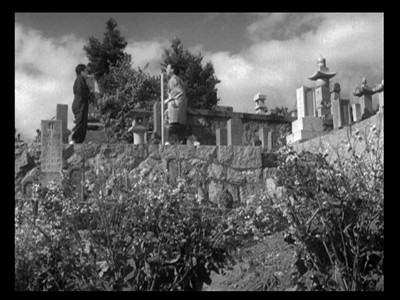


Just as it would have been easy to become overwrought when detailing the personal tragedies and triumphs of Hisako and her students, so too could Kinoshita have gone astray my being more heavy handed in his anti-war message. In the years between Hisako's first class and the advent of WWII, Japan went through the Great Depression and had a continuing conflict with China. The rise of militarism offered young men a chance to have a career, gathering such steam that it practically created a need for a greater conflict. Rather benign expressions of peace cause trouble for Hisako more than once, nearly getting her branded a "Red," and without putting too fine a point on it, Twenty-Four Eyes indicts the prevailing attitudes that would allow such a bloodthirsty and paranoid way of living to take hold. Patriotism is often the banner under which a nation rends its own flesh from its bones.

At the same time, Kinoshita, like his soft-spoken protagonist, is a humanist, and he's not going to point a finger without also holding out a hand in an offering of hope. One need only look at the great care with which he photographs the mountains and the seashore of the fishing village to see how much the director loves his country. By having Hisako return to the rundown schoolhouse and start again, to have her inspire a new generation the way she inspired its parents, is to say that life can go on, that the Japanese people could get back on the proper path, and that the future rested right where it always did--in the dreams of the young.


For a full rundown on the special features, read the full article at DVD Talk.