Showing posts with label kurosawa. Show all posts

Friday, August 31, 2018

THE OUTRAGE - FILMSTRUCK

This review was originally written for DVDTalk.com in 2009.


Hollywood was all over Akira Kurosawa from the get-go. Not in the "We revere you so much we're going to import your movies" sense, but in the "No good idea is too good for us to think we can do better but most likely ruin" sense. Quite a few of his more famous samurai action pictures have been turned into quite a few westerns with a variety of results. Yes, it's hard to believe, but one of cinema's greatest directors was treated the way Hollywood now treats foreign horror movies: grist for the remake mill. Though I knew that a ton of different productions had ripped off the basic Rashomon concept of one story told from multiple yet conflicting points of view, I didn't know anyone had ever had the cajones to remake the 1950 classic in its entirety. Turns out there was a stage version written by Fay and Michael Kanin, and it was even filmed for television twice (including once by Sidney Lumet) before Martin Ritt decided to turn it into a full-fledged film in 1964. The Outrage placed Rashomon in a remote outpost in the post-Civil War American West, and it's a surprisingly obscure effort given that it's both Ritt's and Paul Newman's follow-up to the Oscar-winning Hud.

Then again, maybe it's not so surprising. When I worked in video retail, a customer once told me that he had a theory that the more stars there are in a movie you've never heard of, the worse that movie is likely to be. In addition to Newman, The Outrage stars Edward G. Robinson, Claire Bloom, William Shatner, and Laurence Harvey. It's not exactly a Cecil B. DeMille Greatest Show on Earth ensemble, but that's a pretty solid roster. Not exactly no-names, though not exactly A-List--just as The Outrage is not exactly awful, but not really a classic either.


The story of The Outrage pretty much follows the Kurosawa model: three men gather in a desolated area and end up discussing four different versions of one terrible story. In this case, Shatner plays a preacher who is waiting for a train at a rundown station in hopes of catching the next trip out of town, his faith in humanity shattered along with his belief in the absolute. Waiting with him is the downtrodden prospector (Howard Da Silva) who wants to convince him not to go and a conniving huckster (Robinson) in hiding lest the people he ripped off find him. The day before there had been a trial for a crime perpetrated against a traveling couple. As the verdict stands, the notorious outlaw Juan Carrasco (Newman) raped Nina Wakefield (Bloom) and murdered her husband, Colonel Wakefield (Harvey). At least, that was how Carrasco told the story, but Mrs. Wakefield had a different version and a medicine man (Paul Fix) who heard the Colonel's dying testimony delivers a third. Though Carrasco's past crimes made him an easy conviction, the truth seems lost somewhere in all the variations.

Turns out, there is a fourth version, one known only by the prospector, who as far as the court knows only found the body, but who in reality tells the preacher and the con man that he saw the whole thing from the bushes. Yet, there are reasons to doubt his version, too, as his self-serving secrecy undermines his credibility. The con man's cynical worldview may be the truest of all, that humans are suckers and liars. It makes a certain level of sense, especially when you consider that each person's scenario is more favorable to them. Each teller of the tale is a winner of sorts in their own version. Yet, that is also the most obvious interpretation, and Kurosawa's Rashomon provokes a much deeper response. Truth is not merely subjective, it is also unknowable. How each of us lives is dictated by how well we can reconcile ourselves with that principle.


Martin Ritt and the Kanins (Michael Kanin is credited with adapted screenplay) don't entirely remove the grander meaning for The Outrage, but their fourth act ends up being a rather fatal misstep that comes across as far less convincing and far more blatant than Kurosawa's Rashomon. While the first three stories, the ones told by the bandit, the wife, and the husband, are fairly accurate to the Japanese film, the prospector's version is portrayed as first a broad Southern melodrama before descending into a slapstick fist fight between Paul Newman and Laurence Harvey. The rape is suddenly treated like a punchline, and the decision to change how the Colonel dies in the prospector's story also makes it seem like a cruel joke, a misfortune perpetrated by the indifference of the universe. If the prospector's tale in the real truth, life would then be a B-movie rather than a human tragedy.

The acting is all very good up until that last story, too, with everyone playing his or her roles with the appropriate gravitas. The switch is so severe for the prospector's story, you almost have to wonder if it was all cooked up following a rather wild party and everyone was too drunk to be operating such heavy machinery. Even Shatner kept most of his hammy tendencies in check, though at times this early performance already shows signs of his trademark delivery (in terms of speaking style, he's kind of the Christopher Walken of his day). I'd actually give the top acting marks to Edward G. Robinson as the sharp-talking roadshow salesman. The veteran actor is the most comfortable up there on the screen of any of them, and his skills as a raconteur serve him well.

I'd have been curious to hear how an older Paul Newman reflected on the time he played a Mexican, with dark make-up and all (what is that? tan-face?). To his credit and the credit of his Actors Studio training, he buries himself in the part with the same amount of respect he would give any other role. Though I suppose some could grumble about his accent and gruff voice he adopts (did he study Treasure of the Sierra Madre in lieu of a dialect coach?), he largely manages to avoid racial caricature. In fact, the writing seems to be informed by an awareness of how the Mexican people might have been viewed at the time and includes allusions to racism and shows Carrasco playing at being a stereotype to lure Col. Wakefield into his trap (indeed, even relying on the white man's greed). Beyond the voice and the make-up, I don't get the sense that Newman would have played it any other way if his character were a white bandit named Carson rather than a Mexican one named Carrasco.


If there is one compelling reason to watch The Outrage, it's the sure-handed direction that Ritt displays for most of the movie, as well as the beautiful photography by James Wong Howe (The Sweet Smell of Success). From the rainy railway station that provides the story frame, the waiting men looking like an early test version of the trio at the station at the start of Sergio Leone's Once Upon a Time in the West, to the open desert and the way the people crowd into the town square to witness Carrasco's trial, Ritt and Howe use the wide open spaces of the West to show how remote this little pocket is, how isolated the pioneer is from polite society. They capture every gorgeous detail, every cactus and every raindrop, using the Panavision process to its full limits. In contrast, the little oasis where the crime goes down is softly lit, like a pocket dimension within the greater frontier. The Outrage is a gorgeous movie, tightly edited by Frank Santillo (who also worked with Sam Peckinpah on his more thoughtful movies), an expertly constructed movie from start to finish.

But a technical triumph is still only as big a victory as the script allows, and alas, there is no way around the pitfalls of The Outrage. While the first sixty minutes are very good, if a bit unnecessary given the existence of the Kurosawa original, the final thirty are a terrible blunder. There is little reason to watch a flawed version of Rashomon when you can just watch Rashomon--and that you can take as the absolute truth in a world of wishy-washy opinions. Anyone who says different is either lying or wasn't really there!


Sunday, November 27, 2016

AKIRA KUROSAWA'S DREAMS - #842


Akira Kurosawa is a filmmaker I discovered in high school, in the 1980s when VCRs and video stores made all kinds of movies newly accessible to budding cinephiles. Most likely fueled by Siskel and Ebert, whom I recall covering Ran [review] on their program, I was able to get a hold of that movie, The Seven Samurai [review], and others. It wasn’t until the 1990 release of Akira Kurosawa’s Dreams, though, that I first got to see one of his movies in the theater, and one of only two occasions where I could have seen the movie in first run.

It’s easy to remember the occasion. I was starting my first semester in college, and had been so eager to do so, I arrived at my dorm the first day they’d give me keys, a full weekend before classes started. Any illusions of being some part of an instant community didn’t materialize that weekend--nor, ever, if I’m honest--and I needed to find something else to do. So it was that I ended up at the Beverly Center in Los Angeles, watching Dreams in a shoebox theater with a handful of other people, taking in one of the Japanese director’s more unique works. It was good timing for me, I was fascinated by the concept of dreaming, so much so that I used to keep a diary of my own dreams, a habit I maintained for many years. As someone who has always been disappointed by the use of dream sequences in entertainment--they are usually cheap gags with an exaggerated level of nonsense and far too self-aware--I was curious how the master filmmaker would undertake such a personal subject.


Interestingly enough, Kurosawa’s approach to re-creating his own nocturnal visions has far less of the contrivances that we have come to expect from most film directors, and more to do with tradition and spectacle. From the opening segment of this anthology, Kurosawa establishes his aesthetic--a portrayal of a world that is so familiar and real, we have little cause to question the more fantastic aspects of the stories. And even as things do get fantastic, the use of practical effects and, in the case of the childhood visions like the fox’s wedding and the living tableau of dolls, costumes and masks reminiscent of kabuki theatre ground us. The mysticism and magic is transformed into recognizable pageantry. Kurosawa doesn’t surrender entirely to the dream logic--there are no sudden shifts in circumstance and place, and little that goes unexplained--but rather weaves that logic into the everyday.


Dreams is essentially eight vignettes, each detailing a dream Kurosawa actually had, sometimes combining them with classic Japanese folklore. The selection is seemingly random, but as you watch them all back to back, a structure and narrative pattern emerges. Not only do the chosen dreams arrive in chronological order, from childhood to adulthood and even potential images of the future, but in each, we are presented with a subtle moral complication. Choices that either Kurosawa makes, or that mankind decides on collectively, are leading us toward destruction. In the childhood dreams, a young Kurosawa (Toshihiko Akano and Mitsunori Isaki) either goes against tradition or is witness to its abandonment. The destruction of the peach orchard in the second dream is echoed years later, in the post-apocalyptic visions of a nuclear Japan in the penultimate vignette, “The Weeping Demon.” The titular devil (Chosuke Ikariya) notes that the charred wasteland they are meeting on was once a beautiful field destroyed by toxic waste. In one of Kurosawa’s most powerful images, they sit amongst the only plants that now grow: towering dandelions, more than twice the size of the human and mutant observers. Nature will come back with a vengeance if we fail to understand our folly.


This message fits a certain post-War philosophy also seen in the films of Hayao Miyazaki. Mankind is on the wrong path, more concerned with convenience and power than it is with recognizing and preserving what it has. Though Kurosawa teeters on the brink of being preachy, his simplest message is expertly embedded in what is probably the most famous portion of Dreams. Positioned at the center of the film, it features Kurosawa as a young man (Akira Terao, also in Ran and the director’s final film, Madadayo) entering the paintings of Vincent Van Gogh. In a landscape decorated to look like some of Van Gogh’s paintings (and then actually turning into those paintings), Kurosawa finds the artist himself, appropriately played by Martin Scorsese. The American director brings his fast-talking, manic energy to the part, and it’s perfectly suited to the message Van Gogh is supposed to deliver: life moves too fast not to take in the scenery and transform your appreciation of the same into something more.


Which is really what Kurosawa is trying to tell us in Dreams, and is pretty explicitly stated in the final parable. We have all we need and our drive to conquer the elements and combat one another for dominance is only pulling us away from appreciating that. Look how quickly, for instance, the vivid colors of Van Gogh’s art transform into the deadly rainbow of the nuclear fallout in the dream that immediately follows. Rather than avoid death, we turn it into something aesthetically pleasing.

What keeps Kurosawa’s message from becoming overbearing or even maudlin is the wisdom the storyteller has gathered over his years, and his own ability to recognize the significance of his subconscious visions. This should be every artist’s mission, to communicate what he or she knows deep down in a way that both informs and compels the audience to further improve. Dreams isn’t an indulgent exercise in how weird Akira Kurosawa can get, rather it’s a marshaling of unavoidable emotions. Kurosawa had these eight dreams, and they stuck with him long enough for him to puzzle out their hidden meanings and then reconstruct them into a puzzle all his own.


Akira Kurosawa’s Dreams hasn’t been the easiest film to see in recent years. Since the 2003 DVD went out of print, it’s only been available through the manufacture-on-demand Warner Archive, working with the same outdated transfer. Criterion’s newly restored 4K print is exceptional, capturing all the painstaking details Kurosawa put into the film. (Sometimes too well. The animated crows in the Van Gogh segment now look a little obvious in high-def. Luckily, such unnatural effects work just fine in this kind of situation; dreams aren’t always perfect.) Accompanying the new transfer are multiple extras, including a long 1990 making-of documentary and a more recent 2011 appreciation of Kurosawa and the film, featuring Scorsese, Miyazaki, Bernardo Bertolucci, and more.


This disc was provided by the Criterion Collection for purposes of review. The images above are taken from a previously released DVD version and not the Blu-ray being discussed.

Monday, November 23, 2015

IKIRU (Blu-ray) - #221


Akira Kurosawa was still a relatively young man in 1952 when he made his elegy for old age, Ikiru. Yet, somehow the director still managed to make a deeply felt and wisely observed drama about obsolescence and dying.

Ikiru, which translates as “To Live,” stars Takashi Shimura, the dramatic heavy of Seven Samurai [review], as Kanji Watanabe, a reliable career man at City Hall. Watanabe is known for his predictability: he hasn’t missed a day of work in three decades, and each of those days, he ate plain udon noodles for lunch. So it is that the entire office is rocked when Watanabe fails to show up one morning--a morning that stretches into five days. What could have happened to the man?

Well, we know, even if everyone in the film does not. Watanabe has been diagnosed with stomach cancer and only has six months to a year left. Unsure of what to make of this news, Watanabe decides to keep it to himself. He doesn’t tell his staff, nor does he tell his son and daughter-in-law. Instead, Watanabe enters a kind of fugue. He wanders the city looking for the life he previously rejected in order to raise his offspring. His wife died when their son was very young, and as we see in a series of flashbacks, Watanabe put everything into making sure the boy had a good life. How devastating it must be then, that now that it counts, the old man can’t trust his son with the most important news he’s ever had.


Watanabe spends one night on a bender with a libertine writer (Yunosuke Ito (The Burmese Harp, I Will Buy You [review]) and then he also connects with a young woman from his office (Miki Odagiri) who is bored and herself looking for a change. He confides in these people what he can’t tell anyone else, and at first this provides some succor. There’s only so much frivolity a man of purpose can endure, however, before he must find that purpose again. For Watanabe, it’s undertaking a project no one else wants and proving that City Hall can be more than just paper pushers. One last stand to do something that matters.

Whether or not this worked is the subject of Ikiru’s final act, when Watanabe’s co-workers debate what caused such a change in the man they had only known to be unwavering and meek. It’s an interesting shift, one that allows Kurosawa to avoid portraying Watanabe’s inevitable end, even if the outcome is pessimistic. If you can’t fight City Hall, you probably can’t change it, either.


Ikiru goes to plenty of emotional depths and ponders the darkness with an unflinching courage; yet, it is never dull, much less morose. You’d think watching an old man waiting to die would feel a little bit like death itself, but Takashi Shimura has a sympathetic face and an undeniable screen presence that makes it impossible not to watch and wait to see how it turns out. Kurosawa is not the only one taking a few metaphorical steps forward in tie, Shimura is playing it older, too. Watanabe is slow and hunched and speaks at a level only slightly above a whisper; it’s almost like you have to lean in yourself to hear what he is saying and share in what is happening. And plenty happens--though it’s mostly disappointing for Watanabe. He realizes how little his life has affected, and how much he has been taken for granted. Shimura’s stooped posture makes it look like he is hunting for something, and perhaps he is. Perhaps he’s looking for that lost spark to reignite Watanabe’s passion in his final days.


As low-key as this all may sound, the results are riveting. At times, Kurosawa stages the tale with as sure a footing as most see in Watanabe. As the old man loses that footing, at times we tumble into a kaleidoscope of memory. Past decisions are seen to have a direct effect on the present, and it’s heartbreaking to see all of that effort come out wrong.

Or does it? Surely our estimation of Watanabe is different than his estimation of himself. Because even if you can’t change the system, one individual really can make a difference. Watanabe’s newfound stubbornness, which he enacts in an almost zen-like fashion, turning the subtle force of his meekness into undeniable insistence, forces his co-workers out of their complacency, even if it is just to make the old man go away. Folks who never met Watanabe before also see him as an immovable object. When gangsters who would rather see the park land turned into a red light district come to strong-arm the city officials, they find they are no match for Watanabe. They look in his eyes and see he will not be moved. On the flipside, Watanabe makes positive change where it counts: in the lives of the people living in the neighborhood that gets transformed.


Those among you looking to upgrade your previous edition of Ikiru will be happy to know that the 4K digital transfer on the new Blu-ray is well worth swapping for. The image is not without its flaws, there are occasional irreparable scratches on the short, but the overall clarity is quite wonderful. The old extras are also carried over, including the Ikiru-specific installment of the excellent Akira Kurosawa: It Is Wonderful to Create documentary series that spans many of the Criterion Kurosawa releases.


This disc was provided by the Criterion Collection for purposes of review.


Saturday, October 17, 2015

WHEN HORROR CAME TO SHOCHIKU: GOKE, BODY SNATCHER FROM HELL/THE LIVING SKELETON - ECLIPSE SERIES 37


Well, if there was any prevailing motto for the horror movies being made at the Japanese studio Shochiku in the 1960s, it was “anything goes.” Their films were defiant of genre, narrative structure, logic, and yet embracing of imagination, ambition, and the glee that comes with throwing caution to the wind.

Two from 1968 nestled in the middle of the WhenHorror Came to Shochiku boxed set, Goke, Body Snatcher from Hell and The Living Skeleton couldn’t be more different. One is a color sci-fi mash-up that sits right alongside any flying saucer schlock to be found in an American drive-in; another is a black-and-white ghost story more in the tradition of Val Lewton. Both narratives stem from a horrible accident on a travel vessel--a crashing airplane, a massacre on a boat--but there the similarities end.


Goke, Body Snatcher from Hell was directed by Hajime Sato. It has many of the hallmarks of a smart B-movie production in that it makes do with a limited budget by isolating the events. In this case, a commercial airplane is stranded in the middle of nowhere after being knocked from the storm-torn sky of an alien invasion. Once the craft is on the ground, surviving crew and passengers must wait out the storm and each other’s dwindling patience. Things were tense even before the crash. An anonymous tip told the crew there was a terrorist bomber on board, and while the hunt for him didn’t uncover any explosives, it did expose a hijacker (Hideo Ko) who had smuggled a gun in his luggage. Rather than be detained after the accident, the bad guy takes the stewardess (Tomomi Sato) hostage. His flight from justice only leads him to the alien craft, however, and the gelatinous ooze that has come to Earth looking for a host.


The image would not be out of place in a horror manga. The hijacker’s face splits open and the alien goo crawls inside. Once possessed, the hijacker starts hunting down the other passengers, sucking out their life force like a vampire. One by one, the crew falls, but not before their class positions and particular sins are exposed. It’s like Kurosawa’s TheLower Depths crossed with Hitchcock’s Lifeboat [review]. Amongst the passengers are a corrupt politician (Eizo Kitamura), a feckless arms dealer (Nobuo Kaneko, The Human Condition [review]), and an American widow (Kathy Horan) grieving for the husband she lost in the Vietnam War. The original bomber, as it turns out, was only faking, looking to have some kicks in a world he finds boring, using violence as his own private stimulus.

There is a fairly clear anti-war message here. The aliens, it is theorized, have managed to infiltrate humanity because everyone is so busy fighting each other, they can’t see the threat from beyond the stars. Thus, the bickering fliers are a microcosm of the macro problem. They can’t agree on anything, so they all die. Goke seems sadly prescient. Many of its horrors are relevant to today. Terrorism, privacy, disagreements about science, birds mysteriously falling from the sky--or, committing suicide, as it were. It could just as well be our own timeline the plane is hurtling threw. Albeit, minus the aliens, plastic special effects, and silly plot machinations. Hopefully our world will be absent the bleak ending, as well.


There is some influence of the French New Wave evident in how the scenes of war are cut into the sci-fi monster narrative: random flashes of overexposed violence doused in red flash across the screen at the mere mention of Vietnam. Actually, that’s another element Goke has in common with The Living Skeleton. Sketchy memories of the inciting massacre reappear throughout, just quick splices to remind us of the bloody horror that set all the later spookiness in motion.
Directed by Hiroshi Matsuno, The Living Skelton seems more serious minded than the Shochiku films viewed previously, though with no bigger budget and no better special effects. Hell, there isn’t really a living skeleton, just a lot of fake skeletons anchored to the bottom of the ocean. And they look no more real than the bats that serve as bad omens for the evil men whose greed kicked everything off.


In the opening scenes, a gang of opportunistic pirates attack a sailing vessel and kill everyone on board. Jump ahead three years later, and Saeko (Kikko Matsuoka), the twin sister of one of the murdered, accidentally stumbles on the ship’s ghostly wreckage while scuba diving. She communicates with her lost twin through whatever dimension separates the living from the dead and learns all about the crime. Now having seen the faces of the men responsible, the surviving girl starts posing as the ghost of her sibling, scaring the crooks into their own untimely deaths.

Though essentially a ghost story, its criminal underworld setting adds a touch of noir to The Living Skeleton before eventually careening off into mad scientist territory and even a little tragedy. There are also Christian overtones throughout. The living twin spends much of her time at church commiserating with the priest (Masumi Okada, Crazed Fruit). And, of course, the chaste Saeko only finds the underwater skeletons after having sex with her boyfriend (Yasunori Irikawa, Samurai Spy). Some tropes don’t just transcend genre, but international borders.


The Living Skeleton doesn’t ever really get scary, though credit to cinematographer Masayuki Kato for getting the look just right. The moody photography creates an otherworldly atmosphere. Like the rocky terrain of Goke, Body Snatcher from Hell), the foggy seaside of The Living Skeleton could be everywhere and nowhere. It is of no real origin, of no real time. Kato and Matsuno get inventive with some of the underwater shots, placing the characters in a kind of netherworld. It could be under the ocean, or it could be outer space, or perhaps this is just where we go when we die.


Which, again, sort of encapsulates what is going on in the When Horror Came to Shochiku set. Whether from above or below, from within or without, the threats are indescribable, boundless, and ultimately deadly. Yet, even with the body count, they’re also grand fun.  


Wednesday, February 15, 2012

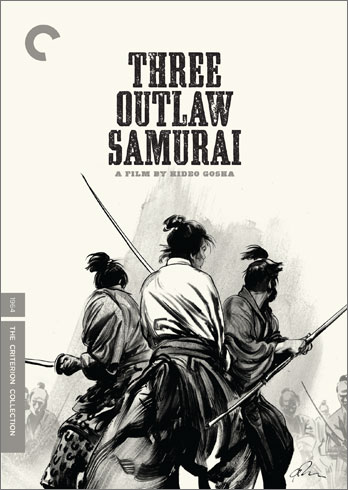
THREE OUTLAW SAMURAI (Blu-Ray) - #596


Hideo Gosha's Three Outlaw Samurai could easily be dismissed as a simple exercise in genre, but to do so would be to fail to see just how potent well-executed genre material can be. Released in 1964, it has as much in common with the work of Sergio Leone as it does with Akira Kurosawa. Though, given that the trio here predates Leone's The Good, the Bad and the Ugly by a couple of years, one could go a bit nutty trying to figure out who influenced whom.

Tetsuro Tamba (Kwaidan, Blackmail Is My Life) stars as Sakon Shiba, a wandering swordsman who ends up in a situation he didn't plan on. He finds a fancy hairpin in the grass, which leads him to enter a nearby shack. There he finds three peasants holding a young girl (Miyuki Kuwano) hostage. She is the daughter of the local magistrate, and they have kidnapped her to try to bargain for better living conditions. Shiba is amused by the idea. He is pretty sure the peasants are in for a terrible wake-up call. He cynically settles in to observe the fun.
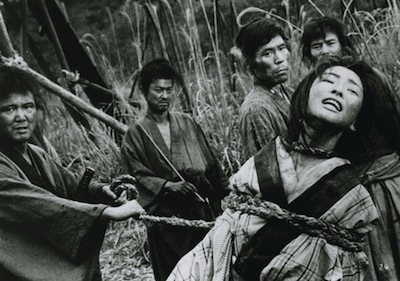


Only, when the man comes for his daughter, Shiba's sense of fair play kicks in, and he stands up for the locals. With this first rescue attempt having failed, and with the magistrate's boss due to arrive in town in a matter of days, the situation is about to turn humiliating for the official. He puts a local samurai, Kikyo (Mikijiro Hira, Sword of the Beast), in charge of the operation, a job that the laconic warrior takes halfheartedly. He is only in the man's employ to take advantage of his wealth, and what happens to anyone else doesn't matter much. He gathers a handful of ronin from the jail to take out to the shack and kill Shiba. Among them is a vagabond samurai named Sakura (Isamu Nagato). Like Shiba, he starts off amused by all the goings on; it's only when he hears the true story that he switches sides and joins the cause of the lower classes. His only sticking point is he accidentally killed one of the farmers who was trying to sneak the men food. Out of guilt, he starts looking after the dead man's wife (Toshie Kimura), and they end up falling in love.

What is supposed to be a simple rescue mission grows increasingly complicated as Three Outlaw Samurai progresses. Shiba makes a deal with the magistrate to save the kidnappers' lives, but when the scoundrel reneges, the crusade is renewed. Shiba is definitely meant to be the traditional, stand-up swordsman. His punishment at the hands of the bad guy, and his subsequent recuperation, has particular echoes of how Clint Eastwood's Man with No Name would be beaten within an inch of his life, only to hole up in a cave and let his body heal. If this were a Kurosawa movie, Shiba would be played by Toshiro Mifune. He's the crafty schemer who can't let a bad deed go unpunished. Tamba lacks Mifune's charisma, but then, most actors do. Even so, he's a solid hero, speaking with authority and more than able to hold his own in combat.


Actually, Sakura could have been a Mifune role, as well. He is a more mannered version of Mifune's character in Seven Samurai [review]--gruff, hairy, physical. Nagato brings levity to the part, and he is most impressive when faced with tough choices. On the flipside, Hira's portrayal of Kiko vacillates between villainy and nobility. He is eventually compelled to join the others in their efforts, though reluctantly so. All the characters in Three Outlaw Samurai are faced with a decision: go with the flow regardless of who is hurt, or draw a line in the sand and protect those who need it. For Shiba, Sakura, and Kikyo, choosing to go against the powers that be makes them outlaws, but it also makes them heroes.

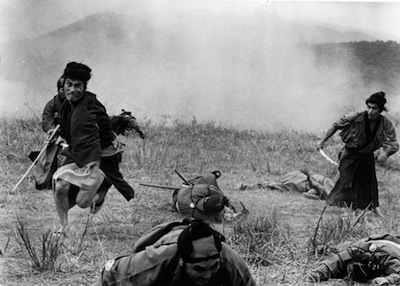
Three Outlaw Samurai was Hideo Gosha's first directorial feature, and the beginning of a long career. He co-wrote the script with two other writers, including Eizaburo Shiba, who he would work with again on Sword of the Beast. The film was shot by Tadashi Sakai, who would only end up behind the camera for three more movies, two of which were directed by Gosha. Despite this crew being fairly unseasoned, Three Outlaw Samurai is an accomplished effort. The sword battles have the right balance of clear choreography and chaos, and Gosha juggles the narrative's many elements without losing focus. The ending is particularly satisfying for its cynical take on human nature, but it also features technical flourishes that add a surprising kick to the finish. In particular, when Shiba loses his cool and goes hunting for the magistrate, Gosha, Sakai, and editor Kazuo Ota get him there quickly by employing quick cuts and zooms. It's shown from his point of view, and the pacing matches his angry stride.


The last scene of Three Outlaw Samurai is a perfect closing of the chapter. Gosha loops the story back to the beginning, with Shiba surrendering to the agent of chance that started this detour. Had he wanted, Gosha could have easily spun what happened next into a series of films. It's the samurai equivalent of the cowboys wandering off into the sunset. You just know that whatever town they find down the road, there's also going to be trouble there, and if they don't do something about it, no one else will.


This disc was provided by the Criterion Collection for purposes of review.

Friday, December 30, 2011

NIKKATSU NOIR: TAKE AIM AT THE POLICE VAN - ECLIPSE SERIES 17


As 2012 comes to a close, this trio of reviews of Seijun Suzuki movies actually catches me up for the weeks I missed in November. This marks four full years of providing one new review to this blog a week. That's a lot of writing and a lot of movies.

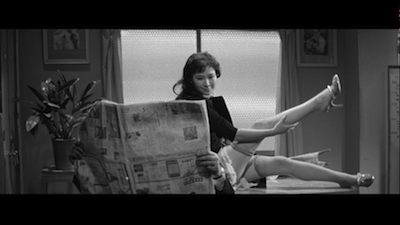
I picked Take Aim at the Police Van from the Eclipse Nikkatsu Noir set because it was the only remaining Suzuki film in my collection that I had not yet watched. It's interesting that my viewing over the past two days has gone in reverse chronological order. I am not sure why Criterion decided to number Tokyo Drifter [review] and Branded to Kill [review] the way they did, but with this 1960 mystery/drama thrown in, the effect for me was to see Suzuki's style get more normal as I progressed.


Coming some six years before Tokyo Drifter, Take Aim at the Police Van is a more conventional genre exercise than the director's later films. It begins with a violent attack on a prison transport van. Suzuki builds tension by having road-sign warnings repeat over and over, moving faster and making the viewer nervous with all their cries of "Caution!" It also doesn't help that we know that up ahead a sniper is waiting. When the van approaches his hillside vantage point, he opens fire, killing two of the prisoners. It was a concentrated attack.


The guard on that run, Daijiro Tamon (Michitaro Mizushima), is held responsible for the assault, and he is put on six months leave. Rather than stay at home and sulk, Tamon decides to look into what really happened all on his own, thus transforming himself into a traditional fictional investigator, doggedly pursuing his goals despite the warnings and the dangers. Suzuki and scriptwriter Shinichi Sekizawa see Tamon as belonging to a western tradition, and even make reference to Ellery Queen and other mystery writers who concocted similar stories with equally committed characters. Tamon begins his case by finding one of the shooting survivors, a low-level crook named Goro (Shoichi Ozawa) who was due to be released on bail the day of the incident. Goro's behavior during the attack makes Tamon think he knows something.


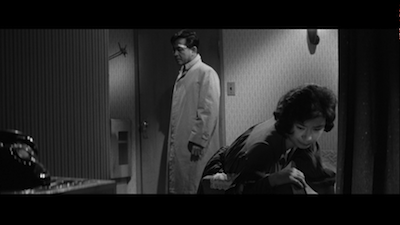
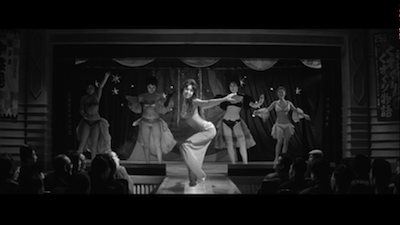
Naturally, pulling on this first thread causes many others to unravel. Tamon follows Goro out of town, where the mistress of one of the dead prisoners and Tsunako, the girl who bailed Goro out (Mari Shiraki), are working as strippers in an illicit brothel. Their involvement leads the prison guard to a human trafficking ring with ties to a mysterious, possibly fictitious big boss named Akiba. More people end up dead, some thought dead end up alive, and Tamon maybe has a thing for one of the possible suspects (Misako Watanabe). Yuko's father runs the "talent agency" that books the girls, and she's taken charge of the business since her old man got sick. She also knows archery, which is interesting since the dead stripper was shot in the heart with an arrow!


Take Aim at the Police Van takes a tried-and-true approach to building its mystery. For every answer Tamon finds, he also uncovers a few more questions. More players join the story, and the cast builds to the point where he doesn't really know who is going to pop out from which shadow next. Mizushima plays the role pretty straight. He's always looking forward, rarely indulging in sentiment or any emotion that might alter his course. He's an older man, and seeing him tangled up with so many young girls creates an amusing incongruity. Tamon is no white knight, but he will get the job done.


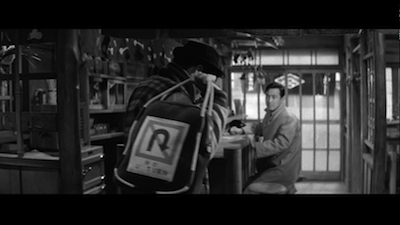
By the time we get to the climax, just about any of the crooks could be Akiba. Tamon has formed an uneasy alliance with Yuko, particularly after the two of them are nearly burned alive in a gasoline truck by the sniper, and he also takes a liking to Tsunako and wants to get her out of whatever trouble Goro might have gotten her into. Motor vehicles and motorways prove dangerous throughout the film. There is a chase on a cliffside highway and later Tamon is nearly run down by coordinated vehicles coming from two different directions. Goro also humorously provides the movie with its second roadside omen: he has a backpack that says "No U-Turns." There is no turning around, there is only forging ahead.


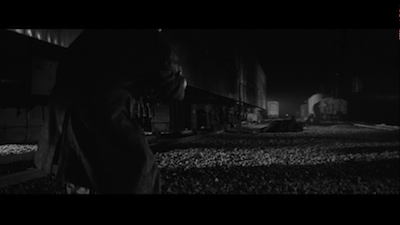
It makes for a sublime kismet, then, that the final shootout in Take Aim at the Police Van goes down in a trainyard. Buses and cars are unpredictable. They crash and they roll, and their course is subject to human control. Trains follow a track. They are reliable and they are sturdy. Their destination can't be changed easily. For some, this will be fatal; for others, salvation. Trains are also the industry of an older generation, one that Tamon can identify with. And perhaps that is why he is as reliable and as dedicated, as well. The young hoods have their flashy cars, but he identifies with the rails, getting the job done and never deviating from the predestined route.


BONUS SEIJUN SUZUKI REVIEWS:

* Detective Burea 2-3: Go to Hell Bastards! (1963)
* Tanuki Goten (Princess Raccoon) (2005)

And one from the archives, part of a group of reviews I did for my old column "Can You Picture That?" on OniPress.com. This one was reviewed alongside Onibaba, and that portion was reprinted here.

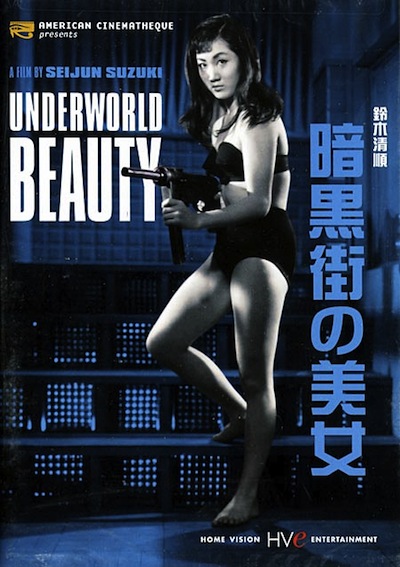
Underworld Beauty (1958): Speaking of cover art, I initially thought that Seijun Suzuki's 1958 yakuza movie, Underworld Beauty, would be a perfect companion to Onibaba. A beautiful woman dramatically posing with a machine gun! Yes! Only the cover art is entirely misleading. Akiko (Mari Shiraki) never picks up a gun inUnderworld Beauty. I was fooled by marketing!

Thankfully, Underworld Beauty is an entertaining film even without a pretty young thing shooting up the bad boys. Released by Home Vision Entertainment along with a spate of other Suzuki films, Underworld Beauty hints a little bit at the scattershot editing style that, a decade later, got Suzuki fired and branded "incomprehensible" (the way sometimes the story jumps from point A to point C pales next to the supersonic speed Branded to Kill travels at). Overall, though, it's a pretty straightforward crime picture with a cynical edge reminiscent of Sam Fuller.

The plot is simple: Miyamoto has spent three years in prison. In that time, he has managed to keep his mouth shut, giving up neither his yakuza bosses nor the hiding place of the jewels he stole. Feeling guilty about his partner, Mihara, who was partially crippled in the heist, he decides to work through his old boss and sell the diamonds, giving the money to his friend. Only someone attempts to steal the stones at the sale, and Mihara ends up swallowing the jewels before leaping off a building to escape. In the wake of his death, Miyamoto and Akiko go up against the yakuza and Akiko's effete, mannequin-manufacturing boyfriend, working through a maze of double-crosses to establish ownership of the three shiny jewels.

What sets Underworld Beauty apart from standard crime films of the period is the clash of the old school gangster (Miyamoto) and the wild-child, idealistic teenager (Akiko). It's never more clear than when the dark-suited hoods step into the bossa-nova rock-and-roll nightclub filled with kids dressed in light colors. The crooks are like brick walls, while the teenagers are much more petite. At one point, one of the bad guys shoves the fresh-faced bartender away from the bar and he practically launches into the air. Thus, the central conflict becomes whether or not Akiko can step up and act maturely. Can she and Miyamoto find common ground, and will it carry them through the classic crime-doesn't-pay ending? (Side note: It's interesting to compare the rather milquetoast version of a rock club in Underworld Beauty to the seedier nightclub in Akira Kurosawa's High and Low [review] five years later. The former is definitely the bobby-soxer '50s version we see in a lot of period entertainment, whereas the latter's sweaty opium den vibe showed the false innocence was already crumbling.)


Sunday, October 16, 2011

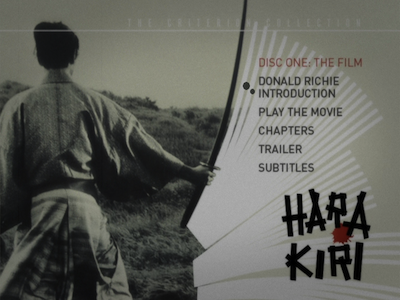
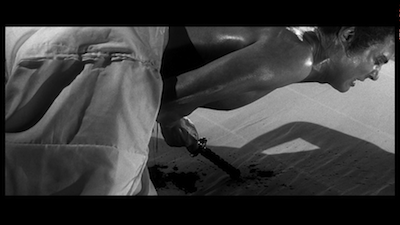
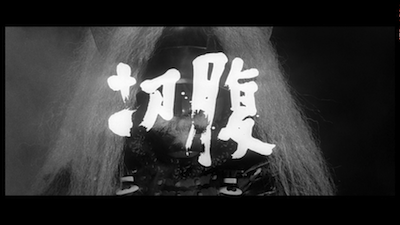
HARAKIRI (Blu-Ray) - #302


The year is 1630. The capital of Japan is still under its original name, Edo, and though samurais still exist, the shogunate has severely lessened their power. An older, bearded swordsman appears at the gate to the estate of Lord Iyi, a still thriving patriarch. Having lost his own master, this samurai has been a ronin for many years. Tired of eking out a living and only finding starvation for his efforts, he requests that Iyi's men let him use the spacious courtyard of their compound as a place to commit ritual suicide, formally known as "seppuku" but also called "harakiri." Indeed, the original title of Masaki Kobayashi's 1962 film was Seppuku in Japan, but it was likely changed to Harakiri for international release as that is the more commonly known term worldwide.

Respected Japanese actor Tatsuya Nakadai stars as Hanshiro Tsugumo, the swordsman at the end of his tether looking for an honorable death. Rentaro Mikuni is Counselor Saito, the man charged with managing the daily goings-on at the Iyi manor. Saito is suspicious of Tsugumo's motives, as it has become commonplace for ronin to show up at rich homes claiming to be seeking a place to die but really looking to extort money from a well-to-do family who doesn't want the public disgrace of a dead warrior in their front yard. This scam began honestly, when one of the many samurai left in the cold by shogunate reform legitimately sought a nice place to spend his last breath. The clan he went to was so impressed by his sincerity, that they gave him a job; those who followed this have been con artists.


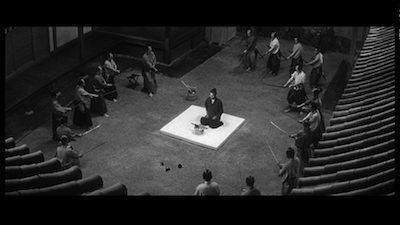
In fact, Tsugumo is not the first to come to the Iyi manner seeking this kind of asylum. Several months before, a younger man named Chijiwa (Akira Ishihama) arrived under similar circumstances. Saito and his men doubted his intentions, too, but ultimately, they made him carry out his promise. Chijiwa's tortuous death is the grisliest scenes in the movie, and Saito's detailed explanation of the disembowelment--which we see as an actual flashback--is meant to dissuade Tsugumo from pushing the matter further. The audience may be unsettled by the painful self-immolation (I certainly was), but Tsugumo is not. He insists on going ahead, his desire to die is very real.

Harakiri's twist, however, is that despite his true intentions, Tsugumo has not revealed his full motivation. The former warrior was a father and a grandfather who watched his family's livelihood dwindle as he clung to an unyielding code of honor--one he has decided that others higher up the food chain have not been as dedicated to. His narrative is more entangled in recent events at the Iyi manor than was originally apparent. The reality of what is happening grows more knotted and tragic the deeper Tsugumo draws us in. The movie may be black-and-white, but its often-grotesque tapestry is anything but. The hubris of the Iyi clan is they demanded simplicity because it was easier for them to deal with, even though life is far more complex.


Tatsuya Nakadai is astounding in the lead role. He plays present-day Tsugumo as a man who is staunchly resolute. He quietly commands the room, wresting control from Saito in ways both bold and manipulative. When insisting that the counselor and his retainers continue listening to his story doesn't work, he has other gambits waiting to be played. In the flashbacks, the actor is afforded the opportunity to show his range. Tsugumo's life swings from happiness to heartache, and the unraveling of his confidence is devastating to behold. The performer shows just as much strength in the battle scenes, finding a balance between an old warrior's confidence and his somewhat faulty muscle memory. He is not as strong or as agile as he once was, and Nakadai is careful to show, through gesture and expression, that it's righteous passion that allows this samurai to not just hold his own, but to best his opponents.


Fans of Japanese cinema likely know Nakadai from his work with Akira Kurosawa, including High and Low [review], where he proved himself more than an able co-star next to the great Toshiro Mifune, but also later in life as the unhinged father in Ran [review]. It's an impressive career even before you factor in his previous collaboration with Masaki Kobayashi, the towering epic The Human Condition [review]. Comparing that multi-part drama with this one is a bit like comparing apples and oranges, but they both stand tall as portrayals of individuals pushed as far as they can be pushed. It's a dramatic situation both timeless and timely: when the system fails to protect the people it was created to serve, when those at the upper levels of power forget about individuals that form the basis for their rule, those desperate for justice will find a way to get their due. Not that any victory is clean. Following a harrowing, tension-filled climax, Harakiri has a bitter denouement. The cynical message: if you're going to strike at a snake, you'd best take out the head, or its venom will still have an outlet to poison the world further.


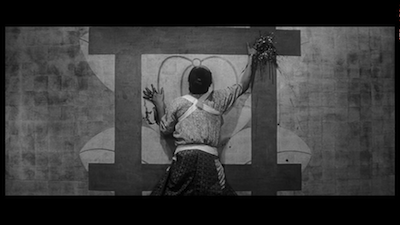
Kobayashi works here from a script by Shinobu Hashimoto. The film is tightly constructed on two different timelines, and the writer makes smart decisions of when to click back and forth between past and present. In some ways, Harakiri is like a mystery. We know, in essence, who killed Chijiwa, but the metaphorical culprit, the source of the misery that led him to the murder scene, still needs to be uncovered. Cinematographer Yoshio Miyajima works in the tight hallways of the palace and even the tighter quarters of Tsugumo's impoverished hovel, to choreograph the narrative and emphasize just how trapped the ronin really is. The courtyard where the suicides take place boxes the victims in, and yet the estate that surrounds them is like a maze. On his climactic dash through the Iyi home, Tsugumo breaks through different walls, each one revealing another layer of the internal bureaucracy. As a metaphor for the lone citizen taking on the system, it's incredibly powerful. What Tsugumo finds there is ultimately hollow, and thus Harakiri is all the more unnerving. If you don't walk away from this movie shaken all the way down to your shoes, I'm not sure you were really watching what was going on.


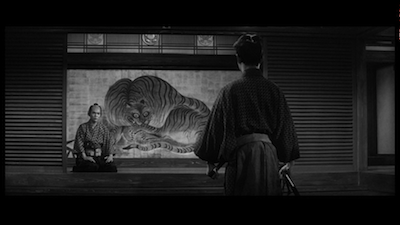
Criterion first released Harakiri back in 2005 as a two-disc DVD set. As the screengrabs here show, the restoration done back then was impressive enough already, but the high-def Blu-Ray transfer is a thing of beauty. The black-and-white photography is sharper than ever before, with rich, deep detail and incredible textures. Close-ups on the actors in tense moments reveal so much about the pain and fear the characters are suffering just by letting us see the sweat on their brow and the tears in their eyes so vividly.

The new edition also keeps all the extras from the previous set, including an interview between Masaki Kobayashi and Double Suicide-director Masahiro Shinoda (that makes for a fitting duo, if not a depressing double feature). There are also more recent interviews with Nakadai and Hashimoto and a pretty cool poster gallery.


There is a 3D remake of Harakiri on the way, helmed by irascible Japanese madman Takashi Miike. It will be interesting to see how Miike handles the material. I'd have thought him a pretty poor choice for Harakiri--and really, would have been against remaking what is essentially a perfect film--before seeing his masterful redo of the samurai showdown picture 13 Assassins [review]. The concept of ritual suicide certainly has the potential for different avenues of exploration. Let's not forget that just three years after Kobayashi stormed Cannes with Harakiri, bad-boy author Yukio Mishima unleashed his short film Patriotism [review], a film that is just as vivid in its gruesome details but with a decidedly different point of view. Whereas Kobayashi decides that seppuku is an empty gesture given foolishly in deference to an uncaring power structure, Mishima considers it the ultimate expression of fealty to something greater than yourself (for him, Japan). Both films are effective, though ultimately, Kobayashi's is more fulfilling and easily more persuasive.


This disc was provided by the Criterion Collection for purposes of review.

Please Note: The screen captures used here are from the standard-definition DVD released in 2000, not from the Blu-ray edition under review.