Showing posts with label masaki kobayshi. Show all posts

Thursday, July 4, 2013

MASAKI KOBAYASHI AGAINST THE SYSTEM: THE INHERITANCE - ECLIPSE SERIES #38


The last entry in the Eclipse box Masaki Kobayashi Against the System jumps ahead a few years from it's forebears, landing in 1962. It's the first film Masak Kobayashi made following his epic-length The Human Condition [review], and as if in response to the breadth of that story, Kobayashi chose a project that was purposely more compact in its scope, though no less complex or ambitious in substance.

The Inheritance is, in a way, a play on the traditional closed-door murder mystery: which of these suspects, all of whom had motive and opportunity, is guilty of the crime? The twist is there is no murder here, at least not centrally, the people of interest won't be directly responsible for the death of the man the majority of them will wrong. Wealthy businessman Senzo Kawara (So Yamamura, Tokyo Story [review]) has been diagnosed with cancer and, at best estimate, will die within six months. Kawara has no official will, and before he will decide how he will divide his fortune, he must track down his three illegitimate children. Depending on how they turned out--they range in age from 7 to early 20s--and whether or not Kawara, no lie, actually likes them, he will give them a share of his estate. If not, it will go to charity.


The only person guaranteed a share is Kawara's wife, Satoe (Misako Watanabe, Take Aim at the Police Van [review]). She was originally his secretary, and they married when she was younger and considered a trophy. She never had kids of her own with Kawara, and their current relations are, shall we say, testy. Satoe immediately begins scheming to cheat the kids out of their money. She has been charged with finding the youngest daughter, while Kawara's underling Furukawa (Tatsuya Nakadai, returning once again) is sent after the older girl. All of the people around Kawara, including his lawyer and his right-hand man, plot to find ways to keep all the cash where they can get their hands on it. They might not have to try all tht hard, though. The lost offspring themselves come with their own problems. Furukawa finds Mariko (Mari Yoshimura), but she's working as a nude model in a seedy club. Not exactly daddy's little girl!


It would seem the dying man's most trusted confidante is his pure-hearted secretary Yasuko (Keiko Kishi again), the girl who replaced Satoe in the position. Kawara assigns Yasuko with finding his son, Narimune (Yusuke Kawazu, Fighting Elegy), and she takes the job seriously. The boy is a disappointment, as well, however: he is a juvenile delinquent who puts the moves on Yasuko. Like father like son, as it turns out: when she returns from the trip, Kawara also casts his lust toward Yasuko.


How the old man's advances and assumptions end up corrupting the sweet girl is reminiscent of how the gangster Killer Joe entrapped the waitress in Black River [review]. Both men use the ladies' trust and expectations against them, leaving them with no other real option. Yasuko finds herself trapped in a cycle of abuse, and it has the unexpected side effect of also giving her bargaining chips with the other scoundrels, who see her increasing influence. Though Kobayashi directs The Inheritance as if it were a chamber room drama--and indeed, some of the events would not be out of place in a serious Bergman film--there is also something almost noirish to how the players maneuver and double-cross. As I suggested, it's like watching a murder mystery where everyone has some kind of blood on their hands, and as the story progresses, we narrow down the suspect pool. Other sins disqualify them from being able to commit the crime in question--stealing all the money for themselves.


In this, The Inheritance is more like I Will Buy You [review] than Black River. The possibility of vast sums of money cause people to do wretched things to the person they allegedly care about. Cash corrupts, and in some aspects, the system itself is rigged. A lot of what Kawara's people attempt is a manipulation of the law. It's a mugging where the weapon is legalese. What disgusts Kobayashi most is how the pursuit of capital gains sullies everyone. Even Kawara's intention to donate to charity is a selfish impulse: he'd be scattering the money to the wind because he finds no one worthy of his lucre. Just like in I Will Buy You, the true puppet master in The Inheritance could end up being the person everyone least expects.


Of the quartet of films in Masaki Kobayashi Against the System, The Inheritance is the only one shot in widescreen. The director uses the extended frame to open up the rooms where the narrative plays out, almost as if these large spaces are indicative of the excess of the upper classes. Compared to the cramped residences of the characters in all three of the other films, including the jail cell in The Thick-Walled Room [review], here the bad guys can stretch out and plan their evil deeds. Money has even bought them the time to do it. Yasuko starts to lose her way when she loses her sense of purpose, when her boss' condition means she no longer has her daily work routine. The devil and idle hands, you know? (The resemblance between her window shopping and the window shopping of Holly Golighty at the start of Breakfast at Tiffany's [review] has to be more than coincidental.) Perhaps the director is also saying something in how blasé everyone is about what is happening. All of the performers play their roles with a particular restraint. They are laid back about their thievery, they don't have the desperation of survival. 

This, of course, separates them from the artist that brought them to life. Masaki Kobayashi's victories were hard-won, coming from The Thick-Walled Room being shelved to actually pulling off something like The Human Condition in less than a decade. His next move would be to shift into historical drama, with Harakiri [review] soon to follow The Inheritance, but the change of timeframe would do nothing to dull the bite he developed cutting his teeth in the early movies in Masaki Kobayashi Against the System. That the last film, The Inheritance, seems so effortless is only a testament to what a vital filmmaker Kobayahi had become.


Read the full review of Masaki Kobayashi Against the System at DVD Talk.


Tuesday, July 2, 2013

MASAKI KOBAYASHI AGAINST THE SYSTEM: BLACK RIVER - ECLIPSE SERIES #38


If Masaki Kobayashi were a Sinatra-style crooner, he'd have good cause to sing about how 1956 was a very good year. The third movie released in those twelve months, Black River, was his most confident yet, gathering up some of the pulpier aspects of the crime genre and arranging them on a contemporary Japanese landscape.


Set near a US naval base in Atsugi, Japan, Black River provides a searing look at the poverty and corruption that generated big business in many such neighborhoods around the country. Pimps, prostitutes, gamblers, and dealers all lurk in the military's shadow. Our hero, Nishida (Fumio Watanabe, The Human Condition [review]) is an engineering student who moves to town in order to save money. He rents a squalid room in a rundown boarding house run by an opportunistic widow (Isuzu Yamada, Sisters of the Gion [review]). She is a purposely grotesque character, outfitted with kitty-cat glasses and outrageous metal teeth, as much Dickens as she is noir. Yet, she is also the least scary of the movie's collection of villains. Her appearance is like a bell around a cat's neck--the mice can see her coming.


Nishida runs afoul of the real evil dude of Black River when he falls for Shizuko (Ineko Arima, Tokyo Twilight [review]). The pretty young waitress has also caught the eye of Joe (Tatsuya Nakadai, High & Low [review]), the slick would-be gangster that acts as the nexus for most of the local crime. Joe dresses in sporty suits and wears sunglasses, as if he were a movie star sunning himself in California rather than slumming on the outskirts of civilization. Not one to be beaten to the punch, Joe sets up an elaborate scenario where Shizuko is kidnapped by his cronies. He pretends to save her from their assault, but in a twisted twist, he rapes her himself. Now that he has "ruined" her, Shizuko begs him to do the right thing, but instead he plays with her emotions until she submits to being his. The girl is too ashamed to explain herself to Nishida, but the do-gooder will soon have plenty of other reasons to clash with his dark rival.


The love triangle described above would be enough to fill any standard crime picture, but Kobayashi and screenwriter Zenzo Matsuyama (who regularly collaborated with the director) are telling the story of a community as much as they are detailing a sordid love affair. Each resident of the shack Nishida lives in is a fully realized character, with both a personality and a purpose. Mr. Okada is the decent guy who turns a blind eye to bad goings-on, the cautionary tale for humiliating yourself in the name of love. His wife, Yasuko, masquerades as a hairdresser, but she's really just another prostitute catering to American GIs. Nishida witnesses her lust first-hand. In one overheated scene, she comes to his room to hit on him. Her seduction technique involves her literally fanning her vagina in his direction.


At the same time, her reason for coming on to Nishida may be a big contributor to why he sticks to his principles. Yasuko tells him that she wants to be with him because he's a real man. Unlike her husband, he knows what he wants and stands up for it. Another factor in fortifying Nishida's moral resolve is Mr. Kim, a family man and a communist who keeps the tenement running. He rails against the American base leeching off Japan's resources and forcing citizens like them to foot the bill, and he pushes the tenants to stand as one against the landlady. This becomes more necessary than ever when the slumlord sells the property to an outside crook so he can build another brothel, and she hires Joe to kick everyone out.


The demolition deadline, set on Joe's birthday, provides the opportunity for a showdown between the lovers and louts. Fed up with the thieves getting away with taking everything, Nishida makes his move--even as Shizuko is looking to carve out her own exit. The climax of Black River is one tense night of drinking, dancing, and sharpened tongues, leading to a surprising climax that is as dark as anything to be found in archetypical American film noir yet as beautifully shot as any closing image in a grand MGM spectacle.

Kobayashi's ensemble cast is note-perfect down to every last performer. The character actors who fill out the roster are all unique and assured, playing to type but yet managing to be stylized without being cartoony. Whether it's the landlady's victim routine, Mr. Kim's earnest speechifying, or Yasuko's breathless flirtation, there's some kind of tragedy behind every extreme behavior, and with that comes humanity.


Both Fumio Watanabe and Ineko Arima bring complexity to their portrayal of good people pushed to doing bad things. His nervous temper solidifies into righteous anger, just as the wanton mask she adopts to cover her humiliation turns to fierce determination. Even Joe, who, on the face of it, appears to exist just to be baaaaaad--and Tatsuya Nakadai is so good at it, too--runs on buried fear. He's really just a little boy dressing up as a cinematic tough guy.

Kobayashi handles the complicated plot deftly, fusing the story's hardboiled tropes with his political message using his Neorealist shooting style as the bond. His work here, particularly in how he handles the large cast, strikes me as more Renoir than Rossellini, but at the same time, the use of realistic locations grounds the melodrama so that neither the comedy nor the tragedy--and there is plenty of both--appears over the top. On the contrary, underneath all of the salacious maneuvering is a yearning for honesty. Mr. Kim wishes the government would own up to what is really going on, just as Shizuko repeatedly tries and fails to come clean with Nishida. The cynicism of Black River, however, is that the outcome is the same whether you champion the truth or live the lie. Kim does no better than Okada, and Nishida, for all his morals, may come out with the least of all.


Sunday, June 30, 2013

MASAKI KOBAYASHI AGAINST THE SYSTEM: I WILL BUY YOU - ECLIPSE SERIES #38


Released the same year The Thick-Walled Room [review] finally got out of limbo, Masaki Kobayashi's I Will Buy You is more conventional in its drama, and though it has some commentary layered into its tale of greed and loyalty, the target is more specific. (To be fair, he made a handful of “safe” melodramas before working his way back to more meaningful territory.)

I Will Buy You is, for all intents and purposes, a baseball picture. But not one that spends much time on the field. In fact, we only see a couple of swings of the bat during it's near two-hour running time. Rather, I Will Buy You is more like an early prototype for Moneyball [review]: it's about the men who control the purse strings and make the teams. It’s capitalism as sport, with the players being substituted for the bat and ball.


The script follows Daisuke Kishimoto (Keiji Sada, also in Kobayashi’s masterwork, The Human Condition [review]), a talent scout for the Toyo Flowers, a franchise in a small slump as their new, untested manager whips the squad into shape. Baseball is a ruthless business, and Kishimoto has to be practical in his decision-making. In the film's opening scenes, he is on his way to sign a pitcher who lives in the sticks, only to discover the boy has lost a finger working in a factory and turn away without seeing him.

Kishimoto next turns his sights on Goro Kurita (Minoru Ooki), a college player with a power hit. The entirety of the Japanese league has zeroed in on the boy, so Kishimoto is going to have to be clever. For the time being, Kurita has a gatekeeper, Ippei Kyuki (Yunosuke Ito, Sanjuro [review]), his private coach for many years. On first meeting, Kyuki presents himself as a moral personage, concerned more for the boy's future than for his own personal gain. Initial impressions change, however--the longer Kishimoto courts Kyuki, the more flexible he finds the man. Baseball, it would seem, is not Kyuki's only game. Ignoring his penchant for gambling, he is most up-front about being in the import business, bringing fruit and other products from China. The rumors that he spied for China during the war may be born of jealousy, or they may be indicative of a truth where Kyuki really is a "leech" using Kurita for his own gain. It doesn't help that the married father's mistress (Mitsuko Mito, There Was a Father [review]) is the sister of his prized pupil's girlfriend. In all of I Will Buy You, Fueko (Keiko Kishi, returning from The Thick-Walled Room) is the only one who we trust, and so her claims that Kyuki is faking his life-threatening gallstone affliction gives both us and Kishimoto pause. It's a bold statement from the lone figure who appears to be unimpeachably moral.


Except, then again, maybe not. By the end on I Will Buy You, it's hard to tell who exactly we are supposed to believe. Even Kishimoto, who is the one who is going to be learning his lesson over the course of this thing, and who also gets to share his true thoughts via voiceover, is still a little hard to fully trust. The entirety of I Will Buy You's story is basically an up-down, push-pull ethical fakeout. We know the talent scouts are lying, but can we believe the coach? What about the girlfriend? Or the baseball player's working class family? Only Goro Kurita escapes our suspicious gaze. Surely the cornfed boy is just a pawn! (I don't know any Japanese equivalent of "cornfed" that doesn't sound racist. Sorry.)


Hopefully I didn't make all that sound irresistible, because it's actually kind of dull. There is a good drama here. Both Sada and Ito are very good, and they feed each other well. If the coach is a con man, he never tips his hand, and with the scout so effectively communicating the ethical conflict, we know whose shoes we're supposed to try to walk in. The problem is, there is not enough variance in the story, nor enough legitimate tension beyond wondering who Kurita will sign with, to justify the extended running time. There is an excess of low-decibel villains, and a real deficit of heroes.

What impresses beyond the strong acting, however, is Kobayashi's increased confidence behind the camera. The director stages the mundane events with a journeyman's hand. The framing in the scene where Kurita finally reveals his decision is particularly impressive. Five characters in three different fields of vision all act and react without the technique overshadowing the content.


Then again, maybe more hot-dogging from the director, or even the writer, might have helped. To mention Moneyball again (which I Will Buy You definitely resembles way more than, say, Pride of the Yankees [review] or Bull Durham), both Aaron Sorkin and Bennett Miller saw that they needed to kick the execution up a couple of notches above the subject. They found the energy in the dry landscape of business athletics that Kobayashi never takes off the bench.


MASAKI KOBAYASHI AGAINST THE SYSTEM: THE THICK-WALLED ROOM - ECLIPSE SERIES #38


Japanese movies made after World War II that deal directly with the post-War conditions following the country's defeat and grappling with the U.S. occupation offer a unique glimpse into a particular time and place that you can't really find anywhere else. I'd suggest the closest equivalent is American-made movies about Vietnam and the climate of unrest that existed as a result of that conflict. Perhaps if movies had been around after the U.S. Civil War, a Southern cinema might have emerged that would have been akin to what Masaki Kobayashi, Seijun Suzuki, and others created in the 1950s and 1960s. They engaged their nation's shame and struggles honestly, rather than the self-mythologizing that we see in American westerns that feature former Confederate soldiers as protagonists.


The Eclipse boxed set Masaki Kobayashi Against the System, as its name suggests, is meant to collect early Kobayashi films that wrestled with difficult and sometimes controversial subjects. The set leads with his third film, the 1956 drama The Thick-Walled Room, a prison story written by acclaimed novelist Kobo Abe (The Face of Another). In particular, The Thick-Walled Room casts its eye on men who have been tried as war criminals and sentenced to an indefinite stay in Sugamo Prison. A handful of them share a bare cell, the thick-walled room of the title, under guard of the American soldiers who run the place. They dream of their eventual release, and a righting of the wrong that was done to them.


Kobayashi and Abe tell their stories through a narrative that alternates between the day-to-day of prison life and flashbacks. As we get to know the characters in the present, we also see their past. Most importantly, we are shown the so-called crimes that got them incarcerated. The bitter sting of their predicament is that, for the most part, these are soldiers who were pushed into heinous acts by bullying officers. The higher-ranking men got away scot-free, leaving their subordinates holding the bag. The resultant anger that this naturally causes is stoked further as a peace treaty with the U.S. granting Japan further independence uses these poor souls as sacrificial pawns. They will stay in jail and do a nation's penance. (The Thick-Walled Room did penance, as well: though made in 1952, it wouldn't see the light of day until 1956 out of fear it would offend the lingering Americans.)


As with any such ensemble drama, The Thick-Walled Room presents a diverse cast of personalities. Kimura (Tsutomu Shimonoto) is a poet, while Nishimura is a smartass. There aren't just Japanese men in Sugamo: Kyo is a Korean soldier who was in the wrong place at the wrong time. Others shun him for being a Communist, particularly as the news of the conflict between North and South Korea filters into to the prison, but as The Thick-Walled Room progresses, others subtly shift toward Kyo's position. Ultimately, the prisoners form their own union, and began to organize to lobby for their release.


The two main stars of The Thick-Walled Room are Yamashita (Torahiko Hamada) and Yokota (Ko Mishima). Both are sensitive men who still have family waiting for them in the outside world. Both are haunted by the brutality they were forced to inflict on the enemy. Yokota is a romantic who dreams of a girl he hopes to reconnect with when he's free. Little does he know that Yoshiko (Keiko Kishi, The Makioka Sisters [review]) is now a prostitute. In the flashbacks, we see that she is fascinated by American servicemen, and while Kobayashi doesn't address the plight of women in post-War Japan as directly as Seijun Suzuki does in movies like Gate of Flesh, there is some understated commentary here. If a country can be judged by how it takes care of its women and children, Japan is failing. Just beyond Sugamo's fence, women sell themselves and little kids hustle to shine the boots of their occupiers.


Yokota serves as a sort of social conscience for the film. He is literally a translator, being the one who speaks English, but symbolically this carries over to his being the character who theorizes about prison life and whose ideology evolves. He is the one who explains the experience to his comrades and, by extension, the audience. "Everybody's turning to dust little by little," he tells his brother. He sees the men who are locked up as growing more desperate, doing things they should otherwise be ashamed of to survive and inventing justifications to assuage their guilt. In the case of one of his roommates, Kawanishi (Kinzo Shin, Youth of the Beast), the shame is too much. In The Thick-Walled Room's most visually memorable sequence, Kawanishi is left alone with his hallucinations. Holes are punched through the walls, like shotgun blasts coming from outside, and through each opening, the man sees his sins and the judgment of his fellow citizens. It's like he's under siege from his own memories. Suicide is a looming presence, and more than one man tries it as a means of escape.


Yamashita has the most direct example of injustice. His superior not only bullied him into murdering an innocent man, but he then testified against him in court. Interestingly, the crime the Americans treat as the most severe is his allegedly having stolen food. Yamashita is to be punished for stealing a loaf of bread, not unlike Jean Valjean in Les miserables [review]. There is a poetic connection between Yamashita and Yokota in that the American that Yokota was forced to beat was also being punished for stealing food to survive. The two men deal with things differently, however: Yokota is given to external expression, while Yamashita internalizes. It's somewhat ironic, then, that The Thick-Walled Room's major climax is Yamashita getting to confront his persecutor directly. The incident brings some closure, and his brief taste of freedom brings the man some peace, but at the same time, it provides no real answers.

It's a bittersweet conclusion. Yamashita returns to his cell ready to embrace his new family. The men who share his fate have made their own community, one that will provide them succor as they forge ahead while also reinforcing the sad truth that they are exiles in their own country.


Saturday, January 19, 2013

EMPIRE OF PASSION - #467


Respected Japanese film director Nagisa Oshima died at the beginning of this week. He was 80 years old. Part of the Japanese New Wave that took over cinema in the 1960s, Oshima was known for his bold flaunting of social mores. His films detailed obsessions of all kinds, though his own main obsession was exploring sexual desire.

I was not a fan of all of his films, so deciding to review the only movie of his left in the Criterion Collection that I had not seen was a risky proposition. I didn't want what should be a tribute to end up being a hatchet job. As luck would have it, his 1978 Cannes prizewinner Empire of Passion turned out to be my favorite of what I've seen. By embracing a more typical genre story, Oshima found a nice balance between traditional storytelling and the extreme impulses that made me think some of his other work was a tad adolescent. Here he manages to walk a carefully drawn line, spinning a good yarn while also addressing his usual thematic concerns and even finding room for at least one shocking scene. This disturbing occurrence--and you'll know it when you see it--is all the more startling for its late arrival, and for standing out as the one time in the when film the auteur strikes for the eyes--both literally and metaphorically.


Empire of Passion is a ghost story set in a remote village of Japan at the very end of the 19th-century. Humble rickshaw driver Gisaburo (Takahiro Tamura) is married to Seki (Kazuko Yoshiyuki), a waitress who, despite being middle-aged, has retained her youthful beauty. They have two kids together--a toddler and a teenaged daughter, Shin (Masami Hasegawa). Shin lives away from home and, like her mother before her, works as a nanny.

Seki also has an admirer, the recently discharged soldier Toyoji (Tatsuya Fuji, Black Sun [review]; In the Realm of the Senses [review])--though she doesn't actually realize that's even a possibility until Gisaburo makes a joke about it. Up until then, she assumed the young man, who is half her age, has been visiting with treats because he is lonely and likes her company. While this is still true, there is also more to his attentions, and when a drunken Toyoji finally decides to act on his desires, Seki gives in. Unfortunately, this is not enough for the young hothead. He is jealous of Seki's relationship with her husband, and he drags Seki into a plot to kill Gisaburo so he can have Seki all to himself. They strangle the older man and toss him in a well, telling the rest of the townspeople that he has gone to work in Tokyo.


Three years pass amidst much gossip, but it's all just speculation until Gisaburo's ghost starts showing up around town. This unnerves Seki, who is undone further when a police officer (Takuzo Kawatani) comes to town to start investigating the rumors. Toyoji, whom so far the specter has avoided, tells his lover to play it cool, but there is no putting this string back on the spindle. Everything is unraveling.

Empire of Passion was shot by cinematographer Yoshio Miyajima, who also photographed Masaki Kobayashi's Kwaidan, one the spookiest and most artful Japanese horror movies ever made. While Oshima's ghost story is neither as surreal nor as lush as Kobayashi's, Miyajima captures some of the same otherworldliness. Gisaburo appears as a pale figure, painted an ashen color, undeterred by doors and walls. In one memorable scene, he forces his wife into his ghostly rickshaw and takes her on roads she doesn't recognize, claiming to have forgotten the way home. When she tries to stop him, his features disappear, and he becomes a faceless apparition reminiscent of the dream figures the old professor sees in Ingmar Bergman's Wild Strawberries. It's a great pit stop on the way to full-blown madness.


If sexual urges compelled Seki and Toyoji to murder, then it's fitting that the crime not only makes it impossible for them to be a real couple, but also that the haunting pushes them further apart. Their celibacy is a consequence of their guilt, and the closer they get to the truth coming out, the hornier they become. Oshima has structured his story to have a delicious symmetry. Hoping to recapture happier days, Toyoji proposes role-playing where he and Seki pretend they are just as they were before they first gave in to their lust. This grotesque reset plays essentially just as it did the first time, but only now their true natures are exposed and they can't cover them up again. Like Adam and Eve eating of the fruit from the Tree of Knowledge and realizing they are naked, the killers can't bring their victim back to life and rekindle their passion. They both revert to something primal, driven only by impulse, and punished for their lack of discretion.


Unsurprisingly, the judgmental folks around the killers are just as bad as the people they would condemn. All are driven by passion in some way, be it the gossipy villagers who thrive on their scandal or the police officer who resorts to torture to get confessions out of Seki and Toyoji, succumbing to barbaric tactics he previously claimed to be above. Their empire claims him and his inhibitions, no matter how pure he tries to remain, no matter how white his uniform. There is poetic justice in Oshima's scheme, then, when a chill settles over the town after their would-be king and queen are removed. The final shot of Empire of Passion is of Toyoji's brother, the village idiot, alone in the snow, fighting against some invisible presence. He carries on chasing ghosts, and he represents them all, still haunted by what happened.

And chances are, when you finish watching, it's this image that will haunt you, too.


Monday, September 3, 2012

SIDELINE: MORE REVIEWS FOR 8/12

My reviews of non-Criterion movies from August.


IN THEATRES...

* 2 Days in New York, the new one from Julie Delpy. Really, if I were Chris Rock, I'd have tapped out after 12 hours.

* The Bourne Legacy, the underprivileged stepchild of the Bourne series still manages to be enjoyable despite some deficiencies.

* The Campaign, the Will Ferrell/Zach Galifianakis comedy is best at insult humor, not so much at political satire.

* Celeste and Jesse Forever, an almost-there down-to-earth rom-com, co-written by and starring Rashida Jones. I love her, but the script loses focus and eventually lost me.

* Dark Horse, Todd Solondz hates comedy almost as much as he hates you. And fat people. And everyyyyyyyyonnnnne!

* Hara-Kiri: Death of a Samurai, Miike remakes Kobayashi in 3D, but without any other added dimension.

* The Imposter, a twisted true crime documentary about a story that's so out there, you almost won't believe it.

* Killer Joe, a depraved new scorcher from William Friedkin, starring Matthew McConaughey his most finger-lickin' good role.

* Lawless, Nick Cave writes, John Hillcoat directs, and Tom Hardy stars. Mm-hmm.

* Oslo, August 31, a heartfelt new personal drama from the director of Reprise.


* Paranorman, the second effort from Laika suffers from some growing pains. Great animation, but an overly wordy script.

* Searching for Sugar Man, an amazing music documentary uncovering the secret history of the artist known as Rodriguez.

* Sleepwalk with Me, in which Mike Birbiglia tries to make friends and influence them to understand his problems.

ON BD/DVD...

* The Devil's Needle, and other Tales of Vice and Redemption, three silent films tackling the worst of Amercia's sins, ca. 1915.

* Fernando Di Leo's Madness, starring Joe Dallesandro as a human 2x4. It's neither mad nor is it any good. Discuss.

* Looney Tunes Mouse Chronicles: The Chuck Jones Collection, gathering the director's Sniffles and Hubie & Bertie cartoons under one cover.

* Misfits: Season One, a clever superpowers show from England.

* Monsieur Lazhar, a surprising example of quality feel-good cinema, adding a nice spin to the inspirational teacher genre.

* Once Upon a Time in Anatolia, an astonishing remodel of the police drama as existential parable. From Nuri Bilge Ceylan, the director of Climates. Best movie of this whole batch!

* Private Hell 36, a tightly wound noir with Ida Lupino. Directed by Don Siegel.

* Les Vampires, the 1915 silent crime serial from Louis Feuillade.


Sunday, October 16, 2011

HARAKIRI (Blu-Ray) - #302


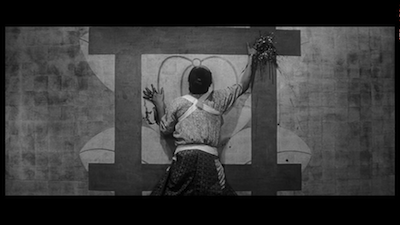
The year is 1630. The capital of Japan is still under its original name, Edo, and though samurais still exist, the shogunate has severely lessened their power. An older, bearded swordsman appears at the gate to the estate of Lord Iyi, a still thriving patriarch. Having lost his own master, this samurai has been a ronin for many years. Tired of eking out a living and only finding starvation for his efforts, he requests that Iyi's men let him use the spacious courtyard of their compound as a place to commit ritual suicide, formally known as "seppuku" but also called "harakiri." Indeed, the original title of Masaki Kobayashi's 1962 film was Seppuku in Japan, but it was likely changed to Harakiri for international release as that is the more commonly known term worldwide.

Respected Japanese actor Tatsuya Nakadai stars as Hanshiro Tsugumo, the swordsman at the end of his tether looking for an honorable death. Rentaro Mikuni is Counselor Saito, the man charged with managing the daily goings-on at the Iyi manor. Saito is suspicious of Tsugumo's motives, as it has become commonplace for ronin to show up at rich homes claiming to be seeking a place to die but really looking to extort money from a well-to-do family who doesn't want the public disgrace of a dead warrior in their front yard. This scam began honestly, when one of the many samurai left in the cold by shogunate reform legitimately sought a nice place to spend his last breath. The clan he went to was so impressed by his sincerity, that they gave him a job; those who followed this have been con artists.


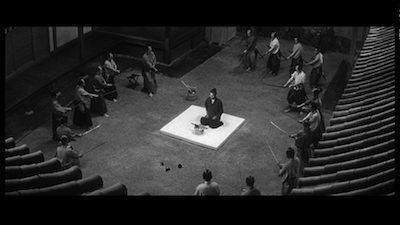
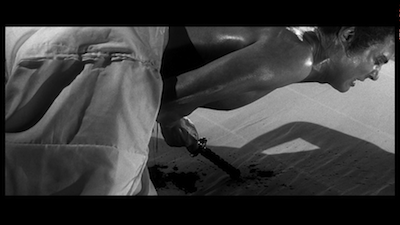
In fact, Tsugumo is not the first to come to the Iyi manner seeking this kind of asylum. Several months before, a younger man named Chijiwa (Akira Ishihama) arrived under similar circumstances. Saito and his men doubted his intentions, too, but ultimately, they made him carry out his promise. Chijiwa's tortuous death is the grisliest scenes in the movie, and Saito's detailed explanation of the disembowelment--which we see as an actual flashback--is meant to dissuade Tsugumo from pushing the matter further. The audience may be unsettled by the painful self-immolation (I certainly was), but Tsugumo is not. He insists on going ahead, his desire to die is very real.

Harakiri's twist, however, is that despite his true intentions, Tsugumo has not revealed his full motivation. The former warrior was a father and a grandfather who watched his family's livelihood dwindle as he clung to an unyielding code of honor--one he has decided that others higher up the food chain have not been as dedicated to. His narrative is more entangled in recent events at the Iyi manor than was originally apparent. The reality of what is happening grows more knotted and tragic the deeper Tsugumo draws us in. The movie may be black-and-white, but its often-grotesque tapestry is anything but. The hubris of the Iyi clan is they demanded simplicity because it was easier for them to deal with, even though life is far more complex.


Tatsuya Nakadai is astounding in the lead role. He plays present-day Tsugumo as a man who is staunchly resolute. He quietly commands the room, wresting control from Saito in ways both bold and manipulative. When insisting that the counselor and his retainers continue listening to his story doesn't work, he has other gambits waiting to be played. In the flashbacks, the actor is afforded the opportunity to show his range. Tsugumo's life swings from happiness to heartache, and the unraveling of his confidence is devastating to behold. The performer shows just as much strength in the battle scenes, finding a balance between an old warrior's confidence and his somewhat faulty muscle memory. He is not as strong or as agile as he once was, and Nakadai is careful to show, through gesture and expression, that it's righteous passion that allows this samurai to not just hold his own, but to best his opponents.


Fans of Japanese cinema likely know Nakadai from his work with Akira Kurosawa, including High and Low [review], where he proved himself more than an able co-star next to the great Toshiro Mifune, but also later in life as the unhinged father in Ran [review]. It's an impressive career even before you factor in his previous collaboration with Masaki Kobayashi, the towering epic The Human Condition [review]. Comparing that multi-part drama with this one is a bit like comparing apples and oranges, but they both stand tall as portrayals of individuals pushed as far as they can be pushed. It's a dramatic situation both timeless and timely: when the system fails to protect the people it was created to serve, when those at the upper levels of power forget about individuals that form the basis for their rule, those desperate for justice will find a way to get their due. Not that any victory is clean. Following a harrowing, tension-filled climax, Harakiri has a bitter denouement. The cynical message: if you're going to strike at a snake, you'd best take out the head, or its venom will still have an outlet to poison the world further.


Kobayashi works here from a script by Shinobu Hashimoto. The film is tightly constructed on two different timelines, and the writer makes smart decisions of when to click back and forth between past and present. In some ways, Harakiri is like a mystery. We know, in essence, who killed Chijiwa, but the metaphorical culprit, the source of the misery that led him to the murder scene, still needs to be uncovered. Cinematographer Yoshio Miyajima works in the tight hallways of the palace and even the tighter quarters of Tsugumo's impoverished hovel, to choreograph the narrative and emphasize just how trapped the ronin really is. The courtyard where the suicides take place boxes the victims in, and yet the estate that surrounds them is like a maze. On his climactic dash through the Iyi home, Tsugumo breaks through different walls, each one revealing another layer of the internal bureaucracy. As a metaphor for the lone citizen taking on the system, it's incredibly powerful. What Tsugumo finds there is ultimately hollow, and thus Harakiri is all the more unnerving. If you don't walk away from this movie shaken all the way down to your shoes, I'm not sure you were really watching what was going on.


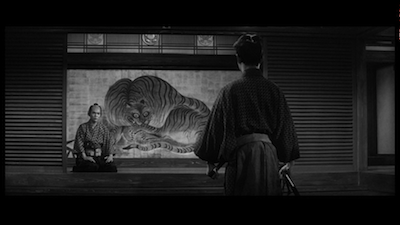
Criterion first released Harakiri back in 2005 as a two-disc DVD set. As the screengrabs here show, the restoration done back then was impressive enough already, but the high-def Blu-Ray transfer is a thing of beauty. The black-and-white photography is sharper than ever before, with rich, deep detail and incredible textures. Close-ups on the actors in tense moments reveal so much about the pain and fear the characters are suffering just by letting us see the sweat on their brow and the tears in their eyes so vividly.

The new edition also keeps all the extras from the previous set, including an interview between Masaki Kobayashi and Double Suicide-director Masahiro Shinoda (that makes for a fitting duo, if not a depressing double feature). There are also more recent interviews with Nakadai and Hashimoto and a pretty cool poster gallery.


There is a 3D remake of Harakiri on the way, helmed by irascible Japanese madman Takashi Miike. It will be interesting to see how Miike handles the material. I'd have thought him a pretty poor choice for Harakiri--and really, would have been against remaking what is essentially a perfect film--before seeing his masterful redo of the samurai showdown picture 13 Assassins [review]. The concept of ritual suicide certainly has the potential for different avenues of exploration. Let's not forget that just three years after Kobayashi stormed Cannes with Harakiri, bad-boy author Yukio Mishima unleashed his short film Patriotism [review], a film that is just as vivid in its gruesome details but with a decidedly different point of view. Whereas Kobayashi decides that seppuku is an empty gesture given foolishly in deference to an uncaring power structure, Mishima considers it the ultimate expression of fealty to something greater than yourself (for him, Japan). Both films are effective, though ultimately, Kobayashi's is more fulfilling and easily more persuasive.


This disc was provided by the Criterion Collection for purposes of review.

Please Note: The screen captures used here are from the standard-definition DVD released in 2000, not from the Blu-ray edition under review.


Sunday, September 13, 2009

THE HUMAN CONDITION - #480


As a fan of early-20th Century American literature, I always noticed that the one group of writers that could inspire real envy in all of the famous Americans was the Russians. Tolstoy and Dostoevsky and the like are regularly mentioned by Hemingway and Fitzgerald and their crew as the authors they most looked to in terms of what they wished they could do, the level of craft they aspired to achieve. For a long time, I didn't understand why, because like many young readers, I was a little frightened by the prospect of reading these legendarily long tomes. Charles Dickens wrote books that fat, and I didn't much care for him, so what chance did these Ruskies have?

Then a couple of years ago I finally read Tolstoy's Anna Karenina, and that changed everything. While I can't claim to have gobbled up a ton more since then, the densely plotted yet deftly told Anna Karenina made me realize what inspired the men who inspired me. The writing is detailed yet lyrical, the story complicated but has enough soap opera to keep it from being boring, and the characters are so richly drawn, you feel like you get to know each and every one, no matter how insignificant. Having experienced Tolstoy, it helped me understand what Steinbeck and Fitzgerald were trying to do when they wrote the mammoth East of Eden and Tender is the Night (respectively), both books I read (and in the case of Fitzgerald, reread) in my post-Anna K. world.

Funny that I should be scared of a big novel, though, as I've never been scared of big cinema. Granted, watching a movie takes place in a set amount of time, and at my reading speed, I've had books drag on for upwards of a year for me. Still, I've spent weekends devouring the whole Godfather set or a complete season of The Wire, an entire evening in an uncomfortable theatre watching The Best of Youth, so why not some time flipping through the pages of War and Peace? When it comes down to it, such substantial artistic experiences are rare. How often do we really get to see or read a truly brilliant work of such incredible density? Berlin Alexanderplatz looked like an insurmountable expedition when I cracked open the box, but I had watched all fifteen hours within two or three days and never checked the clock out of boredom. Shouldn't, then, Proust be on my nightstand?
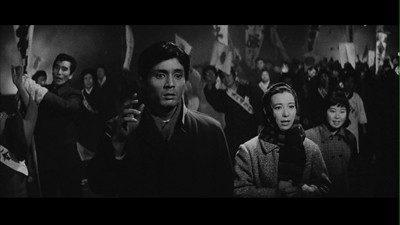


Masaki Kobayashi's nine-and-a-half-hour film The Human Condition was released as three parts over three years, spanning 1959 to 1961. On this new Criterion edition of the landmark film, the three-part structure is preserved over three discs, and it includes the original intermission breaks in each part. So, really, The Human Condition is like a six-chapter novel, the equivalent of six ninety-minute television episodes. Not so daunting when you think about it that way, is it? Not that you'll likely stop at any particular break. Just like reading a good book, I watched The Human Condition into the wee hours, dropping out and going to bed when I just couldn't keep my eyes open anymore, then picking it up where I left off the next day.

Now, even if watching The Human Condition isn't a daunting task, reviewing it is (I know, and get on with it already, right?). To adequately cover the full girth of this particular piece of cinema would practically require a book unto itself. The reason a movie like Kobayashi's is so engrossing is that, like a Russian novel, it is full of recurring themes, side characters with their own lives, and a story that maneuvers through territory as wide as any map--and likely territory that was also covered in the Gomikawa Junpei novel upon which The Human Condition was based. When it comes to a movie of such magnitude, whatever you write in a space like this, it's like using measuring spoons full of water to show someone what the ocean is like. I need flowcharts and character graphs just to keep it all straight!

But here, I'll try...
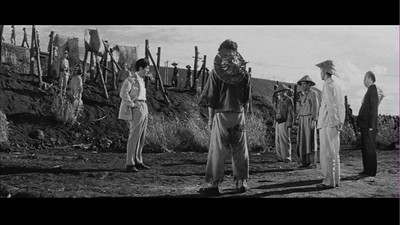


The Human Condition opens in Manchuria in 1943. Japan is in the middle of World War II and using their occupation of China and the country's natural resources as fuel for the war effort. Kaji, played by Tatsuya Nakadai, is twenty-eight years old and full of ideas. He believes that improving working conditions for the common man will improve production output, and even thinks the Chinese forced into labor are entitled to be treated as human beings. Not surprisingly, some consider Kaji to be a radical. His theories sound vaguely Communist.

Like any young man, Kaji is also interested in romance, and he has been dating Michiko (Michiyo Aratama), who works in the same compound with him. She is ready to get married, he is not, as he fears that any day he could be drafted into the Japanese army. A reprieve comes, however, when he is assigned a position at a remote mine where Kaji can employ some of his crazy notions in the aid of extracting precious metals from the Earth. This important work will buy him an exemption from military service. Eager to do some good, Kaji marries Michiko and the two move to the desolate mining town. There, he befriends the tough but fair foreman Okishima (So Yamamura), but quickly makes enemies of the other bosses, who thrive on bribes and sadistic motivational techniques.
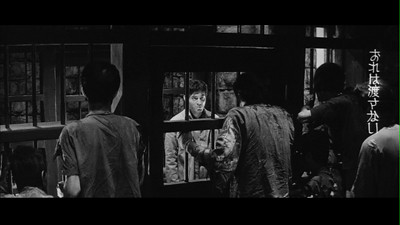


Kaji eventually succeeds, but not without much effort and little praise. Things get more difficult when the army drops off 600 Chinese prisoners and puts Kaji in charge of them. When his enemies help several prisoners escape in order to line their own pockets, Kaji not only loses the trust of the POWs but also runs afoul of a macho military police officer, Sergeant Watai (Toru Abe), who ceases to be amused by Kaji's tactics. Convinced that Kaji has been turning a blind eye to the escapes, particularly once it's revealed that a Chinese boy (Akira Ishihama) that Kaji has taken under his wing has been part of the plot, Watai puts the screws to our hero. Having already been forced to compromise his ideals to the detriment of his self-esteem and his marriage, and often at the cost of lives, Kaji decides to take a stand. His reward? Conscription into the army.
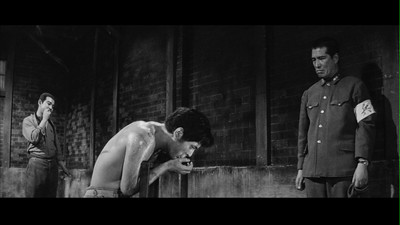


End of Part I, often subtitled No Greater Love; part II is Road To Eternity, and it opens with Kaji on the tail end of his basic training. He and one other solider, the disagreeable Shinjo (Kei Sato), are both outcasts due to their perceived Communist-sympathies, but Kaji in particular has distinguished himself as a sharpshooter. He has also tried to be an ally to the nerdy, pathetic Obara (Kunie Tanaka), who clearly was not cut out for military life. (His kowtowing and almost pathological sycophancy reminded me a little of the similarly pathetic but altogether more unctuous Arthur Storch character in Jack Garfein's The Strange One, released a couple of years earlier but likely just proving there is one in every pack.) The fact that Obara can't be helped is just another lesson about the harshness of reality versus the purity of ideals that Kaji is going to have to learn. While at the start of Part I he is really a student who has not yet been pushed out into the world, by the time he gets to the army, he has experienced injustice in practice, not just in theory. The army will make a man out of him yet. Whether it's the man they want or not will remain to be seen.

There is a crucial moment in Part I where Kaji makes a connection with one of the leaders in the Chinese prison camp, an older man named Wang Heng Li (Seiji Miyaguchi). Wang has been the man whom Kaji has been most eager to have trust him, and even tries to blame Wang's distrust on why some things are going wrong in the camp. It's Wang that expresses that there is more to trust than asking for it, and more to being brave than being stubborn. He cites the fact that they are standing face to face, though staring across barbed wire, and connecting, bridging a divide between their people. It's the men you meet in life whom you find this common connection with that will define the social contract and make the way for real change, be it collective or personal. This encounter will end up being the most important for Kaji in terms of how he deals with the various types he meets from here on out. Which of them will provide the same connection?
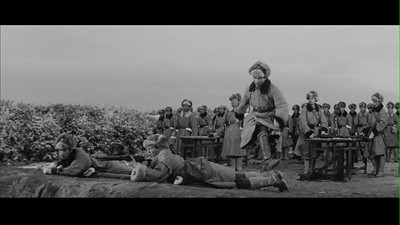


It's also an important instruction from Masaki Kobayashi and co-writer Zenzo Matsuyama on how we should perceive what is going on in this movie. Regardless of the vastness of the landscape, it boils down to the people, the ones who connect with each other, and the ones who connect with us as the audience. This is a technique not dissimilar to David Lean's. The British director used large backdrops and epic stories to create portraits of individuals, showing their courage and their fumbles in the face of situations that were larger than they were. For as awesome as the images we see are, for as breathtaking or soul crushing the locales, it all comes back to the man in the center of the frame.

And make no mistake, in terms of visual power, The Human Condition is awesome. Kobayashi and director of photography Yoshio Miyajima shot their film in black-and-white at a wide 2.35:1 aspect ratio. Within each frame, we see how barren the mine is and also how cramped the army camp; the unending battlefield versus the stifling forest they escape into (Part III). A figure placed within these vistas can appear lonely and overpowered, or if close enough in the foreground, powerful, eclipsing the world behind him. The size also makes close-ups all the more intimate, such as the scenes between Michiko and Kaji when she comes to visit him at his training base and they share a night in the storage shed. The image panel is all about them, all about their love, be it the tight shots of Kaji hugging her naked torso or when they lie down together. Conversely, when their marriage is strained, moving between them and their separate bed mats within this stretched visual space implies a canyon of loneliness and alienation between them.
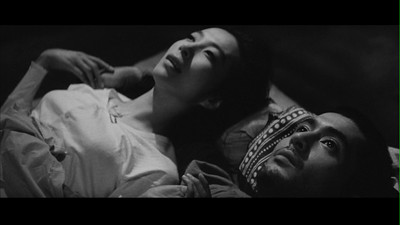


Ironically, though the love of Michiko and Kaji is such an important aspect of his strength in the first arc of the movie--she is both a source of power and temptation--the separation of the pair is integral to Kaji's growth in the second. Her visit to the camp is a farewell of sorts. It's tender, and it's sad; Michiyo Aratama is heartbreaking in how she reacts to her husband clinging to her. After she is gone, though, a sour turn for Obara forces Kaji to stand up for something in the army barracks the way he failed to do back at the mining camp. When he slapped the boy Chen on the urging of a superior, he ignored his better instincts for how workers should be treated, and when his inability to push Obara over the hump leads to hazing and dark consequences, Kaji ends up advocating they enforce the army's judicial code. Again, it's ironic in that he ends up maintaining his own moral strength by embracing the army's stringent guidelines and achieves his own purity by insisting on them being followed exactly. It's a similar stance to the one he took at the mining camp, but this time he manages to make it work without letting authority lord it over him.

The isolation from his wife further allows Kaji to create a tighter sense of community in his new surroundings. When asked to train new recruits, he once again insists on reform, and he creates a solid unit by taking a more humanist approach to basic training. Earn their respect and loyalty with kindness, rather than brutality. Unfortunately, when battle does come to Manchuria, it comes too early, and the men aren't ready in terms of skill, but they do share the bond Kaji hoped for. The fighting turns out to bigger than they are, however. Combat is portrayed as pointless and demeaning, Kaji's unit hiding from the enemy like a giant game of whack-a-mole. One man is assigned to each foxhole, so though the experience is a commonly shared one, they are also isolated. The fewer there are to stand together, the more self-preservation becomes important, and Part II ends with Kaji abandoning what is left, running alone into a darkened wasteland, both in terms of its physical, bombed out appearance and the black clouds hanging in the air, and in the metaphorical sense. Our idealist is rushing headlong into an existential abyss.
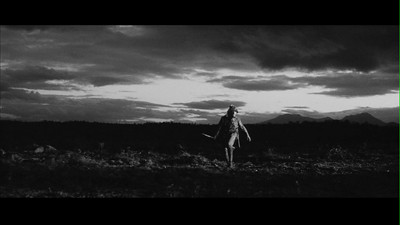


The battlefield sequences are shot with a startling realism, including impressive explosions and large stagings of battle. The enemy is faceless and distant, but there is a starkness to the detail that rivals Kubrick's Paths of Glory or Spielberg's Saving Private Ryan. The size makes it alienating and impersonal. All the more interesting, then, that Kobayashi opens part III of the movie, A Solider's Prayer, with a scene that brings the fighting right to Kaji: a hand-to-hand skirmish with a Soviet soldier. What we see of this, some of it as memories (memory plays a big part in this last third, Kaji's shame shown in freeze frame), is more surreal, the warriors framed in tight shots, a brightly lit night sky full of dark smoke behind them. Kaji is now a man taking charge of his own destiny, and that includes killing. A later one-on-one confrontation with Kaji's ideological rival (Nobuo Kaneko) in a labor camp pushes the expressiveness further, with Kobayashi and Miyajima lighting the beating like a scene out of a film noir. Likewise, eroticism is shot like these individual battles, with the camera moving in so tight, the images of these couplings are practically seen as abstracts.
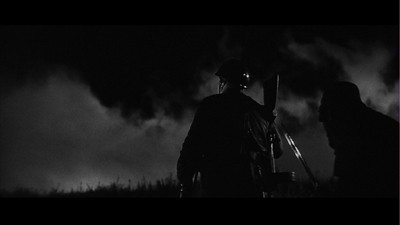
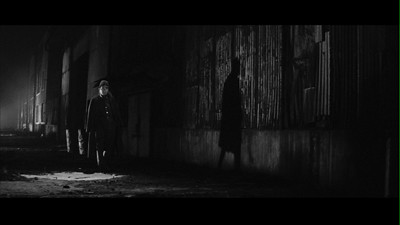


This fifth chapter is concerned with Kaji's long trek home. Reminiscent of Kon Ichikawa's Fires on the Plain, it first shows his hike across an empty wilderness, but soon he is consumed by the jungle that stands between death and freedom. Once inside, he no longer knows where safety lies. At the same time, he is denying the rule of the army, taking charge over a Corporal even though he is only a Private First Class, and eventually establishing his own mini-community. He and the few soldiers he is left with pick up a small group of peasants that they will try to shepherd to secure ground. Most of them won't make it out alive, but they still test Kaji's faith and his leadership, the beliefs by which he defines himself. He is becoming decisive, acting on what he knows to be right without hesitation or compromise. It's Kaji's way, like it or lump it.

In these final chapters, Kaji becomes a sort of Japanese Ulysses on his own Odyssey, his one goal being to get back home to his wife. Along the way, he encounters many perilous temptations, including several women who look to his strength and dedication with desire, but who fall under his single-mindedness much the way his wife had before them. He runs across leaders who refuse to deviate from their outmoded missions, make-shift refugee camps, and other soldiers who have lost their way, and who either seek the kind of leadership Kaji offers or the lawless alternative. In all things, Kaji emphasizes choice. Like I said, it's his way once you've come on board, but at each crossroads, any man in his company is allowed to decide which fork to take. Eventually, however, he ends up a POW forced into labor by the Russians, a predicament that baffles him. In his mind, it goes against the Communist ideal he would have expected from the Soviets, and it also takes him full circle: he is now subject to the very work conditions he once tried to stop. There is a great sequence where he confronts the Russian leaders with what he has learned and what he sees as being wrong with their behavior, but his impassioned speech is merely splatter against the language barrier. Oh, futility!
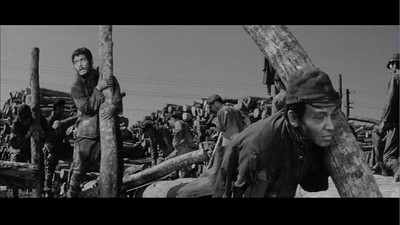


Tatsuya Nakadai is still a working actor to this day, and he has appeared in a number of great films, including starring in Kurosawa's High and Low, Ran, and Kagemusha. He even worked with Kobayashi again in Samurai Rebellion, Kwaidan, and Harakiri. The acting range he displays in The Human Condition is nothing short of extraordinary. Though we only glimpse his character over a handful of years (and, indeed, Nakadai played him for almost as long as the time that passed in the script), we see Kaji go through a full arc. Call it a practical education if you will, growing from an idealistic youth with more stubbornness than technique to an experienced soldier that can enact a philosophy in actual situations and all the way to rock bottom. Just like Ulysses, the final leg of Kaji's journey is spent in the trappings of a beggar, though unlike the hero of myth, Kaji undergoes this development for real.
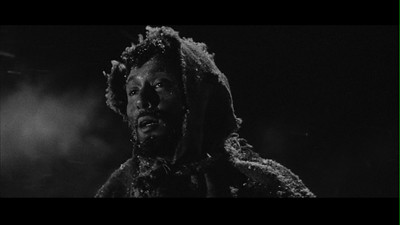


The ending of The Human Condition is bleak. Kaji spends the final scenes on the frozen Manchurian countryside, a tragic turn given that this is where he has run to in order to escape Siberian imprisonment. The world we see through the camera eye is now bleached out, flattened, a blank slate that cannot sustain life. If we continue to consider The Human Condition with an existential mindset, this is a perfect metaphor for the plight of modern man. Sticking to one's ideals, as Kaji does up unto the very end, is a noble pursuit, but one met with more punishment than reward in a world that demands conformity override individual concern. (Indeed, Kaji's problems with the Red Army's approach to socialism is that it swallows men whole in order to just make them part of the same old injustice.) Kaji has gone as far as he can go, and that is a place where he is completely alone, in a landscape that is literally cracking under his feet. Yet, he stumbles onward, his last thoughts being of his wife, the beacon he has followed, the lighthouse of his principles. In one light, this is tragedy, a man who can't be broken but who breaks all the same--that is the human condition, our moral code still depends on our physical body--but in another light, it's a triumph of the same. One can go on but need not give in.

The last shot pulls away from the figure at rest, leaving it rather than zooming in to join it. The reversal takes us from the personal, back to the widescreen picture, back into the world, carrying the image of the man in the snow with us.

The Human Condition has been out of print for many years, and there aren't kudos big enough for Criterion having brought it back to audiences in such spectacular fashion. I've been kicking myself for nearly a decade now for not buying the original three-disc release after spotting it used shortly after getting my first DVD player. In all that time, I hoped Criterion would put out a set and I could finally correct my mistake. To see Kobayashi's masterpiece at last and in such fine packaging--a beautiful looking multi-covered book, a fourth disc full of extras, a remarkably clean transfer--it's been well worth the wait. The Human Condition is an enriching, incomparable cinematic experience.