Showing posts with label hal ashby. Show all posts

Saturday, March 16, 2019

IN THE HEAT OF THE NIGHT - #959


Sometimes I just can’t find my way into a review.

It’s been five days since I watched In the Heat of the Night, and I’ve spent those days skulking past my computer, afraid to make eye contact with the screen, completely at a loss how to begin writing about Norman Jewison’s 1967 cop drama. A landmark of its time, and a template for many well-meaning race-related pictures to come, In the Heat of the Night is a crackling good film. It reminds me of Otto Preminger’s Anatomy of a Murder [review] in how engrossing it is, how easy to watch, how transcendent of its own genre.


But what perspective do I bring? I can acknowledge it’s a classic. I can graze up against the deeper issues of 1960s race relations and compare it to today, particularly the healthy distrust of law enforcement. I can talk about how Jewison avoids the folly of so many by neither making his black cop a saint nor his white cop a pure devil, how they are flawed men hampered by their own pride, and thus there is no real vindication or redemption for either, they just carry on. Surely all of this has already been said, though. Mayhap I am better served just cracking this process open and getting on with it.

Here’s the easy thing to explain: the plot. A man is found dead face down in the streets of Sparta, a small Mississippi town. The victim is a real estate developer from out of state looking to build a factory in the area. It would change the lives of the unemployed poor, but also disrupt the town’s established economy. In short, there are a few rich white folks that would rather not see the system altered.


Coincidentally, Homicide Detective Virgil Tibbs (Sidney Poitier, A Raisin in the Sun [review]) gets stranded in Sparta on a layover waiting for his train to Pennsylvania. At first he is arrested by an overzealous cop (Warren Oates, Two-Lane Blacktop [review]) who finds an unknown African American with a wallet full of cash suspicious, but once his identity is revealed, Tibbs is asked to participate in solving the murder. Newly appointed Police Chief Gillespie (Rod Steiger, Jubal [review]; On the Waterfront) would prefer not to take Tibbs’ help, fearing it will be more trouble than its worth, but once Tibbs takes the case between his teeth, Gillespie has little say. No one does, not even Sparta’s roving packs of violent racists or the brittle eccentric living in the big house on the outskirts of town. Tibbs won’t stop until the true culprit is in jail.


Poitier and Steiger make a great pair. The former is all forward intensity, and the latter reserved agitation. Gillespie is definitely a racist, but he’s also a pragmatist. One could argue he resents Tibbs as being an interloper from the big city as much as he does his being a black man. It’s a trope now, that the bigoted cop’s saving grace is his adherence to the law, but Steiger avoids caricature. He lives in Gillespie’s skin and isn’t afraid of his bad parts. Likewise, Poitier continues to evolve his own screen presence to keep Tibbs human and not a symbol. He’s the smartest man in the room, but too smart for his own good.


Indeed, the knotted personal drama of the small town is its own education for Tibbs. The murder is almost secondary to the struggles and gossip that informs Sparta’s day to day. Haskell Wexler (Medium Cool [review]) shoots the locales with a gritty vibrancy, never dressing up the shots, letting the people occupy the space. Even Oates’ shit-grinning cop and the petulant ingénue he peeps on (Quentin Dean) have the room to be people. Not very likeable people, but then really, how many of us are? The awesome Lee Grant (Shampoo [review]) also gets a pretty good turn as the dead man’s wife, a determined woman whose sense of personal justice cuts through the petty squabbles.


The only performance that moves close to parody is Larry Gates (Invasion of the Body Snatchers) as Endicott, the fat cat who runs Sparta from afar. Endicott is a riff on the mythological Confederate gentlemen, full of privilege and regretting progress. Jewison and writer Stirling Silliphant (The Poseidon Adventure) choose to stage his lone scene in a green house, symbolizing that he is a rare and wilting thing, no longer viable in the open air. This is a cliché we’ve seen before, most notably in Howard Hawks’ The Big Sleep [review]; here it seems an unnecessary and superfluous brush stroke.


The story of In the Heat of the Night remains every bit as challenging and incisive. The mystery is modern, even if some of the more “scandalous” aspects of it have lost their shock value. You might guess the real bad guy early, but you’ll forget you did amidst all the great character moments that follow. Add to this an ultra cool Quincy Jones score, complete with Ray Charles theme song, and you have a crime classic, its aesthetic perfectly bridging the gap from the squeaky clean studio system and the more grimy 1970s--an in between state that renders In the Heat of the Night truly timeless.


Monday, October 22, 2018

SHAMPOO - #947


Shampoo is easily the most Warren Beatty of all of Warren Beatty’s movies. A political and interpersonal comedy, it says as much about Beatty as it does the world. The writer/actor/producer lets his point of view be known, but he also embraces a certain image of himself as the pretty playboy, simultaneously reinforcing and undercutting it, creating a complex portrait of a man who knows what he wants but is often derailed by either his baser desires or what other people perceive of him. In many ways, it’s a prototype for a character and a movie he would revisit/remake more than once. Is George in Shampoo all that different from Jay Bulworth in Bulworth? What about Joe in Heaven Can Wait? Are their journeys that different?

Though Beatty didn’t direct this one, he had a hand throughout the production. He also had the confidence to place the great Hal Ashby (Being There [review]) behind the camera. Shampoo was released in 1975, but its story takes place in 1968, the day Richard Nixon is elected President. The election hangs over everything in the picture, a foregone conclusion not just to contemporary viewers, but also to the men of wealth whose wives go to George to get their hair done. The rest of the participants don’t seem to realize the change that is coming, but they are already starting to feel it. By the morning of the next day, an era will have passed. Ashby uses the Beach Boys’ “Wouldn’t It Be Nice” to bookend the picture, and it goes from a sweet, hopeful anthem of youth to an ironic remembrance of false promises.


Election Day is also the day that George has decided to meet with the bank to talk about opening his own hair salon. George is popular in his profession, and he believes his customer base would follow him if he had his own shingle; unfortunately for him, the bank sees through his lack of business acumen. George is too scared to tell his girlfriend Jill (Goldie Hawn) about this failure, but he does end up spilling the beans to his mistress, Felicia (Lee Grant), who is also a top client. Knowing George’s skills, Felicia sends him to her husband, Lester (Jack Warden). Even though Lester doesn’t sign on immediately, he sees the adulation George receives first-hand, since Lester’s own mistress, Jackie (Julie Christie, Beatty’s dance partner in McCabe and Mrs. Miller [review]), can also vouch for George’s magic hands. Little does Lester know, George and Jackie also used to date, a tidbit that might have dissuaded him from hatching an ill-fated plan: he asks George to accompany Jackie to an election night party, acting as cover for them while Lester attends the same shindig with Felicia. Oh, and Jill will be there, too, because she’s schmoozing a film director to get a part. (The director is played by Tony Bill, who did go on to be an actual film director, helming My Bodyguard, Five Corners, and one of my all-time favorites, Untamed Heart).

Sounds complicated, doesn’t it? Well, Beatty and co-writer Robert Towne (The Last Detail, Chinatown) never lose track of all the players, nor do they ever leave the audience hanging. In may ways, Shampoo seems like it would have been a perfect match for Robert Altman, who could have juggled the massive ensemble and the crisscrossing scenes without breaking a sweat; that said, Ashby shows no perspiration himself. Shampoo is complicated, but never messy, and watching all these things converge ends up being a delight.


For all the trampled feelings and missed connections that happen as the various participants travel from the election event to a large Los Angeles soiree, and then off into the night, most everyone here has similar needs and ambitions. Everyone in Shampoo is after something that they likely can’t have, and for most of them, they can’t have it due to some fault of their own. The clash between George and Lester could have easily been a celebration of a free spirit and the excoriation of a corporate fat cat, but when the two men finally compare notes, they both appear to be just as stranded in a world of their own making. Maybe today is the day they can make their change. Maybe not. Maybe Nixon will change it for them.  Knowing what we know, things will probably change more for George than Lester. Then again, I bet if we had a sequel to Shampoo set in the Reagan era, we’d see them both thriving in the excess of the Me Decade.

Don’t confuse Shampoo for a polemic or a message picture, however; the film is quite funny, both in its quirky rhythms (which is where Ashby probably trumps Altman) and in some of its broad contrivances. Julie Christie getting drunk and wicked provides many a good laugh, as does Lester’s utter confusion over George. Warren Beatty loves to play his characters as befuddled, a little off vibration from the rest of the world, somehow always one step behind but still looking at his next move. He’s great here, especially in the later scenes when George finally opens up. “You’re the only one I trust,” he tells Jackie, and we are with her when her heart breaks for him, knowing that soon he will be all alone. And, of course, watch a very young Carrie Fisher steal the show as Felicia’s randy, vindictive daughter.


Shampoo is also quite sexy. Again, the film leans into Beatty’s ladies man image. Every woman in the movie approaches him projecting an aura of sex. Amusingly, through most of the movie, he is either just missing the moment or we, as the audience, are shut out. So, when we finally do see George in action, it’s a scene that is first met with applause and then uncomfortable laughter, both from within the narrative and from without.

It’s interesting that Shampoo is a mid-’70s Hollywood production looking back at the tail end of the 1960s. The nostalgia is both wistful and disappointed. One gets the sense that Beatty knows how ridiculous some of George’s outfits look, or that choosing to have him ride a Triumph motorcycle is meant to mock him as a false rebel. All these flamboyant, fashionable choices--from having George be a hairdresser to his own artfully messy mane--seem to be intended to provoke a certain segment of the film-going public that probably had a lot of disdain for Beatty (mainly guys like Lester). Nothing on the surface of Shampoo will change their minds. Thus, shoving the cliché in everyone’s faces--fans and foes alike--only to bust it apart, transforms the screen idol into an enduring symbol of the idealistic decade that Shampoo is eulogizing, dashed hopes and all.


This disc provided by the Criterion Collection for purposes of review. 

Saturday, April 8, 2017

BEING THERE - #864

This review originally ran on DVDTalk.com in 2009.


The role of Chance the Gardener in Being There (1979) was one of Peter Sellers' last, as well as the one he struggled the longest to realize. The chameleonic comedian had the rights to Jerzy Kosinski's novel for nearly a decade before cameras rolled under the direction of the great Hal Ashby (Harold and Maude [review], Lookin' to Get Out [review]). Working from a script by Kosinski himself, Sellers' performance left an indelible mark on cinema, providing him with a chance to marry his funnyman skills to material that had real heart.

Chance is an aging manchild who has spent his entire life inside one house, working for its rich owner. He has never learned to read or write, and in fact has never ridden in a car or even gone beyond the property's outer walls. Everything he knows he has learned from television, which Chance watches--and mimics--constantly. If he sees the President of the United States (Jack Warden) on the tube shaking hands, Chance practices shaking hands just like him.


At the start of Being There, Chance's benefactor has passed away, and the lawyers in charge of the estate, not knowing who this strange gardener is, send Chance on his way. Though up until this point we have been lead to believe that Chance is on some spatial southern estate, as soon as he steps through the door, greeted by strains of a 1970s funkified "Also Sprach Zarathustra," we realize that this little house is buried in the heart of urban Washington D.C. Not knowing any better, Chance starts walking, his television remote in hand, in search of new adventures. Or, at the very least, some lunch.


A chance encounter with a limousine--yes, he's named Chance for a reason; many of the names here have outside meanings--leads Chance into the care of the Rands. Benjamin Rand, played by veteran actor Melvyn C. Douglas and perhaps named for Ayn Rand, is a rich capitalist on his death bed, and he and his young wife, Eve (Shirley MacLaine), adopt Chance, mishearing his introduction as Chauncey Gardener and believing him to be a zen master filled with all kinds of soothing wisdom. The newly dubbed Chauncey actually says very little, often just repeating what the last person said, nodding in agreement, or sharing gardening tips, but his calm demeanor mellows the room, inviting people to listen perhaps more intently than they would otherwise. Chauncey becomes all things to all people, allowing them to replace what he doesn't say with exactly what they want to hear. This gardener soon has the ear of the President, shares his advice on television, and attracts the attention of that temptress Eve (oh, those names!), all the while oblivious to the effect he is having or what is really going on.

Ashby and Sellers create a wonderful, magical comedy with Being There. Its bittersweet tone fits well with the gentle satire, and neither the writing nor the staging ever pushes anything too hard. Part of the charm is the simplicity, the lack of fuss. Like Chance himself, Being There is charming for how unassuming it is, and in that sense, it allows us to find the meaning in what passes in front of us in much the same way the people this humble gardener encounters find meaning in his down-home declarations.


Which isn't to suggest that there is no greater meaning here, because there is plenty that one can walk away with after watching Being There. Kosinski is carefully laying out a little parable to prod the audience into thinking more about the complicated nature of modern culture and reassess our humanity, and the magical effect is elevated further by Ashby's apparently spur-of-the-moment ending (and nearly ruined by the legendary bad decision by the studio to put Peter Sellers outtakes over the closing credits, spoiling the feeling Ashby intended to leave you with). Quite often, Being There is also laugh-out-loud funny. Sellers, unsurprisingly, loses himself in the character, exercising incredible restraint and saving the broad comedy for only the right moments. The result is simply wonderful, and Sellers deserved the Oscar nomination that came his way. (Melvyn Douglas actually took the statue home for best supporting actor in Being There.)

Effectively, Chance's purpose in life is to bring people together and to nurture their souls with his delicate care. Like plants, people don't require a heavy hand, they require a soft touch. He sets the dying rich man at ease, shows the lonely wife she can love again (even self-love!), and reminds movie fans that good old-fashioned optimism still has some sway in a cynical world. The famous tagline for the movie is that "Life is a state of mind," though the real message is, wherever you may find yourself within that state, just being there is enough to keep it all going.


Saturday, February 27, 2016

Y TU MAMA TAMBIEN - #723


There is an ephemeral grace to Alfonso Cuarón’s Y tu mamá también that makes it easy to reduce to something simple and small, but that when chased after, reveals deeper meaning and an artful construction of a movie that at times feels like it has no construction at  all.

At it’s most basic, Y tu mamá también is a road trip and a coming-of-age story, both fairly standard and oft predictable genres. At its most grandiose, Y tu mamá también explores erotic identity, political engagement, and the biggest, darkest theme of all: death. It does most of this with a light touch, never once pushing any of these elements so far forward that they dominate. The underlying themes of the eroticism never overtake the erotica itself. More than anything, this is a sexy movie, but like, say, Bernardo Bertollucci’s The Dreamers, a sexy movie with meaning.


The Dreamers is a good comparison for another reason. That movie is a tribute to the French New Wave, and Bertollucci channels the techniques of 1960s cinema through a youthful story of sexual and political awakening. So too does Cuarón adopt the style and the spirit of those influential filmmakers to create something that is free and spontaneous and at its most virtuoso moments, a celebration of moviemaking itself. Released in 2001, and hinting very little at the director’s smart sci-fi blockbusters to come (namely, Children of Men [review] and Gravity [review]) in terms of scope, Cuarón already exhibits the casual mastery of technique that would be so impressive in those later films. Working with frequent collaborator Emmanuel Lubezki (The Tree of Life [review]), he orchestrates long, unbroken scenes that rarely call attention to themselves. They aren’t used to deliver action, but rather are mostly used to probe the environment, to expose the details of the characters’ world by moving away from them and looking around. The one exception is the unforgettable dance sequence between actress Maribel Verdú (Pan’s Labyrinth [review], Tetro [review]) and, almost literally, the camera lens. Her eyes locked dead center, she dances like someone is watching, locking in the audience, seduction through control. Though much is made of her young co-stars, this scene alone explains why the actress got top billing: she’s the star.


Oh, but of those younger men. Y tu mamá también introduced the world at large to Diego Luna and Gael Garciá Bernal; these talented performers would go from Y tu mamá también to separately work with directors as renowned as Spielberg, Gondry, Korine, Jarmusch, Van Sant, and Almodovar. Here they play recent high-school graduates and best friends in Mexico, with Luna taking the role of Tenoch, the son of a rich politician, and Bernal playing Julio, the average son of a middle-class family. The boys are restless during their final summer before college, and spend most of it getting stoned and trying to get laid. It’s at a wedding that they meet Luissa (Verdú), the Spanish wife of one of Tenoch’s cousins. The horny pair invites her to go to the beach with them, promising to show her a beautiful cove so idyllic it’s been nicknamed Heaven’s Mouth. The locale is pure invention, but they haven’t a hope of luring the older woman to go its shores, so that really doesn’t matter.


Except, circumstances change for Luissa, and when she finds out her husband has been cheating on her, she decides to go with them after all. Their naïveté amuses her, and she takes advantage of their eagerness to please by probing them about their sexual adventures (such as they are) while they drive toward the coast in search of paradise. As they reveal more about what they do or do not know--and as she shares with them in equal measure--a sexual tension builds up, one that will eventually find a release.


This in itself would be enough for most filmmakers, but not for Cuarón. Co-written with his brother Carlos, Cuarón’s script for Y tu mamá también never forgets that there is more going on all around the three travelers. There are regular references to political unrest throughout Mexico, and even glimpses off it along the roadway. The travelers pass police checkpoints and people getting arrested, but remain mostly oblivious to the lives being altered within their view, carrying on with their sex talk as if somehow separate from the changing world. This in itself mimics most existences, we all drive on more concerned with our own situation than that of our fellow man. Yet, Cuarón mixes these macro details with the micro. The vacationers also drive by various rites of passage: a car full of newlyweds, a girl having her quinceañera, and a funeral procession. No matter how isolated the transitional experience of two teenage boys and an older woman may feel, the world carries on.


Which also fits the Nouvelle Vague ethos, particularly that of Jean-Luc Godard, who in movies like Masculin Feminin and La chinoise [review] would use the experiences of young people as a springboard to explore other things, to detail the political climate of his era, and expound on his own radical ideas. You could also say similar things of Hal Ashby’s Harold and Maude [review], another film about a young man having an affair with a (much) older woman set against political turmoil. Cuarón goes so far as to give Ashby’s movie a shout out. Y tu mamá también opens with Tenoch having sex with his girlfriend under a Harold and Maude poster.


Not that the reported protests and massacres ever interrupt or invade the getaway; rather, they are representative of the things that these three voyagers are putting off, the seriousness they will ignore and avoid as long as they can in much the same way they--and all of us--put off death. Cuarón regularly reminds us of this unavoidable fate, as well, with the narrator breaking in to tell us about different traffic accidents that happened in spots along the highway when the car passes. This voiceover interrupts regularly to inform us of things we would not otherwise know, filling in details from the past and present and even the future about all the characters. Rather than being overcompensating narration, however, it adds a poetic quality to Y tu mamá también, evoking the style of South American literature. In terms of presentation, it also calls to mind Godard again, the way Cuarón tweaks the sound, turning the volume down on the main audio to give his off-screen speaker the dominance. (It’s probably no coincidence that Luissa’s cheating husband is a writer, and his encouragement of Tenoch’s own literary aspirations gives us cause to wonder if maybe it’s this boy eventually turning their excursion into something more.)


In the end, though, these things all dissipate. Like sea foam, as Luissa might put it. It’s the connection she makes with the boys, and the things they share, that we will remember. Even if--or perhaps because of--their coming together also eventually drives them apart, we can assume it’s also something they can never forget, and perhaps the finality it engenders is because it’s a time of life that can never be replicated. They will always be remembering, always looking back, even as the next road opens up before them.


Included in this set alongside Y tu mamá también is a 2002 short film by co-writer Carlos Cuarón. Though far lighter in tone, You Owe Me One is a fine companion to the main feature, and perhaps should be watched as a lead-in for a full night of programming. The lark features an oversexed family going about their clandestine business on what we can assume is an average night in their home. The laughs are genuine and unforced, with Cuarón lacing together his scenarios with smart cues derived from the story itself. Double the pace, and this would be a screwball comedy, but as it is, it’s genial and fun.


Saturday, December 5, 2015

HAROLD AND MAUDE - #608


Generally, when connecting the two sides of life, a la Shakespeare and the ages of man, babies and senior citizens are usually listed as mirror images of one another. The older person’s functions fail them, they return to helplessness, and also there is a perception of a reclaiming of innocence and naïveté. Watching Harold and Maude, however, one might make a different argument. In Hal Ashby’s 1971 comedy, it’s adolescence and old age that complement one another. They aren’t mirror images, but there is a healthy morbidness and a willingness for adventure that fit together quite well.


Bud Court stars as the titular Harold, a wealthy young man adrift and lacking in purpose. Or so his interfering mother (the fantastically named Vivian Pickles) would have us believe. She wishes Harold would find a good woman, or join the army and get some discipline. Harold isn’t interested in either. All that really interests him is death. He stages elaborate fake suicides to shock his mother--though she has become so immune to his pantomimes, she is more annoyed by the blood on her bathroom mirror than her son lying in the tub with his wrists cut.


Harold likes to attend funerals, and that’s where he meets Maude (Ruth Gordon), a woman in her mid-80s who also likes to crash the services. Maude is, quite aptly, an eccentric. She steals cars and smokes a hookah and liberates plants and animals into the wild. She takes a liking to Harold, and though he is skeptical at first, Harold takes a liking to Maude. A friendship develops, and then a romance.

Harold and Maude is a classic tale of outsiders, a black romantic comedy of misfits. Neither of the lovers fit in the world, but unlike Harold, Maude has created her own space within it. If she offers him any one important thing, it is that: an example by which he can embrace his own uniqueness. Maude has experience with life and death both, and neither scares her. Harold embodies the cliché adolescent feeling of believing he’d be better off dead than alive, which he even admits in a tearful confession midway through the picture, in what is probably Harold and Maude’s most emotional scene. Harold’s first near-death experience brought him both attention and a kind of peace, as everyone believed he really was deceased. For a brief pocket of time, he was in that rare state where people remembered him fondly. Though Maude sees her own time coming up soon, she offers the young man an alternative: an existential rejection of all things mortal. There is freedom living in a state of in-between, a state that Harold will find in the final scene of the film, which itself prefigures a very similar leap of freedom at the end of Quadrophenia [review] just a few years later.



For all this heavy thinking, Harold and Maude is not a ponderous movie. On the contrary, the script, written by Colin Higgins, who would later go on to helm a couple of Dolly Parton vehicles like 9 to 5, is lightly composed, its episodic structure allowing for the narrative to remain nimble and never be bogged down with one scenario too long. Together, Higgins and Ashby create a unique pocket universe for their characters to live in. It’s quirky and stylized in a way that would later influence Wes Anderson, but unlike Anderson, not nostalgic. Rather, it is very much of its time. The filmmakers weave in current events and important issues of the late ’60s and early ’70s, including free love, war, and technology. Harold’s uncle (Charles Tyner) is an army officer that promises him glory overseas; Harold’s dates, found via a computer dating service, bring glimpses of the outside world into Harold’s isolated existence. For instance, one is a political science student, and she is concerned whether or not Harold is “involved.”

My favorite of Harold’s would-be companions is Sunshine (Ellen Geer), an actress who is gung-ho to join in on Harold’s performances. He fakes hara-kiri in front of her, and she not only delights in the public spectacle, but takes the dagger and shows him how she died on stage playing Juliet. In a more conventional film, the script would diverge here, and Sunshine’s arrival would threaten what Harold and Maude have together. Instead, Ashby is content to let the sequence deliver one of the film’s funniest punchlines and then move on.


It’s kind of remarkable I never saw Harold and Maude until well into my twenties, because this would have been an ideal movie for me when I was a teenager. Its obsession with death, its quirky fashion, the flaunting of social convention--it seems ideal for Teenage Jamie. Of course, I didn’t have Rushmore [review] back then, either, and maybe fate was such that I could not be inspired by Harold and Maude, that was reserved for Wes Anderson--who makes no bones about cribbing from Ashby for his second feature. Max Fischer’s obsession with an older woman and his dramatic performances are directly borrowed from Harold and Maude. In a Tarantino-esque move, Anderson even goes so far as to crib some of the Cat Stevens tunes from the soundtrack. I imagine if we ever got to see Max’s first car, it would be a hearse.


What is perhaps most impressive about Harold and Maude--and there is a lot to be impressed with, not least of which are the exceptional performances by Cort and especially Gordon, whose every moment appears effortless--is how Ashby avoids allowing this strange world he’s creating to ever be precious or contrived. While careful thought certainly went into the details--the fashion, the set dressing, the locations--there is also a bit of a shaggy dog imperfection to it all, a trait that comes naturally to Ashby in all of his films. There is a raggedness that lends an air or reality to even the most unreal of proceedings. (See also Being There [review]).

When thinking again about the connection between adolescence and old age, I have to say there is something about how the young man connects to the old woman that appeals to middle-aged me. Perhaps it’s that the message of the movie extends beyond such specific time periods. Harold’s plight is one that many of us will return to again and again. Who am I, and what should I do with myself? If only we would all be so lucky to find a Maude here and there along the way. Or better yet, to wake up to the fact that our own personal Maude might just be us in the future, as we gather experience and wisdom, and simply just learn to be ourselves.


Sidebar 1: In a previous write-up for the Portland Mercury, I chose Harold & Maude as one of three films to watch alongside Rushmore. Read that piece here.

Sidebar 2: Check out more from Jordan Crane, the artist behind the cover and the menus, here.

Monday, July 1, 2013

SIDELINE: MORE REVIEWS FOR 6/13

While I was neglecting this site, I was still watching a lot of movies. Here's proof.

Oh, and I was also redesigning my other site! Have a look. See what I'm working on. Buy some signed books. confessions123.com


IN THEATRES...

* Before Midnight, the latest in the ongoing relationship series is its deepest and most emotionally fraught, and quite easily the best. Once again starring Ethan Hawke and Julie Delpy, directed by Richard Linklater.

 * The Bling Ring, the latest from Sofia Coppola, telling a tale of disaffected Bonnies and their tagalong Clyde.

* Byzantium, Neil Jordan's all-too-serious return to the vampire genre.

* Dirty Wars, a documentary about the covert strikes happening outside the approved combat zones in the War on Teror.

* Man of Steel, is neither worth loving or hating. It's boring and fun and long and loud and dazzling and doltish all at the same time.  

* Monsters University, a Pixar prequel that's funny, if not as fresh as the original.

* Much Ado About Nothing, Joss Whedon's backyard retelling of the Bard.

* Some Girl(s), starring Adam Brody as a writer lacking in self-awareness taking a tour of his old flames. From a script by Neil LaBute.


My Oregonian columns...

* June 14: French animation gets arty in The Painting;  Disney's Pete's Dragon flies back to the big screen; and a life re-examined in Long Distance Revolutionary: A Journey with Mumia Abu-Jamal.

* June 21: Another visit with Andre Gregory in Before and After Dinner, the nuclear power doc Pandora's Promise, and a sleazy Italian slasher flick from 1973, Torso.

* June 28: the dark Australian comedy 100 Bloody Acres; Doin' it in the Park's wild history of NYC pick-up basketball; and a revival of the classic Grant/Hepburn crime/romance hybrid Charade.


ON BD/DVD....

* Broadway Musicals: A Jewish Legacy, documenting the history of the great Jewish songwriters of the American stage.

*  First Family, a tepid 1980 White House satire from writer/director Buck Henry and star Bob Newhart that lacks any political bite.

* Free Radicals: A History of Experimental Film, a worthy introduction to the more abstract side of cinema.

* The Great Gatsby: Midnight in Manhattan, a short BBC documentary about F. Scott Fitzgerald and his best-known novel. Bonus: a 1975 teleplay with David Hemmings as the author.

* Happy People: A Year in the Taiga, Werner Herzog's refashioning of a longer documentary looking at the life of fur trappers in Siberia.

* The Key, a dark wartime drama from Carol Reed. With William Holden and Sophia Loren.

* A Night to Remember, a screwball mystery with Loretta Young, released in 1942.

* Second-Hand Hearts, a romantic flop that kicked off the '80s for Hal Ashby. 

* Whoopee! A good-time musical with Eddie Cantor. Two-strip Technicolar from 1930!


Friday, February 5, 2010

FISTS IN THE POCKET - #333


And you think your family is weird? Trust me, you've got it easy.

The family in Marco Bellocchio's perverse 1965 satire Fists in the Pocket is up there with the great oddball clans of cinema, somewhere between those magnificent Ambersons and the killing breed of Texas Chainsaw Massacre. They are emotionally twisted, physically deficient, and so caught up in each other's business, it's impossible for them to untangle themselves from one another.
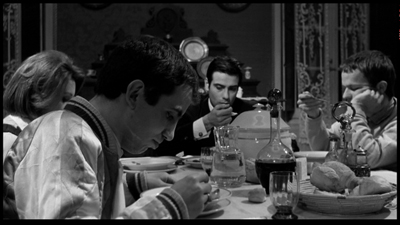
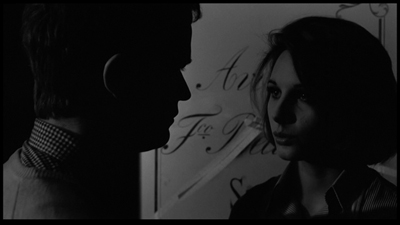

Bellochio's is a family of five--four children, and one blind mother (Liliana Gerace). Of the kids, only the eldest, Augusto (Marino Masé) has it together enough to have a job and the semblance of a normal life. He lives with the others in their out-of-the-way house on the hill, but he goes into the city to work and visit his girlfriend (Jenny MacNeil), leaving his siblings to fill their days with whatever it is they can find. The youngest is the developmentally disabled epileptic Leone (Pierluigi Troglio), who more often than not is left out of the trouble cooked up by the middle kids. Giulia (Paola Pitagora) and Alessandro (Lou Castel) share a strange bond. They are wickedly close to one another, but also constantly on each other's last nerves. Ale is the true mastermind of mischief, pushing buttons and tweaking noses at every turn, but Giulia eggs him on. There is a suggestion that there is something unnatural between them--Ale has written her a love poem that stirs up trouble at the start of the picture--but whether they've ever taken it farther, we don't know.


Giulia is capable of making her own incestuous scandals. The movie actually begins with a note she sent to Augusto's girlfriend, Lucia. Pasting it together with letters she cut out of a newspaper, she informs Lucia that she is pregnant with Augusto's child and the true love of his life. It's all lies, of course. Maybe she does have feelings for Augusto, she gives him many a long look, but the true motivation of this act is likely to sabotage his happiness and keep the family's claim on their number-one son. This is what seems to motivate all the pranks and outbursts. The circle is closed, and no one gets out. As the movie progresses, Ale even plots to keep Augusto from moving out of their family home, which is large and full of the group history. That history is represented in kitsch objects, the eccentric antiques and heirlooms and portraits gathered over the years, like a precursor to the big house in Wes Anderson's The Royal Tenenbaums. These are the sick cousins of the Tenenbaums, the ones who don't have the creative outlets their future cinematic kin find to maintain their semblance of sanity.

Alessandro actually reminds me more of Harold in Hal Ashby's Harold and Maude than he does any of Anderson's children. Like his younger brother, Ale is an epileptic, though one who is trying to keep his malady under control. In addition to his tendency for pranks, the main trait Ale shares with Harold is a morbid fascination with death. For Harold, it manifests in his staged suicides; for Ale, his gallows humor aims for a wider audience and more real results. He concocts a plan to drive himself and the others over a cliff, leaving Augusto to lead his life without being burdened by his useless relatives. When this doesn't come off--he ends up almost literally chasing a thrill instead--the plan morphs to suit the fickle boy's plans. He begins with one murder, and then moves on to two....
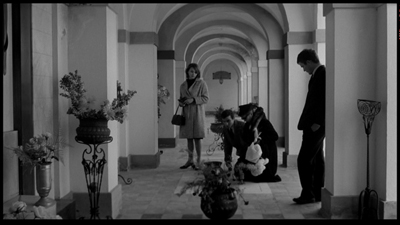
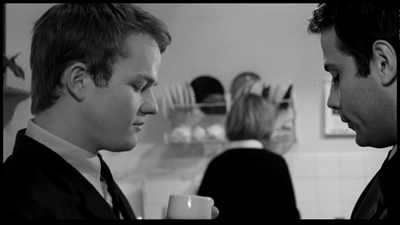
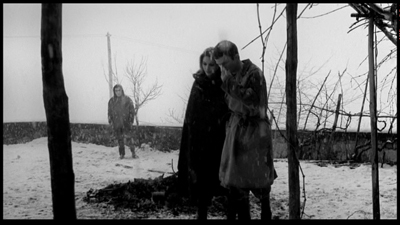
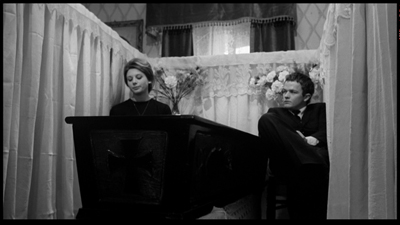
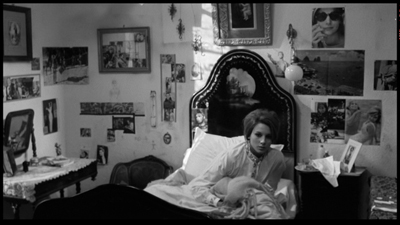
Fists in the Pocket is a bizarre film. It's Bellochio's first feature, and the writer/director revels in an anarchic storytelling style. The narrative is all over the place. Exposition is often repeated, and the script sometimes moves from one scene to another in quick jumps, skipping right over more traditional transitions. When this happens, it's almost like the crew is making it up as they go along, improvising one absurd scenario after another. Visually, the director uses composition to emphasize relationships. There are a lot of two-shots that bring characters closer, emphasizing their connections and their conspiracies. Other times, he puts objects between them, like a casket or the dinner table, to push them apart. He will also foreground those who are joined and background those who are left out, using distance just as effectively as he uses the lack thereof.


As black comedies go, I wouldn't call Fists in the Pocket laugh-out-loud funny. When I laughed, it was more out of admiration and fascination. There is a strange pathology at work in the household. The demented siblings are building their own world within it, but like ancient gods, they have grown bored of their creations. As soon as Ale has hatched one scheme, he's tired of it. His mayhem is plagued by ADD. His motivation is schizophrenic: on one hand, he decides to kill himself and the others to benefit Augusto; on the other, he does things that are meant to knock his brother down a peg. He contrives to catch Augusto cheating at cards, and he also seeks out and hires the same prostitute his brother frequents. When Augusto takes him to a nightclub for Lucia's birthday, we see Ale in the real world for the first time. He is socially awkward, unable to carry through when a pretty girl tries to dance with him.


The only girl Ale has time for is Giulia, and part of the reason his clown act keeps evolving is he's trying to keep her entertained. As an acting pair, Castel and Pitagora are perfectly in sync, working the same offbeat rhythms. The way they communicate is reminiscent of the secret language of twins. Leone tries to be part of it, but he doesn't know the code. Augusto doesn't know it either, but he has no interest in cracking it. In much the same way Cocteau and Melville critique the crumbling social mores of modern culture in Les enfants terribles by isolating their brother/sister duo from the rest of the world, so two does Bellochio draw a tight circle around Ale and Giulia. They choose who comes in and out, rejecting religion, the old and infirm, emotional nostalgia, and conventional survival. It's all empty and waiting to be exploded.


It can only end badly. The problem with this kind of nihilistic ennui is it can only go on for so long before it runs out of things to reject. Ale stumbles into a regular pitfall of the jester: he has to keep pushing for bigger reactions, and he can't see when he's gone too far. At the close of the film, he gets too cocky, thinking he can sew everyone into his web. The one thing he didn't factor on was that in creating chaos, chaos can come back on you. Giulia stops finding him funny once she's seen behind the curtain, and an accident has also left her physically incapable of indulging Ale any longer. Now she chooses to isolate him, staying in her room surrounded by images of idyllic lives they will never have, Marlon Brando and magazine advertisements, while Ale writhes around to the more extreme emotional outburst of an operatic aria. The girl leaves her brother to his own devices the way one lets a screaming baby wail and cry until he can't cry anymore. Rebellion always meets its match when it faces Indifference.