This review was originally written for DVDTalk.com in 2011.
"Not all who wander are lost." -- so goes the bumper sticker that launched a thousand pointless journeys. I would have been absolutely tickled had Kelly Reichardt ended her film Meek's Cutoff with a slow pan over to the back of a covered wagon and revealed that one of the pioneers was sporting this totem. Forget that it would be an anachronism. It still would have been brilliant!
Not that Meek's Cutoff isn't brilliant anyway. It kind of is. It also kind of isn't. Indecision seems to be its major emotion. The film is written by Jonathan Raymond, who worked with Reichardt on her previous directorial efforts, Old Joy and the emotionally rich Wendy and Lucy. Their new film tells the story of a wagon train searching for the Willamette Valley in Oregon in 1845. The title refers to a trail the Meek brothers blazed in an effort to avoid the Blue Mountains, where they believed the Cayuse Indians would attack them. The film focuses on one half of the expedition, of three wagons that split from the main group with Stephen Meek (Bruce Greenwood). Among them were the young Gately newlyweds (Paul Dano and Zoe Kazan); the widower Tetherow and his new wife Emily (Will Patton and Michelle Williams); and the Whites, consisting of father, son, and pregnant mother (Neal Huff, Tommy Nelson, and Shirley Henderson).
Whether or not this group is lost or, as Meek puts it, "finding their way" quickly becomes a bone of contention. Water is running low, and their destination seems to perpetually be just two days away. This question of whether there is anything just over the next ridge sometimes turns existential, and Meek and Emily in particular get into sharp debates about the difference between men and women, trust, and the inevitability of destiny. Most of the time, though, they just wander. There is lots and lots of wandering. Wandering with one squeaky wagon wheel providing a sparse musical score. It's enough to try the travelers' patience, and I am sure the patience of plenty of moviegoers, as well.
It's not that nothing happens, it's that Raymond and Reichardt don't want to romanticize what does, and the movie grows dusty and parched and it stays that way. From a plot standpoint, things heat up a little when the group captures a Native American (Rod Rondeaux) who has been following them, and the "savage" is forced to guide them to water. The language barrier means no one knows if he's really saving them or leading them to their doom. More debate between Meek and Emily follows.
Note that I say Meek's Cutoff will try some moviegoers' patience; it didn't necessarily try mine. I emerged from the theatre somewhat dazed and a little thirsty myself. It's an experience, that's to be sure, and one that doesn't at all telegraph where it's taking the viewer. It only occurred to me in the final 20 minutes, when the travelers were manually lowering their wagons down a steep hillside with a rope, that what Reichardt had done was make a Werner Herzog movie set in the American West. Like, say, Fitzcarraldo or Aguirre: The Wrath of God, Meek's Cutoff isn't a movie you enjoy in a conventional sense, but one you endure alongside the hapless souls stuck on their inevitable collision with whatever grim fate awaits them.
Reichardt and cinematographer Chris Blauvelt, who was also a camera operator on Joaquin Phoenix's twisted journey I'm Still Here [review], shot Meek's Cutoff on location in the desolate Oregon wilds, filming their Western on old-fashioned film at an old-fashioned 1.33:1 aspect ratio. This combination makes for a movie that looks like a classic cowboy picture but that feels like a soul-searching American indie. Most of Meek's Cutoff looks to have been captured in natural light, making for sun-bleached vistas and the blackest of black nights, the darkness only pieced by fires and lanterns. Dialogue is sparse, and the actors all work with the growing desperation, delivering performances that slowly implode. Only Greenwood gets much showing off, telling tall tales that do more to diminish his reputation than enhance it.
And, of course, there is Michelle Williams, who delivers one of her least showy performances as Emily. Reichardt uses the actress' comfortable screen presence to make her the emotional center of Meek's Cutoff. Emily is intelligent and gutsy, though reserving her gumption for when it really matters. It's clear early on that if we're following anyone here, if we expect any of these characters to discover the way out, it will be her. Williams is careful in how she inhabits the part, she keeps some of her usual mannerisms dialed back, and she's no less convincing or charismatic for it. I'll admit, I think I could watch Michelle Williams in just about anything. They could cast her in a three-hour film about trying to get a stain out of a carpet, and I think she'd still be interesting to look at.
I may be stretching, but I think it's largely down to Williams that I found Meek's Cutoff to be more human that what is on display in classic Herzog, and why I think Meek's Cutoff is a movie that I will likely see again, and depending on how that viewing goes, maybe many times after that. It's one I expect to grow in my estimation the more I sit with it, that only gets more interesting the better I come to understand it. Or it will dry up and crumble to dust, like so much detritus tossed out of a wagon on a pioneer's journey. Either/or.
Showing posts with label herzog. Show all posts
Wednesday, May 30, 2018
Thursday, February 11, 2016
THE EMIGRANTS - #796
"The greenest fields lie furthest away."
This is going to sound facetious, but it’s apt: Swedish director Jan Troell’s 1971/72 dual-header is essentially what we’d get if Werner Herzog were hired to direct The Lord of the Rings.
Bear with me.
Two very long (3 hours and up!) interconnected movies,
neither of which is entire unto itself, detailing a long trek through
unforgiving nature and an impossible but worthy goal. No magic, no fantasy, no
indulgent effects showpieces; rather, harsh living, insurmountable odds, and an
indifferent universe all plotting against people banded together to get from
one end of the globe to the other.
Based on a book by Vilhelm Moberg, this ambitious adaptation
by Troell (Everlasting Moments [review]) follows the Nilsson clan in the mid-19th Century as they pull up stakes in Sweden and head for America
in search of the myth of a better life they’ve read about in newspapers and
pamphlets. The journey begins with The Emigrants, which is
essentially the events leading up to their decision to leave, their trip across
the ocean, and then their further delving deep into the American heartland,
destination Minnesota, to lay new stakes in the New World. Once they get there,
the film is done, and what happens next is for the concluding volume.
Max von Sydow (The Seventh Seal [review])
leads the cast as Karl Oskar, a farmer who can’t catch a break. One year the
snow kills his crops, the next year a heat wave. He is married to Kristina (Liv
Ullmann, Autumn Sonata [review]), and together they have three children--though
that number will shift as the story carries on, both regressing and
progressing. Fed up with what he considers cursed soil, Karl Oskar plots with his younger brother, Robert (Eddie Axberg, My Life as a
Dog [review]), a slow-witted farmhand, to make the move. Though, as
Karl Oskar is warned, once he has decided on this journey, he will discover he has
far more relatives than he had previously realized. Kristina’s uncle Danjel (Allan
Edwall, Fanny and Alexander [review]) has been leading his own
Christian congregation, one separate from the dominant church, and he and his
followers have been persecuted for it. He wants to go along and bring the
faithful with him.
So it is that a rather healthy-sized group sets off to sail
the Atlantic for a better tomorrow. The build-up comprises the first third of
The Emigrants, and the sailing the second. Unsurprisingly,
the passage the Nilssons can afford is not the best, and they are crammed into
the hull of a ship with little food and no real ability to cope with the seas
and disease. A much smaller group lands on the American shore, and the final
third of the film goes along with them as they head by train and river for
Minnesota, seemingly finding what they have been looking for.
Troell is content to let the story roll at its own pace, and
his presentation is unadorned and naturalistic. Conditions are severe, and we
feel the drudgery and the disappointment as things grow progressively more
difficult and take more time. The nausea that dominates the ocean voyage practically
comes through the screen. Try not to feel a little green around the gills
yourself. Troell wants to re-create the time with a rigorous and exacting
attention to detail, down to the small talk and diversions. The only bits that
don’t come across as believable are the hairstyles, which change not at all
over a 10-week voyage, and some of the American accents of the people they
encounter upon landing. But those are pretty insignificant nits to pick.
Unsurprisingly, The Emigrants can be a
bit of a struggle to watch, but not an unrewarding one. Though the pacing is slow,
Troell packs the script, which he co-wrote with Bengt Forslund, his
collaborator on Here is Your Life, with plenty of personal
conflict, be it the difficulties of marriage or the clash of ideas, as opposing
views of religion and rational thought criss-cross within the group. (In one
excellent moment of ironic piety, we discover a reformed wanton woman (Monica
Zetterlund) has gained the honest to goodness moral high ground without
remotely tempering her personality.) These are brought to life by a fine cast,
with the expected exceptional performances by von Sydow and Ullmann. He plays Karl Oskar as a man tripped-up by his own vanity (the American will is strong in this one!) but who generally wants to do what
is right; she gives Kristina a foundation of concern and compassion, tempering
her motherly instincts with a practicality her husband sometimes lacks. He is
the dreamer, and she is the one who often has to find each dream’s shape.
So, strap in when you have a full night ahead of you, and
maybe prepare to take a break when the intermission pops up midway through each
feature. For as much as a commitment as these two can be, when you get to the
end of The Emigrants, you’ll want to know what happens next.
Onward to The New Land…
Wednesday, July 17, 2013
BURDEN OF DREAMS - #287/GARLIC IS AS GOOD AS TEN MOTHERS
"I am running out of fantasy. I don't know what else will happen now.."
Werner Herzog speaks those lines at a juncture in Burden of Dreams, Les Blank and Maureen Gosling's 1982 behind-the-scenes exposé of the making of Herzog's film Fitzcarraldo, when his appreciation of irony is rapidly depleting. The Peruvian natives he has hired to be extras and crew on the production have left the location to go answer tribal violence and territorial threats, and Herzog is beginning to realize that, despite his best intentions, his presence in these people's lives has started to affect them in unforeseen ways. In that, he is no different than the rubber barons his script vilifies. He has come to this land to take something from the indigenous people.
It's one of many unfortunate cross-overs that the filmmaker has with his subject. Fitzcarraldo is the story of a European immigrant who went to South America to make his fortune, and once he had, squandered it in hopes of building an opera house to bring his beloved Caruso to sing in person. Klaus Kinski stars as the baron, while Claudia Cardinale co-stars as his love interest, a madame running a brothel. The film's climax details Fitzcarraldo's biggest and most fatal hurdle: getting his boat over a mountain, taking it from one river to another on the opposite side. It's a perilous act, one that is achieved in mud and blood, and at the expense of the lives of the local people he hires to pull it across.
What Burden of Dreams chronicles is how this went from being a written metaphor in a screenplay to an active and lengthy mishap for its author. Over the four years that Herzog tried to make Fitzcarraldo, shooting stalled twice before finally getting underway the last time--only to become elongated by the director's misguided insistence on realism. He shot his movie deep in the Peruvian jungle, far from where it would have been more safe and secure, and then proceeded to demand that his crew pull a boat up a mountain for real. No faking it here!
It's fortuitous that Blank and Herzog chose this particular production for the documentarian to follow. Honestly, the real-life story of Burden of Dreams is far more compelling that Herzog's finished film. It's one thing to create a fiction where a man's goals become a disease and his vision is blinded by obsession and even madness; it's another to watch it happen for real. Herzog, who is infamous for pontificating about his experiences and narrating documentaries where he theorizes about the lives of others, is caught in a philosophical and literary whirlwind of his own design. Burden of Dreams charts the decline of his artistic optimism. As the production becomes increasingly unmoored, so too does the man who would presume to orchestrate it. The last scenes quite literally show Herzog setting one of his boats adrift and trying to capture the chaos on film as he smashes into the rocks, taking his cameraman and star with him.
At the same time this is all happening, Blank and Gosling are also getting to know the local crew that have come on board to assist the crazy German. There is a lot of downtime during the production, and this allows Burden of Dreams to examine local politics, question how white society is encroaching on tradition, and even record some of the customs that still exist amongst the native peoples. There is an interesting contrast between the resilience of an ancient culture and the mutable whims of modern man.
Burden of Dreams was not the only collaboration between Les Blank and Werner Herzog. In the early 1980s, two more of Blank's films featured the director, either directly or tangentially. Herzog makes an appearance in Blank's mid-length feature Garlic is as Good as Ten Mothers. (Not included on the Burden of Dreams DVD, but it is on the Criterion Hulu channel.) The director's cameo is a brief side trip in the documentary. Blank's study of the quirky cult of the clove eventually leads him to ponder its place in vampire lore. He asks Herzog about its absence from his remake of Nosferatu. Perhaps more interesting than the answer is Werner's own puzzled query, "Why did you ask me that?" It demonstrates why the two likely got along: they are both endlessly curious about what motivates people.
Garlic is as Good as Ten Mothers's main thesis is to understand why garlic had long lacked in popularity in America, and what was at that time causing a change in its reputation. Blank centers his study on the annual garlic festival in Gilroy, a Northern Californian town where much of the country's garlic is grown. (I've driven through there. It will cause you to wonder if people can truly become acclimated to any smell, the day-to-day coping with that odor must be a real challenge.) The odd nature of the gathering, where people dress in costume and sing songs in honor of their chosen spice, sets the tone for the rest of Garlic is as Good as Ten Mothers. Garlic is an intense vegetable that inspires intense devotion.
Blank finds a colorful cast of characters. There is the gypsy singer and connoisseur who tells of garlic's important history amongst the Spanish poor; there is the man who literally wrote the book on what he calls the Stinking Rose (and opened a restaurant of the same name); and there are a variety of cooks from many different cultural backgrounds. Blank has tremendous affection for kooks, and his movies gleefully respect that, even if maybe sometimes you wish he'd drop some of the quirks and tighten up the narrative.
Facts emerge as the movie progresses, and the title begins to make sense once we hear testimony of the herb's restorative powers, but this is really secondary to the collage of humanity that Blank has cut together. He moves back and forth through different commentators, comparing customs and culinary techniques, letting the central plant be the common thread between them all. It seems no matter where you are in the world, be it China, Mexico, or the American South, garlic will at some point reach your taste buds. It's the main seasoning in the melting pot of life.
It's no surprise then, that Blank focuses on the big clove of garlic Herzog uses as central flavor when cooking his boot in Werner Herzog Eats His Shoe. Based on the fact that the two shorter films (Werner Herzog Eats His Shoe is only 20 minutes long) were released the same year, and how Herzog looks in both, the Nosferatu Q&A in Garlic is as Good as Ten Mothers likely happened on this shoot. For Werner Herzog Eats His Shoe, Blank films the German auteur making good on a bet: if Errol Morris could finish his first film, The Gates of Heaven, his mentor promised to literally eat his shoe. Ever the hardline poet, Herzog eats the one he was wearing when the wager was made.
Having seen Werner Herzog Eats His Shoe before, I came back to it thinking it a trifle that did not live up to its reputation. You see a man eat his shoe, and that's that. What a documentarian chooses to show you, however, is telling. For Herzog, this is a bold act. He is confirming for all neophyte and wannabe film directors that the dream is real. Yet, Blank shows how far the man can take such symbolic acts by connecting the leathery meal to the director holding court and quite literally justifying such an absurd event by denigrating his own profession and creating pretentious theories that connect his own perceived shallowness with larger social issues. It's like the folly of Burden of Dreams in microcosm.
What is fascinating, though, is how Blank deflates his subject while also showing more of himself. As a pair, Garlic is as Good as Ten Mothers and Werner Herzog Eats His Shoe reveal Les Blank in a way Burden never can. His choice of subject and the cuts he makes in the editing room, as well as the music he lays over the top, demonstrate a sense of humor and a general positive attitude about life's happy accidents that, in Burden of Dreams, gets rolled over by that big boat just like everything else. Burden of Dreams shows Les Blank in service to Herzog's madness; Garlic is as Good as Ten Mothers and Werner Herzog Eats His Shoe effectively turn the tables so that the servant becomes the master.
Les Blank died this past April. The NW Film Center in Portland, OR, will be showing all three of these films as a tribute to his legacy on Friday, July 19, and Satuday, July 20. Check their website for times.
Monday, July 1, 2013
SIDELINE: MORE REVIEWS FOR 6/13
While I was neglecting this site, I was still watching a lot of movies. Here's proof.
Oh, and I was also redesigning my other site! Have a look. See what I'm working on. Buy some signed books. confessions123.com
IN THEATRES...
My Oregonian columns...
* June 14: French animation gets arty in The Painting; Disney's Pete's Dragon flies back to the big screen; and a life re-examined in Long Distance Revolutionary: A Journey with Mumia Abu-Jamal.
* June 21: Another visit with Andre Gregory in Before and After Dinner, the nuclear power doc Pandora's Promise, and a sleazy Italian slasher flick from 1973, Torso.
* June 28: the dark Australian comedy 100 Bloody Acres; Doin' it in the Park's wild history of NYC pick-up basketball; and a revival of the classic Grant/Hepburn crime/romance hybrid Charade.
ON BD/DVD....
Oh, and I was also redesigning my other site! Have a look. See what I'm working on. Buy some signed books. confessions123.com
IN THEATRES...
* Before Midnight, the latest in the ongoing relationship series is its deepest and most emotionally fraught, and quite easily the best. Once again starring Ethan Hawke and Julie Delpy, directed by Richard Linklater.
* The Bling Ring, the latest from Sofia Coppola, telling a tale of disaffected Bonnies and their tagalong Clyde.
* Byzantium, Neil Jordan's all-too-serious return to the vampire genre.
* Dirty Wars, a documentary about the covert strikes happening outside the approved combat zones in the War on Teror.
* Man of Steel, is neither worth loving or hating. It's boring and fun and long and loud and dazzling and doltish all at the same time.
* Monsters University, a Pixar prequel that's funny, if not as fresh as the original.
* Much Ado About Nothing, Joss Whedon's backyard retelling of the Bard.
* Some Girl(s), starring Adam Brody as a writer lacking in self-awareness taking a tour of his old flames. From a script by Neil LaBute.
* June 14: French animation gets arty in The Painting; Disney's Pete's Dragon flies back to the big screen; and a life re-examined in Long Distance Revolutionary: A Journey with Mumia Abu-Jamal.
ON BD/DVD....
* Broadway Musicals: A Jewish Legacy, documenting the history of the great Jewish songwriters of the American stage.
* First Family, a tepid 1980 White House satire from writer/director Buck Henry and star Bob Newhart that lacks any political bite.
* Free Radicals: A History of Experimental Film, a worthy introduction to the more abstract side of cinema.
* The Great Gatsby: Midnight in Manhattan, a short BBC documentary about F. Scott Fitzgerald and his best-known novel. Bonus: a 1975 teleplay with David Hemmings as the author.
* Happy People: A Year in the Taiga, Werner Herzog's refashioning of a longer documentary looking at the life of fur trappers in Siberia.
* The Key, a dark wartime drama from Carol Reed. With William Holden and Sophia Loren.
* A Night to Remember, a screwball mystery with Loretta Young, released in 1942.
* Second-Hand Hearts, a romantic flop that kicked off the '80s for Hal Ashby.
* Whoopee! A good-time musical with Eddie Cantor. Two-strip Technicolar from 1930!
Labels:
carol reed,
documentary,
hal ashby,
herzog,
linklater,
malle,
other reviews,
shakespeare,
Sofia Coppola
Sunday, March 11, 2012
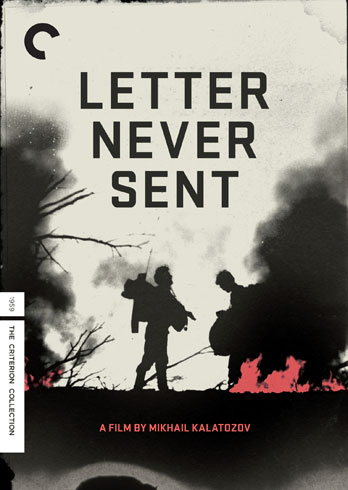
LETTER NEVER SENT (Blu-Ray - #601)
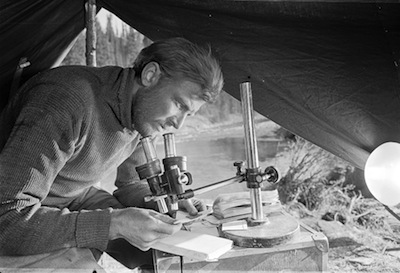
An expedition of four enters the Siberian wilderness. Scientific tests of the soil in the area have shown a possibility for diamond deposits. The group consists of three geologists and their guide, all veterans of similar hunts, though yet to experience success. The mission to find the diamonds could bring them great glory; if they are successful, the treasure will fund new Soviet endeavors. If they fail, it's uncertain if they will get another chance or if new explorers will be sent in their stead.
This is the premise for Letter Never Sent, Russian filmmaker Mikhail Kalatozov's 1959 backwoods drama. It's a man vs. nature tale worthy of Werner Herzog, one with hubris, misplaced ambition, and even a touch of romance. Letter Never Sent is both human and elemental.
Sabinin (Innokenti Smoktunovsky) leads the search party. He is a level-headed man, and his ongoing missive to his wife (Galina Kozhakina) gives the film its title. He began the letter on the plane, but instead of sending it back with the flight crew, he hangs onto it, turning it into a record of their endeavors. The pair of geologists on his team is in a relationship. Andrei (Vasili Livanov) is smart and affectionate, and he and Tanya (Tatyana Samoilova, also in Kalatozov's The Cranes are Flying [review]) share a common pursuit. The guide for the trip, Sergei (Yevgeny Urbansky), also has feelings for Tanya. He is physical and earthy. He is not necessarily Andrei's better, but he is the man's opposite. One is analytical, the other instinctual.
This set-up creates a strong dynamic. All the players have their function, and they serve them. Tanya is aware of Sergei's intentions, as is Sabinin, who acts as a calming influence. Whether Andrei has any clue is up to interpretation. He and Sergei have an altercation that ends ambiguously. It may be telling, however, that Tanya discovers the evidence they have been seeking after dismissing Sergei, and its Andrei that she first celebrates with. Yet, each man has a redemptive moment on the horizon, a chance to take action and make a sacrifice.
It's after Tanya's finding that the real movie begins, and Letter Never Sent turns into a story of survival rather than one of discovery. The morning after she digs up the diamond, the team awakens to a forest ablaze. It's as if Mother Earth is rising up to stop them. She can't simply let these men tear into her soil and take her prize. The hunting party must grab what they can and make a run for safety. Before they find it, they will contend with not just fire, but rain and snow, as well. The terrain is unforgiving, and the weather unrelenting.
Letter Never Sent is a wondrous thing to witness unfold. Mikhail Kalatozov, who is perhaps best known for his innovative travelogue I Am Cuba [review], has a remarkable sense of framing and a masterful photographic eye. He and his regular cinematographer Sergei Urusevsky possess an uncanny grasp of black-and-white dynamics. The nature photography in Letter Never Sent is beautiful, with the camera acting as a vibrant observer. Kalatozov moves with and around the actors, dodging tree branches, going underneath and above the performers, and often acting in concert with them. Though a cold observer, the camera additionally serves as a unifying tool, connecting what the geologists are doing with the environment they are doing it in. In the early scenes, Kalatozov employs montage to show their tireless hunt while laying flickering flames over the top of their activities. As it is occurring, it appears the fire is meant to symbolize the passion with which they undertake their duties; as we get deeper in, these conflagrations are revealed to have been foreshadowing.
Kalatozov's direction manages to be both poetic and realistic, striking an intentional balance between artistic expression and the truth of his scenario, the virtuosity of the invented visuals and the actual beauty of the Siberian forests. This illustrates the disparity between man's dreams of glory and the harsh reality of the natural world. The obvious flourishes of Letter Never Sent's first act disappear once the fire comes for real. From there, the only fantasies Kalatozov indulges are Sabinin's delusions. He converses with his wife, and he sees the industry he believes their findings will make possible. Yet, neither is really happening.
Which isn't to say that all the beauty vanishes once the trees start to burn. Nature has the same capacity to nourish as it does to destroy. The cleansing rain creates salvation, and Kalatozov and Urusevsky capture the relief in a way that resembles religious ecstasy. Tanya leans against a tree and lets the water pour over her, and her expression is serene and joyous. The irony, of course, is that the same rain will turn to ice and become their next deadly obstacle. Time and space become immaterial, with seasons seemingly passing overnight and civilization appearing no nearer. Letter Never Sent is a test of wills: do these explorers have what it takes to get home? Can Sabinin deliver his message, or is failure and hopelessness all that really waits for those who dare challenge that which is bigger than all of us?
For a complete rundown on the special features, read the full review at DVD Talk.
Please Note: The images used here are from promotional materials, not from the Blu-Ray.
Labels:
blu-ray,
herzog,
kalatozov,
Mikhail Kalatozov
Thursday, December 1, 2011
SIDELINE: MORE REVIEWS FOR 10-11/11
Wow, I have been so out of it in November, I never even posted a list of movies I reviewed in October! My apologies for being drag-ass this past month, it's been a weird time. I am getting on track, though, and hope to catch up through December.
In the meantime, my non-Criterion movies...
IN THEATRES...
* The Big Year, it's called birding, not birdwatching, and it's awful either way. Wilson, Black, Martin--the new comedy nightmare team.
* The Black Power Mixtape 1967-1975, a documentary showing a certain portion of history through a different lens.
* The Descendants, George Clooney starring in a new film from Alexander Payne.
* The Ides of March, a political drama from he-that-can-do-no-wrong, George Clooney. Starring Ryan Gosling.
* Into the Abyss, Werner Herzog's documentary on the death penalty in Texas. Very human, very scary.
* J. Edgar, Clint Eastwood continues his trend of almost delivering in this biopic with Leonardo DiCaprio as the legendary lawman.
* Like Crazy, love a la modern cinema verite. Starring Anton Yelchin and Felicity Jones.
* Melancholia, Kirsten Dunst at the end of the world, courtesy of Lars von Trier.
* The Mill and the Cross, Rutger Hauer stars as Pieter Bruegel preparing his painting The Procession to Calvary in Lech Majewski's deconstruction of the masterpiece.
* Restless, Gus Van Sant's latest attempt to go back to high school. Insert words "emo" and "twee" now.
* The Rum Diary, Bruce Robinson returns to moviemaking for a somewhat disappointing Hunter S. Thompson movie with Johnny Depp.
* The Skin I Live In, the disturbing new horror drama from Pedro Almodovar.
* Take Shelter, the movie where Michael Shannon goes crazy and the world seemingly follows his lead.
ON DVD/BD...
* Bad Teacher: Unrated Edition, a superb cast can't prevent this from being one of the least funny movies you'll see this (or any) year.
* Beats, Rhymes & Life: The Travels of a Tribe Called Quest, the story about the influential rap group is also the best music documentary in a long, long time.
* Bellflower, the cult indie strikes me as empty for all the wrong reasons.
* Bored to Death: The Complete Second Season, the continuing adventures of Jason Schwarztman as the pulpy, humorous avatar of author Jonathan Ames.
* Buster Keaton - Short Films Collection: 1920-1923, 19 comedy gems on three discs.
* Cape Fear, Scorsese's potent remake with Robert De Niro and Nick Nolte.
* Dumbo: The 70th Anniversary Edition, the stellar new upgrade for the little elephant that could.
* Great Italian Directors Collection, a boxed set of three films, including the first by Antonioni, a mid-60s Monicelli, and the anthology film Boccaccio '70.
* His Way, a breezy documentary about music promoter/movie producer Jerry Weintraub.
* I'm a Cyborg, But Thats OK, an inconsistent oddity from Park Chan-wook.
* Miss Nobody, an indie black comedy starring Leslie Bibb.
* My Fair Lady, another Audrey Hepburn movie comes to Blu-Ray. (What is that? Three now? Hurry up, Hollywood!)
* Rare Exports: A Christmas Tale, a black action comedy. The true Santa Claus returns!
* Rescue Me: The Sixth Season and the Last Season, the fire fighter bromance ends.
* Tomorrow is Forever, a post-war snooze with Orson Welles and Claudette Colbert doing their best to be mellow in all the drama.
* True Adolescents, a surprising indie comedy starring Mark Duplass as the cliche 30s rocker on his last legs.
* Water for Elephants, a film even a pachyderm would endeavor to forget.
* The White Bus, a short film written by the recently deceased Shelagh Delaney and directed by Lindsay Anderson.
In the meantime, my non-Criterion movies...

IN THEATRES...
* The Big Year, it's called birding, not birdwatching, and it's awful either way. Wilson, Black, Martin--the new comedy nightmare team.
* The Black Power Mixtape 1967-1975, a documentary showing a certain portion of history through a different lens.
* The Descendants, George Clooney starring in a new film from Alexander Payne.
* The Ides of March, a political drama from he-that-can-do-no-wrong, George Clooney. Starring Ryan Gosling.
* Into the Abyss, Werner Herzog's documentary on the death penalty in Texas. Very human, very scary.
* J. Edgar, Clint Eastwood continues his trend of almost delivering in this biopic with Leonardo DiCaprio as the legendary lawman.
* Like Crazy, love a la modern cinema verite. Starring Anton Yelchin and Felicity Jones.
* Melancholia, Kirsten Dunst at the end of the world, courtesy of Lars von Trier.
* The Mill and the Cross, Rutger Hauer stars as Pieter Bruegel preparing his painting The Procession to Calvary in Lech Majewski's deconstruction of the masterpiece.
* Restless, Gus Van Sant's latest attempt to go back to high school. Insert words "emo" and "twee" now.
* The Rum Diary, Bruce Robinson returns to moviemaking for a somewhat disappointing Hunter S. Thompson movie with Johnny Depp.
* The Skin I Live In, the disturbing new horror drama from Pedro Almodovar.
* Take Shelter, the movie where Michael Shannon goes crazy and the world seemingly follows his lead.

ON DVD/BD...
* Bad Teacher: Unrated Edition, a superb cast can't prevent this from being one of the least funny movies you'll see this (or any) year.
* Beats, Rhymes & Life: The Travels of a Tribe Called Quest, the story about the influential rap group is also the best music documentary in a long, long time.
* Bellflower, the cult indie strikes me as empty for all the wrong reasons.
* Bored to Death: The Complete Second Season, the continuing adventures of Jason Schwarztman as the pulpy, humorous avatar of author Jonathan Ames.
* Buster Keaton - Short Films Collection: 1920-1923, 19 comedy gems on three discs.
* Cape Fear, Scorsese's potent remake with Robert De Niro and Nick Nolte.
* Dumbo: The 70th Anniversary Edition, the stellar new upgrade for the little elephant that could.
* Great Italian Directors Collection, a boxed set of three films, including the first by Antonioni, a mid-60s Monicelli, and the anthology film Boccaccio '70.
* His Way, a breezy documentary about music promoter/movie producer Jerry Weintraub.
* I'm a Cyborg, But Thats OK, an inconsistent oddity from Park Chan-wook.
* Miss Nobody, an indie black comedy starring Leslie Bibb.
* My Fair Lady, another Audrey Hepburn movie comes to Blu-Ray. (What is that? Three now? Hurry up, Hollywood!)
* Rare Exports: A Christmas Tale, a black action comedy. The true Santa Claus returns!
* Rescue Me: The Sixth Season and the Last Season, the fire fighter bromance ends.
* Tomorrow is Forever, a post-war snooze with Orson Welles and Claudette Colbert doing their best to be mellow in all the drama.
* True Adolescents, a surprising indie comedy starring Mark Duplass as the cliche 30s rocker on his last legs.
* Water for Elephants, a film even a pachyderm would endeavor to forget.
* The White Bus, a short film written by the recently deceased Shelagh Delaney and directed by Lindsay Anderson.

Lindsay Anderson directing
Tuesday, May 31, 2011
SIDELINE: MORE REVIEWS FOR 5/11
A round-up of my reviews for non-Criterion movies in the past month.
IN THEATRES...
* The Beaver, Jodie Foster directs Mel Gibson, who talks through a beaver puppet. Yes, it's pretty crazy.
* Bridesmaids, this Kristen Wiig-led comedy is a real winner. Funny and heartfelt. And next time someone asks if Bridesmaids is a chick version of The Hangover, ask them if that's a stupid person's version of a smart question.
* Cave of Forgotten Dreams, Werner Herzog's 3D documentary about the Chauvet Caves. My favorite movie of the year so far.
* Everything Must Go, in which Will Ferrell drinks some sad beer, channels Raymond Carver, and is pretty good at doing it.
* Hesher, Joseph Gordon-Levitt stars as the title character. Hit an open chord, take off your shirt, and be a teenage dirtbag, baby.
* Thor, another winner from Marvel. Kenneth Branagh's adaptation of the comic is mighty fun.
* True Legend, a disappointing new action flick from the awesome martial arts choreographer Yuen Woo-Ping. Lame story, too much CGI.
The NW Film Center in Portland also had a festival of twelve films starring Catherine Deneuve. I picked some of my favorites for the Portland Mercury. Read "The Two Faces of Deneuve."
I also wrote blurbs for older movies doing the revival rounds:
* Sergei Eisenstein's Battleship Potemkin
* Claude Lanzmann’s Shoah
ON DVD/BD...
* Araya, Margot Benacerraf's 1959 blending of fact and fiction on the salt marshes of Venezuela.
* Bananas!*, a documentary about the fight against Dole Fruit, accused of poisoning Nicaraguan workers in the 1970s.
* The Captive City, Robert Wise's by-numbers anti-crime PSA from the 1950s.
* Guy and Madeline on a Park Bench, an intriguing mash-up of classic indie cinema and classic movie musicals.
* Henri-Georges Clouzot's Inferno, a stupendous documentary sifting through the remains of the Diabolique-director's unfinished would-be masterpiece.
* Hold On!, Herman's Hermits come to America, join the space race, play some music, pitch some woo.
* The Misfits, John Huston directs Clark Gable and Marilyn Monroe in their final screen roles. Also stars Eli Wallach and Montgomery Clift, in a script by Arthur Miller.
* Not as a Stranger, starring Robert Mitchum as a doctor who can heal anything but his own bad impulses. Directed by Stanley Kramer.
* Shoeshine, a Neorealist classic from Vittorio De Sica, released 1946.
* The Unloved, Samantha Morton's softly rendered, heartfelt directorial debut.
IN THEATRES...
* The Beaver, Jodie Foster directs Mel Gibson, who talks through a beaver puppet. Yes, it's pretty crazy.
* Bridesmaids, this Kristen Wiig-led comedy is a real winner. Funny and heartfelt. And next time someone asks if Bridesmaids is a chick version of The Hangover, ask them if that's a stupid person's version of a smart question.
* Cave of Forgotten Dreams, Werner Herzog's 3D documentary about the Chauvet Caves. My favorite movie of the year so far.
* Everything Must Go, in which Will Ferrell drinks some sad beer, channels Raymond Carver, and is pretty good at doing it.
* Hesher, Joseph Gordon-Levitt stars as the title character. Hit an open chord, take off your shirt, and be a teenage dirtbag, baby.
* Thor, another winner from Marvel. Kenneth Branagh's adaptation of the comic is mighty fun.
* True Legend, a disappointing new action flick from the awesome martial arts choreographer Yuen Woo-Ping. Lame story, too much CGI.
The NW Film Center in Portland also had a festival of twelve films starring Catherine Deneuve. I picked some of my favorites for the Portland Mercury. Read "The Two Faces of Deneuve."
I also wrote blurbs for older movies doing the revival rounds:
* Sergei Eisenstein's Battleship Potemkin
* Claude Lanzmann’s Shoah
ON DVD/BD...
* Araya, Margot Benacerraf's 1959 blending of fact and fiction on the salt marshes of Venezuela.
* Bananas!*, a documentary about the fight against Dole Fruit, accused of poisoning Nicaraguan workers in the 1970s.
* The Captive City, Robert Wise's by-numbers anti-crime PSA from the 1950s.
* Guy and Madeline on a Park Bench, an intriguing mash-up of classic indie cinema and classic movie musicals.
* Henri-Georges Clouzot's Inferno, a stupendous documentary sifting through the remains of the Diabolique-director's unfinished would-be masterpiece.
* Hold On!, Herman's Hermits come to America, join the space race, play some music, pitch some woo.
* The Misfits, John Huston directs Clark Gable and Marilyn Monroe in their final screen roles. Also stars Eli Wallach and Montgomery Clift, in a script by Arthur Miller.
* Not as a Stranger, starring Robert Mitchum as a doctor who can heal anything but his own bad impulses. Directed by Stanley Kramer.
* Shoeshine, a Neorealist classic from Vittorio De Sica, released 1946.
* The Unloved, Samantha Morton's softly rendered, heartfelt directorial debut.
Labels:
clouzot,
de sica,
documentary,
eisenstein,
herzog,
huston,
other reviews,
robert wise
Subscribe to:
Posts (Atom)