Showing posts with label warren beatty. Show all posts
Monday, October 22, 2018
SHAMPOO - #947
Shampoo is easily the most Warren Beatty of all of Warren Beatty’s movies. A political and interpersonal comedy, it says as much about Beatty as it does the world. The writer/actor/producer lets his point of view be known, but he also embraces a certain image of himself as the pretty playboy, simultaneously reinforcing and undercutting it, creating a complex portrait of a man who knows what he wants but is often derailed by either his baser desires or what other people perceive of him. In many ways, it’s a prototype for a character and a movie he would revisit/remake more than once. Is George in Shampoo all that different from Jay Bulworth in Bulworth? What about Joe in Heaven Can Wait? Are their journeys that different?
Though Beatty didn’t direct this one, he had a hand throughout the production. He also had the confidence to place the great Hal Ashby (Being There [review]) behind the camera. Shampoo was released in 1975, but its story takes place in 1968, the day Richard Nixon is elected President. The election hangs over everything in the picture, a foregone conclusion not just to contemporary viewers, but also to the men of wealth whose wives go to George to get their hair done. The rest of the participants don’t seem to realize the change that is coming, but they are already starting to feel it. By the morning of the next day, an era will have passed. Ashby uses the Beach Boys’ “Wouldn’t It Be Nice” to bookend the picture, and it goes from a sweet, hopeful anthem of youth to an ironic remembrance of false promises.
Election Day is also the day that George has decided to meet with the bank to talk about opening his own hair salon. George is popular in his profession, and he believes his customer base would follow him if he had his own shingle; unfortunately for him, the bank sees through his lack of business acumen. George is too scared to tell his girlfriend Jill (Goldie Hawn) about this failure, but he does end up spilling the beans to his mistress, Felicia (Lee Grant), who is also a top client. Knowing George’s skills, Felicia sends him to her husband, Lester (Jack Warden). Even though Lester doesn’t sign on immediately, he sees the adulation George receives first-hand, since Lester’s own mistress, Jackie (Julie Christie, Beatty’s dance partner in McCabe and Mrs. Miller [review]), can also vouch for George’s magic hands. Little does Lester know, George and Jackie also used to date, a tidbit that might have dissuaded him from hatching an ill-fated plan: he asks George to accompany Jackie to an election night party, acting as cover for them while Lester attends the same shindig with Felicia. Oh, and Jill will be there, too, because she’s schmoozing a film director to get a part. (The director is played by Tony Bill, who did go on to be an actual film director, helming My Bodyguard, Five Corners, and one of my all-time favorites, Untamed Heart).
Sounds complicated, doesn’t it? Well, Beatty and co-writer Robert Towne (The Last Detail, Chinatown) never lose track of all the players, nor do they ever leave the audience hanging. In may ways, Shampoo seems like it would have been a perfect match for Robert Altman, who could have juggled the massive ensemble and the crisscrossing scenes without breaking a sweat; that said, Ashby shows no perspiration himself. Shampoo is complicated, but never messy, and watching all these things converge ends up being a delight.
For all the trampled feelings and missed connections that happen as the various participants travel from the election event to a large Los Angeles soiree, and then off into the night, most everyone here has similar needs and ambitions. Everyone in Shampoo is after something that they likely can’t have, and for most of them, they can’t have it due to some fault of their own. The clash between George and Lester could have easily been a celebration of a free spirit and the excoriation of a corporate fat cat, but when the two men finally compare notes, they both appear to be just as stranded in a world of their own making. Maybe today is the day they can make their change. Maybe not. Maybe Nixon will change it for them. Knowing what we know, things will probably change more for George than Lester. Then again, I bet if we had a sequel to Shampoo set in the Reagan era, we’d see them both thriving in the excess of the Me Decade.
Don’t confuse Shampoo for a polemic or a message picture, however; the film is quite funny, both in its quirky rhythms (which is where Ashby probably trumps Altman) and in some of its broad contrivances. Julie Christie getting drunk and wicked provides many a good laugh, as does Lester’s utter confusion over George. Warren Beatty loves to play his characters as befuddled, a little off vibration from the rest of the world, somehow always one step behind but still looking at his next move. He’s great here, especially in the later scenes when George finally opens up. “You’re the only one I trust,” he tells Jackie, and we are with her when her heart breaks for him, knowing that soon he will be all alone. And, of course, watch a very young Carrie Fisher steal the show as Felicia’s randy, vindictive daughter.
Shampoo is also quite sexy. Again, the film leans into Beatty’s ladies man image. Every woman in the movie approaches him projecting an aura of sex. Amusingly, through most of the movie, he is either just missing the moment or we, as the audience, are shut out. So, when we finally do see George in action, it’s a scene that is first met with applause and then uncomfortable laughter, both from within the narrative and from without.
It’s interesting that Shampoo is a mid-’70s Hollywood production looking back at the tail end of the 1960s. The nostalgia is both wistful and disappointed. One gets the sense that Beatty knows how ridiculous some of George’s outfits look, or that choosing to have him ride a Triumph motorcycle is meant to mock him as a false rebel. All these flamboyant, fashionable choices--from having George be a hairdresser to his own artfully messy mane--seem to be intended to provoke a certain segment of the film-going public that probably had a lot of disdain for Beatty (mainly guys like Lester). Nothing on the surface of Shampoo will change their minds. Thus, shoving the cliché in everyone’s faces--fans and foes alike--only to bust it apart, transforms the screen idol into an enduring symbol of the idealistic decade that Shampoo is eulogizing, dashed hopes and all.
Labels:
altman,
hal ashby,
Robert Towne,
warren beatty
Saturday, October 29, 2016
McCABE & MRS. MILLER - #827
There is a lot going on in McCabe & Mrs.Miller, Robert Atman’s 1971 western, and a lot to admire, but I think what comes to mind first for me is the impossible construction.
I mean this in two ways.
First, there is the location itself, the mining town of
Presbyterian Church, set deep in the mountains of the Pacific Northwest. It is
simply a place that should not be, higher than man should really be climbing at
the time, arguably so high that they have surpassed the heavens and offended
God. For certainly He is not present in this ironically named town. The lone
church stands empty and unappreciated, which gives one cause to wonder by what
providence it remains standing. How do its rickety shacks not go sliding down
the side of the mountain? What prevents the even more rickety bridge from
coming undone and plummeting into the water below?
Second, there’s the formless script, written by Altman and
Brian McKay. It has a throughline or two--the new arrivals in town, their
enterprises, and the efforts to shut them down--but there seems to be little
blueprint. In a sense, McCabe & Mrs. Miller is episodic,
but it is also one long endeavor, a drunken bender embarked upon the moment
Warren Beatty’s McCabe climbs down from his horse and enters the cramped,
rundown Presbyterian Church saloon. People come and go, they meet, they
interact, but they don’t follow the dictates of an outline or turns of plot.
Except maybe the villains, who trigger change. But then, they are also their
own force, pushing through, not tied to any necessity but their own.
For all the talk of Altman’s facility with ensemble, as the
title might imply, McCabe & Mrs. Miller is really a character
double header. Beatty plays McCabe, the gambler turned barkeep and pimp, as a posturing
space case. Like many of Beatty’s characters, he is rarely in the moment, he is
always either one step behind or moving on to the next. Beatty has a regular
expression that could either be read as confused or lost in thought. It’s his
way of disarming everyone, to be more than the handsome leading actor.
“That man? That man never killed anybody,” one of the heavy
gunslingers opines in reaction to hearing McCabe’s reputation as an outlaw;
yet, for some reason, we are inclined to believe the legend.
Legend or not, McCabe is no match for Mrs. Miller (Julie
Christie, Billy Liar [review]). Mrs. Miller comes to
Presbyterian Church with a proposition for McCabe: she will take over his
budding prostitution business and be the madame of his whorehouse. The British
woman doesn’t take no for an answer, not in anything. She sees a fixer-upper
like McCabe and his business, and she goes about fixing things--a classic, if
flawed and clichéd, male/female dynamic. Mrs. Miller brings sophistication to the
town. We never quite learn what led her there, though we get the sense that she
is outrunning her past as much as McCabe, a hunch in part confirmed by her bad
habits. She’s looking for numbness through drugs by film’s end, an oh-so-modern
condition. (And an oh-so-ancient one, but perhaps more interesting to consider
in the post-Feminine Mystique context of 1971.)
This central relationship is a romance of sorts, but
McCabe & Mrs. Miller is no more a conventional romance
than it is a conventional western. The two leads are here to serve as examples
of the independent minds ready to take advantage of the frontier spirit that
defined America’s expansion. Naturally, this puts them up against other
concerns. Corporate interests quickly encroach on Presbyterian Church. Whatever
they are mining up there, the moneyed and powerful want it, and they won’t
stand for a rapscallion like McCabe not playing by the rules. The agents of the
unseen conglomerate--including the aptly named company man Roebuck (Altman-regular
Michael Murphy, later to play his blundering politician Tanner)--embody the
lies of free enterprise. The law (here represented by William Devane’s
discouraging attorney) is no help, either. McCabe & Mrs.
Miller is as much about the big man vs. the little man and how that
fight crushes the American Dream as it is about anything. Right down to the
simple fellow making his own way in life (Keith Carradine, Thieves
Like Us [review]) who gets taken down by the blonde bully who doesn’t
care for trust or fairness.
Altman’s touch here is easy. McCabe & Mrs.
Miller is light on its feet, easy to watch, and not without its
humor. Carradine’s “aw shucks” manner and René Auberjonois’ feckless saloon
owner both get laughs, as do Beatty’s unfinished homilies. His repeated “is
there a turd in your pocket?” inquiry is uniquely gross and strange. These
characters and their odd ways set up a soft platform for the script’s
commentary, which also infuses the movie’s genre-fulfilling finale. It’s
fitting that the climax should hinge on the unfinished church, and that the
abandoned preacher should cause our antihero such consternation. The church
also somehow unites the community in a way the other common threat cannot,
perhaps because that threat comes from outside and this one burns from within.
Then again, what’s that thing about how if you’re being attacked in public you
should shout “Fire!” instead of “Help!” because people care more about property
than their fellow human beings? No one lifts a finger in aid of McCabe.
McCabe & Mrs. Miller offers no solution
for its players. Both of its main characters arguably end the film worse off
than they began, partially because their success gave them more to lose. Yet,
that American spirit is still there, because at least they remained true to
themselves. Push came to shove, McCabe didn’t just let them take him out, he
stuck to his price even it the currency changed (your money or your life!), and
Mrs. Miller ends up communing with the only person she can really count on:
herself.
I’d be remiss if I closed this without touching on the
visual style of McCabe & Mrs. Miller. It’s designed to
look natural, from the often ratty and ill-fitting clothes, to the precarious
lodgings. Presbyterian Church is dirty and muddy and as foul smelling and
uninviting as Deadwood would be years later, though here the raggedy aesthetic
was very much reflective of the era in which the film was made. The 1970s
strike me as a very brown decade, and McCabe & Mrs. Miller
is a very brown movie. Legendary cinematographer Vilmos Zsigmond (The Rose; Heaven’s Gate [review]) shot the film
in natural light, letting the dusty haze of mountain living give the movie
life. There is a visible atmosphere in McCabe & Mrs.
Miller. The air has grit.
Adding to the film’s disposition is a trio of songs by the
great Leonard Cohen. His roving narratives and unconventional melodies give the
montage rhythm. In as much as Altman avoids set-up/conflict/resolution in his
storytelling, Cohen largely ignores verse-chorus-verse. His melancholy folk
could have been anachronistic were it not so intrinsic in how McCabe
& Mrs. Miller is cut together. It feels as natural as the ambient
noise, the wind in the trees, the rain on the roof. Which is just how I feel
about a classic Leonard Cohen record on a hungover Sunday morning--a sentiment
McCabe could likely identify with himself.
The songs are perfectly in sync with the cadence and
contradictions of Altman’s tale. They manage to be both intimate and expansive,
and Altman uses the tunes to underline not only the personal, tracking private
moments through close-up and observation, but he also lets Cohen’s mournful
playing bring pause. As the internal dialogue of the movie itself goes quiet,
Zsigmond’s camera pulls back and goes wide, allowing us to appreciate the
scenery. Which maybe gives us more of a sense of what these travelers are all
holding on for. It’s freezing and wet and grimy but it’s also lovely in a way
only such an open, untamed area can be. The way only an Altman movie can
sometimes be. The way McCabe & Mrs. Miller is.
Impossible, but true.
This disc provided by the Criterion Collection for purposes of review.
Labels:
altman,
vilmos zsigmond,
warren beatty,
westerns
Friday, February 1, 2013
SIDELINE: MORE REVIEWS FOR 1/13
My reviews for non-Criterion movies written in the first month of 2013.
IN THEATRES...
* 56 Up, another seven years in the life of Michael Apted's groundbreaking documentary series.
* Amour, Michael Haneke's drama of old age. Reserved and emotionally powerful.
* Barbara, an enthralling German drama about one woman exiled to the country in East Germany, ca. 1980.
* Gangster Squad. The low-bar for 2013 has been set. Here's your challenge, movie industry: don't do worse than this.
* Hansel & Gretel: Witch Hunter. I'm a sucker for Gemma Arterton so I went to see her as Gretel, and now I'm a sucker for this movie.
* The Impossible, a good movie about surviving a tsunami, despite the ethnic whitewash.
* The Last Stand, teaming Arnold Schwarzenegger with awesome director Jee-woon Kim. It's not as good as his Korean movies, but it's better than most Arnie movies.
* Mama, starring recent Golden Globe winner Jessica Chastain. She had a whole week to enjoy her win before this stinker hit.
* Rust and Bone, Marion Cotillard in a dark drama from the director of A Prophet.
IN THEATRES...
* 56 Up, another seven years in the life of Michael Apted's groundbreaking documentary series.
* Amour, Michael Haneke's drama of old age. Reserved and emotionally powerful.
* Barbara, an enthralling German drama about one woman exiled to the country in East Germany, ca. 1980.
* Gangster Squad. The low-bar for 2013 has been set. Here's your challenge, movie industry: don't do worse than this.
* Hansel & Gretel: Witch Hunter. I'm a sucker for Gemma Arterton so I went to see her as Gretel, and now I'm a sucker for this movie.
* The Impossible, a good movie about surviving a tsunami, despite the ethnic whitewash.
* The Last Stand, teaming Arnold Schwarzenegger with awesome director Jee-woon Kim. It's not as good as his Korean movies, but it's better than most Arnie movies.
* Mama, starring recent Golden Globe winner Jessica Chastain. She had a whole week to enjoy her win before this stinker hit.
* Rust and Bone, Marion Cotillard in a dark drama from the director of A Prophet.
Dick Tracy by Brent Schoonover
ON BD/DVD...
* 5 Broken Cameras, the Oscar-nominated documentary made from one Palestinian man's personal video diary.
* Dangerous Liaisons, a 2012 Chinese update of the French novel, transplanting it to Shanghai in the 1930s and starring Zhang Ziyi and Cecilia Cheung.
* Dick Tracy, Warren Beatty's ambitious 1990 comic strip adaptation was a head of its time.
* Doctor Zhivago. Not the good David Lean version, but the boring 2002 TV version.
* Enlightened: The Complete First Season, an unfocused but entertaining HBO series from actress Laura Dern and filmmaker Mike White.
* The Good Doctor, the director who gave us Kisses returns with an ethically curious medical drama with Orlando Bloom.
* Indiscreet, the Stanley Donen romance film reteaming Cary Grant and Ingrid Bergman appears to be geting better with age.
* A Man Vanishes, Shohei Imamura's 1967 breakthrough. In addition to the main film, there are also five documentaries the Japanese director made in the years leading up to Vengeance is Mine.
* Misfits: Season Two. Well, you can't win them all. Sophomore slump?
* Mrs. Miniver, sincere propaganda done as a moving drama by William Wyler, buoyed by an understanding performance from Greer Garson.
* Post Mortem, a strange kind of love story form Chile.
* The Quiet Man, John Ford's romantic classic starring John Wayne and Maureen O'Hara is now a stunning Blu-Ray release.
* Searching for Sugar Man, one of 2012's best documentaries is also a great rock-'n'-roll story.
* Dangerous Liaisons, a 2012 Chinese update of the French novel, transplanting it to Shanghai in the 1930s and starring Zhang Ziyi and Cecilia Cheung.
* Dick Tracy, Warren Beatty's ambitious 1990 comic strip adaptation was a head of its time.
* Doctor Zhivago. Not the good David Lean version, but the boring 2002 TV version.
* Enlightened: The Complete First Season, an unfocused but entertaining HBO series from actress Laura Dern and filmmaker Mike White.
* The Good Doctor, the director who gave us Kisses returns with an ethically curious medical drama with Orlando Bloom.
* Indiscreet, the Stanley Donen romance film reteaming Cary Grant and Ingrid Bergman appears to be geting better with age.
* A Man Vanishes, Shohei Imamura's 1967 breakthrough. In addition to the main film, there are also five documentaries the Japanese director made in the years leading up to Vengeance is Mine.
* Misfits: Season Two. Well, you can't win them all. Sophomore slump?
* Mrs. Miniver, sincere propaganda done as a moving drama by William Wyler, buoyed by an understanding performance from Greer Garson.
* Post Mortem, a strange kind of love story form Chile.
* The Quiet Man, John Ford's romantic classic starring John Wayne and Maureen O'Hara is now a stunning Blu-Ray release.
* Searching for Sugar Man, one of 2012's best documentaries is also a great rock-'n'-roll story.
Thursday, January 14, 2010
CHE - #496
"We now are in a time period where if a film doesn't receive unified acclaim, then it's viewed as damaged or a failure or something worse, and that's unfortunate. I don't feel there's a sense anymore that a movie can be polarizing and that can be a good thing. It's literally what is the number that you got on Rotten Tomatoes and if it's below a certain number, then your movie's not any good. You can imagine the number 2001 would have gotten on Rotten Tomatoes...."
- Steven Soderbergh, from the Making "Che" documentary, DVD 3
Few people have earned the level of respect I hold for Steven Soderbergh. When I first saw Che, the director had brought the roadshow version to Portland's Cinema 21, answering audience questions after a marvelous marathon showing of the movie in full. I've met plenty of people whose art inspired me over the years, and I usually have no problem keeping my cool. When I met Soderbergh, I got nervous and twitchy. My voice shook as I handed him a copy of one of my books
, a small fantasy playing out in the back of my head that I would eventually get a call that he wanted to option it. One hopes that no matter how successful a person gets that they could continue to have such fantasies. Why do you think Barack Obama invites musicians he likes to the White House?
I have a feeling that Steven Soderbergh is also someone who still hangs on to his fantasies. The audacious creativity he shows from film to film leaves little doubt he dares to dream. In a way, he's a throwback to the directors who came up through the studio system in Hollywood's Golden Age, guys who never knew what their next assignment would be. Like how Robert Wise's first two movies were a historical drama and a horror movie, followed eventually by film noir, a boxing movie, comedies about oil lobbyists, war stories, corporate intrigue, and eventually some of the most popular musicals of all time. The difference is that Soderbergh has cinematic history to back him up, and he not only jumps around from subject to subject, genre to genre, but he picks and chooses what time frame he wants to emulate. Out of Sight
was a 1970s crime picture, as much a character study as it was a plot-driven heist movie; The Good German emulated the 1940s in a bold and blatant manner; The Informant! laced in elements of 1960s screwball to underscore its story, especially with its Marvin Hamlisch soundtrack. Soderbergh also regularly returns to the cheap, arty indie fare he helped set the standard for with sex, lies, and videotape
.
There are few filmmakers who would undertake a four-and-a-half hour, two-part biography of Che Guevara, insisting that it be filmed in Spanish to make it more authentic. Which came first? Soderbergh's mad plan or the jokes about Vincent Chase wanting to do the same thing to make Medellín on Entourage? At one point, Vinnie was even going to be replaced in the role of Pablo Escobar by Benicio Del Toro.
Che turned out better for Soderbergh than Vincent Chase's film did for him, even if it wasn't a huge box office hit. (Though, given Soderbergh's cross-platform release, making the movie available through cable on-demand services at the same time it toured theatres, it probably did better than most folks think.) It's doubtful anyone involved with Che set out to make it thinking it was going to make massive money. This is a movie like Warren Beatty's Reds, one that was made precisely because it was such an artistic gamble. It's something that both filmmakers needed to do, consequences be damned.
Beatty and Soderbergh likely looked back at the same influences when they made their films (and who knows, Soderbergh might have actually looked to Reds). Namely, I see Che as a modern political epic on par with the big movies of David Lean. In particular, Lawrence of Arabia
, the story of one man, a controversial figure, who travels great lengths across harsh environments to get to his goal. Both Che and Lawrence of Arabia have two-act structures, with the break between Part I and Part II signalling significant change for the man. The difference with Soderbergh's picture is there is almost an air of "just the facts" to how Soderbergh and writers Peter Buchman and Benjamin A. van der Veen put the narrative together; there isn't the same sweep of drama that marks the Beatty and Lean.
Part I of Soderbergh's film is the story of Ernesto Che Guevara's part in Fidel Castro's overthrowing of General Batista and claiming revolution in the name of the Cuban people. Benicio Del Toro starts the movie as the clean-shaven doctor joining the political cause, and he ends it as the hairy guerilla fighter immortalized on a million T-shirts
and posters
on college dorm walls. This portion of the movie covers three years, 1956 to the start of 1959, tracking the drive of Castro's forces from the coast of Cuba inland toward Havana. Intercut with this is black-and-white footage of Che visiting the United Nations in 1964, talking to the press, rich American intellectuals, and the whole of the UN, making a case for Cuba's independence. This is the first visual distinction Soderbergh makes in Che, contrasting the colorful and rich greens of the Cuban jungle with the newsreel-style footage in New York, which is meant to reflect how the world actually would have seen Che Guevara on his visit to the States, beamed out to them on their television screens.
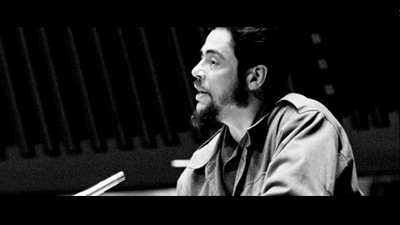
There is another major difference, though this one perhaps unintentional. The New York scenes are shot in an almost cinema-verite style, more loose and off the cuff. It's possible that Soderbergh is making a kind of cinematic pun, using the free-floating shooting techniques of the French New Wave, matching their filmic revolution to Che's political revolution. By contrast, the colorful Cuban scenes are more traditionally choreographed, with the camera often rooted in one spot. The Santa Clara sequence in particular looks and moves like an old-school battle scene, like something out of a John Sturges movie. Efficient, business-like, but still full of tension.
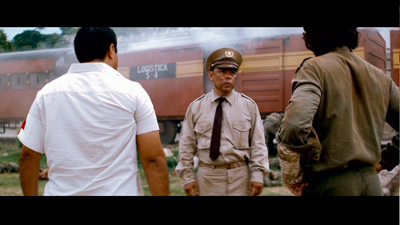
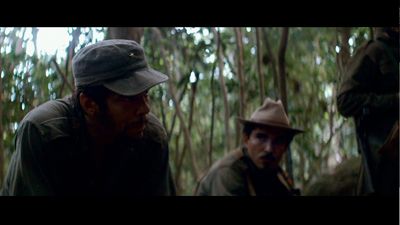
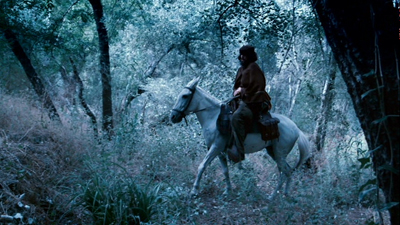
Che was the first movie to be shot entirely with the RED One Digital Cinema camera, and the device freed Soderbergh--who shoots his own films under the name Peter Andrews; also, look for him briefly as the television director when Che is getting interviewed for "Face the Nation"--to experiment and change his style and have it flow seamlessly from one look to the next. Part I of Che is shot in the very wide aspect ratio of 2.35:1, just like a big budget color movie from the 1950s or '60s, whereas Part II is a more restrained 1.78:1. This is meant to illustrate the nature of the two sides of the story. The Cuban campaign is large, full of promise, and triumphant; the Bolivian offensive is cramped, dirty, and ultimately a failure. Che spends most of the time trapped in a forest, unsure of how to get out, and so the screen boxes him in, as well. The color palette even changes. Part II is dirty, brown, and gray; it's sickly and sun-bleached.
Benicio Del Toro plays Guevara as an enigmatic, distant creature. He is kind of the quintessential Del Toro character, actually, as Del Toro's natural presence tends to put him a step or two removed from the audience. Many remember him first seeing the actor as the indecipherable Fenster in The Usual Suspects
. In that role, language made him unknowable, which was also a component of how we perceived his character in his other collaboration with Soderbergh, Traffic. In that movie, he played a Mexican cop who eventually became entangled in a U.S.-based drug sting, and though his was an essential component of the movie, he was also separate. Foreign. Likewise, as Dr. Gonzo in Fear and Loathing in Las Vegas, he was practically a hallucination, a sidekick who didn't exist outside of Hunter Thompson's field of vision. It will be interesting to see how this quality comes into play in his performance as Lawrence Talbot in the upcoming The Wolfman remake.
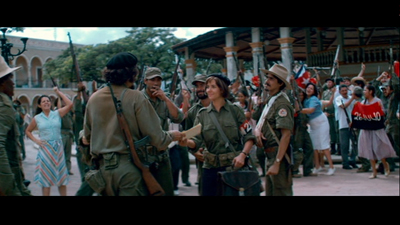
Throughout the first half, Del Toro's Che is a purposeful speaker. He is nearly humorless, completely dedicated to his mission, dogmatically so. He doesn't travel across the Cuban countryside as a warrior so much as he comes across as a missionary, a holy man ready to spread the gospel. As Soderbergh shows him, he talks his way toward Havana, be it convincing the peasants that he has come to help, motivating his troops, or negotiating with enemy officers. Some have complained about this saintly portrayal of the man, believing any film that doesn't get into the atrocities he committed toward his political enemies could never be an accurate depiction. To get into that period of Guevara's career, however, would probably require a third part to the movie, one that would sit uneasily with these two.
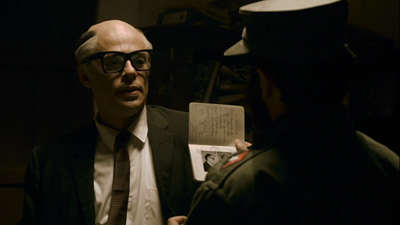
The way I see it, Soderbergh, Buchman, and van der Veen weren't concerned with the right or wrong of Guevara's mission. They aren't taking any sides. In fact, you could say they abstract the character to make him the mission and nothing more. Che in this movie comes to embody the revolutionary impulse, the living icon, more than just a face on a shirt. His entire life becomes about the next liberation. Part I of Che ends by flashing back to the portentous first conversation with Castro, where he agrees to join the cause if Fidel (played here by Demian Bichir) promises he can take the fight to all of Latin America once they have freed Cuba. Part II is then the portrait of a man whose single-mindedness takes him too far off the rails. He subsumes his own identity to the socialist ideal. In the opening scenes of Part II, we see Che in disguise, renouncing his Cuban citizenship (if in gesture only) and heading to Bolivia, not just unrecognizable to us, but also to himself. He is a personality in crisis.
Che spends almost a year, 1966 through 1967, wandering around in the Bolivian jungle, sinking further into the morass of his own idealism. The hubris of righteous belief is taking for granted that everyone else will get on board; the Bolivians do not. The man seems to retreat into himself. He goes by a different name, never allowed to be who he really is, and his asthma all but knocks him down. The motivational speeches are almost entirely gone, there is no more of the smooth-talking rebel. Del Toro physically transforms himself, letting his hair and beard grow long, changing his posture to be more hulking. Che has been turned into a freakish outcast. By the end of the movie, his myopia has so overtaken him, we are literally looking through his eyes.
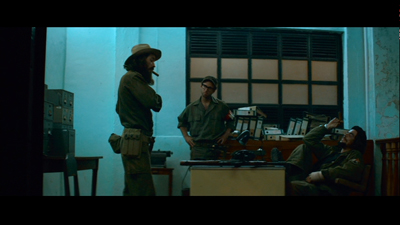
Part II is so mired in disappointment and failure, I am not sure there is any way for Soderbergh to keep it from dragging. The endless trek through the jungle starts to look the same after a while, which puts us in the shoes of the soldiers, but it may also put some people off. The Bolivian troops are a lot more anonymous than the Cuban rebels Che commanded. We don't get to know them, there aren't the distinct personality types. In Cuba, we had the teenagers who grew up in the rebel army, we had Little Cowboy and his cowboy boots, we had Che's fellow officers, who teased and joked with him, and we also had Aleida (Catalina Sandino Moreno from Maria Full of Grace
), the love interest that lurked around the edges. Here, Che takes little interest in his soldiers. He's not educating them, his attitude has changed. While in Cuba he rejected a sixteen-year-old as being too young, in Bolivia he says that's an age where a man is old enough to know what he wants. This keeps the guerillas detached from the audience. Which, again, is accurate, but not as involving. Can we fault a filmmaker, though, for making us feel in a way that is appropriate to the subject?
Che ends with a brief shot of Guevara back on the boat that first carried him into Cuba, reminding us of the youthful promise he once represented, but now colored by all that has followed it. In this last shot, Del Toro somehow looks older, and he now appears pensive. It's a reminder of how far we've come, from that point until now, and the way we see Che is with a new perspective. He has become a man on a collision course with destiny, and we are left to wonder if it was all worth it. The hope of yesterday dies amidst the deluge of too many tomorrows.
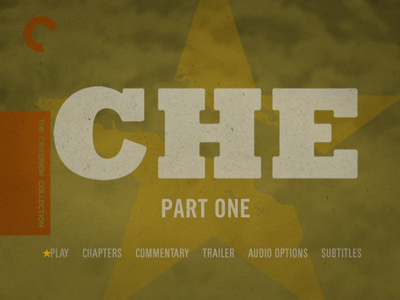
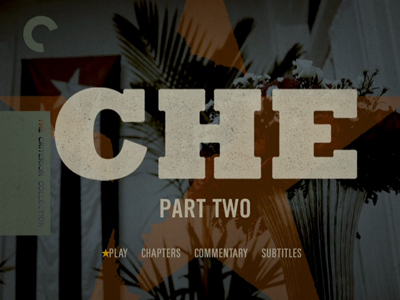
Criterion's release of Che is a three-disc set, packaged in one of their beautiful booklet-style boxes, featuring Eric Skillman's trademark photo illustrations. Each part of the movie is given its own disc, and the third disc is all supplements. The thrust of the extras is history--the history of the production and the history behind it. The film and its winding path from conception to completion is covered at length in a 50-minute making-of documentary. Those curious about how Che came about and why the production team made the choices they did will be more than satisfied by this lean, forthright peek behind the curtain. Even the criticisms the film's detractors leveled at Che are addressed. There is also a separate documentary about the use of the RED One camera that should please tech heads. Soderbergh even touches on the fact that Che the man was considered a cold personality, and addresses my query regarding the tone of the movie: he wanted Che the film to be chilly like Che the man.*
The commentary for both movies is by Jon Lee Anderson, the author whose biography Che Guevara: A Revolutionary Life
was the major source material, alongside Che's diaries, for the movie. Anderson describes the intersection of fact and cinema. Soderbergh was intent on showing only events that could be backed up with historical documentation, and Anderson in turn backs the director up in his goal. There are also new interviews with other historians and people involved in the real events on DVD 3, alongside a 1967 British documentary about Bolivia's situation at the time Che's mission failed called End of a Revolution. This 26-minute program was aired on Granada's "World in Action" in England, and begins with images of Guevara's corpse. Talk about a cold opener!
There is a deleted scene from Part I where Che tells one of his men that he needs to build a hospital in a remote area. The man asks how, he doesn't have the supplies. Che, unbending tells him to figure out a way. This small scene encapsulates the figure: he saw what needed to be done and never wavered from the conviction that it could and would be done. Whatever it took, he'd figure it out. That was how he lived, and that also embodies this production. Against all odds, the people behind Che figured it out. They saw a movie to be made, and they got it done.
And for the record, Che's score on Rotten Tomatoes is currently at 62%.
* As a glimpse inside my process, I always nail down the body of my review before I watch the extras so as to formulate my own opinions free of the influence of others. So, in a case like this, if I have a question that is answered in a bonus feature, I really did ask it and try to wrestle with it myself before stumbling on the revelation. That said, Soderbergh also mentions John Sturges, and so it makes me think that Sturges came to mind for me because the director must have also mentioned that influence when I saw him speak last March.
This disc was provided by the Criterion Collection for purposes of review.
- Steven Soderbergh, from the Making "Che" documentary, DVD 3

Few people have earned the level of respect I hold for Steven Soderbergh. When I first saw Che, the director had brought the roadshow version to Portland's Cinema 21, answering audience questions after a marvelous marathon showing of the movie in full. I've met plenty of people whose art inspired me over the years, and I usually have no problem keeping my cool. When I met Soderbergh, I got nervous and twitchy. My voice shook as I handed him a copy of one of my books
I have a feeling that Steven Soderbergh is also someone who still hangs on to his fantasies. The audacious creativity he shows from film to film leaves little doubt he dares to dream. In a way, he's a throwback to the directors who came up through the studio system in Hollywood's Golden Age, guys who never knew what their next assignment would be. Like how Robert Wise's first two movies were a historical drama and a horror movie, followed eventually by film noir, a boxing movie, comedies about oil lobbyists, war stories, corporate intrigue, and eventually some of the most popular musicals of all time. The difference is that Soderbergh has cinematic history to back him up, and he not only jumps around from subject to subject, genre to genre, but he picks and chooses what time frame he wants to emulate. Out of Sight

There are few filmmakers who would undertake a four-and-a-half hour, two-part biography of Che Guevara, insisting that it be filmed in Spanish to make it more authentic. Which came first? Soderbergh's mad plan or the jokes about Vincent Chase wanting to do the same thing to make Medellín on Entourage? At one point, Vinnie was even going to be replaced in the role of Pablo Escobar by Benicio Del Toro.
Che turned out better for Soderbergh than Vincent Chase's film did for him, even if it wasn't a huge box office hit. (Though, given Soderbergh's cross-platform release, making the movie available through cable on-demand services at the same time it toured theatres, it probably did better than most folks think.) It's doubtful anyone involved with Che set out to make it thinking it was going to make massive money. This is a movie like Warren Beatty's Reds, one that was made precisely because it was such an artistic gamble. It's something that both filmmakers needed to do, consequences be damned.

Beatty and Soderbergh likely looked back at the same influences when they made their films (and who knows, Soderbergh might have actually looked to Reds). Namely, I see Che as a modern political epic on par with the big movies of David Lean. In particular, Lawrence of Arabia
Part I of Soderbergh's film is the story of Ernesto Che Guevara's part in Fidel Castro's overthrowing of General Batista and claiming revolution in the name of the Cuban people. Benicio Del Toro starts the movie as the clean-shaven doctor joining the political cause, and he ends it as the hairy guerilla fighter immortalized on a million T-shirts

There is another major difference, though this one perhaps unintentional. The New York scenes are shot in an almost cinema-verite style, more loose and off the cuff. It's possible that Soderbergh is making a kind of cinematic pun, using the free-floating shooting techniques of the French New Wave, matching their filmic revolution to Che's political revolution. By contrast, the colorful Cuban scenes are more traditionally choreographed, with the camera often rooted in one spot. The Santa Clara sequence in particular looks and moves like an old-school battle scene, like something out of a John Sturges movie. Efficient, business-like, but still full of tension.

Che was the first movie to be shot entirely with the RED One Digital Cinema camera, and the device freed Soderbergh--who shoots his own films under the name Peter Andrews; also, look for him briefly as the television director when Che is getting interviewed for "Face the Nation"--to experiment and change his style and have it flow seamlessly from one look to the next. Part I of Che is shot in the very wide aspect ratio of 2.35:1, just like a big budget color movie from the 1950s or '60s, whereas Part II is a more restrained 1.78:1. This is meant to illustrate the nature of the two sides of the story. The Cuban campaign is large, full of promise, and triumphant; the Bolivian offensive is cramped, dirty, and ultimately a failure. Che spends most of the time trapped in a forest, unsure of how to get out, and so the screen boxes him in, as well. The color palette even changes. Part II is dirty, brown, and gray; it's sickly and sun-bleached.

Benicio Del Toro plays Guevara as an enigmatic, distant creature. He is kind of the quintessential Del Toro character, actually, as Del Toro's natural presence tends to put him a step or two removed from the audience. Many remember him first seeing the actor as the indecipherable Fenster in The Usual Suspects

Throughout the first half, Del Toro's Che is a purposeful speaker. He is nearly humorless, completely dedicated to his mission, dogmatically so. He doesn't travel across the Cuban countryside as a warrior so much as he comes across as a missionary, a holy man ready to spread the gospel. As Soderbergh shows him, he talks his way toward Havana, be it convincing the peasants that he has come to help, motivating his troops, or negotiating with enemy officers. Some have complained about this saintly portrayal of the man, believing any film that doesn't get into the atrocities he committed toward his political enemies could never be an accurate depiction. To get into that period of Guevara's career, however, would probably require a third part to the movie, one that would sit uneasily with these two.

The way I see it, Soderbergh, Buchman, and van der Veen weren't concerned with the right or wrong of Guevara's mission. They aren't taking any sides. In fact, you could say they abstract the character to make him the mission and nothing more. Che in this movie comes to embody the revolutionary impulse, the living icon, more than just a face on a shirt. His entire life becomes about the next liberation. Part I of Che ends by flashing back to the portentous first conversation with Castro, where he agrees to join the cause if Fidel (played here by Demian Bichir) promises he can take the fight to all of Latin America once they have freed Cuba. Part II is then the portrait of a man whose single-mindedness takes him too far off the rails. He subsumes his own identity to the socialist ideal. In the opening scenes of Part II, we see Che in disguise, renouncing his Cuban citizenship (if in gesture only) and heading to Bolivia, not just unrecognizable to us, but also to himself. He is a personality in crisis.

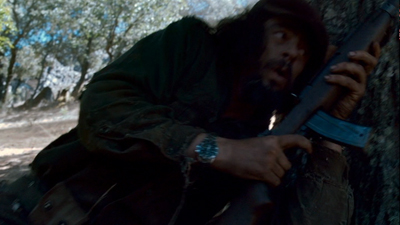
Che spends almost a year, 1966 through 1967, wandering around in the Bolivian jungle, sinking further into the morass of his own idealism. The hubris of righteous belief is taking for granted that everyone else will get on board; the Bolivians do not. The man seems to retreat into himself. He goes by a different name, never allowed to be who he really is, and his asthma all but knocks him down. The motivational speeches are almost entirely gone, there is no more of the smooth-talking rebel. Del Toro physically transforms himself, letting his hair and beard grow long, changing his posture to be more hulking. Che has been turned into a freakish outcast. By the end of the movie, his myopia has so overtaken him, we are literally looking through his eyes.
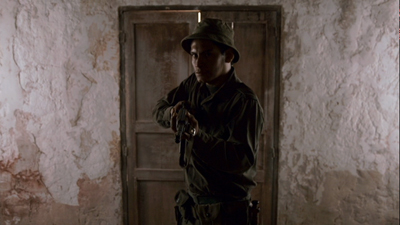
Part II is so mired in disappointment and failure, I am not sure there is any way for Soderbergh to keep it from dragging. The endless trek through the jungle starts to look the same after a while, which puts us in the shoes of the soldiers, but it may also put some people off. The Bolivian troops are a lot more anonymous than the Cuban rebels Che commanded. We don't get to know them, there aren't the distinct personality types. In Cuba, we had the teenagers who grew up in the rebel army, we had Little Cowboy and his cowboy boots, we had Che's fellow officers, who teased and joked with him, and we also had Aleida (Catalina Sandino Moreno from Maria Full of Grace
Che ends with a brief shot of Guevara back on the boat that first carried him into Cuba, reminding us of the youthful promise he once represented, but now colored by all that has followed it. In this last shot, Del Toro somehow looks older, and he now appears pensive. It's a reminder of how far we've come, from that point until now, and the way we see Che is with a new perspective. He has become a man on a collision course with destiny, and we are left to wonder if it was all worth it. The hope of yesterday dies amidst the deluge of too many tomorrows.
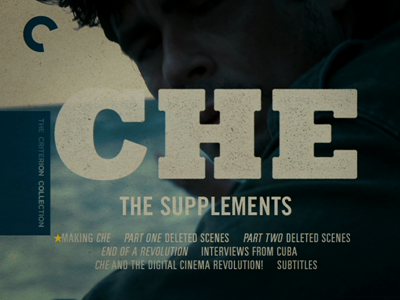
Criterion's release of Che is a three-disc set, packaged in one of their beautiful booklet-style boxes, featuring Eric Skillman's trademark photo illustrations. Each part of the movie is given its own disc, and the third disc is all supplements. The thrust of the extras is history--the history of the production and the history behind it. The film and its winding path from conception to completion is covered at length in a 50-minute making-of documentary. Those curious about how Che came about and why the production team made the choices they did will be more than satisfied by this lean, forthright peek behind the curtain. Even the criticisms the film's detractors leveled at Che are addressed. There is also a separate documentary about the use of the RED One camera that should please tech heads. Soderbergh even touches on the fact that Che the man was considered a cold personality, and addresses my query regarding the tone of the movie: he wanted Che the film to be chilly like Che the man.*
The commentary for both movies is by Jon Lee Anderson, the author whose biography Che Guevara: A Revolutionary Life

There is a deleted scene from Part I where Che tells one of his men that he needs to build a hospital in a remote area. The man asks how, he doesn't have the supplies. Che, unbending tells him to figure out a way. This small scene encapsulates the figure: he saw what needed to be done and never wavered from the conviction that it could and would be done. Whatever it took, he'd figure it out. That was how he lived, and that also embodies this production. Against all odds, the people behind Che figured it out. They saw a movie to be made, and they got it done.
And for the record, Che's score on Rotten Tomatoes is currently at 62%.
* As a glimpse inside my process, I always nail down the body of my review before I watch the extras so as to formulate my own opinions free of the influence of others. So, in a case like this, if I have a question that is answered in a bonus feature, I really did ask it and try to wrestle with it myself before stumbling on the revelation. That said, Soderbergh also mentions John Sturges, and so it makes me think that Sturges came to mind for me because the director must have also mentioned that influence when I saw him speak last March.
This disc was provided by the Criterion Collection for purposes of review.
Labels:
david lean,
eric skillman,
john sturges,
robert wise,
soderbergh,
warren beatty
Subscribe to:
Posts (Atom)


