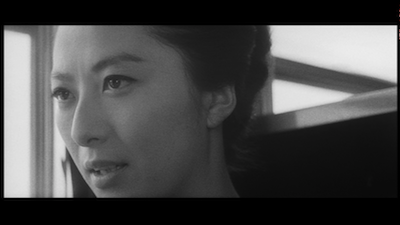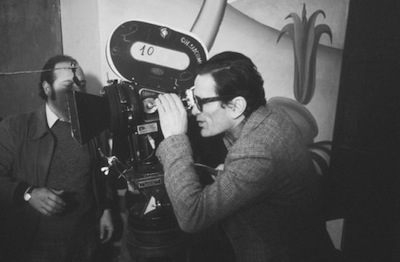
"We need to confront vague ideas with clear images." - slogan painted on the wall in La Chinoise
"In any case, you need sincerity and violence." - Guillaume (Jean-Pierre Leaud)
1967's Jean-Luc Godard feature La Chinoise (The Chinese) makes no bones about the director's emulation of agitprop pioneer Bertold Brecht. Not only does one of the main revolutionaries, Guillaume (Jean-Pierre Leaud, The 400 Blows [review]), espouse the benefits of the playwright's political theatre as handily as he praises Chairman Mao, but in one scene, standing before a blackboard filled with names of philosophers, politicians, and other figures of the world stage, Guillaume erases them all except Brecht. La Chinoise is Godard moving agitprop from the stage to the cinema.
The film takes place over one summer, filming five students in their apartment as they use their vacations to form a radical Communist cell devoted to the teachings of Chinese dictator Mao Tse-Tung and his little red book. At the head of this group is drama geek Guillaume and his philosophy-major girlfriend Veronique (Anne Wiazemsky, star of Bresson's Au hasard Balthazar [review] and Godard's one-time wife). They are of the no-compromise, no-retreat variety of activists, while their cohort Henri (Michel Semeniako) is more willing to accept the contradictions of political revolution. This eventually gets him dispelled from the group, though ironically, amongst all the talk of change and fomenting an uprising, Henri is the only one who we know has left the apartment and joined in any action. He first appears onscreen having been beaten and bloodied by Communists loyal to Russia. Of the many ideas tossed around here, one is that Kruschev has done little to maintain a socialist ideal, and that European Communism is pretty much endorsed by Imperialist America, who is more than willing to do business with Soviet countries when it suits them. The true threat of Asian Communism, as it were, is their lack of interest in playing in the capitalist reindeer games of the U.S. Though there is much to disagree with in La Chinoise, there is also much that intrigues and provokes.
For the most part, La Chinoise is a series of interviews, speeches, and debates amongst the cell, who stay in their apartment and endlessly pour over Mao's book, rows of which line every shelf in the place. Cut into the discourse are Godard's trademark title cards and propaganda-like still images, sometimes working in concert with what is being said, sometimes in juxtaposition to it. Some images are even integrated into the scenery, such as when Veronique shares her revolutionary ideas while sitting beneath a collage of pin-up girl drawings. In addition to the polemics about current political events, Godard uses La Chinoise as another treatise on the purpose of cinema, even breaking down the fourth wall, appearing himself as (presumably) an off-screen interviewer and panning around to show cinematographer Raoul Coutard manning the camera. Hell, he even manages to namedrop Nicholas Ray yet again. Has anyone done a count for how many Godard movies make mention of Johnny Guitar? And it still isn't on DVD?! [Except it is.]
Though the movie isn't exactly subtle with its politics, it is somewhat difficult to dissect what Godard may be personally endorsing from what he is throwing under the bus in his savage portrayal of the students. While I think the director would love to be able to wholeheartedly embrace a youth movement that supported real social change, he clearly is disenchanted with the all-talk and no-action navel gazing that such activists can engage in. Henri may begin as the character we dislike, particularly when it's revealed that he endorses his girlfriend (Juliet Bento, Weekend [review]) engaging in prostitution to pay the cell's bills as a living example of the disparity between working-class reality and socialist ideal, but by the end, Henri's revealed as the only one with a clear head when he refuses to engage in terrorism. Guillaume also may be slightly redeemed in sticking with his theatrical plan, but there is some suggestion that he may only be in it for the girls. (He eventually splits with Veronique to hook up with Bento's more impressionable character.) Really, there is more sincerity than there is violence here, and for some, probably more vagueness than clarity, too.
The most pungent critique is saved for Veronique, the one most fervently advocating acts of terrorism. On a chance encounter with one of her former teachers, the dissident Francis Jeanson playing himself, she tells him of her violent intentions, and he quickly sees how misguided she is. He damns her with one persistent question: once you have carried out your plan, what next? Veronique obviously has no idea how to fill the hole she wishes to create, and right there is seemingly Godard's major issue with bourgeois politics: they have no game plan for how to sustain the change they advocate. Thus, they spend more time talking about change than enacting it, and when they do jump into the fray, as Veronique eventually does, they screw it up. Which is fine for them, because they can walk away, return to school for the new semester, completely unaffected. Therefore, it's almost better to be the fifth member of the cell, the almost psychotic Kirilov (Lex De Brujin), who kills himself rather than do nothing--or, as it were, finally have to do something, and maybe something that will mean nothing.
As far as Godard's political cinema is concerned, La Chinoise is not necessarily the director's best. It's not nearly as incendiary as Weekend or as successful on its own terms as Tout va bien. Even so, he does effectively encapsulate what is often wrong with liberal political movements and their ability to harness youthful enthusiasm without knowing how to apply it, and the director both appreciates the young activists of 1967 even as he exposes their flaws. (Bertolucci has a similar take on the '60s student movement in his film The Dreamers, and even hangs a La Chinoise poster on their bedroom wall.) It's easy to have radical ideas when you, yourself, aren't under any real threat. The middle class can speak for the working class without threatening their own bottom line. In Godard's mind, this is where all Communism has gone wrong, as eventually there will be new leaders to replace the deposed ones.
Of course, charges of ineffectual intellectualism could easily be turned back at Jean-Luc. He is completely aware that one could accuse him of sitting in a vaunted position and making movies rather than joining on-the-ground protests, hence his built-in defenses for cinema. If Nicholas Ray's B-movies could be as effective as a Brecht's overtly political plays as tools for social change, then why not also more enlightened cinema like La Chinoise? When Guillaume starts his theatre, he does take it to the streets, after all, knocking on doors and sharing his ideas and seeing the social reality that surrounds him as he does. Arguably, rock 'n' roll was the more active art of the 1960s, something Godard even saw, hence his coupling with the Rolling Stones a year later.
When it comes down to it, it's not a dispute easily settled, and with Godard's open-ended cinema--Susan Sontag argued that he wasn't making individual movies, but one long, ongoing dialogue--the debate continues. Ironic, in its way, sitting in a room, watching the movie, and then typing about it on a laptop before sending said ideas out into the ether all on their own. Such an endeavor could make me just as deluded as the kids in La Chinoise. And yet, here you are reading it, and the idea passes on. So, maybe Godard's method does work, after all?
This review originally written for DVDTalk.com in 2008.
Showing posts with label bertolucci. Show all posts
Sunday, February 23, 2020
Monday, February 20, 2017
THE TREE OF WOODEN CLOGS - #854
Criterion fans know the name Ermanno Olmi from his excellent Neorealist films, Il posto [review] and I fidanzati [review], small dramas set in then-modern times (1961 and 1962) that are elegant, personal, and focused. And if that, like me, is all you know, then his Palm d’Or-winning The Tree of Wooden Clogs may be a bit of a surprise. Released in 1978, this three-hour-plus drama is modestly epic in scope, more open in approach, and yet surprisingly just as engaged with the personal.
Set in Italy's Bergamo province at the tail of the 19th Century, The Tree of Wooden Clogs tells a season in the life of a farming village. At the time, peasants lived as sharecroppers on a wealthy landlord's estate, working his fields, keeping 1/3 of what they produced, giving the rest to him (see also Bertollucci’s 1900 [review] for a similar scenario). The farmers shared one community building, four or five families per, individual tribes within a larger conglomerate. As his narrative progresses, Olmi dips in and out of different families in one particular dwelling, mining their collective stories. There is the young man looking to woo his neighbor's daughter, or the old timer looking to beat the others to the tomato harvest, and the various wives and mothers keeping their children in clean clothes and nourishment. Each action is individual, but it also adds to the whole. No one family, no patch of land, is an island. Or, to change metaphors, The Tree of Wooden Clogs is a tapestry, and each singular weave somehow ties back to the center, and you don't see the full tableau until you step back and take it all in.
The closest thing we have to a central family is the clan whose challenges give The Tree of Wooden Clogs its name. This incident is a small story embedded in the whole. The family’s young son, Minek, is a bit of a prodigy, and the parish priest insists his father send him to school, even if it is a four-mile walk each way. On one such trek, the same day his baby brother is born, the child breaks one of his clogs. His kindly father doesn't scold him or make a fuss. Instead, he sneaks out into the night and cuts a chunk of wood from a tree alongside the road. It's unclear whether he takes to this task quietly so as not to disturb the boy's mother, still recuperating from the birthing, or because he's taking the wood without clearing it with the landlord. All we feel is there is something momentous and heavy in the act, especially as he begins his carving while the rest of his family says their evening prayers. Is this plea to the heavens to be his absolution?
This
is how connected everything is--religion, birth, survival. Within the
relatively short period--short in the context of an existence, at least, because
make no mistake, this is a long movie--we see the full circle of life. Crops
are grown, animals slaughtered, children born. We see only a small sliver of
the other side, a brief peek into the landowner's life. We see how faith holds
sway, even when impractical. We also catch a glimpse of political tides to
come. But as large as the land and the sky and the whole of the world may
appear, it's still the little things that matter. The simple pleasures.
Olmi applies the Neorealist method to great effect. Like Roberto Rossellini did with the Sicilian fishermen for Stromboli [review], or even Michael Powell and the Scotsmen on The Edge of the World, the director worked with the real people of the Bergamo region, even having them speak in their native Bergamasque. The landscape of The Tree of Wooden Clogs is not populated by actors, but the actual citizenry of the world Olmi is capturing. Yet, they still are actors, aren't they, since they live in the now while dressing up to play their ancestors in front of a camera. Such is the illusion, and so powerful the effect, you'll be forgiven for how often you'll forget you are not watching a documentary. The details are real, and often not for the squeamish (if you've never seen a goose or pig butchered...), and the script so absent of point-A/point-B plotting, the final cut has the feeling of real life, not a cinematic construction. Like life, it can be a bit of a haul to reach the end, but hopefully we’ll all find both tasks worth it. (Though I’m not holding out much hope for this living business...)
The span of The Tree of Wooden Clogs only
grows macro in its third hour, when the young couple we’ve watched court one
another gets married and goes off on their honeymoon. Traveling with them, we
see nearby townships, and people beyond the landlord’s property line. These new
elements almost seem cartoonish by comparison, so used have we come to the
quiet life within the farm. The honeymoon itself passes without much
fanfare--at least until the newlyweds return home and, immediately after, other
narrative threads finally start to pay off--some good, and some bad. I suppose
it’s up to each viewer to divine where Olmi is coming down in terms of the
divine and its relation to what happens to the peasants, or what that also says
about the nature of small community. A sad fate befalls Minek’s family, one
that is swift and without recourse. As neighbor turns away from neighbor and
relies on prayer rather than intervening, I found myself caught between my
empathy for their resorting to their faith due to a need for some kind of
explanation of why life is cruel and my more visceral reaction. I can’t help
but think they are using religion to sidestep their responsibility toward their
fellow man, and that this is perhaps why the cycle of the wealthy oppressing
the poor continues. (“I’ve got mine, let God take care of the rest.) One could
surmise this is why Olmi includes glimpse of the socialist revolution on the
rise. Certainly nothing happens on screen in The Tree of Wooden
Clogs by accident, given that the director, in the truest auteur
fashion, is credited with script, photography, and editing. Just as the hands
of the farmers draw riches from the land, Olmi’s hands draw out this
mis-en-scene. Soil has never been so beautiful, and yet so daunting. Soft and
brown when giving life, dark and muddy as the day grows hard.
Yet, for the filmmaker to add any editorial or exposition
would be to betray his motivating conceit. The Tree of Wooden
Clogs is meant to be an observation, not an explanation. It’s a
morality play without a coda. The staging, the lighting, everything is as
natural and real as is possible in the confines of a motion picture construct. The
camera itself seems to disappear in the crowd. The light is never brighter than
the hazy grays the sun provides. The visual story is limited to what the eye
can see, the same way it would be were this a newsreel. Olmi doesn’t dress the
set, he doesn’t call attention to the design of his shots, he doesn’t zoom
emphatically. His approach is as straightforward and quaint as the daily life
he is chronicling. It’s also as intimate, and therein he finds his truth. From
the supplements accompanying the movie on this disc, especially the British
television special from 1981, we hear how the film was inspired by stories the Olmi’s
grandmother told him about her life, and so we can see that the director’s
exacting methods are born of a personal pride. He is reaching back into his own
history, digging for the roots that would eventually put him on his own two
feet and lead him here.
This disc provided by the Criterion Collection for purposes of review.
Saturday, February 27, 2016
Y TU MAMA TAMBIEN - #723
There is an ephemeral grace to Alfonso Cuarón’s Y tu mamá también that makes it easy to reduce to something simple and small, but that when chased after, reveals deeper meaning and an artful construction of a movie that at times feels like it has no construction at all.
At it’s most basic, Y tu mamá también is a road
trip and a coming-of-age story, both fairly standard and oft predictable
genres. At its most grandiose, Y tu mamá también explores
erotic identity, political engagement, and the biggest, darkest theme of all:
death. It does most of this with a light touch, never once pushing any of these
elements so far forward that they dominate. The underlying themes of the
eroticism never overtake the erotica itself. More than anything, this is a sexy
movie, but like, say, Bernardo Bertollucci’s The Dreamers, a
sexy movie with meaning.
The Dreamers is a good comparison for another reason. That movie is a tribute to the French New Wave, and Bertollucci channels the techniques of 1960s cinema through a youthful story of sexual and political awakening. So too does Cuarón adopt the style and the spirit of those influential filmmakers to create something that is free and spontaneous and at its most virtuoso moments, a celebration of moviemaking itself. Released in 2001, and hinting very little at the director’s smart sci-fi blockbusters to come (namely, Children of Men [review] and Gravity [review]) in terms of scope, Cuarón already exhibits the casual mastery of technique that would be so impressive in those later films. Working with frequent collaborator Emmanuel Lubezki (The Tree of Life [review]), he orchestrates long, unbroken scenes that rarely call attention to themselves. They aren’t used to deliver action, but rather are mostly used to probe the environment, to expose the details of the characters’ world by moving away from them and looking around. The one exception is the unforgettable dance sequence between actress Maribel Verdú (Pan’s Labyrinth [review], Tetro [review]) and, almost literally, the camera lens. Her eyes locked dead center, she dances like someone is watching, locking in the audience, seduction through control. Though much is made of her young co-stars, this scene alone explains why the actress got top billing: she’s the star.
Oh, but of those younger men. Y tu mamá también
introduced the world at large to Diego Luna and Gael Garciá Bernal; these
talented performers would go from Y tu mamá también to
separately work with directors as renowned as Spielberg, Gondry, Korine,
Jarmusch, Van Sant, and Almodovar. Here they play recent high-school graduates
and best friends in Mexico, with Luna taking the role of Tenoch, the son of a
rich politician, and Bernal playing Julio, the average son of a middle-class
family. The boys are restless during their final summer before college, and
spend most of it getting stoned and trying to get laid. It’s at a wedding that
they meet Luissa (Verdú), the Spanish wife of one of Tenoch’s cousins. The
horny pair invites her to go to the beach with them, promising to show her a
beautiful cove so idyllic it’s been nicknamed Heaven’s Mouth. The locale is
pure invention, but they haven’t a hope of luring the older woman to go its
shores, so that really doesn’t matter.
Except, circumstances change for Luissa, and when she finds out her
husband has been cheating on her, she decides to go with them after all. Their
naïveté amuses her, and she takes advantage of their eagerness to please by
probing them about their sexual adventures (such as they are) while they drive
toward the coast in search of paradise. As they reveal more about what they do
or do not know--and as she shares with them in equal measure--a sexual tension
builds up, one that will eventually find a release.
This in itself would be enough for most filmmakers, but not for Cuarón.
Co-written with his brother Carlos, Cuarón’s script for Y tu mamá
también never forgets that there is more going on all around the
three travelers. There are regular references to political unrest throughout
Mexico, and even glimpses off it along the roadway. The travelers pass police
checkpoints and people getting arrested, but remain mostly oblivious to the
lives being altered within their view, carrying on with their sex talk as if
somehow separate from the changing world. This in itself mimics most
existences, we all drive on more concerned with our own situation than that of
our fellow man. Yet, Cuarón mixes these macro details with the micro. The
vacationers also drive by various rites of passage: a car full of newlyweds, a
girl having her quinceañera, and a funeral procession. No matter how isolated
the transitional experience of two teenage boys and an older woman may feel,
the world carries on.
Which also fits the Nouvelle Vague ethos, particularly that of
Jean-Luc Godard, who in movies like Masculin Feminin and
La chinoise [review] would use the experiences of young
people as a springboard to explore other things, to detail the political
climate of his era, and expound on his own radical ideas. You could also say
similar things of Hal Ashby’s Harold and Maude [review],
another film about a young man having an affair with a (much) older woman set
against political turmoil. Cuarón goes so far as to give Ashby’s movie a shout
out. Y tu mamá también opens with Tenoch having sex with his
girlfriend under a Harold and Maude poster.
Not that the reported protests and massacres ever interrupt or invade
the getaway; rather, they are representative of the things that these three
voyagers are putting off, the seriousness they will ignore and avoid as long as
they can in much the same way they--and all of us--put off death. Cuarón
regularly reminds us of this unavoidable fate, as well, with the narrator
breaking in to tell us about different traffic accidents that happened in spots
along the highway when the car passes. This voiceover interrupts regularly to
inform us of things we would not otherwise know, filling in details from the
past and present and even the future about all the characters. Rather than
being overcompensating narration, however, it adds a poetic quality to
Y tu mamá también, evoking the style of South American
literature. In terms of presentation, it also calls to mind Godard again, the
way Cuarón tweaks the sound, turning the volume down on the main audio to give
his off-screen speaker the dominance. (It’s probably no coincidence that
Luissa’s cheating husband is a writer, and his encouragement of Tenoch’s own
literary aspirations gives us cause to wonder if maybe it’s this boy eventually
turning their excursion into something more.)
In the end, though, these things all dissipate. Like sea foam, as
Luissa might put it. It’s the connection she makes with the boys, and the things
they share, that we will remember. Even if--or perhaps because of--their coming
together also eventually drives them apart, we can assume it’s also something
they can never forget, and perhaps the finality it engenders is because it’s a
time of life that can never be replicated. They will always be remembering,
always looking back, even as the next road opens up before them.
Included in this set alongside Y tu mamá también is
a 2002 short film by co-writer Carlos Cuarón. Though far lighter in tone,
You Owe Me One is a fine companion to the main feature, and
perhaps should be watched as a lead-in for a full night of programming. The
lark features an oversexed family going about their clandestine business on
what we can assume is an average night in their home. The laughs are genuine
and unforced, with Cuarón lacing together his scenarios with smart cues
derived from the story itself. Double the pace, and this would be a screwball
comedy, but as it is, it’s genial and fun.
Labels:
alfonso cuaron,
bertolucci,
carlos cuaron,
godard,
hal ashby
Sunday, December 30, 2012
HEAVEN'S GATE (Blu-Ray) - #636
As John Ford so often demonstrated (and as Ford-hater Quentin Tarantino barely took advantage of in the sometimes-cramped Django Unchained [review]*), the western is the ideal vehicle for widescreen motion-picture filmmaking. The vast, open spaces of the American frontier (or, if you're Sergio Leone, Italy and Spain), show us how large a movie screen really can be--and the movie screen in turn teaches us a little something about the size of our world. This is something Michael Cimino learned from Ford, and something he puts to great use in his late-70s western Heaven's Gate, a film where everything is massive, where going small is never an option. Even in the most intimate moments, the frame turns lovers into giants. Isabelle Huppert is here to kiss you puny humans to death.
Most importantly, perhaps, and what maybe separates Ford and Cimino from some of the rest, is this vision is of an idealized America, a belief that these vistas represent everything the country could be, and the nostalgic glow that they seek when they photograph the mountains and the blue sky provides a kind of warmth, soothing the sadness they feel at all the ways we have gone wrong, all the bad we have done in the service to the democratic experiment. The melting pot requires a certain amount of fire, alas.
Heaven's Gate, fittingly, is a movie about an idealist made by an idealist, and both lose control of their situation, ground beneath a machine that is larger than they ever imagined, and yet tragically heroic for doing so. At least unlike his fictional avatar, the rich-boy sheriff James Averill (Kris Kristofferson), Cimino has found some vindication. Though vilified on its release, and mostly for its budgetary excess to the exclusion of its storytelling success, Heaven's Gate has increasingly found new life and new audiences. Having never seen it prior to this Criterion release, I am now in awe of it. It's a phenomenal, audacious masterpiece.
For the plot-minded amongst us, the bulk of Heaven's Gate is set in Wyoming in 1890. (There are also bookends on the story, of Averill graduating Harvard as a young man in 1870, and of the old man reflecting in a brief epilogue set in the early 1900s.) Averill, we quickly learn, is a man who puts his mouth ahead of his money, a true do-gooder who dislikes injustice and human indecency. He promotes fair play where he can, and wearily accepts when the scales are tipped against the little guy. Those scales, he discovers, are soon to take on more weight than they can bear. The wealthy industrialists in his state, a group that previously blackballed Averill for failing to take a hard stance against the lower classes, have shored up their power and are preparing to patch what they perceive to be a hole in the law. Wyoming has become a home for European immigrants, many of whom find the land harder to work than they anticipated--due in no small part to the prejudice that awaits them from "real" Americans. According to the rich men, and at least based partially in fact, some of these immigrants resort to stealing their cattle when times get desperate. Up until now, the courts have done little to prosecute these "thieves and anarchists," but thanks to the efforts of one Frank Canton (Law & Order
's Sam Waterston), they now have a bureaucratically approved kill list. 125 men and women in Averill's county have been marked for death for alleged crimes. Canton and his cohorts are hiring men at $5 a day, and $50 for each dead immigrant they deliver, to wipe these people out. As Averill notes, that's nearly everyone in the whole damn town where most of these farmers have set up shop.
And so it is that Averill returns to his township with a heavy heart, unsure if he can stem the tide that is coming. The town itself, named Sweetwater, is muddy and in progress, a microcosm of the U.S. Beyond its dirty streets is the perfect blue sky, the snow-capped peaks, the lush land that will sustain them all if everyone would just share. At the center of the town is the dancehall/skating rink, Heaven's Gate, surely named such as a gesture of hope, if not just for the earthly pleasures it promises. It will be a name that will take on a deadly irony, however, as it becomes where the townsfolk huddle in fear and anger to learn their seemingly inescapable fate.
Amidst this expansive drama there is, of course, a more personal story. For all his gruff ways, Averill is a lover. (Indeed, his last name is a variation on Aphrodite, goddess of love. Heaven's Gate is a movie where the names of its heroes have meaning.) The sheriff has a rather sweet romance with the French madame at the local whorehouse. Ella Watson, played by a young Isabelle Huppert, is the kind of frontier gal who has learned to take care of herself, who runs her own business, and runs it well. For all intents and purposes, she is on her own, but no one wants to be alone forever, and so she hopes Averill will one day step up and offer her something different. If not, the lawman has a rival. Ella is also having an affair, though one of a different stripe, with Nathan D. Champion (Christopher Walken), a dapper gunslinger who works as foreman for the secret association, but who is also conflicted about their goals. Champion is the embodiment of the American Dream, a man who has come from nothing and who is trying to make something. He resents Averill for his money (the sheriff, some argue, is engaging in an early form of ghetto tourism), and fantasizes about being his equal. His proposal to Ella is to tell her he has enough income to cover them both. And to prove such things are possible, Champion takes her to his shack to show her his wallpaper, a sad and endearing symbol of how out of his element he really is. It's not the kind of decoration we would expect; rather, he has merely covered his walls in newspaper. He's done a nice job with it, but no cigar.
And so this love triangle will play out as the bigger story comes to a boil, with Ella caught between the two men, and the two men needing to learn that just as they love the same women, they believe in the same things. They can't keep up the tug-of-war without tearing everything in two. This becomes an undeniable fact when it is discovered that Ella is on the kill list because she has accepted cattle as trade for her wares, some of which is most assuredly stolen, at least according to the propaganda. There are no hard facts about how rampant this "immigrant problem" is, how many are the thieves and anarchists that Frank Canton keeps harping on. The idea that anyone would forego feeding their family and steal a cow to get laid is, of course, reprehensible; yet, for all we know, it's little more than fear mongering. They're coming for your food and your women! Fox News via pony express!
The narrative of Heaven's Gate, which was written as an original screenplay by Michael Cimino (remember original screenplays?), is grandiose in scope, full of characters and character alike, not unlike a great Russian novel. It is sweeping and human, giving its different participants their moment in the spotlight, allowing for digressions into real life even when it may not obviously serve the plot. Scenes run long, conversations are allowed their natural course. There are two different dance sequences, the waltzing at Harvard (which breaks out into a brawl) and the roller-skating linedance at Heaven's Gate (which breaks into a two-person slow dance for Averill and Ella), both shot as a constant wave of movement by the brilliant Vilmos Zsigmond, dizzying and yet locked down. The dancers keep spinning, but the movie screen maintains its own keel. The sea may be rocking, but the ship will never go under.
Which is maybe what critics and audiences failed to see when Heaven's Gate was first released. They had lost sight of the forest, too concerned with what money was falling from its trees. Does Michael Cimino go overboard? Maybe. But it's only in pursuit of authentic expression. Tolstoy could build bustling crowds and the activity of a city life with words; Peter Jackson can pull an army of orcs out of his digital ass; but Cimino had to make 19th-century Wyoming come to life using flesh and wood. He had to show the human traffic by gathering the numbers together, show where they traveled by building the towns. Once the map was drawn and the sets erected, the mythology had to be lived. In one memorable scene, the first time we really see Champion and Averill talk, the younger man visits the sheriff at the bar where he lives and where he's having his breakfast. (The sibling establishment to Heaven's Gate, both owned by John H. Bridges, and portrayed by Jeff Bridges, who appears so lost in the role, it's almost savant-like the way he plays it.) As they speak, our eye is drawn to the window behind Kristofferson, and the man outside, a juggler, who, via optical illusion, appears to be standing on the actor's shoulder. Is it necessary? Not really. But it does add something to the moment, providing a visual metaphor for the dangerous game Averill is playing. As constable, he is intended to serve all sides, but eventually, he either has to walk away from it all or accept something is likely to drop.
I'm a defender of movies of length. It's a fallacy to say that movies should always be somewhere between 90 minutes and two hours. It's an artificial number concocted by theater owners to maximize the number of showings, to sell the most tickets in a day. Other media have suffered similar fates. Prose fiction and comic books are a certain number of words or pages due to cost of paper and shipping; long-player records famously got longer when CDs were invented because compact discs could hold more music. While artists in all of these fields learned to cope with these restraints, and make an art out of how to meet the economic demands, that does not vindicate the idea that such restrictions are somehow inherent in this mode of expression. Heaven's Gate runs over three-and-a-half hours. There is something refreshing about watching a movie like Heaven's Gate--or, indeed, Bertolucci's 1900 [review] or Leone's Once Upon a Time in America
or more recently Andrew Dominik's The Assassination of Jesse James by the Coward Robert Ford [review], which tellingly are all examples of stories about eras ending and centuries turning--where the scenes are not trimmed to fit, where the dialogue is not manicured to move everything forward**. You can have five minutes of two people talking as people are wont to do, can step back and enjoy the dance, can walk the streets of the town and see the sights. Heaven's Gate is the movie equivalent of a semester abroad. You really live there for a suitable length of time and truly experience the culture; by comparison, most other movies are just two-week package tours.
For as much as Heaven's Gate maybe went from a well-planned cattle drive to an out-of-control stampede during shooting, I don't think that shows on the screen. Or if it does, only when it counts. The film's climax, its true one, not counting the subsequent stinger and the epilogue, is pure chaos. In both of its battle sequences, Cimino unmoors the whole thing and lets the herd run wild. It's impossible to tell who is shooting whom, and where one side has drawn its line and where the other is in relation to it. The pointlessness and confusion is by design, it erases any notion of clear victory, of well-defined winners and losers. And even if it wasn't, even if the auteur had lost control and had to spend time revising, reworking, reimagining--well, this takes us back to novelists again. No one would blink if Steinbeck went beyond his allotted schedule, if his word count exceeded expectations. Not when it meant getting East of Eden
.
And so busted budgets and extra cans of film are also worth it when the result is Heaven's Gate. It's an engrossing movie event, deserving of all the time it demands, deserving of you opening your mind wide to accept it.
* Having only seen Django Unchained once, and not really considering how much of the landscape Tarantino does or does not use until now, I concede in advance that my memory could be playing tricks.
** Back to Tarantino, this is also something he does incredibly well, particularly in how he writes conversational sequences.
Please note: The images used here were taken from promotional materials and other sources, not directly from the Blu-Ray.
Friday, August 3, 2012
SIDELINE: MORE REVIEWS FOR 7/12
My reviews of non-Criterion movies in July.
IN THEATRES...
* The Amazing Spider-Man, the improbable relaunch that could.
* Beasts of the Southern Wild, a noble effort with great acting and beautiful cinematography, but overbearing music and a muddled script.
* The Dark Knight Rises, maybe the most anticipated movie of the year. But must what goes up also come down?
* Ruby Sparks, a would-be deconstruction of the "manic pixie girl" concept that doesn't have the gumption to take it all the way. Noble debut writing effort from actress Zoe Cassavetes, however, and she's also really good in the movie.
* Savages, Oliver Stone's proof that the only losing proposition bigger than the War on Drugs is his movie about the War on Drugs. Contender for worst of the year.
* To Rome With Love, Woody Allen's tribute to Italy is a pleasant comedic quartet.
* Total Recall, a surprisingly action-packed remake with Colin Farrell. Go watch the punching and the shooting and don't worry about it.
* Trishna. It's a bummer summer with Michael Winterbottom adapting Thomas Hardy. Pity poor Freida Pinto.
* The Watch, your summer safeguard against laughing. Trust me. You won't. Starring Stiller, Vaughn, Hill, and a bunch of dead air.
Also, if you're in Portland, the NW Film Center is starting Mark Cousins' epic movie about movies, The Story of Film: An Odyssey this week. It's five parts, spread over all of August. I wrote it up for the Portland Mercury.
Annnnnd, Shawn Levy at The Oregonian did a round-up of Portland comics folks, asking them their opinions about superhero movies. Included are Brian Michael Bendis, Jeff Parker, Natalie Nourigat, Dylan Meconis, David Chelsea, and many others. And, naturally, yours truly. It's a pretty neat round-table. Read the full version online here.
ON BD/DVD...
* 1900, Gerard Depardieu and Robert De Niro star in Bernardo Bertolucci's sprawling, mad epic.
* Force of Evil, a sharp gangster picture from 1948, with John Garfield as a mob lawyer looking to take his gambling racket to the big time.
* The Last of England, Derek Jarman's post-apocalyptic poem. A vision of the future from the vantage point of the 1980s.
* Panda! Go, Panda! an early kids movie from Hayao Miyazaki.
* Rio Grande, a pre-Quiet Man teaming of John Wayne, John Ford, and Maureen O'Hara.
* La terra trema, Luchino Visconti's second feature, is a classic of Italian Neorealism.
* Treme: The Complete Second Season. HBO's most challenging show is a lot like life. And, hey, ain't life worth it?
IN THEATRES...
* The Amazing Spider-Man, the improbable relaunch that could.
* Beasts of the Southern Wild, a noble effort with great acting and beautiful cinematography, but overbearing music and a muddled script.
* The Dark Knight Rises, maybe the most anticipated movie of the year. But must what goes up also come down?
* Ruby Sparks, a would-be deconstruction of the "manic pixie girl" concept that doesn't have the gumption to take it all the way. Noble debut writing effort from actress Zoe Cassavetes, however, and she's also really good in the movie.
* Savages, Oliver Stone's proof that the only losing proposition bigger than the War on Drugs is his movie about the War on Drugs. Contender for worst of the year.
* To Rome With Love, Woody Allen's tribute to Italy is a pleasant comedic quartet.
* Total Recall, a surprisingly action-packed remake with Colin Farrell. Go watch the punching and the shooting and don't worry about it.
* Trishna. It's a bummer summer with Michael Winterbottom adapting Thomas Hardy. Pity poor Freida Pinto.
* The Watch, your summer safeguard against laughing. Trust me. You won't. Starring Stiller, Vaughn, Hill, and a bunch of dead air.
Also, if you're in Portland, the NW Film Center is starting Mark Cousins' epic movie about movies, The Story of Film: An Odyssey this week. It's five parts, spread over all of August. I wrote it up for the Portland Mercury.
Annnnnd, Shawn Levy at The Oregonian did a round-up of Portland comics folks, asking them their opinions about superhero movies. Included are Brian Michael Bendis, Jeff Parker, Natalie Nourigat, Dylan Meconis, David Chelsea, and many others. And, naturally, yours truly. It's a pretty neat round-table. Read the full version online here.
ON BD/DVD...
* 1900, Gerard Depardieu and Robert De Niro star in Bernardo Bertolucci's sprawling, mad epic.
* Force of Evil, a sharp gangster picture from 1948, with John Garfield as a mob lawyer looking to take his gambling racket to the big time.
* The Last of England, Derek Jarman's post-apocalyptic poem. A vision of the future from the vantage point of the 1980s.
* Panda! Go, Panda! an early kids movie from Hayao Miyazaki.
* Rio Grande, a pre-Quiet Man teaming of John Wayne, John Ford, and Maureen O'Hara.
* La terra trema, Luchino Visconti's second feature, is a classic of Italian Neorealism.
* Treme: The Complete Second Season. HBO's most challenging show is a lot like life. And, hey, ain't life worth it?
Labels:
bertolucci,
jarman,
john ford,
oliver stone,
other reviews,
visconti,
woody allen
Tuesday, October 18, 2011
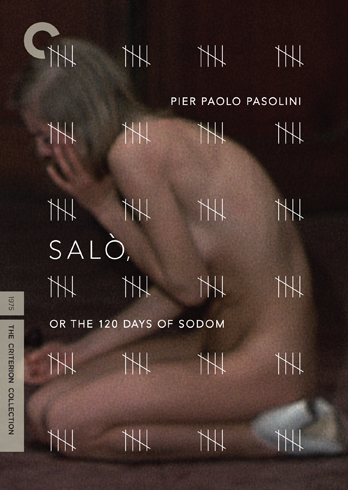
SALO, OR THE 120 DAYS OF SODOM (Blu-Ray) - #17
"All's good if it's excessive."
Once upon a time, Criterion spine #17 was the rarest of the collection*. The early release of Pier Paolo Pasolini's 1976 shocker Salò, or the 120 Days of Sodom was the one of the first discs to go out of print for the label, disappearing not long after it had first been issued. Copies of the release sold for several hundred dollars on eBay, and fans created online guides to steer potential buyers through the murky waters of knock-offs and bootlegs.
When I was working on building a complete Criterion library some ten years ago, Salò was always the one that eluded me. Both the cost-prohibitive mark-up and the movie's scandalous reputation made me gun shy. Eventually, I bought a dubious Chinese facsimile so I could actually watch the thing. My hope was, if Salò was as off-putting as everyone said, viewing it would convince me that it was not something I needed to drop major coin on.
The theory panned out. One time through with Salò was enough for me. It was not a movie I ever felt the need to see again. I finally bought the legitimate reissue a couple of years ago, but I never even opened it. It was gathering dust on my shelf, still wrapped in plastic, when the Blu-Ray came through. I guess enough time had passed. I was finally going to watch Salò a second time after all...
Pasolini's film in is an infamous slab of transgressive art. Inspired by the work of the Marquis de Sade, the controversial Italian director leveled his aim on his country's ruling class. Though set during the years during World War II when Italy was occupied and the Fascist government colluded with the Nazis, Salò takes place away from the combat, isolated to a sprawling, secluded villa owned by a shadowy collective of privileged dignitaries. These men have formed a secret pact, marrying each other's daughters as an old-school symbol of joint power. The four of them are intense libertines, and they have kidnapped nine teenage boys and nine teenage girls, all virgins, and taken them to this hidden house to engage in their every depraved fantasy. With them are adolescent thugs who act as their enforcers and aging prostitutes who stimulate the conversation by sharing the greatest hits of their illustrious careers satisfying the kinky fetishes of other powerful men. The men listen to these stories of indulgence and then indulge themselves with their captives.
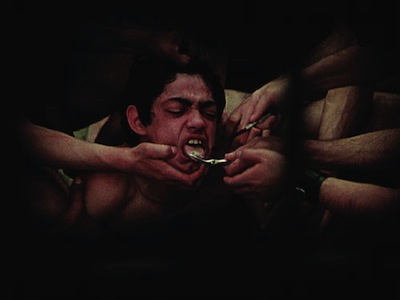
Salò is essentially an escalating chain of humiliation and degradation. As the days wear on, the humiliations inflicted on the kidnapped adolescents gets worse and worse. Religion is banished, as is any display of emotion. If any of the prisoners break these rules, their names go into a little black book. When the excursion is over, the list of wrongdoers will receive a special punishment. Indeed, that perversion of justice is the climax of Salò, an orgy of torture, rape, and death. It's a bizarre concept to wrap your head around. These children have been violated, forced to eat human feces, and beaten, and yet in this upside-down mini society, they are the sinners. You'd think there was no penalty left, yet for Pasolini, no matter how cruel a human can be, there is always someone more cruel, always a deeper level of selfishness and evil that man can sink to.
It can be hard to judge button-pushing art, especially once some time has passed. What was shocking and meaningful in 1976 may not have the same impact or relevance in 2011. Salò, or the 120 Days of Sodom still has the power to disgust. I retched more than once while watching it and frequently squinted or covered my eyes to obscure some of the more terrible depictions. So, I guess that is a win against the belief that we, as a filmgoing public, have been desensitized over the years by increased sex and violence in entertainment. Salò still has the power to make me sick.
On the other hand, it no longer has the power to shock. Maybe it's hard to compete in an age where we have something like The Human Centipede
, the goal post has definitely been moved when it comes to deranged concepts. Or maybe it's that Pasolini's technique is so transparent, it's hard to take his film entirely seriously. Yes, much of what he shows on screen is gross, but some of it is also outright ridiculous. A man in leather panties and dog collar talking about how much he likes anuses and being urinated on may be a very real fetish, but the use of such images in Salò seems more like juvenile rabble-rousing than it does a mature exploration of challenging world views.
Which isn't to say that Salò, or the 120 Days of Sodom is without subtext. For as much as Pasolini is getting his jollies by creating this tableau of human indignity, he also is trying to make a point about the corrupt nature of governance and the true motivations behind fascism. Any will to power, his script suggests, is essentially selfish, no matter how much the would-be leaders crow about the greater good. In amongst the sex talk here, the abusers espouse theories about politics and human nature that seemingly explain and justify their actions. Pasolini undercuts their self-belief by demonstrating that these are just excuses they make in order to satisfy their own base urges. Unsurprisingly, the more harsh things get, survival tactics get more desperate. Prisoners turn on each other. Mankind is its own worst enemy.
Which is where I would guess Pasolini is really coming from. His contempt for the Fascists is equal to his contempt for the common man. Salò, or the 120 Days of Sodom is the product of a severe misanthrope, one whom I suspect wants to get back at a populace that has misunderstood and persecuted him. He is serving us the cinematic meal he thinks we deserve in a way that is almost ironic: he decries cruelty and humiliation by beating up his audience using all the tactics his villains use. You will know what he means because he will make you experience it.
It's not a particularly complex response to a complicated world. Were Pasolini's filmmaking skills not so refined, I'm not sure we'd still be watching and debating Salò, or the 120 Days of Sodom all these years later. It's a well-made movie even if I don't think it's a very good one. I know it has its defenders, and to be honest, I take no issue with that, just as I think Pasolini wouldn't take issue with my negative analysis. Salò is meant to be visceral, and so any visceral reaction on the part of the viewership means success. For my money, though, a better film would have moved me in a more profound manner. It would have still caused me to look away, but it would also inspire me to think about why I had done so. The deepest question I took away from Salò, or the 120 Days of Sodom had nothing to do with narrative or thematic meaning; rather, I just kept wondering how you cast a movie like this. How do you go about finding actors who will read the script and say, "Oh, you want me to strip down to nothing, pretend to get sodomized, and sit in a barrel of excrement? Sounds like the role of a lifetime!"
Criterion has put the two-disc Salò, or the 120 Days of Sodom package onto one Blu-Ray, packaged in a handsome cardboard box with a thick 80-page book featuring credits, chapter listings, photos, and a collection of seven different essays about the movie from filmmakers and critics. It seems to me that it's essential for a film of this nature to acknowledge the debate and give space to a variety of voices to discuss it, so I'm pleased that Criterion has done so both in this written format and on the disc itself. The essays in the booklet actually connect well to the 23-minute Fade to Black featurette that talks to Bernardo Bertolucci, Catherine Breillat, and others about their reaction to the film.
Pasolini himself gets his say in the 33-minute "Salò: Yesterday and Today documentary, which actually did serve to make me appreciate his vision more. He had clear intentions for what he wanted to do, even if some of those intentions are lost in the translation between artist and audience. We also get a look at the actual production in the 40-minute The End of "Salò," which gathers participants and crew members to discuss the working process and also the aftermath, including Pasolini's murder prior to the movie getting released. Amongst those interviewed are set designer Dante Ferreti, who also returns for a separate 12-minute interview. Also interviewed alone is film scholar and director Jean-Pierre Gorin (28 minutes), an aficionado of Pasolini and an appreciative viewer of Salò.
For a complete rundown on the special features, read the full review at DVD Talk.
* In terms of actual number of copies on the market, the very first pressing of The Seven Samurai may total less than Salò, or the 120 Days of Sodom, but given that the only change was the removal of a tiny restoration demonstration, I always considered the pursuit of that particular collectible to be the province of the overly fanatical.

Once upon a time, Criterion spine #17 was the rarest of the collection*. The early release of Pier Paolo Pasolini's 1976 shocker Salò, or the 120 Days of Sodom was the one of the first discs to go out of print for the label, disappearing not long after it had first been issued. Copies of the release sold for several hundred dollars on eBay, and fans created online guides to steer potential buyers through the murky waters of knock-offs and bootlegs.
When I was working on building a complete Criterion library some ten years ago, Salò was always the one that eluded me. Both the cost-prohibitive mark-up and the movie's scandalous reputation made me gun shy. Eventually, I bought a dubious Chinese facsimile so I could actually watch the thing. My hope was, if Salò was as off-putting as everyone said, viewing it would convince me that it was not something I needed to drop major coin on.
The theory panned out. One time through with Salò was enough for me. It was not a movie I ever felt the need to see again. I finally bought the legitimate reissue a couple of years ago, but I never even opened it. It was gathering dust on my shelf, still wrapped in plastic, when the Blu-Ray came through. I guess enough time had passed. I was finally going to watch Salò a second time after all...

Pasolini's film in is an infamous slab of transgressive art. Inspired by the work of the Marquis de Sade, the controversial Italian director leveled his aim on his country's ruling class. Though set during the years during World War II when Italy was occupied and the Fascist government colluded with the Nazis, Salò takes place away from the combat, isolated to a sprawling, secluded villa owned by a shadowy collective of privileged dignitaries. These men have formed a secret pact, marrying each other's daughters as an old-school symbol of joint power. The four of them are intense libertines, and they have kidnapped nine teenage boys and nine teenage girls, all virgins, and taken them to this hidden house to engage in their every depraved fantasy. With them are adolescent thugs who act as their enforcers and aging prostitutes who stimulate the conversation by sharing the greatest hits of their illustrious careers satisfying the kinky fetishes of other powerful men. The men listen to these stories of indulgence and then indulge themselves with their captives.
Salò is essentially an escalating chain of humiliation and degradation. As the days wear on, the humiliations inflicted on the kidnapped adolescents gets worse and worse. Religion is banished, as is any display of emotion. If any of the prisoners break these rules, their names go into a little black book. When the excursion is over, the list of wrongdoers will receive a special punishment. Indeed, that perversion of justice is the climax of Salò, an orgy of torture, rape, and death. It's a bizarre concept to wrap your head around. These children have been violated, forced to eat human feces, and beaten, and yet in this upside-down mini society, they are the sinners. You'd think there was no penalty left, yet for Pasolini, no matter how cruel a human can be, there is always someone more cruel, always a deeper level of selfishness and evil that man can sink to.

It can be hard to judge button-pushing art, especially once some time has passed. What was shocking and meaningful in 1976 may not have the same impact or relevance in 2011. Salò, or the 120 Days of Sodom still has the power to disgust. I retched more than once while watching it and frequently squinted or covered my eyes to obscure some of the more terrible depictions. So, I guess that is a win against the belief that we, as a filmgoing public, have been desensitized over the years by increased sex and violence in entertainment. Salò still has the power to make me sick.
On the other hand, it no longer has the power to shock. Maybe it's hard to compete in an age where we have something like The Human Centipede
Which isn't to say that Salò, or the 120 Days of Sodom is without subtext. For as much as Pasolini is getting his jollies by creating this tableau of human indignity, he also is trying to make a point about the corrupt nature of governance and the true motivations behind fascism. Any will to power, his script suggests, is essentially selfish, no matter how much the would-be leaders crow about the greater good. In amongst the sex talk here, the abusers espouse theories about politics and human nature that seemingly explain and justify their actions. Pasolini undercuts their self-belief by demonstrating that these are just excuses they make in order to satisfy their own base urges. Unsurprisingly, the more harsh things get, survival tactics get more desperate. Prisoners turn on each other. Mankind is its own worst enemy.
Which is where I would guess Pasolini is really coming from. His contempt for the Fascists is equal to his contempt for the common man. Salò, or the 120 Days of Sodom is the product of a severe misanthrope, one whom I suspect wants to get back at a populace that has misunderstood and persecuted him. He is serving us the cinematic meal he thinks we deserve in a way that is almost ironic: he decries cruelty and humiliation by beating up his audience using all the tactics his villains use. You will know what he means because he will make you experience it.
It's not a particularly complex response to a complicated world. Were Pasolini's filmmaking skills not so refined, I'm not sure we'd still be watching and debating Salò, or the 120 Days of Sodom all these years later. It's a well-made movie even if I don't think it's a very good one. I know it has its defenders, and to be honest, I take no issue with that, just as I think Pasolini wouldn't take issue with my negative analysis. Salò is meant to be visceral, and so any visceral reaction on the part of the viewership means success. For my money, though, a better film would have moved me in a more profound manner. It would have still caused me to look away, but it would also inspire me to think about why I had done so. The deepest question I took away from Salò, or the 120 Days of Sodom had nothing to do with narrative or thematic meaning; rather, I just kept wondering how you cast a movie like this. How do you go about finding actors who will read the script and say, "Oh, you want me to strip down to nothing, pretend to get sodomized, and sit in a barrel of excrement? Sounds like the role of a lifetime!"

Criterion has put the two-disc Salò, or the 120 Days of Sodom package onto one Blu-Ray, packaged in a handsome cardboard box with a thick 80-page book featuring credits, chapter listings, photos, and a collection of seven different essays about the movie from filmmakers and critics. It seems to me that it's essential for a film of this nature to acknowledge the debate and give space to a variety of voices to discuss it, so I'm pleased that Criterion has done so both in this written format and on the disc itself. The essays in the booklet actually connect well to the 23-minute Fade to Black featurette that talks to Bernardo Bertolucci, Catherine Breillat, and others about their reaction to the film.
Pasolini himself gets his say in the 33-minute "Salò: Yesterday and Today documentary, which actually did serve to make me appreciate his vision more. He had clear intentions for what he wanted to do, even if some of those intentions are lost in the translation between artist and audience. We also get a look at the actual production in the 40-minute The End of "Salò," which gathers participants and crew members to discuss the working process and also the aftermath, including Pasolini's murder prior to the movie getting released. Amongst those interviewed are set designer Dante Ferreti, who also returns for a separate 12-minute interview. Also interviewed alone is film scholar and director Jean-Pierre Gorin (28 minutes), an aficionado of Pasolini and an appreciative viewer of Salò.
For a complete rundown on the special features, read the full review at DVD Talk.
* In terms of actual number of copies on the market, the very first pressing of The Seven Samurai may total less than Salò, or the 120 Days of Sodom, but given that the only change was the removal of a tiny restoration demonstration, I always considered the pursuit of that particular collectible to be the province of the overly fanatical.
Wednesday, September 1, 2010
SIDELINE: MORE REVIEWS FOR 8/10 + panhandling

Pardon me, but could you help out a fellow American who's down on his luck?
Before we get into this month's list of reviews, I want to call your attention to a donation button on the sidebar of this website. It's there for a specific purpose: I want to buy a Blu-ray player. Unfortunately for me, this means upgrading all of my equipment, not just the player. It's a big move. I currently have access to a Blu-ray and will be reviewing some in the near future (and even one this month), but my time on it will be limited.
Why am I looking to donations? Well, it's simple: I don't make any money at this. My payment for all my reviews is the entertainment itself--even when I buy the discs out of pocket, as I sometimes do. I'm not complaining, mind you. I live a happy life as a freelance writer, and this is a way I have worked out to be able to consume the cinema I want and still get by on the cheap. Though I make my money writing other things, other than the DVDs and the movie screenings that come my way, all I get for film reviews is the $20 or so I receive every three or four months because of the nice folks out there who click my Amazon links before buying things--a kickback I almost always use to buy Criterion DVDs I've missed.
Now, a donation is a donation. This is no guilt trip. I thought about using Kickstarter, but I'd prefer to save that option for a future project. Instead, I am basically leaving it up to you guys. If you feel you want to put something in the jar because you like my reviews, go for it. If not, hey, that's cool, too. This is the internet. I'm doing it for the love of it, you know?
If you do donate, I will set it aside and hold it for when I finally pull the trigger on my upgrade, hopefully in the next couple of months, depending on what kind of financing plans I find. How about, too, if you donate $20 or more, you can add onto the donation a request for a review from something from the Criterion back catalogue that I have not written about. If there's a movie that you've always wondered my opinion on, well, this is your chance!
Again, do what you feel. I have no high horse, I read tons on the internet, too, and only sometimes donate when the site sets up a donation button. I'll keep on keeping on regardless, and I hope you'll keep reading.
Okay, now onto the fun stuff...
IN THEATRES...
* The American, George Clooney in Anton Corbijn's unconventional spy picture. People keep mentioning Melville's Le samourai, but for some reason, I keep wanting to watch Bertollucci's The Conformist
* The Expendables, starring Sylvester Stallone, steroids, and special-effects blood. It's the old man movie not to see this weekend.
* Get Low, starring Robert Duvall and Bill Murray, it's the old man movie you should see this weekend.
* Mesrine: Killer Instinct, the first part of an expertly executed crime epic straight outta France. Vincent Cassel plays the notorious bank robber Jacques Mesrine.
* The Other Guys, a Will Ferrell vehicle that kind of crashes and burns. Yeah, I know, big surprise. But this one comes with an economics lesson at the end!
* Scott Pilgrim vs. the World, the movie to see this weekend. Period.
* Valhalla Rising, a dream-like story of Vikings in the new world, directed by Nicolas Winding Refn, the guy who brought us Bronson. I liked it, but kind of can't figure out why.
* Winnebago Man, the documentary about YouTube sensation "The Angry RV Guy." An interesting idea gets lost somewhere along the way, right around when the filmmaker sticks himself in front of the narrative.
ON DVD...
* Burning Paradise, Ringo Lam's dark martial arts fantasy from the mid-'90s.
* The Good, the Bad, the Weird, a modern Korean western that just could be the most fun I had at the movies all year.
* Helen, Ashley Judd is mentally ill, thanks to the director of Mostly Martha.
* Henson's Place: The Man Behind the Muppets, an all-too-brief but still fascinating portrait of Jim Henson made for the BBC in the 1980s.
* Home, an interesting eco-parable with Isabelle Huppert that kind of goes nowhere.
* John Rabe, a fairly good WWII drama set during the Nanking Massacre.
* Laughology, a documentary on laughing that fails to contrive any mirth.
* Pandora and the Flying Dutchman, a newly restored version of the utterly bizarre Albert Lewin romance. Starring James Mason and Ava Gardner.
* Red Riding Trilogy, a remarkable trio of films from England. Three directors tackle the book series by David Peace. Grim, unrelenting, and yet...hopeful.
* The Square, a tense thriller from Australia that goes a few twists too far. The short film Spider included with the extras is the real gem here.
* Temple Grandin, Claire Danes shines in this inspiring biopic of a woman with autism who revolutionized how we take care of beef cattle.
* The Thorn in the Heart, Michel Gondry's touching documentary about his aunt goes to some surprisingly dark places.
Labels:
albert lewin,
bertolucci,
blu-ray,
corbijn,
documentary,
edgar wright,
melville
Wednesday, May 26, 2010
OSHIMA'S OUTLAW SIXTIES - ECLIPSE SERIES 21

Continuing its tradition of focusing on specific filmmakers at distinct points in their careers, Criterion's Eclipse Series has gathered together five films by Japanese provocateur Nagisa Oshima. Made between 1965 and 1968, Oshima's Outlaw Sixties is a profile of the controversial director as he broke away from the studio system in Japan and started making complex and daring narrative/anti-narrative films that explored taboo subjects and extreme reactions to modern life under his own umbrella. "Provocateur" is not a term I use lightly in this case, Oshima was part of a rebellious zeitgeist. Referred to early on as "the Japanese Godard," his cinematic explorations were of a similar mindset to the Nouvelle Vague crowd, and his independent spirit was in line with what John Cassavetes was doing in New York. Cinema was changing worldwide, and Nagisa Oshima was one of the flashpoints.
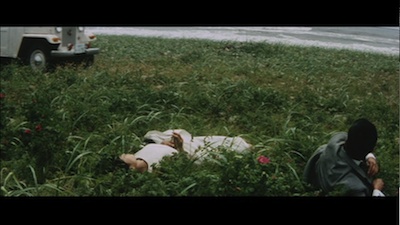
Oshima's Outlaw Sixties begins with the intriguingly titled Pleasures of the Flesh (1965; 91 minutes), the first film Oshima made via his own production company. He wrote and directed the feature, basing it off a novel by Futara Yamada. The movie contains some stylistic choices that would allow Oshima to tap into the popularity of the naughty "pink" genre (essentially, softcore shots of sex and a healthy dose of skin), but at its core, Pleasures of the Flesh is a potboiler, a strange crime film with a unique central concept. Katsuo Nakamura plays Atsushi, an obsessive man in his early 20s who has been pining after Shoko (Mariko Kaga), a young girl he once tutored. He has kept his distance from her ever since her parents persuaded him to kill a blackmailer who had molested Shoko as a child. He borrowed from the philosophy of Hitchcock and committed this crime on a train. It's good advice, and the murder was a near-perfect crime, except Atsushi was spotted by a small-time official who was about to be nabbed for embezzling public funds. He blackmails Atsushi into holding onto a third of the stolen money while he serves his full jail sentence. They have no connection, so the authorities will never know where to look for that portion of the missing cash.
At first, Atsushi dutifully does as he's told, but after Shoko marries another man and it becomes clear that he will never possess her, Atsushi decides to blow all the money. He has a year before the blackmailer will be out of prison, and if he burns through the ill-gotten gains by then, he will kill himself and avoid any further consequence.
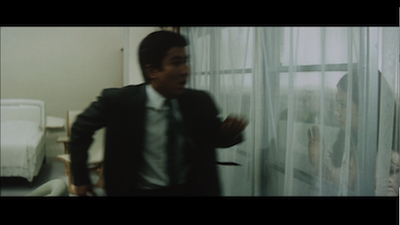
What follows is a series of paid relationships, of Atsushi hiring prostitutes and desperate women to be his live-in mistresses. Most of the women are picked for their resemblance to Shoko, who haunts his mind like a ghost. The various arrangements peter out when other circumstances get in the way. One girl is a gangster's moll, another is married and trying to earn money for her family since her husband is unemployed. The freedom this money provides, and the schism between bought love and the real love Atsushi desires, makes him cruel. He grows bored with the prizes that are easily captured.
Oshima and cinematographer Akira Takada shot Pleasures of the Flesh for widescreen, with garish, fully rendered colors and often startling, abstract compositions. Some of the storytelling is experimental, and so in terms of narrative structure, the film is a little weak. The lock-step construction of your average crime film, where events lead one to another until often the crook falls under the weight of his own guilt, is absent here, replaced by a more breathless rush from one scenario to the next. It works for the large part, though the serial relationships grow a little tiresome before the final quarter of the film finally turns into its last plot twist. Atsushi becomes entangled in ironic coincidences, bringing about punishments he planned to avoid--though not in the ways he would have expected.

Oshima shifts into black-and-white for his 1966 film, Violence at Noon (99 minutes), a choice befitting its serious tone and its themes of duality. The movie is about a love triangle between two women and one man. The man is a thug named Eisuke (Kei Sato), who is also known as the High-Noon Attacker. His nickname was earned on a crime spree. He breaks into homes at midday and rapes the housewives he finds. On the day he is reunited with Shino (Sae Kawaguchi), invading the house where she is working as a maid, he escalates and kills her employer.
Shino and Eisuke come from the same village, and at one point were part of a collective raising pigs and chickens. In with them was the woman who became his wife, the teacher Matsuko (Akiko Koyama). A flood wiped out their livestock, and desperate measures were required. Shino sold herself to a local man of means (Rokko Toura) and ultimately entered into a suicide pact with him. When her own death didn't take, Eisuke took advantage. He rescued her from oblivion, only to force himself on her--a savior who looks for payback.
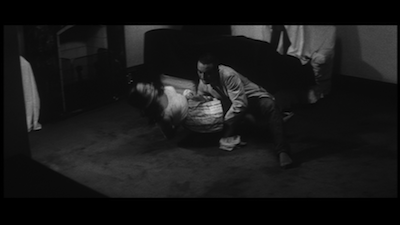
Both Shino and Matsuko are caught between their love for this horrible man and the fact that they know he is horrible. Throughout Violence at Noon, they run away from him but also run toward him. The script by Takseshi Tamura, from a story by Taijun Takeda, jumps back and forth in time to show how this killer wove a sensual web around the women. Oshima and Akira Takada use inventive camera techniques to reflect the multiple points of view and the fractured sense of self the women share. Extreme close-ups, fast zooms, whip pans, chopped-up scenes using repetition and quick cuts to turn action into collage--they all contribute to a feeling that these women are linked by a reality that has come off the sprockets. Only when they agree to their common ground do Shino and Matsuko find the courage to act. Some of the material about the two women being one, as well as the aesthetic methodology, reminded me of Ingmar Bergman's Persona


Violence at Noon can be a bit slow going at times, but its cinematic acrobatics show a more rigorous control on the story than Oshima displayed in Pleasures of the Flesh. There are none of the narrative gaps, none of the leaps that made that film stutter. The conflict between common sense and desire is already developing as a major theme in these first two films: we chase our passion even when we know it's not necessarily healthy to do so.
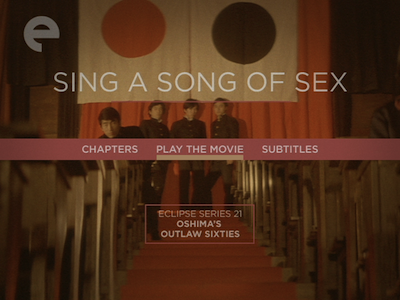
Clearly there was some cinematic back and forth going on between Japan and Europe during the 1960s. While Persona and Violence at Noon criss-crossed in their productions and likely didn't influence one another, the Godard tag that Oshima picked up earlier in his career has some real merit. The use of Shino's written letters in Violence is not dissimilar to Godard's use of title cards in his films. The French director is also known for his playful approach to audio, and I hear echoes of his technique in Oshima's soundtracks. Dropping out all sound for absolute silence, sudden bursts of incongruous music--these are JLG trademarks. The third film in Oshima's Outlaw Sixties, Sing a Song of Sex (1967; 103 minutes) begins with no sound. The camera is silently centered on a burn mark, and as the music comes in, so does the flame. (The use of audio in the opening scenes of the next film of the set, Japanese Summer, is even more dazzling.)
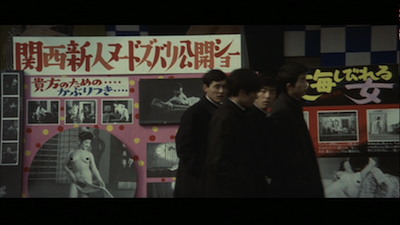
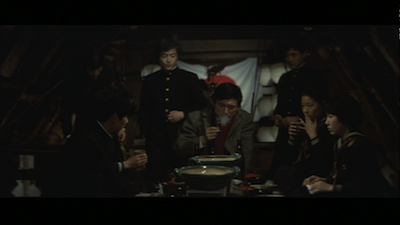
Sing a Song of Sex was a largely improvised film, and this "on the street" technique and its political posturing add more to the connection with the Nouvelle Vague. As the movie follows four restless, horny students over two days, Akira Takada's camera probes the scenes, rooting out the story. In one sequence, the camera is on a swivel, swinging back and forth between the bored and the drunk at a restaurant. In many others, it walks with its characters as they pass through the city. The use of advertising as a backdrop doesn't just evoke thoughts of Godard, but also Warhol and pop art.
In terms of story, Sing a Song of Sex is about a quartet of older students who are bored and restless as they talk about sex, go out drinking with their teacher and some of their female classmates, and deal with the intrusion of real life on their self-contained world. The movie is set during the return of a controversial nationalistic holiday, and the boys pass by protests without ever considering anything beyond their libido. Much of the film is spent searching for the elusive student #469 (Kazuko Tajima), a dreamgirl that only one of them has even seen, but for whom they all indulge a shared violent rape fantasy. Oshima is putting the political up against the personal and critiquing the disconnect of youth. His characters lack a moral center, and indeed, there is even a struggle to find the moral center of the nation. On one hand, you have the protest against the return of old-fashioned values, and on the other, you have kids looking to America, standing up against Vietnam and singing folk songs from the U.S. (Songs are seen as a method of communication that carries messages through changing history.) At the same time, Oshima brings up questions about Japan's Korean origins and the country's subsequent treatment of its neighbors.
Sing a Song of Sex goes on a little too long. (I had the same problem with all the films in Eclipse Series 21, actually, including as noted above; they kept going even after my interest in the initial concepts had worn out.) The final scenes bring the boys together with three women they have objectified or victimized and they are forced to prove whether they are all talk and daydreams or if they can make their sick fantasies actually happen. The staging is abstract and pedantic, much like later Godard or the pretentious soul searching of Bernardo Bertolucci's 1968 Partner
[Side note: There is an interesting comparison to be made between Sing a Song of Sex and Toshiyaki Toyada's 2001 juvenile delinquent film Blue Spring

Whatever wall of reality Oshima shattered at the end of Sing a Song of Sex (I prefer to think he went past the fourth wall and straight on into the fifth or sixth), it stays shattered for his 1967 film Japanese Summer: Double Suicide (99 minutes) (a.k.a. Night of the Killer). This black-and-white parable takes place mostly underground, in a basement prison where a roving gang is locking up abductees they hope to indoctrinate into their wanton cause. Our gateway into this No Exit
Both the death-obsessed teen and Nejiko represent Oshima's ongoing concern with the moral bankruptcy of bored youth. The old duo "sex and death" come up time and again in Japanese Summer, though Nejiko has a hard time finding anyone who will actually sleep with her. When she finally does, it isn't satisfying and nowhere close to life affirming. When the boy makes his first kills, he also finds it underwhelming. Give the kids what they want, and they realize they don't want it anymore. Nejiko's fate is tied to Otoko's regardless, and ultimately, they will discover that sex and death are tastes that are only great when they go together.
In the bunker, the sole link to the outside world is a TV set, one that is governed over by the pragmatist, earning him the nickname Television (played by Rokko Toura). The prisoners use the TV to monitor the progress of their captors and their gang war, but also to listen to the news about an American sniper that is killing Japanese citizens for no apparent reason. Oshima makes comparisons between this man and the assassination of John F. Kennedy, as well as between the political turmoil in his version of Japan and the race riots in the U.S. His heavily coded narrative weaves in and out of these real-world analogues, and presumably, each of his characters are meant to represent some piece of society. Some of the abducted are on the side of the killer, some want him dead, and even the ones who agree with each other can't actually agree to agree.
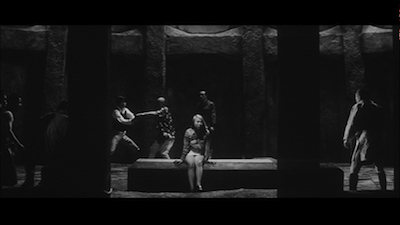
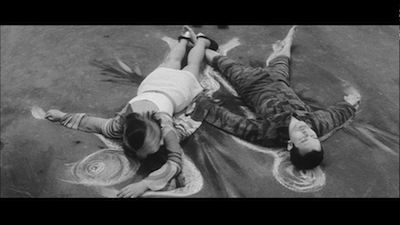
Japanese Summer: Double Suicide is obtuse by design, and Oshima provides no magic decoder ring to sort it all out. Some of his symbols are obvious (Nejiko and Otoko, for instance, are constantly framing themselves in outlines of bodies, like the chalk figures at murder scenes), and others are lost either to an historical/political context that I personally didn't understand or possibly are red herrings that only mean something to the director and his co-writers, Mamoru Sasaki and Takeshi Tamura. From the liner notes, I am led to believe that Oshima would be pleased that I was confounded by his movie; however, I am not sure how he'd feel about me being bored by it. Interestingly enough, for as abstract as the story is, the film itself is the most straightforward in terms of visual style. Japanese Summer is the first feature in the box to be shot by someone other than Akira Takada. New cinematographer Yasuhiro Yoshioka drops most of the experimentation and seems to favor more formal frame construction. The actors are usually arranged according to a very strict placement, calling to mind the look of classic paintings or still photographs.

I was disappointed to peek at the liner notes of Three Resurrected Drunkards (1968; 80 minutes) (a.k.a. Sinner in Paradise) midway through the movie and see that a Monkees comparison was already made for me, because I was totally ready to call that out. Opening with three guys walking arm and arm on a beach while a sped-up pop tune rattles along underneath, I couldn't help but think of the PreFab Five. Seeing the seemingly random comedic events that follow, the comparison stuck. Though, let's call it out: the Monkees' full-length Head
Three Resurrected Drunkards is like an angry art school comedy. Three new graduates--O-noppo, Chu-noppo, and Chibi, a.k.a. Big, Middle, and Tiny, a.k.a. actors Kazuhiko Kato, Osamu Kitayama, and Norihiko Hashida--go for a swim, only to have a mysterious hand come up out of the sand, take half their clothes, and replace them with other clothes and cash. Left with no choice but to put on the new outfits, O-noppo and Chibi are mistaken for two illegal Korean immigrants ("stowaways"), a soldier (Kei Sato) and his companion, who ran from South Korea rather than join U.S. troops in Vietnam. The Koreans try to kill the boys to cover their tracks, but the boys escape assassination only to be deported. They also get entangled with a Korean girl (Mako Midori) who helps them, despite having her own problems.
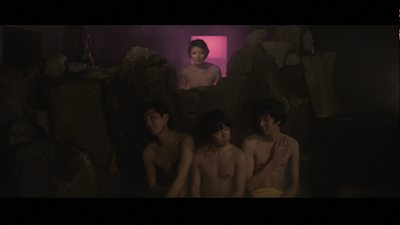
The odds are stacked against the trio, but Oshima gives them a Bunuel-esque out. Midway through the movie, Three Resurrected Drunkards resets, taking us back to the beginning. This time, though, the guys begin to alter events. Their main change: admitting they are Korean. This is a shift that was set-up by a faux-documentary digression where the actors take to the streets to interview people and challenge them as to how they define their national identity.
On paper, Three Resurrected Drunkards is a daring experiment in gonzo filmmaking; in practice, it's dated and makes for lethargic viewing. Were this really a Monkees jam, it would be a lot more manic and silly, and while that may not have been Oshima's intention, it might have been a little more palatable than the self-satisfied seriousness that is here instead. Everything seems too dialed down, including the more dramatic second half. O-noppo's crush on the girl, for instance, is too reserved, and so his anger when he sees how horrible her guardian (Fumio Watanabe) treats her doesn't have much impact. Oshima is building to a startling conclusion, one that drives home his anti-war message and boils with the anger he feels in regard to Vietnam and the historical mistreatment of Korea, but like most of the films in Oshima's Outlaw Sixties, it takes too long to get there, and the view along the way gets tiresome.

Look, I get why Nagisa Oshima is so well respected, and I also understand why the title of Oshima's Outlaw Sixties - Eclipse Series 21 is well earned. The Japanese film director was an outlaw. An independent filmmaker who broke from the studio system when it was clear he was not going to be able to make the volatile movies he wanted to make the way he wanted to make them, Oshima is a man with a mission. He is an artist with a passion for cinema, and his cinema is about the passion of individuals. Eclipse Series 21 showcases a selection of movies that are sensuous, aesthetically audacious, and for the 1960s, politically provocative. The five films in the box attack the foundations of moviemaking and dig down to its core, casting aside the rubble willy-nilly. For me, however, the more obtuse and disconnected the narratives became, the less interested I was as an audience member. This may make me an outsider, too, it's certainly not conventional critical wisdom, but I have to imagine that Oshima would respect my stance as much as I respect his. Your views on any of this, of course, will also be you own.
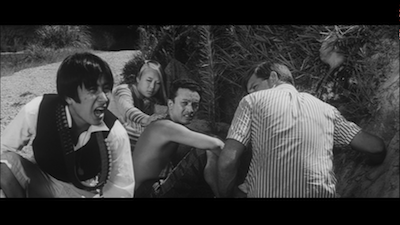
Trailers for: Sing a Song of Sex
Japanese Summer: Double Suicide
For a full rundown on the special features, read the full article at DVD Talk.
Labels:
bergman,
bertolucci,
cassavetes,
eclipse,
godard,
nagisa oshima
Subscribe to:
Posts (Atom)