Showing posts with label linklater. Show all posts

Saturday, May 21, 2022

BERNIE - CRITERION CHANNEL

 This review was originally written for DVDTalk.com in 2012.


There's something about the way the title card declaring that Bernie is based on a true story that compels you to think that maybe you're being conned. Perhaps it's just that Fargo has made the moviegoing audience a bit suspicious of quirky films about a murder in a small town, but it's not helped that co-writer and director Richard Linklater and star Jack Black, who previously worked together on The School of Rock, don't even try to hide their tongues in their cheeks. They're pushing those suckers hard against the inside of their mouths. The bulges are evident.


And yet, Bernie is taken from real life. The story of an East Texas funeral director who killed his rich benefactor and then spent nine months pretending she was alive while he spent her money has already done the "true crime" rounds. Screenwriter Skip Hollandsworth wrote the article that is the basis for the film. His angle was to focus on the fact that many of the citizens in Bernie Tiede's community rallied around him and pushed for leniency despite his having shot a senior citizen in the back four times. Linklater makes much dark comedic hay out of this idea, attempting a light-hearted version of a docudrama by blending "real" interviews with "authentic" townspeople with the more traditional humorous staging of the events. The effort is noble, if not entirely successful.
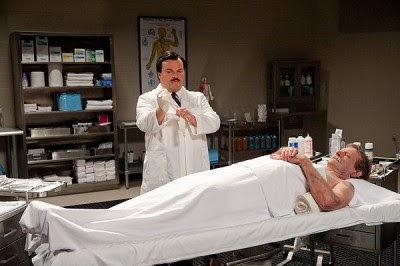


Black is amusing and restrained as Bernie, a religious-minded funeral director who, by all accounts, took his job seriously and extended generosity to the families he aided above and beyond the norm. He had a particular ability to get along with the older widows, and he managed to charm the uncharmable. Marjorie Nugent, who is played with particular comedic aplomb by Shirley MacLaine, was a pretty mean old woman. Her husband owned the local bank, and both of them were notorious misers. Bernie and her became friends, traveling all over the world together, though eventually Bernie became more of an on-call servant. As Marjorie grew more and more demanding, he snapped and shot her with the "armadillo gun."


Or so he says. The county district attorney, Danny Buck, thinks otherwise. Buck is played by Matthew McConaughey, whose big break was back in Linklater's Dazed and Confused [review]. McConaughey has traded that film's feathered hair and tight T-shirts for a bad wig and ill-fitting suit, yet he has kept all the cockiness. Buck is convinced that Bernie is more of an operator than he lets on. Their neighbors think Buck is the operator, that he's just an opportunist with a re-election campaign to manage. All the money Bernie spent while hiding the body was to help out his friends, and no one liked Marjorie much anyway. Where's the harm?


Bernie strikes a tenuous balance between macabre humor and gruesome reality. The down-home values angle is a bit of a trick. One gets the sense that Linklater wants us to have some sympathy for Buck, who, for whatever his flaws, would rather see the law upheld than distorted by some kind of misguided sense of charity. The problem is, the writing is too wishy-washy, never really coming down firmly on either side of the argument. It's almost as if Linklater himself was charmed by the folksy wisdom and forgot that it's not as imbued with common sense as the tellers seem to think. They con the filmmaker, even in absentia, as much as Buck believed that Bernie conned them.


The other problem with Bernie is that, like its main character, it's almost too nice. The storytelling is elevated by a genial comic touch, and I never got the sense that Jack Black is making fun of the man he's portraying; at the same time, I started to wish everyone involved would stop being so damned polite and start getting more invasive. We never get to really know Bernie Tiede, we never figure out what makes him tick. Sure, there are segments questioning whether he and his victim were ever romantic or if he was actually gay, but these notions are treated as so silly as to almost be immaterial. It's quite possible that Tiede's mercurial personality is what makes his story so fascinating, but if that's the case, that's something the film needs to own up to. Danny Buck almost touches on it in his closing arguments, but then Bernie shies away again.


Linklater has made a movie that is hard not to enjoy, but it's also equally hard to love. I like a lot of what he has done here. Playing the fake documentary element with such a straight face while at the same time letting the dramatization be more loose and carefree is kind of an interesting take on the genre--though, if I'm going to watch a mockumentary about a delusional theater person in a small rural town, I'm going to go with Waiting for Guffman. It's a better film. The kind of better film Bernie should have been. Instead, Bernie's just all right.


Sunday, February 17, 2019

COLD WATER - #944


You do stupid things when you’re young. Destructive things.

When I was 12 or 13, a couple of friends and I used to go to the high-rise apartment building behind where we lived and race through their hallways, like a suburban remake of Band of Outsiders [review], replacing the marbled floors of the Louvre for gaudy 1980s carpeting. Not all three of us on the same hallway, though, but each on a different floor. We’d climb the outside staircase on one side of the building, and pop open the locked doors on the top floor and two below it, each competitor positioned on his respective floor. On GO!, we’d start running and race to the exit onto the stairway on the other side. With each successive race, run over a matter of weeks, we’d increase the level of nuisance. We’d yell and knock on doors, and once, my friend Jimmy grabbed an abandoned bottle full of oil and some other fluids out of a garage, pissed in it, and then trailed it behind him as he ran, leaving a long stain on the carpet. This was probably the beginning of what would get us noticed, leading to the last straw.


Another time we discovered the management had repainted all the guardrails on the staircase and carved things into the gooey, still-drying paint, mostly using our fingers. It was after that incident, after we’d caused some real damage, that they started keeping an eye out for us, and on a subsequent race, men were waiting for us out on the stairs at the finish line side.

We were taken to the management office and told to sit tight, the police were coming. Not being a real priority crime, we were going to have to wait a while. The couple that ran the building started talking to us, curious why we did it. We copped to the racing, but denied everything else. Worse, we started moralizing on our own. “Why would anyone do such a thing?” we pondered. “How terrible!” Meanwhile, we were biting off our nails to get rid of the paint that was still lodged beneath them. By the time Johnny Law finally did show up, we had convinced our victims that we were innocent. The cops scoffed, seeing right through our ruse (we’d even offered to help clean up, an obvious sign of guilt), but with no one to press charges, we were let go.

Why would anyone do such a thing? It was an honest question to ask ourselves, since we had no answer to offer, no motivation. We were just young and bored, we felt misunderstood, and we needed to lash out at something.


These same unknowable impulses drive the kids in Olivier Assayas’ 1994 semi-memoir Cold Water, a teen drama set in 1970s France. Very little understanding is sought, less offered. At one point, when confronted by his girlfriend’s angry mother (Dominique Faysse, Irma Vep), the Assayas stand-in, Gilles (Cyprien Fouquet, in his only film appearance), tells the worried parent that her daughter runs away because she does not pay attention to her. It’s as good an explanation as any, and probably partially true. Yet, it’s also too simple to fully communicate the miasma of hormones and emotion that make adolescence so trying.


The girl in question is Christine, and she’s played by Virginie Ledoyen (The Beach, 8 Women). Christine is caught in a custody dispute between her parents, and if you asked her, she’d prefer to be with neither. After she gets caught shoplifting some records with Gilles, her father decides to send her to a mental hospital. It’s not the first time he’s done it, either. Though Christine plays it cool, again offering no hint of her true feelings, if she ran across those same cops who interrogated my friends and I (they did check under what was left of our nails, by the way), they’d see through her as easily as they saw through us. Christine is a troubled girl; while the solution is too extreme, she probably does need some kind of help.

Meanwhile, Gilles does not appear to have much reason for his teenage ennui. Outside of maybe trying to impress Christine--who at the start of Cold Water is just his friend--not much seems to fuel his delinquency. His parents have split, as well, but his father (László Szabó, Le petit soldat [review]; The Confession) seems like an all right guy, one who has been willing to give his son enough rope. But then...we all know how that cliché finishes, and dear ol’ dad is seeing how some clichés still hold truth. Gilles doesn’t seem to care about anything, not even the girl he is supposed to love; when she is caught and he is not, he just keeps running and never looks back, leaving Christine holding the bag for his theft. In fact, so lacking in purpose is Gilles’ rebellion, we never get any explanation or payoff for one of his most distressing crimes: he buys half-a-dozen sticks of dynamite and leaves them with his younger brother, teaching him how to attach the detonator and fuse. It’s like that saw blade scene in Richard Linklater’s Boyhood [review] in terms of audience panic. And just like in Boyhood, the perceived danger never manifests.


Much of the above occupies the first third of Cold Water, with the rest of the film hinging on an extended party scene in an abandoned house. Fueled by hash and 1970s rock-and-roll, the kids cut loose, trashing the house, and starting a bonfire. To compare to another Richard Linklater film, it’s like the kegger in Dazed & Confused [review], only the nostalgia has been replaced by apocalyptic anxiety. Even the songs on the soundtrack are darker cuts from Roxy Music, Nico, Bob Dylan, and Creedence Clearwater Revival. Assayas finds the sinister drive of “Around the Bend” so effective, he re-starts the song midway through, letting that opening riff work its magic twice (and I say that as someone who loathes Creedence). Gilles and Christine are reunited and dance to Leonard Cohen’s “Avalanche,” which isn’t exactly romantic. Rather, it has a push-and-pull, the narrator rejecting that someone has helped him, and even implies hurt. “Well I stepped into an avalanche / It covered up my soul.”


If the kids really did want attention, Assayas gives them plenty. Cold Water was shot by Denis Lenoir, who also lensed Assayas’ Carlos [review] and the Julianne Moore drama Still Alice [review]. His camera is patient, letting the moments unfold rather than forcing them. This gives the teens time to thrash and flail, and to discover their own mistakes. It’s hard to tell if Gilles sees any of his own errors at the end, or if he’s gotten what he wants. He certainly has let the avalanche cover him, and one can argue that avalanche does him a mitzvah by rolling over him and leaving him behind--itself racing from one stairwell to the next, across the floor of the Louvre, on to whatever finish line its heading for.


Sunday, February 3, 2019

BEFORE MIDNIGHT (re-review) - #859

“It’s not time that they’re lost in, but perception.”


And perception is key to this review of Before Midnight, the closing chapter of the Richard Linklater’s Before Trilogy. I reviewed this film enthusiastically upon its release in 2013 [read it here], but I have not re-read that piece since re-posting it to this blog. Thus, I come to Before Midnight fresh, hot on the heels of watching and reviewing the first two entries (Before Sunrise and Before Sunset), building my impressions as I go. If I contradict my previous self in this outing, it’s to be forgiven, the product of time passing, personal change, and different perceptions based on where one sits at any particular moment.

Jesse and Celine, as embodied by Ethan Hawke and Julie Delpy, certainly sit in different places than we have seen them before. The kids of Before Sunrise searching for a meaningful life have found one. They are in what is probably a common-law marriage with children--twin girls from this union, and a son from Jesse’s former marriage. She is a successful environmental activist, he is a popular novelist. The movie finds them on a vacation in Greece, hosted by an elder statesmen of literature, sharing the time with three other couples. Before Midnight is the first movie of the Before Trilogy to open up and give us not just glimpses of Jesse and Celine interacting with others at length, but interacting with other people without each other. It breaks the mold, to a degree, but as with all the choices made across the three films, this is done with purpose: we have to see them come back together. The presence of others in their lives isn’t necessarily driving them apart, but there has to be a certain reminder of what it means for them to be together alone.


We probably should have braced ourselves for the melancholy at the jump. Before Midnight opens with Jesse dropping his son at the airport, sending him back to America and his mother. The child can only visit in summers and on holidays, and Jesse’s melancholy over the situation sparks a slow-burning argument about what he and Celine may want. She is faced with a potential job change, a step up in the political world but a surrender of sorts, since it will take her away from the small but effective campaigns that do a lot of good when they work. But, is Jesse’s suggestion of spending more time with the son really a suggestion that they uproot everything and move to America?

It’s the seed of what will become an argument in the second half of the movie. The first half shows them socializing with the other vacationers. The group is almost like a capsule of the Trilogy itself, with a young couple, another middle-aged couple, and then an older non-couple, a widower and a widow who show two sides of a future where you outlive your spouse. The discussion careens through these points of view, covering not just relationships, but technology, dreams, and memory. It’s happy times, with just an undercurrent of the animosity that will fuel the film’s second half, when Jesse and Celine go off on their own for a romantic night that turns into anything but.


But first, we see them walking from the villa to the local hotel, a glimpse of the couple we have come to know, chatting and laughing and sharing ideas. They revisit old themes, like death and time. There’s a lot of talk about time, how it’s too slow when you’re young and too fast when you’re old. And how one marks its passage, how we measure the events of our lives. In some sense, the important happenings are still stretched out on the same continuum that Jesse proposes in Before Sunset, with the audience being blessed with the macro view, knowing that Celine isn’t entirely right when she says they have not changed at all, but also not entirely wrong. We’ve watched in a way they cannot.

There is an increased familiarity that informs Before Midnight: our familiarity with the characters and their familiarity with each other, but also the relationship between the performers and the filmmakers. There is a comfort here, and known tropes to fall back on, but also an even more natural rapport. Linklater and his actors are infusing their years together into how they portray the same level of time having passed between their avatars. Everything just feels right. Maybe Celine really is correct. There’s a consistency to their union we appreciate...

(l to r) Hawke, Delpy, & Linklater, ca. Before Sunset

...and that they doubt. If this is a couple’s midlife crisis, consistency is at the heart of it. Not just the boring or reliable stuff, but a consistency of mistakes, of character flaws, of foibles. Long-term couples always advise younger lovers that the secret to a relationship’s success is hard work, it’s not all magic. Before Midnight is a portrait of that. It’s actually kind of exciting to watch, mostly because we so rarely see this kind of relationship on screen. (Though Bergman comes to mind.)


It’s almost impossible not to watch Ethan Hawke’s Jesse at this stage and not think of his similar character in Boyhood [review]. The rock-and-roll dad who still wants to be cool, and thus appears unreliable, who lives separate from the child, but who means well. On that front, we also must consider Julie Delpy’s character in her own films, 2 Days in Paris [review] and 2 Days in New York [review]. She brings a lot of the same anxieties to that role, but amplified to the point of being alienating. In those movies you wish the couples would split; in the Before Trilogy, you wish they’d stay together.


If they do, it’s still up to you. Before Midnight keeps the conceit laid out at the beginning of Before Sunset. How you decide the fate of Jesse and Celine depends on what baggage and beliefs you bring to the table. In this case, though, it’s not really a question of how romantic you are, but how much do you believe in true love, in a deep connection. Jesse practically says it himself in his casual reference to the Bee Gees. At the same time, I once again wonder how much of this was planned from the start. If it wasn’t, credit to Linklater and his collaborators for finding the clues he and Kim Krizan left for them in Before Sunrise. Remember that time travel concept Jesse uses to convince Celine to jump off the train with him? It’s ripe to make a return. Before Midnight seemingly ends, but really, it takes us back to the start, to the initial “will they or won’t they.” It’s time to take another jump...or get on separate trains.

It’s all down to your perception. And how you interpret the way Jesse and Celine have shared with you their own perceptions of the time they spent together. There is no right answer, no one single timeline from here, but one for each person partaking in the experience.


BEFORE SUNSET - #858


Confession: I didn’t see Before Sunset during its theatrical run, it was a couple of years before I finally gave in and checked it out. I had dismissed the notion of a sequel to Before Sunrise [review], being in my early 30s and still full of strange and precious ideals about story, I had rejected the idea that the magic could be recaptured or that we needed to know if Jesse and Celine ever saw each other again. It wasn’t until the graphic designer working on my graphic novel with Joëlle Jones, 12 Reasons Why I Love Her, gave me a DVD copy and insisted that I give it a try that I finally did. And was pleasantly surprised.

I mention this in part because how Jesse (still played by Ethan Hawke) answers the questions about the book he wrote fictionalizing the events of Before Sunrise sounds a lot like how I answer questions about my books. Specifically, the “did they or didn’t they” ending being a litmus test for how romantic you are. I give the same answer about the ending of 12 Reasons Why I Love Her.


Clarification: I am re-watching each movie of the Before Trilogy and writing about it afterwards. Thus, when I wrote my Before Sunrise review, I had not yet watched Before Sunset, and so when I wrote that each moment of that movie was every moment of the series, I had no idea that Jesse says the same thing, also in the scene discussing his book, in this entry. What can I say, we share a wavelength.

And the Affair to Remember [review] comparison? Fitting that the reunion of Jesse and Celine echoes the “did you or didn’t you” of the final scenes of the Leo McCarey film, though with a much lighter touch...before moving on. In Affair it was the end; in Sunset, the start.


Before Sunset is the very definition of a middle part of a trilogy. It’s a bit darker, a bit more serious. It feels incomplete, acting as the connection between the kick-off and the finale. And like most second parts, many fans are going to argue that it’s the best. For all the reasons cited.

Richard Linklater gets this. He’s not setting out to make a crowd-pleasing affirmation of Before Sunrise’s goopier potentialities. Before Sunset has a level of sincerity about what it means to be in one’s 30s that underlines how sincere its predecessor was about capturing the airiness of being in your early 20s. They’ve had a whole life to live, to fail, to lose or hang onto their romantic notions. Amusingly, Jesse is more hopeful now, and Celine (Julie Delpy) is a politically driven realist. Where their paths diverged somehow caused him to increase his belief, and for her to tamp her romance down. Then again, he is also in an unhappy marriage, so maybe by being so grounded he can appreciate feelings that are less so. I mean, there is a definite irony to her being jaded by romance, when he suffered the true disappointment; yet, her failure to carry through has arrested her emotional development. She is not sure she can ever again feel the way she did during their Viennese dalliance.

Though, even as she points out, Jesse has arrested himself. He has chosen to stay in that moment, regardless of how much his life charges on. The impetus for their reunion in Before Sunset is that he has written a novel about their one night together, and the book tour has brought him to Paris. This adds a fun metatextual layer to the movie. They are fictional characters that, at least for a brief period of the movie, are grappling with fictional versions of themselves. More importantly, though, it brings up the question of perception: his version of events vs. hers.


Or, perhaps more precisely, it questions the quality of a particular witness or narrator: how does their retelling of Before Sunrise change based on what they prefer to hide or celebrate. Of course, those alterations are based on what they feel and what they wish to suppress or keep secret--a tactic that spills over into how they represent their current life. Both begin with a desire to present their best face, forgetting that they are with the only person who is really capable of unmasking their pretenses. And they only have a couple of hours to get the job done. He has to leave for the airport at 7:30.

Fitting into the collegiate preoccupations both Jesse and Celine had in Before Sunrise, Before Sunset uses their ill-fated first reunion as a way to ponder questions of faith, the “what if” scenarios suggesting a different path for the wannabe lovers. Sure, they would have been different if they had seen it through, but not necessarily for the better. Is it possible that they needed to shed their youthful ideology in order to really be together? Would they have lasted if they had run with that first blush of emotion and not gathered the life experience that would give them the tools and tenacity to commit? Probably not. And thus, it is befitting that Before Sunset fails to end with a grand declaration, fading out instead on a quiet recommitment to love.


In terms of style and approach, not much has changed here, though it’s clear that budget and nearly a decade of work under their belts has improved all skills. The camerawork is cleaner, the look of the film more polished--but that could be an uptick in technology giving all indie filmmakers a leg up. Lee Daniel shot both movies, as he has many Linklater efforts, including Dazed and Confused [review 1, 2] and Boyhood [review], so I imagine the two had quite a rapport by this outing. Daniel also has a lot of documentary credits on his resume, which suggests certain skills he certainly could apply here.

Luckily, this progression helps rather than hurts. If the first film has the scruffiness of youth, this has the sheen of success, the characters showing off at a time when they can and when making sure everyone knows you’ve accomplished something matters. It can’t be the same every time...and as we’ll see, it won’t be.


Saturday, February 2, 2019

BEFORE SUNRISE - #857


My first thought in rewatching Before Sunrise was to wonder if they had a plan all along. Back in 1995, were writers Richard Linklater and Kim Krizan already looking ahead to 2013, imagining their decades-spanning Before Trilogy, and laying tracks for the relationship to come? Because it’s hard not to flash forward to the third chapter when Jesse and Celine’s relationship is experiencing friction while watching how it originally came together. [Link to my original Before Midnight review; link to my 2018 re-review.]

It’s all right there in the first scene. Celine (Julie Delpy) is reading  book on the train, and a German couple arguing forces her to retreat to another empty seat on the car. This puts her across from Jesse (Ethan Hawke), a fellow reader and another solo traveler. The bickering gives them a reason to chat, and Celine shares a factoid about how when men and women grow older, they physically lose the ability to hear each other; Jesse then wonders if that’s how couples manage to stay together, evolving to a state where they contentedly tune each other out. The problems of the old become the meet-cute of the young.


To examine this, to leap ahead in time, is to actually indulge in Jesse’s own winning argument for convincing Celine to leave the train: imagine yourself in twenty years, married with children, and you have no idea if one of those men you met but did not hook up with would have been more exciting than your boring, familiar husband. Jesse offers himself as the predictive answer, proposing that Celine see this excursion as a time travel experiment. And in a sense, this relationship will be timeless. Jesse and Celine are of this moment, and this moment is every moment, a time capsule that remains relevant even as it updates itself. This is version 1.0, and in nine years we will get 2.0, and nine more 3.0. Added layer for me: they meet on my birthday, so I probably feel the time more than any of you.

The future and mortality are running themes of the conversations in Before Sunrise--a movie that is, conceptually, one long chat, as the two young lovers stroll Vienna and get to know one another, the audience falling for the pair as they fall for one another. These morbid thoughts aren’t really surprising. Is there any stage of life where one feels a more pronounced obsession with death than in one’s youth? Is that not the whole point of Romantic poetry? One of the best things about Before Sunrise is how unashamedly young it is, how Linklater and Krizan lean into the grand ideas that possess a growing mind, no matter how silly or pretentious they may be. Thus we can forgive Jesse for his self-regard, surface-level “big” thinking, and sheer punchableness, his gray T-shirt and leather jacket, his grunge goatee. It was the early ’90s, after all. He looks like a version of Chris Cornell if Chris Cornell were a glass of milk that someone put ice cubes in and the ice had melted.

This paragraph is a placeholder/palate cleanser because I’m pretty proud of that image and I want you to take a second to really imagine it.


There’s a beauty to the writing here in how perfectly imperfect these two are for one another. The script could have simply relied on the cliché division between Europeans and Americans, that she is more sophisticated and worldly and he’s an accidental tourist waiting to happen; instead, it goes deeper into that divide to look at their personalities. Despite her fatalism, Celine is open to the world, ready to accept the proclamations of a grisly palm reader or the improvised street poetry of a homeless Lord Byron; Jesse is the know-it-all American male, too aware of the angles to enjoy the shape of them. It’s what leads to their only real conflict. Yet, we may also surmise that it’s no conflict at all, that he likes her daffy indulgences, and she appreciates how he preens for her. She’s smart enough to see that he needs to be seen as smart himself, confident enough to call him stupid, and enough of a romantic herself to take the compliment. One of the best scenes is watching her bust his ego by making fun of their first kiss. Credit to Hawke, he seems to get this guy, because he quickly turns the bruised feelings into self-aware laughter.


Both performances here are easygoing, natural, and unaffected--perfectly in sync with the ultra-indie shooting style (nothing fancy here, just the actors, the camera, and the city). Hawke is more prone to acting, including demonstrative hand gestures and fidgety business, but it fits how Jesse himself is performing. On her side of things, Celine is more laid back, perhaps less invested, but again, that fits her personality. She’s open to whatever happens, he’s intent on making it happen.

It’s a charming little dance, staying just on the right side of mawkish for most of the narrative to allow for the filmmakers to go whole hog at the end, stamping Before Sunrise with an Affair to Remember-style ending, where a promise is made to prove this is more than a one-night stand by returning to the spot where they parted in six months time.

Only for us it would it would be considerably longer than that before we’d find out if that promise remained unbroken.


Sunday, March 11, 2018

WEEKEND (2011) - #622


A chance flirtation that leads to a one-night stand ends up as a weekend-long affair that should affect both men involved for a lifetime.

Knightfall’s Tom Cullen plays Russell, a lifeguard in Nottingham, England, who lives a semi-closeted life alone in a high-rise flat. One night he leaves a gathering of his straight friends to go to a gay bar, where he spies Glen (Chris New). Though Glen doesn’t appear to return his interest, cut to the following morning, and the two have spent the night together. As is his wont, Glen tape-records Russell’s impressions of the previous evening’s activities for an art project he’s developing where men he sleeps with speak frankly about their sexuality--something he says gay men rarely happens in public. Straight society being as pervasive as it is, real talk about other types of sex are stifled. The conversation stirs something in both men, moving their connection from a fling to something more substantial.


Weekend is the debut feature of 45 Years-director Andrew Haigh [review], and in its way, it is the realization of the fictional Glen’s proposed ambitions. A sort of gay Before Sunrise, Weekend is an intimate glimpse of the private affair of two lovers who never expect to be together, and indeed, know that they can’t. Glen is going to leave England for America on Monday. So, the pair packs as much into their 48 hours as they can--including an extended night together, staying up and getting plastered, sharing memories, and revealing their hidden secrets. And it’s not just about their feelings and desires, but frank conversations about the sex they have had, separately and with each other. Glen being who he is, no personal act can pass without some rearview scrutinization.

The dynamic between the two men fits the paradigm of most romantic movies. One lover, Glen, is outgoing and dynamic; the other, Russell, is more shy. In this case, though, it informs who they are in ways that are different than the heterosexual paradigm. Glen’s openness has allowed him more experiences, while Russell’s reserved nature means he has kept this aspect of his life mostly to himself--and that affects how they fit not just within gay culture, but the straight world, as well. That said, Haigh doesn’t do anything as predictable as suggest that one knows himself better than the other. For Russell and Glen, how they choose to live their lives not only fits their personality for the good, but in the negative sense, it creates a certain barrier, a façade they can hide behind. And in both cases, that gives them an “out” when it comes to lasting intimacy. Both are avoiding long-term relationships for individual reasons, and both end up proving dangerous to the other’s perceived emotional safety.


Like Richard Linklater before him, Haigh doesn’t contrive typical plot machinations to keep his narrative going. Weekend doesn’t have a MacGuffin that the director can keep calling back to, nor do the characters end up in predictable situations to force reaction or change. Rather, conversation carries the action--though Weekend is less talky than Before Sunrise. Sure, the chatter turns to personal philosophies as the men share their histories, but they aren’t pondering bigger truths like third-year communications majors as a matter of course. They don’t even appear to be trying to impress one another with verbal or mental gymnastics; they are just getting along. Both Cullen and New are comfortable not just on screen, but with one another, erasing any impression of either script or improv from the their performance and instead just being.

Haigh and his tiny crew achieve a similar feeling visually. The camerawork is observational rather than designed. Photographed entirely on location, the public scenes often appear to be shot on the fly. It’s hard to tell if the other people are extras or just passersby. In the film’s emotional climax in the train station, watch the folks moving around the actors. Many appear to be aware that Russell and Glen are the focal point of something (presumably that big camera just over there). Even more fascinating is the careful, slow zoom towards the pair as they say goodbye, shot from the other side of the fence, some of the dialogue drowned out by natural ambience. Are the off-screen reactions we here from unseen commuters real or planned? It doesn’t really matter in the long run, but it’s indicative of just how immersive Weekend’s reality turns out to be.


Similarly, the physical connection between the actors appears to be just as real. Their lovemaking appears spontaneous and full of passion, serving as punctuation to the emotional connections they form. Here, Haigh is doing Glen one better--he’s not just talking about gay sexuality, he’s showing it.

In the end, however, for anyone watching Weekend, the sexual orientation of its main characters will not be as important as the humanity they share. Such is the importance of representation, and it’s where Haigh’s realism truly counts. Like another of Linklater’s films, Boyhood [review], the absence of typical screenwriter cause-and-effect means we forget the set-up and become fully invested in the lives being witnessed, moving us past pretense and preconceptions to feel something more profound. A good romantic film should leave us feeling more invested in the very idea of love than we were when we started the picture. It doesn’t matter if the lovers end up together--no one would call Roman Holiday [review] lacking in romance, for example--but how they end up in the perception of the viewer. In this, perhaps above all, Weekend is immensely successful. Were there to be a sequel, an Another Weekend, we would care how Glen got on in America, and who Russell ended up with next, and if such a sequel never come, then fine, because they will remain with us--and with each other--all the same.


Monday, July 24, 2017

L'ARGENT - #886


There was an “everything is connected” subgenre in the late ‘80s/early ‘90s that was perhaps kicked off by Richard Linklater’s Slacker, but that really traces roots back to Max Ophuls and La ronde [review]--films where characters are connected by social happenstance (13Conversations About One Thing) or perhaps an object (Robert Altman’s Gun TV series). One chat leads to another, one careless act affects a passerby, a butterfly flaps its wings and a writer looks for meaning.

Linklater is a devotee of Robert Bresson, and it would stand to reason that Bresson’s 1983 crime drama L’argent was an inspiration. Based on a story by Tolstoy, L’argent tells the tale of several lives thrown into upheaval by two selfish teenagers choosing to pass a counterfeit bill at a small camera and photo shop. When the storeowners decide to unload it, along with other fraudulent notes, on a trusting deliveryman, they not only expose their own unscrupulousness, but force the driver into a legal wrangle he can’t get himself out of.


This man, Lucien (Vincent Risterucci), is the closest we get to a main character--or at least he's the one we root for, if only temporarily. His life is the most damaged by the initial crime and the several more it inspires. His plight is transformative. He is the good man forced to be bad. It's a gradual change, one that seems natural, despite of--or perhaps because of--Bresson’s technique. The French director is famous for extracting emotion from performance and approaching his actors as poseable “models.” His cast blandly hits marks, delivers its lines with little intonation, and maintains a steady gaze. To some, it's stiff and amateurish, but once you tune in to Bresson’s wavelength, his narrative theories begin to make sense. You just have to lock them in place.

It's almost like kabuki in its formalism. By staging L’argent with such a rigorous dispassion, we are spared the melodrama, we are spared being swayed by our own feelings, and instead we watch the pieces move, staying in the moment rather than trying to guess the plot twists, reserving judgment until it has all passed, the audience serving as an observant jury. We don't judge Lucien, we don’t put ourselves in his shoes, we instead just watch. In fact, when he does show some real emotion, it's such an affront, Bresson has him bury his head in a pillow. Open weeping is for other movies.


Which isn’t to say we aren't invested. We totally are. The sheer cruelty of humanity underlying every callous turn is undeniable, it's just that we follow the events as we would a true crime story rather than a fiction, as if they already happened and are thus beyond inevitable. We can't help but feel for Lucien, but perhaps it makes us less sympathetic when he makes wrong turns. L’argent does not romanticize his crimes.

Ironic, then, that showing the crimes themselves is the only place where Bresson’s theories fail him. While the mechanics of the violence are evident, the abstraction renders them ineffective and even confusing. Is it that showing the actual blood and gore as evidence would bias us more than the director would like, or is he just squeamish? If we are the jury, we would need to consider the victims--even after some of them are declared unlikable--otherwise the testimony is incomplete. Lucien’s actions already seem outsized, and Bresson’s editing—chopping up the scenes, showing the beginning of the action and an implied outcome (jumping from a raised weapon to blood splatter, etc.) but never the in between, proves only to make them less believable.

Luckily, this does nothing to lessen the tragic poetry of L’argent. Particularly as the truly bad people, unmoored as they are by the appearance of this fake cash, suffer very little consequence. Bresson carves out a world where heeding one’s conscience only leads to mistakes and punishment. The survivors mostly serve themselves, or feign charity for effect. Which, when you really think about it, means the themes of L’argent are perfectly in sync with the storytelling. Remove emotion, stick to what can be known--and done.


This disc provided by the Criterion Collection for purposes of review.

Friday, December 23, 2016

BEFORE MIDNIGHT - #859

I intend to review the full Before Trilogy when the release comes out this February, but in the meantime, here is my original review of Before Midnight written for DVDTalk.com for the movie's theatrical release in 2013.


It hit me with a heavy thud early on in Before Midnight when Ethan Hawke's Jesse expresses his disbelief that he is now 41 years old: I have been the exact same age as the characters in this series whenever each movie has come out. The initial meeting between Jesse and Celine (Julie Delpy) happened when we were all 22 (Before Sunrise [review]), and then ten years later in Before Sunset [review], at the onset of our 30s (so far the best decade in terms of growing up and growing old), and now we rejoin the narrative as we are settling into middle age.

I'll be curious to hear what my younger friends take away from Before Midnight. The ongoing relationship and occasional romance that the characters have with one another, and which they also have with us, the audience, is not getting any easier, even as it grows more comfortable. Despite a decade together and all the ups and downs that come with it, the relationship between these two (dare we say?) soulmates is just as deeply furrowed as it's always been. They can joke together and they can appreciate the wonders of the world, but they also disagree and fail to communicate and have to push hard to keep the love standing between them.

[Note: Other reviewers have treated some of the plot details about Before Midnight as spoilers; I don't think much of this hand-wringing is warranted. What I detail below is discovered within the first several minutes of the movie, but should you be concerned, don't read between the next two photographs. Then again, if you're that invested, why are you reading this instead of getting in line for a ticket?]


This third go-around, directed in the same au-naturale style by Richard Linklater, who has also shared co-writing credit with his stars since 2004's original sequel, finds Celine and Jesse in Europe at the tail-end of a vacation. Jesse has just put his son back on a plane to Chicago to be with his mother, and the farewell was tough. The boy is about to start high school, and Jesse realizes he has lived away from the child most of the kid's life. He and Celine have their own children, whom they live with in Paris, and Celine has a fulfilling job, all of which makes even the thought of moving the family to America problematic.

That's the essential situation that gets Before Midnight underway, providing the complications that will cause the extended conversation that forms the bulk of the film. There is one pitstop before the ball really gets rolling. Jesse and Celine are staying at the Greek villa of an older man who admires Jesse's writing. With them are two other couples: a funny, loving duo who are a generation ahead of Jesse and Celine, and a newer pair of lovers that are the same age that Jesse and Celine were in Before Sunrise. In a spirited dinner table conversation, Linklater and crew give us a full representation of the stages of life as they exist now, and how age and origin informs each romance. Alongside the older host (veteran cinematographer Walter Lassally) is a widow (Xenia Kalogeropoulou), who gives the film's most emotional monologue when remembering her late husband. It's this moment that sets up one of the film's main themes: the preciousness of time and how our memorializing of the same distorts it. It's a beautiful segment, and the first of many times I teared up during Before Midnight.


It's after this meal that Jesse and Celine depart on their own, heading down from the villa to spend a night alone in a hotel. Unfortunately, without saying much more about specifics, the tension that has been brewing between them reaches full steam, and the romantic night turns into a difficult argument. Both participants are equal part aggressor and victim. They are alternately cruel, unfair, and selfish. They are also vulnerable and protective of what they have, both as individuals and together. You will find your sympathies shifting back and forth. Jesse can't calm the situation without saying something stupid, whereas every time Celine gives an inch, she takes it back with sharp-tongued fury. Exposition is smartly folded into the back-and-forth, catching us up on what got them from Before Sunset to here, and the more we learn, the more we realize that they don't always know each other--or even themselves.

Which is the real heavy-duty truth that Before Midnight reveals about not just long-term relationships, but also what it's like to be in middle age. From what I am discovering, one's 40s are a period of self-assessment and self-doubt. Both Jesse and Celine are asking where the time has gone, reevaluating their decisions, and wondering how much time they have left to get it right. Listen to what they say, all of those things are in there. Likewise, they are questioning why their bodies are changing, why they are often not in control of their own impulses, and why despite four decades of wisdom, they can't change their worst traits (if they even need to). Being in your 40s feels like being a teenager again, you're suddenly not in control of your physical form or your mental and emotional state. For the past twelve months, I've personally been living in the I Heart Huckabees "How am I not myself?" rubber ball scene on perpetual loop, and so it struck me deeply to hear both Jesse and Celine ask the same basic question of each other: "How am I not the person you fell in love with?"


That Linklater, Hawke, and Delpy manage to balance so many things, to make their characters three-dimensional and flawed while also keeping them likable, and make Before Midnight as uplifting and cathartic as it is emotionally distressing, is really the secret to why this series has managed to sustain its quality and appeal. The level of talent on display here, the depth and nuance of the performances and of the writing, is incredible. I'd also posit that it's a chemistry that is impossible to replicate. Delpy has starred in and directed two very similar movies, 2 Days in Paris [review] and 2 Days in New York [review], both of which fail to conjure the same magic. She can't do it without Linklater or Hawke any more than they could do it without her and each other. It's like the Beatles as a unit vs. the Beatles apart. The whole is greater than the sum of its parts.

And so we are left again at an impasse, a momentary truce that may hold. Like the devastating ebbs and flows of the union in Ingmar Bergman's Scenes from a Marriage, we will never be sure from one entry to the next where our subjects will land. Somewhere on the internet, I am sure a Before... franchise fan has already started a doomsday clock counting down the next ten years, marking the time until we all meet again. The point, though, is not to count the minutes or the years, but to live them. Only then will the next reunion's lessons make sense, or even this one's be justified.


UPDATE: It took me over a year, but here is my 2018 review of Before Midnight.

Monday, October 10, 2016

BOYHOOD - #839

This review was originally written for the theatrical release of Boyhood and published on DVDTalk.com in 2014.


When we left the screening of Boyhood, one of my friends mentioned that he was sort of prepared to be impressed by Richard Linklater's twelve-year experiment regardless of whether it was good or bad, just because he took it to completion. I hadn't really considered that. I know I was pretty excited by the idea myself and was somewhat predisposed to like Boyhood, but even accepting that, I feel pretty confident the film wasn't something I was automatically prepared to give an A for effort, it would have mattered if it sucked. When you consider say, an entire TV season like the recent runs of True Detective or Fargo, they are just as much work, there is an equal amount of investment. The only thing separating them from other TV shows is their quality. Did you make it through John from Cincinnati and not declare it a colossal waste of a lot of people's time? What about the extended experiment of an arty film like Godfrey Reggio's Visitors [review]? The nature of his endeavor couldn't overcome the agony of watching the final cut.

Of course, whether or not Linklater would have or should have gotten a free pass is moot since Boyhood doesn't suck. It doesn't waste the time of the participants or the viewers. It's an experiment that pays off. Over and over.


For those not in the know, Richard Linklater, the man who gave us Dazed & Confused [review] and the Before Sunrise series [review], began shooting Boyhood in 2002 when his young lead, Ellar Coltrane, was 7 years old. For the next twelve years, the director gathered his cast back together and shot a few more scenes in the child's life. Coltrane was playing a young Texan named Mason, growing up with a single mom (Patricia Arquette, True Romance) and his older sister (Lorelai Linklater), with occasional visits from his dad (Ethan Hawke, The Purge [review], Before Midnight). Each year, Mason is a little bit older, a little bit different, morphing into a young adult while we watch. Linklater finally stopped shooting Boyhood when Coltrane turned 18.


The resulting narrative, fashioned by the director and his longtime editor, Sandra Adair, covers the changes the family goes through, but with a particular focus on Mason as he navigates school, peer pressure, bad stepfathers, and just trying to figure it all out. Individual moments are fantastic. Dad is kind of a pretentious doofus, the sister goes from being a brat to acting as her brother's sometime confidante, and the awkward teen years are full of generally too-accurate awkwardness. If you end up hating Boyhood and wondering why so many critics love it, it's because we were all smarty-pants youths who thought we had a unique and profound perspective on what was really going on, and so Mason's emo decoding of the meaning of his own existence is too painfully real for us to ignore. We have a twinge of "yup, I was that much of a dumbass, too." (Sadly, I think I'm still some deluded version of the dad, pre-minivan.)


Along the way, Linklater gives us poignant moments with the rest of his main cast. As he's figuring stuff out, Mason gets to witness those around him have their own epiphanies. What's interesting to me is that Linklater could have easily spun off and followed anyone else. I'd be just as down with tracking Samantha's progress in Girlhood or even a movie called Momhood. The material is that good, the breadth of it that carefully considered. (Snarkily, I assume that Dadhood will just be Ethan Hawke's autobiography.)

Which does raise the question of how much of Boyhood is luck and how much is planning. Is Ellar Coltrane's evolving fashion sense his own, and if so, what would they have done had he turned into something else? Could Boyhood have just as easily been a sequel to Friday Night Lights if the little boy star had become a jock? What if Lorelai Linklater had turned 16, decided she was done being involved, and told her old man to get bent?


These are questions you will have, though not while you're actually watching Boyhood. During the movie's nearly three-hour running time--which, honestly, passes in a blink--I was so invested, I was always just wondering what would happen next, not how they made it happen. The film avoids any attempt to shape the chosen events into anything resembling a conventional plot with structured set-ups and finishes, instead leaving the audience to make the same discoveries Mason does as he makes them. There is tension at times. We wonder if the boy will make the wrong choices or fail to heed parental warnings or somehow fate will intervene and knock him on his ass. Linklater lets little metaphors and parables emerge, but he doesn't hammer on them. They're just there. He also doesn't draw attention to divisions in time. There are no title cards declaring the year, just changing pop songs and new models of Playstations and fleeting references to current events (Texas politics being what they are).

The sum total of these excellent scenes is a pretty impressive whole, the image of a life lovingly observed. So, yes, my friend is right, we should be impressed by the experiment, but the validation is in how well it works.
