Showing posts with label visconti. Show all posts
Sunday, December 30, 2018
THE MAGNIFICENT AMBERSONS - #952
Orson Welles is the true prototype of a Wes Anderson character. A child prodigy, precocious and intelligent, obsessed with magic, a born entertainer, emerging from a semi-privileged background with a blind self-determination that would hinder as much, if not more, than it helped, he could have been Max Fischer or Steve Zissou or, god help him, in terms of his relationship to Hollywood, Eli Cash.
And I think even Wes Anderson would tell you, he wouldn’t have created his real second feature (Bottle Rocket fans, come at me [review]) without Orson Welles’ 1942 second feature, no The Royal Tenenbaums [review] without The Magnificent Ambersons.
The comparisons are obvious from the jump: the intro for each is a family history played out in a montage using artificially antiquated imagery, explained by a narrator with a soothing voice, somewhat detached, somewhat reverent, but also sardonic and prone to ironic commentary. In the case of The Magnificent Ambersons, it’s Welles himself, his only mask the recording booth, grappling with the stars of his narrative like a proud parent resigned to letting his children make their own mistakes.
Like the Tenenbaums, but with a more pronounced urgency, the Ambersons are a family in decline, even if they can’t see it yet. A family soon to be out of step. As the 19th century nears its close, the Ambersons are top of the heap, but soon they will be as superfluous as the horse-drawn carriage. Indeed, their happiness and prosperity will become inextricably linked to the advancement of the automobile. A onetime suitor of Isabel Amberson (Dolores Costello, Little Lord Fauntleroy), Eugene Morgan (Joseph Cotton, The Third Man [review]) returns to town after years in exile looking to establish his own auto factory, building a model he designed. A widower with a young daughter, Lucy (Anne Baxter, All About Eve), Eugene is everything the most recent two generations of Ambersons are not. Namely, he is self-made and self-sufficient. Essentially, he is the Danny Glover character in The Royal Tenenbaums, an example of frugalness and responsibility--and thus an interloper in a clan resigned to doing things their own way.
It only takes one brief encounter for it to become apparent that a torch still burns between Eugene and Isabel. And one also quickly ignites between Lucy and Isabel’s bratty son, George (Tim Holt, Stagecoach [review]). They all come together at a glorious party thrown by the Ambersons and beautifully choreographed by Welles. There is dancing at the soirée, but the affair itself is its own dance, a physical exchange set to social rhythms. Welles favors long, complicated shots with the partygoers circling each other, George trying to disengage from the flow and isolate Lucy, but the crowd consistently coming together, dialogue providing the occasional percussive flourish. It’s a smooth and elegant set piece, establishing the full dynamic of The Magnificent Ambersons, assigning each player their part in the ballet. It’s also effortless, the director’s technique becoming invisible since his first feature; where Citizen Kane dazzled with its constant invention, Ambersonssoothes with its easygoing, imperceptible style.
The Magnificent Ambersons is based on a sprawling book by Booth Tarkington (Alice Adams), a family melodrama informed by historical sea changes. Part of adapting the book to film is paring it down to a manageable narrative, with a focus on George as the central figure. There is an irony to George. As the youngest Amberson, he is the most resistant to change, probably because he is the one who has benefited most from his grandfather’s fortune while contributing absolutely nothing to it. George expects everything to be handed to him and expects nothing to disrupt that. So, why adopt a horseless carriage when he is getting on fine with the dependable horse-drawn version? And when his father passes, if he were to let his mother marry Eugene, who knows what that would mean for the family fortune.
While George succeeds at heading off the romance, the business of making cars is something the remaining Ambersons see as a good investment prospect. Thus George’s two biggest concerns become linked, and if one were to believe in karma, his selfish block against happiness results in professional failure for Eugene and the bankruptcy of the Ambersons. George is a tough part to play. If an actor is too petulant, as was Jonathan Rhys Meyers in the 2002 Alfonso Arau adaptation, the movie becomes unwatchable. No one ends up really liking George, not his family, not even his director, but Tim Holt manages to maintain some glimmer of humanity for the character. There is a sense that his shell could break with the right impact. He can cross over from the side of the family that never worked for anything to the side that pitches in where it counts, leaving his bitter, scornful Aunt Fanny (Agnes Moorehead, Magnificent Obsession [review]) to join the jovial Uncle Jack (Ray Collins, Touch of Evil [review]), as it were. If George has cursed the family, then it will require a sacrifice to undo it.
Sadly, even as Welles had pared down the Tarkington novel, the studio would pare down The Magnificent Ambersons in his absence, gutting the plot by nearly an hour to shorten the running time. The full Welles cut of the film is one of the great holy grails of cinema, though one likely to never come to fruition, as there has been no indication that the missing footage exists anywhere, and up until Criterion recently rescued the film, Warner Bros. had treated it like an unwanted stepchild, only ever releasing it on DVD coupled with its more accomplished sibling, Citizen Kane. It’s a testament to Welles’ skill that the movie is still so damn good, but if you are watching it and get a weird feeling that something is missing or has been glossed over, your instinct could very well be correct. The one spot where it’s most obvious is the hurried conclusion, which was shot without the great director. Georgie’s off-screen redemption and rescue feels rushed. You have to wonder what the true character arc here was, what great moments fell to the editor’s scissors, or how it would have left the audience without the tacked-on finish. The final fade out in The Magnificent Ambersons comes without much warning.
A couple of other quick notes I jotted down on this viewing of The Magnificent Ambersons:
* Joseph Cotton has always had a quiet presence, making him the perfect foil for a blustery actor like Orson Welles, but in movies like Citizen Kane or Hitchcock’s Shadow of a Doubt, he also has an angry edge. Not so here. Eugene Morgan is his most gentle performance, and with his kind eyes and somewhat growly voice, it suits him.
* The audio in The Magnificent Ambersons is particularly impressive. Welles mixes the sound to match the location, with voices echoing and fading out in relation to where the actor is to the central focal point within the cavernous halls of the Ambersons mansion. Likewise, the lighting is designed to be natural, befitting the time period, meaning lots of shadows are cast across the rooms, changing to fit the time of day. In some scenes, the aesthetic becomes almost gothic, befitting the stifled passions and secrets that lay behind each door in the Amberson household. (See also: Hitchcock’s Rebecca [review]; Lang’s The Secret Beyond the Door [review].)
* I watched The Magnificent Ambersons on Christmas Eve, and there is enough wintery melancholy here to qualify it as a Christmas movie, but I’m posting the write-up closer to New Year’s, a more fitting holiday for The Magnificent Ambersons, as it’s all about the passage of time, and the need for growth and change. Shall we start a new tradition? Maybe pair it with Visconti’s The Leopard?
Labels:
alfonso arau,
christmas movies,
fritz lang,
hitchcock,
robert wise,
visconti,
welles,
wes anderson
Monday, January 1, 2018
CONVERSATION PIECE - FILMSTRUCK
This review was originally written for DVDTalk.com in 2012.
"I'm not interested in people who lose control of their own destiny."
Luchino Visconti's second-to-last picture, Conversation Piece (original title: Gruppo di famiglia in un interno) is a contemplative chamber drama. Released in 1974, it is perhaps the great Italian director's most modern effort, reflecting an old man's acceptance of the changes happening in the world around him while also establishing at least some sort of defense of all the things that came before. In his way, this is Visconti meeting the new generation halfway, simultaneously sharing the ways of old with them while taking a glimpse at what they have to offer. In between, he finds some unexpected commonalities.
Burt Lancaster, who played a similar role in the director's masterful The Leopard, returns to Italy to play "Il Professore," an American scholar who has made his home in a large house in Rome. For years, he has lived alone with his books and paintings, enjoying the solitude of memory and the invented lives of the people depicted in the portraits that fill his walls. His preferred medium is the "conversation piece," an 18th-century style of painting that shows families together, most often in natural environments.
Things change dramatically for the Professor when the Marchesa Bianca Brumonti (Silvana Mangano, Ludwig [review], Dune) forces her way into his life. She has learned that he has a disused upstairs apartment, and she wants to rent it for her lover, a young German hothead named Konrad (Helmut Berger, The Romantic Englishwoman [review]). In addition to inheriting this hustler, the Professor's life is also disrupted by the Marchcesa's daughter, Lietta (Claudia Marsani), and her boyfriend, Stefano (Stefano Patrizi). The new arrangement goes wrong rather quickly when Konrad decides to remodel the place with a sledge hammer, but before long, the Professor begins to accept the young people--and all their disruptions--into his life. The change is largely caused by his discovery that Konrad is not entirely as he seems to be. Though a gigolo now, he was once a political activist and knows a thing or two about painting and music. The Professor, in a way, comes to view him as a son. The old man also comes out of the shell he crawled into after suffering personal loss. We get brief glimpses of his sad past in flashback, though we never learn what really happened. (In these scenes, his wife is played by Claudia Cardinale and his mother by Dominique Sanda.)
Luchino Visconti was part of the post-War Neorealist movement, but is unique amongst his peers for being from an aristocratic family and thus being more concerned with the upper classes. In films like Senso [review] and his segment of Boccaccio '70 [review], he explored the clash of old-fashioned social mores and modernity, as well as exposing the truth behind his subjects' public façade. In short, the rich have the same pettiness and heartbreak as anyone else, regardless of how ornate their outward disguise.
These same concerns inform the script for Conversation Piece, and the more secrets that are exposed, the more the social niceties break down in the Professor's house. The Marchesa has her own reasons for paying for love, and Konrad has his for taking the payment--just as the Professor has his reasons for hiding from the rest of the world. He has accepted his lot in life, as well as the fact that his time is soon going to pass. The Professor is much like the character Lancaster played in The Leopard: his usefulness in a changing culture is also indicative of his own mortality. It's ironic that he would be reawakened at so late an hour. He grows closest to the three young people, even if it's too little too late. Unsurprisingly, Lancaster is quite good as the elder statesman, maintaining a kind of stoic grandeur that is slowly chipped away, leaving him vulnerable. Helmut Berger is also excellent as the would-be con man. His foul-mouthed demeanor gives way to a startling sensitivity. Both actors begin on opposite sides of the emotional spectrum, but both are guarded. The more they drop their defenses, the more human their portrayals become.
All of the scenes in Conversation Piece occur inside the Professor's spacious home. The film, however, is neither static nor confined. Long hallways and high ceilings give the characters plenty of room to roam, and the copious decorations fill the frame so there is always plenty to look at. The still images on the paintings are meant to represent an arrested existence, though Konrad's approval of the Professor's aesthetic choices give him some validation. (Indeed, Lietta and Stefano sway the old man by meeting him on his own terms, buying him a new family painting for his wall, a symbolic giving of "themselves.") Visconti and his regular cinematographer, Pasqualino De Santis, relish in the details. The full spaciousness of the interiors are given emphasis when it is suitable to show how lost the players are within this invented scene. Likewise, they play with a sort of upstairs/downstairs metaphor (young above, old buried below), as the top apartment is demolished and rebuilt as a modern-art experiment. The primary colors give it an expansive feel that shows just how cramped and overstuffed the Professor's life has become.
Of course, as more truths are revealed, things grow more and more complicated for this makeshift clan. Despite first and even second impressions, there is more to each story than is immediately evident. Much comes to light at a dinner that was originally meant to reestablish peace amongst everyone after Konrad's latest attempt to escape the Marchesa nearly landed him in jail. Words are exchanged, both good and bad, and for some they are words that can't be taken back. The Professor also tells an old story about how death can arrive unannounced and in disguise, a truth he has always feared but one that his new friends have convinced him to no longer concern himself with. Thus, in its final scenes, Conversation Piece becomes a cautionary tale, warning against waiting too long to engage in life and embrace the people around you. Unfortunately for some, it is a message that comes too late, and its revelation is bittersweet.
"I'm not interested in people who lose control of their own destiny."
Luchino Visconti's second-to-last picture, Conversation Piece (original title: Gruppo di famiglia in un interno) is a contemplative chamber drama. Released in 1974, it is perhaps the great Italian director's most modern effort, reflecting an old man's acceptance of the changes happening in the world around him while also establishing at least some sort of defense of all the things that came before. In his way, this is Visconti meeting the new generation halfway, simultaneously sharing the ways of old with them while taking a glimpse at what they have to offer. In between, he finds some unexpected commonalities.
Burt Lancaster, who played a similar role in the director's masterful The Leopard, returns to Italy to play "Il Professore," an American scholar who has made his home in a large house in Rome. For years, he has lived alone with his books and paintings, enjoying the solitude of memory and the invented lives of the people depicted in the portraits that fill his walls. His preferred medium is the "conversation piece," an 18th-century style of painting that shows families together, most often in natural environments.
Things change dramatically for the Professor when the Marchesa Bianca Brumonti (Silvana Mangano, Ludwig [review], Dune) forces her way into his life. She has learned that he has a disused upstairs apartment, and she wants to rent it for her lover, a young German hothead named Konrad (Helmut Berger, The Romantic Englishwoman [review]). In addition to inheriting this hustler, the Professor's life is also disrupted by the Marchcesa's daughter, Lietta (Claudia Marsani), and her boyfriend, Stefano (Stefano Patrizi). The new arrangement goes wrong rather quickly when Konrad decides to remodel the place with a sledge hammer, but before long, the Professor begins to accept the young people--and all their disruptions--into his life. The change is largely caused by his discovery that Konrad is not entirely as he seems to be. Though a gigolo now, he was once a political activist and knows a thing or two about painting and music. The Professor, in a way, comes to view him as a son. The old man also comes out of the shell he crawled into after suffering personal loss. We get brief glimpses of his sad past in flashback, though we never learn what really happened. (In these scenes, his wife is played by Claudia Cardinale and his mother by Dominique Sanda.)
Luchino Visconti was part of the post-War Neorealist movement, but is unique amongst his peers for being from an aristocratic family and thus being more concerned with the upper classes. In films like Senso [review] and his segment of Boccaccio '70 [review], he explored the clash of old-fashioned social mores and modernity, as well as exposing the truth behind his subjects' public façade. In short, the rich have the same pettiness and heartbreak as anyone else, regardless of how ornate their outward disguise.
These same concerns inform the script for Conversation Piece, and the more secrets that are exposed, the more the social niceties break down in the Professor's house. The Marchesa has her own reasons for paying for love, and Konrad has his for taking the payment--just as the Professor has his reasons for hiding from the rest of the world. He has accepted his lot in life, as well as the fact that his time is soon going to pass. The Professor is much like the character Lancaster played in The Leopard: his usefulness in a changing culture is also indicative of his own mortality. It's ironic that he would be reawakened at so late an hour. He grows closest to the three young people, even if it's too little too late. Unsurprisingly, Lancaster is quite good as the elder statesman, maintaining a kind of stoic grandeur that is slowly chipped away, leaving him vulnerable. Helmut Berger is also excellent as the would-be con man. His foul-mouthed demeanor gives way to a startling sensitivity. Both actors begin on opposite sides of the emotional spectrum, but both are guarded. The more they drop their defenses, the more human their portrayals become.
All of the scenes in Conversation Piece occur inside the Professor's spacious home. The film, however, is neither static nor confined. Long hallways and high ceilings give the characters plenty of room to roam, and the copious decorations fill the frame so there is always plenty to look at. The still images on the paintings are meant to represent an arrested existence, though Konrad's approval of the Professor's aesthetic choices give him some validation. (Indeed, Lietta and Stefano sway the old man by meeting him on his own terms, buying him a new family painting for his wall, a symbolic giving of "themselves.") Visconti and his regular cinematographer, Pasqualino De Santis, relish in the details. The full spaciousness of the interiors are given emphasis when it is suitable to show how lost the players are within this invented scene. Likewise, they play with a sort of upstairs/downstairs metaphor (young above, old buried below), as the top apartment is demolished and rebuilt as a modern-art experiment. The primary colors give it an expansive feel that shows just how cramped and overstuffed the Professor's life has become.
Of course, as more truths are revealed, things grow more and more complicated for this makeshift clan. Despite first and even second impressions, there is more to each story than is immediately evident. Much comes to light at a dinner that was originally meant to reestablish peace amongst everyone after Konrad's latest attempt to escape the Marchesa nearly landed him in jail. Words are exchanged, both good and bad, and for some they are words that can't be taken back. The Professor also tells an old story about how death can arrive unannounced and in disguise, a truth he has always feared but one that his new friends have convinced him to no longer concern himself with. Thus, in its final scenes, Conversation Piece becomes a cautionary tale, warning against waiting too long to engage in life and embrace the people around you. Unfortunately for some, it is a message that comes too late, and its revelation is bittersweet.
LUDWIG - FILMSTRUCK
This review was originally written for DVDTalk.com in 2008.
Luchino Visconti's 1972 film Ludwig is an example of a biopic done as an epic, a grand and opulent study of the life of the 19th-century "mad kind of Bavaria," Ludwig II. A member of the Italian aristocracy himself, Visconti stood apart from his filmmaking contemporaries and their embracing of Neorealism, instead crafting meticulous studies of the various classes that were almost more realistic in their painstaking attention to detail but at the same time created a feeling of another world. This feeling of disconnection went hand in hand with the themes of many of the director's pictures, where his characters were often at odds with the world around them and seemed to walk rarefied streets that had little in common with the spaces they connected. Thus, we get Marcello Mastroianni's lonely romantic traversing bridges and canals in Le notti bianche or Burt Lancaster's patriarch in The Leopard, a symbol of a passing age.
Lancaster's aging nobleman actually has a lot in common with Ludwig II. As played by Helmut Berger (The Garden of the Finzi-Continis), this monarch has little connection to the kingdom he rules. Through most of Visconti's four-hour portrait, King Ludwig is indoors, locked away in his opulent estates. He is not part of the lives that he governs, but instead is informed of what is going on by various aides and courtly officials. A dreamy young man crowned in his teens, it is assumed that Ludwig is unschooled in all things, and much of the first half of the picture is about the King's education in matters of love, war, and sex. By the end, Ludwig begins to tire of these conspiracies, even tossing out the prostitute his counsel hires to teach him how to be a lover before she can earn her money.
Ludwig's one respite is sneaking out at night and riding his horse under the stars. This is where onlookers begin to suspect him of madness, as apparently this quest for solitude was considered strange behavior back then. He finds some comfort in the fact that his cousin Elisabeth, the Empress of Austria (Romy Schneider, who also played the Empress at a younger age in the Sissi trilogy fifteen years earlier), engages in similar activity, and she joins him for a few moonlight rides. Of course, he has also fallen in love with this independent woman, who seems to enjoy the freedom he does not, and his pining for her postpones any serious hunt for a wife and causes further rumblings of his state of mind. So, too, does his harboring of Richard Wagner (Trevor Howard, Brief Encounter [review]), the composer, whose music Ludwig adores but whose personal life and money grubbing ends up being an embarrassment to his sponsor.
Like most of Visconti's dramas, Ludwig has a leisurely storytelling style that adds to the feeling of serious contemplation the film requires and is also successful in creating that sense of another world that is essential to understanding his outsider characters. The director is not hurried in his portrayals, but rather able to document the ennui with a pacing that is akin to real time, the languorous dialogue scenes showing a lack of urgency in Ludwig's life. Even discussions of war seem protracted and separate, with Ludwig having no idea what the frontlines are like and not understanding why his younger brother, Prince Otto (John Moulder-Brown), can't merely abandon his duty.
In the case of Ludwig, the longer running time also allows Visconti to avoid the compression that hobbles so many biography movies. There is no rush to cram everything in, Visconti can take his time. The first half of the picture begins with Ludwig's coronation and ends in the midst of his engagement to Tsarina Sophie (Sonia Petrovna), whom Elisabeth has chosen for the King. The second half looks at Ludwig's later years and his being deposed. Visconti also cuts interviews with members of Ludwig's cabinet into the action, with the noblemen talking directly to the camera to explain some of the interpretations of the King's behavior and the scandals that dogged him. It's not a device that Visconti labors over, but it certainly prefigures the fake documentary style that would become popular decades later.
Of course, that longer running time can be a fault as much as it is a virtue, and the second half of the film does drag, particularly in its first hour when Ludwig disappears into his obsessions and instead of trying to break free into the outer world, locks himself away from it. The King continues to pursue a love of the performing arts, including inviting an actor he admires (Folker Bohnet) back to his home and trying to make him his personal performer the way he wanted Wagner to be his personal composer. Ludwig also builds a continuous string of ever-opulent palaces, one after the other, most of them left to sit idle as soon as he moves on to the next. (Visconti shows these in exacting detail when Elisabeth takes a tour of them. These scenes were shot on location, but special praise should also be reserved for production designers Mario Chiari and Mario Scisci.) In his exile, he cavorts with young boys and lets his health deteriorate. By the end, he is a pale shell of himself, his teeth rotting along with his brain. Helmut Berger, who bares both a passing physical resemblance to Alain Delon as well as the actor's icy demeanor, really distinguishes himself in these scenes, imbuing his performance with a brittle incredulity that is both childish and sad. Throughout Ludwig, he comes off as a monarch that is more tolerated than followed, which contrasts well with Schneider's portrayal of Empress Elisabeth as a woman always in charge. Her manipulation and domination of her troubled cousin is quite impressive.
In this period, Ludwig is not at all concerned with governance, which eventually attracts the notice of the ruling officials. At this juncture, the "documentary" interviews meld with the narrative as we realize that they are part of an inquiry into Ludwig's mental health. The investigation leads to a political coup, and here the film begins to pick up again as the various conspiracies to remove the King from his throne and to protect him intersect. Multiple doctors diagnose Ludwig as paranoid, so imagine what it must be like when, shortly after being imprisoned/hospitalized, he discovers the peepholes in the wall where his enemies spy on him--he may be paranoid, but they have really come after him! In this last act, the early hints of Ludwig's eccentricities being calculated and voluntary start to have some bearing. (One aide, Count Duerckheim, played by Helmut Griem, even says as much.) Ludwig may also be truly mad, it's an unanswerable question, and one that Visconti isn't too rigorous about pursuing; rather, as King Ludwig II accepts his fate, he joins other Visconti protagonists in acknowledging the passing of his time on top. The King seems to realize that it's over for him, that the world can no longer tolerate his passions, and that it will continue to turn without him. (He would be pleased to know that Wagner's music still endures, I am sure.)
A film with the scope and patience of Ludwig certainly requires as much patience from its audience, but there are few directors that can guide his viewers through the grandeur of this kind of lifestyle the way Luchino Visconti can. While other filmmakers would be drawn to monarchs who distinguished themselves in battle or effected greater social change, Visconti is more fascinated with a ruler who felt trapped by his position and yearned to be a part of the larger tableau of music and art. For him, Ludwig was more important for how his heart was broken by beauty than for how he lost his country. With sumptuous set designs and well-tailored performances from the distinguished cast, Ludwig takes us behind palace walls to view the fragility that is often secured inside them.
Luchino Visconti's 1972 film Ludwig is an example of a biopic done as an epic, a grand and opulent study of the life of the 19th-century "mad kind of Bavaria," Ludwig II. A member of the Italian aristocracy himself, Visconti stood apart from his filmmaking contemporaries and their embracing of Neorealism, instead crafting meticulous studies of the various classes that were almost more realistic in their painstaking attention to detail but at the same time created a feeling of another world. This feeling of disconnection went hand in hand with the themes of many of the director's pictures, where his characters were often at odds with the world around them and seemed to walk rarefied streets that had little in common with the spaces they connected. Thus, we get Marcello Mastroianni's lonely romantic traversing bridges and canals in Le notti bianche or Burt Lancaster's patriarch in The Leopard, a symbol of a passing age.
Lancaster's aging nobleman actually has a lot in common with Ludwig II. As played by Helmut Berger (The Garden of the Finzi-Continis), this monarch has little connection to the kingdom he rules. Through most of Visconti's four-hour portrait, King Ludwig is indoors, locked away in his opulent estates. He is not part of the lives that he governs, but instead is informed of what is going on by various aides and courtly officials. A dreamy young man crowned in his teens, it is assumed that Ludwig is unschooled in all things, and much of the first half of the picture is about the King's education in matters of love, war, and sex. By the end, Ludwig begins to tire of these conspiracies, even tossing out the prostitute his counsel hires to teach him how to be a lover before she can earn her money.
Ludwig's one respite is sneaking out at night and riding his horse under the stars. This is where onlookers begin to suspect him of madness, as apparently this quest for solitude was considered strange behavior back then. He finds some comfort in the fact that his cousin Elisabeth, the Empress of Austria (Romy Schneider, who also played the Empress at a younger age in the Sissi trilogy fifteen years earlier), engages in similar activity, and she joins him for a few moonlight rides. Of course, he has also fallen in love with this independent woman, who seems to enjoy the freedom he does not, and his pining for her postpones any serious hunt for a wife and causes further rumblings of his state of mind. So, too, does his harboring of Richard Wagner (Trevor Howard, Brief Encounter [review]), the composer, whose music Ludwig adores but whose personal life and money grubbing ends up being an embarrassment to his sponsor.
Like most of Visconti's dramas, Ludwig has a leisurely storytelling style that adds to the feeling of serious contemplation the film requires and is also successful in creating that sense of another world that is essential to understanding his outsider characters. The director is not hurried in his portrayals, but rather able to document the ennui with a pacing that is akin to real time, the languorous dialogue scenes showing a lack of urgency in Ludwig's life. Even discussions of war seem protracted and separate, with Ludwig having no idea what the frontlines are like and not understanding why his younger brother, Prince Otto (John Moulder-Brown), can't merely abandon his duty.
In the case of Ludwig, the longer running time also allows Visconti to avoid the compression that hobbles so many biography movies. There is no rush to cram everything in, Visconti can take his time. The first half of the picture begins with Ludwig's coronation and ends in the midst of his engagement to Tsarina Sophie (Sonia Petrovna), whom Elisabeth has chosen for the King. The second half looks at Ludwig's later years and his being deposed. Visconti also cuts interviews with members of Ludwig's cabinet into the action, with the noblemen talking directly to the camera to explain some of the interpretations of the King's behavior and the scandals that dogged him. It's not a device that Visconti labors over, but it certainly prefigures the fake documentary style that would become popular decades later.
Of course, that longer running time can be a fault as much as it is a virtue, and the second half of the film does drag, particularly in its first hour when Ludwig disappears into his obsessions and instead of trying to break free into the outer world, locks himself away from it. The King continues to pursue a love of the performing arts, including inviting an actor he admires (Folker Bohnet) back to his home and trying to make him his personal performer the way he wanted Wagner to be his personal composer. Ludwig also builds a continuous string of ever-opulent palaces, one after the other, most of them left to sit idle as soon as he moves on to the next. (Visconti shows these in exacting detail when Elisabeth takes a tour of them. These scenes were shot on location, but special praise should also be reserved for production designers Mario Chiari and Mario Scisci.) In his exile, he cavorts with young boys and lets his health deteriorate. By the end, he is a pale shell of himself, his teeth rotting along with his brain. Helmut Berger, who bares both a passing physical resemblance to Alain Delon as well as the actor's icy demeanor, really distinguishes himself in these scenes, imbuing his performance with a brittle incredulity that is both childish and sad. Throughout Ludwig, he comes off as a monarch that is more tolerated than followed, which contrasts well with Schneider's portrayal of Empress Elisabeth as a woman always in charge. Her manipulation and domination of her troubled cousin is quite impressive.
In this period, Ludwig is not at all concerned with governance, which eventually attracts the notice of the ruling officials. At this juncture, the "documentary" interviews meld with the narrative as we realize that they are part of an inquiry into Ludwig's mental health. The investigation leads to a political coup, and here the film begins to pick up again as the various conspiracies to remove the King from his throne and to protect him intersect. Multiple doctors diagnose Ludwig as paranoid, so imagine what it must be like when, shortly after being imprisoned/hospitalized, he discovers the peepholes in the wall where his enemies spy on him--he may be paranoid, but they have really come after him! In this last act, the early hints of Ludwig's eccentricities being calculated and voluntary start to have some bearing. (One aide, Count Duerckheim, played by Helmut Griem, even says as much.) Ludwig may also be truly mad, it's an unanswerable question, and one that Visconti isn't too rigorous about pursuing; rather, as King Ludwig II accepts his fate, he joins other Visconti protagonists in acknowledging the passing of his time on top. The King seems to realize that it's over for him, that the world can no longer tolerate his passions, and that it will continue to turn without him. (He would be pleased to know that Wagner's music still endures, I am sure.)
A film with the scope and patience of Ludwig certainly requires as much patience from its audience, but there are few directors that can guide his viewers through the grandeur of this kind of lifestyle the way Luchino Visconti can. While other filmmakers would be drawn to monarchs who distinguished themselves in battle or effected greater social change, Visconti is more fascinated with a ruler who felt trapped by his position and yearned to be a part of the larger tableau of music and art. For him, Ludwig was more important for how his heart was broken by beauty than for how he lost his country. With sumptuous set designs and well-tailored performances from the distinguished cast, Ludwig takes us behind palace walls to view the fragility that is often secured inside them.
LA TERRA TREMA - FILMSTRUCK
This review was originally written for DVDTalk.com in 2012.
"'Give me time and I will dig a hole for you,' said the worm to the stone."
Director Luchino Visconti's second full-length feature, La terra trema (The Earth Will Tremble), is a triumph of the Italian Neorealist movement. Made in 1948, it solidifies the aesthetic, marrying real life to fictional storytelling in an imperceptible, irresistible union.
Though based on a 19th-century novel, Visconti updates La terra trema to modern times and all the concerns that come with it. The film's narrative is set in a Sicilian fishing village. It follows the community as it struggles to get by. This is a place where life is hard and so is the work to sustain it. Like anyone else, the fishermen dream of a better existence. In some cases, this might be gotten through love, but for some of the young idealists, things could be better for everyone if working conditions were improved. The bosses take an unfair cut off the top, and the law cracks down on anyone who might say otherwise.
At the center of the film is the Valastro family. Their eldest daughter, Mara, is contrasted with another young woman, Nedda. Both work at home and perform the duties required there, which we clearly see are no less taxing than going out on the waves. Nedda is being courted by Ntoni Valastro, Mara's brother, the hothead who is encouraging the other workers to take their fates into their own hands. Mara has flirtations with the more down-to-earth laborer Nicola, who is forced to seek employment anywhere he can find it, including out of town. Their younger sister, Lucia, has also caught the eye of the town marshal, who is a genial personality but, ultimately, he represents the privilege and recklessness of authority, particularly in how he so cavalierly treats those in his charge.
These subplots add some conventional drama to La terra trema, but the essential backbone of the film is the day-to-day. Visconti and cinematographer G.R. Aldo (Umberto D. [review], Welles' Othello) shoot the men at work, and indeed, it's the real work they all do to get by when they aren't performing in front of a movie camera. La terra trema is infamous for having no professional actors. Everyone on screen is a citizen of the town where the movie was shot. They are, ostensibly, re-creating their own lives according to the director's script; he in turn is using these invented scenarios to show the actuality of a tough way of living to the rest of the world. Visconti himself narrates, creating a sort of political travelogue of the region.
There is actually little time for romance when your day-to-day is consumed with just keeping up and staying fed, but all the relationships I've mentioned will prove important as the Valastroes' story and situation changes. Ntoni mortgages the family home for money to buy a boat and set his people up to work on their own. Initially, he and his brother and grandfather do well, bringing in a large anchovy haul. Unfortunately, bad weather, bad business practices, and the general bad attitudes of the working class collaborate to destroy Ntoni's dreams and his family's stability. In Visconti's scenario, the biggest enemy of the people is the people themselves. As the song goes, we hate it when our friends become successful, and rather than encourage Ntoni to blaze a trail they could later follow themselves, others tear him down for being too big for his britches. Social mores being what they are, Nicola ends his courtship of Mara, citing that now she is above him in class, and he is shown to be the one decent guy in the village when the tables turn again. Most of the other townspeople revel in the family's suffering. The old bosses will only give Ntoni more work if he submits to their ridicule, and indeed, Ntoni has to hit rock bottom before seizing on his own destiny again, holding his head high in the face of humiliation.
The Neorealist aesthetic is beautifully crystallized in La terra trema. Using non-actors works particularly well for Visconti. While in similar hands such experiments can seem stiff and awkward, the director finds a comfortable space for his performers to work--both literally and figuratively. Using the real locations where these people live probably helped a lot. They get to be themselves in their own regular environment. The backdrop is appropriately ragged, yet it is photographed lovingly. Visconti chooses to shoot the locale wide, letting all the detail come through. Such is his dedication to capturing reality.
Despite its length of over two-and-a-half hours, La terra trema rarely drags, even at its most bleak. Structurally, Visconti works each element like it was a vignette. So, for instance, we see Ntoni's brother become dissatisfied and what drastic measures his restlessness causes him to take before moving on to the next stage of Ntoni's descent. The bad stuff compounds on the Valastro family, yet Visconti provides a hopeful out, using simple literary devices to put Ntoni back on his feet and back in a boat. This allows for an end that suggests that despite the drudgery of their everyday lives, if nothing else, the Valastroes and all good people like them will persevere.
"'Give me time and I will dig a hole for you,' said the worm to the stone."
Director Luchino Visconti's second full-length feature, La terra trema (The Earth Will Tremble), is a triumph of the Italian Neorealist movement. Made in 1948, it solidifies the aesthetic, marrying real life to fictional storytelling in an imperceptible, irresistible union.
Though based on a 19th-century novel, Visconti updates La terra trema to modern times and all the concerns that come with it. The film's narrative is set in a Sicilian fishing village. It follows the community as it struggles to get by. This is a place where life is hard and so is the work to sustain it. Like anyone else, the fishermen dream of a better existence. In some cases, this might be gotten through love, but for some of the young idealists, things could be better for everyone if working conditions were improved. The bosses take an unfair cut off the top, and the law cracks down on anyone who might say otherwise.
These subplots add some conventional drama to La terra trema, but the essential backbone of the film is the day-to-day. Visconti and cinematographer G.R. Aldo (Umberto D. [review], Welles' Othello) shoot the men at work, and indeed, it's the real work they all do to get by when they aren't performing in front of a movie camera. La terra trema is infamous for having no professional actors. Everyone on screen is a citizen of the town where the movie was shot. They are, ostensibly, re-creating their own lives according to the director's script; he in turn is using these invented scenarios to show the actuality of a tough way of living to the rest of the world. Visconti himself narrates, creating a sort of political travelogue of the region.
There is actually little time for romance when your day-to-day is consumed with just keeping up and staying fed, but all the relationships I've mentioned will prove important as the Valastroes' story and situation changes. Ntoni mortgages the family home for money to buy a boat and set his people up to work on their own. Initially, he and his brother and grandfather do well, bringing in a large anchovy haul. Unfortunately, bad weather, bad business practices, and the general bad attitudes of the working class collaborate to destroy Ntoni's dreams and his family's stability. In Visconti's scenario, the biggest enemy of the people is the people themselves. As the song goes, we hate it when our friends become successful, and rather than encourage Ntoni to blaze a trail they could later follow themselves, others tear him down for being too big for his britches. Social mores being what they are, Nicola ends his courtship of Mara, citing that now she is above him in class, and he is shown to be the one decent guy in the village when the tables turn again. Most of the other townspeople revel in the family's suffering. The old bosses will only give Ntoni more work if he submits to their ridicule, and indeed, Ntoni has to hit rock bottom before seizing on his own destiny again, holding his head high in the face of humiliation.
The Neorealist aesthetic is beautifully crystallized in La terra trema. Using non-actors works particularly well for Visconti. While in similar hands such experiments can seem stiff and awkward, the director finds a comfortable space for his performers to work--both literally and figuratively. Using the real locations where these people live probably helped a lot. They get to be themselves in their own regular environment. The backdrop is appropriately ragged, yet it is photographed lovingly. Visconti chooses to shoot the locale wide, letting all the detail come through. Such is his dedication to capturing reality.
Despite its length of over two-and-a-half hours, La terra trema rarely drags, even at its most bleak. Structurally, Visconti works each element like it was a vignette. So, for instance, we see Ntoni's brother become dissatisfied and what drastic measures his restlessness causes him to take before moving on to the next stage of Ntoni's descent. The bad stuff compounds on the Valastro family, yet Visconti provides a hopeful out, using simple literary devices to put Ntoni back on his feet and back in a boat. This allows for an end that suggests that despite the drudgery of their everyday lives, if nothing else, the Valastroes and all good people like them will persevere.
Friday, August 3, 2012
SIDELINE: MORE REVIEWS FOR 7/12
My reviews of non-Criterion movies in July.
IN THEATRES...
* The Amazing Spider-Man, the improbable relaunch that could.
* Beasts of the Southern Wild, a noble effort with great acting and beautiful cinematography, but overbearing music and a muddled script.
* The Dark Knight Rises, maybe the most anticipated movie of the year. But must what goes up also come down?
* Ruby Sparks, a would-be deconstruction of the "manic pixie girl" concept that doesn't have the gumption to take it all the way. Noble debut writing effort from actress Zoe Cassavetes, however, and she's also really good in the movie.
* Savages, Oliver Stone's proof that the only losing proposition bigger than the War on Drugs is his movie about the War on Drugs. Contender for worst of the year.
* To Rome With Love, Woody Allen's tribute to Italy is a pleasant comedic quartet.
* Total Recall, a surprisingly action-packed remake with Colin Farrell. Go watch the punching and the shooting and don't worry about it.
* Trishna. It's a bummer summer with Michael Winterbottom adapting Thomas Hardy. Pity poor Freida Pinto.
* The Watch, your summer safeguard against laughing. Trust me. You won't. Starring Stiller, Vaughn, Hill, and a bunch of dead air.
Also, if you're in Portland, the NW Film Center is starting Mark Cousins' epic movie about movies, The Story of Film: An Odyssey this week. It's five parts, spread over all of August. I wrote it up for the Portland Mercury.
Annnnnd, Shawn Levy at The Oregonian did a round-up of Portland comics folks, asking them their opinions about superhero movies. Included are Brian Michael Bendis, Jeff Parker, Natalie Nourigat, Dylan Meconis, David Chelsea, and many others. And, naturally, yours truly. It's a pretty neat round-table. Read the full version online here.
ON BD/DVD...
* 1900, Gerard Depardieu and Robert De Niro star in Bernardo Bertolucci's sprawling, mad epic.
* Force of Evil, a sharp gangster picture from 1948, with John Garfield as a mob lawyer looking to take his gambling racket to the big time.
* The Last of England, Derek Jarman's post-apocalyptic poem. A vision of the future from the vantage point of the 1980s.
* Panda! Go, Panda! an early kids movie from Hayao Miyazaki.
* Rio Grande, a pre-Quiet Man teaming of John Wayne, John Ford, and Maureen O'Hara.
* La terra trema, Luchino Visconti's second feature, is a classic of Italian Neorealism.
* Treme: The Complete Second Season. HBO's most challenging show is a lot like life. And, hey, ain't life worth it?
IN THEATRES...
* The Amazing Spider-Man, the improbable relaunch that could.
* Beasts of the Southern Wild, a noble effort with great acting and beautiful cinematography, but overbearing music and a muddled script.
* The Dark Knight Rises, maybe the most anticipated movie of the year. But must what goes up also come down?
* Ruby Sparks, a would-be deconstruction of the "manic pixie girl" concept that doesn't have the gumption to take it all the way. Noble debut writing effort from actress Zoe Cassavetes, however, and she's also really good in the movie.
* Savages, Oliver Stone's proof that the only losing proposition bigger than the War on Drugs is his movie about the War on Drugs. Contender for worst of the year.
* To Rome With Love, Woody Allen's tribute to Italy is a pleasant comedic quartet.
* Total Recall, a surprisingly action-packed remake with Colin Farrell. Go watch the punching and the shooting and don't worry about it.
* Trishna. It's a bummer summer with Michael Winterbottom adapting Thomas Hardy. Pity poor Freida Pinto.
* The Watch, your summer safeguard against laughing. Trust me. You won't. Starring Stiller, Vaughn, Hill, and a bunch of dead air.
Also, if you're in Portland, the NW Film Center is starting Mark Cousins' epic movie about movies, The Story of Film: An Odyssey this week. It's five parts, spread over all of August. I wrote it up for the Portland Mercury.
Annnnnd, Shawn Levy at The Oregonian did a round-up of Portland comics folks, asking them their opinions about superhero movies. Included are Brian Michael Bendis, Jeff Parker, Natalie Nourigat, Dylan Meconis, David Chelsea, and many others. And, naturally, yours truly. It's a pretty neat round-table. Read the full version online here.
ON BD/DVD...
* 1900, Gerard Depardieu and Robert De Niro star in Bernardo Bertolucci's sprawling, mad epic.
* Force of Evil, a sharp gangster picture from 1948, with John Garfield as a mob lawyer looking to take his gambling racket to the big time.
* The Last of England, Derek Jarman's post-apocalyptic poem. A vision of the future from the vantage point of the 1980s.
* Panda! Go, Panda! an early kids movie from Hayao Miyazaki.
* Rio Grande, a pre-Quiet Man teaming of John Wayne, John Ford, and Maureen O'Hara.
* La terra trema, Luchino Visconti's second feature, is a classic of Italian Neorealism.
* Treme: The Complete Second Season. HBO's most challenging show is a lot like life. And, hey, ain't life worth it?
Labels:
bertolucci,
jarman,
john ford,
oliver stone,
other reviews,
visconti,
woody allen
Saturday, March 31, 2012
SIDELINE: MORE REVIEWS FOR 3/12
A round-up of the non-Criterion movies I saw in March, 2012.
IN THEATRES...
* The Conquest, a biopic of French President Nicolas Sarkozy. The satirized starts to become the seducer...
* Friend with Kids, a truly adult "no strings attached" comedy with an exceptional cast.
* The Hunger Games, odds are I sorta kind love this movie. A smart adaptation of the books makes for one pleasing blockbuster.
* Jeff, Who Lives at Home, a preciously magical comedy. Or magically precious. I can't remember which. Either way, it's very good.
* John Carter, a mixed bag of sci-fi action and deathly dull exposition.
ON DVD/BD...
* Conversation Piece, the elegant penultimate film from Luchino Visconti.
* The Double Hour, this recent Italian thriller is a must-see. The debut of director Giuseppe Capotondi, and starring Filippo Timi
* Downton Abbey: Season 2, or Gosford Park Goes to War.
* Everyday Sunshine: The Story of Fishbone, an in-depth documentary on the seminal Los Angeles rock band
* Looney Tunes Super Stars: Pepé le Pew, I should have reviewed this as if it were a tragedy, not a comedy.
* Public Image Limited - Live at Rockpalast 1983, a classic live concert from Lydon & Co.
* The Sitter, the latest in the decline of David Gordon Green. A tepid comedy starring Jonah Hill.
* This is Not a Movie: Three Edward Furlongs, one bad script.
* Tyrannosaur, a brutal social drama about the cycle of violence from British actor Paddy Considine
* La Visita (The Vistor), a bittersweet 1960s romantic comedy starring 8 1/2's Sandra Milo
The Hunger Games art by Ross Campbell
IN THEATRES...
* The Conquest, a biopic of French President Nicolas Sarkozy. The satirized starts to become the seducer...
* Friend with Kids, a truly adult "no strings attached" comedy with an exceptional cast.
* The Hunger Games, odds are I sorta kind love this movie. A smart adaptation of the books makes for one pleasing blockbuster.
* Jeff, Who Lives at Home, a preciously magical comedy. Or magically precious. I can't remember which. Either way, it's very good.
* John Carter, a mixed bag of sci-fi action and deathly dull exposition.
ON DVD/BD...
* Conversation Piece, the elegant penultimate film from Luchino Visconti.
* The Double Hour, this recent Italian thriller is a must-see. The debut of director Giuseppe Capotondi, and starring Filippo Timi
* Downton Abbey: Season 2, or Gosford Park Goes to War.
* Everyday Sunshine: The Story of Fishbone, an in-depth documentary on the seminal Los Angeles rock band
* Looney Tunes Super Stars: Pepé le Pew, I should have reviewed this as if it were a tragedy, not a comedy.
* Public Image Limited - Live at Rockpalast 1983, a classic live concert from Lydon & Co.
* The Sitter, the latest in the decline of David Gordon Green. A tepid comedy starring Jonah Hill.
* This is Not a Movie: Three Edward Furlongs, one bad script.
* Tyrannosaur, a brutal social drama about the cycle of violence from British actor Paddy Considine
* La Visita (The Vistor), a bittersweet 1960s romantic comedy starring 8 1/2's Sandra Milo
Labels:
david gordon green,
documentary,
music,
other reviews,
visconti
Thursday, December 1, 2011
SIDELINE: MORE REVIEWS FOR 10-11/11
Wow, I have been so out of it in November, I never even posted a list of movies I reviewed in October! My apologies for being drag-ass this past month, it's been a weird time. I am getting on track, though, and hope to catch up through December.
In the meantime, my non-Criterion movies...
IN THEATRES...
* The Big Year, it's called birding, not birdwatching, and it's awful either way. Wilson, Black, Martin--the new comedy nightmare team.
* The Black Power Mixtape 1967-1975, a documentary showing a certain portion of history through a different lens.
* The Descendants, George Clooney starring in a new film from Alexander Payne.
* The Ides of March, a political drama from he-that-can-do-no-wrong, George Clooney. Starring Ryan Gosling.
* Into the Abyss, Werner Herzog's documentary on the death penalty in Texas. Very human, very scary.
* J. Edgar, Clint Eastwood continues his trend of almost delivering in this biopic with Leonardo DiCaprio as the legendary lawman.
* Like Crazy, love a la modern cinema verite. Starring Anton Yelchin and Felicity Jones.
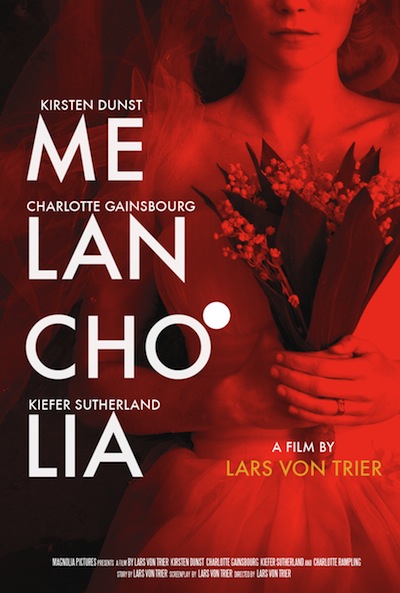
* Melancholia, Kirsten Dunst at the end of the world, courtesy of Lars von Trier.
* The Mill and the Cross, Rutger Hauer stars as Pieter Bruegel preparing his painting The Procession to Calvary in Lech Majewski's deconstruction of the masterpiece.
* Restless, Gus Van Sant's latest attempt to go back to high school. Insert words "emo" and "twee" now.
* The Rum Diary, Bruce Robinson returns to moviemaking for a somewhat disappointing Hunter S. Thompson movie with Johnny Depp.
* The Skin I Live In, the disturbing new horror drama from Pedro Almodovar.
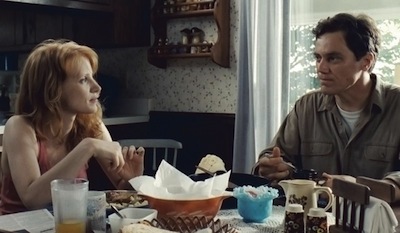
* Take Shelter, the movie where Michael Shannon goes crazy and the world seemingly follows his lead.
ON DVD/BD...
* Bad Teacher: Unrated Edition, a superb cast can't prevent this from being one of the least funny movies you'll see this (or any) year.
* Beats, Rhymes & Life: The Travels of a Tribe Called Quest, the story about the influential rap group is also the best music documentary in a long, long time.
* Bellflower, the cult indie strikes me as empty for all the wrong reasons.
* Bored to Death: The Complete Second Season, the continuing adventures of Jason Schwarztman as the pulpy, humorous avatar of author Jonathan Ames.
* Buster Keaton - Short Films Collection: 1920-1923, 19 comedy gems on three discs.
* Cape Fear, Scorsese's potent remake with Robert De Niro and Nick Nolte.
* Dumbo: The 70th Anniversary Edition, the stellar new upgrade for the little elephant that could.
* Great Italian Directors Collection, a boxed set of three films, including the first by Antonioni, a mid-60s Monicelli, and the anthology film Boccaccio '70.
* His Way, a breezy documentary about music promoter/movie producer Jerry Weintraub.
* I'm a Cyborg, But Thats OK, an inconsistent oddity from Park Chan-wook.
* Miss Nobody, an indie black comedy starring Leslie Bibb.
* My Fair Lady, another Audrey Hepburn movie comes to Blu-Ray. (What is that? Three now? Hurry up, Hollywood!)
* Rare Exports: A Christmas Tale, a black action comedy. The true Santa Claus returns!
* Rescue Me: The Sixth Season and the Last Season, the fire fighter bromance ends.
* Tomorrow is Forever, a post-war snooze with Orson Welles and Claudette Colbert doing their best to be mellow in all the drama.
* True Adolescents, a surprising indie comedy starring Mark Duplass as the cliche 30s rocker on his last legs.
* Water for Elephants, a film even a pachyderm would endeavor to forget.
* The White Bus, a short film written by the recently deceased Shelagh Delaney and directed by Lindsay Anderson.
In the meantime, my non-Criterion movies...

IN THEATRES...
* The Big Year, it's called birding, not birdwatching, and it's awful either way. Wilson, Black, Martin--the new comedy nightmare team.
* The Black Power Mixtape 1967-1975, a documentary showing a certain portion of history through a different lens.
* The Descendants, George Clooney starring in a new film from Alexander Payne.
* The Ides of March, a political drama from he-that-can-do-no-wrong, George Clooney. Starring Ryan Gosling.
* Into the Abyss, Werner Herzog's documentary on the death penalty in Texas. Very human, very scary.
* J. Edgar, Clint Eastwood continues his trend of almost delivering in this biopic with Leonardo DiCaprio as the legendary lawman.
* Like Crazy, love a la modern cinema verite. Starring Anton Yelchin and Felicity Jones.
* Melancholia, Kirsten Dunst at the end of the world, courtesy of Lars von Trier.
* The Mill and the Cross, Rutger Hauer stars as Pieter Bruegel preparing his painting The Procession to Calvary in Lech Majewski's deconstruction of the masterpiece.
* Restless, Gus Van Sant's latest attempt to go back to high school. Insert words "emo" and "twee" now.
* The Rum Diary, Bruce Robinson returns to moviemaking for a somewhat disappointing Hunter S. Thompson movie with Johnny Depp.
* The Skin I Live In, the disturbing new horror drama from Pedro Almodovar.
* Take Shelter, the movie where Michael Shannon goes crazy and the world seemingly follows his lead.

ON DVD/BD...
* Bad Teacher: Unrated Edition, a superb cast can't prevent this from being one of the least funny movies you'll see this (or any) year.
* Beats, Rhymes & Life: The Travels of a Tribe Called Quest, the story about the influential rap group is also the best music documentary in a long, long time.
* Bellflower, the cult indie strikes me as empty for all the wrong reasons.
* Bored to Death: The Complete Second Season, the continuing adventures of Jason Schwarztman as the pulpy, humorous avatar of author Jonathan Ames.
* Buster Keaton - Short Films Collection: 1920-1923, 19 comedy gems on three discs.
* Cape Fear, Scorsese's potent remake with Robert De Niro and Nick Nolte.
* Dumbo: The 70th Anniversary Edition, the stellar new upgrade for the little elephant that could.
* Great Italian Directors Collection, a boxed set of three films, including the first by Antonioni, a mid-60s Monicelli, and the anthology film Boccaccio '70.
* His Way, a breezy documentary about music promoter/movie producer Jerry Weintraub.
* I'm a Cyborg, But Thats OK, an inconsistent oddity from Park Chan-wook.
* Miss Nobody, an indie black comedy starring Leslie Bibb.
* My Fair Lady, another Audrey Hepburn movie comes to Blu-Ray. (What is that? Three now? Hurry up, Hollywood!)
* Rare Exports: A Christmas Tale, a black action comedy. The true Santa Claus returns!
* Rescue Me: The Sixth Season and the Last Season, the fire fighter bromance ends.
* Tomorrow is Forever, a post-war snooze with Orson Welles and Claudette Colbert doing their best to be mellow in all the drama.
* True Adolescents, a surprising indie comedy starring Mark Duplass as the cliche 30s rocker on his last legs.
* Water for Elephants, a film even a pachyderm would endeavor to forget.
* The White Bus, a short film written by the recently deceased Shelagh Delaney and directed by Lindsay Anderson.

Lindsay Anderson directing
Monday, July 11, 2011
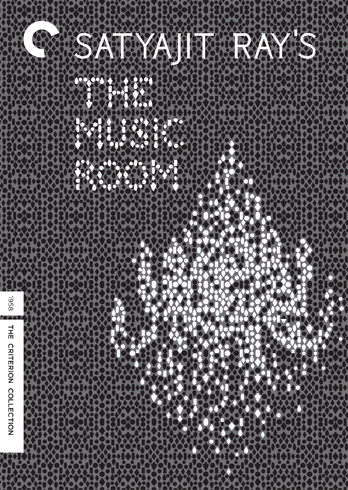
THE MUSIC ROOM (Blu-Ray) - #573

It's too bad Criterion didn't release their edition of Satyajit Ray's The Music Room at the same time they released Wes Anderson's The Darjeeling Limited [review]. Anyone who has spent any time with the more recent movie's soundtrack will instantly recognize the song that opens The Music Room. Indeed, Anderson used lots of cues from older Indian films in Darjeeling, and the way he pays tribute to the melodies of Ray's home country is very much in keeping with the legendary director's own showcasing of Bengali music in his 1958 feature.
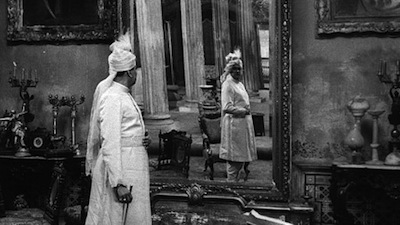
Fitting, too, that The Music Room thematically demonstrates the struggle between old and new, tradition and progress. Popular Indian actor Chhabi Biswas stars as Biswambhar Roy, a local monarch whose bank account has seen better days. Roy is addicted to music. Specifically, he is addicted to his music room, where he lounges with his hookah and hosts listening parties, hocking his wife's jewelry to pay for private recitals from popular acts. The music room is a status symbol, and so Roy's displays of wealth only escalate, especially when his new neighbor starts to offer him competition.
Mahim Ganguli (Gangapada Bose) is the son of a moneylender, and he has entered the family business. He pays a visit to Roy on the day the older man's son is supposed to have his initiation ritual. Roy could actually stand to borrow some money to cover the cost, but he's too proud to ask Mahim for the coinage. Mahim is seen as new money, someone who has to hustle for his purse. He doesn't have the aristocratic blood that the Roy family has. He also likes modern innovations, like electric devices for the home and cars. Biswambhar Roy rides a white horse and dresses up his elephant just to cross the street.

Things change drastically when tragedy strikes the Roy clan and the aging leader is left alone. He refuses to leave his house, and his station in life continues to decline as Mahim's rises. Neither is happy, though, because neither has what he really wants. Mahim is refused respect by the townspeople because of his less-than-noble birth, yet modernity is clearly here to stay and kings are outmoded. Like Burt Lancaster in The Leopard, Biswambhar Roy can see the world changing and moving past him; like Charles Foster Kane
Satyajit Ray works his way patiently through the script, which he wrote based on a short story from Tarasanka Banerji. The Music Room flirts with melodrama--the deaths in the Roy family bring the weightiest emotions; insects show up throughout the film, serving as insidious omens--but Ray restrains himself. The social changes are represented in gesture and decoration. How the two men carry themselves and the way Biswambhar Roy's house starts to fall apart, and even how his servants address him, say enough about how heavy the crisis really is. Even what the two men choose to smoke speaks volumes. Roy uses the hookah, and he calmly inhales his tobacco; Mahim begins by inhaling snuff, but eventually turns to cigarettes, and each says something about who he is and his position on the social ladder. As actors, Biswas and Gupta complement one another. Biswas' performance is more interior, and his reserved posture gives away to physical fragility as the film progresses; meanwhile, Gupta is less mannered and more twitchy, not quite method but almost comedic.
The plot of The Music Room regularly pauses for the musical performances. Ray gives the featured musicians full scenes so they can perform complete songs. In the film's final act, we don't just get music, but dancing as well. It's a special sequence, with Ray using the dance to show the hypnotic power of performance and how music could equalize the two rivals if they would just acknowledge the shared experience. It's ironic, because as much as Roy uses music to bring together his friends, and even though he is clearly moved by the rhythm and melodies, he has long since ceased to give any credence to the way a concert or a popular song can remove personal or even class barriers. Anyone can enjoy a good tune, but I guess only a rich man thinks he can buy it for himself.
The moment to see the error of his ways comes and passes, and the petty victory the fading aristocrat seizes instead does him little good. Honestly, seeing the missed opportunity moved me more as a viewer than the aftermath, which was still powerful despite being more predictable than the material that had preceded it. Then again, there is no other way for The Music Room to end, the march of time must stamp out all that came prior. The old saying "this too shall pass" is meant to be comforting, to suggest that bad times will eventually end, but it applies to all of us as individuals, as well. One day things will change, we'll have aged, and we'll find ourselves on the other side of the line. It may be that the culture has changed simply and quietly and we can carry on or adapt, or it may be the kind of invisible violence that alters the world so drastically, someone like Biswambhar Roy won't survive the metamorphosis. Either way, we too shall pass.

Satyajit Ray
For a complete rundown on the special features, read the full review at DVDTalk.
Labels:
blu-ray,
satyajit ray,
visconti,
welles,
wes anderson
Wednesday, February 23, 2011
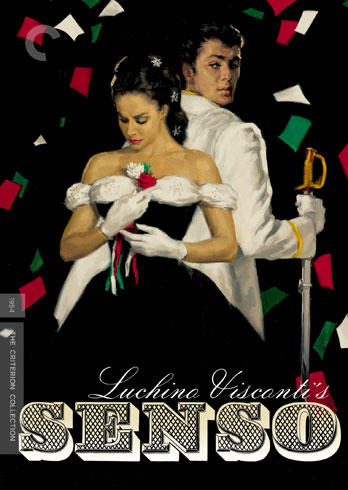
SENSO (Blu-Ray) - #556

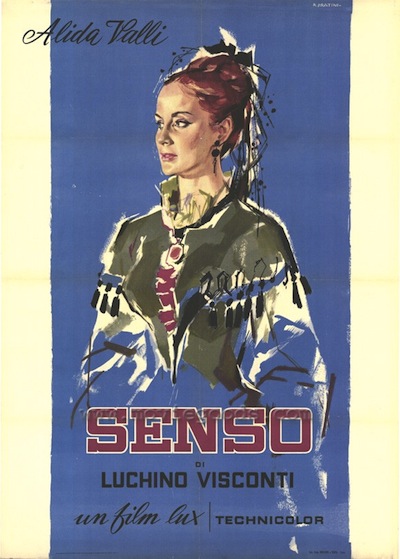
Senso is one of those film's with a history that is nearly as checkered and tragic as any of the melodrama that it depicts onscreen. Released in 1954, Luchino Visconti's colorful tale of love and betrayal in 19th-century Italy was met with scorn by Italian critics who disliked its politics and felt that Visconti had strayed too far from the Neorealist movement he had helped create. Also, despite featuring romantic leads who had previously had success in hit films--Farley Granger in Strangers on a Train
My major exposure to it was through Martin Scorsese, who talked about Visconti at length in his documentary My Voyage to Italy
The title Senso pretty much translates as what it sounds like: "sense." Visconti's film is certainly designed to provoke the senses, particularly sight and hearing, the two fundamental ways in which we enjoy cinema. Senso is a masterfully constructed film, with opulent, expansive sets and a bold soundtrack that, in addition to its own evocative music, opens with a selection from a Verdi opera. These early scenes, set in a Venetian theatre, use the performance as a backdrop for our introduction to the movie's central relationships and conflicts. At the time of the film, Italy was not a whole country, and Venice was under the occupied rule of Austrian forces. When a nationalistic outburst causes an uproar amongst the split crowd, Austrian officer Franz Mahler (Granger) exchanges words with patriotic activist Roberto Ussoni (Massimo Girotti). Their argument ends in the challenge of a duel. When Roberto's cousin, the Countess Livia Serpieri (Valli), attempts to intervene on his behalf, an unlikely relationship between her and the enemy soldier begins to foment.
These happenings are surely operatic unto themselves, but Visconti's staging leaves no question as to the emotional tenor of his cinematic undertaking. There is a trifold effect in these scenes. There is the image of the stage production, with its semi-realistic but clearly fake sets; there is the "reality" in front of it, and the far more convincing illusion of Visconti's vision of Italy; and then there is the audience watching Senso, accepting its reality in the way the fictional characters accept the Verdi, knowing it is a concocted vision and yet choosing to go along regardless. All fiction has some kind of layered structure--a world within a world, objects within an object, be it words in a book (Senso is based on a novella by Camillo Boito) or a series of images captured on a DVD. Visconti wants to remind his audience up front that they are to be witness to a heightened experience. He was a firm believer in melodrama and its power to stoke the passions of the audience consuming it, and this set-up prepares the viewer to take it all in, the way a lavishly illustrated menu prepares them for a fantastic meal.
The duel that Livia fears never happens, though Roberto doesn't escape punishment. His public denouncing of the Austrians gets him a year in exile. Though she is sure that Franz is behind it, Livia is seduced by the man in uniform, and the two begin having an affair. It is interrupted by the onset of war, as Italy pushes to expel the invaders. This places Livia in a difficult position between the love of her country and her romantic feelings for Franz. Seeing him is risky, and she further tempts damnation by helping him find a way to escape the dangers of combat.
The performances by Valli and Granger are interesting. They are as finely mannered and sculpted as the magnificent sets in which they perform. Valli is a handsome woman with a strong physical presence. She carries herself as befitting a lady, but there is an intensity always apparent, smoldering just beneath her good manners and dignity. As Senso progresses, this comes out more and more, and Valli's performance grows more fiery as madness takes over. The word "sense" doesn't just mean the five physical senses, but mental as well. Our "sense," common or otherwise, is also our mind, our wits, and our sanity. Senso is a film about taking leave of one's senses. Farley Granger's performance also blossoms as the story grows more hysterical. Franz, too, has been holding back, but in a more dishonest manner than Livia's sense of propriety. As he reveals who he truly is, his wickedness borders on dementia.
Much of Senso takes places indoors, in high-ceilinged mansions full of amazing art and fancy furniture. These are fulsome settings for the selfish rendezvous of these ill-fated lovers to play out. In these confined spaces, they are alone and separate from the troubles of the world. Visconti contrasts these with the open battlefields, of a free Italy crying out for liberty with only the sky hanging over their heads. Likewise, in the early scenes, when Franz is courting Livia, the bridges and back alleys of Venice almost seem like something out of a fairy tale (not unlike the use of the city in Visconti's wonderful romantic 1957 film Le notti bianche); as things unravel, the city looks ashen and burdened by darkness. Design and color matter in Visconti's cinema; how everything looks is of equal importance to what is happening. Image is feeling, and there is a whole of feeling going on.

Criterion's much-anticipated Blu-Ray release of Seno presents a hi-def full frame version of the restored Film Foundation/Cineteca di Bologna copy of the 1954 film. The image quality is phenomenal, with rich, sumptuous Technicolor and a clean surface image. Detail is excellently tuned, and there is an overall warm, painterly glow to the look of the film. This is a movie that can be stared at without any concern for story or dialogue, its photography is an art object unto itself, and this digital release makes sure we get a glimpse of as much of each and every frame as possible. Keep an eye on background details, particularly in the last act of the film when Livia is back in Venice. Note how the walls and the objects on them appear. Compare the interior of Franz's hideout and all the decorations and the softer, though dilapidated textures, next to the altogether stark, pockmarked exterior wall that Livia walks along in despair--the level of texture in both is fantastic, though vastly different.
Criterion has also included the alternate English-language version--with its more suggestive title The Wanton Countess--and though its picture is surprisingly good considering what a little-seen artifact it is, you can see a big difference between it and the more comprehensive clean-up on its main counterpart. Presented in its entirety (though a good half hour shorter than the Italian version) and in full high-definition, it is interesting to peek in on, but not essential viewing. The big sell on this version is the actors are not dubbed over in Italian and you get a more accurate representation of what is presumed to be the contributions of Williams and Bowles.

Luchino Visconti
Once it's all put together, the Senso - Criterion Collection Blu-Ray is another outstanding release in the company's ever expanding film library. The 1954 film from Luchino Visconti is a visually exciting melodrama of love and compromise. Set in the mid-1800s in Italy, it stars Farley Granger and Alida Valli as a soldier and a society woman from different sides of the same war who find love where they shouldn't and ultimately pay the price. With its full-bore picture restoration and packing the disc full of substantial bonus features, this release of Senso is high-brow home viewing at its finest.

For a complete rundown on the special features, read the full review at DVDTalk.
Labels:
blu-ray,
scorsese,
tennessee williams,
visconti
Tuesday, March 31, 2009
SIDELINE: MORE REVIEWS FOR 03/09
IN THEATRES...
* Che--less a full review, more of a brief recount of the experience and the day, including meeting Steven Soderberg.
* The Great Buck Howard loses a bravura John Malkovich performance in an overly genial script.
* I Love You, Man, a gut-busting bromance with stand-out performances by Jason Segel and Paul Rudd.
* Watchmen--as in, man, are you going to be looking at your watch. A lot.
ON DVD...
* Elegy, the recent Philip Roth adaptation with Sir Ben Kingsley and Penelope Cruz.
* Max Fleischer's Gulliver's Travels, the classic cartoon gets a fishy remastering.
* L'Innocente, the final film of Luchino Visconti is a steamy winner.
* The Kaiser's Lackey, a 1950s East German satire that has lost some of its bite over the years, thought it still retains its artistic vigor.
* Paul Newman X 2: The Helen Morgan Story, a fairly average biopic about a doomed singer, and The Outrage, Martin Ritt's perplexing remake of Rashomon.
* The Robe, the overwrought, overripe religious picture is only really notable for being the first studio production released in Cinemascope.
* The Romance of Astrea & Celadon, an Eric Rohmer period piece that gets stuck up its own class.
* The Scarlett Johansson Collection, collecting three more indie-minded movies featuring the actress.
* Yentl, the Babra Streisand musical is a real eye-opener.
* Che--less a full review, more of a brief recount of the experience and the day, including meeting Steven Soderberg.
* The Great Buck Howard loses a bravura John Malkovich performance in an overly genial script.
* I Love You, Man, a gut-busting bromance with stand-out performances by Jason Segel and Paul Rudd.
* Watchmen--as in, man, are you going to be looking at your watch. A lot.
ON DVD...
* Elegy, the recent Philip Roth adaptation with Sir Ben Kingsley and Penelope Cruz.
* Max Fleischer's Gulliver's Travels, the classic cartoon gets a fishy remastering.
* L'Innocente, the final film of Luchino Visconti is a steamy winner.
* The Kaiser's Lackey, a 1950s East German satire that has lost some of its bite over the years, thought it still retains its artistic vigor.
* Paul Newman X 2: The Helen Morgan Story, a fairly average biopic about a doomed singer, and The Outrage, Martin Ritt's perplexing remake of Rashomon.
* The Robe, the overwrought, overripe religious picture is only really notable for being the first studio production released in Cinemascope.
* The Romance of Astrea & Celadon, an Eric Rohmer period piece that gets stuck up its own class.
* The Scarlett Johansson Collection, collecting three more indie-minded movies featuring the actress.
* Yentl, the Babra Streisand musical is a real eye-opener.
Labels:
martin ritt,
other reviews,
rohmer,
soderbergh,
visconti
Friday, October 31, 2008
SIDELINE: MORE REVIEWS FOR 10/08
Halloween is here, and I hit my goal for one horror movie a week for October. Go me!
In addition to those reviews, here are some other movies I was able to scare up reviews for in the past month:
IN THEATRES...
* Ashes of Time Redux, the restoration of Wong Kar-Wai's martial artist stunner. I was very excited to see this, as you will likely read!
* Blindness, a take on the post-apocalyptic genre where a disease strikes people like Mark Ruffalo and Gael Garcia Bernal blind, while leaving Julianne Moore with her sight so she can be Queen. I'm still torn on this film, and was almost going to rate it at "Rent It" right up until posting time. I am still struggling with whether or not its doldrums overpower the good bits or vice versa.
* Happy-Go-Lucky, the new Mike Leigh dramedy with a stellar performance from Sally Hawkins as the eternal clown.
* Let the Right One In, a Swedish vampire film that really gives the genre a whole new lease on its undead life.
* Rachel Getting Married, Jonathan Demme's unbalanced movie about family nearly stifles great turns from Anne Hathaway and Rosemarie DeWitt as sisters trying to deal with their past as they move into the future.
* W., Oliver Stone's perplexing biopic of George W. Bush.
* What Just Happened, a Hollywood tell-all that tells nothing, despite some good work from Robert DeNiro. Based on a book by Art Linson, the story has been defanged beyond recognition.
ON DVD...
* Chaplin: 15th Anniversary Edition, the flawed biopic stays memorable thanks to Robert Downey, Jr.
* Flight of the Red Balloon, wherein one of my favorite contemporary filmmakers, Hou Hsiao Hsien, pays tribute to one of my favorite children's films.
* Ludwig, the gigantic Luchino Visconti biography of the mad king of Bavaria. This took a while to get through, which is why I slowed down some. (Plus, I have some big sets I am starting, too.)
* Mondays in the Sun, a Javier Bardem vehicle about men struggling with unemployment in Spain. A surprisingly meaningful drama with good characters and a balance of humor.
* The Picture of Dorian Gray, the chilled 1940s adaptation of the Oscar Wilde classic. Directed by Albert Lewin.
* Six in Paris, an anthology of French New Wave directors tackling different neighborhoods in the City of Light. Produced by Barbet Schroeder, and featuring segments by Rohmer, Chabrol, and Godard.
* Touch of Evil: 50th Anniversary Edition, a two-disc examination of Orson Welles' troubled noir classic.
* The Unforeseen, a dreamy, soulful documentary about urban sprawl and its effect on Austin, Texas. Co-produced by Robert Redford and Terrence Malick.
* Warner Home Video Western Classics Collection, collecting six cowboy movies from the Warner Bros. vaults, only two of which--the Rod Serling-penned Saddle the Wind and the Gregory Peck-vehicle The Stalking Moon--are really worth it. Also features Anthony Mann's Cimarron, William Holden in Escape from Fort Bravo, and Richard Widmark as another charismatic bad guy in The Law & Jake Wade.
In addition to those reviews, here are some other movies I was able to scare up reviews for in the past month:
IN THEATRES...
* Ashes of Time Redux, the restoration of Wong Kar-Wai's martial artist stunner. I was very excited to see this, as you will likely read!
* Blindness, a take on the post-apocalyptic genre where a disease strikes people like Mark Ruffalo and Gael Garcia Bernal blind, while leaving Julianne Moore with her sight so she can be Queen. I'm still torn on this film, and was almost going to rate it at "Rent It" right up until posting time. I am still struggling with whether or not its doldrums overpower the good bits or vice versa.
* Happy-Go-Lucky, the new Mike Leigh dramedy with a stellar performance from Sally Hawkins as the eternal clown.
* Let the Right One In, a Swedish vampire film that really gives the genre a whole new lease on its undead life.
* Rachel Getting Married, Jonathan Demme's unbalanced movie about family nearly stifles great turns from Anne Hathaway and Rosemarie DeWitt as sisters trying to deal with their past as they move into the future.
* W., Oliver Stone's perplexing biopic of George W. Bush.
* What Just Happened, a Hollywood tell-all that tells nothing, despite some good work from Robert DeNiro. Based on a book by Art Linson, the story has been defanged beyond recognition.
ON DVD...
* Chaplin: 15th Anniversary Edition, the flawed biopic stays memorable thanks to Robert Downey, Jr.
* Flight of the Red Balloon, wherein one of my favorite contemporary filmmakers, Hou Hsiao Hsien, pays tribute to one of my favorite children's films.
* Ludwig, the gigantic Luchino Visconti biography of the mad king of Bavaria. This took a while to get through, which is why I slowed down some. (Plus, I have some big sets I am starting, too.)
* Mondays in the Sun, a Javier Bardem vehicle about men struggling with unemployment in Spain. A surprisingly meaningful drama with good characters and a balance of humor.
* The Picture of Dorian Gray, the chilled 1940s adaptation of the Oscar Wilde classic. Directed by Albert Lewin.
* Six in Paris, an anthology of French New Wave directors tackling different neighborhoods in the City of Light. Produced by Barbet Schroeder, and featuring segments by Rohmer, Chabrol, and Godard.
* Touch of Evil: 50th Anniversary Edition, a two-disc examination of Orson Welles' troubled noir classic.
* The Unforeseen, a dreamy, soulful documentary about urban sprawl and its effect on Austin, Texas. Co-produced by Robert Redford and Terrence Malick.
* Warner Home Video Western Classics Collection, collecting six cowboy movies from the Warner Bros. vaults, only two of which--the Rod Serling-penned Saddle the Wind and the Gregory Peck-vehicle The Stalking Moon--are really worth it. Also features Anthony Mann's Cimarron, William Holden in Escape from Fort Bravo, and Richard Widmark as another charismatic bad guy in The Law & Jake Wade.
Subscribe to:
Posts (Atom)