Showing posts with label david gordon green. Show all posts

Thursday, January 20, 2022

BRIGHT STAR - CRITERION CHANNEL

 This review was originally written for DVDTalk.com in 2009.


As a moody, death-obsessed writer whose genius has yet to be recognized, Jane Campion's portrayal of poet John Keats in her new film Bright Star hit a little too close to home. Depressed, misunderstood, doomed romance--hey, John, I can identify. Just tell me how I can be lucky enough to get tuberculosis, and I'll follow you all the way down. Damn my parents and their stupid vaccinations!*


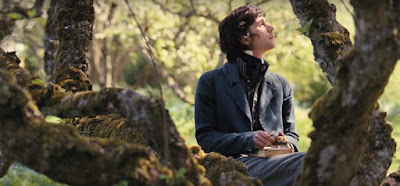
Bright Star isn't an all-encompassing biopic of the Romantic poet, but rather, it follows Keats over a couple of specific years, beginning in 1818 when the young writer met the love of his life and the tragic turn that soon followed. Keats is played by Ben Whishaw, who portrayed the antagonistic, on-trial version of Bob Dylan in Todd Haynes' I'm Not There (he was the one in black-and-white who wasn't Cate Blanchett) [review]. He's getting pretty good at this broody poet thing. Alternately cocky, self-loathing, and frightfully charismatic, he makes Keats a dark and dreamy apparition. Thus, it's no wonder that the pretty young seamstress, Fanny Brawne (Abbie Cornish, Elizabeth: The Golden Years [review]), is attracted to him, despite having no understanding of poetry and thinking that wit and smooth moves on the dancefloor are the two best traits in a man. Opposites do attract, though, and both the poet and the girl have an intensity to their personalities that somehow makes them a perfect match.


Not that everyone would agree. Socially, John Keats is a pauper. His books don't sell, and he has no viable prospects, so as a candidate for marriage, he doesn't lead the pack. He's also friends with another poet, Charles Armitage Brown (Paul Schneider, All the Real Girls and TV's Parks and Recreation), a crank who is protective of Keats' talent and also distrustful of women, especially girls he sees as flirty and frivolous. Fanny fits this category as far as he is concerned, and the two spare no opportunity to express their disdain for one another. Ironically, Charles is probably more along the lines of what Fanny expects of a male suitor, even if his humor is much darker and pointed than she would like. Paul Schneider, whose previously been best known for his David Gordon Green collaborations, gives the best performance of his career as the sardonic poet. I've never seen him so comfortable in his own skin and so at ease with his lines. His previous performances often relied on a quirky naturalism that is all but gone here, replaced by a more forceful presence. Some of the film's strongest scenes come as Brown is revealed to lack the moral purity that was so valued by the Romantics. He is not John Keats, and he knows it, and he can live with it as long as no one else points it out.
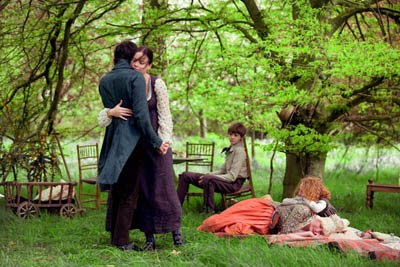


Campion, who also wrote the screenplay for Bright Star, establishes a fascinating social order in the movie. No one here is entirely well off, and though they are members of polite society, there is some funds-stretching going on. One trick is apparently moving house a lot, following the changing seasons in search of cheaper lodgings. This puts the Brawne family--Fanny's widowed mother and her two siblings--in the other half of the house where Charles Brown is renting and where he lets Keats stay for free. Being in such close proximity, the romance between the poet and his new muse, which previously has consisted largely of poetry lessons, misunderstandings, and a gentle touching of hands, can take full bloom. Soon it's kissing in the forest and touching the wall that separates their beds night after night, feeling the heat of love pass between. Fanny becomes entirely wrapped up in Keats, which can feel just as bad as it may feel good since he is prone to mood swings. If he writes a line about butterflies in a love letter, Fanny catches every butterfly she can and creates an oasis for them in her bedroom; when he selfishly ignores her, she demonstrates her ineptness at suicide. Abbie Cornish is very good as Fanny. The actress understands the melodrama of adolescent angst, and she manages to make it real without overdoing it. Her most enthralling moments, however, are when she lets herself be an empty vessel silently letting Keats fill her up.


There's something refreshing about seeing a romantic relationship on film that doesn't involve sex. It's not that Campion isn't comfortable with it--she did direct In the Cut, after all--it's that she is aware here, as she was in The Piano [review], that the greatest passion often lies somewhere beyond physical expression. Though there is no crossing over to the other side the way the characters did in The Piano, Bright Star is more intensely realized for it. Why not a love affair that involves reciting poetry and quickly stolen glances? Brown encourages Keats to bed the girl and get it over with, hoping it will cure his friend of his crush, but Keats won't even consider it. Perhaps he sees the consequences Brown fails to consider when he knocks up the maid, but I doubt it's anything as crass as all that. Poetically, to take their relationship further would spoil it. Campion sees Keats' life as one of extremes: the butterflies and the punctured veins, dazzling beauty and dark lows. She and cinematographer Greig Fraser capture both sides beautifully. They infuse the warm summer with color and light, and yet they shoot the snow of the chilled winters with as much clarity, letting each flake stand out under a dark sky. At the same time, there is a softness to everything, as if a very thin veil of muslin had been placed over the camera lens. This faint yet ever-present whiff of grey reminds us that there is a sadness that can't be escaped in this story. Bright Star is young love on a deadline.


John Keats' death at 25 is well known. He contracted tuberculosis, which also took his brother from him not long after he and Fanny Brawne had met. Keats foreshadows this regularly by talking about his own death even when he is healthy, something Campion never portrays as ironic or dramatic, but something Keats firmly believed. Any biopic that ends in such a way is always faced with the challenge of overcoming the audience's knowledge of the inevitable, and the fact that Bright Star doesn't worry about getting around that is both one of its greatest strengths but also its only weakness. The movie does drag a little at the tail end when the closeness of death is more obvious. Perhaps had Campion not let Whishaw be so earnest in his doom and gloom we might not feel it as heavily--which could have been a bad choice all on its own. As it stands, it's a small point, and the benefits of that choice far outweigh any of the failings.
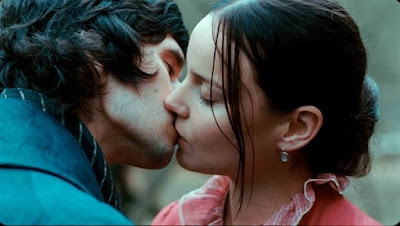


When it comes down to it, Bright Star works because it inspires the viewer to take part in the tenderness and the sorrow. In explaining poetry to Fanny, John Keats likens the act of reading to jumping in a lake. You don't dive into the water just to do so, to go under and then get out; you jump in to experience the water, to be in it. So, too, must one linger on a poem, spending time within it, experiencing its language and images and not just reading it line by line. The same could be said of a biopic, that a good one lets you walk a mile or two in its subjects cinematic shoes. Jane Campion achieves just that with Bright Star, making us part of Fanny and John's world for two hours. To watch it is not to stand at a distance, but to step right into the middle of it and feel it all.


* 2022 Update: Jokes! I am totally pro-vaccines.

Saturday, October 27, 2018

NIGHT OF THE LIVING DEAD - #909


What’s there to say about Night of the Living Dead that hasn’t been said a million times? The seminal horror indie has been one of the most influential genre pictures of movie history, dissected by critics for the last 50 years, explored from every angle, praised for its technique, innovation, and deeper political subtext. There have even been full-length documentaries made about the production, including 2015’s Birth of the Living Dead [review], which featured Romero himself. And, of course, scores of sequels, remakes, and imitators.

Give Night of the Living Dead a spin and it’s easy to see why the hullabaloo persists. Made on a shoestring budget in the late 1960s, it’s a clever pressure cooker of a zombie film. Most of its running time takes place in a single house, as would-be survivors of an undead apocalypse hole up in hopes of some kind of rescue. It starts with two, Ben (Duane Jones), an African American man, and Barbra (Judith O’Dea), a white woman gone nearly catatonic after seeing her brother attacked before barely escaping herself. They are soon joined by a young couple and a family of three who were hiding in the basement. While the night draws on, arguments ensue about how best to get out alive, as radio and television reports present an increasingly bleak picture of the spreading doom.


It’s not hard to see the political metaphors when you’re looking for them. The optics of a black man and a blonde woman facing an onslaught of mostly white men hell-bent on destroying them are sadly as relevant in 2018 as they were in 1968. It’s also hard to ignore how when the older white man (Karl Hardman, looking like an early demo of Rob Corddry) arrives on the scene, he immediately tries to take charge, barking orders without considering any alternative point of view. When his wife (Marilyn Eastman) points out how important it is for him “to be right, everyone else to be wrong,” you can feel the pent-up frustration, born of years of listening to him blather on. Tellingly, when it’s time to decide whether to stick with her husband or listen to Ben, the wife is paralyzed with doubt. It’s hard to break a pattern.


Romero is employing a classic technique here. Plenty of low-budget character studies used a confined space to (a) save on location costs and (b) trap their subjects together so they can’t escape one another. See, for instance, Hitchcock’s Lifeboat [review] or countless Twilight Zone episodes. The one I most think of is “The Shelter,” where one family with a bomb shelter has to fend off their neighbors, who scoffed at the notion of such a thing but are now desperate to get in when there is threat of a nuclear attack. When examining Night of the Living Dead, we can talk race or gender, or we can also just study the personalities as the drive for self-preservation overtakes any desire to help one’s fellow man. Is it that different when the living people inside the house start tearing each other apart verbally than when the zombies outside literally feast on the flesh of the fallen?


One has to give Romero credit for pushing the boundaries in that particular scene. The stone-faced actors chewing on a turkey leg or playing with fake entrails paint a pretty grisly picture of a society that has broken down. Though it comes only midway through Night of the Living Dead, it’s really the beginning of the end. It’s when the hordes taste victory and get the strength to carry on, and the last vestiges of civilization fall.

But Romero really saves the best for last. The most unsettling moments in Night of the Living Dead come at the very end, when we learn the fate of Ben. If there is any remaining resistance to the political reading of the movie, that should all vanish here. Romero chooses to show these last shots as a montage of grainy stills, resembling news footage, focusing as much on the uncaring, self-satisfied faces of Ben’s unwitting attackers--who think they are doing the right thing--as much as the sad outcome of their actions. Anyone seeing Night of the Living Dead on initial release would have, unfortunately, found images like these far too familiar, far too similar to what they had been seeing in newspapers throughout the Civil Rights Movement. And the power to provoke has not dulled. (Spike Lee made a similar move, pulling in current events to upend his own entertainment in this summer’s BlacKkKlansman.)


This is what good horror can do: create a commentary on the times, delivering uncomfortable truths in the guise of seemingly unthinkable, frightening events. There’s a reason that the genre thrives when the real world is going through tumultuous times. A good scary movie can make us reflect on the current situation in ways that are obvious (the analogues for the Reagans in Wes Craven’s The People Under the Stairs) or subtle (the triumphant #metoo parable of David Gordon Green’s recent Halloween sequel, the stifled voices of good people in John Krasinski’s A Quiet Place). For most of Night of the Living Dead, George A. Romero goes for the subtle, saving up that sucker punch for when it really counts.


Monday, May 28, 2018

SELECTED SHORTS III - CRITERION CHANNEL

The Criterion Channel, in addition to hosting a plethora of feature films, also has a varied collection of short films--live action, animated, fiction, documentary; comedy and drama; silent and talkies.

Short cinema--just like short stories--is a unique art form unto itself, employing different conventions, and bringing with it different expectations, but these pieces are no less worthy of consideration than full-length films. From time to time, I will take a look at a selection of what’s on offer. You can read the previous columns here and here.


Neighbours (1952; Canada; 8 minutes): Two men with adjoining homes find their friendship disrupted by a flower growing on their property line. They argue, build fences, and try to take possession of the plant until the whole thing overwhelms them. Told without dialogue, and shot using stop-motion techniques, Neighbours is a whimsical, surreal parable. Director Norman McLaren was a wizard with the camera, and he says more about human greed and the futility of war in this abstract handful of minutes than many say with a full script and an extended running time.


Casus Belli (2010; Greece; 11 minutes): A clever construct. Director Yorgos Zois strings people together queue by queue, showing groups standing in line for groceries, a nightclub, confession, off-track betting, an art museum, and an ATM. We scroll past each gathering, and the first person in the line steps out of it and moves over to the next. Unfortunately, when Zois gets to his point, the turn is rather heavy handed, ending at a bread line and featuring an actor giving a disdainful look to the camera when the charity comes up short. I get the idea is to switch from the frivolous to the serious, but it’s a pretty obvious move and Casus Belli is less effective for it.


Skunk (2014; USA; 17 minutes): Writer and director Annie Silverstein creates an uncomfortable, but strangely comforting short tale of adolescence. When a Texas teen (Jenivieve Nugent) takes her dog down to the river to give him a bath after he ended up on the wrong end of a skunk, she meets an opportunistic boy (Sam Stinson) who toys with her emotions, promising her all kinds of things if she’ll hook up with him and let him use her pooch in a dogfight.

Stories like this come with a built-in tension, as we have seem the likes of this boy before, and we know his brand of interference rarely bodes well. One watches Skunk with a knot of worry. Just how bad will this go for Leila? Silverstein approaches the events with an unwavering honesty, she is not exploitative. While Criterion has smartly paired this with Andrea Arnold’s Fish Tank [review], I’m perhaps reminded more of David Gordon Green’s George Washington [review]. What all three directors have in common is an empathy for their characters; their storytelling is observational, they never look down their noses at their protagonists, but rather try to put themselves into the situation to see where they come from.


The Acquaintances of a Lonely John (2008; USA; 12 minutes): A solo outing from Benny Safdie (one half of the team behind Good Time), this short follows one guy on his daily meanderings. Aimless by design, one I suppose should be prepared to forgive a lot, but only a few of the scenarios are charming. Likely Safdie--who also plays the titular John--is making best use of what he had available; the film mostly loses its way when it settles down at a gas station for some Clerks style antics. Ironically, The Acquaintances of a Lonely John is actually best when Safdie is alone and simply amusing himself.


John’s Gone (2010; USA; 22 minutes): Josh and Ben Safdie directing together, with Ben starring as John--perhaps the same John from Benny’s earlier effort, hard to say. The tone is similar to The Acquaintances of a Lonely John: a touch of comedy, a loose plot, episodic. Here John is hustling various goods out of his apartment, selling second-hand junk and pulling internet scams. The film itself puts focus on the strange customers, and John’s interactions with other people in his apartment building. He’s a guy who seems to try to have a hand in everything, and sometimes it gets him in trouble. Many narrative opportunities are missed here. The Safdies could go in deep on any number of the relationships, or even hold John’s feet to the fire when a one-night stand he was rude to comes back, but John’s Gone always stays on the superficial. Ultimately, there is no ending here, no conclusion to be drawn, the movie just fades out.


The Black Case (2014; Canada; 13 minutes): A mysterious, surreal drama with elements of horror, The Black Case causes the audience to question the nature of identity, voyeurism, and in a way, one’s own physicality. Set in a strange hospital scenario, we see two children locked away and the doctor and nurse that are meant to care for them. Just about everything isn’t what it seems, and though co-directors Caroline Monnet and Daniel Watchorn eschew all exposition--and hell, dialogue for the most part--they don’t obfuscate for the mere sake of it. Like Eraserhead but with one foot still in reality.


L’opera-mouffe (1958; France; 16 minutes): Also known as Diary of a Pregnant Woman, this black-and-white short from Agnès Varda, who was indeed pregnant at the time of the making and serves as her own model at the start of the picture, is more of a collage of the life cycle of a small French village than it is a look at the cycle of pregnancy. Set to a score by the great Georges Delerue (Jules et Jim), Varda details many aspects of existence, from sex and food to drunkenness and anxiety. The bits that do touch on the birth process tend to be more abstracted, including the surreal growth and eventual hatching of a chicken from a glass bowl. The result is whimsical and strange, but also kind of sobering. Also, a greater collection of real faces you aren’t likely to find in any cinematic era.

(This film is also available on the DVD of Cléo from 5 to 7.)


The Burden (2017; Sweden; 14 minutes): Another surreal musical, this time by director Niki Lindroth von Bahr, whose Tord and Tord I covered back in the first installment of this column.
Created via stop-motion animation, The Burden features fish in a motel, mice working in fast food, telemarketing monkeys, and a lone canine shopping in a mega-mart. In each scenario, the lonely animals are searching for some kind of connection and eventual release in an increasingly convenient world (or should that be “convenient” in quotes?).

Charming, unpredictable, and surprisingly joyous.


Sunday, March 25, 2018

BAAL - #914


Made for German television in 1970, Volker Schlöndorff’s adaptation of Bertolt Brecht’s Baal transports the 1918 play to (then) modern day, providing filmmaking wunderkind Rainer Werner Fassbinder with an impressive showcase for his acting skills, but ultimately failing in making the work feel vital to the times. In fact, Brecht’s widow was so unhappy with it, the family estate placed a ban on the release that was not lifted until four decades later.

Baal is the story of a larger-than-life personality--a bisexual, alcoholic poet--equal parts Byron, Kerouac, and Bukowski. Fassbinder plays the bard with a full-force gusto. Baal is besotted with drink and with his own self-worth, resorting to reciting his rhymes rather than engage with others, preferring squalor to success and society. Indeed, the film’s second scene--each individual sequences is announced by numbered title cards, lending a kind of nouvelle vague tenor to the whole montage--is probably its most interesting. Decked out in a suit and tie, Baal is being hosted by a rich benefactor willing to publish his poems. Surrounded by upper crust intellectuals, Baal tweaks their noses rather than get along. He drinks too much, stuffs his face, insults them, and openly hits on the rich man’s wife (Miriam Spoerri). It’s a bit like watching the charity banquet scene in Ruben Östlund’s The Square--an animal has been let loose in the soiree. Baal’s response to their objections? You shouldn’t have invited me in if you didn’t expect me to be myself.


Which pretty much sums up how Baal conducts himself throughout the story. Anyone who enters into his orbit should expect to be brought down by his gravitational pull. At first, this is compelling in the way that the behavior of scoundrels can often be; across subsequent scenes, Baal publicly humiliates the rich man’s wife, steals the girlfriend of a loyal friend, deflowers her, and then shames her into suicide. The dude is bad news. But as Baal progresses, and we watch the main character wander from bottle to bottle, shivving anyone who stands in between, he starts to be less interesting. To Fassbinder’s credit, he never hits a false note, and the hatred he engenders in the viewer is real, but he and Schlöndorff fail to give us any nuance to the character. His philosophy never shines nor sticks. Brecht appears to provide moments where we might get glimpses of an actual soul beneath the rough exterior, but the filmmakers don’t seize on them.


That said, Baal arrives with a surprising punk rock aesthetic that has less in common with either the French New Wave and Easy Rider Hollywood than it does with the anarchic back-half of the 1970s. From the opening scenes, when a leather-jacketed Baal strolls to the beat of a song celebrating his godlike status, there is a feeling that something gutsy is occurring. Cinematographer Dietrich Lohmann, who would work with Fassbinder on many of his own films like Love is Colder Than Death, has a gritty spontaneity to his shooting. His camera never feels locked down, and so Baal comes over as improvisational as the life of its subject. That keeps the movie interesting even when the screenplay lacks heft.

Side note, but when Baal and his cohort Ekart (Sigi Graue, The Merchant of Four Seasons) hit the road in the German backwoods, was anyone else reminded of David Gordon Green’s Prince Avalanche? Knowing Green’s tastes, it would not surprise me if Baal was somehow an influence.


This disc provided by the Criterion Collection for purposes of review.


Saturday, March 31, 2012

SIDELINE: MORE REVIEWS FOR 3/12

A round-up of the non-Criterion movies I saw in March, 2012.


The Hunger Games art by Ross Campbell


IN THEATRES...

* The Conquest, a biopic of French President Nicolas Sarkozy. The satirized starts to become the seducer...

* Friend with Kids, a truly adult "no strings attached" comedy with an exceptional cast.

* The Hunger Games, odds are I sorta kind love this movie. A smart adaptation of the books makes for one pleasing blockbuster.

* Jeff, Who Lives at Home, a preciously magical comedy. Or magically precious. I can't remember which. Either way, it's very good.

* John Carter, a mixed bag of sci-fi action and deathly dull exposition.


ON DVD/BD...

* Conversation Piece, the elegant penultimate film from Luchino Visconti.

* The Double Hour, this recent Italian thriller is a must-see. The debut of director Giuseppe Capotondi, and starring Filippo Timi

* Downton Abbey: Season 2, or Gosford Park Goes to War.

* Everyday Sunshine: The Story of Fishbone, an in-depth documentary on the seminal Los Angeles rock band

* Looney Tunes Super Stars: Pepé le Pew, I should have reviewed this as if it were a tragedy, not a comedy.

* Public Image Limited - Live at Rockpalast 1983, a classic live concert from Lydon & Co.

* The Sitter, the latest in the decline of David Gordon Green. A tepid comedy starring Jonah Hill.

* This is Not a Movie: Three Edward Furlongs, one bad script. 

* Tyrannosaur, a brutal social drama about the cycle of violence from British actor Paddy Considine

* La Visita (The Vistor), a bittersweet 1960s romantic comedy starring 8 1/2's Sandra Milo


Saturday, April 30, 2011

SIDELINE: MORE REVIEWS FOR 4/11

A round-up of my reviews for non-Criterion movies in the past month.


IN THEATRES...

* The Conspirator, Robert Redford has some questions about Lincoln's assassination. Asked and answered!

* Hanna, the feisty action picture starring a young female lead to see right now.

* Meek's Cutoff, Michelle Williams and fellow pioneers get lost on the Oregon Trail. So lost, they end up someplace where it's not even raining. Directed by Kelly Reichardt.

* Miral, Julian Schnabel's fascinating yet muddled look at the history of a string of Palestinian women in Israel in the latter half of the 20th Century. Starring Freida Pinto.

* Stake Land, a derivative but totally entertaining vampire-killing road trip.

* Super, in which James Gunn takes on the whole "real world crimefighter" thing, and his hero gets upstaged by a little girl.

* Uncle Boonmee Who Can Recall His Past Lives, Apichatpong Weerase-thakul's divisive meditation on death, folklore, and horny fish.

* Your Highness: Oooh! Oooh! I got one. "Puff, puff, pass--emphasis on the pass."

In addition to my regular movie reviews, check out my contribution to the Portland Mercury, in which I pick a few movies to go along with the a recent week-long booking of Full Metal Jacket. (Longer reviews of two of the movies mentioned: The Strange One and Paths of Glory.)


ON DVD/BD...

* A.I. Artificial Intelligence, Spielberg meets Kubrick, and the results are stunning.

* Arabeseque, Stanley Donen tries to recapture the magic of his previous success and fails. With Gregory Peck and Sophia Loren.

* The Incredibles, Pixar's killer superhero adventure gets the Blu-Ray treatment.

* Ingrid Bergman in Sweden, three films from the homeland, before the iconic actress went to Hollywood.

* Leaving, an absolutely ordinary, and thus boring, infidelity drama with Kristin Scott Thomas.

* No One Knows About Persian Cats, noble in its ambitions, not quite as successful in its final execution, a rock 'n' roll movie from Iran and Bahman Ghobadi.

* The Paranoids, a quirky dramedy from Argentina. An intriguing character study made all the better by its awesome lead actor.

* The Perfume of the Lady in Black, a chilly, pretty entry in the "blonde woman goes mad" genre of psychological horror. From 1974.

* Ricky, Francois Ozon's version of a family movie. Those crazy French! (Also, check out my capsule review of his most recent film, Potiche.)

* The Scent of Green Papaya, the perennial art house film from the early '90s is gorgeous on Blu-Ray. A romantic cinematic poem.

* Summer in Genoa, a movie from Michael Winterbottom, starring Colin Firth as a widower father trying to lead his family back to normalcy.

* The Vanquished, an early triptych by Michelangelo Antonioni.

Tuesday, June 30, 2009

SIDELINE: MORE REVIEWS FOR 06/09

IN THEATRES...

* Away We Go, the Sam Mendes-helmed comedy with John Krasinski and Maya Rudolph is mostly good, but the literary pretensions of authors Dave Eggers and Vendela Vida sometimes get in the way.

* Chéri, the lacklustre reteaming of Stephen Frears, Christopher Hampton, and Michelle Pfeiffer.

* Easy Virtue, Colin Firth rises high in this Noel Coward adaptation, but other problems get in the way of this simple pleasure.

* Food, Inc., an illuminating look at how food became big business and what's wrong with that development.

* The Hangover, a good, raunchy comedy made all the better by Ed Helms and Zach Galifianakis.

* O' Horten, a quietly involving portrait of a changing life from Norwegian director Bent Hamer.

* Year One, Jack Black and Michael Cera starring in the worst movie of the year so far. Avoid at all costs.

Also, keep your eye out for more reviews of summer movies that are already in limited release. I should be posting my thoughts on the Oscar-winning Japanese film Departures, Moon, and Woody Allen's Whatever Works to DVDTalk.com this Thursday.


ON DVD...

* Au Bonheur des Dames, Julien Duvivier's 1930 silent adaptation of Emile Zola is visually stunning but a little weak in the end.

* Brief Encounter (1974), a BBC remake with Richard Burton and Sophia Loren that holds its own against the older David Lean version.

* Diary of a Suicide, a lost French film from the early 1970s that was better off not found. With Delphine Seyrig and Sami Frey.

* Eastbound & Down - The Complete First Season, the latest release from HBO's TV division is the perfect vehicle for comedian Danny McBride. Dirty, mean-spirited fun! Includes three episodes directed by David Gordon Green.

* Harlan Ellison: Dreams With Sharp Teeth, an electrified portrait of the influential writer, a singular personality if ever there was one.

* Lonely are the Brave, a fantastic forgotten gem with Kirk Douglas as the last cowboy to stand against the modern world. With Gena Rowlands, Walter Matheau, and a script by Dalton Trumbo.

* Lookin' to Get Out: Extended Version, a little-known later work from Hal Ashby gets a new airing.

* Two more 1980s films from Alain Resnais, even more disappointing than the last two: Life is a Bed of Roses and I Want to Go Home, Resnais' flaccid collaboration with Jules Feiffer.

* Scott Walker: 30 Century Man, an incredible music documentary profiling an enigmatic performer.

* The Strange One, a 1950s drama penned by Calder Willingham and showing hazing at a military college. Features a stand-out performance by a young Ben Gazzara in his first film.

* The Trail of the Lonesome Pine, notable for being Paramount's first color picture, but a bit dull. With Henry Fonda, Sylvia Sidney, and Fred MacMurray; directed by Henry Hathaway.

* Une Femme Mariée, Godard's 1964 will-she-or-won't-she portrait of a married woman torn between husband and lover. Features a fantastic performance by Macha Méril.

Sunday, August 31, 2008

SIDELINE: MORE REVIEWS FOR 8/08

Given that I write more reviews than what you see here, below is a list of non-Criterion films I covered in the past month that may be of interest to Criterion fans.

IN THEATRES...

* Pineapple Express, a sprawling comedy reuniting Seth Rogen and James Franco under the tutelage of director David Gordon Green. It's a real departure for the director from his serious indie fare, and he drops all restraints.

* Vicky Cristina Barcelona, Woody Allen goes abroad for a scintillating romantic drama about passionate, pretty people.

ON DVD...

* The Anton Chekhov Collection, six discs with ten BBC adaptations of the master playwright's stage work.

* Blues in the Night, Anatole Litvak's lively 1941 picture attempting to bring jazz to Hollywood. Features director Elia Kazan in a supporting role.

* Delicatessen: Special Edition, a straight-up reissue of the Jean-Pierre Jeunet dark comedy from 1991.

* Derek, an illuminating documentary about pioneering queer filmmaker Derek Jarman.

* Extasis, featuring a young Javier Bardem in a Spanish thriller suitable for Tom Ripley.

* Joy House. Speaking of Tom Ripley, this film teams up Rene Clement and Alain Delon, the Purple Noon team, for a disappointing but interesting thriller released as a lacklustre DVD. With a very young, so very hot, Jane Fonda.
* Moontide, in which Jean Gabin washes ashore in Hollywood to find Ida Lupino, only to make a so-so thriller with her.

* Pete Kelly's Blues, a stiff Jack Webb vehicle elevated by appearances by Ella Fitzgerald and Peggy Lee.

* Road House, a mullet-free 1948 noir with fantastic performances by Ida Lupino and Richard Widmark. If you've seen the Swayze movie and not this one, you're what's wrong with with this country. 'm just sayin'.

* Satantango, Bela Tarr's seven-hour masterpiece is a riveting human tragedy. Not the greatest DVD in the world, but the movie transcends all.

Monday, July 21, 2008

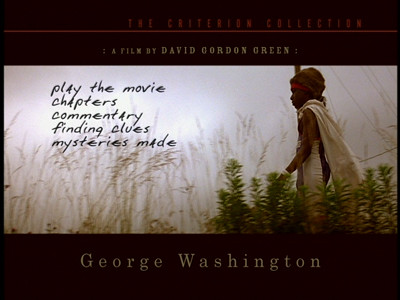
GEORGE WASHINGTON - #152


Ever since it was announced that David Gordon Green would be directing Pineapple Express, the next Judd Apatow-produced script by the Superbad writing team of Seth Rogen and Evan Goldberg, there has been much speculation as to how the director would adapt his realistic style to a stoner comedy full of rude humor and action sequences. Over the last eight years, Green has made four movies, and though each one has moved him steadily closer to the mainstream, he has stayed pretty true to a particular aesthetic, a cross between 1970s maverick filmmaking and 1990s indie auteurism. There wasn't really a question of whether or not he could do it, but a question of how. What would a David Gordon Green comedy be like?

Well, I've seen Pineapple Express, and I think fans of the director will be pleased to see his naturalistic approach brought to bear on a completely unrealistic script, using his eye for realism to lend believability to a screenplay that would fall to pieces under a more fanciful commercial director. Green understands actors, he understands what a moment requires, and like a classic Hollywood director, I think we'll find that neither genre nor style can contain him.

But that's really a review for another time and another venue (and one now available here). As the August 8 release date for Pineapple Express approaches, I thought it would be a good excuse to dig back into my collection and watch Green's 2000 debut, George Washington, again. I had always intended to do a joint piece on George Washington and Lynne Ramsay's Ratcatcher (1999). The proximity of their release on Criterion DVD caused me to originally watch them very close to one another, and in a lot of ways, they are the same movie even though they were made in two completely different parts of the world. Time permitting, I may still try to cover Ratcacher this week. (Edit: And have done so. Read the review here.)

Anyway, on to George Washington...


First off, no, it's not a biopic of our nation's first president. It's a bit daring to make a movie and call it George Washington and hope your potential audience won't be confused about what they are getting. I know I have a natural tic, which you just witnessed, to clarify as soon as I tell people about the movie. I suspect Green knew what he was doing, though, when he put that title together with the promotional iconography of the film. Despite the film not really being a critique of race relations in America, it does portray socioeconomic problems and how they affect people in the rural South one summer during the George H.W. Bush presidency. Green had to know that the juxtaposition of that name with the faces of his young black actors in his movie would raise an eyebrow or two.

The title is not without meaning in the context of the movie's narrative either. The focal character of George Washington is George Richardson (played by Donald Holden), a 13-year-old boy whom we are told dreams of being President one day. It's a passing mention by the narrator in the beginning of the film, and it doesn't come up again until the end, when the same narrator tells us of George's future plans to save the people of America over a collage of images that include Revolutionary War drawings, Sitting Bull, and President Washington himself. It's the payoff of other points in the movie where we see that George wants to be a part of the bigger picture. Not in some hokey sense where he is going to petition the mayor of his town or even write a letter to President Bush the First (though he does hang the man's toothy portrait on his bedroom wall) and end up on Oprah because of his patriotism; no, it's that he sees something beyond the borders of the rundown town where he is growing up, something he wishes he could join. Call it opportunity or the American Dream, call it the audacity of hope. After the 4th of July parade, George goes to the man who played Uncle San and tells him he was his favorite part of the procession. George isn't speaking to the man in the costume, he sees the icon behind it.

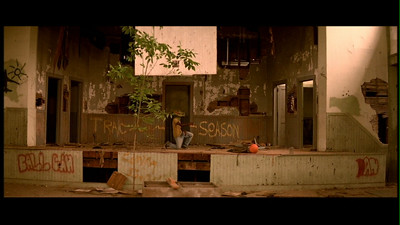
All of the children in the film have similar dreams to George's. For instance, the young girl Sonya (Rachael Handy) who hangs with the older boys is always stealing cars, despite apparently having nowhere to drive. 12-year-old Nasia (Candace Evanofski) dumps her boyfriend Buddy (Curtis Cotton III) because he isn't mature enough, even though he is a year older than she is, and she tells her girlfriends that if they ever want a good man they have to go look someplace else. Not that the men of the town have much of a chance to aspire to anything more. Most of them work down at the railyard, watching the trains go in and out, but never being able to go themselves. The poverty on display is staggering, the abandoned and rundown buildings almost looking like sets from an apocalyptic sci-fi movie or a post-war picture. All the more heartbreaking to consider that Green shot on real locations in North Carolina, and so these places actually exist.


The kids end up playing in what looks like an abandoned zoo, a surreal setting that ends up being a subtle metaphor. Such is the state of the cage that is meant to contain them. There is a sense of abstraction all around, that these children are stuck in some kind of pseudo-reality. Buddy even dons a lizard mask and performs on a stage at a theatre long since shut down, dramatically reciting a soliloquy asking that God not forget him and his brethren entirely. (When he is spotted by the affable Rico Rice, played by Green perennial Paul Schneider, Rico asks, "Is that the Bible or Shakespeare?" It's a smartass question, but meaningful. Just what kind of drama are you in, kid? Sacred, profane, or somewhere in between?) It's an ironically nostalgic speech, recalling a time when the speaker walked with God and enjoyed his blessings. For a boy Buddy's age, when would these halcyon days have been? Elementary school?

It is, of course, a ministration of God's favorite whipping boy, Job, who refused to give in no matter what maliciousness his Lord visited upon him. It's the indicator that Buddy is the center of things, his finger in the dam that holds back despair. Just as such a heavy speech is ironic coming out of his mouth, it also is ironic that the one boy who doesn't really want to leave, who is content being with his friends and really just wants Nasia to treat him right and not hook up with George, ends up being the catalyst to change everything and make the others consider options beyond what has been given to them.


One day while out playing, George, Buddy, Sonya, and the giant of the group, Vernon (Damien Jewan Lee), are playing in the bathroom at the zoo. They start hazing Buddy, and after Buddy shoves George too hard, hitting the boy's head, George lashes back. For much of the movie, George wears a helmet due to a condition where his skull is soft like a baby's, and he is not supposed to get it wet or suffer any heavy blows. Angry, George knocks Buddy roughly toward Vernon, and Buddy slips, bangs his head, and dies. (More irony for Buddy, alas.) Rather than just tell people what happened, the remaining kids try to hide the body.

How this act affects them is the focus of the second half of George Washington. Both Sonya and Vernon go through a bout of Dostoevskian self-doubt and question the entirety of their moral belief systems. Sonya continues to spin her wheels in the end, but Vernon's soul searching leads to some particularly poignant soul expression. Working with largely untrained actors, it's amazing that David Gordon Green, as a first-time director, was able to get these kids to open up the way they do. Vernon's speech about dreaming of a world where he can be at peace, alone and unbothered, free to do as he pleases, a world where Buddy has not died in a game he was participating in, strikes hard. The way the various wishes rattle off the boy's tongue with barely a pause between them gives the moment an emotional honesty that would not have been present had the actor given it a more "professional" line reading. The strength of his desire is why Vernon is the only one who is able to board a train and get out of there at the end, reminding me of a fictional touchstone in my life, Sherwood Anderson's Winesburg, Ohio. In that book, an entirely different George W. takes a train to a better life, too.


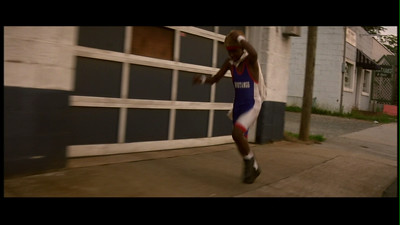
The evolution of this movie's George, however, is its own bizarre beast. Shortly after the incident with Buddy, George finds another boy face down in a swimming pool, and despite his condition, George jumps in and pulls the drowning boy to safety, risking his own life. Heralded as a hero, and perhaps seeking to do penance, George dons a cape and Buddy's old wrestling unitard and starts trying to do more good in the world, be it directing traffic or saving another life should the opportunity come along. In some ways, he looks crazy, but in some eyes, including his admirer Nasia (also the film's narrator), it shows that he is a dreamer. Rico sees it, too, encouraging George to endure no matter what people might say. Despite being the town clown, Rico is really the adult version of Buddy, having advised that boy in his love woes, as well as trying to keep his community together by encouraging the rail workers to support their union. (The Quebecois could have used a guy like Rico in Mon Oncle Antoine.) Nasia's sister even dates him, apparently proving the younger girl wrong in that there are good men in their 'burg. (One must assume that Nasia also moves on, since as narrator, she has at least some time, perspective, and a venue through which she can express herself.)

When George Washington came out, David Gordon Green received a lot of comparisons to Terrence Malick. It's easy to see Malick's influence on Green's style--the beautifully composed shots of untouched environments, the disconnected female narrator, and the eschewing of more predictable narrative structures for something more ambling and poetic. Green and his editors, Steven Gonzales and Zene Baker, cut the movie to match the rhythm and pace of a hot summer's day. They capture that lackadaisical feeling of youth, when it feels like there is too much time and never enough to do, that the world has ceased turning altogether. In pursuit of this feeling, Green does end up creating George Washington's one major flaw, a sense of time being out of joint. There are only three days between Buddy's death and the movie's conclusion, and yet so much happens, it seems like many more. Then again, that could actually be intentional. Enough evidence of an elastic, molasses-like passage of time exists elsewhere in George Washington, that this could be Green's final wrinkle to create an overriding aura of separateness.


Having now seen George Washington again and pondered it in relationship to Pineapple Express, even I find myself asking how we got there from here. In all of Green's other films, including this year's staggeringly great Snow Angels, the writer/director is concerned with the same communities of people that form the heart of the American South, examining how they struggle to come together and to get by. I suppose it makes its own kind of sense, then, that his first movie disconnected from his own background, set in California instead, is about people who don't really have that community and amidst all the weed jokes and explosions, form one. Arguably, he's just trading one type of disenfranchised American for another, the Southern problems for a Californian one.

There is one moment in Pineapple Express, though, that is pure David Gordon Green, that even if you forget he is the man guiding the action, reminds you of who is behind the camera. Lost and on his own, James Franco's character breaks down in a park. It's a wide shot, and in the background, we see an odd-looking Mexican girl watching him. She is on the other side of a chain link fence, and she wears a one-piece bathing suit. The camera cuts to her, and the director of All the Real Girls shows us a real girl, the type of girl that is all over the non-movie version of Los Angeles, a girl that could roll with George and Buddy and the gang. It's a detail another director would throw out, but the director of George Washington, even when in a more light-hearted mode (and more power to him), never would.


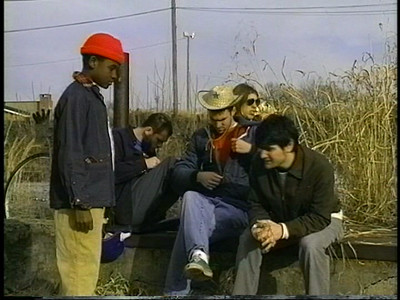
The Criterion release of George Washington comes backed with three short films, two from David Gordon Green's student days and one by actor Clu Gulager, the gunman who wasn't Lee Marvin in Don Siegel's version of The Killers. Made in 1969, A Day with the Boys inspired Green in terms of its visual style and the way it showed youngsters at play. It's a strange little film, but in terms of imagery, quite interesting.

Green's 1998 film Physical Pinball features several of the actors from George Washington, including Candace Evanofsky. It's a sweet coming-of-age story, shot and scored like a 1970s "After School Special." Candace plays a young tomboy growing up with a widowed father (Eddie Rouse, George's uncle in the main feature) who treats her like a son, encouraging her to fight, work on cars, and hustle at pinball. The setting for this short is fantastic, with the family living in a renovated school bus in an old auto yard. Again, Green creates a wasteland vibe, with cars upturned and hoods standing open. Physical Pinball finds the girl at the onset of puberty, and tells the story about how both her and her father accept her oncoming womanhood in a way that is emotionally resonant rather than being trite or cliché.

1996's Pleasant Grove has a much more direct lineage to George Washington. The relationship of the boy Garland with his dog and the character's soft skull are like rough drafts for very similar scenes with George. Eddie Rouse and Paul Schneider also play early versions of their future characters. Shot cheaply on video and rife with overacting, Pleasant Grove hints at the filmmaking talent but lacks the skill, making it more of a curiosity than Physical Pinball, which shows quite a bit of growth for Green in just two short years. Two more after that and George Washington had come to fruition. One interesting style choice that changed over the years: in this short, there is no other pre-adolescent characters, and so the boy narrates the film himself.


Tuesday, April 1, 2008

SIDELINE: MORE REVIEWS FOR 3/08

Given that I write more reviews than what you see here, below is a list of non-Criterion films I covered in the past month that may be of interest to Criterion fans.

IN THEATRES...

* Boarding Gate, Eurotrash from Olivier Assayas with a boring Asia Argento trying to act like she's tough and alluring.

* Girls Rock!, a heartwarming and thoughtful documentary about the Girls Rock 'n' Roll Camp.

* Married Life, a melodrama set in the 1950s that has great style, performances, and ideas, but might have gone too heavy on the restraint. Some appeal here for Douglas Sirk fans.

* Snow Angels, a fantastic new drama from David Gordon Green, with outstanding performances from an ensemble cast that includes Sam Rockwell and Kate Beckinsale.

ON DVD...

* Bonnie & Clyde: Ultimate Collector's Edition, a rad boxed set giving the red carpet treatement to a violent classic.

* Dangerous Crossing, an appealing 1950s thriller playing on the The Lady Vanishes formula, but this time with Jeanne Crain on a boat.

* The Inner Life of Martin Frost, wherein novelist Paul Auster tries to create a Wings of Desire for muses, but lacks the inspiration to go all the way with it. Still, Irene Jacob is in it.

* James Ellroy's Feast of Death, a killer documentary about the murders that obsess one of our finest crime novelists.

* Lions for Lambs, Robert Redford's attempt at a political thinkpiece ultimately goes awry.

* No Country for Old Men, wherein I tell you why you're stupid if you say you didn't like the ending.

* Pride of the Yankees - Collector's Edition, the quintessential sports biography, with Gary Cooper as Lou Gehrig.