* Iceberg Slim: Portrait of a Pimp, an interesting man overcomes the conflicting message of the commentary his profilers give him, proving personality always wins.
* I'm So Excited, a light-hearted trifle from Pedro Almodovar. As Duran Duran once said, "doesn't have to be serious."
* Red 2, the old men need some Viagra, but the ladies have a good time anyway.
* The Wolverine, just the kind of do-over we were hoping for. Go get 'em, bub!
My Oregonian columns...
* July 5: The Chinese drama Beijing Flickers and the documentary A Girl and a Gun, alongside Rossellni's "Solitude Trilogy"
* July 12: Augustine, a historical drama; Survival Prayer, a meditative documentary; and V/H/S/2, a total piece of crap.
* July 19: A documentary on Big Star, a tribute to Les Blank, and the Serbian gay rights comedy The Parade.
* July 26: Hava Nagila: The Movie traces the history of the famous song; Men in Suits looks at the actors who dress as our favorite movie creatures; and the not-so-fantastic Fantastic World of Juan Orol is a biopic of the Mexican Ed Wood.
* August 2: Get In Bed With Ulysses and let James Joyce put you to sleep; or look at dramas based on real life, the human trafficking story Eden and James Cromwell in Still Mine.
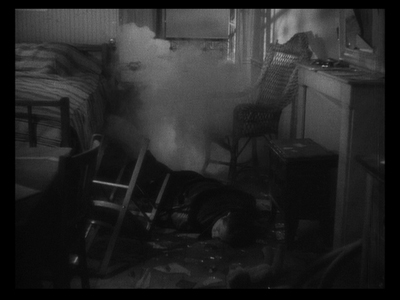
A man is shot behind a closed door. He stumbles from the apartment and tumbles down the stairs, passing the only witness, a blind man. Police are summoned. The believed shooter has locked himself in his room at the top of the tenement. By all accounts, he's a good man. No one knows who the dead man is, much less why their neighbor shot him. The only one with all the answers is behind a closed door and not talking.
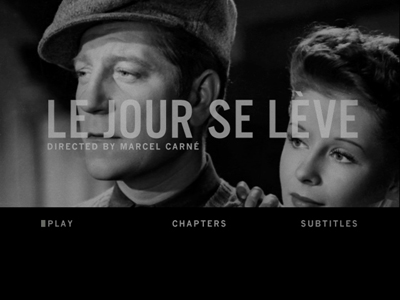
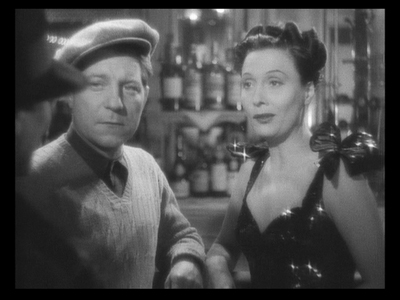
This is the opening scene and basic set-up of Le jour se lève, Marcel Carné's tense 1939 thriller. The shooter is played by the formidable Jean Gabin, one of the more naturalistic and believable actors of early cinema. His presence is like that of Bogie's, his girth a precursor to Gerard Depardieu. But in truth, he is just Gabin, unlike no other. Perfectly believable as a working-class hero, and the kind of personality that could hold our interest pacing a tiny studio all by his lonesome. Which is essentially what he does in Le jour se lève, though his dark night of the soul is mixed up with memory and regret. The title translates as Daybreak, and Jean's character, Francois, will stay barricaded in his apartment overnight, as the police and the townspeople wait for him to reveal himself. He's locked in his own head at the same time, a victim of stinkin' thinkin' not just tonight, but in all the events leading up to this.
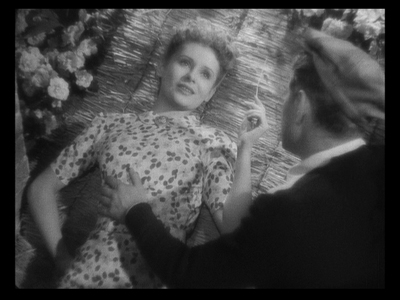
Through a series of flashbacks, Carné and writers Jacques Viot and Jacques Prévert reveal that Francois is caught in two intersecting love triangles. He first falls for the pretty Francoise (Jaqueline Laurent) when she comes to his work to deliver flowers to his boss' wife. Francois labors in a factory where the hazardous conditions are affecting his health; in every way, he is a man with a death sentence hanging over his head even before he becomes a murderer. He and the girl quickly bond, the common name between them working as a starting point for what turns out to be a sweet, intimate relationship. Their scenes together are shot quietly, first by necessity (everyone else in the house is asleep) and then just by nature of the love they share. Carné is a tricky bastard. He knows that if someone whispers, the listener will automatically lean in. Here we fall in love because we can't help but climb into the room with the lovers. Francois and Francoise speak so quietly, we are engaged to be a part of their liaison.
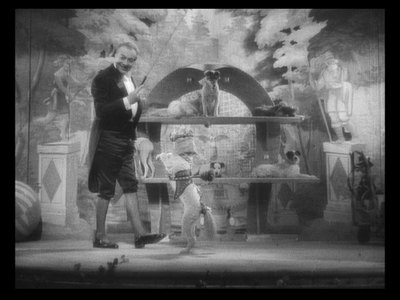
On the night when Francois visits her house, he ends up following Francoise after she leaves him for a prior engagement. She ends up at a small theatre where a dog trainer named Valentin (Jules Berry) is putting on a vaudevillian act where his pooches do ludicrous tricks. It also happens to be the night where Valentin and his pretty assistant Clara (Arletty) are splitting. Clara is a more mature woman than the naïve Francoise, and she sees through Valentin in ways the younger girl is not yet sophisticated enough to manage. Clara also spots the beefy Francois at the bar and quickly attaches herself to him. She becomes his mistress while Francoise remains his chaste girlfriend. Yet, the question is what Francoise's relationship to the slimy con man Valentin is, and whether it's as chaste as her connection to Francois.
It's the untangling of Valentin's lies that eventually gets him shot, the act revealed as the climax of Francois's flashbacks and just prior to the full climax of Le jour se lève. Valentin is a creepy cat, and Jules Berry squeezes every ounce of slime out of the performance as he can. There is a natural division between the men, and though we never see their hands, they would be the telltale sign of how different they are. Valentin's hands would be soft, never having seen hard labor, and Francois's would be rough. Valentin crows about his own intelligence, and the postcards he has sent Francoise from around Europe are meant to suggest that he can offer her a life beyond this remote village. Francois is just a dumb brute by comparison, stuck here for life, no prospect of moving on. Even though Francois sees a paying job as his ticket to personal freedom, the girl may not feel the same. This is the stick Valentin pokes him with, and the true measure of Gabin's performance is how much his understated seething makes us seethe on his behalf. Put that gun in my hand, I'd shoot the huckster, too.
Le jour se lève has a lot going on underneath its melodramatic plot. In addition to the bits about the class distinctions, there is also a lot being said about male aggression. It's kind of like Peckinpah's Straw Dogs in reverse, with the smart guy in the role of antagonist. There are also interesting things to be gleaned about the role of women at the time: how they are perceived, and how those perceptions not only define them, but also how they spur the men in their lives to treat them and/or act on their behalf. Clara is arguably a fallen woman, but she is also a realist. Francois is kind of kidding himself when he tells her he's not the romantic type. He demands a certain honesty from her, waiting to judge her beauty until he sees her without her stage make-up, but he lies to himself. He's an absolute romantic, and he's also a total wuss when it comes to ending their relationship. Clara takes it like a trooper, though that doesn't stop her from being a right bitch. I suppose a lifetime of being thrown over for the innocent girls has given her good reason to debunk the myth of that innocence.
Watching Le jour se lève, I had the feeling that I had seen this all before. Not that I found it derivative, but that some other movie had been derived from it. Turns out there was a good reason I felt this way, I hadn't realized that this was the movie Hollywood remade in 1949 as The Long Night, starring Henry Fonda and Vincent Price and directed by Anatole Litvak. I reviewed that film three years ago as part of Kino's Film Noir: The Dark Side of Hollywood boxed set. It was my favorite of the box, and though my memories of it are fond, Le jour se lève strikes me as the superior picture. More grimy, less hamstrung by production codes when it comes to the finer details of the love affairs. From what I can recall, the broad strokes are the same, though the ending of each version is more befitting the country of origin. Fonda is actually in a similar talent class as Gabin in terms of solitary action and the way he commands a screen. Both movies also have a cinematic realism that is quite effective. We aren't seeing our wronged men making their bad choices on a soundstage. Small town life, particularly as the neighbors spill out to watch the spectacle of the stand-off, is as much a part Jacques Viot's story as anything else.
One fascinating thing about Le jour se lève is how little it actually explains itself. Or, more accurately, how little we are told about the motivations of Francois. He doesn't make any big speeches to Valentin before he kills him, and really, he is reacting more than anything, goaded into proving the power of his might vs. that of Valentin's twisted talk. There is no such antagonizing factor in his final decision, however; it's still just him all alone. My first impulse was to say that he's a man that doesn't allow decisions to be made for him, and so he maintains control by choosing how it will all play out. Thinking about Gabin's face both times he uses a gun, I realized we really have to read his expressions to understand where his real shame lies. He let Valentin poke and prod him into making a mistake, effectively removing the control from him. It's the one decision that we could say he didn't make for himself, and the last scene of the movie is him taking over his own fate once again. The fade-out is on Francois and no one else. There are no parting words. Just the man in his room.
This disc was a Christmas present from my good friend, the writer Christopher McQuain, and thus got immediately bumped up in my post-holiday queue. Thanks, Chris! Check out his top 10 picks for the films that defined the last decade here.
Well, I guess it just goes to show, you're never as smart as you think. Here's what I knew about Mayerling: that it showed up regularly on lists of Audrey Hepburn movies as a 1957 television production the actress starred in opposite her then husband, Mel Ferrer. I had always hoped this show would one day surface, being pretty much the only significant television appearance Hepburn made in the first half of her career. I didn't know anything about the story, much less that it was based on a true event and that there were a bunch of other film versions of the tale. All were based on what is known as the "The Mayerling Incident," an 1889 scandal involving the murder-suicide of Crown Prince Rudolf of Austria and his lover, Baroness Maria Vetsera. Live and learn.
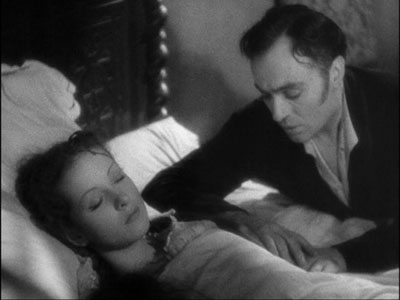
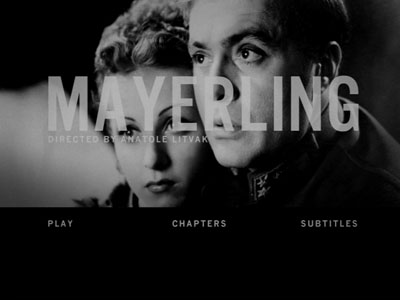
Anatole Litvak directed that Hepburn performance, twenty years after he helmed the story for the first time in this French production, realeased here as part of Criterion's Essential Art House line and which also happens to be the first dramatization of the affair. Made in 1936, Mayerling stars Charles Boyer as Rudolf and Danielle Darrieux as Maria. The two would also reunite later as the stars of Max Ophuls' The Earrings of Madame de..., a far more successful coupling as far as I'm concerned. There is nothing wrong with Litvak's Mayerling, per se, it's just that this arch costume drama is the product of a different time. A somewhat dispassionate, reserved time.
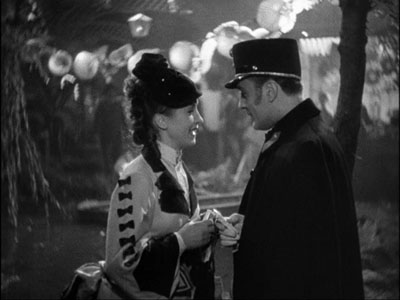
The story follows the outline of many a tragedy. The young Archduke Rudolf first goes astray by entertaining rogue political ideas. He is friends with Szeps (Rene Bergeron), a rabble-rousing newspaper editor known to be part of anti-monarchy protests. Rudolf is quickly put into line and pushed into an arranged, loveless marriage. The years pass, and Rudolf lets most of them go by drinking and partying with his buddies and loose-moraled gypsies. The party boy image is a front, however, and Rudolf yearns for an anonymous life and true love. He finds both when he runs into Maria Vetsera, who at first doesn't realize who this handsome soldier is. When they find each other again, they begin a secret affair, one that eventually becomes public. When the pope turns down Rudolf's request for a marriage annulment so he can be with Maria, the prince reaches the end of the line. Told by his father (Jean Dax), to get rid of Maria, Rudolf resorts to drastic measures. They go on an overnight trip to Mayerling, never to return.
The screenplay for Mayerling was adapted by Joseph Kessel (the novel Belle de jour) and Irma Von Cube (Johnny Belinda) from a novel by Claude Anet. The spicy historical details, and I am sure more than a few embellishments are all there, though I imagine the 1930s production code kept the filmmakers from going too far with what really went on. References to whores and lewd carryings on make it slightly more risqué than had it been a Hollywood production, but the folks in California also knew clever ways of getting more scandalous points across without saying everything outright. There are moments when I thought maybe I was supposed to infer more than what was being shown--like, were Rudolf and Szeps gay lovers, in addition to political radicals?--but also thought that could have been my modern eye spying things that weren't really there.
Litvak stages Mayerling as a grand spectacle, including nights out at the ballet and fancy-dress balls. The evening at the theatre, when Rudolf and Maria see each other for the first time after their chance meeting, is put together wonderfully. Litvak moves up and down and in and out of the various boxes, using a modified upstairs-downstairs technique to indicate the levels of the class structure in the royal court. His camera flies on the wings of gossip, mostly lead by the Archduke's cousin, and the whispered plans for future rendezvous provides Mayerling with its only real heat. Except for their final outing together--and we know how that one ends--most of the lovers' meetings look to be ridiculously chaste. Though, one has to wonder why army officers weren't more careful back in the day when they took their mistresses out for drinks. Rudolf getting caught out by his men, as well as Maria's brother, is remarkably similar to Lord Nelson being discovered boozing with Lady Hamilton in Alexander Korda's That Hamilton Woman.
Though we are apparently to believe that Maria Vetsera is a ripe seventeen, Danielle Darrieux and, indeed, the whole movie comes off as much older than that. Mayerling is really too mature. It needs a touch of Romeo & Juliet adolescent angst to give this star-crossed love affair a little more oomph. Even Rudolf's quickly jettisoned political rebellion could have been cranked higher. For a guy doing his best to piss off his father, he cordially stays out of the old man's face. There is little to signal that these two are passionate or dramatic enough to want to take their own lives. It's a development that comes out of nowhere, and seeing Boyer's shaky determination in the final scenes made me wonder where this kind of emotion had been in the preceding 90 minutes. Even the atmosphere out at Mayerling is different--more desolate and remote, with the lovers playing hide and seek on a late foggy night.
Anatole Litvak would eventually leave France and enjoy a fairly successful career in Hollywood, including directing the jazz film Blues in the Night, the desperate noir The Long Night, and another historical drama, Anastasia with Ingrid Bergman. Mayerling definitely shows a style in development. He understands that a costume piece like Mayerling has alternating demands, with wide shots needing to be employed to show the big set pieces and extreme close-ups necessary for the extreme emotions. He also finds ways to get his camera moving, regularly starting tight on a specific thing and moving back to reveal the whole scene. There is a particularly memorable use of this technique in the middle of the movie, when Rudolf has been drowning his sorrows during Maria's absence. We have heard that the Prince has been out carousing, and Litvak takes us into the decadence by starting on a champagne bottle and then zooming out as it's poured, showing the drunk royal in his cups amongst his courtesans. So, despite some slowness in the overall narrative, it's clear that this filmmaker is just starting to get warmed up.
This does make me wonder, though, is there a more definitive version of Mayerling out there? There are multiple films of the story, including one with Omar Sharif and Catherine Deneuve, and even interpretations off the screen--a ballet, a German opera, a Japanese musical, and a manga, of all thngs. What say you readers? What do you recommend?
By the way, in researching this article, I discovered that a 9-minute clip of the Audrey Hepburn/Mel Ferrer production is now online and that we may actually see this surface in the future. Info here, and the clip itself:
Author of prose novels and comic books like Cut My Hair, It Girl & the Atomics, You Have Killed Me, and 12 Reasons Why I Love Her. Jamie's most recent novel is the serialized book Bobby Pins and Mary Janes, and his most recent graphic novels are the sci-fi romance A Boy and a Girl with Natalie Nourigat; Madame Frankenstein with Megan Levens; and the weird crime comic Archer Coe & the Thousand Natural Shocks with Dan Christensen.






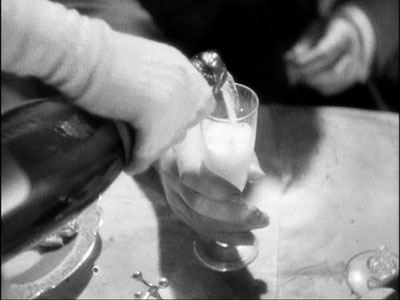
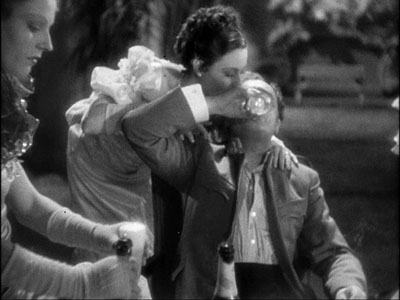
 with Ingrid Bergman. Mayerling definitely shows a style in development. He understands that a costume piece like Mayerling has alternating demands, with wide shots needing to be employed to show the big set pieces and extreme close-ups necessary for the extreme emotions. He also finds ways to get his camera moving, regularly starting tight on a specific thing and moving back to reveal the whole scene. There is a particularly memorable use of this technique in the middle of the movie, when Rudolf has been drowning his sorrows during Maria's absence. We have heard that the Prince has been out carousing, and Litvak takes us into the decadence by starting on a champagne bottle and then zooming out as it's poured, showing the drunk royal in his cups amongst his courtesans. So, despite some slowness in the overall narrative, it's clear that this filmmaker is just starting to get warmed up.