Showing posts with label marcel carne. Show all posts

Monday, September 24, 2012

LES VISITEURS DU SOIR (Blu-Ray) - #626


Love may conquer all, but it can't do it without putting in a good fight first.

Or so we may glean from Marcel Carné's 1942 romantic fantasy Les visiteurs du soir (The Devil's Envoys). In this medieval tale, two minstrels arrive at a castle in the midst of festivities for an oncoming marriage. The Baron Hugues (Fernand Ledoux, La bête humaine [review]) is joining his daughter Anne (Marie Déa, Orpheus [review]) with the noble Lord Renaud (Marcel Herrand, Fanfan la Tulipe [review]). She is a young romantic, he is a slightly older pragmatist. Presumably their union is advantageous in some other way, as they don't really love one another. Renaud doesn't believe in such things.

The banquet has been wearing on for several days, and while not starved for food, the attendees are starved for entertainment, and their demands are turning toward cruelty. As the riders approach, they are met with a man who lost his pet, a bear that was shot by the partygoers for sport. Inside the castle, the guests laugh at three deformed little people brought in for their amusement. Only Anne has enough shame to turn away. The songs of the minstrels please her, they sing soft ballads about longing and love. Renaud doesn't care for them.


As it turns out, the minstrels are no ordinary players. We have already seen them perform special tricks: the male singer resurrected the distraught man's bear, while his companion questioned his off-model compulsion to do good. Dominique (Arletty, Children of Paradise) and Gilles (Alain Cuny, The Milky Way [review]) are former lovers who made an undisclosed deal with the devil. He now owns their souls, and they travel looking for more of their kind for him to possess. Their mission is to find situations such as this and throw a spanner in the works. Gilles seduces Anne with his songs of fidelity, whereas Dominique catches Renaud's eye by being that which he can't have. Both of Satan's minions turn things on their head by switching the roles around and upending emotions. Renaud becomes a romantic, while Gilles grows cruel with Anne. The unsuspecting mortals betray their own best interests for that which they don't really want. To further gum things up, Dominique also offers herself to the Baron, who is longing for his dead wife. Pretty soon, the father-in-law and groom will be squaring off for the right to love the same woman.

Les visiteurs du soir is a carefully rendered morality play in which privileged individuals who are amused by the misery of the less fortunate have the tables turned and become the playthings of a power greater than their own. At first, the seduction is quiet and almost idyllic, like one of the forlorn songs Gilles performs throughout. He in particular is quite the dullard, brooding over a love he cannot have. Anne inspires the kindness that lies dormant in her suitor to resurface, and he legitimately falls for her. This goes against protocol, and so the boss man has to come to fix what the boy did wrong.


The arrival of the devil at the castle kicks Les visiteurs du soir into a whole other gear. This Beelzebub is played as a devious imp by Jules Berry (Le jour se lève [review]). Presenting himself as a nobleman lost in a storm, he pushes his way into the party, poking at the weaknesses his envoys have discovered and then exposing them to the rest of group. He arranges for Anne to be caught with Gilles, and then manipulates the Baron and Renaud into a duel. Carné has fun with this supernatural character, who can appear in different places at once and otherwise bend space and time to his will. Berry makes for an excellent jester. He is agile both physically and verbally, and his permanent smirk gives his wicked deeds a pleasurable edge. At the same time, the director and his writers, Jacques Prévert and Pierre Laroche, also humanize him. The unshakeable love that Anne has for Gilles proves too much for the devil, and his need to break and possess her reveals that, at least in this narrative, evil is caused by the absence of something. The devil is the creature that he is for the lack of anyone to love him.

Given the time period and the conditions under which Carné made Les visiteurs du soir (some of which is covered in the documentary that appears as a supplement on the disc), some added meaning could be read into the film. The Nazis occupied France, and filmmakers were urged to join the collaboration and make pictures that promoted the "go along to get along" cause. Carné and his crew made their movie independent of Goebbels' propaganda machine, seemingly choosing a medieval fantasy tale to avoid any modern correlation. Yet, it's possible to see Les visiteurs du soir as veiled commentary on the perils of the Vichy government. If the Baron had been more wary of outsiders, had he and his daughter and her fiancée not been so quick to please these people that held sway over them, disaster might have been avoided. Only Anne manages to come through with her principles. The tyrant is powerless when confronted with her purity. Her ideal for living and loving is stronger than his, and in the end, he is a petty fool.


As interesting as this history is, it's also immaterial to one's enjoyment of Les visiteurs du soir. Any well-made art is both of its time and separate from it. It's quite easy to enjoy the movie for what is on the surface. Carné's concoctions still delight. His playful special effects, both simplistic and clever, still create a sense of magic. In my favorite sequence, Dominique strums her mandolin and stops time. Then she and Gilles pluck their targets from the frozen scene and lead them into the garden, where lovers enjoy one another amidst the topiary. Arletty is particularly alluring here. Her mysterious eyes and reserved manner invite the viewer to want to know more, which is the exact opposite effect to Cuny's brawny mope. His sad wailing in his prison cell is almost comical to behold.

Making Cuny a hunky leading man is the one illusion Marcel Carné can't pull off in a movie that is full of wonderful creations. The castle, the costumes, the odd creatures in the shadows--the director achieves his cinemagic by being meticulous in his detail, but also by treating it as if it were normal. There is nothing overdone about Les visiteurs du soir. The movie has been built with the same uncluttered clarity as we see in art director Alexandre Trauner's unassuming paintings, which Criterion have used to decorate their Blu-Ray package. (I quite like that the inside of the case is the inside of the castle.) The direction is as unfussy as the movie's message: it's all about purity, about staying true and staying the course. It's the simplest seduction of all, no devilish tricks required.

Special note should be made of the gorgeous high-definition transfer on the Les visiteurs du soir BD. The film has been restored lovingly, so that the black-and-white image looks sharp and shows very little blemish. It makes me all the more eager to check out the other new Marcel Carné disc, the re-release of Children of Paradise. The roadshow version of the new print is said to be stupendous, and I can't imagine any less from Criterion's HD treatment of the same.


This disc was provided by the Criterion Collection for purposes of review.


Wednesday, December 30, 2009

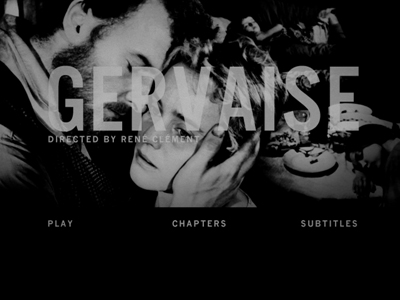
GERVAISE - ESSENTIAL ART HOUSE

"They were the only good things in my life. Maybe that's why they left."


Réne Clément's 1956 historical drama Gervaise is an adaptation of Emile Zola's L'assommoir, part of the French author's multi-part character epic, Les Rougon-Macquart. The novel's title, L'assommoir, is said to be an old colloquialism that is roughly the equivalent of the American phrase "to get hammered." Apparently the focus of this chapter of Zola's narrative was alcoholism and the devastating effects it has on a family. The drinking is also there in Clément's film version, but the focus is more on the title character, Gervaise Marquart (Maria Schell), and how she gets hammered by life.
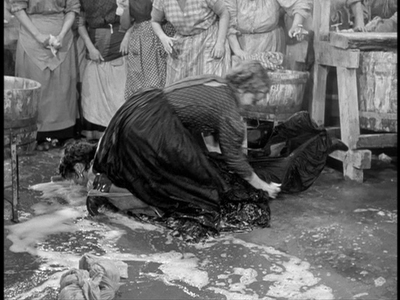
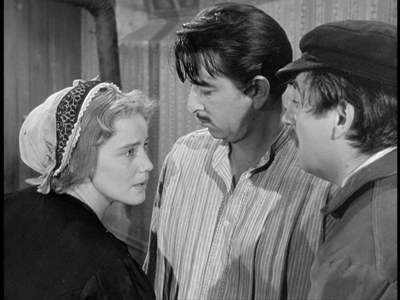
As Gervaise herself tells us in her hopeful opening narrative, she is the girl who shouldn't have expected very much. At the start of the picture, which takes place in the late 1800s, she is living with her common-law husband Lantier (Armand Mestral), who has taken her on despite her limp and given her two boys in the time they have been together. Too bad for her that Lantier is the kind of man no female deserves, and pretty soon he runs off with a loose woman who lives across the street. Gervaise's anger leads to her having a knockdown drag-out fight with that strumpet's sister, Virginie (Suzy Delair). Despite taking place in a giant public laundromat, it's a pretty dirty scuffle, ending with Virginie's bare ass being spanked with a paddle. The indignity is one she promises never to forget.


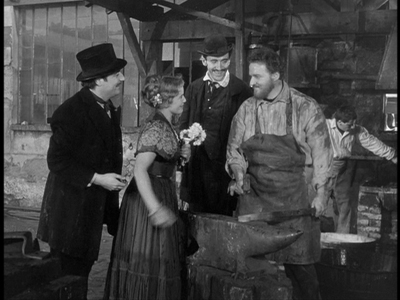
With Lantier out of the way, things start looking up for Gervaise. She marries a kindly roofer, Henri Coupeau (Francois Périer), despite the protests of his family. They have a daughter together, Nana (Chantal Gozzi), and they make plans for Gervaise to open her own launderette. This dream is nearly scuttled when Coupeau falls off a roof and Gervaise's insisting on taking care of him herself leaves them broke. The kindly blacksmith Goujet (Jacques Harden) loans her the downpayment for her lease, revealing his buried love for Gervaise and sparking an unacknowledged jealousy in her husband in the process. Once again things are looking up for Gervaise.


Of course, you can only look up so long before the sun burns your eyes, and that's when the blindside comes. Gervaise is one of those up-and-down melodramas where every step up the ladder the protagonist takes is followed by her being knocked back two more, all the way to the bottom and down to hell if the earth would just comply and open up. It's the sort of story that, when done poorly, compels the audience to throw up its hands and cry, "Enough! I give up!" When done well, however, as Gervaise most certainly is, it makes co-dependents of us all. Yes, Gervaise, we'll watch you get your hopes up, and we'll wait with wetted lips for them to get dashed on the rocks. Especially because we know each failure will be bigger than the last.

I think an essential component of any such movie succeeding is the strength of its lead. In this case, Maria Schell imbues Gervaise with a natural warmth and kindness that somehow makes us root for her even as we slowly begin to realize that she's not really that innocent of a victim. Or maybe "innocent" is the wrong word. It's more that she is less a victim of opportunistic men then she is her own bad choices. Whatever societal forces may be informing her misguided decisions, and the lack of education that leaves her without other tools, it becomes increasingly hard to reconcile the Gervaise that fought back against Virginie and whooped her ass with the Gervaise who allows a besotted Coupeau to let Lantier move in with them, and who is then manipulated in jumping between the beds of both men. We know she is capable of better, but she has latched onto bad luck as her own addiction. It's like she wouldn't know what to do without it. With her kind face and clear, expressive eyes, Schell reminds me a lot of Liv Ullmann, which is probably a major reason why I was drawn to her. She is an excellent actress in her own right, though, and later played both the love interest in Luchino Visconti's marvelous Le notti bianche and the immigrant frontier wife in Anthony Mann's version of Cimarron.


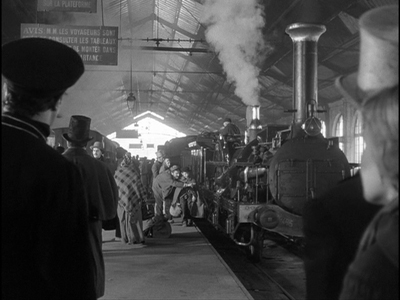
Symbolically, the blacksmith Goujet is Gervaise's conscience. He never fails to see what is really going on, and when she later tries to lie to him, she can't really do it. He also serves as the example of social change, and when he is sent to jail for organizing a strike to protest unfair wages, that's when things really go south for Gervaise. Without him there watching, she has no one to help her pick her drunken husband up off the street or ward off Virginie's machinations. As in Carné's La jour sa lève, work is what sets a man free. When Coupeau stops working, he disappears inside a wine bottle, whereas Goujet's taking Gervaise's eldest, Etienne (Christian Férez), under his wing offers the boy a way out of the squalor. Jacques Harden lends Goujet a rugged earthiness that would have made him right at home as the love interest in one of Douglas Sirk's movies from the same period. The scene when Gervaise goes to see him and Etienne off, and he doesn't see her standing there on the train platform--or quite possibly ignores her--is one of the most heartbreaking in the movie.


Its rival for saddest scene is the very end of the picture, when we see poor Nana heading on the road to ruin herself. René Clément had already proved himself an expert at portraying childish behavior and the hidden meanings behind it in Forbidden Games when he made Gervaise, and he turns Nana into a cautionary element that is integral to the narrative. If Etienne is an example of how a child can escape his surroundings with a little guidance, the blank sponge that is Nana soaks up all the nastiness, all the dirty laundry, that fills Gervaise's shop. Left to her own devices, the unbathed child wraps a ribbon in her hair and runs to an eager group of young boys. They turn to chase her the way a flock of birds shifts flight in mid-air. It's a creepy image all on its own, but knowing where that chase will lead her, it's all the more chilling. Nana is the star of another of Zola's novels, which has been adapted to film itself more than once, most notably by Jean Renoir in 1926.
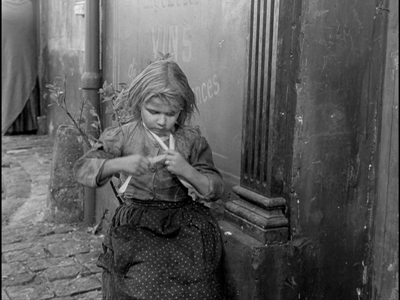


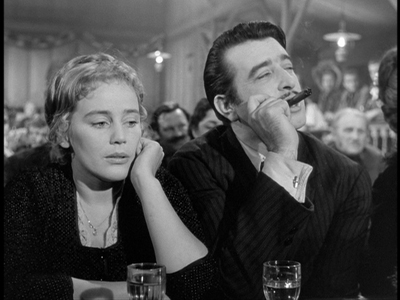
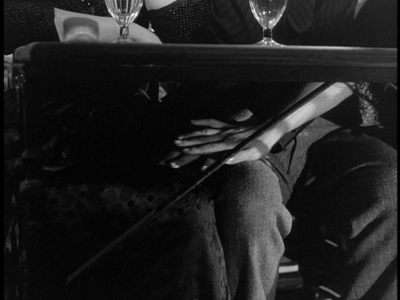
Observing behavior that is meant to remain unseen has always been Clément's strong suit. Be it the cons of Alain Delon in Purple Noon or the secret rituals the children undertake in Forbidden Games (which was written by Jean Aurenche and Pierre Bost, the same team on the script for Gervaise), Clément is attracted to the hidden actions and the pathology that underlines the things people do to themselves and one another. In a pivotal scene in Gervaise, his camera coyly pans down from up above the table where Gervaise, Lantier, and Virginie sit to look under the table at what is happening out of sight. One could almost call the drift of the camera "sprightly." It's a delicious moment, made all the better by Suzy Delair's relish for playing the villainess.
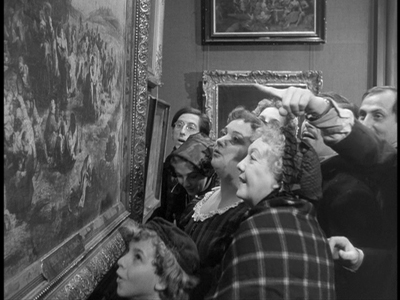
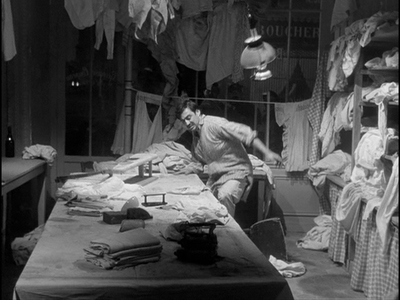
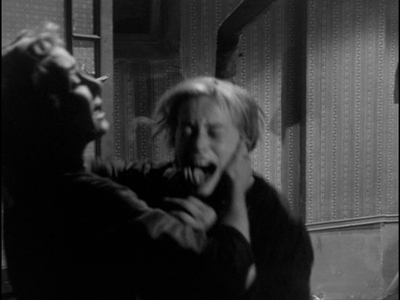
The same attention to detail is paid to all of Gervaise, and the director and his crew recreate 19th-century France with gritty accuracy. One of the most impressively realized sequences takes place on Gervaise and Coupeau's wedding day, when the working-class wedding party goes to the Louvre, many of them for their first and only time. They tour the museum, looking at the paintings, laughing at the ones with nudity, tracking mud through the institution's corridors. Clément shows us both the expanse of the galleries, but also the tight formation of the group, including ducking down to check out that dirty footwear.


Alongside Schell's charisma, such exacting focus on getting every inch of the movie right is crucial to our accepting the emotional histrionics of Gervaise. The movie never feels like a put-on, and it's most certainly never manipulative. By creating a believable world, René Clément also makes the story believable, even when we don't want to believe that our heroine is going to go the wrong way again. Real life is full of mistakes, and a movie's main character is allowed to make them, but the storytellers are not.


This disc was a Christmas present from my good friend and regular editor, the writer Maryanne Snell. What can I say, it was an Essential Art House Holiday. Many thanks, Maryanne!

Tuesday, December 29, 2009

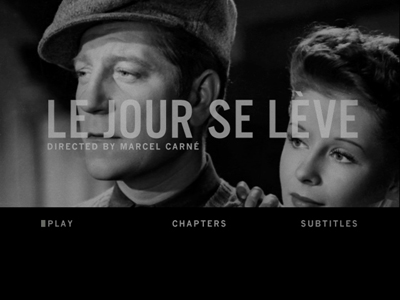
LE JOUR SE LEVE - ESSENTIAL ART HOUSE


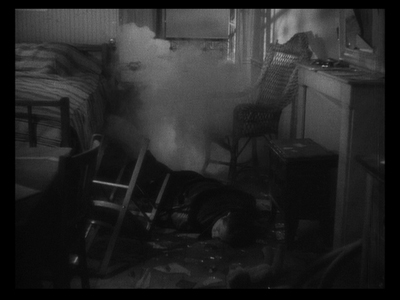
A man is shot behind a closed door. He stumbles from the apartment and tumbles down the stairs, passing the only witness, a blind man. Police are summoned. The believed shooter has locked himself in his room at the top of the tenement. By all accounts, he's a good man. No one knows who the dead man is, much less why their neighbor shot him. The only one with all the answers is behind a closed door and not talking.

This is the opening scene and basic set-up of Le jour se lève, Marcel Carné's tense 1939 thriller. The shooter is played by the formidable Jean Gabin, one of the more naturalistic and believable actors of early cinema. His presence is like that of Bogie's, his girth a precursor to Gerard Depardieu. But in truth, he is just Gabin, unlike no other. Perfectly believable as a working-class hero, and the kind of personality that could hold our interest pacing a tiny studio all by his lonesome. Which is essentially what he does in Le jour se lève, though his dark night of the soul is mixed up with memory and regret. The title translates as Daybreak, and Jean's character, Francois, will stay barricaded in his apartment overnight, as the police and the townspeople wait for him to reveal himself. He's locked in his own head at the same time, a victim of stinkin' thinkin' not just tonight, but in all the events leading up to this.


Through a series of flashbacks, Carné and writers Jacques Viot and Jacques Prévert reveal that Francois is caught in two intersecting love triangles. He first falls for the pretty Francoise (Jaqueline Laurent) when she comes to his work to deliver flowers to his boss' wife. Francois labors in a factory where the hazardous conditions are affecting his health; in every way, he is a man with a death sentence hanging over his head even before he becomes a murderer. He and the girl quickly bond, the common name between them working as a starting point for what turns out to be a sweet, intimate relationship. Their scenes together are shot quietly, first by necessity (everyone else in the house is asleep) and then just by nature of the love they share. Carné is a tricky bastard. He knows that if someone whispers, the listener will automatically lean in. Here we fall in love because we can't help but climb into the room with the lovers. Francois and Francoise speak so quietly, we are engaged to be a part of their liaison.


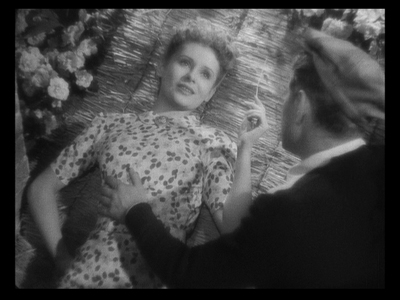
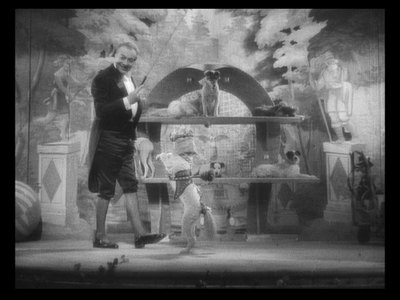
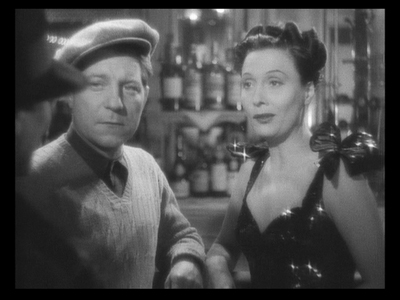
On the night when Francois visits her house, he ends up following Francoise after she leaves him for a prior engagement. She ends up at a small theatre where a dog trainer named Valentin (Jules Berry) is putting on a vaudevillian act where his pooches do ludicrous tricks. It also happens to be the night where Valentin and his pretty assistant Clara (Arletty) are splitting. Clara is a more mature woman than the naïve Francoise, and she sees through Valentin in ways the younger girl is not yet sophisticated enough to manage. Clara also spots the beefy Francois at the bar and quickly attaches herself to him. She becomes his mistress while Francoise remains his chaste girlfriend. Yet, the question is what Francoise's relationship to the slimy con man Valentin is, and whether it's as chaste as her connection to Francois.


It's the untangling of Valentin's lies that eventually gets him shot, the act revealed as the climax of Francois's flashbacks and just prior to the full climax of Le jour se lève. Valentin is a creepy cat, and Jules Berry squeezes every ounce of slime out of the performance as he can. There is a natural division between the men, and though we never see their hands, they would be the telltale sign of how different they are. Valentin's hands would be soft, never having seen hard labor, and Francois's would be rough. Valentin crows about his own intelligence, and the postcards he has sent Francoise from around Europe are meant to suggest that he can offer her a life beyond this remote village. Francois is just a dumb brute by comparison, stuck here for life, no prospect of moving on. Even though Francois sees a paying job as his ticket to personal freedom, the girl may not feel the same. This is the stick Valentin pokes him with, and the true measure of Gabin's performance is how much his understated seething makes us seethe on his behalf. Put that gun in my hand, I'd shoot the huckster, too.


Le jour se lève has a lot going on underneath its melodramatic plot. In addition to the bits about the class distinctions, there is also a lot being said about male aggression. It's kind of like Peckinpah's Straw Dogs in reverse, with the smart guy in the role of antagonist. There are also interesting things to be gleaned about the role of women at the time: how they are perceived, and how those perceptions not only define them, but also how they spur the men in their lives to treat them and/or act on their behalf. Clara is arguably a fallen woman, but she is also a realist. Francois is kind of kidding himself when he tells her he's not the romantic type. He demands a certain honesty from her, waiting to judge her beauty until he sees her without her stage make-up, but he lies to himself. He's an absolute romantic, and he's also a total wuss when it comes to ending their relationship. Clara takes it like a trooper, though that doesn't stop her from being a right bitch. I suppose a lifetime of being thrown over for the innocent girls has given her good reason to debunk the myth of that innocence.


Watching Le jour se lève, I had the feeling that I had seen this all before. Not that I found it derivative, but that some other movie had been derived from it. Turns out there was a good reason I felt this way, I hadn't realized that this was the movie Hollywood remade in 1949 as The Long Night, starring Henry Fonda and Vincent Price and directed by Anatole Litvak. I reviewed that film three years ago as part of Kino's Film Noir: The Dark Side of Hollywood boxed set. It was my favorite of the box, and though my memories of it are fond, Le jour se lève strikes me as the superior picture. More grimy, less hamstrung by production codes when it comes to the finer details of the love affairs. From what I can recall, the broad strokes are the same, though the ending of each version is more befitting the country of origin. Fonda is actually in a similar talent class as Gabin in terms of solitary action and the way he commands a screen. Both movies also have a cinematic realism that is quite effective. We aren't seeing our wronged men making their bad choices on a soundstage. Small town life, particularly as the neighbors spill out to watch the spectacle of the stand-off, is as much a part Jacques Viot's story as anything else.


One fascinating thing about Le jour se lève is how little it actually explains itself. Or, more accurately, how little we are told about the motivations of Francois. He doesn't make any big speeches to Valentin before he kills him, and really, he is reacting more than anything, goaded into proving the power of his might vs. that of Valentin's twisted talk. There is no such antagonizing factor in his final decision, however; it's still just him all alone. My first impulse was to say that he's a man that doesn't allow decisions to be made for him, and so he maintains control by choosing how it will all play out. Thinking about Gabin's face both times he uses a gun, I realized we really have to read his expressions to understand where his real shame lies. He let Valentin poke and prod him into making a mistake, effectively removing the control from him. It's the one decision that we could say he didn't make for himself, and the last scene of the movie is him taking over his own fate once again. The fade-out is on Francois and no one else. There are no parting words. Just the man in his room.


This disc was a Christmas present from my good friend, the writer Christopher McQuain, and thus got immediately bumped up in my post-holiday queue. Thanks, Chris! Check out his top 10 picks for the films that defined the last decade here.