Showing posts with label jean gabin. Show all posts

Thursday, July 5, 2012

GRAND ILLUSION - #1


This review of Grand Illusion, the first numerical Criterion DVD, was written in conjunction with the new 75th-Anniversary print of the film’s engagement at Portland’s historic Cinema 21 theater, starting this Friday, July 6. I got to attend a press showing and was taken aback by how good the new print, which was struck from an original negative, looks today. It’s as if no time has passed at all. 

The numerical structure of the review is largely to separate certain sections. Namely, part 1 is a version of the short review that ran in the Portland Mercury. It’s available on their site, alongside a sidebar article I wrote about other films that bear the Renoir influence.
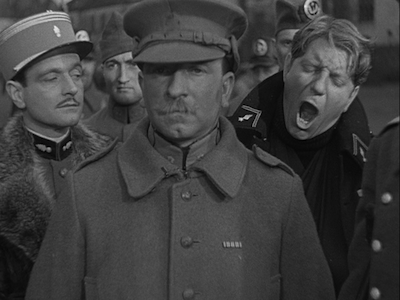

(1) Jean Renoir’s Grand Illusion is 75 years old. Which is70 more years than it took for them to reboot the Spider-Man films. That’s got to say something for how powerful a drama this war movie really is.

Grand Illusion stars Jean Gabin, the French Humphrey Bogart, as a pilot shot down behind German lines during WWI. He is taken to a prison camp where he immediately joins a group of his countrymen in digging a tunnel to escape. Bad luck ends that particular scheme, but not the dream; when Gabin and his effete captain are moved to another prison, this one run by the pilot that knocked them out of the sky (and played impeccably by Erich von Stroheim), the urge to flee becomes undeniable.

There’s a lot of humor and even some heartbreak to be found in the first 2/3 of Grand Illusion. The real meat of the film is in its final reels, however, when Gabin’s flight from incarceration tests his patience with his fellow fugitive and leads to finding love in the countryside. Renoir’s script is both sprawling and devilishly compact. The freewheeling structure keeps it feeling fresh even today. Comments that “the war to end all wars” will do nothing of the sort now seem eerily prescient, as they must have also in 1937, when Hitler was shoring up power. Yet, it’s not what Grand Illusion says about war that keeps it relevant, it’s what it says about the human spirit and the bonds people form in troubling times. 
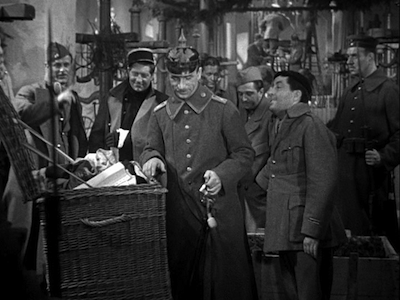

(2) It’s actually interesting to consider how far away from the war the events in the movie are. At the start of the picture, Gabin’s Lieutenant Maréchal is given orders to take Captain de Boeldieu (Pierre Fresnay) on a mission into enemy territory. Jump cut to a very similar scene, with von Stroheim’s stately Captain von Rauffenstein returning from a sortie of his own. I am sure the confusion the sudden change causes is intentional. It takes a couple of lines of dialogue to realize these aren’t the same pilots we saw just seconds ago. In fact, von Rauffenstein is returning from shooting Maréchal and de Boeldieu down. The mission is over, it happened offscreen.

A lot of the action does, at least until the men are finally on the run. There’s another escapee who is killed at the first prison camp, but the shots are fired out of sight. Likewise, when Maréchal is thrown in solitary confinement, we see the instigating action that gets him punished, but not the beatdown. There are also tales of other escape attempts that occurred in between that first prison and ending up at von Rauffenstein’s castle. The German’s have commandeered a 12th-century estate to use as their holding pen. von Rauffenstein has experienced his own comedown in the year or so since he first met the French soldiers. A combat accident has left him with burns all over his body, and he looks like a gothic grotesquerie in his plastic truss. His head practically looks disconnected from his body, placed in the cup of the unyielding girdle. These are all important things that occur, but all of them happen away from the camera eye.
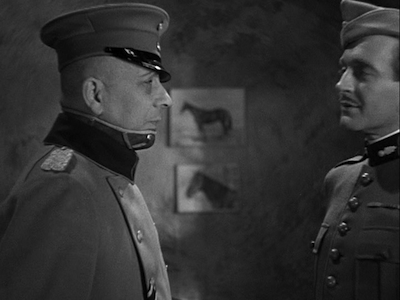

von Rauffenstein’s relationship with de Boeldieu is one of the more crucial in the film, and it gets to the heart of what Renoir and co-writer Charles Spaak are saying about the strange bedfellows wars make. There is a pronounced civility between the fighting men when on the ground. Just because their countrymen are duking it out elsewhere doesn’t mean they can’t get along when guns aren’t blazing. The German Captain sees a comrade in the French Captain. In a way, rank equals class. Yet, there is also a marked difference between de Boeldieu’s aristocratic air and the more friendly Rosenthal (Marcel Dalio), a Jewish immigrant whose family amassed a fortune in France. He didn’t need to fight, but his patriotism extends to protecting the country that blessed him with riches. The major split between von Rauffenstein and de Boeldieu is caused by the German officer’s anti-Semitism and his dismissal of the working-class Maréchal as something lesser.
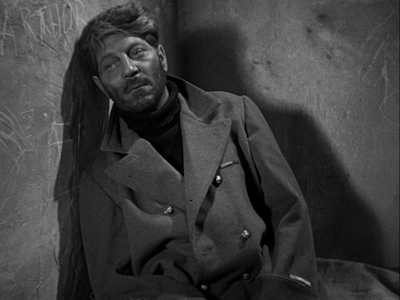

The action becomes more immediate, and visible, when Maréchal and Rosenthal finally break out, following a plan created by de Boeldieu as atonement for his privilege. We see the men at work, we see them running and hiding, the peril becomes urgent and real. And yet, here too life has a habit of continuing unabated. Eventually Maréchal and Rosenthal hole up in an out-of-the-way farmhouse where a German widow (Dita Parlo, L’Atalante [review]) lives alone with her daughter, having lost all her male relatives to the conflict. She and Maréchal find some comfort and romance with each other, and the unit operates as a temporary family. The regular needs of regular people don’t stop because bureaucrats far away are squabbling over lines on a map.
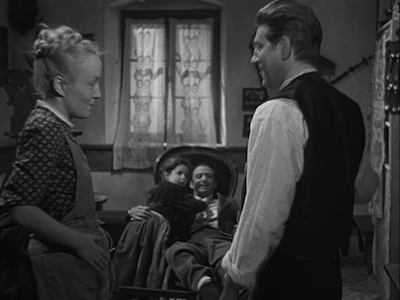

(3) Jean Renoir, assistant director Jacques Becker (who later made his own masterful prison-break picture, Le Trou), and director of photography Christian Matras (who also shot Le Plaisir [review], Fanfan la Tulipe [review], and The Milky Way [review], among others) carefully balance the intimate and the massive, turning the two elements on their heads and contrasting the difference between confinement and freedom. There is something more secure about the closed spaces. It’s friendly there. Not just with your fellow prisoners, but no one is shooting at you. You know where you are and the boundaries that accompany it.
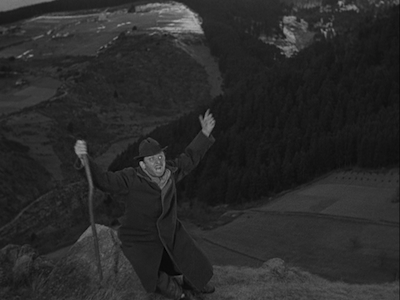

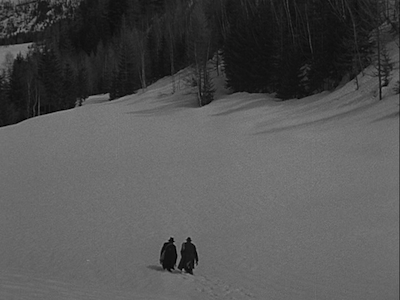
On the other hand, when Maréchal and Rosenthal are racing across the snowy countryside, they are subject to the elements, dogged by their jailers, and generally uncertain about their future. It’s the irony of freedom. You can do as you please, but there are unpredictable consequences to your actions. Gabin has a natural confidence on camera, but part of the appeal of Grand Illusion is watching this charismatic actor unravel, seeing him lose his cool, watching him take a chance. The unseen escape attempts are treated like a joke--he disguised himself as a guard in one; in another, he dressed in drag, only to be hit on by a non-commissioned officer--but this last shot at liberty is seriously dangerous.

Funny enough, it had been so long since I had seen Grand Illusion, I remembered the ending going a certain way. I e-mailed a friend and said so, and he asked me if this time it turned out that the pair escaped. This is a big question. Did they or didn’t they? What are we supposed to take away from the final shots: that the grand illusion of the title is our belief that there is any safety or security out there? The men note that even if they get home, their most likely fate will be to be sent to the front yet again. They’ll keep going until they win or don’t come back. Regardless of how you interpret the end, the futility of human endeavor seems obvious. Maréchal and Rosenthal are oblivious to how close they came to meeting their deaths, trudging blindly up a hill to who knows where. The folly of man is that we keep climbing, because to stop seems even more pointless. Or so we kid ourselves, carrying on and on in an endless cycle.



Saturday, September 10, 2011

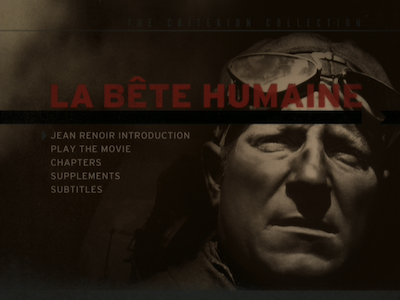
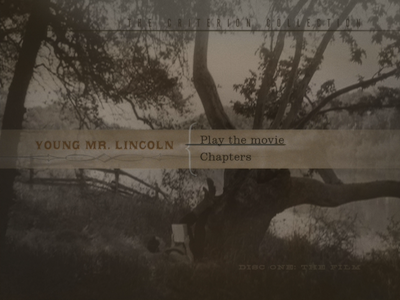
BLAST FROM MY OWN PAST: LA BETE HUMAINE - #324/YOUNG MR. LINCOLN - #320 [capsule reviews]

I was hunting around for an old piece on Breakfast at Tiffany's and I stumbled on a collection of capsule reviews I wrote for my defunct OniPress.com DVD column back in February, 2006. I will one day hopefully do something more extensive about La bệte humaine and Young Mr. Lincoln both, but in the meantime, here are my first reactions from the pair's initial release:


La bệte humaine: Jean Renoir made two films with Jean Gabin in 1938. The first was Grand Illusion and is an admitted classic; the second is La bệte humaine (The Human Beast), which sadly has been unavailable for quite some time. Based loosely on an Emile Zola novel, La bệte humaine is a precursor to film noir, with Gabin playing Jacques Lantier, a train conductor who gets cast as the replacement third point in a love triangle after his predecessor is murdered. Lantier is a man of machines, more in love with his locomotive than he’s ever been able to connect with a human. Part of it is that he has a congenital problem that makes him prone to madness and violent outbursts, something that doesn’t effect his interaction with his train. In fact, we see right from the opening shots that he is most free when riding the rails. La bệte humaine is perhaps Renoir’s most unabashed foray into genre filmmaking, a stylish thriller that could have just as easily been made by Hitchcock (though after likely punching up the humor and the threats). Like most Renoir, though, it’s a portrait of human foibles. He loves his characters for all their faults, and he shows them in exacting detail. Criterion has done a stellar restoration on this, as they have with all of their Renoir releases, and they’ve dug up a few vintage extras to round out the package. Most interesting is a television segment from the ’50s where Renoir is reunited with La bệte humaine’s femme fatale Simone Simon, and he gives a lesson on directing by remaking a scene from the film with her.


* * *


Young Mr. Lincoln The Criterion Collection offers a classic film from 1939, starring Henry Fonda and directed by John Ford. It’s hard to nail down what I liked best about this fantastic and charming movie, as every aspect of it worked in tandem to achieve the best motion pictures have to offer. Fonda is exceptional as Honest Abe, who at the time of the story is merely an up-and-coming lawyer in Illinois. His easy way with words matches his ambling gate step for step, as Fonda completely transforms himself into the tall and gentle legend (he’s given a little help by an excellent make-up team, providing the actor with a fake nose that blends smoothly with his recognizable facial features). Ford matches Fonda with gorgeous photography. His stunning vistas would draw away from the actor if handled by a less capable director. Here, they work in conjunction with Fonda’s performance to show how in tune Lincoln was with the American landscape. Criterion has done another excellent job restoring an old film, delivering exceptional picture and sound. There are also some informative extras, including various programs about Ford and Fonda. The 1975 interview with Fonda, who was then in his '70s, shows how vivacious of a personality he really was, and it’s worth it just for the anecdote about him and Jimmy Stewart drunkenly plotting to dig an underground tunnel into Greta Garbo’s house.


The other films I covered that month were Elia Kazan's Pinky, Dave McKean's MirrorMask, the Keira Knightley-led Pride & Prejudice adaptation, and a Hollywood-based indie called The Young Unknowns.

And it turns out I either lost that Breakfast at Tiffany's review or I am nuts and never wrote it. I was working on a new piece, anyway, now that the movie is on Blu-Ray.


Tuesday, December 29, 2009

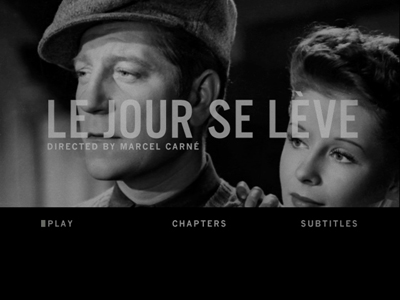
LE JOUR SE LEVE - ESSENTIAL ART HOUSE


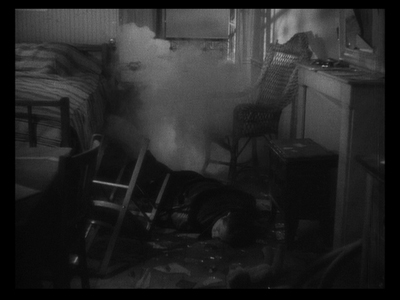
A man is shot behind a closed door. He stumbles from the apartment and tumbles down the stairs, passing the only witness, a blind man. Police are summoned. The believed shooter has locked himself in his room at the top of the tenement. By all accounts, he's a good man. No one knows who the dead man is, much less why their neighbor shot him. The only one with all the answers is behind a closed door and not talking.

This is the opening scene and basic set-up of Le jour se lève, Marcel Carné's tense 1939 thriller. The shooter is played by the formidable Jean Gabin, one of the more naturalistic and believable actors of early cinema. His presence is like that of Bogie's, his girth a precursor to Gerard Depardieu. But in truth, he is just Gabin, unlike no other. Perfectly believable as a working-class hero, and the kind of personality that could hold our interest pacing a tiny studio all by his lonesome. Which is essentially what he does in Le jour se lève, though his dark night of the soul is mixed up with memory and regret. The title translates as Daybreak, and Jean's character, Francois, will stay barricaded in his apartment overnight, as the police and the townspeople wait for him to reveal himself. He's locked in his own head at the same time, a victim of stinkin' thinkin' not just tonight, but in all the events leading up to this.


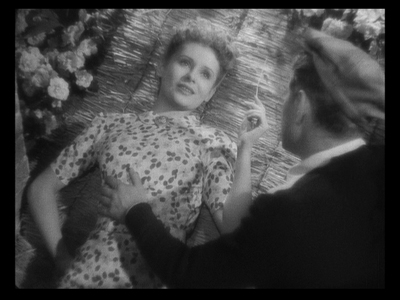
Through a series of flashbacks, Carné and writers Jacques Viot and Jacques Prévert reveal that Francois is caught in two intersecting love triangles. He first falls for the pretty Francoise (Jaqueline Laurent) when she comes to his work to deliver flowers to his boss' wife. Francois labors in a factory where the hazardous conditions are affecting his health; in every way, he is a man with a death sentence hanging over his head even before he becomes a murderer. He and the girl quickly bond, the common name between them working as a starting point for what turns out to be a sweet, intimate relationship. Their scenes together are shot quietly, first by necessity (everyone else in the house is asleep) and then just by nature of the love they share. Carné is a tricky bastard. He knows that if someone whispers, the listener will automatically lean in. Here we fall in love because we can't help but climb into the room with the lovers. Francois and Francoise speak so quietly, we are engaged to be a part of their liaison.


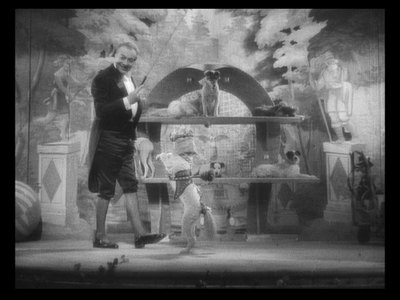
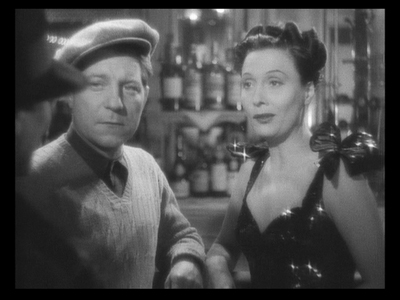
On the night when Francois visits her house, he ends up following Francoise after she leaves him for a prior engagement. She ends up at a small theatre where a dog trainer named Valentin (Jules Berry) is putting on a vaudevillian act where his pooches do ludicrous tricks. It also happens to be the night where Valentin and his pretty assistant Clara (Arletty) are splitting. Clara is a more mature woman than the naïve Francoise, and she sees through Valentin in ways the younger girl is not yet sophisticated enough to manage. Clara also spots the beefy Francois at the bar and quickly attaches herself to him. She becomes his mistress while Francoise remains his chaste girlfriend. Yet, the question is what Francoise's relationship to the slimy con man Valentin is, and whether it's as chaste as her connection to Francois.


It's the untangling of Valentin's lies that eventually gets him shot, the act revealed as the climax of Francois's flashbacks and just prior to the full climax of Le jour se lève. Valentin is a creepy cat, and Jules Berry squeezes every ounce of slime out of the performance as he can. There is a natural division between the men, and though we never see their hands, they would be the telltale sign of how different they are. Valentin's hands would be soft, never having seen hard labor, and Francois's would be rough. Valentin crows about his own intelligence, and the postcards he has sent Francoise from around Europe are meant to suggest that he can offer her a life beyond this remote village. Francois is just a dumb brute by comparison, stuck here for life, no prospect of moving on. Even though Francois sees a paying job as his ticket to personal freedom, the girl may not feel the same. This is the stick Valentin pokes him with, and the true measure of Gabin's performance is how much his understated seething makes us seethe on his behalf. Put that gun in my hand, I'd shoot the huckster, too.


Le jour se lève has a lot going on underneath its melodramatic plot. In addition to the bits about the class distinctions, there is also a lot being said about male aggression. It's kind of like Peckinpah's Straw Dogs in reverse, with the smart guy in the role of antagonist. There are also interesting things to be gleaned about the role of women at the time: how they are perceived, and how those perceptions not only define them, but also how they spur the men in their lives to treat them and/or act on their behalf. Clara is arguably a fallen woman, but she is also a realist. Francois is kind of kidding himself when he tells her he's not the romantic type. He demands a certain honesty from her, waiting to judge her beauty until he sees her without her stage make-up, but he lies to himself. He's an absolute romantic, and he's also a total wuss when it comes to ending their relationship. Clara takes it like a trooper, though that doesn't stop her from being a right bitch. I suppose a lifetime of being thrown over for the innocent girls has given her good reason to debunk the myth of that innocence.


Watching Le jour se lève, I had the feeling that I had seen this all before. Not that I found it derivative, but that some other movie had been derived from it. Turns out there was a good reason I felt this way, I hadn't realized that this was the movie Hollywood remade in 1949 as The Long Night, starring Henry Fonda and Vincent Price and directed by Anatole Litvak. I reviewed that film three years ago as part of Kino's Film Noir: The Dark Side of Hollywood boxed set. It was my favorite of the box, and though my memories of it are fond, Le jour se lève strikes me as the superior picture. More grimy, less hamstrung by production codes when it comes to the finer details of the love affairs. From what I can recall, the broad strokes are the same, though the ending of each version is more befitting the country of origin. Fonda is actually in a similar talent class as Gabin in terms of solitary action and the way he commands a screen. Both movies also have a cinematic realism that is quite effective. We aren't seeing our wronged men making their bad choices on a soundstage. Small town life, particularly as the neighbors spill out to watch the spectacle of the stand-off, is as much a part Jacques Viot's story as anything else.


One fascinating thing about Le jour se lève is how little it actually explains itself. Or, more accurately, how little we are told about the motivations of Francois. He doesn't make any big speeches to Valentin before he kills him, and really, he is reacting more than anything, goaded into proving the power of his might vs. that of Valentin's twisted talk. There is no such antagonizing factor in his final decision, however; it's still just him all alone. My first impulse was to say that he's a man that doesn't allow decisions to be made for him, and so he maintains control by choosing how it will all play out. Thinking about Gabin's face both times he uses a gun, I realized we really have to read his expressions to understand where his real shame lies. He let Valentin poke and prod him into making a mistake, effectively removing the control from him. It's the one decision that we could say he didn't make for himself, and the last scene of the movie is him taking over his own fate once again. The fade-out is on Francois and no one else. There are no parting words. Just the man in his room.


This disc was a Christmas present from my good friend, the writer Christopher McQuain, and thus got immediately bumped up in my post-holiday queue. Thanks, Chris! Check out his top 10 picks for the films that defined the last decade here.

Wednesday, November 12, 2008

TOUCHEZ PAS AU GRISBI - #271


In Touchez pas au grisbi (1954), Jean Gabin's Max the Mentor precedes Jean Servais' Tony le Stephanois from Rififi by only a year, but in a way, the two are as far apart as they could get. Then again, there is a lot about them that is the same, as they are both aging gangsters who are seeing that their time in the crime game is growing short. You could almost turn these two films into companion pieces, a single epic about two friends on opposite sides of the tracks. Call it something like Rich Crook, Poor Crook.

Whereas Rififi is set in rundown streets and hollowed-out buildings, Jacques Becker's Touchez pas au grisbi (translation: "Hands off the loot!") shows us the ritzy Parisian nightclubs where men of means pursue their more lurid hobbies. Whereas le Stephanois has had a less than successful career that has included jail time, Max has managed to stay on top for the duration. His nickname denotes the level of respect that others have for him: he's seen it all and knows how it's done. He spends his nights enjoying himself, indulging in the ladies and what have you; yet, he also manages to stay disciplined. He eats properly, stays clean, maintains a personal order.


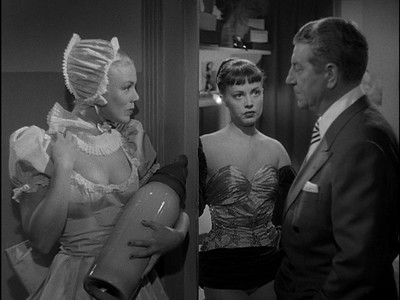
Perhaps sensing something is in the wind, Max decides it's time to move on. He has made a big score in gold with his longtime partner Riton (Rene Dary), and once he unloads it, he can go off the job. For a guy who values being in control, things are starting to slip away that will make this complicated. Riton has a new girl (a young Jeanne Moreau) and information from his loose lips passes to hers, and then on to Angelo (Lino Ventura), the drug dealer angling for the top spot. Max even tries to offer up his own protégé, Marco (Michel Jourdan), to plug the hole he will leave, but it's no good. Riton gets kidnapped, and now Max's last big score will have a totally different payoff.

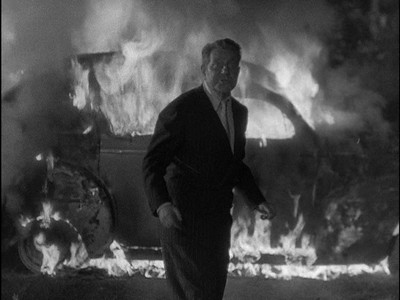
In contrast to the control Max is losing over his own life, Jacques Becker exerts it in spades over his film. Touchez pas au grisbi is masterfully constructed, moving at a confident pace and building in tension and suspense as Max's predicament worsens. It would be easy to just pile the conflicts on the beleaguered hood, but Becker is exacting in his plotting, twisting the plot only when it makes sense, not just for the sake of having more kinks in the narrative. The finale of the picture is haunting and desolate, involving a burning car far off the beaten path, a flaming symbol of the tragic end that could await all of these players if they don't maintain the core values of loyalty and commitment to purpose that Max has always placed his trust in and that have carried him through this far.


As a personal aside, the scenes with the car in Touchez pas au grisbi bring to mind something that happened to me when I was younger. It was in my college years, during a period where I regularly drove back and forth from Los Angeles to where I lived in the high desert because there was nothing to do in our town. One night, on the opposite side of the freeway, I saw a car stopped in the middle of the road, its headlights on, and a man on his hands and knees in front of it, facing the vehicle. No one else saw it. I was driving, and my passengers insisted I was crazy. But I know I did, I know it was there.

I guess it's neither here nor there, and it seems like something out of a modern rural crime picture than Jacques Becker, but Grisbi makes me think of it all the same.

This was prepared as part of my review of the boxed set 10 Years of Rialto Pictures for DVDTalk.com.