Showing posts with label david lynch. Show all posts

Thursday, May 23, 2019

THE DAY HE ARRIVES - CRITERION CHANNEL

This review was originally written in 2012 for DVDTalk.com. It is reprinted here on the occasion of the Criterion Channel launching a triple feature of Hong Sang-Soo films that also includes Claire's Camera and On the Beach at Night Alone.


Seongjun is a filmmaker who made four films before abandoning the craft and becoming a professor at a small school in the Korean countryside. On the occasion of The Day He Arrives, the latest from Hong Sang-soo (Woman is the Future of Man; In Another Country [review]), the emotionally wounded artist (played by Yu Jun-Sang) has returned to Seoul to visit a friend, Youngho (Kim Sang Jung). On that first day, the friend is nowhere to be found, and so Seongjun wanders his old stomping grounds, running into an actress he knows, drinking with some film students, and when deep in his cups, visiting his ex-girlfriend, Kyungjin (Kim Bo-Kyung). There is still pain between them, and also some love, though when she sends him away, it seems for the best.

When we see Seongjun again, it's the next morning, and he is back on the hunt from Youngho. If the circumstances look the same, it's because they are. The Day He Arrives, for the purpose of this film, is every day, and every drunken night gives over to the same hungover morning. Seongjun realizes it...and he doesn't. The only time he acknowledges the passage of days, it's when he runs into the actress again. He remembers seeing her the day before, and she remembers seeing him. The air around her is different.


On day 2, Seongjun connects with his friend, and they go out together, hooking up with his colleague, a woman named Boram (Song Seon-Mi). Youngho and Boram are film professors, as well, and they teach together in Seoul. Boram is attracted to Seongjun, she likes his films, and she's curious about his broken heart. He is distracted, however, when they go to a bar called Novel, and the pretty owner turns out to be a dead ringer for Seongjun's ex-lover. Indeed, in a move reminiscent of Bunuel (or perhaps Lynch), Kim Bo-Kyung also plays Yejeon. The director is drawn to this woman, the coincidence is too overpowering. It must mean something, right?


This is the central philosophical question that Hong Sang-soo sets out to examine in his mesmerizing drama. The repetition of events in The Day He Arrives is not an empty gimmick, it's a considered choice that has been undertaken with purpose. As each new version plays out, different things happen. On day 3, an actor friend joins the group. Seongjun also makes progress with the bartender. On day 4, Youngho is drunk and reveals himself a little more. Each character is getting a kind of do-over. They take more risks, speak more truths, and essentially get at what they are trying to get at.

I suppose how you interpret the changes and escalation is going to determine how you assess The Day He Arrives. It may also be a personality litmus test. The liner notes to the film, written by critic James Quandt, are titled "Déjà Vu," but I think that's too tidy a concept for the existential riddle that Hong is posing. His main character sets the parameters when he says he doesn't believe that coincidence has meaning. Life is a series of random events, and we spend so much time trying to connect them, we risk missing that there is only one inevitable outcome. Whatever circumstances keep bringing these people together, whatever common thoughts drive them (throughout the movie, conversations are repeated with speakers switching roles and/or echoing each other in the discussions), this is all chance. For the optimistic among you, the repetition of these happenings ultimately puts luck on your side. In a kind of Groundhog Day romantic scenario, the characters can get better, do better, and get closer to some kind of true connection. If you're pessimistic like me, the randomness only proves to emphasize how alone we, as humans, really are. Every day, Seongjun gets to know the barmaid a little better, gets to like her more, and eventually succeeds in being with her...only to let his own emotional dysfunction dictate his next move. It's like the old saying goes, no matter where you go, there you will be. Seongjun can't help but be alienated. He is eternally the outsider, always arriving, never staying.


The Day He Arrives, for all its long scenes of conversation, is a tightly edited film. For its surreal concept, it's also surprisingly grounded. The acting and the writing are naturalistic. Hong never forces the drama, nor does he spell out his intentions through overly explanatory or self-reflexive dialogue. Instead, his references are subtle, and he lets the actors be themselves within the scene, lets them find the truth. The camera probes occasionally, moving in tighter on a moment when further intimacy is required, but otherwise it's unobtrusive. We hang back and watch, we aren't pushed into the center of the intellectual mystery. This, of course, makes it all the more intriguing. Hong seduces us with the unknowable, and it's hypnotizing. Even as we begin to discern the magician's tricks, the illusion is never dissolved--meaning we are there wholly and completely when the final devastating day comes at last.


Saturday, July 21, 2018

SELECTED SHORTS IV: ANIMATION EDITION - CRITERION CHANNEL

The Criterion Channel, in addition to hosting a plethora of feature films, also has a varied collection of short films--live action, animated, fiction, documentary; comedy and drama; silent and talkies.

Since this will post while I am attending this year’s San Diego Comic-Con International, I decided to select this month’s films according to an appropriate theme. Namely, all of these shorts are animated.


Old Man (2012; United States; 6 minutes): Director Leah Shore takes a recorded phone call between author Marlin Marynick and an imprisoned Charles Manson and brings it to life via a mish-mash of animation styles. The technique is impressive, but the intent is questionable. These morphing images defang the malice and sick ideas inherent in Manson’s rant, which may be the point, but it doesn’t sit well with me to see his ramblings treated as if they were a piece of innocuous found audio or an internet meme. The lack of editorialization more or less suggests that he’s a harmless old coot and his stream of consciousness is at best humorous and at worst normal. Which may be overthinking it, but that’s my impression nonetheless. 

The short is accompanied by a 5-minute introduction by the director, which failed to change my mind. While Shore does give some insight into her own creative process and explains how she stitched this six minutes together from hours of interviews, it also reveals a lack of insight into the source material and a strange divorcement from everything loaded into the Manson persona. Art for art’s sake is fine, but callous kitsch is just lazy.


Call of Cuteness (2017; Germany; 4 minutes): Brenda Lien uses a tiled animation style to spotlight our obsession with cats and the memes their opportunistic owners spawn before moving into more grotesque areas that call into question just what the hell we are doing to these animals. Both alluring and unsettling, it’s just the right kind of media consumption indictment, not entirely what it critiques, but just enough that, when it’s all said and done, we feel like a pile of garbage for so easily being drawn in.


Pussy (2016; Poland; 9 minutes): This one is not about cats. But it does have a vagina that detaches itself from its owner and becomes sentient. I was disturbed by it, but I don’t think director Renata Gasiorowska intended me to be. Which probably says enough and maybe I should just stop right here....


Begone Dull Care (1949; Canada; 8 minutes): Set to the jazz of the Oscar Peterson Trio, this abstract animated film from Norman McLaren and Evelyn Lambart is a joyous explosion of sound and color. Bending lines, morphing shapes, the texture and groove of film itself dances to the rhythm, bringing improvisational modern art together with two of the most popular art forms of the time--film and music. A delightful confectionary.


Asparagus (1979; USA; 18 minutes): Suzan Pitt’s animated experiment was often paired with David Lynch’s Eraserhead in its early years, the two playing art houses together as a dual course for adventurous filmgoers.

The colorful visuals perfectly bring to life late 1970s psychedelia, looking like an underground comic strip animated by a Monty Python-era Terry Gilliam. Pictorially stream of conscious, Pitt’s narrative is made up of images melting and transforming into the next thing. It is both mind-bending and sexual, with the image of the asparagus plant itself serving as a proxy for both male and female sex organs.


Edmond Was a Donkey (2012; Croatia; 15 minutes): An office prank inspires an outsider to reject the conformity of his co-workers and embrace what makes him different; in this case, his desire to have the simple, contemplative life of a donkey. Franck Dion’s 3D modeling has the feel of a modern storybook, making the surreal seem solid. Edmond’s journey is one of perception. Is he sick? Is he crazy? Or does he just know more than everyone else. The ending is appropriately ambiguous in some ways, but also allows the viewer to feel a sense of satisfaction by leaning in favor of Edmond getting his wish.

Monday, May 28, 2018

SELECTED SHORTS III - CRITERION CHANNEL

The Criterion Channel, in addition to hosting a plethora of feature films, also has a varied collection of short films--live action, animated, fiction, documentary; comedy and drama; silent and talkies.

Short cinema--just like short stories--is a unique art form unto itself, employing different conventions, and bringing with it different expectations, but these pieces are no less worthy of consideration than full-length films. From time to time, I will take a look at a selection of what’s on offer. You can read the previous columns here and here.


Neighbours (1952; Canada; 8 minutes): Two men with adjoining homes find their friendship disrupted by a flower growing on their property line. They argue, build fences, and try to take possession of the plant until the whole thing overwhelms them. Told without dialogue, and shot using stop-motion techniques, Neighbours is a whimsical, surreal parable. Director Norman McLaren was a wizard with the camera, and he says more about human greed and the futility of war in this abstract handful of minutes than many say with a full script and an extended running time.


Casus Belli (2010; Greece; 11 minutes): A clever construct. Director Yorgos Zois strings people together queue by queue, showing groups standing in line for groceries, a nightclub, confession, off-track betting, an art museum, and an ATM. We scroll past each gathering, and the first person in the line steps out of it and moves over to the next. Unfortunately, when Zois gets to his point, the turn is rather heavy handed, ending at a bread line and featuring an actor giving a disdainful look to the camera when the charity comes up short. I get the idea is to switch from the frivolous to the serious, but it’s a pretty obvious move and Casus Belli is less effective for it.


Skunk (2014; USA; 17 minutes): Writer and director Annie Silverstein creates an uncomfortable, but strangely comforting short tale of adolescence. When a Texas teen (Jenivieve Nugent) takes her dog down to the river to give him a bath after he ended up on the wrong end of a skunk, she meets an opportunistic boy (Sam Stinson) who toys with her emotions, promising her all kinds of things if she’ll hook up with him and let him use her pooch in a dogfight.

Stories like this come with a built-in tension, as we have seem the likes of this boy before, and we know his brand of interference rarely bodes well. One watches Skunk with a knot of worry. Just how bad will this go for Leila? Silverstein approaches the events with an unwavering honesty, she is not exploitative. While Criterion has smartly paired this with Andrea Arnold’s Fish Tank [review], I’m perhaps reminded more of David Gordon Green’s George Washington [review]. What all three directors have in common is an empathy for their characters; their storytelling is observational, they never look down their noses at their protagonists, but rather try to put themselves into the situation to see where they come from.


The Acquaintances of a Lonely John (2008; USA; 12 minutes): A solo outing from Benny Safdie (one half of the team behind Good Time), this short follows one guy on his daily meanderings. Aimless by design, one I suppose should be prepared to forgive a lot, but only a few of the scenarios are charming. Likely Safdie--who also plays the titular John--is making best use of what he had available; the film mostly loses its way when it settles down at a gas station for some Clerks style antics. Ironically, The Acquaintances of a Lonely John is actually best when Safdie is alone and simply amusing himself.


John’s Gone (2010; USA; 22 minutes): Josh and Ben Safdie directing together, with Ben starring as John--perhaps the same John from Benny’s earlier effort, hard to say. The tone is similar to The Acquaintances of a Lonely John: a touch of comedy, a loose plot, episodic. Here John is hustling various goods out of his apartment, selling second-hand junk and pulling internet scams. The film itself puts focus on the strange customers, and John’s interactions with other people in his apartment building. He’s a guy who seems to try to have a hand in everything, and sometimes it gets him in trouble. Many narrative opportunities are missed here. The Safdies could go in deep on any number of the relationships, or even hold John’s feet to the fire when a one-night stand he was rude to comes back, but John’s Gone always stays on the superficial. Ultimately, there is no ending here, no conclusion to be drawn, the movie just fades out.


The Black Case (2014; Canada; 13 minutes): A mysterious, surreal drama with elements of horror, The Black Case causes the audience to question the nature of identity, voyeurism, and in a way, one’s own physicality. Set in a strange hospital scenario, we see two children locked away and the doctor and nurse that are meant to care for them. Just about everything isn’t what it seems, and though co-directors Caroline Monnet and Daniel Watchorn eschew all exposition--and hell, dialogue for the most part--they don’t obfuscate for the mere sake of it. Like Eraserhead but with one foot still in reality.


L’opera-mouffe (1958; France; 16 minutes): Also known as Diary of a Pregnant Woman, this black-and-white short from Agnès Varda, who was indeed pregnant at the time of the making and serves as her own model at the start of the picture, is more of a collage of the life cycle of a small French village than it is a look at the cycle of pregnancy. Set to a score by the great Georges Delerue (Jules et Jim), Varda details many aspects of existence, from sex and food to drunkenness and anxiety. The bits that do touch on the birth process tend to be more abstracted, including the surreal growth and eventual hatching of a chicken from a glass bowl. The result is whimsical and strange, but also kind of sobering. Also, a greater collection of real faces you aren’t likely to find in any cinematic era.

(This film is also available on the DVD of Cléo from 5 to 7.)


The Burden (2017; Sweden; 14 minutes): Another surreal musical, this time by director Niki Lindroth von Bahr, whose Tord and Tord I covered back in the first installment of this column.
Created via stop-motion animation, The Burden features fish in a motel, mice working in fast food, telemarketing monkeys, and a lone canine shopping in a mega-mart. In each scenario, the lonely animals are searching for some kind of connection and eventual release in an increasingly convenient world (or should that be “convenient” in quotes?).

Charming, unpredictable, and surprisingly joyous.


Friday, October 13, 2017

TWIN PEAKS: FIRE WALK WITH ME - #898


Sometimes don’t you just wish people would leave well enough alone?

Listen, I love Twin Peaks. And I love David Lynch. So much so that I saw Twin Peaks: Fire Walk With Me on opening weekend. I saw it with my friend who also loved Twin Peaks, and I think there were only three of us in the whole theater, which usually makes everything better. You know, because it’s quiet and the theater is yours and you can just enjoy it. No such luck here. I hated Fire Walk With Me. So much so that I waited until just this past year to watch it again, despite re-watching the whole of Twin Peaks itself more than once, as part of my re-immersion for Twin Peaks: The Return (or, if you will, Season Three).


Now, I know some of you are clicking off or discounting my opinion for bias or are firing up the comments to let me have a piece of your mind, but let me just say this: not only is twenty-five years a long time to hold a grudge, but I don’t “hate watch” anything. I would never give a movie another spin without some genuine interest in seeing if I was wrong. Over the decades, I have heard many defenses of Fire Walk With Me, heard many a person tell me how much it terrified them, and I was interested in seeing what those people saw. I mean, I’m not twenty years old anymore, maybe the person I am now will find something completely different than he once had. Hell, the movie I watched right after this was Luc Besson’s The Fifth Element, which I also hadn’t seen in nearly twenty years, and I didn’t like it as much now as I had when it was new. Anything is possible.

The funny thing is, I had pretty much the same reactions I had the first time, only softer. I partially credit Twin Peaks: The Return, which maybe has helped by elaborating on what would have been Lynch’s technique and intention here. Certainly these two elements connect to each other better than the actual series bridges the gap between. There’s also probably some managed expectations. When Fire Walk With Me first touched down in cinemas, my yen for it was high; spinning it again, I had a better idea of what to expect.


Here are the two main reasons I have trouble with Fire Walk With Me:

(1) It doesn’t work as an individual piece. As both a prequel to the Twin Peaks television show and the beginning of an intended film series about the Black Lodge mythology, it relies heavily on what you know while simultaneously withholding new information in anticipation of a later payoff. It’s merely a sliver.

(2) As a prequel, it doesn’t show us anything that we actually need to know. Fire Walk With Me does not enhance the mystery of Laura Palmer. There is nothing new to be gleaned from witnessing her final days, for seeing her realize the true identity of her tormentor. In fact, it may even detract from the mystique by putting too fine a point on some things. I’ve always felt that Twin Peaks was at its best when there were two potential explanations. Is Leland Palmer possessed by a man named Bob, or is Bob merely a dissociative coping mechanism? (Sorry if you see that as a spoiler, but then why are you reading a review of a prequel to a murder mystery?)


If the goal was to better know Laura Palmer, there was more to be gleaned from Jennifer Lynch’s  book, Secret Diary of Laura Palmer, than there is in Fire Walk With Me. Lynch and co-writer Robert Engel don’t add any more to who she is. This is not a story of an innocent being ruined, but merely the last days of someone who has been victimized to the point of no return. And worse, there is a creepy aspect to how Lynch chooses to show the events, leering at Sheryl Lee’s naked body, that seems to dispel any condemnation of the abuse that got her here. The camera sweats and pants in her presence as much as Leland Palmer does, lingering on Laura’s exposed pain as if the suffering itself were art.


Which, let’s be real, if it’s art, it’s because Sheryl Lee elevates it. If there is any one reason for Fire Walk With Me to exist, it’s to show what a beast of a performer she is. Laura Palmer is no easy role. She’s simultaneously meant to embody the American cliché of the perfect “girl next door” and show all that is rotten behind that illusion--in other words, the culmination of Lynch’s oeuvre up to that point embodied in one character. At this time in her life, Laura doesn’t know whether she’s coming or going. Between the trauma she’s suffered and her self-medicating, her moods swing at the flick of a light switch. At the same time, she attempts to maintain a semblance of control by being all things to all people. Lee manages to hit every note--every feeling, every mask, every persona--while also maintaining a consistency that means Laura is never actually “out of character.” She’s always the same person underneath, she never deviates. It’s astonishing to watch. How Sheryl Lee wasn’t every famous director’s first choice for their next movie is beyond me. (And there still isn’t an actress whose scream can unnerve and curdle the blood as much as Lee’s, as evinced by her anguish at the end of The Return.)


The opposite can be said of Ray Wise in the Leland Palmer role. Whatever nuance and restraint he had in the television series is gone; Lynch has reduced him to a bug-eyed pervert who can barely use his words. It’s indicative of a cartoonishness that permeates Fire Walk With Me and the worst parts of The Return (Dougie Jones, anyone?). There’s a sense that Lynch finds this all disposable. It is just television, after all. How else to explain the chintzy slow-mo effects or his reliance on the jazzy posturing that seemed so hip and fun in the orginal series but just seems perfunctory here? Fire Walk With Me is paving the way for the near self-parody of Lost Highway.


Which isn’t to say there is nothing good. Were the first chunk of the movie, with Chris Isaak as Agent Desmond, shaved off and turned into its own thing, Lynch might have had the makings of an interesting modern crime flick. And while seeing Laura’s last days doesn’t shed any light on her character, we do see different sides of Bobby (Dana Ashbrook), James (James Marshall), and Donna (a miscast Moira Kelly), showing how at times they are nearly as close to the edge as their friend.


It’s not enough, though, and those that would contend that a longer director’s cut would maybe solve these problems need only look to The Missing Pieces to see that this would not be the case. It doesn’t take much to see that, with the exception of the portentous scene with Doc Hayward, there was nothing essential trimmed out, it’s just more of the same.

When I expressed disappointment over the conclusion of Twin Peaks: The Return, a friend pointed me to this excellent clip of Siskel and Ebert arguing over Blue Velvet back in the day. There is something to be said for Ebert’s reaction against how Lynch sometimes treats women, but also much that is right about Siskel’s contention that the director evoked from Roger exactly what he wanted, that he played him like a violin. While I believe that to be the case for the David Lynch they are debating, I’d contend that Fire Walk With Me marks the artist beginning to lose control of his instrument. I wonder if our willingness to fill in the gaps for him, to rationalize the missteps of The Return or even some of the unfinished threads of Mulholland Drive, is us giving the man too much credit (as I likely did in my review of Inland Empire), and by turn, his being lazy. I’ve heard arguments that the best thing about older Lynch is he doesn’t take the audience into consideration and just does what he wants, but at the same time, art is about communication, and even though it is the audience’s responsibility to do some interpretation, it shouldn’t be our job to do the actual writing or to build with tools that aren’t provided for us (no matter how much we may want to). Or invent meaning where there is none. If Fire Walk With Me is where David Lynch stopped giving us consideration, how is it that we still give so much to him? Particularly here, where the brilliant flashes we see in both Mulholland and Twin Peaks: The Return are absent.

Twin Peaks: Fire Walk With Me? More like Just Walk Away. Don’t @ me.


Saturday, May 27, 2017

DAVID LYNCH: THE ART LIFE - #895

Though not yet released on disc, Criterion is offering David Lynch: The Art Life on digital platforms like Amazon and iTunes.


One wouldn’t expect any portrait of David Lynch to be all that straightforward, but the straight story is exactly what you’ll get when watching David Lynch: The Art Life. Building a narrative from an extended monologue by the auteur, directors Rick Barnes, John Nguyen, and Olivia Neegaard-Holm put together a pretty clear path from Lynch’s early life to his first film, Eraserhead, backing the anecdotes with home movies, personal photographs, and images of Lynch’s art, as well as contemporary footage of the man at work in his home studio. David Lynch: The Art Life is both insightful and surprisingly unassuming. Those expecting Lynchian digressions into uncharted weirdness will be surprised to find there are none here. Rather, the artist looks back with clear eyes at the building blocks and stepping stones that led to his cinematic career.


Those also expecting behind-the-scenes gossip or explanations about Lynch’s challenging filmography are going to be more disappointed than surprised, however; The Art Life is not about that. Nor is it about taking Lynch’s formative memories and looking for their reoccurrence in his fictions. There are some things you might infer for yourself--the tale of the naked woman emerging on his suburban street when he was a child brings to mind Isabella Rossellini’s nude escape in Blue Velvet; his time growing up in Spokane may have been the origin of Twin Peaks [review]; etc.--but the documentarians instead work with Lynch’s fine art, finding images that match his words and juxtaposing the two in provocative ways. David Lynch: The Art Life is a lesson in the other side of the director’s creative life, the one not seen as regularly.

The greatest revelation here is just how average Lynch’s experience seems. But then, isn’t that also thematically in tune with the cinematic stories he would eventually tell? Beneath the most innocuous surface lurks darker thoughts. It just takes a willingness to look behind the veneer to find them--and that’s exactly what David Lynch: The Art Life does.


Monday, January 12, 2015

3 WOMEN (Blu-ray) - #230


“I’m trying to reach toward a picture that’s totally emotional--not narrative or intellectual--where an audience walks out and they can’t say anything about it except what they feel.”

Robert Altman’s description of his intentions with 3 Women doesn’t really decode the entire thing, but it does give a key to opening up whatever secret book holds the answers. Because 3 Women, which Altman wrote and produced under his own Lion’s Gate banner as well as directed, is not a story that works on paper, it’s not a script with a traditional plot. Its act breaks are more like psychotic breaks, in that the movie transforms twice, shifting when its main characters face trauma, swapping their roles, and yet never stopping to explain. Altman is clear in his nod here to Luis Bunuel, naming a pushy boss Mrs. Bunweill as tribute, and interestingly enough, holds much in common with the movie the Spanish filmmaker released that same year. 1977 brought us both 3 Women and That Obscure Object of Desire. In Bunuel’s film, the lead actress changes mid-way through the picture, a confounding narrative conceit that demands the audience take a leap of faith that it all means something. Altman plays a few parlor tricks of his own. Both these men were driving down Mulholland Dr. a couple of decades before David Lynch.


The story here begins normally enough. A young woman named Pinky Rose (Sissy Spacek) is starting work at a nursing home, and she is assigned Millie Lammoreaux (Shelley Duvall) to train her. The two couldn’t be more different. Millie is tall and composed; Pinky is small and shy. Millie talks constantly, yet no one ever seems to listen; Pinky is always watching, yet others often don’t see her. Millie pretends to be the sophisticate; Pinky is a child. Millie likes dressing in yellow; Pinky is nicknamed Pinky for a reason.

Pinky is also somewhat of a mimic. An emotional and physical chameleon. She is drawn to Millie and soon begins copying her. She borrows a phrase here, a detail there. When Millie needs a new roommate, Pinky seizes on the opportunity. What better way to observe her new obsession than in her natural habitat? It’s like Single White Female for the art house, but without the murderous intent.


Things are up-and-down for the new roomies. Millie notices things being slightly off about the younger woman. Likewise, the landlord’s wife and proprietress of the saloon where Millie drinks, the similarly named Willie (Janice Rule), appears suspicious of the new girl. I suppose in this pyramid, Willie is the crone, and indeed, she and her elaborate paintings have a kind of bewitching effect on Pinky, drawing her in the way the moon draws the tide. The spying girl often observes Willie through water, or in relation to water, like in a fish tank or at the bottom of an empty pool, and every time, Willie can sense the staring almost immediately.


Altman makes great use of the murals that Willie paints (though in reality they were created by artist Bodhi Wind). She does small abstract work that can be hung on walls, though those she tends to riddle with bullet holes, which only calls further attention to their humble size. Her masterpieces, on the other hand, are large and impressive, covering walls or the floors of swimming pools. She depicts mythic creatures, alien and surreal, masculine and violent. In one, which also ends up being the final image of the movie, her bizarre creatures rant and rave at an object in the heavens, suggesting they are as primal as the apes at the start of 2001 [review]. One can presume she is painting the world she sees around her--the saloon is populated by men riding dirt bikes and shooting pistols--but maybe she also feels that desperate pull herself.

Everythng changes midway through 3 Women. In a surprising twist--though not really a spoilery one, it would be sort of impossible to spoil a movie this unconcerned with conventional narrative--after Millie turns on her, Pinky tries to drown herself. Feeling guilty, Millie stands by her while she is in a coma, only to find the girl who wakes up in that hospital bed is radically changed. Pinky is now the assertive one, and Millie can only do her best not to be completely subsumed, to have her entire identity swallowed. It takes another tragedy, this time involving Willie’s baby, to shake things up again. (Digression: It might be interesting to compare how Altman allows the birth to affect the lives of the main characters in a movie about women vs. how the birth scene at the end of his male mid-life crisis picture Dr. T and the Women [review] affects Richard Gere. Is there something to be said for why it is magical and liberating for the man and not for the ladies?)


I briefly considered tracking my feelings throughout my viewing of 3 Women, but that seemed to kind of miss the point of the experiment by intellectualizing it too much. It would also pull me away from the screen and make me focus on the paper, and 3 Women requires undivided attention. That said, in the first half of the movie, there is definitely a feeling of desire and hope, but that translates to pity, as well--which is an audience reaction, not a function of the storytelling. Neither Pinky nor especially Millie are that self-aware. Later, I felt in sync with Millie, as Pinky’s attempted suicide and the fall-out thereafter inspires anxiety in both the viewer and the actress. Duvall is a fascinating onscreen presence. She almost doesn’t seem like that good of an actress. Her delivery can be flat, and she can appear ill at ease. Her gawkiness can be hypnotic, in much the same way her Margaret Keane-like features make her beautiful. I am always hyper aware she is Shelley Duvall, whether she’s playing the scared wife in The Shining or Olive Oyl in Popeye. Yet I find myself enjoying watching her all the same.


It’s a demeanor that is ideally suited for a movie as intentionally dreamy as 3 Women. Shelley Duvall is practically surreal unto herself. This makes it all the more smart to cast Sissy Spacek opposite her. Spacek is naturally more grounded. As Pinky, she maintains the girl-next-door vibe she had in Badlands [review] and Carrie, and yet is utterly convincing when she becomes the more confident and mean of the two roommates. One could posit she’s putting the little-girl-lost routine to bed for good. Performance-wise, she is as natural on screen as Duvall is awkward. I would almost try to argue that all of 3 Women is Millie’s dream, given how menacing a figure her counterpart becomes, but the changes occur in Pinky’s vision. She observes, she sees the rifts, and she dives into them.


Altman approaches all this with a measured gaze. He doesn’t push the odd happenings too hard, he doesn’t go all wonky or psychedelic. Pinky’s early “visions” are more practical. The first superimposition of waves over the image, for instance, uses water that is actually in the scene. It’s only near the end that Altman steps away from this, indulging in one short yet meaningful dream sequence, a kind of quick run through the greatest hits of everything we’ve seen so far. He’s practically working at odds with his own skewed motives here. 3 Women deals with strange events, but Altman makes most of it seem as real as possible. Even the obvious symbols, like the pair of twins that work with Millie and Pinky, are really just twins who work with Millie and Pinky. Though, they do allow for some leading dialogue. “Do you think they know which one they are?” Pinky asks. “Maybe they switch back and forth.”


This earthiness and lack of show makes it easier to go along with the more obtuse occurrences, just as Gerald Busby’s distant and ominous music provides a throughline in the sometimes rambling narrative. Altman is far from indulgent, he’s giving the audience as much as required to keep them invested and on track. It’s only in the final scenes, when the lever on the cinematic slot machine is pulled one last time and the titular trio of women slides into its final roles, that some might end up truly confounded. I’ve seen the movie twice now and I’m still not sure if it’s a jackpot of “Ah-ha!” or otherwise some combination of “what’s that?” and “why this?”

I like it anyway. I am fascinated and enraptured, hypnotized by its vibrant colors the way Pinky is hypnotized by Willie’s paintings, every time I watch it. And I don’t worry about what is happening or what it’s trying to say. Which would mean Altman is successful in creating an all-in experience, one that entices and teases and provokes even if it never explains.


Note: 3 Women will be playing the NW Film Center on Sunday, January 18, as part of a Robert Altman weekend.


Monday, May 9, 2011

SOMETHING WILD - #563


It's true what they say, you know, about how you always remember your firsts.

My sexual awakening can be traced through cinema thusly: I saw my first bra when my dad snuck me into National Lampoon's Animal House, sometime just prior to my starting school. I don't remember much else about that screening, but I do recall some heavy petting in the back of a car. Movies were contraband at that point, we weren't allowed to go due to church connections. My dad was an assistant pastor in suburban Michigan, and my very earliest movie memories are of seeing clandestine matinees in a college theatre. Mainly Bruce Lee stuff. And a bra in Animal House.

My first pair of boobs was Caddyshack. I don't know if it was during the original release, but it's possible, because the movie embargo broke the year prior with The Black Stallion. My mom placed her hand in front of my eyes, but since her palm was a few inches away from my face, I just moved my head to the side a little to see the bare breasts. To this day, I'm still a bit of a prude, so it at least had some effect.
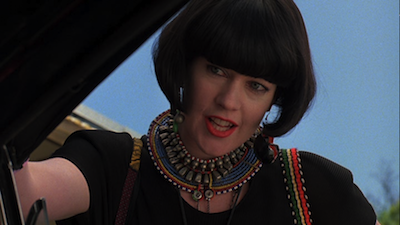


And the first time I remember being turned on by a sex scene in a movie and not grossed out was Something Wild. I was 14 and I managed to catch the off-center comedy on cable after hearing Siskel and Ebert enthuse over the film. It wasn't the first time I had seen sex in a movie--times had changed so much, my dad had taken me to see Scarface and Flesh + Blood during their theatrical runs (both terrible then, both terrible now)--but none of the smut really connected. Given how many movies I saw with my parents, I can be forgiven feeling oogey about such action. Cable liberated me in that sense, giving me a way to view cinema unsupervised, and I taped Something Wild and ended up watching it multiple times. And, yes, I'm sure I watched the scene when Melanie Griffith mounts Jeff Daniels in the hotel more than the others. Perhaps I saw myself in the Daniels character, even if others probably didn't. He was a meek good guy hiding a rebel deep down; I was closer to the big-mouthed rebel hiding a nerd underneath his brash exterior.
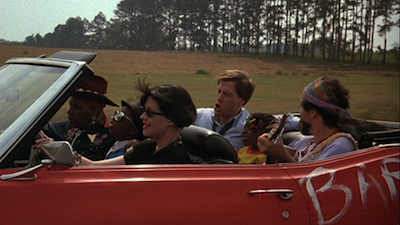


I am now more than twice the age I was when I first saw Something Wild. Hell, I think I'm at least twice the age I was when last I saw it. That VHS is long gone, and so is the quirky time in which a movie like Something Wild could be made without having its weirdo tendencies smoothed out by heavy market research. Melanie Griffith's portrayal of Audrey, a.k.a. Lulu, wouldn't fly anymore. For one, she'd be botoxed and body-doubled to the point of no longer actually looking like a real woman; for another, prevailing mores would dictate she would have to be broken somehow. Audrey predates the coinage of the "manic pixie girl" by nearly two decades, so she's not actually a victim nor does she have any kind of mental problem. Sure, the liberated woman whose past catches up to punish her for her freedom somewhat fits the victim bill, but Audrey's plight is more like something out of an old film noir than it is a product of post-modern malaise. She's a conwoman and a thief, after all, who picks up Charlie Driggs (Daniels) because she sees an easy mark that she can manipulate to going along with her schemes.

The way I see it, the whole of Something Wild's first hour or so is a movie that could only be from the 1980s. There is a kind of quaint naiveté to how Demme presents the seediness of city life and the criminal misadventure that finance-man Charlie finds himself on. He is a suburban husband and father who gets hijacked by a crazy girl who takes him on a road trip fueled with booze, sex, robbery, and lies--some hers, but some his. The suburbs has its secrets, too. Clearly something was in the zeitgeist, since 1986 was also the year David Lynch cracked the suburban egg in Blue Velvet. Perhaps the weirdoes were just sick of the normals fobbing their neuroses off on them like they were blaming their farts on the dog. It was time to show America what really went on inside the house next door.
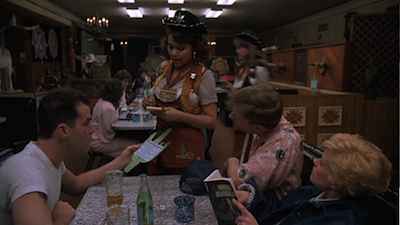


Digressing slightly, I had a similar reaction only just seeing Walter Hill's 1979 film The Warriors for the first time a few months back. The Warriors has a surprising lack of context, and so it was fascinating to imagine that its gangs were what Middle America actually imagined thugs and hooligans looked like in New York City at the time. If you lived in a town where there was no danger of you being mugged on the street, maybe it was perfectly reasonable to you that a crook in the Big Apple might wear a baseball uniform or clown make-up. It's this kind of sheltered misconceptions that Demme and screenwriter E. Max Frye (Palmetto) were satirizing in Something Wild. Lulu had crazy clothes and listened to music that wasn't in English, so of course it was okay to get in a car with her and drive to Pennsylvania. If a guy like Charlie was going to cut loose, it should be with a woman like her. Where was the harm? Hell, you know you totally would.
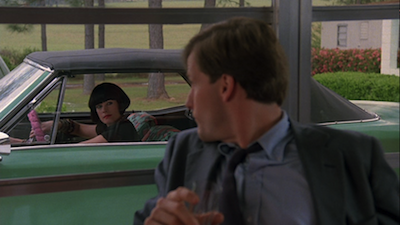


Charlie ends up on the free-love freeway, leaving job and family behind, meeting Lulu's mother, discovering her name is Audrey, pretending to be her husband, going to her high school reunion. To be fair, her real crimes are just out of sight whenever he's around, he doesn't know she's stealing and lying. That's just the thing, Charlie is oblivious. Thus, he's not going to see it when the harsh reality comes speeding at him like an oncoming truck--a simile I don't throw out just for the hell of it (it's too obvious on its own). Compare Charlie at the start of the film when he first chases Lulu across the street and nearly gets run over to the confident Charlie at the end who outwalks a city bus. In other words, traffic is a signifier!
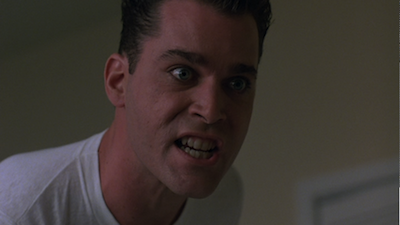


A young Ray Liotta plays this harsh reality. He is Ray, a figure from Audrey's past and a real bad guy. He is jealous of Charlie, and so he puts his imagined rival right in harm's way. No plausible deniability if you're on camera while the convenience store gets robbed. The back and forth escalates between them, with Charlie getting the chance to play the hero, but also getting that heroism shoved back in his face. Sure, Audrey's appearance normalizes more and more as the movie progresses, but even that's a noir trope: the femme fatale is the dark-haired beauty, but the gal whom the protagonist eventually runs to is the more earthy blonde, the kind of girl who can wear a summer dress unironically. The change in either character is not so simple as just Audrey becoming grounded and Charlie letting go. Demme and Frye are working to subvert that, and even after all this time, the culmination of Ray's psychotic rage is still shocking. The climactic scenes of Something Wild are proportional in violence to the alternate feel-good image of a multicultural world that Demme builds elsewhere in the picture. The filmmaker really goes all the way in the showdown, and it's easy to forget that it's coming, to be as blind as Charlie, because the goofy romance can be real distracting.
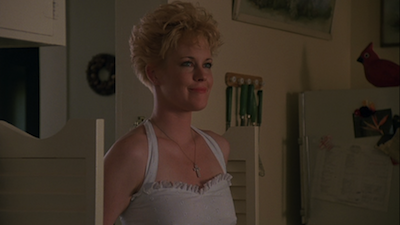


Which is really to say that Melanie Griffith can be real distracting. Something Wild kicked off a string of truly excellent performances from the actress. Or I should say, a string of excellent performances sprinkled in with a bunch of truly bad movies. Something Wild was such a flashpoint for Griffith, it's too bad she didn't make smarter choices after it came her way. Excepting her Oscar-nominated turn in Working Girl two years later, even most of her good movies are largely forgotten now. Yet, seeing her in Something Wild makes it easy to remember why she was the "It Girl" at least for a little while there. As Audrey, she is carefree and natural, comfortable with the appearance of going with the flow but also equally adept at showing that more was going on than was immediately obvious. In the early part of the movie, Demme gives us more time with Audrey than he does Charlie, and we're several steps ahead of the patsy in knowing what kind of game she may be running. As the character axis shifts and we move more into following Charlie, it actually mirrors what is going on with Audrey. She is growing tougher and hardening herself. Griffith shows the walls going up as the character tries to put Charlie on the other side. She knows the consequences they could face, and in her way, she's really the one playing the heroic card by trying to send Old Yeller into the woods. "Get away, I don't want you anymore, you dumb dog!"
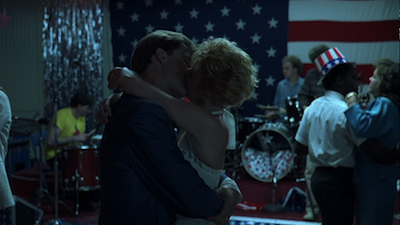


A lot of the Demme trademark touches are evident in Something Wild. He over directs the weirdness, creating characters and environments that are too quirky to ever truly breathe in the real world--Audrey's wardrobe, Audrey's apartment, Audrey--and yet he somehow makes them work. The high school reunion is one uninterrupted party with long cuts of the director's current favorite band (in this case, the Feelies) doing their thing. The humor is black, the violence is even blacker. In much the same way that Gus Van Sant was his most Van Sant-like in My Own Private Idaho, I think Something Wild is the purest form of Demme. They both might have made weirder movies and better, more substantial movies, but these choices show both of these arististc oddballs at their most peculiar and expressive. You can't imagine anyone other than Gus Van Sant making Idaho, and only Jonathan Demme could have made Something Wild.
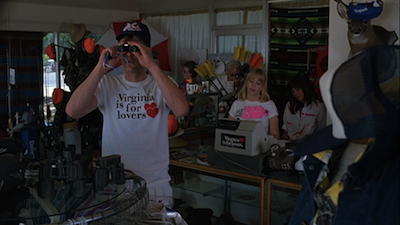


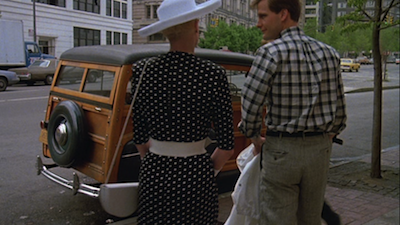
There is a lot going on in Something Wild that went right by me all those times I watched it as a teen. While it can be appreciated as the fun yet slightly sinister romp that it is regardless, there are deeper things about growing up and wrestling with nostalgia and dealing with the person you have become vs. the person you wanted to be that only have maximum impact after you've gathered a few years under your belt. For whatever strange notions about the world that Audrey has (to describe it as her mother did), the persona she has cultivated as Lulu is meant to both hide her identity (think Ava Gardner in The Killers) but also allow her to hang on to the kind of person she imagines herself to be--a little bit of a 1920s flapper, a little Bettie Page, a little Holly Golightly. (Okay, it's easier and easier to see what an influence that this had on my young psyche. The black stockings and the dark, bobbed hair alone....) By the time she gets back to her hometown, she is presenting herself as the woman her mother would have liked to see her become. By the time Something Wild ends, however, she has morphed into the woman she was always intended to be, an Eliza Doolittle of her own design, big hat and all, heading off to the races.


This disc was provided by the Criterion Collection for purposes of review.
