Showing posts with label schlondorff. Show all posts

Sunday, March 25, 2018

BAAL - #914


Made for German television in 1970, Volker Schlöndorff’s adaptation of Bertolt Brecht’s Baal transports the 1918 play to (then) modern day, providing filmmaking wunderkind Rainer Werner Fassbinder with an impressive showcase for his acting skills, but ultimately failing in making the work feel vital to the times. In fact, Brecht’s widow was so unhappy with it, the family estate placed a ban on the release that was not lifted until four decades later.

Baal is the story of a larger-than-life personality--a bisexual, alcoholic poet--equal parts Byron, Kerouac, and Bukowski. Fassbinder plays the bard with a full-force gusto. Baal is besotted with drink and with his own self-worth, resorting to reciting his rhymes rather than engage with others, preferring squalor to success and society. Indeed, the film’s second scene--each individual sequences is announced by numbered title cards, lending a kind of nouvelle vague tenor to the whole montage--is probably its most interesting. Decked out in a suit and tie, Baal is being hosted by a rich benefactor willing to publish his poems. Surrounded by upper crust intellectuals, Baal tweaks their noses rather than get along. He drinks too much, stuffs his face, insults them, and openly hits on the rich man’s wife (Miriam Spoerri). It’s a bit like watching the charity banquet scene in Ruben Östlund’s The Square--an animal has been let loose in the soiree. Baal’s response to their objections? You shouldn’t have invited me in if you didn’t expect me to be myself.


Which pretty much sums up how Baal conducts himself throughout the story. Anyone who enters into his orbit should expect to be brought down by his gravitational pull. At first, this is compelling in the way that the behavior of scoundrels can often be; across subsequent scenes, Baal publicly humiliates the rich man’s wife, steals the girlfriend of a loyal friend, deflowers her, and then shames her into suicide. The dude is bad news. But as Baal progresses, and we watch the main character wander from bottle to bottle, shivving anyone who stands in between, he starts to be less interesting. To Fassbinder’s credit, he never hits a false note, and the hatred he engenders in the viewer is real, but he and Schlöndorff fail to give us any nuance to the character. His philosophy never shines nor sticks. Brecht appears to provide moments where we might get glimpses of an actual soul beneath the rough exterior, but the filmmakers don’t seize on them.


That said, Baal arrives with a surprising punk rock aesthetic that has less in common with either the French New Wave and Easy Rider Hollywood than it does with the anarchic back-half of the 1970s. From the opening scenes, when a leather-jacketed Baal strolls to the beat of a song celebrating his godlike status, there is a feeling that something gutsy is occurring. Cinematographer Dietrich Lohmann, who would work with Fassbinder on many of his own films like Love is Colder Than Death, has a gritty spontaneity to his shooting. His camera never feels locked down, and so Baal comes over as improvisational as the life of its subject. That keeps the movie interesting even when the screenplay lacks heft.

Side note, but when Baal and his cohort Ekart (Sigi Graue, The Merchant of Four Seasons) hit the road in the German backwoods, was anyone else reminded of David Gordon Green’s Prince Avalanche? Knowing Green’s tastes, it would not surprise me if Baal was somehow an influence.


This disc provided by the Criterion Collection for purposes of review.


Friday, April 12, 2013

PIERRE ETAIX: LE GRAND AMOUR/HAPPY ANNIVERSARY - #655


If you're unfamiliar with the name Pierre Étaix, don't worry, you're not alone. Up until recently, the celebrated French comedian's films have been largely unavailable due to a legal tangle with the distribution rights. I don't know the particulars of what finally caused those rights to be untangled, but soon all film fans will have a chance to get to know Étaix's artistry, thanks to a touring retrospective of his work and an upcoming Criterion boxed set.

The writer/director/star only made a handful of feature films and shorts through the 1960s, following stints as an assistant and gag writer for the likes of Jacques Tati, Robert Bresson, and Nagisa Oshima. Étaix left film to return to his first career as a clown, but not before leaving an indelible mark on the cinematic landscape. In reviewing his final comedy feature, Le Grand Amour, released in 1969 and leading the dual weekend of Pierre Étaix films playing the NW Film Center [full schedule here], it's easy to see why. His playful flights of fancy, careening out of conventional narrative and into the realms of imagination, are delightful and intoxicating. One can't help but imagine that movies like Le Grand Amour were an early influence on Jean-Pierre Jeunet, whose Amélie would not be out of place as one of the many girlfriends Pierre fantasizes about throughout this rumination on love and marriage. (Etaix actually had a small role in Jeunet's film Micmacs [review].)


Le Grand Amour begins with a wedding, as befitting any such movie. Étaix is at the altar, waiting to tie the knot with Florence (Annie Fratellini), and remembering his past loves and imagining a few paths not taken. The ceremony ends, and the film jumps ahead a decade. Pierre and Florence have settled into their married life, with all the ups and downs that entails. They are mostly happy, despite the gossip that's being passed around about them. In one ingenious sequence, Étaix shows the evolution of a rumor, as a chance greeting is soon inflated into a full-grown affair, the moment replaying and escalating with each added whisper. Pierre takes some lumps for this false story, before falling into a similar trap for real. He becomes quite smitten with his new secretary (Nicole Calfan), despite her being 20 years his junior.

The rest of Le Grand Amour shows Pierre trying to concoct a way to have the young girl and be free of his wife. He lives out the illicit, though amusingly tame, relationship in dreams, both of the sleeping and waking variety, debating the pros and cons. One amusing scene shows him obsessing over a strand of hair left on his desk, going back and forth between it and a portrait of his bride. It's one of the more straightforward segments of the film; other bits break the bounds of reality. When Pierre consults with a friend, that man becomes a part of the daydream, often to have his own speculations backfire (pie to the face!) because he doesn't understand Florence the way her husband does.  In Le Grand Amour's most memorable stretch, Pierre's bed leaves his room and goes out onto the open road, joining the traffic of other slumbering dreamers as he searches for the object of his affection. The beds, in their way, have become cars, and Étaix ups the ante by having their drivers suffer from engine trouble, crash into one another, and other mundane experiences normally reserved for regular metal automobiles.


Étaix is a charming presence. His approach, at least here, is quieter than the likes of Tati or Rowan Atkinson, who bears a slight resemblance to the French comic. Le Grand Amour has some slapstick, but it's mostly situational. Étaix prefers mix-ups to pratfalls. His pacing is more languid, as befitting a dreamer. The laughs are subtle and unforced. Some jokes sneak up on you, such as when Étaix leaves his apartment to go downstairs and hang up on his mother-in-law in person. In that same scene, the strains of violin that have been playing under the action are revealed to be coming from a live player, Pierre's henpecked father-in-law. The comedian otherwise doesn't use music to emphasize his punch lines, that would be too obvious. Étaix lets the humor happen, he doesn't telegraph.

This allows for a cleverly ironic ending, one that maybe I should have seen coming, but that is funny enough to transcend cliché. Suffice to say, Pierre learns to appreciate what he has, only to find himself becoming jealous via the same kind of speculation that already bit him on the butt once.


It should probably be noted here that the majority of Étaix's films were co-written by Jean-Claude Carrière, a prolific screenwriter who also worked with Luis Buñuel on most of his movies through the 1960s and 1970s and who also worked on the script for Schlöndorff's adaptation of The Tin Drum. The Étaix/Carrière collaboration dates all the way back to the clown's earliest film efforts, including his second short, Happy Anniversary (1962), which makes for a nice thematic pairing with Le Grand Amour (probably why the NW Film Center is showing them together). In this black-and-white comedy, Pierre Étaix plays a husband trying to get home for his anniversary dinner, only to end up stuck in traffic and himself causing further disruptions for his fellow drivers as he tools about running errands. Some of the on-the-road humor, as we ping from car to car, traveler to traveler, is reminiscent of Tati's Trafic [review], which was still over a decade away.


Monday, January 28, 2008

THE LOST HONOR OF KATHARINA BLUM - #177


The more I look around at the past, the more I start to think that anyone who is surprised by the current state of the U.S. government simply hasn't paid enough attention. There is no way to argue that it is inconceivable that the political climate would ever get this bad, because it's happened before, and despite the efforts of those who tell stories and make art to illuminate us to these sad facts, they seem to go largely unnoticed.

Case in point: the 1975 film adaptation of the Heinrich Böll novel The Lost Honor of Katharina Blum, written and directed by Volker Schlöndorff and Maragarethe von Trotta. It's a cautionary tale of what could happen if a ruling government has too much power, and they use the fear of the people and a collaborative press corps to spread lies and maintain control. Libel is not a problem, and neither are wiretaps and intrusive investigations into the minutia of the lives of regular citizens. These are the acts of patriots, are they not?

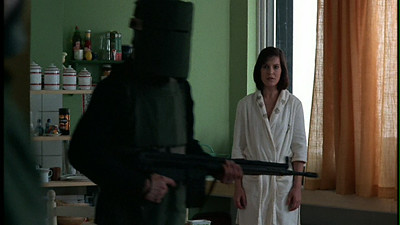
Katharina Blum, played with an almost blank-slate caginess by Angela Winkler, is a regular young woman working as a maid in West Germany. One night at a party she meets the dashing Ludwig (Jürgen Prochnow), whom she allows to take her home. By morning, the police are breaking through her door, accusing her of collaborating with a terrorist. They say Ludwig is an anarchist bank robber, and they believe that Katharina has been his lover for two years and has been using his ill-gotten gains to support her own income. She denies this, and really, outside of some unexplained purchases, there is no real evidence against her. A hand-written quote from Karl Marx they found in one of her books is as close as they've gotten to any kind of corroboration of their conspiracy plot, and even that was given to her by a Dominican monk.

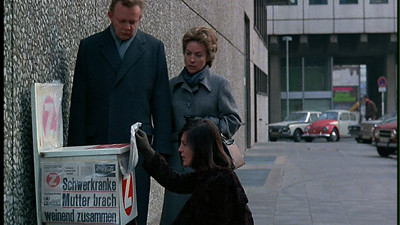
Not that this matters once Katharina's story becomes fodder for the tabloid press. The real collusion is between a sleazy reporter (Dieter Laser) and the Kommissar (Mario Adorf) in charge of Katharina's arrest. The police want her to tell him where Ludwig is hiding, and she refuses to tell him anything. There is an explanation for the unaccounted-for money, as well as an actual lover whom Katharina will not publicly out. Kommissar Beizmenne leaves it to the reporter, Toetges, to fill in the gaps on his own, doctoring quotes and peppering them with dirt, all to make Katharina look like an unpatriotic slut; then, these printed fictions become the official facts. If the truth is blackened in this pursuit of "justice," not to worry. That's what whitewashing is for.


Given the image most Americans have of terrorists, there is a little irony in watching The Lost Honor of Katharina Blum in 2008 and seeing the cop who files the first false report on Katharina dressed in a costume as an Arab sheik. It's too often forgotten that it doesn't require skin tones of a darker hue to commit acts of terrorism. Böll modeled Ludwig's alleged connections on the Baader-Meinhof organization, and Katharina's persecution has roots in libelous articles printed about the author in relation to that group. Baader-Meinhof sought political change in Europe through violent means. They were honest-to-goodness anarchists (albeit organized), and in a fairly new democracy like Germany, terms like "anarchist" and "communist" carried real weight. People were dying for what they believed, and often being punished just for believing it. Right-wing pundits in the U.S. might do well to consider that before they resort to such hot-button tags, either seriously or in jest (the former is dangerous, and the latter even moreso). But then, that ties in exactly with what Schlöndorff and von Trotta were getting at in their film adaptation: why worry about what's really happening when you can bundle it all up in a scapegoat's clothes.

We’d do well to pay attention to what they are saying, too. There are some very literary tags we could put on Katharina's plight in the film. Orwellian comes to mind. So does Kafka-esque. Katharina is brought under charges her accusers refuse to explain to her and given no real recourse to defend herself. Put a hood over her head and ship her down to Cuba, and she'd fit right in at Guantanamo Bay. Sure, she has secrets to hide, but don't we all? At the outset of her persecution, her biggest crime is wanting to keep her private life private. Kommissar Beizmenne suggests that she cooperate with him now, for her own good, because he's a fair man who will treat her right--the sheep's clothing worn by every wolf in a totalitarian state that claims the shepherd's pasture is a democracy.

The mystery that runs through The Lost Honor of Katharina Blum is how Ludwig slipped past the police to get out of her apartment. It's not much of a spoiler to say that Katharina has more of a hand in his flight than she lets on, yet it's also not much of surprise that the more she hears of the police's case against him, the less inclined she is to reveal her knowledge. Given their treatment of her, why should she believe them, anyway?

The end result of the false accusations is that by the time Katharina is let off the hook, she has been turned against her oppressors to such a degree, she becomes exactly what they accused her of being. Though Böll's main axe to grind is with the sensationalistic press, it could have just as easily been brought down on the governmental forces that put their boot into Katharina's life. The author and the film directors saw that if you treat people as if they are thieves, they will ultimately steal from you, having nothing left to lose. Escalate the dirty deeds you accuse them of, and the resulting creation will match.

So, don't tell me we couldn't foresee that falsely detaining Muslim men and accusing them of terrorism would create more terrorists, or that wrongly invading another country and forcing them to accept our straw-man version of democracy wouldn't result in that straw man being kicked to the ground. The Lost Honor of Katharina Blum made all of that quite clear via a chilling, easy-to-digest mis-en-scene. Isn't it time we all started paying attention?