Showing posts with label Rod Serling. Show all posts

Saturday, October 27, 2018

NIGHT OF THE LIVING DEAD - #909


What’s there to say about Night of the Living Dead that hasn’t been said a million times? The seminal horror indie has been one of the most influential genre pictures of movie history, dissected by critics for the last 50 years, explored from every angle, praised for its technique, innovation, and deeper political subtext. There have even been full-length documentaries made about the production, including 2015’s Birth of the Living Dead [review], which featured Romero himself. And, of course, scores of sequels, remakes, and imitators.

Give Night of the Living Dead a spin and it’s easy to see why the hullabaloo persists. Made on a shoestring budget in the late 1960s, it’s a clever pressure cooker of a zombie film. Most of its running time takes place in a single house, as would-be survivors of an undead apocalypse hole up in hopes of some kind of rescue. It starts with two, Ben (Duane Jones), an African American man, and Barbra (Judith O’Dea), a white woman gone nearly catatonic after seeing her brother attacked before barely escaping herself. They are soon joined by a young couple and a family of three who were hiding in the basement. While the night draws on, arguments ensue about how best to get out alive, as radio and television reports present an increasingly bleak picture of the spreading doom.


It’s not hard to see the political metaphors when you’re looking for them. The optics of a black man and a blonde woman facing an onslaught of mostly white men hell-bent on destroying them are sadly as relevant in 2018 as they were in 1968. It’s also hard to ignore how when the older white man (Karl Hardman, looking like an early demo of Rob Corddry) arrives on the scene, he immediately tries to take charge, barking orders without considering any alternative point of view. When his wife (Marilyn Eastman) points out how important it is for him “to be right, everyone else to be wrong,” you can feel the pent-up frustration, born of years of listening to him blather on. Tellingly, when it’s time to decide whether to stick with her husband or listen to Ben, the wife is paralyzed with doubt. It’s hard to break a pattern.


Romero is employing a classic technique here. Plenty of low-budget character studies used a confined space to (a) save on location costs and (b) trap their subjects together so they can’t escape one another. See, for instance, Hitchcock’s Lifeboat [review] or countless Twilight Zone episodes. The one I most think of is “The Shelter,” where one family with a bomb shelter has to fend off their neighbors, who scoffed at the notion of such a thing but are now desperate to get in when there is threat of a nuclear attack. When examining Night of the Living Dead, we can talk race or gender, or we can also just study the personalities as the drive for self-preservation overtakes any desire to help one’s fellow man. Is it that different when the living people inside the house start tearing each other apart verbally than when the zombies outside literally feast on the flesh of the fallen?


One has to give Romero credit for pushing the boundaries in that particular scene. The stone-faced actors chewing on a turkey leg or playing with fake entrails paint a pretty grisly picture of a society that has broken down. Though it comes only midway through Night of the Living Dead, it’s really the beginning of the end. It’s when the hordes taste victory and get the strength to carry on, and the last vestiges of civilization fall.

But Romero really saves the best for last. The most unsettling moments in Night of the Living Dead come at the very end, when we learn the fate of Ben. If there is any remaining resistance to the political reading of the movie, that should all vanish here. Romero chooses to show these last shots as a montage of grainy stills, resembling news footage, focusing as much on the uncaring, self-satisfied faces of Ben’s unwitting attackers--who think they are doing the right thing--as much as the sad outcome of their actions. Anyone seeing Night of the Living Dead on initial release would have, unfortunately, found images like these far too familiar, far too similar to what they had been seeing in newspapers throughout the Civil Rights Movement. And the power to provoke has not dulled. (Spike Lee made a similar move, pulling in current events to upend his own entertainment in this summer’s BlacKkKlansman.)


This is what good horror can do: create a commentary on the times, delivering uncomfortable truths in the guise of seemingly unthinkable, frightening events. There’s a reason that the genre thrives when the real world is going through tumultuous times. A good scary movie can make us reflect on the current situation in ways that are obvious (the analogues for the Reagans in Wes Craven’s The People Under the Stairs) or subtle (the triumphant #metoo parable of David Gordon Green’s recent Halloween sequel, the stifled voices of good people in John Krasinski’s A Quiet Place). For most of Night of the Living Dead, George A. Romero goes for the subtle, saving up that sucker punch for when it really counts.


Wednesday, August 22, 2018

THE ARENA/STRIKE - FILMSTRUCK

A different version of this review was published on DVDTalk.com in 2010 to promote a Rod Serling-focused DVD.


Studio One was CBS' premiere drama anthology, running 1948 to 1958. Every week they presented a live play for the television audience, be it a new script by a hot young writer or an adaptation of stage material. Amongst the writers who cut their teeth in these early days was Rod Serling, whose keen observational eye and serious interest in the nuance of moral dilemmas quickly earned him notice. Serling is best known today for his Twilight Zone series, which he introduced on camera at the start of every episode. Twilight Zone's reputation is often unfairly reduced to knee-jerk jokes about its twist endings, but the truth of the matter is, those shows endure not because of their often surprising turns, but because of the heartfelt and soulful dramatics that lead to the twist. Serling is one of television's foremost chroniclers of the human condition, something that is more than obvious in his Studio One collaborations with director Franklin J. Schaffner. No sci-fi trappings here, just straightforward storytelling.

Schaffner went on to helm Advise and Consent on the stage and Patton for the big screen, and worked with Serling again on Planet of the Apes, and it's interesting to consider how the two teleplays they did for Studio One, 1956's The Arena and 1954's The Strike, predicted the subject matter that would continue to interest the director. Like Advise and Consent, The Arena is set in the U.S. Senate, and like Patton, The Strike is a war story about the courage of leadership.


The Arena tells the story of James Norton (Wendell Corey), a junior Senator appointed to a seat once occupied by his father. Dear ol' dad likely pulled some strings to get his boy in there, a fact not lost on Norton Sr.'s old political rival, Senator Harvey Rogers (John Cromwell). Despite the advice of his spin doctor, Jack Feeney (Chester Morris), Norton immediately locks horns with Rogers, a fight he is not equipped to handle. The more experienced politician massacres him, and Norton must decide whether a particularly juicy piece of dirt he has on the older man is worth the price of his integrity.


The Strike is set in South Korea in 1951. Major Gaylord (James Daly) is in charge of five-hundred men trapped under enemy fire in the middle of the Korean wilderness. He has one patrol of twenty that got lost on a recon mission, and when it comes time to move out, he is faced with a difficult choice. An air attack can take out the Communist artillery, but the recon unit would be collateral damage. Are the lives of twenty a fair trade for the full battalion?

In both teleplays, Serling poses a central question for two very different men: what is the right thing to do? Not what is the easiest, what is the most convenient, but what is right. The difference is that, in the case of Senator Norton, the right thing will allow him to sleep easier at night, but in the case of Major Gaylord, it will likely haunt him for the rest of his life. Norton is a stubborn man whose levers are pulled by his bitter father, and he lets his ambition and need to please his dad cloud his judgment; Gaylord is a man crippled by his conscience. Past experience has taught him that losing even one soldier hurts, and he'd be more than willing to pass off the decision to someone else. It's his men who force him to lead, demanding he fulfill the confidence and trust they have put in him.


The beauty of a Rod Serling script is that though he may pose a question that seems extremely compact, he unfolds it so that every possible angle can be explored, showing how large the true issue is. This is especially true of The Strike, where the men in Gaylord's command offer different reactions and modes of thinking in regards to the problem. A visiting chaplain (Roy Roberts) is a voice of faith and the greater good, while the soldiers take a far more cynical, practical view. They expect their higher-ups to make the bad decisions they can't and accept death as a product of war.

The acting is uniformly good through both shows. Chester Morris gets the meatiest role in The Arena. Senator Rogers even says as much: the man in the middle is the one with the real burden, he's the one who must see both sides and sway to either. Morris maybe overdoes some of the drunk scenes, but they work all the same. In The Strike, James Daly commands the screen as the Major. He is a fairly standard Serling lead. Rod loved watching a man fall apart. Daly sweats, paces, twitches, and loses his cool at every turn of the script page.


Anytime I watch these old shows, I always have to pause and admire their construction. The performers and the crew had to move between sets without taking a break, and I'm always fascinated by the complicated set-ups they create to give everyone time to get where they are going. When you step back and dissect what you are seeing, it's pretty remarkable. There were no do-overs. If the camera was not in place, if an actor tripped and fell or forgot his lines, there was no way to fix it, everyone would see. It's like live theatre, but beamed across the nation. Most of the productions on Studio One or other anthology shows, including these two episodes, rivaled regular motion pictures, and often, they got remade as full movies. You'd expect productions of this kind to be quaint throwbacks to a simpler time, but they are really far more complex than most of what the networks put on television in the decades after taped broadcasts became the norm and prior to the more recent cable revolution.


Thursday, January 5, 2012

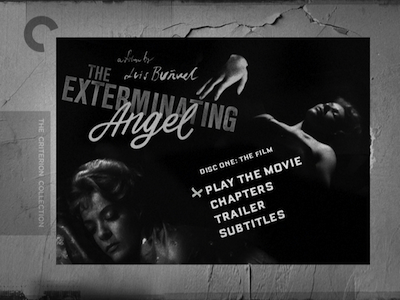
THE EXTERMINATING ANGEL - #459


Friends of the Spanish director Luis Buñuel must have regularly taken pause before accepting his dinner invitations. In may of the cinematic prankster's films, sitting down for a meal can be the impetus for the most bizarre events. In his 1972 classic The Discreet Charm of the Bourgeoisie [review], his well-to-do diners have all manner of inconveniences inflicted upon them, not the least of which is being mowed down by machine guns. In its sibling, The Phantom of Liberty, the chairs around the dining room table are replaced by toilets. There is also apparently a rather memorable "last supper" in his 1962 film Viridiana, which gives me a serious reason to move that film forward in my review pile.

Perhaps the most extreme scenario, however, is 1962's The Exterminating Angel, in which a dinner party turns into an existential trap, one that lasts for several weeks and takes no less than three lives. Sure, more people "die" in The Discreet Charm of the Bourgeoisie, but the number of partygoers and the extent to which they are trapped in this earlier effort far outweigh what Buñuel would perpetrate a decade later.


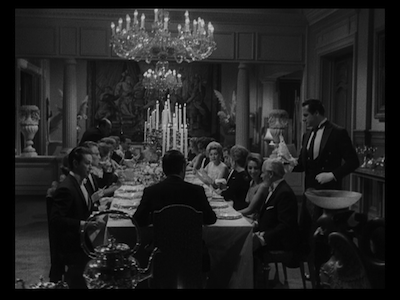
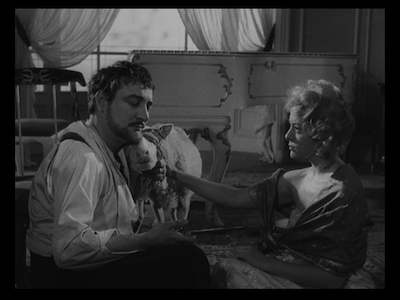
The dinner party in question is being given by Edmundo and Lucia de Nobile (Enrique Rambal and Lucy Gallardo) to celebrate an opera performance. Many of the guests are part of the opera company; others are various well-to-do friends of different occupational and political backgrounds. At the start of the evening, things already seem off. The household servants all inexplicably leave, with only the dedicated butler Julio (Claudio Brook) remaining to serve the dinner. The hostess, Lucia, is apparently known for her elaborate practical jokes, but after an accident is met with poorly by one of her more esteemed guests, she cancels her intended trick. It somehow involved a live bear and a trio of sheep. What exactly she meant to do with them is never explained.

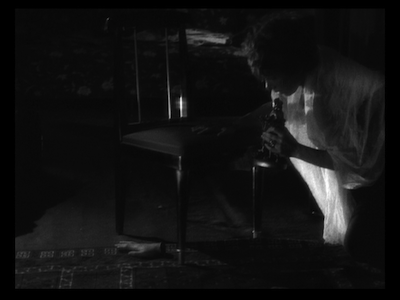
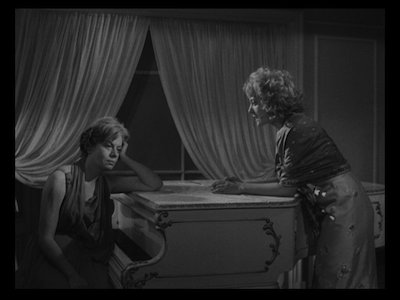
Nor does it matter, the cosmos has a more elaborate ruse prepared for the self-absorbed, self-important gathering. Following the meal, everyone gathers in the sitting room to listen to one of the women play piano. When the song is done, it's approaching 3:00 a.m., and the guests start to grumble about leaving. Only, none of them do. Instead, one by one they lay down and fall asleep. It's only when they wake the next morning that they begin to realize how strange their own behavior has been. They make a pretense of going, but once they reach the threshold of the room, they make excuses to stay. When Julio brings them coffee and leftover meat for breakfast, he is then trapped inside the room, too. Nothing is visibly holding them in the space, but nothing can make them cross the line and leave, either.


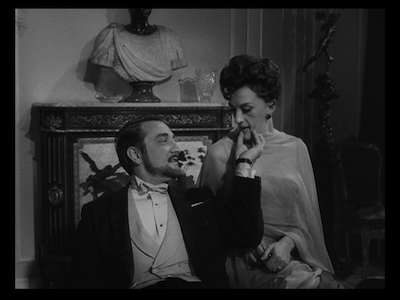
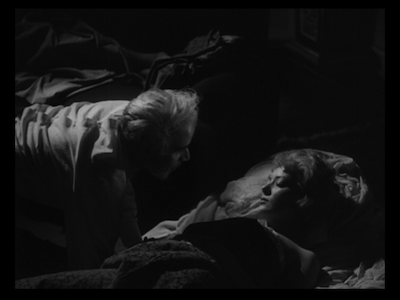
Food and water is gone rather quickly. The days pass, and so too does hygiene and proper manners. Rivalries and cruelties emerge. Some grow ill, all grow desperate. The types begin to take on their roles. Lovers hide in the closet for illicit rendezvous, while two Masons conspire. Alliances form, the hosts are blamed. One woman begins to hallucinate from the hunger. (In a memorable sequence, a dead man's hand crawls from its owner's resting place to strangle her.) One dirty old bugger tries fondling the women as they sleep. The servant keeps his cool, and so does a doctor (Augusto Benedico), who has helped many of the trapped people with previous ailments. The impossibility of the predicament is only surpassed by the improbability of their ongoing survival.

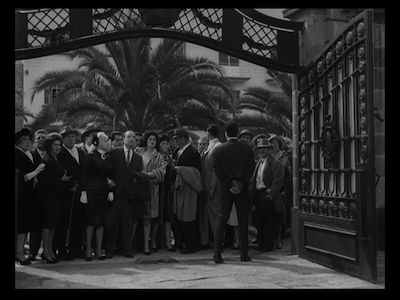
Unbeknownst to those in the house, the public has gotten wind of the bizarre happening and have gathered on the street outside. They, too, are unable to step through the gates of the estate. They don't know why, either. The only creatures free to roam the grounds are the bear and the sheep, who also seem like they might be starving. Too bad for the bear that the humans are the more dangerous predator.


Buñuel, unsurprisingly, is having fun at the expense of the upper classes. For many, their first concern is for their own vanity, then for the loss of creature comforts. There is barely a thought given as to why this punishment might have been visited down on them. Since whatever force overtook the house compelled the servants to leave, the segregation appears to have a specific intent. As the situation worsens, even vices begin to get revealed. There's the old man, for instance, stealing kisses, and also Edmundo has some opium stashed away. One conniving, effeminate man steals the drugs and shares them with his sister, even though much of the time they also bicker between themselves. They form a faction of their own, and other factions also pop up.


This splintering of the main collective is both realistic and necessary. It is like a drawing room version of Lord of the Flies, and my interpretation would be that Buñuel is showing these people as being trapped by their own stifling social mores and the divisive class structure they benefit from. Their own selfishness has created a vacuum. It's a limbo given shape by their willingness to follow along with the accepted way of things rather than ever questioning the morality of a society that allows so many to have so much and look down on those who don't.  Buñuel extends this further in The Exterminating Angel's final scenes. As the movie closes, there is a repetition of its most bizarre circumstances, but this time tied to religion, which for Buñuel represents another confining structure man has invented for himself--and one that allows for darker forces to take command of the streets.


The film is shot beautifully despite being so confined. Gabriel Figueroa photographs every expensive detail of the de Nobile home, lingering on faces and clothes and allowing us to watch as both become subject to neglect and filth. Compositions tighten and the people become more confined the longer they are stuck together. The look of The Exterminating Angel and the oppressively ostentatious setting reminded me of the old Twilight Zone episode "The Masks" (1965; directed by Ida Lupino). In that show, a rich old man gathers his family together before he dies and isolates them to force them to show their true faces. Perhaps Buñuel's film had a little influence on it. Indeed, the mind boggles at the idea of Buñuel teaming with Rod Serling for an episode or two. His social satire via surrealism could have fit right in. 


Fittingly, the group solves its joint problem by getting over their disagreements and working together. The way out is spotted by the prim blonde beauty Leticia (Silvia Pinal), who had previously been dubbed "The Valkyrie" and "The Virgin" by her so-called friends. No matter which nickname you choose, it fits symbolically. The Valkyrie comes to escort the fallen to their final resting place, the Virgin brings salvation when all humanity is lost. The fact that failure is imminent is down to Buñuel's cynical opinion of human nature more than it is his lack of faith in a porcelain beauty. After all, the man was working in motion pictures, where such a figure regularly held sway. And, hey, if you have to believe in something, why not the good-looking blonde?


Sunday, January 1, 2012

SIDELINE: MORE REVIEWS FOR 12/11

A round-up of the non-Criterion movies I saw in December.


IN THEATRES...


* The Adventures of Tintin, a surprisingly fun 3D adventure from Steven Spielberg with all the appropriate nods to Hergé.

* The Artist, a loving and entirely accurate tribute to the silent era of cinema.

* A Dangerous Method, Jung and Freud meet David Cronenberg.

* Mission: Impossible - Ghost Protocol, is an absolute corker. Brad Bird delivers the best in the series.

* We Bought a Zoo, an effective new feature from Cameron Crowe...but is it any good?


ON DVD/BD...

* The Art of Getting By, a predictable but solid Young Adult story, with fine performances by Emma Roberts and Freddie Highmore.

* Behind the Mask, a mid-40s misfire that attempts to turn the popular Shadow radio serials into...light comedy?!

* The Birth of a Nation: Deluxe 3-Disc Edition, D.W. Griffith's historically inaccurate epic is an important piece of cinema, but that doesn't stop it from being racist and boring.

* Crime Story: The Complete Series, the Michael Mann police drama set in the 1960s but made in the 1980s.

* A Farewell to Arms, Frank Borzage's masterfully melodramatic adaptation of Ernest Hemingway.

* Friends with Benefits, not even Justin Timberlake and Mila Kunis can make this sex comedy misfire come off as either sexy or funny.

* Incident in an Alley, a middling early 1960s crime film based on a Rod Serling short story.

* Nothing Sacred, a slight bit of entertainment from 1937, directed by William Wellmen and starring Carole Lombard and Frederic March.

* Seven Chances, an hilarious Buster Keaton short where the great comedian plays a man in desperate need of a wife.


Sunday, February 28, 2010

SIDELINE: MORE REVIEWS FOR 02/10, plus CRITERION ON HULU

After launching their YouTube channel last month, Criterion has now also started a Hulu channel, beginning with the first six Zatoichi movies. Details here.

Also, I reviewed a bunch of films over the last couple of weeks that I saw as part of the Portland International Film Festival, including such anticipated releases as A Prophet, Fish Tank, and Police, Adjective, and the new work of Ken Loach, Marco Bellocchio, and Bong Joon-ho. You can see all my pieces at my other blog, here.


IN THEATRES...

* Shutter Island, Martin Scorsese's pulpy Dennis Lehane adaptation. Over-the-top B-movie excitement, sure to inspire debate.

* The Wolfman, needs to disappear gently into that dark night. What a tragic bore!

* The White Ribbon, Michael Haneke's Oscar-nominated black-and-white period piece. The most affecting morality play ever, or the most affected bunch of twaddle? Can't decide

ON DVD...

* Buena Vista Social Club, a by-numbers reissue of the Wim Wenders musical doc, part of Lionsgate's Music Makers series.

* Eleven Minutes, a documentary about the (annoying) first winner of Project Runway.

* Orson Welles in King Lear, a somewhat stiff 1950s television broadcast.


* Rod Serling - Studio One Dramas, two live teleplays from the master writer.

* Sarah Silverman Progam: Season Two, Part 2, a hilarious collection of episodes skewering the sitcom format in Silverman's inimitable way.

* Split Second, a B-movie that drops a nuclear bomb on the crime genre. Directed by Dick Powell, who was Philip Marlowe once upon a time.

* Tell Them Anything You Want: A Portrait of Maurice Sendak, Spike Jonze and Lance Bangs give us a wonderful documentary about the Wild Things author.

* Wild Oranges, a lusty King Vidor silent picture.

Thursday, November 26, 2009

THE GOLDEN AGE OF TELEVISION - #495


Years ago, I was co-host of a cable access show. Every two weeks, we'd be live on Portland television for an hour, showing music videos, working without a script. Hardly anybody watched it, there were no consequences if we sucked, but even so, that hour was a nerve-wracking, electrified, exciting time. We were beaming across the city to whatever homes had cable, to whoever might have happened across us while scanning the airwaves with their remote controls. What a thrill! From the signal that we were on the air to the studio's screen going black, whatever happened happened, there was no taking it back.

I can only imagine what it must have been like to do live television dramas in the 1950s. The best I can do is try to marry my slim community theatre experience with the cable access experience. Put together a scripted show where I had to remember lines and hit my marks with that feeling of reaching beyond the protected performance space, that what we were doing wasn't just going to be seen by those in the immediate vicinity, but potentially by hundreds. Thousands. Millions. It wasn't just a matter of showing up and running out the clock, you'd really have to perform.
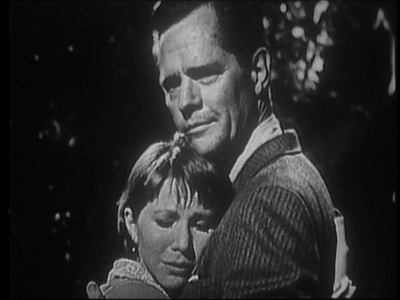


That's how TV was done in the early days. Live shows, like hour-long plays, often with the best and the brightest of Broadway, new talent cutting their teeth in a new media. Eight of these programs are collected in the new Criterion boxed set, The Golden Age of Television. The collection is named for a PBS series that showcased this exciting time. The original presentations were performed live on the East Coast, shot with multiple cameras, but in the days before video tape, so no clean way to capture what was happening. The filmmakers edited as they went, it wasn't on film. What PBS resurrected and what they showed when this series first ran back in the early 1980s, bringing these vintage teleplays back to the air for the first time in decades, were recordings called "kinescopes." Essentially, kinescope was a process of photographing the broadcast by pointing a special camera at a video monitor. Like if you took a camera yourself and set it up in front of your TV and recorded a show. It wasn't perfect--you can sometimes see the curve of the screen, or a speck of dirt on the glass, or any number of glitches--but it was the only way to prevent these programs from just disappearing into thin air.

The material here is the cream of the crop, chosen from hours of television. Amongst the shows, we get early scripts from writers as revered as Paddy Chayefsky, Ira Levin, and Rod Serling, direction from future legends like John Frankenheimer, and performances by Ed Begley, Andy Griffith, Rod Steiger, Elizabeth Montgomery, George Peppard, Paul Newman, Julie Harris, Kim Hunter, Jack Palance, Mel Torme, and Piper Laurie in roles both big and a small. There are also small-screen turns by established big-screen stars like Everett Sloane, Edmond O'Brien, and Mickey Rooney. Structured more like the legitimate theatre, these high-wire acts show a precision of craft and a dedication from the talent we don't see all that much anymore. There were no do-overs. They only got one shot.
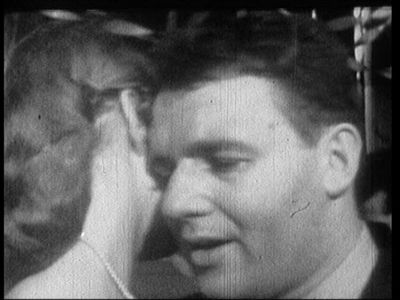


*** Disc 1 ***


Marty (1953): Directed by Delbert Mann and written by Paddy Chayefsky, this initial version of Marty predates the Oscar-winning movie by several years. It stars a young Rod Steiger in the role later popularized by Ernest Borgnine. He plays Marty, the lonely butcher in his late 30s whose bachelorhood is beginning to weigh heavy on his shoulders and his heart. His mother (Esther Minciotti) is worried that her eldest will never marry the way her younger children have--though even as she encourages Marty to get out there, she begins to doubt whether his finding a wife is the best thing for her. Life changes affect everyone, including the old moms who live with their sons.

Marty eventually meets a woman, a schoolteacher (Nancy Marchand), at a dancehall. He becomes aware of her when another guy asks him to take her off his hands. They had come here on a blind date, and he's decided she's a dog. Seeing a familiar crack in her broken heart, Marty risks further pain by sharing his hurt with the girl, and they see glimmers of happiness in one another. It's a tender story, enacted with a touching sensitivity. Steiger is the epitome of a gentle giant, and his expressions of doubt and heartache are disarming coming not just from a man of his size, but any man really. It's not usually the fella we see waiting at home for the phone to ring in romantic stories. Chayefsky builds Marty's predicament with such care, layering the story with thematic parallels, that he staves off any impending mawkishness. Marty is sweet and touching, but it's not manipulative, it comes by those heartstrings it tugs honestly.
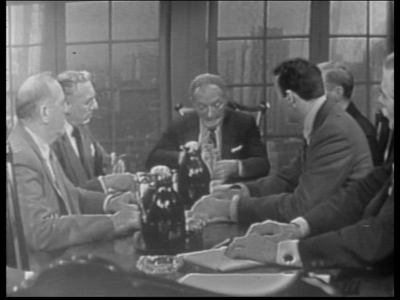


Patterns (1955): Rod Serling's big-business drama caused a sensation when it first aired, and it went a long way to building the reputation that would eventually lead to the writer landing his own series, The Twilight Zone. Unlike that show, this Fielder Cook-helmed drama stays close to the earth, detailing the regime change in a large corporation. Fred Staples (Richard Kiley) is a new vice president being brought in to edge out the old, Andy Sloane (Ed Begley). The boss, Mr. Ramsie (Everett Sloane), sees Andy's moralistic approach to business as a relic from his father's age, a hold-over from a time long gone. Fred doesn't know he has been fashioned into an assassin's bullet, but it doesn't take long for his true purpose to be revealed.

Rod Serling's strength has always been socially conscious dramas that manage to wear their pointed message out in the open, but like Chayefsky, he wrote in such a way that it never seemed obvious or cloying. In Patterns, the pieces all move with precision--there is the hard-charging boss, the rising star and the fading champ, the secretary who sees everything (Elizabeth Wilson), the wife (June Dayton) who wants to see her husband climb the ladder. Everyone has a function, but the way the gears lock together never show. Grandstanding speeches come off as natural. They are written with an ear for speech, and spoken by true masters. Ed Begley is fragile as the aging executive, losing the last grip he has on stability, and Everett Sloane is ruthless as the company president. It's all Richard Kiley can do to remain standing between them as they obliterate one another.
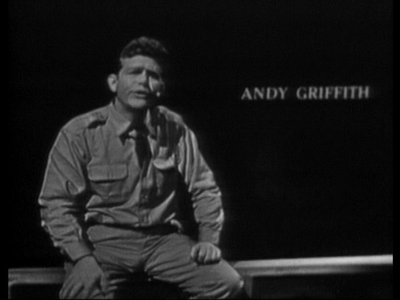


No Time for Sergeants (1955): The lone comedy in the set stars Andy Griffith as Will Stockdale, the country bumpkin draftee who gets through the army on his blind luck, blind charm, and well, blind everything. His is the kind of character who never seems to clue in to what all is going on around him, to the precariousness of his situation or the dismay he may be causing others. In truth, they are uptight and overly concerned with rules and such; he is free to be himself.

No Time for Sergeants was adapted by Ira Levin (Rosemary's Baby) from a novel by Mac Hyman, and this Alex Segal-directed production actually predates the more famous Broadway version, which grew out of this show and also starred Griffith. It's also the first show in The Golden Age of Television to feature a first-person narrator that talks directly to the audience (Bang the Drum Slowly is another), and we follow Griffith as he crosses through the sets, even makes jokes about the empty facades and the ease with which he gets from one place to the other. Griffith is definitely charming (if not also a little annoying), and though the humor is of an antiquated variety, the down-home joking hasn't grown stale. Harry Clark plays Will Stockdale's foil, the flummoxed Sergeant King, and he and Griffith play off each other really well. It's a little like watching a live-action Looney Tune.


*** Disc 2 ***


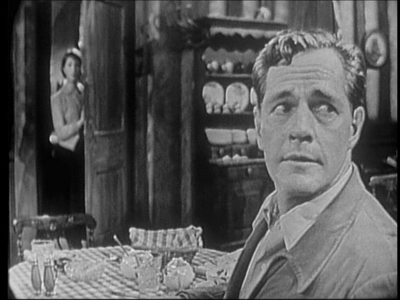
A Wind from the South (1955): This quiet love story set in Ireland stars Julie Harris as Shevawn, the sisterly half of a brother/sister duo running a bread and breakfast in the countryside. Unlike her angry brother (Michael Higgins), Shevawn hasn't resigned herself to a life stuck in her hometown, she dreams of travel, a fantasy life fueled by the lives in transit passing through their establishment. Amongst the current guests is the American ad man Robert (Donald Woods), a man equally frustrated with his stagnant life, but who covers his frustrations with jocularity, poetry, and drink. Shevawn and Robert share a brief one-night affair, one that stirs both of them, and that plays out in surprising, satisfying ways. The emotional denouement shows a lot of depth. The script is by James Costigan, a notable name in early television, and inspired by, of all things, an album of songs recorded by Merv Griffin in tribute to The Quiet Man (Collector's Edition). While the future talk-show host doesn't appear on screen, he does sing "A Soft Day" at the start and close of the show, as well as at the act breaks. As the lyric goes, "A soft day, thank God/ A wind from the South with a honeyed mouth."

Harris was a Broadway star who would be one of the emerging talents in 1950s television; she would match this success with big screen triumph in A Member of the Wedding and East of Eden. I quite liked her in A Wind from the South, it's a role filled with earnestness and longing, but tempered by sweetness--the actress' specialty. Directed by Daniel Petrie (Rocket Gibraltar), the tiny drama has a remarkable sensitivity, exploring the notions of dreams and how desires often must give way to reality.
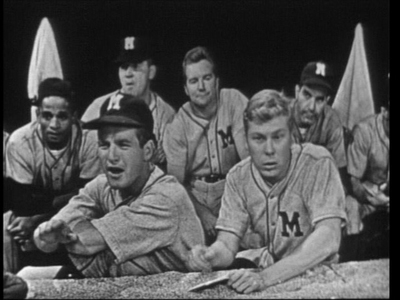


Bang the Drum Slowly (1956): Daniel Petrie also directed this baseball story, adapted by Arnold Schulman from a book by Mark Harris. A young Paul Newman stars as Henry "Author" Wiggen, the first-person narrator of the story. He is a minor league pitcher who becomes entangled in the life of his catcher, Bruce Pearson (Albert Salmi), a player of little talent and even less brains. When Bruce becomes terminally ill, Author takes him under his wing, doing his best to keep his ailment a secret so he doesn't get cut from the team. The locker room talk here is pretty tame, but the camaraderie is still a lot of fun. Author is an amusing character, hung up on taxes and caught up in his own story to a point where he almost forgets that it's someone else's tale he's telling.

Or maybe that's the consequence of having Paul Newman leading the charge. He's an electric performer, even at this stage, imbuing Author with an Actor's Studio twitchiness. The method gets in the way of Newman's naturalism a little, but his inherent charisma and comfort in front of the camera was too pronounced to squash. Albert Salmi is also very good. I am used to seeing him as the heavy, but he is quite convincing as a big palooka.

Speaking of big palookas...
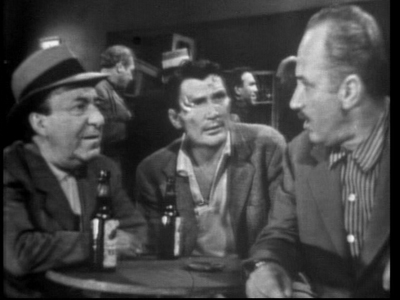


Requiem for a Heavyweight (1956): This famous Rod Serling drama was one of the first productions on "Playhouse 90," the series that ushered in the 90-minute drama. If these guys could do a full hour, why not an hour and a half? No big deal, right?

Well, it was a big deal, but Requiem makes it look easy. Jack Palance stars as Mountain, a boxer who is over-the-hill at 33. He lost his latest bout in a big way, and the doctor says if he keeps fighting, he'll go blind. To make matters worse, his trusted manager, Maish (Keenan Wynn), didn't think he could make it past three rounds, and when the bruiser manages to take it to seven, Maish doesn't make book and it puts the gambler in big-time hock. As Mountain tries to figure out what to do with himself if he's not fighting, Maish has to figure out how he's going to pay off the gangsters. In between is the cut-man Army (Ed Wynn), who'd like to see both of his friends get out of their predicaments with dignity.

Requiem for a Heavyweight is a remarkable piece of work. It set the standard for boxing stories, so much so that filmmakers are still borrowing from it to this day. Jack Palance is nearly unrecognizable as the punchy knuckleduster, turning his massive girth into sensitive mush. His relationship with Kim Hunter's employment officer is sweet and believable, the smart gal falling for the gentle giant. Serling's ability to capture the essential human decency of any situation makes Requiem more than your basic sports story, he takes this very specific tale of descent and makes it a play about universal triumph.


*** Disc 3 ***


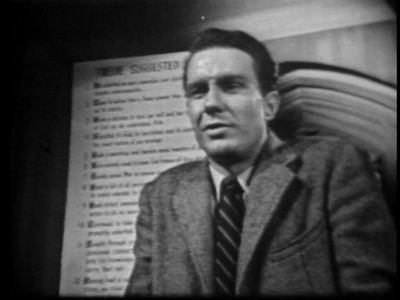
The final disc belongs to John Frankenheimer, an innovative director who would move from television to direct movies like The Manchurian Candidate and Ronin. What Frankenheimer brought to the screen in terms of style is immediately apparent from the very first scene on this DVD. There is a tremendous sense of movement, of smart choreography and tricky set-ups, that is unlike anything that came before it. With the constant creativity of the age, of new programs being staged every night, such innovation was inevitable. It's like exercising: you only get stronger the more you do it.
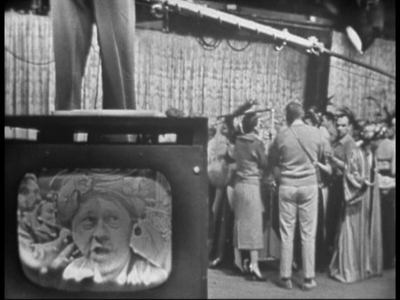


The Comedian (1957): The Comedian opens in a television studio, jumping back and forth between the control booth and the floor, staging close-ups using a video monitor in the extreme foreground, showing us the tail end of a disastrous rehearsal for comic legend Sammy Hogarth's latest extravaganza. Hogarth, played with knowing verve by Mickey Rooney, is making his transition into 90-minute television. How meta can you get? Based on a story by respected writer Ernest Lehman, this Rod Serling teleplay tears the live TV world apart, showing us the inflated egos of its stars and the people they destroy from the top on down. Edmond O'Brien (D.O.A.) plays the washed-up writer who chisels Sammy's schtick, and singer Mel Torme is his hapless brother, a do-it-all assistant who is also the butt of most of Sammy's jokes. In a Sweet Smell of Success-style twist, Whit Bissell plays Elwell, a gossip columnist looking to take Sammy down because of a vicious impersonation of his signature style the actor once performed. (Note: Lehman also wrote that picture.) It all comes to a head on the big night.

The Comedian is unrelenting and sometimes brutal. Sammy is an irredeemable character, even with the hidden pain Serling unearths in the final act. He's not meant to be redeemed, we're only meant to see the source of his pathology. The actors are all incredible. Rooney is incendiary, O'Brien is tragic and feral, and the only nobility in the play belongs to the women, with Kim Hunter and Constance Ford seeing the writing on the wall long before their men do. Torme is the only weak link, his portrayal of Lester Hogarth never quite coming together, perhaps a case of the character's weakness overtaking the actor.

Frankenheimer is the real star, though. The Comedian is an ambitious piece of work, full of inventive, nearly surreal set pieces and featuring a final-act montage that must have been a real bear to undertake. Layering stock footage and scenes of the Sammy Hogarth show, he elevates this one-off production to a level that was equal to anything playing at the local movie house.

As an aside, The Comedian is introduced by Claudette Colbert, whom we learn over the closing credits is scheduled to be on "Playhouse 90" the following week. Likewise, Sterling Hayden introduces the next program...
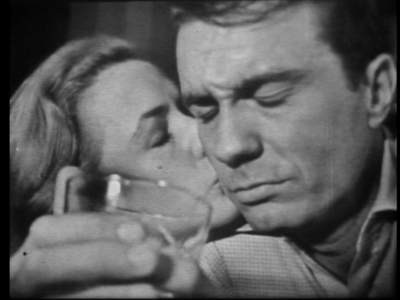


Days of Wine and Roses (1958): This hard-hitting drama about alcoholism was probably the first time most Americans saw inside an Alcoholics Anonymous meeting. Cliff Robertson stars as Joe Clay, the anonymous witness for this session, who tells the story of his drinking life with Kirsten Arnesen (Piper Laurie). They met through booze and stayed together with booze, and the J.P. Miller script tracks the ups and downs of their relationship, the highs and the incredible lows. They fail more than once to kick the sauce, and Joe's AA membership acts as a wedge between them, redefining how they look at one another. The show looks at not just how drinking affects the pair, but their family and the people around them.

Like Requiem for a Heavyweight's boxing clichés, a lot of what we see here has become standard practice for addiction-based melodramas, and though the final scene featuring Joe reciting the serenity prayer may seem a little hokey now, I doubt it was as commonplace in 1958. Cliff Robertson and Piper Laurie really go through the ringer in Days of Wine and Roses, they must have felt like they were running a marathon. So demanding was the show, Frankenheimer actually elected to pre-record the scenes at AA, he couldn't have Cliff Robertson running back and forth and changing his suit as much as would be required. One scene these guys are sober, the next they are drunk--there are even a couple of detox sequences. Surprisingly, Miller doesn't wrap everything up neatly in the end, either. Not everyone walks away happy.
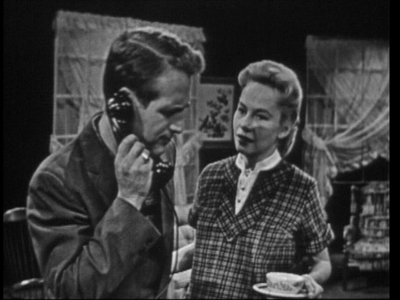


The thing about watching The Golden Age of Television is that you would never know these productions were recorded live if you weren't told. They aren't gimmicky or shambolic, they aren't simply one-room sets like filming a stage play within its confined space. What is still amazing to see is how deftly these filmmakers pulled this off, how seamlessly they move from one location to the next, from character to character, never letting the cracks show. These are fine-tuned productions, expertly rehearsed, carefully honed to come off without a hitch. These dramas were meant to compete with motion pictures--and they do. Quite easily.

The Golden Age of Television - Criterion Collection is an invaluable historical document that also manages to be a potent testament to the quality of early television drama (and one comedy!). These eight shows, recorded live between 1953 and 1958, show a medium in emergence, propelled by unmatched talent. The writing, direction, and acting--every aspect of the performance--is a wonder to behold, and all the more impressive for the fact that this was all done exactly as we see it here. No retakes, no do-overs, pure live theatre--though not the traditional trodden boards, the theatre of the air!
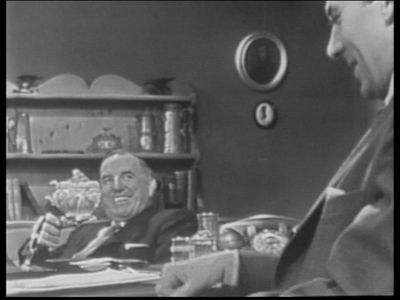


For a full rundown on the special features, read the full article at DVD Talk.