
Years ago, I was co-host of a cable access show. Every two weeks, we'd be live on Portland television for an hour, showing music videos, working without a script. Hardly anybody watched it, there were no consequences if we sucked, but even so, that hour was a nerve-wracking, electrified, exciting time. We were beaming across the city to whatever homes had cable, to whoever might have happened across us while scanning the airwaves with their remote controls. What a thrill! From the signal that we were on the air to the studio's screen going black, whatever happened
happened, there was no taking it back.
I can only imagine what it must have been like to do live television dramas in the 1950s. The best I can do is try to marry my slim community theatre experience with the cable access experience. Put together a scripted show where I had to remember lines and hit my marks with that feeling of reaching beyond the protected performance space, that what we were doing wasn't just going to be seen by those in the immediate vicinity, but potentially by hundreds. Thousands. Millions. It wasn't just a matter of showing up and running out the clock, you'd really have to perform.
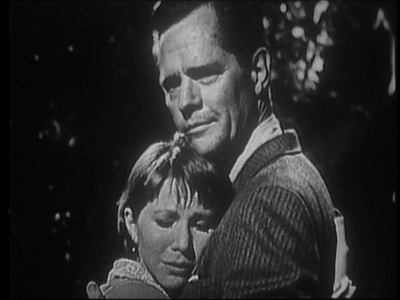
That's how TV was done in the early days. Live shows, like hour-long plays, often with the best and the brightest of Broadway, new talent cutting their teeth in a new media. Eight of these programs are collected in the new Criterion boxed set,
The Golden Age of Television. The collection is named for a PBS series that showcased this exciting time. The original presentations were performed live on the East Coast, shot with multiple cameras, but in the days before video tape, so no clean way to capture what was happening. The filmmakers edited as they went, it wasn't on film. What PBS resurrected and what they showed when this series first ran back in the early 1980s, bringing these vintage teleplays back to the air for the first time in decades, were recordings called "kinescopes." Essentially, kinescope was a process of photographing the broadcast by pointing a special camera at a video monitor. Like if you took a camera yourself and set it up in front of your TV and recorded a show. It wasn't perfect--you can sometimes see the curve of the screen, or a speck of dirt on the glass, or any number of glitches--but it was the only way to prevent these programs from just disappearing into thin air.
The material here is the cream of the crop, chosen from hours of television. Amongst the shows, we get early scripts from writers as revered as Paddy Chayefsky, Ira Levin, and Rod Serling, direction from future legends like John Frankenheimer, and performances by Ed Begley, Andy Griffith, Rod Steiger, Elizabeth Montgomery, George Peppard, Paul Newman, Julie Harris, Kim Hunter, Jack Palance, Mel Torme, and Piper Laurie in roles both big and a small. There are also small-screen turns by established big-screen stars like Everett Sloane, Edmond O'Brien, and Mickey Rooney. Structured more like the legitimate theatre, these high-wire acts show a precision of craft and a dedication from the talent we don't see all that much anymore. There were no do-overs. They only got one shot.
*** Disc 1 ***
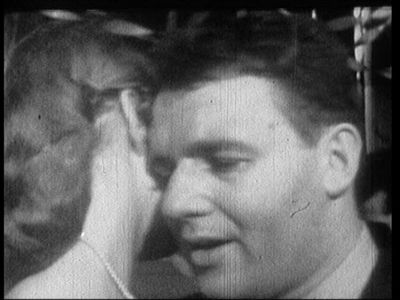
Marty (1953): Directed by Delbert Mann and written by Paddy Chayefsky, this initial version of
Marty predates
the Oscar-winning movie
by several years. It stars a young Rod Steiger in the role later popularized by Ernest Borgnine. He plays Marty, the lonely butcher in his late 30s whose bachelorhood is beginning to weigh heavy on his shoulders and his heart. His mother (Esther Minciotti) is worried that her eldest will never marry the way her younger children have--though even as she encourages Marty to get out there, she begins to doubt whether his finding a wife is the best thing for her. Life changes affect everyone, including the old moms who live with their sons.
Marty eventually meets a woman, a schoolteacher (Nancy Marchand), at a dancehall. He becomes aware of her when another guy asks him to take her off his hands. They had come here on a blind date, and he's decided she's a dog. Seeing a familiar crack in her broken heart, Marty risks further pain by sharing his hurt with the girl, and they see glimmers of happiness in one another. It's a tender story, enacted with a touching sensitivity. Steiger is the epitome of a gentle giant, and his expressions of doubt and heartache are disarming coming not just from a man of his size, but any man really. It's not usually the fella we see waiting at home for the phone to ring in romantic stories. Chayefsky builds Marty's predicament with such care, layering the story with thematic parallels, that he staves off any impending mawkishness.
Marty is sweet and touching, but it's not manipulative, it comes by those heartstrings it tugs honestly.
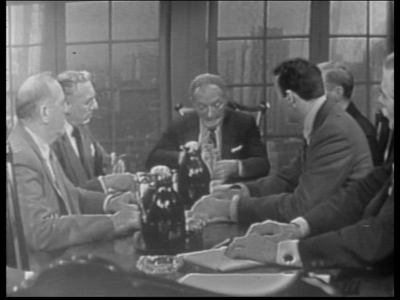
Patterns (1955): Rod Serling's big-business drama caused a sensation when it first aired, and it went a long way to building the reputation that would eventually lead to the writer landing his own series,
The Twilight Zone
. Unlike that show, this Fielder Cook-helmed drama stays close to the earth, detailing the regime change in a large corporation. Fred Staples (Richard Kiley) is a new vice president being brought in to edge out the old, Andy Sloane (Ed Begley). The boss, Mr. Ramsie (Everett Sloane), sees Andy's moralistic approach to business as a relic from his father's age, a hold-over from a time long gone. Fred doesn't know he has been fashioned into an assassin's bullet, but it doesn't take long for his true purpose to be revealed.
Rod Serling's strength has always been socially conscious dramas that manage to wear their pointed message out in the open, but like Chayefsky, he wrote in such a way that it never seemed obvious or cloying. In
Patterns, the pieces all move with precision--there is the hard-charging boss, the rising star and the fading champ, the secretary who sees everything (Elizabeth Wilson), the wife (June Dayton) who wants to see her husband climb the ladder. Everyone has a function, but the way the gears lock together never show. Grandstanding speeches come off as natural. They are written with an ear for speech, and spoken by true masters. Ed Begley is fragile as the aging executive, losing the last grip he has on stability, and Everett Sloane is ruthless as the company president. It's all Richard Kiley can do to remain standing between them as they obliterate one another.
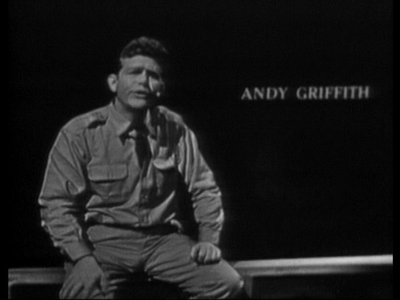
No Time for Sergeants (1955): The lone comedy in the set stars Andy Griffith as Will Stockdale, the country bumpkin draftee who gets through the army on his blind luck, blind charm, and well, blind everything. His is the kind of character who never seems to clue in to what all is going on around him, to the precariousness of his situation or the dismay he may be causing others. In truth, they are uptight and overly concerned with rules and such; he is free to be himself.
No Time for Sergeants was adapted by Ira Levin (
Rosemary's Baby
) from a novel by Mac Hyman, and this Alex Segal-directed production actually predates the more famous Broadway version, which grew out of this show and also starred Griffith. It's also the first show in
The Golden Age of Television to feature a first-person narrator that talks directly to the audience (
Bang the Drum Slowly is another), and we follow Griffith as he crosses through the sets, even makes jokes about the empty facades and the ease with which he gets from one place to the other. Griffith is definitely charming (if not also a little annoying), and though the humor is of an antiquated variety, the down-home joking hasn't grown stale. Harry Clark plays Will Stockdale's foil, the flummoxed Sergeant King, and he and Griffith play off each other really well. It's a little like watching a live-action
Looney Tune.
*** Disc 2 ***
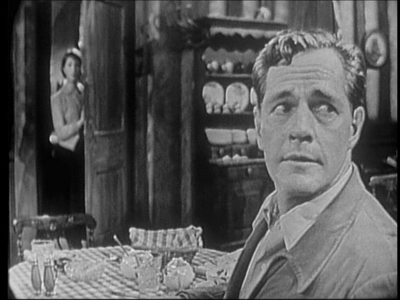
A Wind from the South (1955): This quiet love story set in Ireland stars Julie Harris as Shevawn, the sisterly half of a brother/sister duo running a bread and breakfast in the countryside. Unlike her angry brother (Michael Higgins), Shevawn hasn't resigned herself to a life stuck in her hometown, she dreams of travel, a fantasy life fueled by the lives in transit passing through their establishment. Amongst the current guests is the American ad man Robert (Donald Woods), a man equally frustrated with his stagnant life, but who covers his frustrations with jocularity, poetry, and drink. Shevawn and Robert share a brief one-night affair, one that stirs both of them, and that plays out in surprising, satisfying ways. The emotional denouement shows a lot of depth. The script is by James Costigan, a notable name in early television, and inspired by, of all things, an album of songs recorded by Merv Griffin in tribute to
The Quiet Man (Collector's Edition)
. While the future talk-show host doesn't appear on screen, he does sing "A Soft Day" at the start and close of the show, as well as at the act breaks. As the lyric goes, "
A soft day, thank God/ A wind from the South with a honeyed mouth."
Harris was a Broadway star who would be one of the emerging talents in 1950s television; she would match this success with big screen triumph in
A Member of the Wedding and
East of Eden
. I quite liked her in
A Wind from the South, it's a role filled with earnestness and longing, but tempered by sweetness--the actress' specialty. Directed by Daniel Petrie (
Rocket Gibraltar
), the tiny drama has a remarkable sensitivity, exploring the notions of dreams and how desires often must give way to reality.
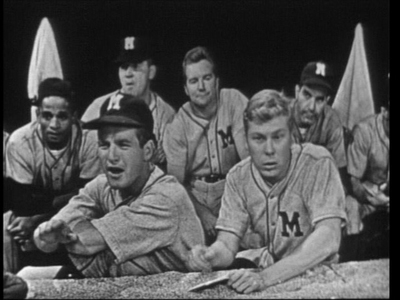
Bang the Drum Slowly (1956): Daniel Petrie also directed this baseball story, adapted by Arnold Schulman from a book by Mark Harris. A young Paul Newman stars as Henry "Author" Wiggen, the first-person narrator of the story. He is a minor league pitcher who becomes entangled in the life of his catcher, Bruce Pearson (Albert Salmi), a player of little talent and even less brains. When Bruce becomes terminally ill, Author takes him under his wing, doing his best to keep his ailment a secret so he doesn't get cut from the team. The locker room talk here is pretty tame, but the camaraderie is still a lot of fun. Author is an amusing character, hung up on taxes and caught up in his own story to a point where he almost forgets that it's someone else's tale he's telling.
Or maybe that's the consequence of having Paul Newman leading the charge. He's an electric performer, even at this stage, imbuing Author with an Actor's Studio twitchiness. The method gets in the way of Newman's naturalism a little, but his inherent charisma and comfort in front of the camera was too pronounced to squash. Albert Salmi is also very good. I am used to seeing him as the heavy, but he is quite convincing as a big palooka.
Speaking of big palookas...
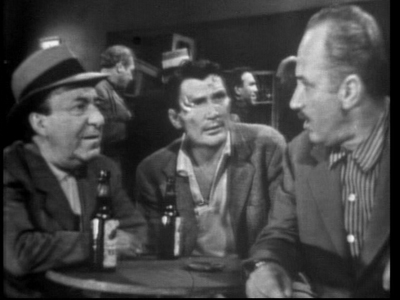
Requiem for a Heavyweight (1956): This famous Rod Serling drama was one of the first productions on "Playhouse 90," the series that ushered in the 90-minute drama. If these guys could do a full hour, why not an hour and a half? No big deal, right?
Well, it was a big deal, but
Requiem makes it look easy. Jack Palance stars as Mountain, a boxer who is over-the-hill at 33. He lost his latest bout in a big way, and the doctor says if he keeps fighting, he'll go blind. To make matters worse, his trusted manager, Maish (Keenan Wynn), didn't think he could make it past three rounds, and when the bruiser manages to take it to seven, Maish doesn't make book and it puts the gambler in big-time hock. As Mountain tries to figure out what to do with himself if he's not fighting, Maish has to figure out how he's going to pay off the gangsters. In between is the cut-man Army (Ed Wynn), who'd like to see both of his friends get out of their predicaments with dignity.
Requiem for a Heavyweight is a remarkable piece of work. It set the standard for boxing stories, so much so that filmmakers are still borrowing from it to this day. Jack Palance is nearly unrecognizable as the punchy knuckleduster, turning his massive girth into sensitive mush. His relationship with Kim Hunter's employment officer is sweet and believable, the smart gal falling for the gentle giant. Serling's ability to capture the essential human decency of any situation makes
Requiem more than your basic sports story, he takes this very specific tale of descent and makes it a play about universal triumph.
*** Disc 3 ***
The final disc belongs to John Frankenheimer, an innovative director who would move from television to direct movies like
The Manchurian Candidate
and
Ronin
. What Frankenheimer brought to the screen in terms of style is immediately apparent from the very first scene on this DVD. There is a tremendous sense of movement, of smart choreography and tricky set-ups, that is unlike anything that came before it. With the constant creativity of the age, of new programs being staged every night, such innovation was inevitable. It's like exercising: you only get stronger the more you do it.
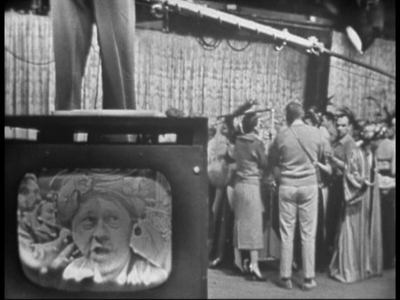
The Comedian (1957): The Comedian opens in a television studio, jumping back and forth between the control booth and the floor, staging close-ups using a video monitor in the extreme foreground, showing us the tail end of a disastrous rehearsal for comic legend Sammy Hogarth's latest extravaganza. Hogarth, played with knowing verve by Mickey Rooney, is making his transition into 90-minute television. How meta can you get? Based on a story by respected writer Ernest Lehman, this Rod Serling teleplay tears the live TV world apart, showing us the inflated egos of its stars and the people they destroy from the top on down. Edmond O'Brien (
D.O.A.
) plays the washed-up writer who chisels Sammy's schtick, and singer Mel Torme is his hapless brother, a do-it-all assistant who is also the butt of most of Sammy's jokes. In a
Sweet Smell of Success-style twist, Whit Bissell plays Elwell, a gossip columnist looking to take Sammy down because of a vicious impersonation of his signature style the actor once performed. (Note: Lehman also wrote that picture.) It all comes to a head on the big night.
The Comedian is unrelenting and sometimes brutal. Sammy is an irredeemable character, even with the hidden pain Serling unearths in the final act. He's not meant to be redeemed, we're only meant to see the source of his pathology. The actors are all incredible. Rooney is incendiary, O'Brien is tragic and feral, and the only nobility in the play belongs to the women, with Kim Hunter and Constance Ford seeing the writing on the wall long before their men do. Torme is the only weak link, his portrayal of Lester Hogarth never quite coming together, perhaps a case of the character's weakness overtaking the actor.
Frankenheimer is the real star, though.
The Comedian is an ambitious piece of work, full of inventive, nearly surreal set pieces and featuring a final-act montage that must have been a real bear to undertake. Layering stock footage and scenes of the Sammy Hogarth show, he elevates this one-off production to a level that was equal to anything playing at the local movie house.
As an aside,
The Comedian is introduced by Claudette Colbert, whom we learn over the closing credits is scheduled to be on "Playhouse 90" the following week. Likewise, Sterling Hayden introduces the next program...
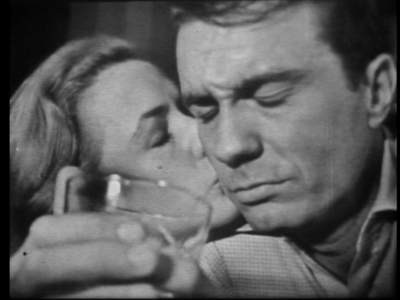
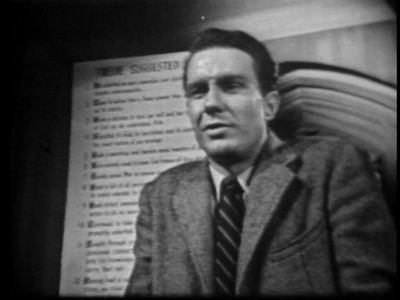
Days of Wine and Roses (1958): This hard-hitting drama about alcoholism was probably the first time most Americans saw inside an Alcoholics Anonymous meeting. Cliff Robertson stars as Joe Clay, the anonymous witness for this session, who tells the story of his drinking life with Kirsten Arnesen (Piper Laurie). They met through booze and stayed together with booze, and the J.P. Miller script tracks the ups and downs of their relationship, the highs and the incredible lows. They fail more than once to kick the sauce, and Joe's AA membership acts as a wedge between them, redefining how they look at one another. The show looks at not just how drinking affects the pair, but their family and the people around them.
Like
Requiem for a Heavyweight's boxing clichés, a lot of what we see here has become standard practice for addiction-based melodramas, and though the final scene featuring Joe reciting the serenity prayer may seem a little hokey now, I doubt it was as commonplace in 1958. Cliff Robertson and Piper Laurie really go through the ringer in
Days of Wine and Roses, they must have felt like they were running a marathon. So demanding was the show, Frankenheimer actually elected to pre-record the scenes at AA, he couldn't have Cliff Robertson running back and forth and changing his suit as much as would be required. One scene these guys are sober, the next they are drunk--there are even a couple of detox sequences. Surprisingly, Miller doesn't wrap everything up neatly in the end, either. Not everyone walks away happy.
The thing about watching
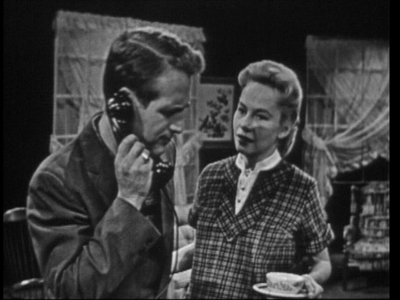
The Golden Age of Television is that you would never know these productions were recorded live if you weren't told. They aren't gimmicky or shambolic, they aren't simply one-room sets like filming a stage play within its confined space. What is still amazing to see is how deftly these filmmakers pulled this off, how seamlessly they move from one location to the next, from character to character, never letting the cracks show. These are fine-tuned productions, expertly rehearsed, carefully honed to come off without a hitch. These dramas were meant to compete with motion pictures--and they do. Quite easily.
The Golden Age of Television - Criterion Collection is an invaluable historical document that also manages to be a potent testament to the quality of early television drama (and one comedy!). These eight shows, recorded live between 1953 and 1958, show a medium in emergence, propelled by unmatched talent. The writing, direction, and acting--every aspect of the performance--is a wonder to behold, and all the more impressive for the fact that this was all done exactly as we see it here. No retakes, no do-overs, pure live theatre--though not the traditional trodden boards, the theatre of the air!
For a full rundown on the special features, read the full article at DVD Talk.


