Showing posts with label Nicholas Ray. Show all posts

Thursday, December 31, 2020

THE LUSTY MEN - CRITERION CHANNEL

This review originally written for DVDTalk.com in 2014.


Equal parts modern western and prototypical sports picture, Nicholas Ray's 1952 drama The Lusty Men is an interesting sideshow story about a particularly hard-living group of fellows and the consequences their choices have on the women in their lives.
 

Robert Mitchum stars in The Lusty Men as Jeff, a champion of the rodeo circuit who returns to his Texas hometown after an injury takes him out of competition. Looking to make a little money and maybe even save up to buy the house he grew up in, Jeff signs on at a nearby ranch. There, he befriends Wes (Arthur Kennedy), a newlywed who has designs on the old property himself. Wes and his wife Louise (Susan Hayward) have been content with the slow and steady path to homeownership, but meeting Jeff gives Wes an idea: he can start riding broncos and busting bulls and make the cash he needs quicker. Louise isn't so keen on the idea, she's scared her husband will end up with a debilitating injury the same way his new trainer did. She doesn't get much say in the matter.


The majority of The Lusty Men's running time takes place on the road, as the threesome hooks up with the regular rodeo caravan and go from town to town chasing prize money. Wes takes to it naturally and starts winning; he also takes to the nomadic lifestyle, partying after the big show, attracting the attention of groupies. Meanwhile, Louise attracts the attention of Jeff, who silently pines for the sort of life she's hoping to achieve. She takes comfort in his steady gait, even as she begs him to get her husband out of the game alive. It's an interesting love triangle, lacking in any real infidelity. Jeff only states his true intentions outright when Wes has taken things too far. The resultant showdown takes place in the arena, with each man looking to measure his masculinity by how long he can stay on a bucking horse.


The Lusty Men is refreshingly restrained when it comes to the melodrama, with Ray preferring the rough-and-tumble world of professional cowboys to any bedroom antics. The movie's heroes are adrenaline junkies who view settling down as a kind of selling out. That is, until they don't anymore. Mitchum plays it tough, but the actor also shows great empathy and vulnerability. He doesn't stop Wes because he knows he can't, the rider has to make his own choices; yet, he also recognizes the damage done to the wife. (If he didn't, the script provides the audience with multiple parallels so we can see places Wes might end up.) For her part, Hayward shows a nice balance, allowing the allure of the party life to distract her, but never losing her resolve.


Ray and cinematographer Lee Garmes (Duel in the Sun, Nightmare Alley) capture all the thrills and danger of the rodeo events, working nicely with editor Ralph Dawson (Harvey) to meld the long shots of the actual horseplay with the close-ups of the actors both in and out of the stadium. It works nicely. The Lusty Men is reminiscent of many race-car pictures that would follow, not to mention a little bit like a western version of the traveling circus drama. The even emotional tone might disappoint some, but it fits the idea that these tough customers leave everything out there on the field. My only complaint is a rather abrupt ending that not only sews things up a little too neatly, but also left me confused and reaching for the rewind to try to discern whether what they suggest just happened really did.


Sunday, February 23, 2020

LA CHINOISE - CRITERION CHANNEL

"We need to confront vague ideas with clear images." - slogan painted on the wall in La Chinoise

"In any case, you need sincerity and violence." - Guillaume (Jean-Pierre Leaud)


1967's Jean-Luc Godard feature La Chinoise (The Chinese) makes no bones about the director's emulation of agitprop pioneer Bertold Brecht. Not only does one of the main revolutionaries, Guillaume (Jean-Pierre Leaud, The 400 Blows [review]), espouse the benefits of the playwright's political theatre as handily as he praises Chairman Mao, but in one scene, standing before a blackboard filled with names of philosophers, politicians, and other figures of the world stage, Guillaume erases them all except Brecht. La Chinoise is Godard moving agitprop from the stage to the cinema.

The film takes place over one summer, filming five students in their apartment as they use their vacations to form a radical Communist cell devoted to the teachings of Chinese dictator Mao Tse-Tung and his little red book. At the head of this group is drama geek Guillaume and his philosophy-major girlfriend Veronique (Anne Wiazemsky, star of Bresson's Au hasard Balthazar [review] and Godard's one-time wife). They are of the no-compromise, no-retreat variety of activists, while their cohort Henri (Michel Semeniako) is more willing to accept the contradictions of political revolution. This eventually gets him dispelled from the group, though ironically, amongst all the talk of change and fomenting an uprising, Henri is the only one who we know has left the apartment and joined in any action. He first appears onscreen having been beaten and bloodied by Communists loyal to Russia. Of the many ideas tossed around here, one is that Kruschev has done little to maintain a socialist ideal, and that European Communism is pretty much endorsed by Imperialist America, who is more than willing to do business with Soviet countries when it suits them. The true threat of Asian Communism, as it were, is their lack of interest in playing in the capitalist reindeer games of the U.S. Though there is much to disagree with in La Chinoise, there is also much that intrigues and provokes.


For the most part, La Chinoise is a series of interviews, speeches, and debates amongst the cell, who stay in their apartment and endlessly pour over Mao's book, rows of which line every shelf in the place. Cut into the discourse are Godard's trademark title cards and propaganda-like still images, sometimes working in concert with what is being said, sometimes in juxtaposition to it. Some images are even integrated into the scenery, such as when Veronique shares her revolutionary ideas while sitting beneath a collage of pin-up girl drawings. In addition to the polemics about current political events, Godard uses La Chinoise as another treatise on the purpose of cinema, even breaking down the fourth wall, appearing himself as (presumably) an off-screen interviewer and panning around to show cinematographer Raoul Coutard manning the camera. Hell, he even manages to namedrop Nicholas Ray yet again. Has anyone done a count for how many Godard movies make mention of Johnny Guitar? And it still isn't on DVD?! [Except it is.]

Though the movie isn't exactly subtle with its politics, it is somewhat difficult to dissect what Godard may be personally endorsing from what he is throwing under the bus in his savage portrayal of the students. While I think the director would love to be able to wholeheartedly embrace a youth movement that supported real social change, he clearly is disenchanted with the all-talk and no-action navel gazing that such activists can engage in. Henri may begin as the character we dislike, particularly when it's revealed that he endorses his girlfriend (Juliet Bento, Weekend [review]) engaging in prostitution to pay the cell's bills as a living example of the disparity between working-class reality and socialist ideal, but by the end, Henri's revealed as the only one with a clear head when he refuses to engage in terrorism. Guillaume also may be slightly redeemed in sticking with his theatrical plan, but there is some suggestion that he may only be in it for the girls. (He eventually splits with Veronique to hook up with Bento's more impressionable character.) Really, there is more sincerity than there is violence here, and for some, probably more vagueness than clarity, too.


The most pungent critique is saved for Veronique, the one most fervently advocating acts of terrorism. On a chance encounter with one of her former teachers, the dissident Francis Jeanson playing himself, she tells him of her violent intentions, and he quickly sees how misguided she is. He damns her with one persistent question: once you have carried out your plan, what next? Veronique obviously has no idea how to fill the hole she wishes to create, and right there is seemingly Godard's major issue with bourgeois politics: they have no game plan for how to sustain the change they advocate. Thus, they spend more time talking about change than enacting it, and when they do jump into the fray, as Veronique eventually does, they screw it up. Which is fine for them, because they can walk away, return to school for the new semester, completely unaffected. Therefore, it's almost better to be the fifth member of the cell, the almost psychotic Kirilov (Lex De Brujin), who kills himself rather than do nothing--or, as it were, finally have to do something, and maybe something that will mean nothing.

As far as Godard's political cinema is concerned, La Chinoise is not necessarily the director's best. It's not nearly as incendiary as Weekend or as successful on its own terms as Tout va bien. Even so, he does effectively encapsulate what is often wrong with liberal political movements and their ability to harness youthful enthusiasm without knowing how to apply it, and the director both appreciates the young activists of 1967 even as he exposes their flaws. (Bertolucci has a similar take on the '60s student movement in his film The Dreamers, and even hangs a La Chinoise poster on their bedroom wall.) It's easy to have radical ideas when you, yourself, aren't under any real threat. The middle class can speak for the working class without threatening their own bottom line. In Godard's mind, this is where all Communism has gone wrong, as eventually there will be new leaders to replace the deposed ones.


Of course, charges of ineffectual intellectualism could easily be turned back at Jean-Luc. He is completely aware that one could accuse him of sitting in a vaunted position and making movies rather than joining on-the-ground protests, hence his built-in defenses for cinema. If Nicholas Ray's B-movies could be as effective as a Brecht's overtly political plays as tools for social change, then why not also more enlightened cinema like La Chinoise? When Guillaume starts his theatre, he does take it to the streets, after all, knocking on doors and sharing his ideas and seeing the social reality that surrounds him as he does. Arguably, rock 'n' roll was the more active art of the 1960s, something Godard even saw, hence his coupling with the Rolling Stones a year later.

When it comes down to it, it's not a dispute easily settled, and with Godard's open-ended cinema--Susan Sontag argued that he wasn't making individual movies, but one long, ongoing dialogue--the debate continues. Ironic, in its way, sitting in a room, watching the movie, and then typing about it on a laptop before sending said ideas out into the ether all on their own. Such an endeavor could make me just as deluded as the kids in La Chinoise. And yet, here you are reading it, and the idea passes on. So, maybe Godard's method does work, after all?


This review originally written for DVDTalk.com in 2008.


Saturday, June 24, 2017

THEY LIVE BY NIGHT - #880


The first feature from director Nicholas Ray, 1948’s They Live By Night prefigures his iconic Rebel Without a Cause as a story about two doomed teenagers who fall in love despite the circumstances that put them on the wrong side of an adult world that either doesn't understand them or refuses to try. Adapted from the Edward Anderson novel Thieves Likes Us (also made into a later film by Robert Altman, reviewed here), They Live By Night stars Farley Granger (Rope) as Bowie, a kid who got into some trouble when he wasn't looking for it and now has broken out of jail with older bank robbers who also had life sentences for murder. On their backwoods crime spree, Bowie meets Keechie (Cathy O'Donnell, The Best Years of Our Lives), and their reaction to each other is romantic, hormonal, and strangely endearing and comforting. Keechie tries to find solutions to get Bowie out of his trouble, but the newspapers have seized on him as some kind of pretty boy highwayman, putting the lives of the two young lovers beyond their own grasp.


That kind of foreboding permeates They Live By Night. Ray harnesses the adolescent us-against-the-world feeling of doom and gloom and wraps the entire picture in it like a cloth. It doesn't matter what Bowie and Keechie try to do, they can't live in isolation. A water pipe might burst and the plumber will recognize the young thief, or a former ally might get an itch for some kind of reward and turn snitch. Even Ray's camera acts as an otherworldly force, with his pioneering helicopter shots careening over the fleeing couple, showing just how much larger their surroundings are than a pair of kids in love. They live by night because the daylight means exposure.

By the end of the film, the phrase "thieves likes us" has become a kind of mantra. Bowie has to accept that a thief is what he is now, there is no use struggling. It's a cold ending for the boy, because once he gives in, the shields come down, and the punishment that is meted out to such tragic figures arrives with swift ferocity.


For those who owned They Live By Night in its previous incarnation, as part of Warner Bros.’ Film Noir ClassicCollection, vol. 4--which is what I originally wrote this review for--will recognize most of the bonus features here as coming from that 2007 set. The upgrade here is in picture and sound, which have been newly restored and remastered, rescuing the finer details of Ray’s production and preserving them for new audiences.

You also get a new package design with art by MarkChiarello, a colleague of mine at DC Comics. Mark is a master of visual language, and his simple, evocative drawings bring the figures from the film to life in a way that captures their essential character while also transcending caricature.


Folks who enjoy They Live By Night might be curious to note that Granger and O’Donnell reunited two years later for director Anthony Mann in a movie called Side Street. Since the previous release presented the two films as double feature, here is a bonus review of Side Street:

They Live By Night opens with tight close-ups of the lovers clutching one another as words on the screen inform us that they have been stranded in a world that hasn't allowed them their right to grow up. In similar fashion, Anthony Mann's Side Street has an all-pervasive narrator whose almost wry tone suggests that here, too, there are elements of fate that extend beyond what we can choose for ourselves. In fact, as the ersatz hero of the story will learn, one false move ends up having reverberations, setting off a chain of events that could be impossible to undo.

Side Street reteams Farley Granger and Cathy O'Donnell as another pair of young newlyweds. Joe and Ellen Norson aren't that different than Bowie and Keechie from Night, except they live in New York instead of the hills and they started out by trying to live right, only the payoff hasn't been very good. Ellen is pregnant, but after a stint in the army and a failed business venture, Joe can only find part-time work as a postal carrier. He dreams of buying his beloved wife a fur coat, but he can't even afford their own apartment. On his delivery route, he sees that a lawyer keeps cash stashed in his office. Thinking he'll be stealing only enough to get by, Joe returns to rob the place. Only, when he checks the stash, it's actually $30,000. Unbeknownst to Joe, the crooked lawyer and his heavy have blackmailed a rich pervert, and the girl that lured the patsy to his doom has ended up dead. Yup, poor Joe is in over his head.


Tough-guy director Mann, working from a script by Sydney Boem (The Big Heat), arranges his various plot points like pieces in a game, each character moving across the giant playing field, no less than New York City itself. Shooting on location, Mann takes us through the streets of Joe's troubles, mixing the semi-documentary style of Jules Dassin's The Naked City [review] with the nervous, feral atmosphere of the noir masters (something Dassin was also pretty good at, particularly in Night and the City [review]). There's nobody in this film that Joe and Ellen can trust, not even the police, who though righteous in their duties aren't necessarily compassionate. Friends will rob you, street-savvy children will sell you out for ice cream money, and life isn't worth very much at all. And yet, despite his brutal directing hand, Mann always has a weird 1950s innocence to him. As much as Joe flails about, there is a kind of safety in Mann's tone. It's like he's that smart little kid with the info, who even tries to school the police in how to resolve the situation. He knows how it's all gonna turn out, not to worry. It's also the comfort of genre: we have certain marks to hit, and Mann is going to get us there.


Portions of this review originally published on DVDTalk.com.

Images here are taken from the 2007 standard-definition release of They Live by Night and not the Blu-ray under discussion.

This disc provided by the Criterion Collection for purposes of review.

Sunday, May 1, 2016

IN A LONELY PLACE - #810

Note: The screengrabs here are from an earlier DVD release and not the Criterion Blu-ray being reviewed.


Oh, the sick mind of a writer. And nothing so perverse as believing your particular brand of sickness is special.

I’ve been fascinated by In a Lonely Place for some years now. Film noir at its best, In a Lonely Place is a cynical, hard-bitten favorite. So much so, I wrote about in my most recent (currently abandoned) novel, as there are similar themes to be had in both. Here, let me cut and paste the pertinent section from the rough draft, which explains some of what the movie is about: 


When I was done with Leandro, I drove over to a revival theatre in Santa Monica where they were showing an old Humphrey Bogart movie. In a Lonely Place, 1950, directed by cinema himself, Nicholas Ray--a dark-side-of-Hollywood picture. While I was waiting for it to start, eating a box of Jordan almonds, I wondered what I would do next. Leo drew the line at giving me Adam’s address. He said that didn’t pop up right away, he’d have to go farther into the system, and that would leave fingerprints. I would have to find Adam some other way. Last I heard of him, after Brianne left him and we moved here and the divorce, he was still in Oregon working for that computer company. I didn’t suppose it would be too hard to find out if he was still there.

The movie was amazing. Bogie plays Dixon Steele, a washed-up screenwriter with rage issues. One night he takes a coat-check girl back to his apartment to talk about a book he’s supposed to adapt, and after she leaves his place, she never makes it home. The police chief decides Bogie did it, that he was really living out one of the lurid scenarios he writes for the pictures. Enough people keep telling that story that other folks start to believe it, including the one person who shouldn’t, the actress who provided his alibi and whom he then fell in love with. There is enough pressure that before they know it, they really are in an old Hollywood potboiler. There’s no way out of it then, and Bogie ends up back where he started. The lonely place--where murders are committed, stories are imagined, and the broken-hearted reside. “I was born when she kissed me, I died when she left me, I lived a few weeks while she loved me.”

Leaving the theatre, I noticed a poster advertising an upcoming retrospective of the films of Jean-Luc Godard. Images of Anna Karina and Jean-Paul Belmondo and Jean-Pierre LĂ©aud. Temptresses, gangsters, and teenagers. I’d have to come back for that.


Movies come up a lot in my book. And detective fiction. Rest assured, I’ll be taking a pretty heavy pair of scissors to the above. I can see tons of things I’d cut right now, get it down to the bones. Much like Dix eventually savages the book he’s meant to turn into a faithful screen version. The way the coat-check girl (Martha Stewart) describes the imagined romance novel, I can’t help but think of Leave Her ToHeaven, and maybe that’s the kind of sharpness Dix brings to his script. We can only guess. All we know of the unseen screenplay is what the onscreen author tells us.


Dix is a sinister storyteller, one who doesn’t shy away from the more gruesome details of a plot. Naturally, when the police, including an old buddy from his army days who’s now turned detective (Frank Lovejoy, The Hitch-Hiker [review]), show the wordsmith the murder scene photos and outline their own timeline for how Dix killed the girl, he starts to puzzle through the potential suspects and motives himself. He even relays his own version to that buddy and his wife (Jeff Donnell, The Sweet Smell ofSuccess). As he spins the yarn, directing them at to act it out at the same time, Ray and director of photography Burnett Guffey (The Strange One [review]) isolate the light on Bogart’s face, making it look the way it does when a kid telling ghost stories at camp holds a flashlight under his chin. The irony is Dix can’t imagine himself doing it, despite every one else thinking he probably did. Or, to clarify, he can’t imagine himself doing this particular murder. He never wavers in his belief he didn’t, not even when he cruelly jokes with his agent that maybe he did. There’s truth in that wicked humor, and little that Dix is capable of some pretty nasty business. He has violent spells that give everyone pause. The same light lands on him when the moods take over, a visual cue to let us know that we are heading into darkness. It’s almost supernatural--even if now we recognize him as a man with anger management problems, perhaps even some PTSD from his combat service, and the classic patterns of an abuser. He erupts, attacks, and then is sorry, making amends through grand gestures and promises to never do it again. Dix is a hard man to like, and yet we do anyway, because he’s still Humphrey Bogart. Playing on the actor’s star power, Ray messes with our perceptions. We have a feeling Bogart is the good guy, because he most often is, and so we put our faith where no one else can.


In essence, we are the lover that the actress who falls for Dix can’t be, because we put aside our doubts and put our faith in the supposed inevitability of a Hollywood happy ending. The noir twist here is how the stories about the writer, rather than the ones he crafts himself, take their toll on Laurel (played by Nicholas Ray’s real-life (and estranged) wife Gloria Grahame (The Big Heat, Sudden Fear [review]). Laurel lets her imagination get the better of her; she can’t separate the violence she’s witnessed from the violence Dix is accused of perpetrating. It’s a shame when you let a thing like a dead body get in the way of a good love story, but then again, as Dix explains, “A good love scene should be about something else besides love...Anyone can look at us and tell we’re in love.” This little bit of poetry is delivered during the scene where the film really turns. He’s making her breakfast, and Laurel is groggy, having taken sleeping pills to (unsuccessfully) block out her nightmares about Dix beating another man. Where earlier in the film she saves him with her alibi and pulls him out of his slump by taking care of him, now he’s her caretaker, right down to the domestic chores--though the results aren’t quite the same. There is a wonderful metaphor embedded in this scene: Dix is trying to prepare Laurel’s breakfast grapefruit, but he is having a hard time because he has straightened out the curve in the grapefruit knife, thinking the bend is not supposed to be there. All the better for stabbing things with...?


Bogart and Grahame are a natural screen pairing. They are attractive and confident, and they both have a bit of a speech impediment. She is aloof, and then a rock, and then a bundle of nerves that grows more tangled even as she unravels. (Dix will never straight her out!) Fascinatingly enough, Laurel’s not opportunistic. The failed actress never pushes the more successful scribe for a part in his new movie. This makes Laurel less the femme fatale and more the stable good girl. Dix has no nemesis but the one buried inside him.


Nicholas Ray manages to both have his tongue in his cheek when dealing with this Hollywood nonsense and be perfectly serious when relaying the rest of his tale. In a Lonely Place goes to some deep recesses and sifts around in the muck, yet it also maintains the aura of illusion. The scenes around Dix and Laurel’s apartment complex are played with an almost sitcom-like airiness. It’s classic Hollywood at its finest, and also a subversive, self-reflexive tribute to the system that spawned it. Joining the pair is a cast of eccentric characters and Hollywood types: a nebbish agent, a one-time matinee idol turned drunk, a controlling masseuse, a raven-haired actress on the prowl, the producer that’s also the son-in-law of a studio chief and whom no one respects. All that’s missing is a studio fixer. Even the coat-check girl is a type, she’s the wide-eyed movie fan who can’t believe she’s rubbing elbows with celebrities. In a Lonely Place is a cautionary tale: motion pictures are a deadly business.


Elsewhere on Criterion’s disc of In a Lonely Place, the camera is turned on the filmmaker. The 1975 documentary I’m a Stranger Here Myself caught up with Nicholas Ray while he was working as a teacher, at the time he was shooting We Can’t Go Home Again [review]. The movie details Ray’s cinematic philosophy, shedding light on his approach to character, his championing of the outsider, and how he expects to communicate with the audience. John Houseman, Natalie Wood, Francois Truffaut, and others also chime in to talk about the filmmaker. Early in the doc’, Ray talks directly about In a Lonely Place, including how he came to the film’s knockout ending.

Among the other extras is a 1948 radio adaptation of Dorothy B. Hughes original novel for In a Lonely Place. (Hughes also wrote the source book of Ride the Pink Horse.) Performed for the Suspense series, it stars Robert Montgomery as Dixon Steele, a would-be novelist and serial strangler. Though a Los Angeles story, there are no Hollywood trappings, and the portrayal of Dix’s compulsive behavior is far less complex, despite being related from a first-person point of view. Is it possible Bogart’s dismissal of then novel he’s supposed to adapt in the movie version a meta joke about In a Lonely Place’s own source material.


This disc was provided by the Criterion Collection for purposes of review.


Friday, November 30, 2012

SIDELINE: MORE REVIEWS FOR 11/23

My reviews of non-Criterion movies for November.


IN THEATRES...

* Anna Karenina, in which Joe Wright goes as crazy as his heroine and throws cinema under the train. But in a good way!

* Killing Them Softly, the reteaming of Brad Pitt and his The Assassination of Jesse James by the Coward Robert Ford director takes on and dismantles the crime genre the same way they did the Western.

* A Liar's Autobiography: The Untrue Story of Monty Python's Graham Chapman sounded like a good idea. In 3D, animated, built with audio recordings by the late comedian. Too bad it sucks.

* Life of Pi. The 3D or the tiger? Definitely worth seeing in the theater to see Ang Lee's beautiful adoption of the extra dimension, but expect to be underwhelmed by the story.

* Lincoln. Day-Lewis. Spielberg. 'nuff said.

* Silver Linings Playbook, in which David O'Russell asks, "How is Bradley Cooper not himself?" You may need a tissue for this one. Either from crying or...er, um...Jennifer Lawrence. (Yeah, I went for that joke.)

* Skyfall, Sam Mendes joins the Bond franchise, makes it legitimately good.


* Smashed, an underdeveloped but well-meaning tale of addiction with Mary Elizabeth Winstead and Aaron Paul.

Also, if you live near Portland, you should stop by Cinema 21 for their three-film, weeklong Bogart celebration "You'll Take It and Like It." I wrote about it for the Mercury.

ON BD/DVD...

* D.W. Griffith's Abraham Lincoln, a 1930 biopic in which the grandfather of cinema and the father of John Huston make the 16th President seem like a real dud.

* Comic Book Confidential: 20th Anniversary Edition, an entertaining snapshot of the comics scene in the 1980s.

* The Day He Arrives, an existential quandary, and arthouse take on Groundhog Day, from Korean director Hong Sangsoo.


* Film Noir Collection, Volume One: Olive Films bundles together four of its noir and not-so-noir titles for a pretty solid collection of 1950s B-movies.

* Harry Potter and the Deathly Hallows, Part 1 and 2: Ultimate Edition. Or how I spent my Thanksgiving.


* John Cage: Journeys in Sound, an informative documentary about the avant-garde composer.

* Long Day's Journey Into Night, Sidney Lumet's masterful staging of the Eugene O'Neill drama, with Katharine Hepburn in the lead.

* Die Nibelungen, Fritz Lang's epic silent film adaptation of the classic Nordic poem. From 1925.

* People Like Us, a mainstream drama with surprising depth. Starring Chris Pine and Elizabeth Banks.

* Ramrod, a dark western with Joel McCrea and Veronica Lake, the stars of Sullivan's Travels.

* We Can't Go Home Again & Don't Expect Too Much, the lost experimental film of Nicholas Ray paired with a documentary about its making.


Saturday, September 18, 2010

BIGGER THAN LIFE - #507


"You're a poor substitute for Abraham Lincoln."

That may have just leaped to the head of the pack for the best denouement of any movie.

It's rare that a film with a reputation for being nuts is as nuts as everyone says it is, particularly when said jar of cashews is nearly 50 years old. But Nicholas Ray's 1956 subversion of suburbia Bigger Than Life is just as mixed-up as I've always heard, with James Mason's towering title performance worthy of getting his face carved into the Mount Rushmore of acting. Right next to Honest Abe.
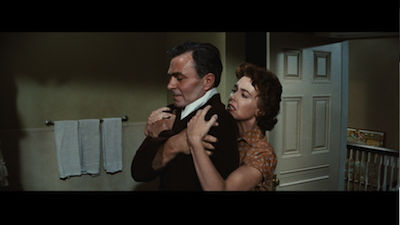


Bigger Than Life starts out normal enough. At first glance, you'd think it was a light school dramedy. It opens as the day ends at an elementary school somewhere in a faceless neighborhood in America. Smiling children bound out the doors, and the teachers pack up for the day. There is James Mason sitting behind his desk, inhabiting the body of Ed Avery, a jocular teacher with a jaunty accent who isn't afraid of flirting with the cute younger woman in the classroom next to him. He also trades japes with his buddy Wally, the gym teacher with a strange taste in head gear (a young Walter Matthau, already typecast, it seems). It's all terribly normal. It's like Ed asks his kid Richie (Christopher Olsen) when peeking in on his television habits: "Doesn't this bore you? It's always the same story."
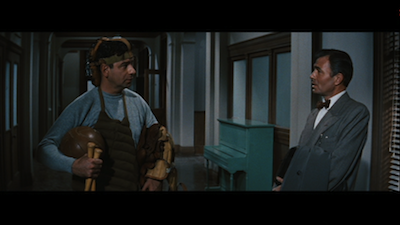


The first montage is barely over before the cracks begin to show, but even those start normal enough. To supplement his salary, Ed is secretly working as a taxi dispatch, lying to his wife and claiming he has administrative meetings to attend. He's also hiding the fact that he's having pains in his gut. Ulcers from stress, maybe? It doesn't matter. Ed and his wife, Lou (Barbara Rush), are hosting a dinner party for friends and co-workers. It's only after that the pain becomes unbearable. Ed collapses. He ends up in the hospital, and it's just in the nick of time. Whatever Ed has, it's nearly fatal, and after a battery of invasive tests, Ed's doctor (Robert Simon) decides the new drug cortisone is the only way to treat this malady.

It works. Ed is back on his feet, and he's got a new lease on life. Back at work, he's got a spring in his step. At home, he's feeling randy. He insists on taking Lou out and buying her a new dress. He plays football indoors with Richie (this was before "The Brady Bunch" warned us of such things). He's also strangely aggressive, mouthing off and throwing his weight around, and temperamental. Richie and Lou notice it right away, but when they question it, Ed doesn't like it.
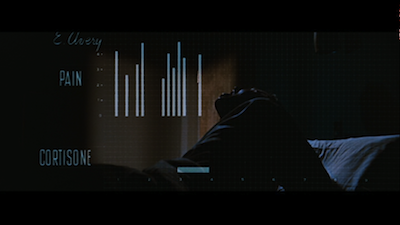


Long story short, Ed is addicted to his prescription meds and they are making him act this way. Bigger Than Life is quite possibly the first ever movie about abusing pills in Middle America, and unlike the countless Lifetime movies that would follow in its wake, it surprisingly is about a man getting hooked on the poppers, not a bored housewife. Once Ed is out of the hospital, Nicholas Ray and his pair of writers, Cyril Hume and Richard Maibaum, chronicle the breakneck pace of Ed's breakdown. His skull is a pressure cooker, cranking the heat steadily until the crazy is coming out his ears. Apparently, the story began as a New Yorker article, so there must be some basis in fact here, but who cares? Bigger Than Life gets just as cracked as its main character, and it's fantastic to watch.
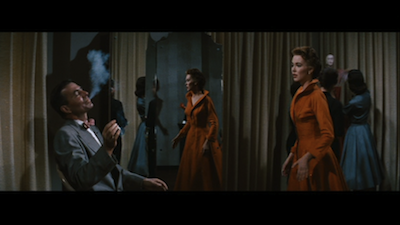


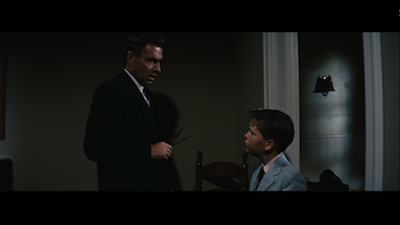
Mason is a powerhouse as Ed, slowly losing his marbles and getting the jones for his prescriptions. He never overdoes it, there is no slurred speech or anything too comical in how he presents himself. Instead, you can see his mind is burning fuel at a rapid rate, and the conflagrations emerge as all kinds of socially improper behavior and opinions, before settling into dark places when the tank gets empty. Bigger Than Life has a black sense of humor, and there are many laugh-out-loud lines. It ranges from Ed mistakenly thinking that a hypodermic to his sternum means his buttocks ("Sorry," he says when corrected, "I did four years in the navy.") to more abstract jokes on modern psychology. At the school, a young boy shows Ed a twisted painting he has done, and when Ed wonders if the black and red smudge is a thunderstorm, the kid says, "This is a man. He's just mad at his mother." It's even more devilish now, because the kid was Jerry Mathers, who went on to play the Beaver. Youth icons are not safe in Bigger Than Life. Presumably little Richie's red jacket is Nicholas Ray poking fun at himself. He put James Dean in one just like it a year before in Rebel Without a Cause.


Bigger Than Life is not just about gonzo parodies, however; Ray is getting at something about the modern condition, the way we compartmentalize and isolate ourselves in our boxed-off neighborhoods, with psychology and pharmaceuticals and the like. His canvas is the 1950s, but it's still relevant. At Ed and Lou's dinner party, one of the guests tells an anecdote about how she feels she is faced with two options: having a baby or buying a new vacuum cleaner. Do you want a life in the traditional sense, or do you want technological convenience?

Likewise, suburbia itself is a façade. Lou tries to keep the secret of Ed's drug-fueled kookiness, but it's hard to be real when the milkman can walk by at any moment. And he literally does; the scene juxtaposes the quaint Norman Rockwell image of American life with the hush-hush perversions each person is trying to hide. It's dangerous to challenge the illusion--and that's just what Ed does. He rails against everything, including family and Christian morality ("God was wrong!" he shouts at one point, and shortly after, very nearly stabs a Bible). At a PTA meeting, he declares that childhood is a congenital disease, and education cures it. Adulthood and reason weeds out the primal impulse. It's ironic, though, because cortisone is giving Ed back his. He's riding entirely on Id and instinct. He struts around like a werewolf--though Conan O'Brien's "Coked-Up Werewolf" more than Jacob Black--or maybe Renoir's Hyde-like Mr. Opale from The Doctor's Horrible Experiment [review]. He's a real creep!


The colorful sets and the photography of Joe MacDonald (Niagara, House of Bamboo) reflect the turmoil Ed is going through. Like a Douglas Sirk movie, every middle-class stick of furniture is perfectly designed to convey the movie's meaning. Just look around the Avery home, and you can see the war of moods. Most everything is a calm blue, with the occasional touch of white, but then there are trouble spots like the red couch, brief territories where the rainbow runs hot. There is also the orange dress that Ed buys Lou. It makes her stand out from everything. Did he give it to her to serve as a warning sign, a symbol reminding him not to trust her? Or is the fact that she is wearing it akin to waving a red flag at a bull? Later, there is a red warning light outside of Ed's hospital room. Red for danger!
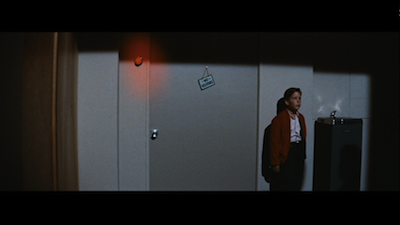


No visitors.


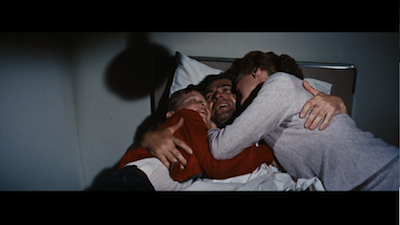
The thing is, it's Lou that eventually has to take charge and fix things. The final act of Bigger Than Life very nearly turns into a slasher movie. Ed holds scissors over his son, an implied threat that he then voices as very real. Lou tiptoes around the house, scared of attracting the beast's attention, surreptitiously calling for help over the phone and hoping to sneak out. She uses her wiles to placate him briefly, buying enough time to let others intervene. Back at the hospital, the doctors try to cut her out, suggesting that, as a woman, she can't control her emotions. Throughout Bigger Than Life, people have said similar, and Lou has even been called an idiot. Yet, she's always the one who has to clean up for her manic husband, who has to take charge and stay calm. In the end, she's the only one who believes in him. Her expression of faith in all the things he's denied, and her rejection of the chemical faith the presiding powers want her to have, ends up being the Averies' salvation.
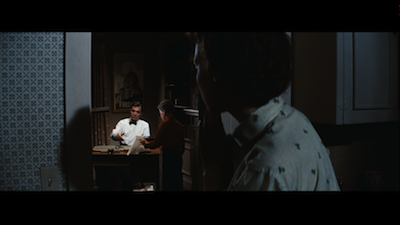


Again, Nicholas Ray borrows from outside the sudsy genre. His brightly colored family drama ends like a horror movie. The sun rises, the evil passes, Scarlett O'Hara standing outside Tara and swearing to never go off her rocker again. It's amazing what Ray has done. He has taken all the tropes of the Hollywood melodrama, the image of the American family, the colorful palette of Technicolor, and the epic sprawl of Cinemascope, and he has created a darkly subversive movie. Though illuminating the hidden shadows of suburbia is a common theme these days (especially post-Blue Velvet), it wasn't so back then. The myth of the 1950s was the nuclear family, security in community, etc. In a film noir, it's the city that is wicked, and getting out of it means safety and a place to hide. Hitchcock's splendid 1943 film Shadow of a Doubt had Joseph Cotton introduce murder to Anytown U.S.A., but it hadn't been there before. Hitchcock was saying that evil could lurk in our families, but there was still something "other" about the visiting uncle.
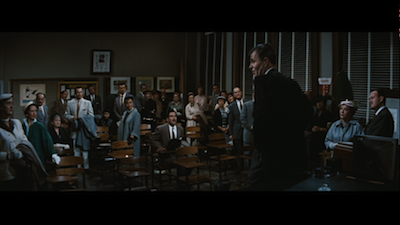


But Ray and his writers were putting the iniquity right there in the center of it all. The villain was one of the best of us, a well-spoken teacher, a trusted individual. And it was all the trappings of this kind of life, everything he worked two jobs to earn, that did it to him. If families in 1956 did happen to catch a matinee of Bigger Than Life, daddy must have gotten some strange looks on the way home. Which is what made the film so startling in its rebellion, the way it plants these radical ideas. I would guess its failure on release was not because it was unbelievable, but because it was too believable. Just like Wilder's Ace in the Hole [review], it told America too much about itself, and so America rejected it.

Except now we know that Wilder and Ray were both right, that America should have been scared; that they are more right now than ever is the scariest part of all.


Watch the trailer for Bigger Than Life.