Showing posts with label erich von stroheim. Show all posts

Wednesday, January 1, 2020

UNTIL THE END OF THE WORLD - #1007


I couldn’t have picked a more fitting movie to watch at the close of 2019, nor could I have timed it better. It was an accident that U2 and the movie’s credits kicked in around 11:57 p.m. Had I not watched “The Song,” Uli M. Schueppel’s documentary on Nick Cave and the Bad Seeds’ contribution to the Until the End of the World soundtrack, before jumping from disc 1 to disc 2 or taken various other pauses, the timing would have been different. The song and the credits would not have concluded just as midnight ticked over to a new decade. Wim Wenders’ characters celebrate the move from 1999 to 2000; I move from 2019 to 2020.

And it’s not a real stretch to suggest we have as much existential angst now as Wenders imagined we would at the turn of the millennium. Released in 1991, Wenders took a gamble basing his artsy sci-fi road picture only eight years in the future. He was potentially building an expiration date into his own move. Yet, looking back, he accurately predicted the way technology would change and what would concern us, even if the look of his future was just a little more clunky than what turned out. Internet privacy, personal communicators, high definition, GPS, VR, digital preservatio, and digital escapism--all these things are at the fingertips and the forefront of the mind in Until the End of the World. To Wenders, technology was getting better, but also taking over in unforeseen ways.


It’s worth watching the director’s introduction to the movie to hear how long it took to get Until the End of the World onto the screen, how much longer it took to get to this version--final cut nearly twice the length as what initial audiences witnessed in theaters and on home video--and how the virtual world he shows then represented the cutting edge of technology. Amusingly, the filmmaker’s final product horrified the people who had loaned him their high-definition capabilities, as he used their inventions not to enhance and increase the clarity of images, but to tear them apart. But what better metaphor for technology’s propensity to overtake our humanity? It breaks everything down into pixels and data, abstracting the original, and the more removed it becomes from that initial experience, the more we seemingly want it.


Until the End of the World is a movie that has always fascinated me. I had listened to its now classic soundtrack album hundreds of times before I ever got to watch the movie itself. Elvis Costello, Nick Cave, Julee Cruise, R.E.M., Neneh Cherry, Depeche Mode--Wenders was in my zone. (Recently reissued on double-vinyl, I’m listening to it now, and the compilation still delights.) Eventually I caught the movie on VHS and was enthralled by its unwieldy, ambitious narrative. Even then, there were rumors of longer versions. The United States had a 158-minute version, but Europe got 20 minutes more, and Japan somehow got nearly an extra 100. Wenders’ original cut was anywhere between 12 hours and 20 depending on what you read, but his preferred version, as seen here, is 287 minutes--or nearly five hours. This longer version, or some semblance of it, has been promised on DVD since the early 2000s. Remember when Anchor Bay supposedly was going to release it? (Remember Anchor Bay?!)


That sounds like a lot of math, but it’s a classic cinema tragedy. From von Stroheim to Welles to Tati, there are persistent tales of directors whose mad visions were undercut by business concerns. These “lost” cuts become fabled, and it’s always a gamble of whether or not what was intended ends up being what was best. You could have Ridley Scott finally getting to finish Blade Runner properly or the rediscovery of Peter Bogdanovich’s At Long Last Love, or you could get Francis Ford Coppola’s endless tinkering of Apocalypse Now and Oliver Stone’s exhaustive mining of Alexander [review].

Wim Wenders is somewhere in the middle. Until the End of the World is not a masterpiece, but it’s an impressive look at a celluloid Icarus almost making it to the sun. It is at times almost too playful with tonality, while later maybe becoming too ponderous, too in love with its own ideas. Not everything works, and the narrative structure is perhaps more befitting a novel than a film. Criterion smartly splits Until the End of the World across two discs to go with what is a very natural intermission. Part 1 is the international chase and long-term courtship of Sam Farber (William Hurt, Broadcast News [review]) and Claire Tourneur (Solveig Dommartin, Wings of Desire [review]), a con man/scientist and a morally questionable party girl, respectively. It treks across Europe, Asia, and the U.S. before sending the characters toward their final destination, breaking for Part 2 just as they leave San Francisco for Australia.


Part 2 is more serious and heavy, trading the madcap physical chase in for a more intellectual pursuit. Sam has been on the run from the law. He is wanted for industrial espionage and the stolen technology he is carrying. When Claire finds him, he is traveling around the world recording messages from family members using special glasses that will record not just the video and audio, but the experience of seeing the event, the waves that connect the eye and the brain. The intent is to capture something that can be re-created in the brains of blind people, to let them “see” again. Sam’s father, Henry (Max Von Sydow, The Seventh Seal [review]), started the experiment, and had to go into hiding rather than let government or corporate interests take over. He’s built a lab in the Australian outback, and his number-one test subject is to be his wife and Sam’s mother, Edith (Jeanne Moreau, The Lovers [review]).


The Australian half is all about trying to make the tech work and to understand the consequences and implications. It’s a struggle of fathers and sons, but also men and women, and ultimately played out against the backdrop of total annihilation. This whole time, an Indian nuclear satellite has been falling from the sky, and there is a full expectation that it will signal the end of the planet. In this pocket of waiting, a community forms; yet, as they wait, there is a bigger question of what will happen if the prediction is false.

That’s a pretty simplistic breakdown of Until the End of the World. As suggested above, it’s kind of all over the place. Wenders’ approach changes almost with every locale switch, as the cast expands and he touches on different genres. Is this a caper picture? Is it romance? Is it a literary character study? Science fiction? Family drama? Political?


Of course, Until the End of the World is all of the above. Some of it clicks, some is hokey. The acting can be all over the place. Dommartin is an alluring cipher, defined more by the vision of her presented in the authorial narration than anything she does on screen. Sam Neill (My Brilliant Career) plays a writer who, as her former lover, is writing a book about Claire and, ostensibly, this movie, and he spends much of the running time waxing poetic about Claire’s elusive sensuality. Wenders’ supporting cast is like a tour of the Criterion Collection--from Ozu-stalwart Chishu Ryu to David Gulpilil from Walkabout [review]--but dotted along the globe, embracing different legendary personages wherever his crew lands and integrating them into the outline. The effect, though, can often be of miscommunication, as some of the performances feel lost in translation. Rudiger Volger’s private detective or Chick Ortega’s French hoodlum never seem comfortable working in English and often go too broad and cartoony for the rest of the movie. Would that more of the actors just spoke their own language and subtitles did the rest.


Weirdly, this mish-mash serves William Hurt well. His character arc involves a lot of strange turns as he adapts his personality to fit the moment. As an actor, Hurt is perfectly suited for this. His quirky persona is appropriately malleable, but it’s ultimately that quirk that maintains a thread through every scenario. As an actor, William Hurt was already as weird as the movie was intended to be.

That Until the End of the World takes on so much with such audacity leads me to believe that its detractors will forgive it as much as they dismiss it. You have to appreciate that Wim Wenders went for it as boldly as he did, and as an independent production no less. It’s full of hubris, and thus folly. For those like me that take it on and accept it, however, Until the End of the World can be as addictive and dreamy as Max Von Sydow’s futuristic machine, leading us through the dread of a changing world toward the hope of a better tomorrow. It’s colorful and crazy and deeply satisfying, and pretty much unlike anything else out there. And for that, to borrow from its own poetry: I will love it until the end of the world.


Thursday, July 5, 2012

GRAND ILLUSION - #1


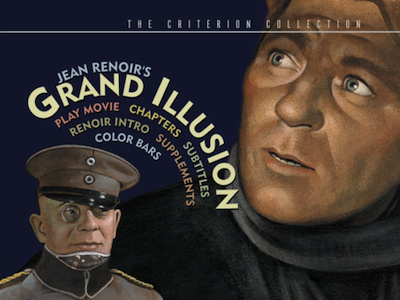
This review of Grand Illusion, the first numerical Criterion DVD, was written in conjunction with the new 75th-Anniversary print of the film’s engagement at Portland’s historic Cinema 21 theater, starting this Friday, July 6. I got to attend a press showing and was taken aback by how good the new print, which was struck from an original negative, looks today. It’s as if no time has passed at all. 

The numerical structure of the review is largely to separate certain sections. Namely, part 1 is a version of the short review that ran in the Portland Mercury. It’s available on their site, alongside a sidebar article I wrote about other films that bear the Renoir influence.


(1) Jean Renoir’s Grand Illusion is 75 years old. Which is70 more years than it took for them to reboot the Spider-Man films. That’s got to say something for how powerful a drama this war movie really is.

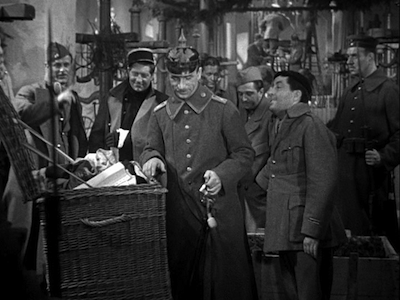
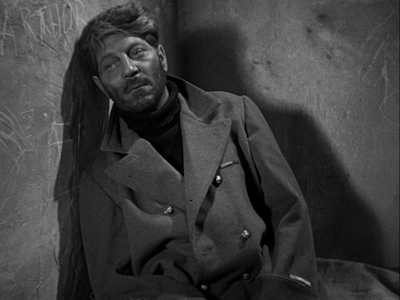
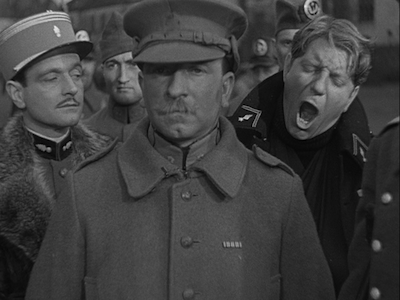
Grand Illusion stars Jean Gabin, the French Humphrey Bogart, as a pilot shot down behind German lines during WWI. He is taken to a prison camp where he immediately joins a group of his countrymen in digging a tunnel to escape. Bad luck ends that particular scheme, but not the dream; when Gabin and his effete captain are moved to another prison, this one run by the pilot that knocked them out of the sky (and played impeccably by Erich von Stroheim), the urge to flee becomes undeniable.

There’s a lot of humor and even some heartbreak to be found in the first 2/3 of Grand Illusion. The real meat of the film is in its final reels, however, when Gabin’s flight from incarceration tests his patience with his fellow fugitive and leads to finding love in the countryside. Renoir’s script is both sprawling and devilishly compact. The freewheeling structure keeps it feeling fresh even today. Comments that “the war to end all wars” will do nothing of the sort now seem eerily prescient, as they must have also in 1937, when Hitler was shoring up power. Yet, it’s not what Grand Illusion says about war that keeps it relevant, it’s what it says about the human spirit and the bonds people form in troubling times. 


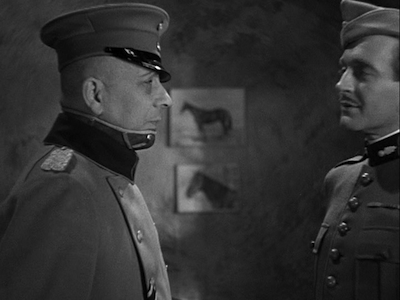
(2) It’s actually interesting to consider how far away from the war the events in the movie are. At the start of the picture, Gabin’s Lieutenant Maréchal is given orders to take Captain de Boeldieu (Pierre Fresnay) on a mission into enemy territory. Jump cut to a very similar scene, with von Stroheim’s stately Captain von Rauffenstein returning from a sortie of his own. I am sure the confusion the sudden change causes is intentional. It takes a couple of lines of dialogue to realize these aren’t the same pilots we saw just seconds ago. In fact, von Rauffenstein is returning from shooting Maréchal and de Boeldieu down. The mission is over, it happened offscreen.

A lot of the action does, at least until the men are finally on the run. There’s another escapee who is killed at the first prison camp, but the shots are fired out of sight. Likewise, when Maréchal is thrown in solitary confinement, we see the instigating action that gets him punished, but not the beatdown. There are also tales of other escape attempts that occurred in between that first prison and ending up at von Rauffenstein’s castle. The German’s have commandeered a 12th-century estate to use as their holding pen. von Rauffenstein has experienced his own comedown in the year or so since he first met the French soldiers. A combat accident has left him with burns all over his body, and he looks like a gothic grotesquerie in his plastic truss. His head practically looks disconnected from his body, placed in the cup of the unyielding girdle. These are all important things that occur, but all of them happen away from the camera eye.


von Rauffenstein’s relationship with de Boeldieu is one of the more crucial in the film, and it gets to the heart of what Renoir and co-writer Charles Spaak are saying about the strange bedfellows wars make. There is a pronounced civility between the fighting men when on the ground. Just because their countrymen are duking it out elsewhere doesn’t mean they can’t get along when guns aren’t blazing. The German Captain sees a comrade in the French Captain. In a way, rank equals class. Yet, there is also a marked difference between de Boeldieu’s aristocratic air and the more friendly Rosenthal (Marcel Dalio), a Jewish immigrant whose family amassed a fortune in France. He didn’t need to fight, but his patriotism extends to protecting the country that blessed him with riches. The major split between von Rauffenstein and de Boeldieu is caused by the German officer’s anti-Semitism and his dismissal of the working-class Maréchal as something lesser.


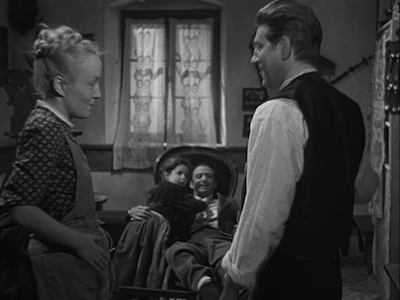
The action becomes more immediate, and visible, when Maréchal and Rosenthal finally break out, following a plan created by de Boeldieu as atonement for his privilege. We see the men at work, we see them running and hiding, the peril becomes urgent and real. And yet, here too life has a habit of continuing unabated. Eventually Maréchal and Rosenthal hole up in an out-of-the-way farmhouse where a German widow (Dita Parlo, L’Atalante [review]) lives alone with her daughter, having lost all her male relatives to the conflict. She and Maréchal find some comfort and romance with each other, and the unit operates as a temporary family. The regular needs of regular people don’t stop because bureaucrats far away are squabbling over lines on a map.


(3) Jean Renoir, assistant director Jacques Becker (who later made his own masterful prison-break picture, Le Trou), and director of photography Christian Matras (who also shot Le Plaisir [review], Fanfan la Tulipe [review], and The Milky Way [review], among others) carefully balance the intimate and the massive, turning the two elements on their heads and contrasting the difference between confinement and freedom. There is something more secure about the closed spaces. It’s friendly there. Not just with your fellow prisoners, but no one is shooting at you. You know where you are and the boundaries that accompany it.


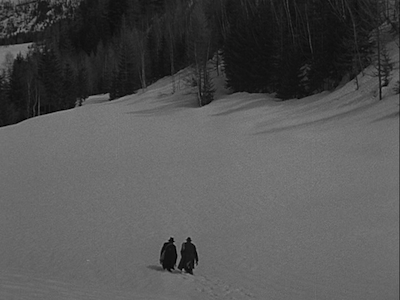
On the other hand, when Maréchal and Rosenthal are racing across the snowy countryside, they are subject to the elements, dogged by their jailers, and generally uncertain about their future. It’s the irony of freedom. You can do as you please, but there are unpredictable consequences to your actions. Gabin has a natural confidence on camera, but part of the appeal of Grand Illusion is watching this charismatic actor unravel, seeing him lose his cool, watching him take a chance. The unseen escape attempts are treated like a joke--he disguised himself as a guard in one; in another, he dressed in drag, only to be hit on by a non-commissioned officer--but this last shot at liberty is seriously dangerous.

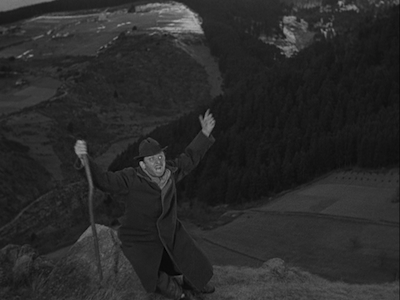
Funny enough, it had been so long since I had seen Grand Illusion, I remembered the ending going a certain way. I e-mailed a friend and said so, and he asked me if this time it turned out that the pair escaped. This is a big question. Did they or didn’t they? What are we supposed to take away from the final shots: that the grand illusion of the title is our belief that there is any safety or security out there? The men note that even if they get home, their most likely fate will be to be sent to the front yet again. They’ll keep going until they win or don’t come back. Regardless of how you interpret the end, the futility of human endeavor seems obvious. Maréchal and Rosenthal are oblivious to how close they came to meeting their deaths, trudging blindly up a hill to who knows where. The folly of man is that we keep climbing, because to stop seems even more pointless. Or so we kid ourselves, carrying on and on in an endless cycle.