Showing posts with label becker. Show all posts

Saturday, May 18, 2019

DIAMONDS OF THE NIGHT - #969


Jan Němec’s 1964 debut Diamonds of the Night is all things at once. Simple and complicated. Sparse and detailed. Accessible and challenging. Grounded and poetic.

Based on a novel by Arnošt Lustig, Diamonds of the Night is the story of two young men on the run in World War II-era Czechoslovakia. Having escaped from a train hauling them to a Nazi concentration camp, the boys charge through the forest and countryside, avoiding people, looking for food, and occasionally resorting to desperate acts to survive. Told with little dialogue and shot in real locations, there is a harsh realism to the story Němec lays out. These boys are isolated, without hope, never sure if the people they spot along the way are friend or foe.


Yet, we maybe can’t be sure of the young men either. We have our assumptions regarding whom they might be and why they were rounded up, but as Němec plays with time and memory, slicing up his scenes, splicing in random shots that could be past or present, fantasy or reality, we can’t help but build different scenarios. Němec starts to really play tricks on us when the fugitives rob a farmhouse, forcing the farmer’s wife to make them sandwiches. We see them take the food and go, but we also see them attack her, leaving her unconscious on the kitchen floor. Which was it? What really happened? As we get more information later, we even start to doubt why she was initially scared of the intruders.


Taken one way, the lack of exposition in Diamonds of the Night causes us to question why the civilians that the escapees encounter don’t help them, why these common folk give their allegiances to outside invaders, whom history has already judged by the time the film was made; taken another way, we are forced to question ourselves, why we automatically perceive things a certain way, and if our failure to challenge the known is the reason fascism can creep in and ultimately win out.

Either way, it’s a compelling experience, rarely giving the viewers time to catch their breath, and revealing a director with a firm grasp of his own cinematic vocabulary.


Arnošt Lustig was a real-life prisoner of war and much of his writing was based on his experiences. A short documentary included on the Criterion edition of Diamonds of the Night explores how Jan Němec interpreted Lustig’s work for film. Also included is Němec’s 1960 student film, A Loaf of Bread, based on one of Lustig’s stories.


A Loaf of Bread details three prisoners plotting and undertaking a scheme to steal bread to feed them on a planned escape. Though more straightforward than Diamonds of the Night, it displays a similar tight control, reminding me somewhat of the French noir of Jacques Becker or Jean-Pierre Melville for how the attention to small action builds tension. It’s easy to see the promise in the young director that would pay off four years later.


This disc provided by the Criterion Collection for purposes of review.

Wednesday, August 25, 2010

SIDELINE: ALL TOMORROW'S PARTIES POSTERS

Criterion is taking part in the upcoming All Tomorrow's Parties festival, curated by none other than Jim Jarmusch. The esteemed filmmaker has put together a great line-up of films, and if you're anywhere near Monticello, New York, next weekend, you should go. Here are the details.

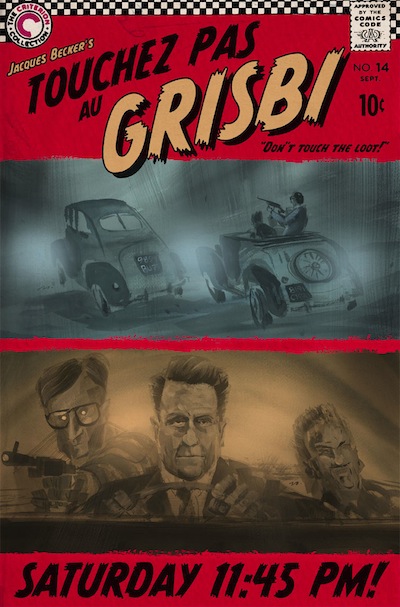
For the occasion, Criterion's designer Eric Skillman has commissioned a bunch of comic book artists to do new posters for films being shown.

Below are the ones released so far. I will update and repost as more come out. (For instance, I know Scott Campbell is cooking up something.) I will also recommend books by these fine fellows that I think will appeal to film fans. You really should check out their work.

* Matt Kindt

Night of the Hunter


Recommended Reading: Revolver, 3 Story: The Secret History of the Giant Man, Super Spy

* Scott Morse

Brute Force [review]


Touchez pas au grisbi [review]


Check out Scott's other recent movie images, including 8 1/2 [review].

Recommended Reading: The Barefoot Serpent, Spaghetti Western, Volcanic Revolver


Wednesday, November 12, 2008

TOUCHEZ PAS AU GRISBI - #271


In Touchez pas au grisbi (1954), Jean Gabin's Max the Mentor precedes Jean Servais' Tony le Stephanois from Rififi by only a year, but in a way, the two are as far apart as they could get. Then again, there is a lot about them that is the same, as they are both aging gangsters who are seeing that their time in the crime game is growing short. You could almost turn these two films into companion pieces, a single epic about two friends on opposite sides of the tracks. Call it something like Rich Crook, Poor Crook.

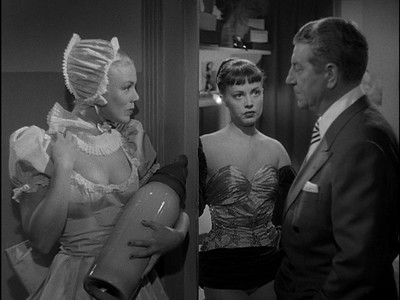
Whereas Rififi is set in rundown streets and hollowed-out buildings, Jacques Becker's Touchez pas au grisbi (translation: "Hands off the loot!") shows us the ritzy Parisian nightclubs where men of means pursue their more lurid hobbies. Whereas le Stephanois has had a less than successful career that has included jail time, Max has managed to stay on top for the duration. His nickname denotes the level of respect that others have for him: he's seen it all and knows how it's done. He spends his nights enjoying himself, indulging in the ladies and what have you; yet, he also manages to stay disciplined. He eats properly, stays clean, maintains a personal order.


Perhaps sensing something is in the wind, Max decides it's time to move on. He has made a big score in gold with his longtime partner Riton (Rene Dary), and once he unloads it, he can go off the job. For a guy who values being in control, things are starting to slip away that will make this complicated. Riton has a new girl (a young Jeanne Moreau) and information from his loose lips passes to hers, and then on to Angelo (Lino Ventura), the drug dealer angling for the top spot. Max even tries to offer up his own protégé, Marco (Michel Jourdan), to plug the hole he will leave, but it's no good. Riton gets kidnapped, and now Max's last big score will have a totally different payoff.

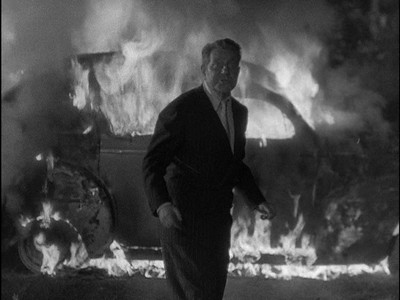
In contrast to the control Max is losing over his own life, Jacques Becker exerts it in spades over his film. Touchez pas au grisbi is masterfully constructed, moving at a confident pace and building in tension and suspense as Max's predicament worsens. It would be easy to just pile the conflicts on the beleaguered hood, but Becker is exacting in his plotting, twisting the plot only when it makes sense, not just for the sake of having more kinks in the narrative. The finale of the picture is haunting and desolate, involving a burning car far off the beaten path, a flaming symbol of the tragic end that could await all of these players if they don't maintain the core values of loyalty and commitment to purpose that Max has always placed his trust in and that have carried him through this far.


As a personal aside, the scenes with the car in Touchez pas au grisbi bring to mind something that happened to me when I was younger. It was in my college years, during a period where I regularly drove back and forth from Los Angeles to where I lived in the high desert because there was nothing to do in our town. One night, on the opposite side of the freeway, I saw a car stopped in the middle of the road, its headlights on, and a man on his hands and knees in front of it, facing the vehicle. No one else saw it. I was driving, and my passengers insisted I was crazy. But I know I did, I know it was there.

I guess it's neither here nor there, and it seems like something out of a modern rural crime picture than Jacques Becker, but Grisbi makes me think of it all the same.

This was prepared as part of my review of the boxed set 10 Years of Rialto Pictures for DVDTalk.com.