Showing posts with label eisenstein. Show all posts

Wednesday, April 4, 2018

STRIKE - CRITERION CHANNEL

This review originally written for DVDTalk.com in 2011.


Russian filmmaker Sergei Eisenstein's 1925 debut Strike is an auspicious arrival for the man who is largely credited with establishing the art of the montage. This silent tour-de-force is a political drama, part historical document and part propaganda device. Scripted by four different writers and originally intended as the beginning of a larger series detailing the workers' struggle in early 20th-century Russia, it re-creates a real factory uprising from 1903, but the filmmaker inflates the terrible battle to an epic scale, making history into filmic art.

In terms of plot, though Eisenstein divides the story into six different chapters, it's actually far more simple than that. Strike can pretty much be broken down into three acts: the events leading to the walk-out, the long wait for the people's demands to be considered and the toll it takes on the striking families, and the final clash after the demands are rejected. Within this, Eisenstein details all facets of life, from the homeless criminal to the common working family and all the way up to the fatcats that pull the purse strings. The director even takes time for the smallest creatures among us: pets and stray animals, and also children. The footage of poverty could almost be passed off as documentary; Eisenstein and his trio of cinematographers stage the scenes with an eye toward realism, photographing all the squalor in order to make their case for better conditions for the common populace. On the flipside, Strike's depiction of the upper classes borders on caricature. The bosses embody a cartoon villainy, wasting food while their underlings starve and laughing at their misery.


While the young filmmaker displays an extraordinary facility for visual metaphor, at this stage in his development, Eisenstein is also prone to overdoing it. Whether this was the result of youthful folly or a conciliation to the propaganda machine is hard to say. Strike paints the picture of a vast conspiracy amongst the government and men of means. Undercover agents sneak through the workforce, spying on them and reporting any questionable activities. Eisenstein gives each of the covert infiltrators an animal code name and then proceeds to not only have the actors embody their monikers, but also cross-cuts their activity with images of the actual animals, layering their faces using double exposure and fades. It oversells the point a little, especially when one agent, nicknamed "Bulldog," is shown panting and drooling as if he were an actual dog. In other instances, when the animal imagery is better integrated into the story--the starving kitten scavenging amongst the suffering masses; the slaughter of livestock as tempers flare--the juxtaposition packs way more punch.


Strike doesn't follow too many central characters. The spies, the factory owners, and a few of the workers make regular appearances, but Eisenstein treats each group of people within the clash as if they were individuals, underscoring the rallying cry for unity amidst the classes. Some of the large-scale crowd scenes are breathtaking. A brutal raid on an impoverished tenement plays out on a variety of physical levels, as police on horseback drive residents from the top floors down to the bottom. Likewise, the scenes of crowds moving on the factory are astonishing. The orchestration of such a massive cast shows how vital cinema was as an art form right from the get-go. There were no limits.


Eisenstein also tries out many different camera tricks and experimental effects, favoring cross-fades and images within images to tie different aspects of his tale together. This affinity for transitions lends Strike an editorial agility, infusing the realistic storytelling with a sense of peril and melodrama. The director's reliance on exaggeration also gives Strike occasional notes of surrealism. In one sequence, a diplomat has little people dancing on a table as background entertainment; in another, a whole community of squatters reveals themselves by popping out of holes in an underground shantytown Eisenstein pointedly dubs a "graveyard." These touches ensure that not only is Strike visually inspiring, but also that its intended message never overshadows its primary role as entertainment. Strike is as vivacious today as it must have been nearly a century ago.


Saturday, February 3, 2018

THE BATTLESHIP POTEMKIN - CRITERION CHANNEL

Capsule review from The Portland Mercury, May 2011:


Sergei Eisenstein pretty much invented cinematic language in his 1925 silent film about rebellion on a Russian cruiser, but don’t mistake watching The Battleship Potemkin as akin to reading a textbook--it’s as stirring today as it was nearly a century ago. The dizzying battle sequences and iconic riot on the Odessa stairs (you’ve seen it ripped off hundreds of times) turned what would’ve otherwise been a standard propaganda film into tension-filled art.

Saturday, September 3, 2011

SIDELINE: MORE REVIEWS FOR 8/11

I am a little more than halfway through the 28th Eclipse box, The Warped World of Koreyoshi Kurahara, but in the meantime, here are the other films I reviewed in August...


IN THEATRES...

* Colombiana, with Zoe Saldana as an assassin kills everyone. EVERYONE!

* The Future: Miranda July is as kitten as a cat, but I'm not as smitten as that.

* Our Idiot Brother, a surprisingly genial, if slack-paced comedy bolstered by a strong cast, including Paul Rudd, Elizabeth Banks, Rashida Jones, and more.

* Rise of the Planet of the Apes. I found it really boring for about the first 2/3, but everyone else loves it. I'm right, of course, but make up your own mind. :)

* Senna: You will enjoy a documentary about car racing. No lie.

ON DVD/BD...

* Daguerreotypes, a 1975 documentary from Agnes Varda, capturing the local color in the neighborhood she still calls home.

* Dark Days - 10th Anniversary Edition, a well-done reissue of the documentary chronicling homeless people living in New York's subway tunnels.


* David Holzman's Diary: Special Edition, Jim McBride's seminal indie movie from the late 1960s.

* A Fistful of Dollars, the stylistically explosive beginning of the Leone/Eastwood "Man with No Name" films.

* Let's Do It Again, a musical remake of The Awful Truth starring Jane Wyman and Ray Milland.

* The Muppets Take a Manhattan, third time is not a charm for the venerable comedy troupe.

* One Day in the Life of Andrei Arsenevich, a trio of Russian-themed documentaries, including Chris Marker's tribute to Andrei Tarkovsky.

* Park Benches, a disconnected French comedy that never comes together. Dammit, Catherine Deneuve, why were you in this?!

* The Purple Gang, a 1950s gangster picture with a young Robert Blake as a Detroit tough guy.

* Strike: Remastered Edition, the first feature from Soviet cinema pioneer Sergei Eisenstein.

* Three Hours to Kill, a solid 1950s Western, playing with a deadline a la High Noon.

* Win Win, a well-meaning family drama that falls short of its intended mark. Starring Paul Giamatti.

Tuesday, May 31, 2011

SIDELINE: MORE REVIEWS FOR 5/11

A round-up of my reviews for non-Criterion movies in the past month.


IN THEATRES...

* The Beaver, Jodie Foster directs Mel Gibson, who talks through a beaver puppet. Yes, it's pretty crazy.

* Bridesmaids, this Kristen Wiig-led comedy is a real winner. Funny and heartfelt. And next time someone asks if Bridesmaids is a chick version of The Hangover, ask them if that's a stupid person's version of a smart question.

* Cave of Forgotten Dreams, Werner Herzog's 3D documentary about the Chauvet Caves. My favorite movie of the year so far.

* Everything Must Go, in which Will Ferrell drinks some sad beer, channels Raymond Carver, and is pretty good at doing it.

* Hesher, Joseph Gordon-Levitt stars as the title character. Hit an open chord, take off your shirt, and be a teenage dirtbag, baby.

* Thor, another winner from Marvel. Kenneth Branagh's adaptation of the comic is mighty fun.

* True Legend, a disappointing new action flick from the awesome martial arts choreographer Yuen Woo-Ping. Lame story, too much CGI.


The NW Film Center in Portland also had a festival of twelve films starring Catherine Deneuve. I picked some of my favorites for the Portland Mercury. Read "The Two Faces of Deneuve."

I also wrote blurbs for older movies doing the revival rounds:

* Sergei Eisenstein's Battleship Potemkin
* Claude Lanzmann’s Shoah

ON DVD/BD...

* Araya, Margot Benacerraf's 1959 blending of fact and fiction on the salt marshes of Venezuela.

* Bananas!*, a documentary about the fight against Dole Fruit, accused of poisoning Nicaraguan workers in the 1970s.

* The Captive City, Robert Wise's by-numbers anti-crime PSA from the 1950s.


* Guy and Madeline on a Park Bench, an intriguing mash-up of classic indie cinema and classic movie musicals.

* Henri-Georges Clouzot's Inferno, a stupendous documentary sifting through the remains of the Diabolique-director's unfinished would-be masterpiece.

* Hold On!, Herman's Hermits come to America, join the space race, play some music, pitch some woo.

* The Misfits, John Huston directs Clark Gable and Marilyn Monroe in their final screen roles. Also stars Eli Wallach and Montgomery Clift, in a script by Arthur Miller.

* Not as a Stranger, starring Robert Mitchum as a doctor who can heal anything but his own bad impulses. Directed by Stanley Kramer.

* Shoeshine, a Neorealist classic from Vittorio De Sica, released 1946.

* The Unloved, Samantha Morton's softly rendered, heartfelt directorial debut.

Friday, December 24, 2010

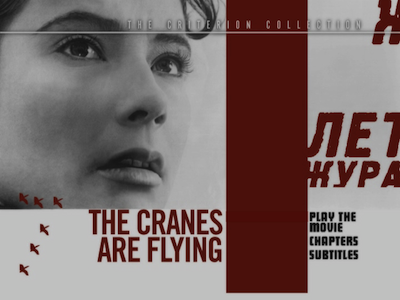
THE CRANES ARE FLYING - #146


The Cranes are Flying is a Christmas miracle. At least to me.

I guess it was around 2002 that I got my first DVD player. I was excited to build my movie collection and had been hunting out deals and starting to buy lots of Criterion discs off of eBay. I am sure in those early days I focused on movies I knew, I could worry about the other titles later. Then again, I may have had no Criterions at that point, it gets hard to remember after a while. Regardless, it was my first Christmas where getting movies as gifts was a possibility.

My friend and fellow writer Christopher McQuain and I have an ongoing gift exchange. It's one we never let wane, as we know each other's tastes fairly well and, whenever we can, like to surprise each other with something that maybe the other person hasn't seen, read, or heard. It was that Christmas that Christopher gave me my copy of Mikhail Kalotozov's The Cranes are Flying. I had not heard anything about the film, but he was convinced I would like it.

How right he was. The Cranes are Flying is a 1957 Russian film, a romance swept up in the rush of war. It is a movie that burns with the fever of desire, but that also sinks with the chill of heartbreak. It is both beautifully written and beautiful to look at. More than once I have been asked to compile a list of my essential Criterions, the top 5 or however many everyone should know. Two or three of those choices regularly change, but The Cranes are Flying is one of the mainstays.


The Cranes are Flying opens on a scene of two lovers, Veronica and Boris (Tatiana Samoilova and Alexi Batalov). They have stayed out all night, and morning is fast approaching. Their families know they are seeing each other, but the two of them still act as if it is a secret. Perhaps it is more exciting that way? He calls her Squirrel, and she plays coy. It will be several days before they can see each other again, even though he aches to be with her sooner. Why should it be so urgent? They are young, and they have all the time in the world.

Except they don't. Russia enters World War II, and everything changes. Boris works day and night at the factory, and he has to miss their next date. His cousin Mark (Alexander Shvorin) goes to see Veronica instead. He is a pianist, and he wants to dedicate his music to the dark-haired beauty; she is skeeved out by him and dismisses him.


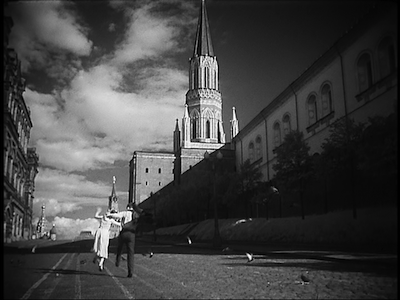
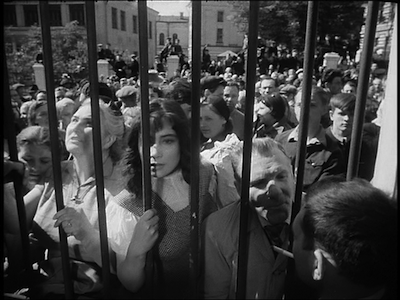
Boris, of course, ends up joining the army. He could have probably gotten an exemption from the draft, but he volunteered instead. He is called up the day before Veronica's birthday. He leaves behind a stuffed squirrel for her, an object that will take on great importance later, if for no other reason that there is a love letter hidden in its acorn basket. Boris' departure is a tragic scene. Veronica is late and misses him at the apartment, and then she can't find him at the train station, there are too many people and a fence between her and the parade of recruits. Kalatozov creates a terribly sad image here. Veronica has brought her lover a care package full of crackers and cookies and she tosses it toward the departing men in hopes of getting it to its intended, only for the package to break apart. All those treats of nourishment and love are scattered underfoot.
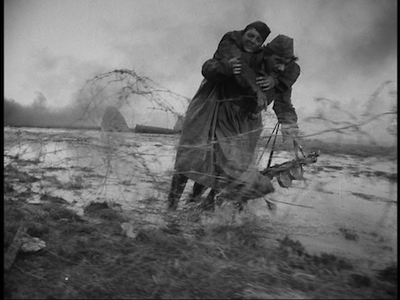


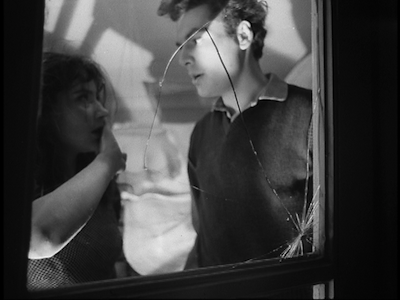
The rest of the movie follows both the war at home and the front lines where Boris is stationed. Bad luck rules on both sides. Veronica loses her parents and is taken in by Boris' family, since they believe he will return and marry her. Instead, during an air raid, Mark takes advantage and presses Veronica into being his own. Kalatozov encapsulates all the violence of war in this one expressionistic scene. Bombs have broken the apartment window, and the only lights are the flashes of fire and explosion. Mark acts like a man possessed, and in some ways, the way director of photography Sergei Urusevsky lights the scene reminds one of a horror movie; in other ways, it's a wartime noir. Flickering lights, bending shadows, and the wide-eyed frenzy of a rapist. Before all this happened, Veronica had declared that she was afraid of nothing; by the end, man's capacity for violence has taken advantage of her every confidence.


This harrowing sequence is one of many virtuouso scenes in The Cranes are Flying. Anyone who has seen Kalatozov's better-known 1964 film I Am Cuba [review] knows that he is a gifted and daring visual storyteller. He is no less ambitious here; in fact, you can see him cutting several cinematic teeth. The director has an elegant sense of composition. Some of his close-ups of Tatiana Samoilova recall Dreyer's tight framing of Falconetti in The Passion of Joan of Arc, whereas in other scenes, the way he and Urusevsky pull the camera back or take it up high so that the characters are rendered small and eclipsed by the background is reminiscent of Welles, particularly the imposing landscapes of The Trial (though, admittedly, Orson's film was several years off).

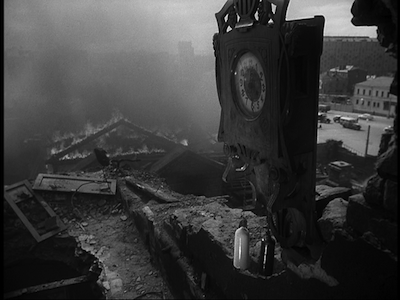
Perhaps more striking is Kalatozov's sense of movement. Veronica running through the burning ruins of Moscow to her shelled apartment building, darting past rubble and flames, is just as impressive as Kirk Douglas rushing across Kubrick's No Man's Land in Paths of Glory [review]. He caps this frightened dash with another symbolically effective single image: all that is left of Veronica's fourth-floor apartment is the wall clock. It stands tall over the city, its pendulum still swinging. What was that about having nothing but time?


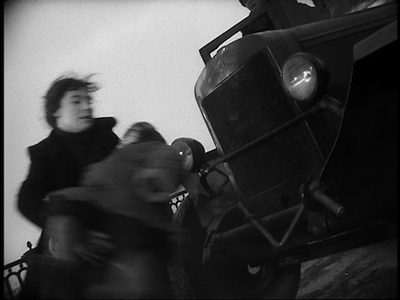
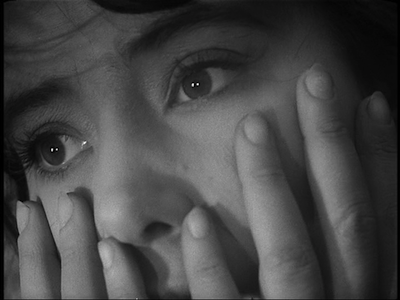
The Cranes are Flying is significant for Urusevsky's pioneering use of handheld cameras. It is particularly noticeable midway through the film, when the family has moved out of Moscow and live in cramped tenements while Boris' father (Vasily Merkuryev) and sister (Svetlana Kharitonova) run the Army hospital. (In a progressive turn, though the father outranks his daughter, he is a general practitioner and she a surgeon.) Veronica works there, as well: she's a volunteer. Things get particularly raw for her when one of the wounded has a fit because he found out his girlfriend married someone else while he was away. Feeling the collective condemnation of all the other soldiers who have their friend's back, Veronica runs from the hospital. The camera alternates between her point of view, running behind and biting at her ankles, and a vantage point just under her chin, looking up at her panicked face. The editing grows choppy, the shutter speed increases, and the race through the village looks like something out of a contemporary action flick. The whole thing ends in a dizzying crash on a bridge, with Veronica saving a child from an oncoming truck. It's like the Odessa Steps sequence from Battleship Potemkin gone suicidal.


The child Veronica saves turns out to be named Boris, and he has been separated from his family. The woman sees the obvious coincidence here, and though she doesn't say it, it's like this Boris is a second chance with her Boris, who at this point is missing and possibly dead. Doubles play a subtle importance in Viktor Rozov's script for The Cranes are Flying. There are two air raids that have dire consequences for Veronica. There are the two men, both of them artists--Boris, we are told, draws, while Mark is a musician. Another undisciplined musician proves as dangerous for Boris on the battlefield as Mark does back home. There is also the unseen other girlfriend who could not outlast the battle.

For his part, Kalatozov also creates visual rhymes in the movie. The most obvious, of course, are the V-formation cranes that start and end the movie and give it its title. Also, there is clock tower that we see in the opening credits, and later it is matched by the clock left standing at Veronica's. (And though not a rhyme, notice too how the spiky metal barricades increase with each passing scene, until they finally almost completely box in Mark and Veronica.) More significantly, though, are the two scenes at the train station, first Veronica rushing to try to say good-bye to Boris and then, after the war is over, her hoping to find him amongst the returning troops. In both, she runs along a fence, pushing her way through the crowd, carrying a package, hopeful that she will meet her man. Each ends differently, of course, though you'll hopefully be surprised where Kalatozov manages his emotional upswell.
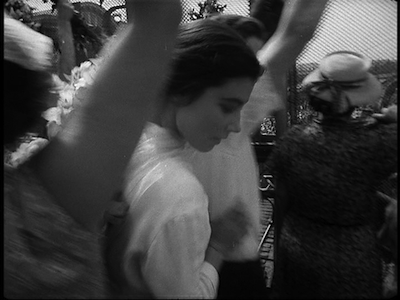


Tatiana Samoilova is an intriguing actress. As far as I can tell, I haven't seen her in anything else, though I'd be curious to get my hands on Kalatozov's next film, The Unmailed Letter, or the 1967 production of Anna Karenina with Samoilova in the title role. Her Veronica is a mysterious and alluring woman. She is headstrong and stubborn, which makes her fun in the early scenes with Boris. Yet, when those same qualities meet the sadness following his departure, the dark beauty becomes possessed of a pervasive gloom. When Boris is out on the battlefield, one of his superiors sees Veronica's photo and comments that she is a woman worth fighting for. More satisfying, however, is seeing her finally fight for herself.


I won't go any further into how that happens or even what happens. Though The Cranes are Flying is a romantic melodrama, and thus some of the genre trappings will probably be a little predictable to seasoned viewers, there is still something to be said for the way genre pays off when it's done this well. I certainly found it a surprising cinematic experience at Christmastime eight years ago, and it still has the capacity to bring back that same old feeling. There's no time like the first time, sure, but as with so many things, the second and even third time, what with the nostalgia combined with the things you missed before, manage to only make everything better.