Showing posts with label Whit Stillman. Show all posts

Saturday, August 26, 2017

KITTY/DAWN - TWO SHORTS ON FILMSTRUCK/CRITERION CHANNEL


Two actresses who gained their initial fame in the 1990s have stepped behind the camera to make their own short films, each focusing on a young girl facing a life-altering change, but in very different ways.

Criterion fans will recognize Chloë Sevigny from Whit Stillman’s The Last Days of Disco [review] and also had a featured role on the HBO series Big Love [review]. Kitty is her 2017 adaptation of a Paul Bowles (The Sheltering Sky) story. It stars Edie Yvonne as young Katherine, a.k.a. Kitty, a child who dreams of being a cat to such an impassioned degree, she eventually transforms into one.


Sevigny’s short is about the power of imagination, positive and negative. Childhood has both a light and a dark side, and while the girl Kitty finds happiness in her flights of fancy, the adults around her don’t share her whimsical vision. Even as the girl starts to slowly adopt the physical attributes of her namesake, her parents and neighbors fail to see what she sees, they have grown past such things--and to illustrate this divide Sevigny constructs her shots so that we can’t see their faces. It’s a bit like the Peanuts cartoons, all grown-ups are just out of frame, or shielded by something. It’s almost as if they consider Kitty too insignificant to bother.

This only changes when the metamorphosis is complete, but then only because Kitty is exiled for real, having embraced her imagined form in total. There is a bit of Roald Dahl here: by leaning into the magic, the child forever separates herself from the life she once had and can never fully return to the real world. Her choices have made her “different.”


Rose McGowan’s 2014 effort, Dawn, has a far more serious setting and a far darker outcome than Kitty. Known for her performances in both segments of Grindhouse [review] and the original Scream, McGowan has shifted her personal spotlight from acting to activism in recent years. Dawn illustrates some of the issues she has raised with Hollywood and our sexualized culture, but in a way that intrigues through storytelling rather than explicitly laying it out.

Set in the 1960s, Tara Lynne Barr (Hulu’s Casual) plays Dawn, a teenager experiencing her sexual awakening. Though warned against the hunky gas station attendant (Reily McClendon) who has caught her eye, when there’s no one around to chase him away, he and some friends come calling. Dawn decides to go with them into the woods, opening herself up to a violent fate, the doomed heroine of a true-crime fairy tale. (See also Joyce Chopra’s Smooth Talk.)


McGowan, working from a script by Joshua John Miller and M.A. Fortin, co-creators of Queen of the South, uses juxtaposition of two different worlds and points of view in much the same way as Sevigny--though here it’s the balance between the idyllic vision many have of 1960s rural America, and the modern sadism that lurks just underneath. In both cases, the shorts end with the titular characters being lead away by someone else, but only one finds happiness, the other finds tragedy.

I wouldn’t dare suggest that either outcome in any way suggests a difference between the filmmakers any more than these are just the stories they wanted to tell; rather, I think it’s more interesting to highlight the similar impulse that drives them. As actresses themselves, it makes sense that both Chloë Sevigny and Rose McGowan would choose tales that put their stars front and center, that highlight female characters driven by their particular desires and the center of their own narrative. Not relegated to the sideline as girlfriends or fetish objects, but true main characters.

On a side note, Rose McGowan was herself featured in an artful short film recently. The video for Luna’s cover the Cure’s “Fire in Cairo” is a tribute to her. Watch it for yourself below.

Saturday, May 28, 2016

THE LAST DAYS OF DISCO - #485


Of all of Whit Stillman’s films, The Last Days of Disco is by far my favorite. It’s the most full realization of his unique vision, and the most watchable on repeat viewings, offering multiple complete story arcs for its ensemble of characters. It was also what, for many years, we thought would be his final film. In a move worthy of Terrence Malick, Stillman would wait 14 years to release his next movie, 2012’s Damsels in Distress [review]. For all we knew, we were never getting him back.

Released in 1998, The Last Days of Disco takes us back to the early 1980s, when disco was enough of a cultural phenomenon to inspire mass hatred across America. (One spliced-in news report of a public burning of disco records is so exaggerated you’d not believe it were it not real.) The screenplay follows a handful of twentysomethings over the better part of a year, as they realize the young professional life they were promised is not exactly as described. They are fresh enough that what university their peers attended still matters, but on the precipice of having enough experience to discover it really doesn’t matter at all.


The group that Stillman follows congregates at a Studio 54-esque nightclub, mostly at the behest of Des (Chris Eigeman), one of the club’s managers. If they can’t get in through the front door, he sneaks them in through the back. This doesn’t always earns him points with his bosses. Junior ad man Jimmy (Mackenzie Astin) is persona non grata, but he keeps weaseling his way in, convinced it’s the access that keeps him employed.

More important to the social group are Alice (Chloe Sevigny, Manderlay [review]; Big Love [review]) and Charlotte (Kate Beckinsale, Snow Angels [review]), two assistant editors at a major publishing house who, despite attending the same college, weren’t really friends until now. Mirroring their roles in Stillman’s latest, Love & Friendship, Sevigny’s Alice is more naïve and impressionable, while Beckinsale’s Charlotte spews advice incessantly. Her helpful hints are often born of jealousy and intended to position herself better, whether she realizes it or not. In fact, as Alice’s fortunes rise both in romance and at work, Charlotte pushes to get in ahead of her. She even ends up dating Jimmy not long after Alice has moved on to Tom (Robert Sean Leonard, DeadPoet’s Society).


The characters in The Last Days of Disco bear a striking resemblance to those in Metropolitan [review], just a few years further down the line when they are no longer living at home and no longer able to rely on the same level of handouts from their family. All are anxious to make their mark in the world, but at the same time, they find that it’s not as easy as they expect. As Jimmy and Des complain at one point, they keep being branded as “yuppies” despite the fact that neither has a job that feels upwardly mobile or professional, much less lucrative.


But this is where disco comes in. Stillman has cast he discothèque as a metaphor for cultural change. The dancefloor bouillabaisse mixes all types together, and the scene offers different promises to each. Charlotte sees it as the harbinger of a real sexual revolution where women will have control, whereas Josh (Matt Keeslar), a freshman district attorney, sees it as a great equalizer where anyone can be whomever they want. His interpretation is particularly ironic, since being who they want to be is exactly what these young adults are failing at.


As episodic as Barcelona [review], and yet as socially contained as Metropolitan, The Last Days of Disco provides Stillman with his most pronounced opportunity to place his idealized caricatures within the real world. Released from the manicured confines of their Manhattan apartments or the exile of a foreign land, the ensemble here steps closest to a recognizable world of any of the films. In fact, though released last, it fits the trilogy as a middle piece. A cameo of Audrey and Jack from Metropolitan shows us that there is some hope for these anxious wannabes, while an appearance by Ted from Barcelona (Taylor Nichols pulls double-duty) points a way of escape for the young men. The fact that unlike the other films, however, the characters all find their place by the end, or at least believable direction to the same, gives The Last Days of Disco a greater sense of finish. (We are still completely ignoring that Barcelona epilogue.)


By this go-around, Eigeman had perfected the fast-talking cynicism routine that had serviced him through Stillman’s previous efforts. Des fully embraces his role as a scoundrel, and his well-rehearsed routine of dumping women by telling them he has realized he is gay is tinged with equal parts savvy and machismo. And if we ever doubt Stillman’s sympathy for the cad, there is a Tarantino-worthy debate between Josh and Des over whether The Lady and the Tramp reinforces an unhealthy obsession with the bad boy or shows that a gadabout can really change.

The Last Days of Disco really belongs to Sevigny and Beckinsale, however. Though Alice bristles at being compared to a kindergarten teacher, Sevigny has never been more wholesome or confident, disguising her real charm as plainness. And Beckinsale’s performance is marvelously knowing. She treats Charlotte’s bullshit with the utmost sincerity, so much so that at times you can’t help but nod along and say, “Yeah, but she’s right, you know.” Frankly, by the end, I kind of feel like Charlotte and Des are the ones who’ve really got if figured out. They don’t see the value in conventional delusions.


The best part about The Last Days of Disco, though, is that it’s pragmatic without lacking hope. Stillman appears to judge his characters less, and to embrace their foibles without the wry irony of his earlier films. Perhaps it’s his own heartfelt  love of disco, just as he loves all dance crazes, and his full embrace of it that allows him to spread his wings a bit more. Or perhaps it’s just the confidence that comes from having made a few films. Regardless, The Last Days of Disco remains his crowning achievement. Nearly two decades later, it’s fun, and touching, and just plain likable.


Which makes it all the more ironic that if The Last Days of Disco has one real flaw, it’s that the dance-obsessed Stillman is not very good at directing the dancing itself. The club scenes are stiff and subdued, and never match up to the rhythms of the soundtrack. The discothèque is too brightly lit, removing any mystery or allure; it never feels like the type of place you’d really want to be. That may be the only advantage the “true-to-life” 54 has over its rival. Mark Christopher’s grim mess was released just a few months after Stillman’s triumph, to much more fanfare and failure proportional to the same. It’s coked out and seedy and mired in the 1970s, and Christopher makes Studio 54 look like a real good time, whereas Stillman is stepping forward toward the neon 1980s with little lingering nostalgia, a move that makes all the difference.


Sunday, May 22, 2016

BARCELONA - #807


I can’t imagine a more withering critique from a Whit Stillman character than Fred, the caustic American patriot in Stillman’s 1994 film Barcelona, realizing that the Spanish partygoers he’s with won’t dance because they consider it too early in the evening. To combat this ridiculous revelation, Fred puts on a limbo record and sets up a pool cue to serve as the stick everyone is intended to shimmy beneath. To say it doesn’t go down well would be an understatement.

Stillman’s second film in many ways could be seen as a sequel to his first, Metropolitan [review], even though they don’t quite share any of the same characters. The three movies in Criterion’s A Whit Stillman Trilogy are a thematic series, exploring different pockets of life in the 1980s. Barcelona, which is the middle film in terms of release but more likely the third in terms of the narrative timeline, breaks the tradition set by the others by not just taking place in Spain, but the American transplants who are visiting there, Fred (Chris Eigeman) and Ted (Taylor Nichols), are from Chicago rather than New York. Not that it matters in Stillman’s world. Absent of accent or dialect, the cousins are two pieces of the same upper crust that Stillman bakes for all his movies.


The movie begins with Navy man Fred arriving at Ted’s Barcelona flat on an advance mission to prepare the way for the arrival of his fleet. Set near the end of the Cold War, the visitors must face political unrest and anti-American sentiment. Ted is a salesman who has been living and working in Barcelona for a few years. He is acclimated to the scene, running in an international circle that mostly deals with foreign business, hanging out with women who present at trade shows (never was quite sure what that meant). Recently heartbroken, Ted is trying to live a religious-fueled life, theorizing that much of the failure of love in Western civilization is down to our obsession with physical beauty.

As a pair, Ted and Fred could easily be Jack and Nick from Metropolitan, with Nichols once again playing the neurotic thinker and Eigeman his sarcastic foil. Fred takes his job seriously, but little else, and quickly skewers his cousin’s philosophy while simultaneously sapping some of the vanilla out of Ted’s game by telling the ladies Ted is an S&M daddy with a leather fetish. Ted’s own commitment to his beliefs is ruined shortly thereafter, when the so-called homely girl stands him up and sends her pretty friend Montserrat (Tuska Bergen) in her stead. Ted falls for her, and gets serious fast--though their dating is complicated by the fact that Montserrat is in an open relationship with a reporter (Pep Munné) who not only is obsessed with beauty, but also American vulgarity and conspiracy theories. He believes Fred is a C.I.A. agent.


Barcelona is light on plot, but as you can tell, heavy on story. The episodic script follows the cousins over a month or so, focusing on their social life and their mishaps as strangers in a strange land. Unlike Metropolitan, which tracks one outsider infiltrating a small group, the leads here are outsiders in a much larger venue, with no real potential to fully assimilate. Amusingly, Stillman juxtaposes Fred’s boorish behavior with the bruised sensitivity of proud Americans who just can’t understand why everyone doesn’t think their cool. The way the two men get along with their Spanish lovers and their friends is the source of Barcelona’s humor and drama in equal measure. The separation is even evident in acting styles. The American’s are far more caricatured, the Spaniards more natural. (Including a pre-Mighty Aphrodite Mira Sorvino, wholly immersed in her role as a Barcelona girl who strikes Fred’s fancy.)


More important that the cultural divide, though, is the relationship between the cousins, which has vacillated between love and hate since they were kids. Ted can’t handle Fred’s humor, and believes him to take advantage, regularly borrowing without asking permission or returning what he took. Yet, they are also the only family they have and will stick with each other when it counts. Their realization of this--and where the two boys playing around overseas have to finally try to be adults--comes after a few misconceptions about Fred’s real identity leads to him being shot. Honestly, Barcelona suffers after this story turn and never really finds its balance. While the first 2/3 of the movie is fairly footloose and fancy free, the final third tries for a gravitas it never quite lands, complete with a pat coda that comes off as wholly unnecessary. Like the indie director was trying to placate his new corporate bosses.

Still, that first hour or so is what will draw you back to repeat viewings. In my write-up of Metropolitan, I compared Stillman’s creation of a self-contained world to that of Woody Allen’s, but I think with Barcelona there are more comparisons to be made between the two auteurs. Beginning with the simple credits (lettering on a black field, traditional music) and carrying through the light filmmaking approach--there are no zooms, and only the subtlest of camera movement--one can’t help but think of some of Allen’s more recent European-set movies, including Vicky Cristina Barcelona [review]. Ted and Fred could be the usual Allen stand-in cleaved in two--though, one would never mistake the writing for Woody. Stillman’s comic tone is far more droll.


Also like those recent Allen films, Barcelona seems more like a lark rather than one of Stillman’s more considered efforts. Which isn’t to suggest he didn’t take it seriously, but more that he maybe let the process take him where it would rather than bearing down on a greater meaning or story. It’s a carefree vacation abroad, with the extraneous philosophizing being merely a pretense. That stuff is the jazz that Fred so abhors, and we’re all really here to limbo.


Saturday, May 21, 2016

METROPOLITAN - #326


Whit Stillman released his first film when he was nearly 40: Metropolitan, an erudite, witty portrait of New York rich kids nearly half his age. That was in 1990.

I graduated high school in 1990. If memory serves, I saw Metropolitan sometime in my first year at college. Its appeal for me was similar to the appeal of F. Scott Fitzgerald or the portraits of the upper class in Vanity Fair magazine (which I particularly like to read for when it all goes wrong and some millionaire has to cover up a murder). It has a voyeuristic draw. I am the outsider with my face against the glass, or peering over the fence. Or, in the cases of The Great Gatsby and Metropolitan, I am Nick Carraway or Tom Townshend: the outsider invited to crash the party.


Metropolitan’s Tom is played by Edward Clements, a first-time actor who, interesting bit of trivia, went on to become a preacher in Canada and never made a film again. For the majority of the cast, this little examination of manners and morals was their only acting work, adding not just to the movie’s indie cred but also its sense of realism. These are not actors with pre-formed personalities. Even the ones who would go on to do other things, like Chris Eigeman and Taylor Nichols, we know mostly from the other movies they made with Stillman. Like Woody Allen before him, Stillman is telling a New York story that is very much contained by his own worldview--urbane, dry, knowingly self-involved, and totally enticing.


Stillman’s story takes place over the course of one winter break and follows a group of well-to-do college students from party to party, though focusing mostly on the after parties, when the rich boys and the debutantes drink, play cards, gossip, and wax philosophical. Tom joins this group by sheer accident. He is leaving the same soiree as his soon-to-be new friends, and they mistake him for having dibs on the taxi they want. In truth, Tom can’t afford the cab ride and intends to take public transportation home. The other kids completely ignore his explanation, however, and rewrite his narrative for him: he was getting in the cab, they can all share, and he might as well come to their friend Sally Fowler’s house.


It’s a great example of how the privileged operate. How they perceive the situation must be true. This is perhaps the most pronounced theme of Metropolitan. To these spoiled students, perception is everything. Whether it is judging an experience they never actually had or fretting over their reputations, how they look at the world and how it looks back at them is paramount. Maybe it’s unfair to lay this on them because they come from money, because as we’ll discover, Tom, the would-be poor boy and socialist who is too good for such social events, is no different. He hides his family background until the situation requires a revelation, and he professes to prefer reading literary criticism to actual literature. “You don’t have to have read a book to have an opinion on it,” he said (and thus predicting the internet). He is no better than the people he criticizes, and he also falls quite easily into their lifestyle.


The literary discussion Tom has mainly centers around Jane Austen, and Mansfield Park in particular, a book described in the film as being about the morality of a group of children putting on a play. The comparison here is obvious, as we are watching not just a fiction (Tom hates fiction because he knows someone made it up, it never happened) being acted out by a group of young people, but a fiction about a group of young people whose whole social interaction is its own kind of performance. It’s all about your tux and your dress. (Stillman, of course, would go on to release a Jane Austen adaptation this year, Love and Friendship, only his fifth film, and a very good one at that; it’s what inspired me to dig back into his earlier work.)


Amidst all this conversation, we also get to peer in on the personal dramas that affect each participant. The Mansfield Park debate, for instance, is actually part of the flirtation between Tom and Audrey (Carolyn Farina), a gamine who has a crush on the ginger-haired intruder. Audrey is the nice girl, arguably pure of heart, and Tom’s treatment of her gives us our clearest indication that he is not the staunch idealist he would pretend to be. In fact, he’s rather judgmental, letting his preconceived notion of what the rich kids are like color how he interacts with them. There is also an irony to how quickly he gloms onto the story Nick (Eigeman) tells about another trust-funder who treats women badly. Tom’s behavior may not stray into the date rape allegations Nick contrives, but he is callous to Audrey’s feelings. In fact, the whole group lacks any empathy, for the most part. Their selfishness is in wanting their problems to matter above all others. Thus, Tom’s mistreatment by Serena (Elizabeth Thompson), a girl with a boyfriend at every Ivy League school, is tragic to him, but he never gives a thought to how it affects the other boys in her pen-pal chain, much less Audrey.


On paper (or, I guess, your screen), I imagine my descriptions of Metropolitan make it sound insufferable. Why would anyone want to watch a bunch of spoiled college students blowing smoke up their own asses, like some kind of cinematic equivalent of a Vampire Weekend record? Well, that’s the charm of Stillman. Like the aforementioned Nick Carraway’s narration of Gatsby, Stillman’s own storytelling is a wonderful mix of genuine affection and gentle disdain. His humorous writing serves as a self-critique. He is not afraid to let his characters sound ridiculous, even as he forgives them since they are so incredibly earnest about it. It’s basically the core of all his movies, showing the self-absorbed slowly become more aware of the world around them, eventually stepping out of their comfort zones to get on with life. Eigeman is always the quintessential Stillman hero/rogue, in that he believes the bullshit most of all, even while affecting an air of indifference. He’s obnoxiously charming, and at least here, the guy who is pretty much exactly who he says he is. (See also Greta Gerwig’s well-meaning buffoon in Damsels in Distress [review]. Given her love of dance crazes, she’d surely dance the cha-cha-cha with Nick.)


For much of the group, their changes require them stepping away from the cliques. Sally (Dylan Hundley) and Jane (Allison Rutledge-Parisi) find other men to date; Nick leaves to visit his family. The optics change, as well. While most of Metropolitan takes place inside New York apartments, the final scenes force Tom and Charlie (Nichols) to leave the familiar, acknowledge how helpless they are (neither can drive), and essentially try to have a real experience. The fact that it’s one they concoct to defend Audrey’s honor, cobbled together from various white-knight scenarios straight out of the sort of books Audrey would read, right down to Tom’s comical derringer, turns out to be a sly send-up on Stillman’s part. These boys have a lot of growing up to do.


Yet, there is real change by the time credits roll. The final scene of Metropolitan is no longer Tom walking alone, as he tried to do the morning after the first party, but he and Jack and Audrey having to figure out how to get home from the Hamptons, hitchhiking on the side of the road. It’s the same light-of-day camaraderie we will see at the end of The Last Days of Disco [review], when the main cast leaves the nightclub and heads off to whatever is next. In this fashion, Whit Stillman’s films are always about characters in a state of becoming--perhaps not a strange view for a man who suddenly started making movies as he approached middle age to adopt. It’s a bit Sherwood Anderson, this shift from sales and advertising to the role of artiste, but for Stillman, it’s a shift that paid off.


Monday, October 1, 2012

SIDELINE: MORE REVIEWS FOR 9/12

My reviews of non-Criterion movies from September.


IN THEATRES...

* Bachelorette, Kirsten Dunst and Isla Fisher lead a great cast into some crass territory the night before the wedding.

* Compliance, dramatizing real-life events about extreme prank calls made on fast food restaurants and their employees, a film to test your ethical fortitude.

* For a Good Time, Call..., or as I like to call it Phone Sex and the City. I know that's not funny, but neither is the movie.

* Looper, starring Joseph Gordon-Levitt as a time-bending hitman. From the director of Brick and The Brothers Bloom.

* The Master, Paul Thomas Anderson's latest bid for a slot amongst the American classics of the 1970s. I'd say he got there.

* Red Hook Summer, the latest Spike Lee film, takes us back to some familiar ground to tackle difficult subject matter in a fiercely compelling fashion.


ON BD/DVD...

* The Babymakers, perhaps the least funny comedy of the year. I like Paul Schneider and Olivia Munn, but there's no salvaging this weak script. Directed by Jay Chandrasekhar (Supertroopers).

* Battle Circus, a 1950s Korean War movie in which Humphrey Bogart, I kid you not, provides the template for Hawkeye Pierce.

* Bored to Death: The Complete Third Season is unfortunately also the last of this literary comedy with Jason Schwartzman.

* Damsels in Distress, Whit Stillman's return to cinema proves he is as charming and anachronistic as ever. Plus, Greta Gerwig!

* The Dark Mirror, a psychological thriller from Robert Siodmak, starring Olivia De Havilland as twins, one of whom may be a murderer.

* Korczak, Andrzej Wajda's devastating drama about a doctor in the Warsaw ghetto in WWII.

* The Loved Ones. Inventing a new genre: torture prom. Absolute trash.

* Macbeth, Orson Welles' skewed version of Shakespeare finally makes it to DVD.

* Man-Trap, a post-noir love triangle gone wrong.


* My Son John, Leo McCarey's 1952 propaganda drama. "Mama, I think our boy may be a Commie."

* Pursued, an excellent melding of western and romance starring an appropriately fatalistic Robert Mitchum.

* The Salt of Life, another charming slice of Italian life from the director of Mid-August Lunch.

* Secret Beyond the Door, in which Fritz Lang attempts to do a cover version of Hitchcock's Rebecca.

* Windjammer: The Voyage of the Christian Radich, a fluffy 1958 documentary noted for its use of the Cinerama widescreen format--which the Blu-Ray does an awesome job replicating.


Friday, June 22, 2012

SIDELINE: A LENA DUNHAM MEA CULPA


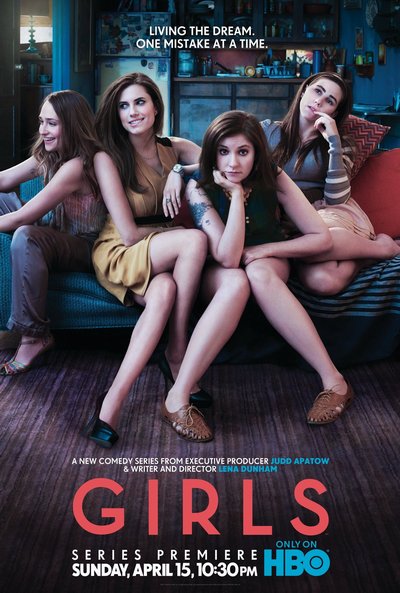
When I ran my review of Tiny Furniture on this blog, I added a coda dismissing Lena Dunham's HBO series Girls. Based on the pilot, it appeared we were in for just a retread of all the irksome traits of her full-length feature: self-important, entitled myopia magnified to a level of false importance. Worse, as the series sank in, it started to look like Girls was going to merely be a post-college Sex and the City [review]. There was the promiscuous blonde girl, the virginal brunette, the uptight responsible one, and the neurotic writer doing her best to fail at relationships. Yeah, I know, this is such a Charlotte thing for me to say, but I didn't like it.

The debate kept going elsewhere, however, and it got heated enough and was interesting enough that I felt compelled to give Girls a chance and follow my own three-installment rule. This rule says that any piece of art, particularly serialized art, deserves three chapters or episodes or issues to find its footing and let you know what it's all about. If a show or a comic book or whatever can't hook you in three, then you have every right to move on.

And sure enough, by episode three, a disarming vulnerability had crept into Girls. Dunham not only revealed a larger capacity for examination than she'd previously shown, but it also became evident that the earlier self-involvement had possibly been defensive and, in reality, she was becoming increasingly aware of her own place in the world. Better yet, she understood the people around her and could, indeed, dig into the lives of the characters she was bringing along with her for this endeavor. As the writer, director, and star, it would have been easy to make Girl rather than Girls, but over the coure of the first season, all the supporting cast got their due and grew into meaningful people.

By the finale, Dunham had done what she could not do in Tiny Furniture: bring her fictional persona to a point of new understanding that allows for a true emotional breakthrough. And not one just tacked on, but earned. Her character, Hannah, had gone from someone I rebuked as being terrible to someone I actually empathized with. She's still terrible--and in two different, powerful scenes in the last two episodes, other characters tell her not only how terrible she is, but exactly why--but yet, aren't we all?


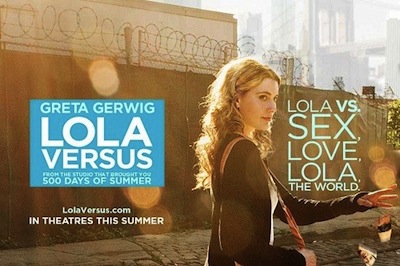
I bring this up now because, in reviewing Daryl Wein and Zoe Lister Jones' Lola Versus, I found myself not only thinking of Dunham's work, but also Jennifer Westfeldt's Friends with Kids [review]. The one thing all of these cinematic efforts have in common is that they portray the lives of (mostly) white people living comfortably in New York, walking a strange and achingly thin line between self-serious drama and satire, seemingly oblivious to how good they have it. In Lola Versus, do all those references to Kombucha and vegan food and the like amount to a critique of trend chasing or does all of these things fall into the characters (and, by default, their creators) being exactly what they pretend they aren't? (Expect this to come up again this summer when the Lee Toland Krieger-directed Celeste and Jesse Forever lands in theaters [review].) Striking a balance between emulation and exhumation is something Whit Stillman regularly pulls off (his recent Damsels in Distress is a very good example), managing a sort of erudite Fitzgeraldian tone of simultaneous adoration and amusement. It's also something I think Lena Dunham has now figured out. The jury is still out on the rest.

Anyway, for what it's worth, I was wrong about Girls. I take back what I said. Mea culpa, Lena Dunham.


Saturday, May 5, 2012

SIDELINE: MORE REVIEWS FOR 4/12


IN THEATRES...

* The Avengers, the film at pole position for the summer blockbuster season. Joss Whedon delivers a big budget aventure with great characters and even better action.

* The Cabin in the Woods, a fun puzzle of horror and comedy. Avoid info on this one, just go! (Whedon also writes this one.)

* Damsels in Distress, it's Whit Stillman to the rescue in the director's first movie in 14 years.

* The Deep Blue Sea, beauty and heartbreak in a new film from Terence Davies. Starring Rachel Weisz.

* The Five-Year Engagement, an uneven romantic comedy with genuine laughs and heavy sentiment. Starring Jason Segel and Emily Blunt. 

ON DVD/BD...

* Roadie, Michael Cuesta's middle-aged rock 'n' roll drama has sharp writing and sharper performances.

* Something to Live For, featuring Ray Milland in an unofficial sequel to The Lost Weekend.