It's easy to pigeonhole a director based on our own limited experience of his work. My previous exposure to Polish filmmaker Andrzej Wajda was the Criterion boxed set
Three War Films, an incredible triptych of on-the-ground stories set in the mid-century turmoil of Poland's internal revolution and their struggles with the Communist influence. These were radical films, made under government scrutiny and threat of censure. As far as I knew, this was Andrzej Wajda.
So, what then when a DVD of his 1983 historical epic about the French Revolution,
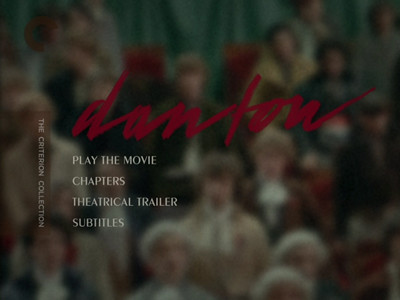
Danton, comes along? I was surprised to say the least, but pleasantly so when I actually sat down and watched the movie. Of course, Wajda was more than I was giving him credit for. How could he not be? Why make so boneheaded an assumption?
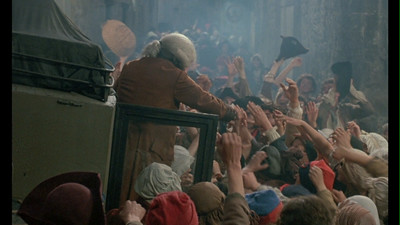
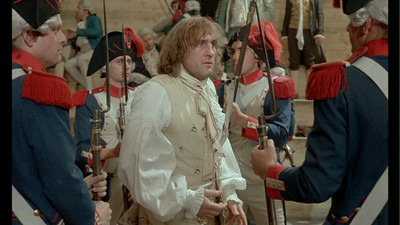
The Danton of the title is Georges Danton (Gerard Depardieu), an architect of the Revolution and a founder of the tribunals that brought the ruling class a dose of working-class justice. Having since become a bit of a folk hero--they call him "the Man of August 11," referring to the day the king was toppled--and also grown fat on the spoils of the struggle, he has continued to be beloved by the citizenry but has turned into a thorn in the side of the governing body. Of particular frustration is his connection to the newspaper of Camille Desmoulins (Patrice Chereau), which is highly critical of the ruling Committee. In particular, Danton's one-time ally Maximilien Robespierre (Wojciech Pszoniak), who is in the midst of his "Reign of Terror," silencing his dissenters with the guillotine, casting himself as the despotic father nurturing the infant liberty towards maturity with some tyrannical tough love.
The script for
Danton is credited to five different writers (including Wajda) and was based on a play. It mainly involves the final days of Danton's struggles with Robespierre, the political posturing, the backroom arguments, and the incendiary public debates, leading to a kangaroo court where Danton is accused of conspiracy against the foundling government. Though ostensibly a talking heads drama, Wajda has made anything but a simple point-counterpoint back-and-forth. This is an electrified political thriller, a war picture in its own right, it's just a different kind of battlefield. Wajda and cameraman Igor Luther are always on the move, circling characters, moving across the angry throngs, working within the rooms of power the way they might also run through trenches on the front lines.
In these scenarios, words are as forceful and deadly as any bullet, and this makes Gerard Depardieu perfect casting as Georges Danton. In watching
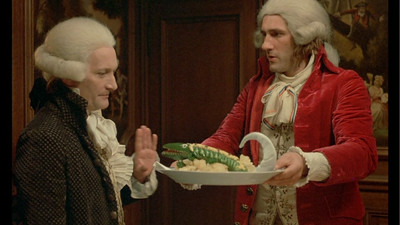
The Last Metro just a couple of days ago, I was struck by how physical Depardieu is onscreen. He puts his whole body into a role, and he makes Danton a self-described clumsy oaf, rarely sitting still, bobbing and weaving around the scenery like a drunken boxer. At the same time, Depardieu has his way with the language, displaying his voice like a great muscle. In one scene, meeting with Robespierre at a hotel, the actor at first plays Danton as a giddy child excited to meet his hero, and then he flips to angry and brutish, before dropping it down again, making it less hero worship and almost a love affair, manipulating and humiliating his opponent with each turn. Later, he declares that it's his voice that will see him and his group through their trumped-up trial, and he commands the room with such vigor, he eventually loses his one true power, his most fearsome muscle growing hoarse, flaccid. It's a simple symbol of his political loss, the freedom fighter being robbed of his freedom.
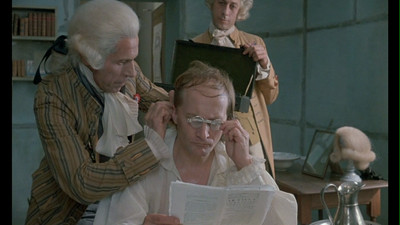
By contrast, his opponent is meek, bottled up, and fragile. Robespierre is shown as sickly in the very first scenes, his compromised principles turned to a kind of cancer the way his oppressive policies are tearing apart the fledgling democracy. Wajda isn't subtle about it. Our final visions of the tyrant is of him sweaty and cowering under a sheet, the linen pulled over his face like a death shroud. We aren't meant to feel sorry for this man, nor are we meant to have any question about what side we're supposed to be on. In a kind of twisted play on the old convention of children reflecting our violent society in their play (perhaps best used by Peckinpah in
The Wild Bunch), Wajda closes on a young child rattling off the basic principles of the Revolution, a laundry list of all Robespierre has thrown away.
It makes sense that Wajda would be so up front with his political message. Apparently at the time he was making
Danton, the Polish Solidarity movement was falling under the wheels of the ruling government, which also might explain why the director was working in France. I'll leave it to others with more historical knowledge to dissect how that all connects (Leonard Quart covers some of those points in his liner notes in the DVD booklet), just as I'll let others dissect the truth of Wajda's version of history (a couple of historians are actually listed in the opening credits). I will note, however, that this film is everything I wished the
Rossellini history films had been but weren't. Roberto Rossellini wanted to bring history to life, but his dogmatic style arguably drained all the life right out of them. Andrzej Wajda's version of history has all the blood, spit, piss, and vinegar that fuels revolutions. Under his lens, it's a living thing, full of human bluster and human blunders, and it's riveting.
Kudos also to Criterion for finding another interesting artist to do the cover illustrations for
Danton, as they did with the
Ophuls releases last year and with their hiring of various
comic book artists.
Riccardo Vecchio has a loose line quality that is almost anarchic in its approach to likenesses, and it totally fits Wajda's energetic cinematic portrait. Visit his site and be sure to check out the Shakespeare covers he's done.


