Showing posts with label Lena Dunham. Show all posts
Friday, June 22, 2012
SIDELINE: A LENA DUNHAM MEA CULPA
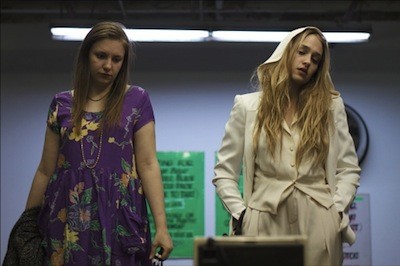
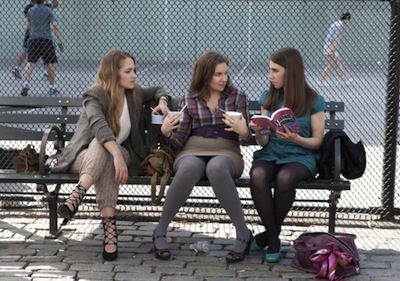
When I ran my review of Tiny Furniture on this blog, I added a coda dismissing Lena Dunham's HBO series Girls. Based on the pilot, it appeared we were in for just a retread of all the irksome traits of her full-length feature: self-important, entitled myopia magnified to a level of false importance. Worse, as the series sank in, it started to look like Girls was going to merely be a post-college Sex and the City [review]. There was the promiscuous blonde girl, the virginal brunette, the uptight responsible one, and the neurotic writer doing her best to fail at relationships. Yeah, I know, this is such a Charlotte thing for me to say, but I didn't like it.
The debate kept going elsewhere, however, and it got heated enough and was interesting enough that I felt compelled to give Girls a chance and follow my own three-installment rule. This rule says that any piece of art, particularly serialized art, deserves three chapters or episodes or issues to find its footing and let you know what it's all about. If a show or a comic book or whatever can't hook you in three, then you have every right to move on.
And sure enough, by episode three, a disarming vulnerability had crept into Girls. Dunham not only revealed a larger capacity for examination than she'd previously shown, but it also became evident that the earlier self-involvement had possibly been defensive and, in reality, she was becoming increasingly aware of her own place in the world. Better yet, she understood the people around her and could, indeed, dig into the lives of the characters she was bringing along with her for this endeavor. As the writer, director, and star, it would have been easy to make Girl rather than Girls, but over the coure of the first season, all the supporting cast got their due and grew into meaningful people.
By the finale, Dunham had done what she could not do in Tiny Furniture: bring her fictional persona to a point of new understanding that allows for a true emotional breakthrough. And not one just tacked on, but earned. Her character, Hannah, had gone from someone I rebuked as being terrible to someone I actually empathized with. She's still terrible--and in two different, powerful scenes in the last two episodes, other characters tell her not only how terrible she is, but exactly why--but yet, aren't we all?

I bring this up now because, in reviewing Daryl Wein and Zoe Lister Jones' Lola Versus, I found myself not only thinking of Dunham's work, but also Jennifer Westfeldt's Friends with Kids [review]. The one thing all of these cinematic efforts have in common is that they portray the lives of (mostly) white people living comfortably in New York, walking a strange and achingly thin line between self-serious drama and satire, seemingly oblivious to how good they have it. In Lola Versus, do all those references to Kombucha and vegan food and the like amount to a critique of trend chasing or does all of these things fall into the characters (and, by default, their creators) being exactly what they pretend they aren't? (Expect this to come up again this summer when the Lee Toland Krieger-directed Celeste and Jesse Forever lands in theaters [review].) Striking a balance between emulation and exhumation is something Whit Stillman regularly pulls off (his recent Damsels in Distress is a very good example), managing a sort of erudite Fitzgeraldian tone of simultaneous adoration and amusement. It's also something I think Lena Dunham has now figured out. The jury is still out on the rest.
Anyway, for what it's worth, I was wrong about Girls. I take back what I said. Mea culpa, Lena Dunham.
Sunday, February 12, 2012
TINY FURNITURE - #597

Aura just graduated from college, getting a film degree and a YouTube video of herself frolicking in a bikini in the school fountain to go with it. Her name is ironic, because though it conjures hippy-dippy images of love and happiness, Aura is more like a plague of whining. The movie Tiny Furniture is the story of what she does immediately after school. The grad returns to her home in Tribeca to sponge off her artist mother, squabble with her little sister, reconnect with old friends, and chase after the wrong men. She also gets a job, but the subject of her future is something she's actively avoiding. I don't think she ever says she doesn't know what she wants to do, it's more that she doesn't want to think about it.
Engaging with the disengaged can be tough sometimes. So it is with Tiny Furniture. There is clearly ambition on display here: not for nothing, Lena Dunham has it together enough to assemble a whole movie. This is Dunham's first feature, and she wrote, directed, and starred in the thing, shooting it on a miniscule budget in her mother's real apartment, and roping her real-life mother and sister--Laurie Simmons and Grace Dunham--into putting up with her on the screen. One can't presume to say that this movie is autobiographical, but it is a little surprising that, given the opportunity to dream up an imaginary life for herself, Lena Dunham went for such an uninteresting one.
The story of Tiny Furniture basically covers two weeks of Aura in freefall. Just prior to leaving school, her boyfriend of two years dumped Aura to go find himself. It's a split that is given little credit, though it's thematically significant. In fact, if you consider the men that Aura gloms on to once she is back in New York, it becomes clear that this is a woman currently letting others define the world around her. The vain and selfish Jed (Alex Karpovsky) is pursuing television deals for his own YouTube vids, though from what we see he's not nearly as funny as he thinks he is, while the emotionally manipulative hipster Keith (David Call) is a sous chef in the restaurant where Aura briefly works. Aura is attracted to Keith because he has something he cares about: food. Or so she says. By all evidence--and the film proves our first impressions right--Keith just cares about pills and sex. And tentacle porn. Seriously, ladies, if a guy tells you he's into tentacle porn, it shouldn't be considered a mark in the plus column.

Two of the best scenes in Tiny Furniture actually come as a result of these sorta hook-ups. Midway through the movie, Dunham gives herself actual conversations with both men, where the poses fall away and people actually talk to one another rather than work their way around the mealy-mouthed punchlines that otherwise serve as humor. In terms of comedy, there isn't much that made me chuckle here. The script is like a Noah Baumbach rough draft, the outline of jokes the writer might make before he does the soul searching to give his quips meaning. The only real laughs come from Aura's best friend Charlotte (Jemima Kirke), a spoiled rich girl who has transformed her malaise into withering scorn that somehow becomes more comical by being delivered in a fake British accent. The rest of the laughter comes from the horror of how sad this all really is--and not in a good "laughing with you" satirical way, either. By the time we get to a terrible and awkward sex scene that serves as the film's climax (pun not intended by me, but possibly intended by the filmmaker), it would seem that the nausea and disgust is intentional. The boredom, however...?
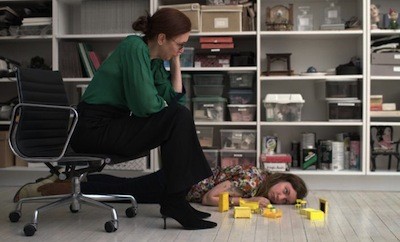
In terms of filmmaking, Dunham and cinematographer Jody Lee Lipes don't do a bad job. Though Tiny Furniture is light on planned aesthetics, there are occasional inspired set-ups. The pair make good use of the large apartment Aura's family lives in, shooting through doorways and using walls as natural dividers. In one shot, Aura is laying on the couch while her overachieving sister, who towers over her in accomplishment and stature, is only visible as a pair of legs on a treadmill. It makes for a good contrast. The rest of the film is mostly static, though it thankfully avoids the shaky-cam we have come to expect from most mumblecore features--"mumblecore" being the almost-genre Tiny Furniture most closely resembles. The performances here fit that movement, with all the actors under-acting in an attempt to appear "real." It doesn't work for Dunham or her cast. This feels like a production that never got out of rehearsals.
Tiny Furniture does end on a positive note. The last scene, following the bad sex, features the first real communication of the film. Aura and her mother stop bickering and actually talk, and connections are made between the generations that suggest that Aura's predicament is not only normal, but that things will get better. The insight is maybe too little, too late, but it gives me hope that maybe Lena Dunham could eventually figure this whole cinema thing out, too.


POSTSCRIPT: This review was originally written when Tiny Furniture was released theatrically, so there has been some time to see if the auteur would deliver on the more promising aspects of her creative endeavor. Dunham's new project is helming a sort-of sitcom for HBO. Girls is produced by Judd Apatow and is set to debut this year. I've seen the pilot, and though having a strong producer has helped in terms of tightening the material structurally, I am afraid in terms of the things that concern Dunham and how she presents herself, what we've seen is what we're going to get. Girls is more of the same and, unless there is significant development in the episodes that follow, it's likely only going convince detractors that we were altogether too kind to give credit where we perceived it to be due.
POSTSCRIPT 2: Now that the whole season has run its course, I have done a complete 180 on Girls. Please read this update.

Still from Girls
Subscribe to:
Posts (Atom)