Thursday, January 7, 2010

UMBERTO D. - #201


I'm a cat person. Anyone who knows me will tell you. Hell, anyone who has read my fiction can tell you, too. Only my odd little book I Was Someone Dead has a dog in it. Almost all my other books feature a cat in some kind of major role. Even my crime graphic novel.

I don't trust dogs. My foundation for this? Because I was once told if I had a pet dog, he or she wouldn't eat me after I'm dead, whereas if I breathed my last here in the apartment, Sadie would feast on my corpse if she got hungry during the considerable wait before someone finally realized I'd succumbed. There is something more honest about that, I think. (Pardon me if I've used that line before...sometimes I can't remember if my jokes are ones I tell, or ones I've written down once upon a time.) Dogs are sneaky creatures. It's all about approval ratings. Their insistence that you must like them, that you will pay attention and be their friend, is their sneakiest move. It's like the pretty girl that gets you to buy her drinks and dinner, and then leaves without giving you her number; they know it will work, they know you will succumb. Cats let you know where they stand; dogs pretend not to be self-serving as a method of enslavement.

And no, I'm not immune. Case in point: Boss.



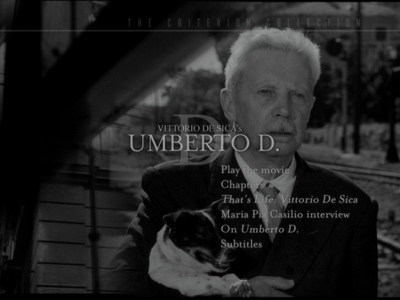
Boss is a pug who belongs to a friend of mine. That's him and me there. I'm the one with the shiny forehead. He looks like Wilford Brimley and goddamn if I wouldn't buy a bowl of oatmeal from that little jerk. People I know have seen me walking him in the neighborhood, and they usually do a double-take. My regular excuse is that he's a chick magnet (which is true, he is), but the real story is that he conned his way into my heart and we're pals. I even walked him tonight, jumped at the chance when my friend called and asked if I'd have time.
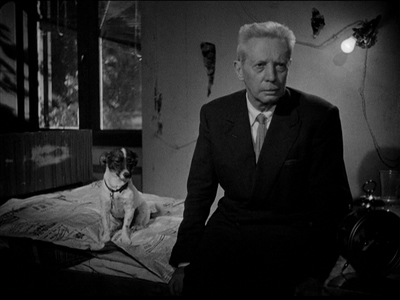


Pet love is universal, regardless of the species. I am only on this dog tangent because Vittorio De Sica's 1952 drama Umberto D. is about an old man and his dog. Umberto Domenico Ferrari, as played by Carlo Battisti, and Flike, as played by Napoleone. Harlan Ellison wrote a famous novella called "A Boy and His Dog," about a guy who survives the nuclear apocalypse with his faithful pooch. Though it doesn't have nuclear war or mutants, De Sica and Cesare Zavattini's script for Umberto D. is built on the same principle: man's best friend can make anything bearable.

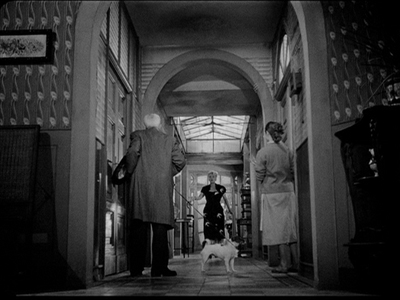
Old Umberto is a retiree who is having trouble making ends meet on his pension. Behind on his rent, he is at odds with his exasperated landlady (Lina Gennari), who is ready to kick her tenant of twenty years to the curb. Desperate to save cash and get ahead, Umberto manages to get a bed in the public hospital and weasel an extended stay. When he finally leaves, however, he returns home to find Flike gone and the rooming house being remodeled. Though he finds Flike again, he can't do anything about the fact that the walls of his tiny room are being torn down. Umberto needs another solution.


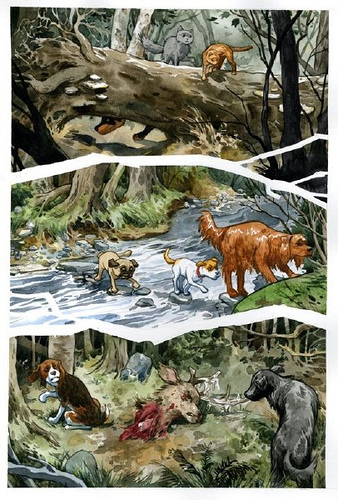
Make a movie about a dog, and it's almost guaranteed to be schmaltzy. There's no quicker way to pull the heartstrings right out of their sockets than get a cute dog to look sad and whimper. Beasts of Burden, a recent comic book series by Evan Dorkin and Jill Thompson, uses dogs and cats rather effectively to tell old school ghost stories, and I wondered while reading it if I would have cared as much about what was happening if they had used humans instead. Their furry monster fighters came without the human baggage, and the quick emotional connection I made to the characters made the spooky stories all the more harrowing. Is it possible that slasher flicks have immunized me so much, that had the legion of ghostly puppies in the second issue actually been the specters of a bunch of dead kids, I wouldn't have gotten as choked up when they cried for justice?


Put a story about a pet in the hands of accomplished artists, such as Dorkin or Thompson, and they can manage to tell a sentimental yarn without making it overly sentimental. I know that sentiment is an icky thing in most critical playbooks, but it's kind of a fake pose. Sentimentality is not inherently evil unto itself. Like most things, it's excess that makes sentimentality bad, or going straight for the easy tears without really earning it. You're not going to find a more delicate hand than that of Vittorio De Sica, particularly at this stage of his career. It would have been easy to go over the top with any number of scenes in Umberto D. The old man looking for his pup at the pound, for instance, the way he sees other dogs being wheeled into the abattoir--this could have been an awfully trite sequence in any other movie. De Sica, in his quest for naturalism and adherence to the Neorealist credo, underplays everything. When an event is as naturally dramatic as this one, there is no need to pile anything on top of it.

Working with a combination of non-actors and seasoned professionals, De Sica creates a world that resembles reality yet toys with the idea of performance. Sensing there is already a natural divide in his story, that between the poor people like Umberto and the maid Maria (Maria Pia Casilio) and the ones with money, such as the landlady, the director playfully adds artificial divisions, as well. The landlady, for instance, sits in her boudoir analyzing music with her snooty friends--they are all performers, or at the very least, wannabes--and she is going to move up in the world by marrying a cinema owner. Miniature soap operas play out in her social circle, as well, like the two lovers Umberto and Maria spy through the keyhole. How far away the cheating wife's predicament is from the more critical crisis of the maid, who is pregnant, unsure of who the father is, and convinced that she will lose her job once the landlady discovers she's with child.
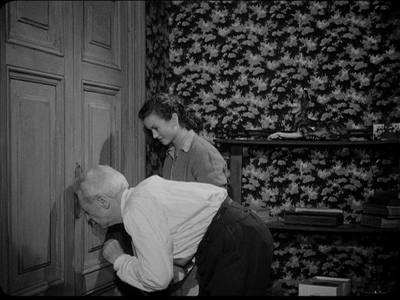
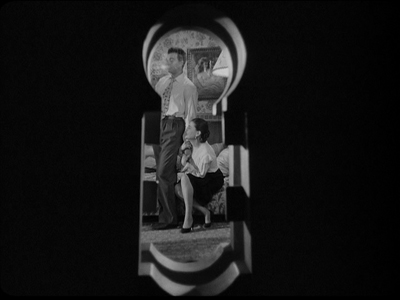


It's all these tiny dramas that make the world of Umberto D.. Whole lives are being lived in stairwells, whole stories being told on the street. The cheating wife shows up more than once, ashamed and nervous to be seen by the old man who knows her secret (even if he barely seems to remember; his spying on her through the keyhole has a sort of visual rhyme in us spying on him through the gaping hole put in his wall). There are the tales the beggars tell to manipulate passersby into giving them money (stand-ins for those falsifying, overly sentimental filmmakers, one could say), and there is even the political foundation De Sica lays at the start of the picture. Umberto is one amongst a crowd of old men who have taken to the streets to protest unfair pension policies, only to be chased by policemen in jeeps. The world is unfair and uncaring. The ornate, towering city in ruins buries its older citizens, makes them small (particularly the way De Sica frames them).
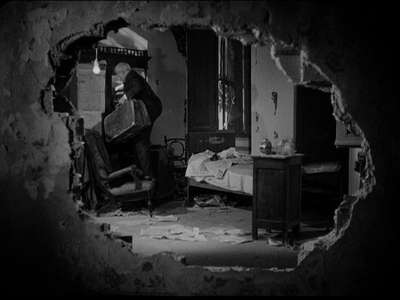


Carlo Battisti plays Umberto as a quiet, proud man. He is a man who wants to raise his fist in the air and shake it, but he's more likely to do it standing behind a door than out in the open. The only time he really gets heated up is after he finds Flike again, and he confronts his landlady to her face. Flike is the one thing he cares about, and that's because he knows Flike cares about him. The third act of Umberto D. takes a dark turn, when Umberto's despair becomes so great, he considers ending it all. The only thing stopping him is the dog. He can't leave Flike without someone to care for him. He considers boarding the animal but doesn't like the look of the lodgings. He tries to give Flike to a little girl, but her nanny reinforces the notion that modern society is cynical and uncaring, she believes there must be a catch. Umberto tries to run, but Flike finds him.

This relationship puts me in mind of my father and his relationship with his dog Shep. It's actually in tribute to that friendship that I put the dog Gus into I Was Someone Dead; it may be no small coincidence that Vittorio De Sica dedicated Umberto D. to his father. No one else in my family really liked Shep. He was an Australian Shepherd, a slightly large dog, and too dumb to realize his own size. He was also usually pretty filthy. My dad loved him. As he explained it, Shep never cared what kind of day he had, what he did or did not accomplish, the pup always greeted my pop the same way whenever he got home. Eventually Shep got sick and had to be put to sleep, and my father, who has not always been prone to personal expressions, still tears up more than ten years later when he talks about having had to make that decision. You'd be hard-pressed to get a single drop out of him in regards to an ex-wife.
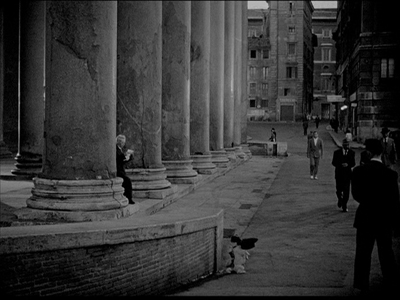
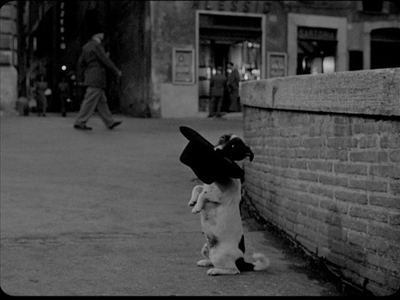


There is nearly half a century between Shep and Flike, but again, such is the commonality of having pets. Flike gives Umberto a reason to go on, and his friendly, nonjudgmental gaze compels Umberto to maintain his dignity. Innocence is a mirror in which we see our own guilt. At one point, Umberto considers panhandling, but he can't bring himself to carry it through. Instead, he has Flike sit on the sidewalk holding his hat. When someone they know comes by, I get the sense that Umberto is more ashamed that he made Flike do his dirty work than he would have been had the colleague caught him begging on his own.

When it comes down to it, the relationship between Umberto and Flike is a replay of the relationship between the father and son in De Sica's Bicycle Thieves. In both, daddy is going to have to do some bad things that he wishes his child was not around to see, but he can envision no other option. The difference here is that the child does not have the capacity to protest or for the most part even understand what is wrong. This makes it all the more gutwrenching when Umberto makes a decision that actually affects the animal, so much so that Flike runs from him and is reluctant to let his old pal back into his good graces. It's another mini drama, but this time with the central characters, a micro narrative that provides Umberto the way to redemption. It's Abraham and Isaac, but Isaac is both the sacrificial lamb and the angel that stays his master's hand.

Flike gives in kind of easy, if you ask me. A cat would have held out for much longer, made the old goat suffer, and then got a special treat out of it, sentimental finales be damned.

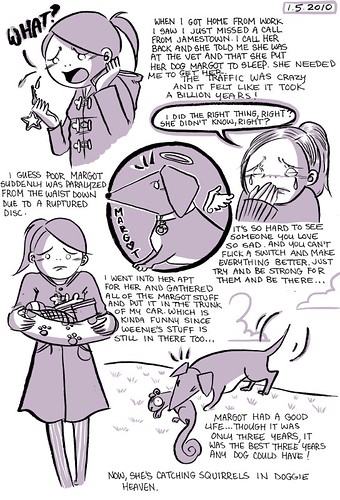


Yesterday's EmiTown was coincidentally appropos of this topic.


Thursday, December 31, 2009

SIDELINE: MORE REVIEWS FOR 12/09

Sorry if updates seemed slow this month. I thought it would be late in the month when things would go wonky, but I followed a stacked schedule for theatrical releases during the first week of December with a dental emergency immediately after. (I actually just typed "mental emergency," which I guess works, too.) My whole plan for having a productive end of the year went kablooey.

As you can see, though, I am back on track...

Please be sure to also check out my list of My Top 15 Movies of 2009, which I posted to my other blog.

I also voted in the DVD Talk end-of-the-year poll, and these are the top 20 DVDs as picked by the writing staff. I kind of hate being part of any list that includes Watchmen, but such is a democracy. I wrote the blurbs for Wings of Desire, The Human Condition, and Up.


IN THEATRES...

* Avatar, the James Cameron blockbuster makes up for its lackluster script with truly stunning effects.

* Broken Embraces, the new Pedro Almodovar is the movie for Penelope Cruz fans to see right now. Forget the one with the music.

* The Messenger, the hard-hitting drama with Woody Harrelson, Ben Foster, and Samantha Morton. Portlanders, it's finally here.

* Nine, the musical remake of Fellini's 8 1/2 lacks the original's creative spark and is really just a snoozer. Second appearance by Penelope Cruz, first by Marion Cotillard this month, both of whom make this at least passable. Don't forget my review of the Fellini a few entries back.

* The Princess and the Frog, Disney's fun-filled return to classic animation is a winner.

* The Private Lives of Pippa Lee, Rebecca Miller's new film. It falls apart in the final third, but the strong start and performances are enough to keep it as a recommended feature.

* Sherlock Holmes, Guy Ritchie's movie is the worst thing you could have done to yourself this Christmas.

* A Single Man, Tom Ford's movie is the best thing you could have done to yourself this Christmas.

* Up in the Air, Jason Reitman and George Clooney deliver the true winner of the season. I loved it!

* The Young Victoria, a lovely historical drama with Emily Blunt as the titular Queen.


ON DVD...

* Beautiful Losers, an interesting documentary about a group of contemporary artists who came up through NYC in the 1990s.

* In the Loop, Armando Iannucci's blistering political satire. Peter Capaldi and James Gandolfini let the profanity fly!

* Lion's Den, one of my favorites of the year is a little-seen prison drama from Argentina. Martina Gusman is fantastic.

* Public Enemies: 2-Disc Special Edition, Michael Mann's gangster movie is the prettiest nap you can ever take. The second appearance of Marion Cotillard in this month's list of reviews. Between this and Nine, she deserves better.

* Spectacle: Elvis Costello With... - Season 1, a show where Elvis sits and chats with other musicians about music. Its brilliance is equal to its simplicity.

* Tora-san: Collector's Set 1, the first four movies in the extensive Japanese film series, featuring a charismatic drifter in increasingly addictive romantic adventures.

Wednesday, December 30, 2009

GERVAISE - ESSENTIAL ART HOUSE

"They were the only good things in my life. Maybe that's why they left."


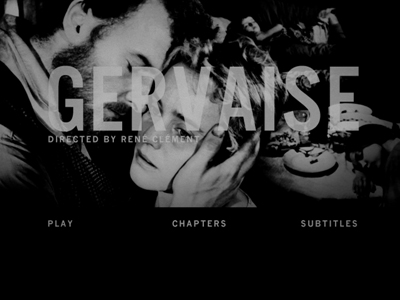
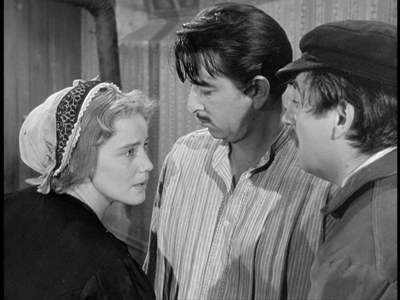
Réne Clément's 1956 historical drama Gervaise is an adaptation of Emile Zola's L'assommoir, part of the French author's multi-part character epic, Les Rougon-Macquart. The novel's title, L'assommoir, is said to be an old colloquialism that is roughly the equivalent of the American phrase "to get hammered." Apparently the focus of this chapter of Zola's narrative was alcoholism and the devastating effects it has on a family. The drinking is also there in Clément's film version, but the focus is more on the title character, Gervaise Marquart (Maria Schell), and how she gets hammered by life.
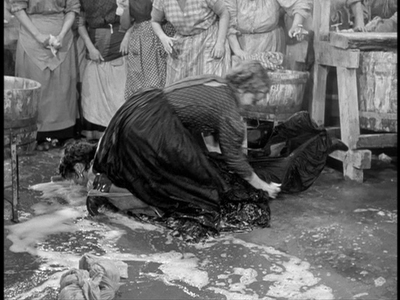
As Gervaise herself tells us in her hopeful opening narrative, she is the girl who shouldn't have expected very much. At the start of the picture, which takes place in the late 1800s, she is living with her common-law husband Lantier (Armand Mestral), who has taken her on despite her limp and given her two boys in the time they have been together. Too bad for her that Lantier is the kind of man no female deserves, and pretty soon he runs off with a loose woman who lives across the street. Gervaise's anger leads to her having a knockdown drag-out fight with that strumpet's sister, Virginie (Suzy Delair). Despite taking place in a giant public laundromat, it's a pretty dirty scuffle, ending with Virginie's bare ass being spanked with a paddle. The indignity is one she promises never to forget.


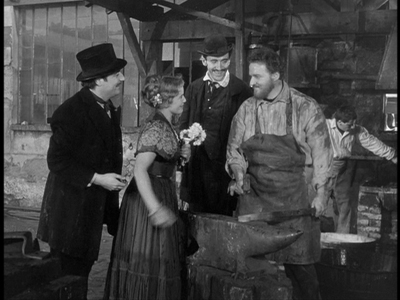
With Lantier out of the way, things start looking up for Gervaise. She marries a kindly roofer, Henri Coupeau (Francois Périer), despite the protests of his family. They have a daughter together, Nana (Chantal Gozzi), and they make plans for Gervaise to open her own launderette. This dream is nearly scuttled when Coupeau falls off a roof and Gervaise's insisting on taking care of him herself leaves them broke. The kindly blacksmith Goujet (Jacques Harden) loans her the downpayment for her lease, revealing his buried love for Gervaise and sparking an unacknowledged jealousy in her husband in the process. Once again things are looking up for Gervaise.


Of course, you can only look up so long before the sun burns your eyes, and that's when the blindside comes. Gervaise is one of those up-and-down melodramas where every step up the ladder the protagonist takes is followed by her being knocked back two more, all the way to the bottom and down to hell if the earth would just comply and open up. It's the sort of story that, when done poorly, compels the audience to throw up its hands and cry, "Enough! I give up!" When done well, however, as Gervaise most certainly is, it makes co-dependents of us all. Yes, Gervaise, we'll watch you get your hopes up, and we'll wait with wetted lips for them to get dashed on the rocks. Especially because we know each failure will be bigger than the last.

I think an essential component of any such movie succeeding is the strength of its lead. In this case, Maria Schell imbues Gervaise with a natural warmth and kindness that somehow makes us root for her even as we slowly begin to realize that she's not really that innocent of a victim. Or maybe "innocent" is the wrong word. It's more that she is less a victim of opportunistic men then she is her own bad choices. Whatever societal forces may be informing her misguided decisions, and the lack of education that leaves her without other tools, it becomes increasingly hard to reconcile the Gervaise that fought back against Virginie and whooped her ass with the Gervaise who allows a besotted Coupeau to let Lantier move in with them, and who is then manipulated in jumping between the beds of both men. We know she is capable of better, but she has latched onto bad luck as her own addiction. It's like she wouldn't know what to do without it. With her kind face and clear, expressive eyes, Schell reminds me a lot of Liv Ullmann, which is probably a major reason why I was drawn to her. She is an excellent actress in her own right, though, and later played both the love interest in Luchino Visconti's marvelous Le notti bianche and the immigrant frontier wife in Anthony Mann's version of Cimarron.


Symbolically, the blacksmith Goujet is Gervaise's conscience. He never fails to see what is really going on, and when she later tries to lie to him, she can't really do it. He also serves as the example of social change, and when he is sent to jail for organizing a strike to protest unfair wages, that's when things really go south for Gervaise. Without him there watching, she has no one to help her pick her drunken husband up off the street or ward off Virginie's machinations. As in Carné's La jour sa lève, work is what sets a man free. When Coupeau stops working, he disappears inside a wine bottle, whereas Goujet's taking Gervaise's eldest, Etienne (Christian Férez), under his wing offers the boy a way out of the squalor. Jacques Harden lends Goujet a rugged earthiness that would have made him right at home as the love interest in one of Douglas Sirk's movies from the same period. The scene when Gervaise goes to see him and Etienne off, and he doesn't see her standing there on the train platform--or quite possibly ignores her--is one of the most heartbreaking in the movie.


Its rival for saddest scene is the very end of the picture, when we see poor Nana heading on the road to ruin herself. René Clément had already proved himself an expert at portraying childish behavior and the hidden meanings behind it in Forbidden Games when he made Gervaise, and he turns Nana into a cautionary element that is integral to the narrative. If Etienne is an example of how a child can escape his surroundings with a little guidance, the blank sponge that is Nana soaks up all the nastiness, all the dirty laundry, that fills Gervaise's shop. Left to her own devices, the unbathed child wraps a ribbon in her hair and runs to an eager group of young boys. They turn to chase her the way a flock of birds shifts flight in mid-air. It's a creepy image all on its own, but knowing where that chase will lead her, it's all the more chilling. Nana is the star of another of Zola's novels, which has been adapted to film itself more than once, most notably by Jean Renoir in 1926.
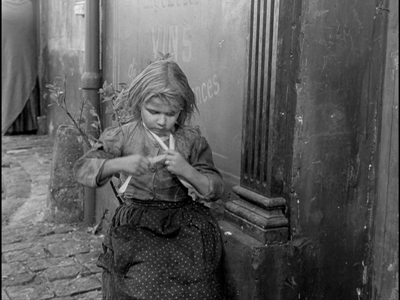


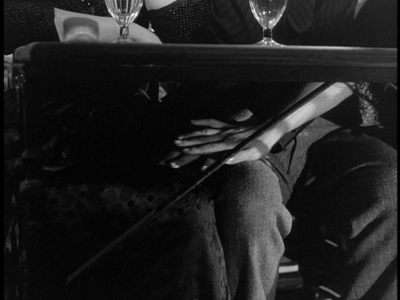
Observing behavior that is meant to remain unseen has always been Clément's strong suit. Be it the cons of Alain Delon in Purple Noon or the secret rituals the children undertake in Forbidden Games (which was written by Jean Aurenche and Pierre Bost, the same team on the script for Gervaise), Clément is attracted to the hidden actions and the pathology that underlines the things people do to themselves and one another. In a pivotal scene in Gervaise, his camera coyly pans down from up above the table where Gervaise, Lantier, and Virginie sit to look under the table at what is happening out of sight. One could almost call the drift of the camera "sprightly." It's a delicious moment, made all the better by Suzy Delair's relish for playing the villainess.
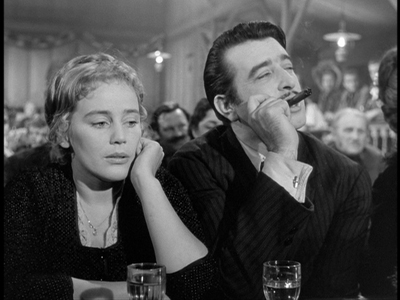
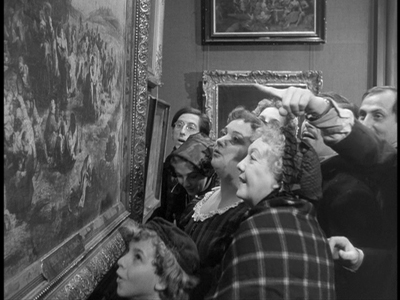
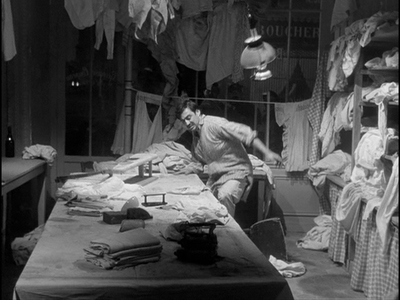
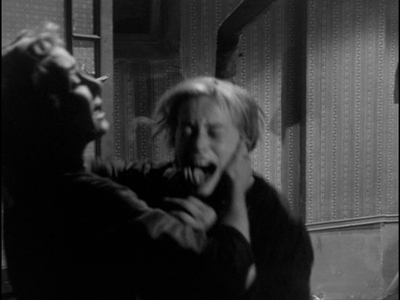
The same attention to detail is paid to all of Gervaise, and the director and his crew recreate 19th-century France with gritty accuracy. One of the most impressively realized sequences takes place on Gervaise and Coupeau's wedding day, when the working-class wedding party goes to the Louvre, many of them for their first and only time. They tour the museum, looking at the paintings, laughing at the ones with nudity, tracking mud through the institution's corridors. Clément shows us both the expanse of the galleries, but also the tight formation of the group, including ducking down to check out that dirty footwear.


Alongside Schell's charisma, such exacting focus on getting every inch of the movie right is crucial to our accepting the emotional histrionics of Gervaise. The movie never feels like a put-on, and it's most certainly never manipulative. By creating a believable world, René Clément also makes the story believable, even when we don't want to believe that our heroine is going to go the wrong way again. Real life is full of mistakes, and a movie's main character is allowed to make them, but the storytellers are not.


This disc was a Christmas present from my good friend and regular editor, the writer Maryanne Snell. What can I say, it was an Essential Art House Holiday. Many thanks, Maryanne!

Tuesday, December 29, 2009

LE JOUR SE LEVE - ESSENTIAL ART HOUSE


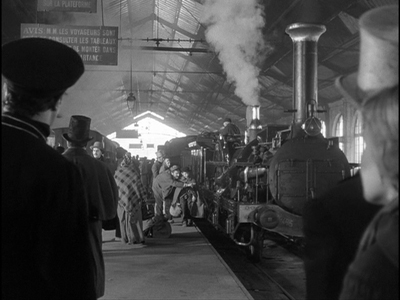
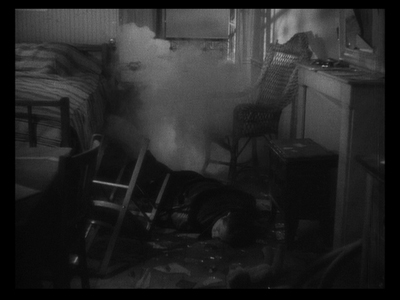
A man is shot behind a closed door. He stumbles from the apartment and tumbles down the stairs, passing the only witness, a blind man. Police are summoned. The believed shooter has locked himself in his room at the top of the tenement. By all accounts, he's a good man. No one knows who the dead man is, much less why their neighbor shot him. The only one with all the answers is behind a closed door and not talking.

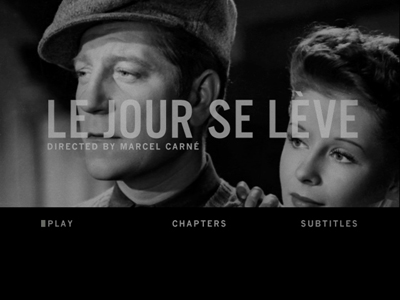
This is the opening scene and basic set-up of Le jour se lève, Marcel Carné's tense 1939 thriller. The shooter is played by the formidable Jean Gabin, one of the more naturalistic and believable actors of early cinema. His presence is like that of Bogie's, his girth a precursor to Gerard Depardieu. But in truth, he is just Gabin, unlike no other. Perfectly believable as a working-class hero, and the kind of personality that could hold our interest pacing a tiny studio all by his lonesome. Which is essentially what he does in Le jour se lève, though his dark night of the soul is mixed up with memory and regret. The title translates as Daybreak, and Jean's character, Francois, will stay barricaded in his apartment overnight, as the police and the townspeople wait for him to reveal himself. He's locked in his own head at the same time, a victim of stinkin' thinkin' not just tonight, but in all the events leading up to this.


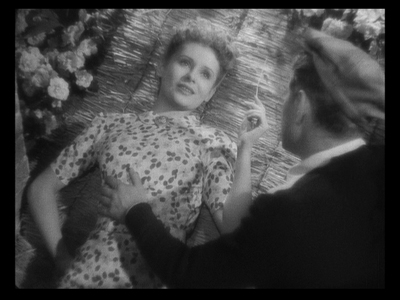
Through a series of flashbacks, Carné and writers Jacques Viot and Jacques Prévert reveal that Francois is caught in two intersecting love triangles. He first falls for the pretty Francoise (Jaqueline Laurent) when she comes to his work to deliver flowers to his boss' wife. Francois labors in a factory where the hazardous conditions are affecting his health; in every way, he is a man with a death sentence hanging over his head even before he becomes a murderer. He and the girl quickly bond, the common name between them working as a starting point for what turns out to be a sweet, intimate relationship. Their scenes together are shot quietly, first by necessity (everyone else in the house is asleep) and then just by nature of the love they share. Carné is a tricky bastard. He knows that if someone whispers, the listener will automatically lean in. Here we fall in love because we can't help but climb into the room with the lovers. Francois and Francoise speak so quietly, we are engaged to be a part of their liaison.


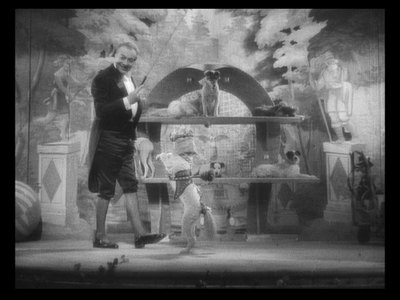
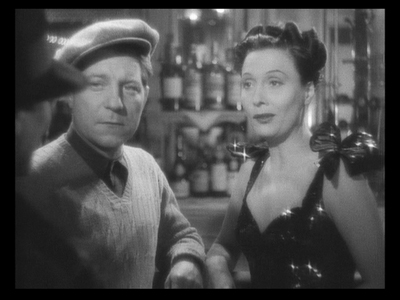
On the night when Francois visits her house, he ends up following Francoise after she leaves him for a prior engagement. She ends up at a small theatre where a dog trainer named Valentin (Jules Berry) is putting on a vaudevillian act where his pooches do ludicrous tricks. It also happens to be the night where Valentin and his pretty assistant Clara (Arletty) are splitting. Clara is a more mature woman than the naïve Francoise, and she sees through Valentin in ways the younger girl is not yet sophisticated enough to manage. Clara also spots the beefy Francois at the bar and quickly attaches herself to him. She becomes his mistress while Francoise remains his chaste girlfriend. Yet, the question is what Francoise's relationship to the slimy con man Valentin is, and whether it's as chaste as her connection to Francois.


It's the untangling of Valentin's lies that eventually gets him shot, the act revealed as the climax of Francois's flashbacks and just prior to the full climax of Le jour se lève. Valentin is a creepy cat, and Jules Berry squeezes every ounce of slime out of the performance as he can. There is a natural division between the men, and though we never see their hands, they would be the telltale sign of how different they are. Valentin's hands would be soft, never having seen hard labor, and Francois's would be rough. Valentin crows about his own intelligence, and the postcards he has sent Francoise from around Europe are meant to suggest that he can offer her a life beyond this remote village. Francois is just a dumb brute by comparison, stuck here for life, no prospect of moving on. Even though Francois sees a paying job as his ticket to personal freedom, the girl may not feel the same. This is the stick Valentin pokes him with, and the true measure of Gabin's performance is how much his understated seething makes us seethe on his behalf. Put that gun in my hand, I'd shoot the huckster, too.


Le jour se lève has a lot going on underneath its melodramatic plot. In addition to the bits about the class distinctions, there is also a lot being said about male aggression. It's kind of like Peckinpah's Straw Dogs in reverse, with the smart guy in the role of antagonist. There are also interesting things to be gleaned about the role of women at the time: how they are perceived, and how those perceptions not only define them, but also how they spur the men in their lives to treat them and/or act on their behalf. Clara is arguably a fallen woman, but she is also a realist. Francois is kind of kidding himself when he tells her he's not the romantic type. He demands a certain honesty from her, waiting to judge her beauty until he sees her without her stage make-up, but he lies to himself. He's an absolute romantic, and he's also a total wuss when it comes to ending their relationship. Clara takes it like a trooper, though that doesn't stop her from being a right bitch. I suppose a lifetime of being thrown over for the innocent girls has given her good reason to debunk the myth of that innocence.


Watching Le jour se lève, I had the feeling that I had seen this all before. Not that I found it derivative, but that some other movie had been derived from it. Turns out there was a good reason I felt this way, I hadn't realized that this was the movie Hollywood remade in 1949 as The Long Night, starring Henry Fonda and Vincent Price and directed by Anatole Litvak. I reviewed that film three years ago as part of Kino's Film Noir: The Dark Side of Hollywood boxed set. It was my favorite of the box, and though my memories of it are fond, Le jour se lève strikes me as the superior picture. More grimy, less hamstrung by production codes when it comes to the finer details of the love affairs. From what I can recall, the broad strokes are the same, though the ending of each version is more befitting the country of origin. Fonda is actually in a similar talent class as Gabin in terms of solitary action and the way he commands a screen. Both movies also have a cinematic realism that is quite effective. We aren't seeing our wronged men making their bad choices on a soundstage. Small town life, particularly as the neighbors spill out to watch the spectacle of the stand-off, is as much a part Jacques Viot's story as anything else.


One fascinating thing about Le jour se lève is how little it actually explains itself. Or, more accurately, how little we are told about the motivations of Francois. He doesn't make any big speeches to Valentin before he kills him, and really, he is reacting more than anything, goaded into proving the power of his might vs. that of Valentin's twisted talk. There is no such antagonizing factor in his final decision, however; it's still just him all alone. My first impulse was to say that he's a man that doesn't allow decisions to be made for him, and so he maintains control by choosing how it will all play out. Thinking about Gabin's face both times he uses a gun, I realized we really have to read his expressions to understand where his real shame lies. He let Valentin poke and prod him into making a mistake, effectively removing the control from him. It's the one decision that we could say he didn't make for himself, and the last scene of the movie is him taking over his own fate once again. The fade-out is on Francois and no one else. There are no parting words. Just the man in his room.


This disc was a Christmas present from my good friend, the writer Christopher McQuain, and thus got immediately bumped up in my post-holiday queue. Thanks, Chris! Check out his top 10 picks for the films that defined the last decade here.

Wednesday, December 23, 2009

8 1/2 - #140

"I really have nothing to say, but I want to say it all the same."


Several years ago, I blogged about how I didn't believe in writer's block. Don't let that there are only three comments on the entry fool you, it was one of my more "controversial" topics. I got plenty of e-mails about it, had it brought up fairly regularly at work-related social gatherings, I had a lot of professional writer friends who either agreed or disagreed and wanted to hash out what separated us and what linked us. I stand by that lack of belief still. I may get stuck, I may have bad days, but "writer's block" is still not a real condition.


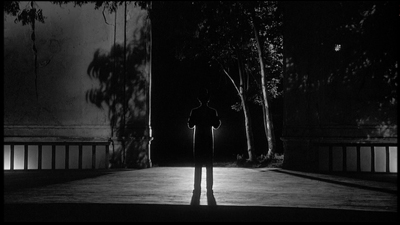
Upon once again watching Fellini's 1963 masterpiece of troubled creation, 8 1/2, it occurred to me that one of the big problems with Nine [full review], the newly filmed musical adaptation of this unadaptable classic, is how much the writers of that travesty missed the point of Guido Anslemi's ailment. He is not blocked, not even remotely, his problem is an overabundance of ideas and a lack of clarity. Nine reduces his artistic plight to comedic business: he can't write, refuses to write, lies about writing. Then again, the entire production of Nine is one of simple-mindedness. The play makes it all about Guido's frayed libido and offers a solution of monogamous fidelity. In 8 1/2, one female muse does show Guido the way, but the true lesson is he needs all of them. The wife, the mistress, the fantasy. He needs everyone, male and female, to get his work done.

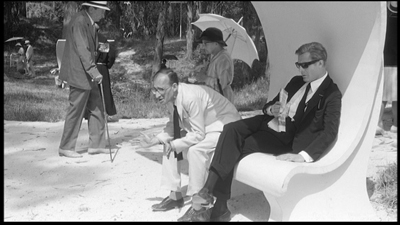
The great Marcello Mastroianni stars in 8 1/2 as Guido, the successful film director whose career is heading toward the skids. He's hiding out in a health spa, drying out via a combination of medicine and Catholicism. He is working on his new screenplay with a caustic writer named Daumier (Jean Rougeul), who keeps telling him that his script is incomplete due to a lack of a point, not for want of story. In fact, Guido has too much story. It's everywhere around him. It appears to him in dreams, as visions and reenactments of memory, creeping into his every living moment. Fellini has dismantled the wall between reality and imagination, leaving us to decide where to apply the definition of each. In truth, of course, it's all imagination, this is a flickering fiction we are watching, and the curtain will drop at the end, Guido conducting his cast the way Fellini is off screen conducting his.


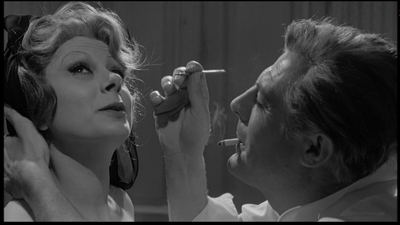
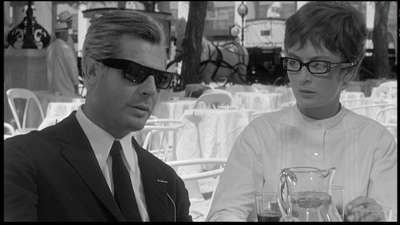
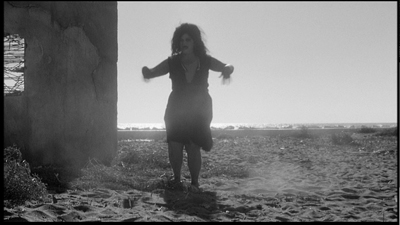
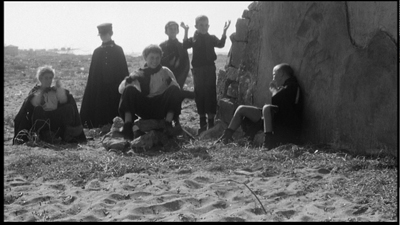
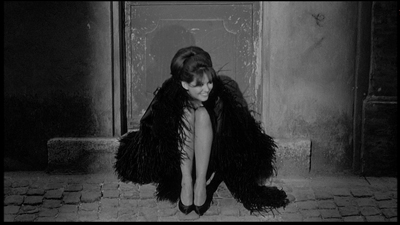
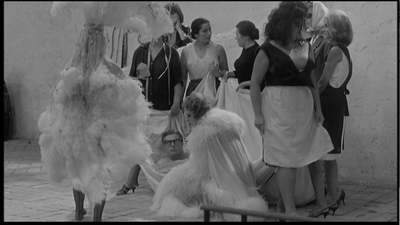
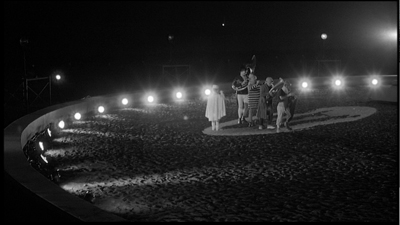
Guido's life has become one of never-ending spectacle. A famous figure whose films are known for their "soullessness," he is followed by religious figures, studio busybodies, actresses and their flunkies--all of them part of some spectacle or other, none of them any more substantial than their accusations. Throughout 8 1/2, more and more people gather around Guido. His producer, crewmen, and, of course, his wife and mistress. The mistress is a flashy married woman named Carla, played by the gorgeous and sexy Sandra Milo, a silly creature who is playful with her lover even as she is selfish and demanding. By contrast, Luisa Anselmi (Anouk Aimee), in her glasses and plain white shirt, is serious and demands very little. Her biggest request? Don't lie to her. Unfortunately, lies are Guido's stock in trade. His new epic, despite the fact that it has a spaceship as its central set piece, is really a rehashing of his biography. From the memories of his childhood, of his mother and father and the mentally unstable whore Saraghina (Edra Gale) who dances a rumba for a young Guido and his chums, all the way through his interactions with Carla and how he hides his infidelity from Luisa, these things are the spine of his script. A painful run-through of screen tests, showing an endless parade of interchangeable actresses going through the motions of each part, reveals how stuck in his own mess Guido is.


The director is the architect of his own fate. Success is his albatross. He is trapped by expectations--those of the press, the businessmen, the clergy, and even his own. What does he have to say that he hasn't said before? Is the reason that he can't make a movie about love because he doesn't know how to experience true love in his own life? That's what his actress tells him. Most of the film is spent waiting for Claudia, played by the divine Claudia Cardinale, to arrive. She appears as visions prior to her really showing up, and she is the simple idea that Guido is waiting for. Just before she lands, he has his most elaborate vision, in which all the women of his life are part of an extended harem that he is trying to maintain control of. It's within this dream that it becomes clear that it's all gotten too complicated for him. It's like Hemingway implored, that each writer must struggle to write that "one true sentence." Claudia is that true sentence, and she is also the truth teller. She sees right through the filmmaker's pretense.


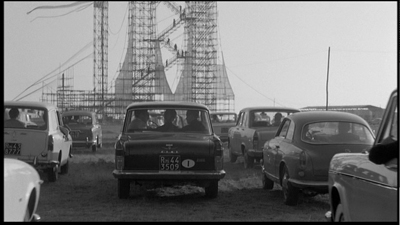
The wonderful thing about Federico Fellini is how effortlessly he blends his reality into the fabric of show business. Channeling his own anxieties about maintaining creative success into 8 1/2 could have been an exercise in precious self-indulgence, but it's really just another day at the office for a director whose lifelong passion was the sparkle and glitz of performance. Much in the same way Bergman was drawn to the façade of entertainers and what it revealed about the human condition, Fellini works to bolster the illusion as if it were the true mirror rather than a distorted reflection. He and cinematographer Gianni di Venanzo create a stunning black-and-white world full of open spaces, isolating Guido within his spacious mindscapes, while also working with art director Piero Gheradi in creating a monument to the complexity of his fantasies with the towering launchpad for his cinematic spaceship (an excellent metaphor that--filmmakers are all astronauts, the movie set their point of take-off).


Sound is also important, perhaps just as important as the look of the movie. The music of Nino Rota creates surreal audioscapes; the score for the dream where Guido sees his parents reminded me of desolate Twilight Zone episodes like "The Lonely" (the one where Jack Warden is a convict living with a robot on an isolated asteroid). The sound designers, Mario Faraoni and Alberto Bartolomei, also add telling effects to different scenes. Listen to that sucking noise Guido hears when he gets on the elevator with the priests. It's like they are drawing him down into death itself, like a fading patient hooked up to a ventilator in a hospital somewhere.

Marcello Mastroianni is one of cinema's great charmers, basically Italy's answer to Cary Grant or George Clooney. His charisma refuses to be buried, and so 8 1/2 avoids becoming dour. He's a scoundrel, always checking out the ladies, humorlessly unapologetic when caught in the act. When Carla and Luisa collide, Guido goes into performance mode, adding another layer to the acting. Mastroianni is playing the part of a cad playing his part. Yet, when Claudia comes along, he is also capable of being vulnerable. The veneer is torn asunder, and the exposure leaves him hanging out there in the big climax. His producers have scheduled a huge press conference/cocktail party out at the launchpad set, and Guido has nowhere to hide. There are so many questions and accusations being tossed at him out there, I almost didn't notice that the producer suggests that Guido has been hiding out for three days, trying to avoid this public appearance. Is it possible that we are meant to imagine Guido as a kind of Christ-like figure, dead for three days and now rising again? His floating away at the start of the picture is even reminiscent of the opening of La Dolce Vita.


If so, the order is a little backwards, because this party is Guido's crucifixion, and depending on how literally you want to take it, possibly his suicide. (And you know, given that Christ sacrificed himself willingly, this is also not off the mark.) The difference here is that no one expects Guido to come back. Not even Guido. In that, though, is his own salvation. The pressure is off, and the disparate pieces of the story he has been chewing on come together. He needed to give himself permission to stop worrying about expectations, stop worrying about how much exposure he was giving the truth, and just go with it. How cathartic that must have been for Fellini, too, getting to that point in the script and granting himself the same privilege as his character. Like the conga line of the dead at the end of The Seventh Seal, Guido's cast dances off into the sunset, which is a pretty accurate representation of what it's like to finish writing something.

In fact, I may do a little dance right now. Because I'm done, too.


Though I reviewed this watching the original release bought for my collection in 2001, you should know that Criterion just released a Blu-Ray version. Here is a review of it by DVD Talk's Adam Tyner.

Tuesday, December 1, 2009

A CHRISTMAS TALE - #492


Sometimes bad blood is a metaphor, sometimes it's literal. In the Vuillard family, they have both kinds and plenty of it.

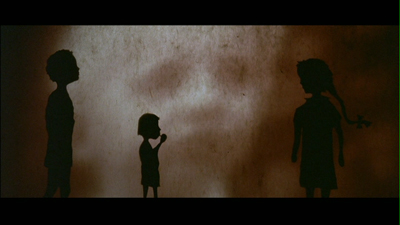
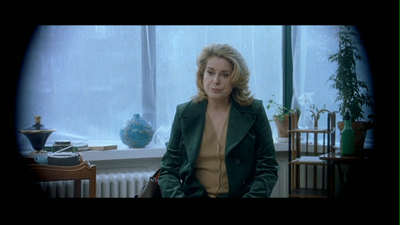
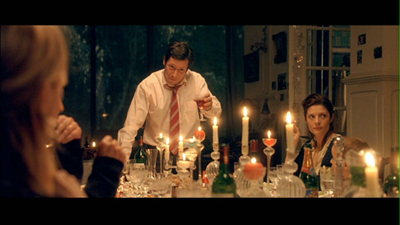
Arnaud Desplechin's A Christmas Tale is a multi-leveled yet somehow easily assembled family drama that tracks the Vuillards over the course of four days, December 22nd through 25th--not including the considerable history they bring with them to their holiday celebration. Desplechin sets the table for this feast in the very first scenes, using cut-out puppet theatre to catch us up on the family dynamic. The heads of the clan are Abel (Jean-Paul Roussillon), who is in the fabric dye business, and Junon (Catherine Deneuve). They had four children together, though their oldest, Jonathan, died of a rare condition when very young. Neither his parents nor his sister Elizabeth (Anne Consigny) could offer him the transfusion he needed, and even little Henri (Mathieu Amalric) was tested in the womb to see if he could help. No dice, Jonathan passed, and his specter has haunted the family ever since, particularly settling on Henri, who was born right at the same time, yet somehow leaving the next down the line, Ivan (Melvil Poupaud), alone.


When A Christmas Tale picks up in real life and real time, the kids have grown up and mother Junon has been diagnosed with a cancer much like Jonathan's. Once again, there is a scramble to find matching marrow. There are complications, however, Henri has been in exile for six years, his sister having banished him in return for assuming his debts. He is a drinker and a screw-up, and everyone else has gone along with Elizabeth even though they don't have any idea why she chose to be so extreme. Henri is about to return to the family, joining them for Christmas, a move largely precipitated by Elizabeth's teenage son Paul (Emile Berling). Paul has recently been diagnosed as schizophrenic, apparently at the same age that Ivan had similar mental problems. It would appear that when it comes time to fill out a hospital form, the Vuillard's can check "yes" next to "a history of mental illness."


There are a lot of narrative threads criss-crossing one another in A Christmas Tale, but Desplechin, who co-wrote the movie with Emmanuel Bourdieu, is careful never to get them tangled. Both Paul and Henri test positive as bone marrow donors for Junon, and this draws a connection between the three generations. These are the three outcasts, in a way, all on the outs due to their various illnesses, and events tend to morph around them. How the family deals with each other is based on their moods, their needs. This could be the reason for Elizabeth's jealousy, and it also allows a safe space for a side drama to play out. Ivan's wife, Sylvia (Chiara Mastroianni), apparently had a love affair with Henri first, and there were also sparks between her and their cousin Simon (Laurent Capelluto). As it turns out, the three boys chose between them who would end up with her, and it makes Sylvia question her time with Ivan and how much she has been the master of her own destiny.

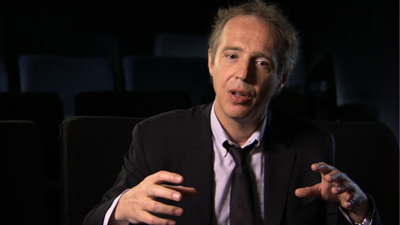
There is a preciousness to A Christmas Tale's construction that seemed familiar to me, and it struck me midway through that it felt like I was watching a French version of The Royal Tenenbaums. I am not sure I would have ended up being able to scratch that mental itch had not Arnaud Desplechin recently interviewed Wes Anderson for Interview magazine. Their conversation revealed a camaraderie and similar interests in narrative and films. I'm not going to hazard to say it's intentional, but the similarities are fascinating. Both films deal with the reunion of a troubled family at the home where all the kids grew up. The children are all creative, though with divergent passions and personalities; the lone sister among the boys is a playwright. Mental illness and death hang around like a black cloud, sometimes baffling the two young, identical-looking nephews. There is an outsider who wishes to be accepted as more of a family member, one whose substance abuse leads to violent episodes, and who is in love with one of the women of the family. (Though Simon is tame compared to Eli Cash.) Likewise, there is even some question as to whether or not something sexual occurred between Henri and Elizabeth, a la Richie and Margot. There are also aesthetic parallels, including the drawings of the wolf that lives in the basement and the hand-crafted playbill for the Christmas Eve performance. The use of title cards to mark time and divide the film into chapters remind us that the movie is dramatic artifice the way they did in Tenenbaums, and Desplechin takes that a step further by regularly employing an iris effect to suggest nostalgia for older films, memory, and even a little voyeurism. The times where he has characters read their letters aloud directly into the camera are also reminiscent of Anderson's voiceovers and use of montage.


It makes for interesting food for thought, comparing the two, though beyond these surface points, A Christmas Tale is very much its own thing. The direct connection of mother and son when it comes time for the transplant is more concrete than anything in Anderson's film, and it's not much of a fix. Henri and Junon openly have a distaste for one another, and neither are that interested in correcting that. Family is something you take as is in Desplechin's world, there is no repairing it. The schism between Henri and Elizabeth also goes far deeper, and the truth behind that rift is never revealed. Though we see the physical evidence of it in the form of a letter, that is one piece of mail that Henri chooses not to read. If The Royal Tenenbaums is musical theatre, A Christmas Tale is literary drama.


The acting in A Christmas Tale is electric from start to finish. Catherine Deneuve is fierce and commanding as the matriarch, her steely influence holding sway over everything. At one point, Henri basically says that how much any one person can get away with is directly related to how much they can insist on others liking them; Junon can get away with anything and everything, as she demands everyone's allegiance. As that wise but unpredictable son, Mathieu Amalric consistently either disproves or proves his character's theory, I'm not sure which. His kinetic, wiry style consistently pulls the camera his way. He can take it over the top when called for, but his best moment comes at the Christmas toast, when he must pull everything back in, firing off one last salvo before passing out. I'd much rather see him in stuff like this and The Diving Bell and the Butterfly than wasting his talents as some one-note James Bond villain. I also quite liked Chiara Mastroianni in this film, and am happy to see her in something good rather than just doing her best to stay afloat in crap like Christophe Honoré's Love Songs.


In terms of holiday movies, A Christmas Tale hits some major points. It's about family coming together, and it's about a hope for a better tomorrow that comes through reconciling the past. There are also elements of magic that tie into psychosis, something we see in films as far flung in time as Capra's It's a Wonderful Life and Bergman's Fanny & Alexander (here, it's Paul's visions). Arnaud Desplechin is playing it a little coy at the finish. The final scene between Henri and Junon ends with raised eyebrows and a question, and the very end of the film has Elizabeth quoting Shakespeare, wondering if anything is truly mended or if this dream merely cycles into another one. Whether or not you walk away from that deciding A Christmas Tale reaches a positive or negative conclusion is down to you. It's how you choose to make your own peace that makes all the difference, something that puts you right in line with the Vuillard family dynamic.


In 2007, Desplechin made an hour-long documentary called L'aimee (Beloved). Included here, it is an interesting glimpse on the life that informed A Christmas Tale. The director began by making a film about his father selling the house he grew up in, but it soon turns into a journey of father and son through the family records. Specifically, they explore their connections to the matriarchs in their family, discussing the elder Desplechin's grandmother, biological mother, and adopted mother. Arnaud's own mother has passed away, and he is curious about the history of the Desplechin women. A journal and letters from his grandmother lead them to sort through the life she lived. She was a nurse who later suffered and died in a sanitarium, quarantined from her son. There is a respect for the incredible ladies that came before them, as well as a distance, and it sheds a lot of light on what went into the script for A Christmas Tale.


For a full rundown on the special features, read the full article at DVD Talk.