A different version of this review was published on DVDTalk.com in 2010 to promote a Rod Serling-focused DVD.
Studio One was CBS' premiere drama anthology, running 1948 to 1958. Every week they presented a live play for the television audience, be it a new script by a hot young writer or an adaptation of stage material. Amongst the writers who cut their teeth in these early days was Rod Serling, whose keen observational eye and serious interest in the nuance of moral dilemmas quickly earned him notice. Serling is best known today for his Twilight Zone series, which he introduced on camera at the start of every episode. Twilight Zone's reputation is often unfairly reduced to knee-jerk jokes about its twist endings, but the truth of the matter is, those shows endure not because of their often surprising turns, but because of the heartfelt and soulful dramatics that lead to the twist. Serling is one of television's foremost chroniclers of the human condition, something that is more than obvious in his Studio One collaborations with director Franklin J. Schaffner. No sci-fi trappings here, just straightforward storytelling.
Schaffner went on to helm Advise and Consent on the stage and Patton for the big screen, and worked with Serling again on Planet of the Apes, and it's interesting to consider how the two teleplays they did for Studio One, 1956's The Arena and 1954's The Strike, predicted the subject matter that would continue to interest the director. Like Advise and Consent, The Arena is set in the U.S. Senate, and like Patton, The Strike is a war story about the courage of leadership.
The Arena tells the story of James Norton (Wendell Corey), a junior Senator appointed to a seat once occupied by his father. Dear ol' dad likely pulled some strings to get his boy in there, a fact not lost on Norton Sr.'s old political rival, Senator Harvey Rogers (John Cromwell). Despite the advice of his spin doctor, Jack Feeney (Chester Morris), Norton immediately locks horns with Rogers, a fight he is not equipped to handle. The more experienced politician massacres him, and Norton must decide whether a particularly juicy piece of dirt he has on the older man is worth the price of his integrity.
The Strike is set in South Korea in 1951. Major Gaylord (James Daly) is in charge of five-hundred men trapped under enemy fire in the middle of the Korean wilderness. He has one patrol of twenty that got lost on a recon mission, and when it comes time to move out, he is faced with a difficult choice. An air attack can take out the Communist artillery, but the recon unit would be collateral damage. Are the lives of twenty a fair trade for the full battalion?
In both teleplays, Serling poses a central question for two very different men: what is the right thing to do? Not what is the easiest, what is the most convenient, but what is right. The difference is that, in the case of Senator Norton, the right thing will allow him to sleep easier at night, but in the case of Major Gaylord, it will likely haunt him for the rest of his life. Norton is a stubborn man whose levers are pulled by his bitter father, and he lets his ambition and need to please his dad cloud his judgment; Gaylord is a man crippled by his conscience. Past experience has taught him that losing even one soldier hurts, and he'd be more than willing to pass off the decision to someone else. It's his men who force him to lead, demanding he fulfill the confidence and trust they have put in him.
The beauty of a Rod Serling script is that though he may pose a question that seems extremely compact, he unfolds it so that every possible angle can be explored, showing how large the true issue is. This is especially true of The Strike, where the men in Gaylord's command offer different reactions and modes of thinking in regards to the problem. A visiting chaplain (Roy Roberts) is a voice of faith and the greater good, while the soldiers take a far more cynical, practical view. They expect their higher-ups to make the bad decisions they can't and accept death as a product of war.
The acting is uniformly good through both shows. Chester Morris gets the meatiest role in The Arena. Senator Rogers even says as much: the man in the middle is the one with the real burden, he's the one who must see both sides and sway to either. Morris maybe overdoes some of the drunk scenes, but they work all the same. In The Strike, James Daly commands the screen as the Major. He is a fairly standard Serling lead. Rod loved watching a man fall apart. Daly sweats, paces, twitches, and loses his cool at every turn of the script page.
Anytime I watch these old shows, I always have to pause and admire their construction. The performers and the crew had to move between sets without taking a break, and I'm always fascinated by the complicated set-ups they create to give everyone time to get where they are going. When you step back and dissect what you are seeing, it's pretty remarkable. There were no do-overs. If the camera was not in place, if an actor tripped and fell or forgot his lines, there was no way to fix it, everyone would see. It's like live theatre, but beamed across the nation. Most of the productions on Studio One or other anthology shows, including these two episodes, rivaled regular motion pictures, and often, they got remade as full movies. You'd expect productions of this kind to be quaint throwbacks to a simpler time, but they are really far more complex than most of what the networks put on television in the decades after taped broadcasts became the norm and prior to the more recent cable revolution.
Showing posts with label Frank Schaffner. Show all posts
Wednesday, August 22, 2018
Tuesday, December 6, 2011
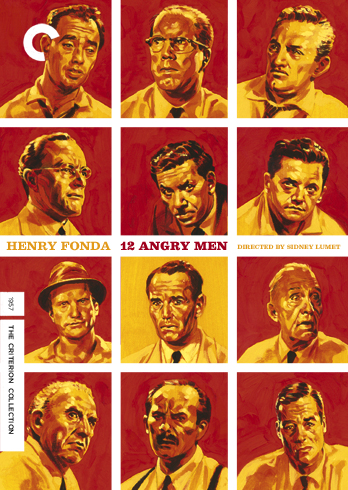
12 ANGRY MEN (Blu-Ray) - #591

No one likes jury duty. Well, some people probably do, but one hopes they are smart enough to keep it to themselves. At the same time, the right to a trial by jury is a great thing about the American justice system, and everyone should serve at least once and see how it all works. If you've ever been stuck in a back room arguing over the particulars of a case, you will never again wonder about some of the baffling verdicts passed down by civilian tribunals in high-profile trials. It's harder to armchair deliberate when you know how sentencing instructions and the literal wording of the law can affect the outcome of a seemingly open-and-shut debate.
While juries I have served on have never been as articulate, or as heated, as the regular joes and uncommon men who populate the tiny room of 12 Angry Men, Reginald Rose's script captures the back-and-forth quibbling over legal minutia pretty well. Inspired by his own time on a jury, Rose first wrote 12 Angry Men as a teleplay broadcast live in 1955 (which is also included here), and then expanded the hour-long program into a full movie screenplay, which was directed by Sidney Lumet in 1957.

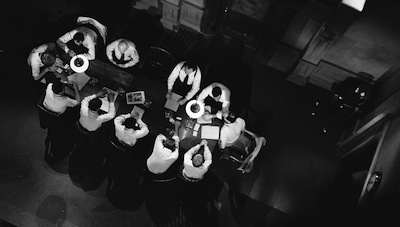
The movie begins after the trial is over. Outside of some short instructions from the judge and a lone shot of the accused, we have missed the proceedings. The camera travels the jury box, recording the faces of the jurors, before following them into a cramped room where they will be asked to stay until they can agree on a verdict. Most assume that the deliberation will be quick: the first vote is actually eleven for "guilty." The lone hold-out is Juror #8 (Henry Fonda), whose mind isn't made up. Maybe the boy killed his father, maybe he didn't. Despite pressure from the others to bend, #8 stays true to his insistence that if they are going to send a 19-year-old kid to the electric chair, they should at least spend some time exploring the realms of reasonable doubt.
Slowly, #8 works his way through the case. The testimony of the downstairs neighbor is questioned, then the uniqueness of the murder weapon, a switchblade knife. One by one, each juror is drawn into the discussion, and one by one they reveal something about who they are. #9 (Joseph Sweeney) is an observant old man, #5 (Jack Klugman) is from the same slums as the accused, and #11 (George Voskovic) is an immigrant who believes in America's sense of justice. On the stubborn side we have #3 (Lee J. Cobb), the father with an angry temper, and #4 (E.G. Marshall), the business man with the steady demeanor. There is also #7 (Jack Warden), who just wants to get out of there and go to a ballgame. And perhaps worst of all, the one that everyone else eventually turns against, is #10 (Ed Begley), a racist who believes the boy, who looked like he was maybe Puerto Rican, is a natural born liar, it's a byproduct of his skin color.
As the case disintegrates, personal feelings flare up, sides are taken, and threats are made. Rose has built a microcosm of American society, and also a sounding board for political ideas that were prudent to the American experience of the time. Civil rights, the vilification of unpopular or "radical" ideas, economic divides, the notion of might making right--these concepts are challenged just as the evidence is challenged. What would motivate a witness to lie? How much does an abused kid's background matter? What does it mean to be impartial and what constitutes reasonable doubt? For a locked room scenario, it's a surprisingly potent drama. Each man is given a rich background and each has an inner life. Nothing here is incidental. The writing is precise and dramatic and it's not afraid to be writing.
For his part, Sidney Lumet, who was transitioning out of television into this, his first feature film, keeps 12 Angry Men moving. Boris Kaufman's camera is agile and lively, moving through the room, capturing important expressions and gestures. The director and his cinematographer enact bold compositions, emphasizing the cramped space via contrasts of physical size. One man foregrounded may tower over the one in the background, but the power is often shifted: what the "smaller" man says weakens the "bigger" man. Live television had taught Lumet how to use a limited set to his advantage. If you think about it, it took TV to bridge the gap between stage and film, not just by putting together complicated one-time performances, but also by teaching a generation of new filmmakers to be economical and use confined spaces to their advantage. While the 1960s might have kicked down the walls of cinema and explored the open frontiers that new technologies allowed for, directors like Sidney Lumet and John Frankenheimer and others who first worked in l950s TV used restrictions to their advantage.
12 Angry Men had a profound effect on legal procedurals to follow. The notion that a criminal trial could be the basis for exploring bigger ideas has been exploited in most recent memory by the legal dramas of David E. Kelley and the whole Law and Order franchise. Even if those shows did move the action back into the courtroom, they still owe something to what Reginald Rose and Sidney Lumet (and Frank Schaffner, who directed the 1955 broadcast) did here. The whole strata of society passes through the doors of any given justice building, and for true justice to hold sway, they all must be honored the same.

Frank Schaffner's original 1955 broadcast version is thankfully included on this release, giving viewers a chance to witness the historic, Emmy-winning Studio One production. In some ways, this older version is somewhat superior. For one, the cast is not as well known, and having Robert Cummings (Hitchcock's Saboteur [review]) as Juror #8 instead of Henry Fonda makes the character more interesting. Fonda brings with him a certain moral authority, whereas Cummings' stuttering, unsure portrayal makes him less immediately convincing. Likewise, not showing the accused leaves that character up to our imagination, and a picture of him forms the more we learn. Lumet chose a scrawny, sympathetic looking kid that we make up our mind about right away. In general, the drama is more concise here. Having less time meant that Reginald Rose didn't have the opportunity to go off on as many personal tangents for each character, and one could argue that makes the dramaturgy less heavy handed. Both work for me, and I think in the spirit of this thing, we could make a case for either/or. (A 15-minute introduction by Ron Simon, from the Paley Centre for Media, adds further context.)
Most exciting, as well, is the addition of another live television drama, this one pairing Reginald Rose with Sidney Lumet a year before 12 Angry Men. The teleplay Tragedy in a Temporary Town features another mob of men, but this one isn't brought together by the legal system. Rather, it's vigilantism. The show stars Lloyd Bridges and two men that would go on to work for Lumet in 12 Angry Men, Jack Warden and Edward Binns (Juror #6). Set in a worker's camp, the story revolves around a young girl getting grabbed and kissed in the darkness. Failing to listen to Bridges' protest, Warden forms a posse to hunt through the camp, dragging the traumatized girl around in hopes she'll find her attacker. They barge into every home, writing down the names of any male age fifteen and over, until they land on a suspect that they can accept. It's not about finding the right guy, but about venting their restless anger.
Rose touches on the idea of personal "justice" in 12 Angry Men. The workers here are like the jurors unleashed. If the men in the other film could have gotten out of the room and been allowed to do as they wished with the accused, they very well could have resorted to violence. Here the misguided actions of the lynch mob threatens the safety of the whole community rather than making it more secure. Ironically, the men in the posse are looking for a threat within, not realizing they are it. Bridges is forceful in the lead, though his moral equivocations don't quite match Warden's menacing bluster.

For a complete rundown on the special features, read the full review at DVD Talk.
Please Note: The images used here are from promotional materials and are not taken from the Blu-ray edition under review.
Subscribe to:
Posts (Atom)