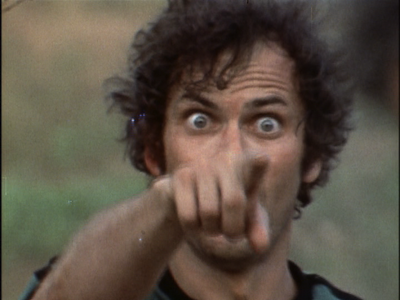
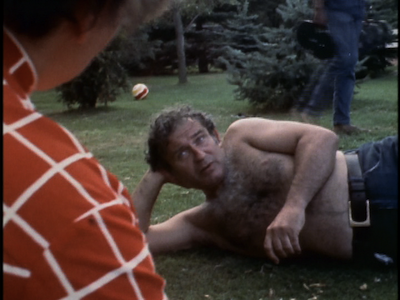
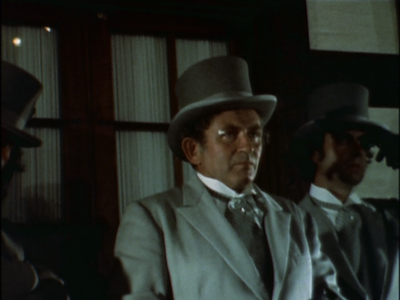
"I carry a broken heart in every knuckle."
Norman Mailer has always been a larger-than-life literary figure, one whose gargantuan personality regularly precedes and often supersedes the quality and passion of his prose. He's one of those authors that most people know by name, but whom they maybe have never read. His outlandish behavior and public spats regularly put him at the center of controversy, as did the wildly varied success of his writing. Whether a book of his was loved or loathed, he at least usually went for it with an admirable level of gusto.
So it makes a certain kind of sense that the author would gravitate to a medium where he could put himself front and center in every sense of the word. At the tail end of the 1950s, Mailer could see the status of the Great American Novel declining as other entertainments took over. He started peeking in on the New York cinematic circles, visiting the Actor's Studio and embracing "The Method." This coming together practically seems like an inevitable meeting of the minds. He was an author who often lived his writing, or at least the persona concocted as a byproduct of the prose; as an actor and filmmaker, he would live those stories, too. The timing is also hard to ignore. As Mailer was turning to movies,
Truffaut and
Godard and their peers in the Nouvelle Vague were altering the art form in exciting, innovative ways, freeing it from the studio-bound grandiosity of Golden Age Hollywood.
John Cassavetes was doing the same on Mailer's home turf, blazing a trail for independent cinema and achieving pioneer status.
By the late 1960s, Mailer was ready to pick up a camera himself, and in three years, he starred in and directed three films, collected here as
Maidstone and Other Films by Norman Mailer, part of Criterion's Eclipse series. It's Cassavetes that these efforts most resemble--the high-wire act of improvisation, the rawness of the portrayals, the formless construction. While Mailer's first effort
Wild 90 (1967; 81 mins.)
was reportedly a response to Andy Warhol's films (which Mailer found dull), it more recalls Cassavetes'
Faces in its limited space and how it depicts a collection of drunks whose party has gone wrong.
Unfortunately, even when taken as an amateur's debut,
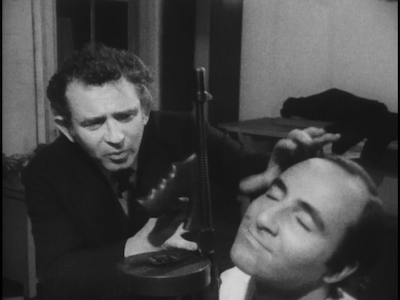
Wild 90 is really bad. For most others, it would be a career ender, not a starter. Mailer shot the film over two days. It mostly just features himself and his two friends and collaborators, Buzz Farbar and Mickey Knox, playacting as gangsters holed up in a New York apartment. The set-up borrows equally from Sartre and Beckett. These three fellows are locked down, under threat of death if they leave. Yet, suspicious colleagues, hookers, and police come and go throughout the film. They are all aware that danger lies outside the building's walls--Mickey's character, 20 Years, is convinced snipers lurk in the high rise across the street--but no solutions are offered.
Wild 90 is essentially the three hoods sitting around a table drinking and carping at each other. Since there is no script, there is also little direction to the conversation. There's a lot of repetition, a lot of posturing, and not much of real substance. Mailer is embarrassing as the heaviest heavy, whom, in a self-aggrandizing move, he has named Prince. The auteur's "performance" consists of him mumbling, grunting, and swearing. It's mostly incomprehensible. At times, you can see Mailer using his ranting to "direct" the others, bullying them in the way he wants to go, though never ending up anyplace all that interesting.
Wild 90 is a crudely made picture, shot in a small space on black-and-white film by D.A. Pennebaker (
Don't Look Back [
review]), who also appears on screen as one of the cops. The only sequence that comes to anything is when Beverley Bentley (a.k.a. the fourth Mrs. Mailer in real life), playing Prince's girlfriend, provides a challenge to the men's self-satisfaction. Here the nakedness of the production works, but largely because Bentley proves a commanding actress who can anchor and defy all the male egos. Naturally, it doesn't last, with Mailer ending
Wild 90 by turning the spotlight back on himself to address the audience directly. I am not sure whom I am more mortified for: myself for having seen this movie, or Norman Mailer for having made it.
Tellingly, Mailer's second movie,
Beyond the Law (1968; 98 mins.), ends in much the same way. Mailer looks directly into the camera, says his parting words, and freeze frames. It's a disheartening miscalculation because up until the last 20 minutes or so when he puts on his drunk act again,
Beyond the Law was not about Norman Mailer. It was about people, their shared job, and the lifestyle existing around it. For the bulk of it, the director manages to restrain the love he has for hearing himself ramble and lets the movie be an independent creature.
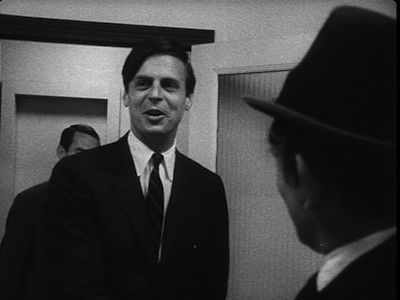
Beyond the Law has two settings: an inner-city police station and the neighboring bar where the cops go to drink. Farbar and Knox return as Rocco Gibraltar and Mickey Berk, two police officers who, at the start of the picture, end their shift by going to the pub to meet two blind dates (Mary Wilson Price and a young Marsha Mason). To impress the ladies, they start telling them about their crazy day and their bullish lieutenant, Francis Xavier Pope (Mailer). The film cuts back and forth between the bar and the station, where we watch the cops grill the day's suspects over their various crimes. Mailer and editors Jan Welt and Lana Jokel, move freely between the different Q&A sessions, blending them together, erasing any sense of linear time. The most striking scenarios involve a man who murdered his wife (Edward Bonnetti), an older gentleman arrested for soliciting (Peter Rosoff), and two hippie bikers who aren't taking any guff.
One of the bikers is played by Rip Torn (
The Man Who Fell to Earth [
review],
The Larry Sanders Show [
review]), who delivers a coarse, musky performance. Also notable is an appearance by writer
George Plimpton, who is quite effective here as the Mayor. He is stopping by the precinct to question charges of unfair behavior and examine Pope's methods. The frank and unscripted manner in which the cops and the crooks interact transcends most similar genre pictures, and unlike
Wild 80, actually generates a potent sense of realism. It also helps that Mailer chooses to explore material that mainstream pictures would never touch--homosexuality, sadomasochism, and pedophilia--amongst the more expected criminal behavior.
Beyond the Law's best sequence, however, occurs at the pivotal 3/4 mark, shortly after Pope gets off duty and joins the others at the bar. He is also met by his wife (Beverly Bentley again). The montage jumps between different conversations. The blind dates in the bathroom talking about the men; the men at the table talking about the ladies; and Pope getting some heavy news dropped on him. The contrast between the different points of view is remarkable, with the characters revealing themselves in the way they dish on each other. For all the self-serving fumbling in
Wild 90, it didn't take Mailer long to move on from that and start figuring this cinema thing out. The result is still a bit lopsided--it's hard to understand a lot of what is being said, and the movie grinds on a little too long--but
Beyond the Law fits in nicely with an emerging American cinema that would come to fruition in the next decade. (1968 was also the year of Scorsese's
Who's That Knocking at My Door?
, which also owes a huge debt to Cassavetes but that is ultimately more successful in realizing its aspirational cinema verité.)
The synthesis of Mailer's art-imitates-life philosophy came with
Maidstone (1970; 105 min.), an ambitious failure that attempts to create a nexus for all the chaos that marked the ragged end of 1960s America. The conflicting pursuits of personal freedoms and social responsibility come together in the figure of Norman T. Kingsley, an arthouse pornographer who has decided to run for President. This Mailer avatar has decamped to the Hamptons to make his version of a Bunuel film, a story about a whorehouse that services female clientele. While Kingsley is casting the bodies for his feature, serious minds are gathering in his home to discuss his viability as a candidate and ponder whether interests would be better served by turning the wild man into a martyr. One source of concern is Kingsley's amorphous political views; another is his entourage, a loose collection of rebels called the Cashbox, fronted by his brother Rey (Rip Torn). On hand for the weekend are also African American radicals, supervising as Kingsley has a rap session with inner-city youth. That sequence in particular harnesses the power of the unrehearsed, as the teens grill Kingsley (and really Mailer) about what he knows about being poor. He sells them a line, but openly. He admits it's a line.
The first hour or so of Maidstone is kind of great. The faux-documentary style really works, establishing a credible false reality that aids in creating an air of distrust around Kingsley. Is he a fake, or is he a real fake? He goes from group to group, claiming to be an independent entity, but yet also kind of telling them what they want to hear. The hedonistic party that is the film within the film scrapes against the serious politics.
Just past the halfway mark,
Maidstone completely falls apart. Mailer attempts to harness the aforementioned chaos and control it, and it ends up beating him to a pulp. This quick-cut descent is a self-serious mess, a poor man's surrealism and smarmy psychedelia. The director can't quite wrestle his way out of it, and the lack of a clear story, the key to his improvisational experiment, bites him on the ass. Once again, he basically throws in the towel and simply removes the scrim. The morning after is an apparently real cast and crew meeting where the roles are dropped and everyone talks as themselves, dissecting how they "feel" about the five-days they've spent shooting. It's hard to say when breaking the fourth wall in this way became so ho-hum, maybe it was still invigorating in 1970; now it's a snooze at best, a cheat at worst.
Surprisingly, Maidstone gets a little of its fire back in the last 15 minutes. Despite what I just said about the cast meeting that upends the rickety narrative, I think the actual story here might be the behind-the-scenes tale: what happened beyond the range of the cameras instead of what Mailer and his crew actually captured on film. If we take this last sequence as fact, Rip Torn ambushes Mailer and they get into a very real fight, with Torn insisting he's giving Norman what he wants--a true end to Maidstone--and Norman calling the actor a traitor. Questions of the authenticity of the whole Norman Mailer construct are raised, ones that the movie leaves dangling. It's a pretty self-aware and gutsy choice for an artist who has spent so much time and effort building himself up in the way Mailer has, because Rip Torn makes the more convincing argument.
Maidstone and Other Films by Norman Mailer, the 35th entry in the Eclipse series, is a trio of films more interesting for what they represent than how they actually turned out. I give Norman Mailer credit for going at moviemaking whole hog, even if he does end up proving he should have stuck to prose. (It would be another 14 years before he was able to make another film, and by all accounts
Tough Guys Don't Dance
is another turkey.) His experiments at improvisation were intended to get at some unfettered truth, and at times, particularly in
Beyond the Law and
Maidstone, that actually happens. Unfortunately, in both cases, once Mailer has the truth in his hands, he doesn't know what to do with it. You can run with a ball as long as your lungs allow, but unless you figure out where the goal posts are, it's not really worth it.
For a complete rundown on the special features, read the full review at DVD Talk.