Showing posts with label ingrid bergman. Show all posts

Saturday, April 14, 2018

INGRID BERGMAN’S SWEDISH YEARS: INTERMEZZO/A WOMAN'S FACE - ECLIPSE SERIES 46

These reviews originally appeared on DVDTalk.com as part of a previous set of films released in 2011.


Ingrid Bergman is a genuine Hollywood icon thanks to her co-starring role in Casablanca and her collaborations with Alfred Hitchcock [review 1, 2. While many are aware of her later films, including the challenging Italian pictures directed by her husband Robert Rossellini, as well as her eventual pairing with the other famous Swedish Bergman, Ingmar, not as much attention is paid to her pre-Hollywood career. For a short period, Ingrid Bergman made her name as an actress in Sweden, and six of her m films from her home country are now collected in the Ingrid Bergman's Swedish Years boxed set from Eclipse--giving many of us our first chance to see a screen legend developing her craft in the earliest stages of her endeavors.


Though she had appeared in six features prior (including one uncredited role), one could argue that the 1936 version of Intermezzo was really what got things started. Directed by Gustaf Molander, who co-wrote the screenplay with Gösta Stevens, Intermezzo was the movie that brought Ingrid to the attention of famed producer David O. Selznick. He would soon bring her to Hollywood and cast her in the remake of Intermezzo, her breakthrough English-language role, in 1939.

In the movie, Bergman plays Anita Hoffman, a promising young pianist who ignores better advice and pairs up with concert violinist Holger Brandt (Gösta Ekman), joining the married man as both his musical accompanist and his lover. Brandt sacrifices his home life, leaving behind his wife and two children, to go on tour with Anita, who also gives up the tutelage of Brandt's former partner (Hugo Björne). The two are essentially happy, but they practically live in exile, with Anita in the subservient role of being Brandt's back-up rather than blossoming into her own as an artist. When an opportunity to study in Paris comes along, the two must ask themselves what is really important: the love for each other, or the love of music. Brandt must also face what he's already left behind. As he puts it, they are stuck with the irony that his past and her future can never be joined.


For a movie about two passionate artists locked in a scandalous affair, Intermezzo is surprisingly lacking in both passion and scandal. Its polite restraint is almost Victorian, like something akin to an Edith Wharton novel. Though solidly written, it never really gets much gas, and the inevitability of the melodrama more drifts toward its foregone conclusions than it relays any sense that there is a great force driving their fates. Thankfully, it's a film that is very well performed, with both Gösta Ekman and Ingrid Bergman making great use of their roles. They strike a fine balance, with Ekman's needy ego fitting in perfectly with Bergman's desire to please. The actress displays a sweet innocence at the start of the movie that is vastly different than some of her better-known, well-traveled roles. Intermezzo is also a pretty film to look at, with lots of intricate sets and a gorgeous wardrobe, presumably reflecting the style of 1930s Sweden.


Bergman teamed with Gustaf Molander a second time for the 1938 film A Woman's Face. Written again by Gösta Stevens, but this time adapted from a play by Francis De Croisset, A Woman's Face is a melodrama with a touch of noir. Bergman plays the villain of the piece--or at least, half a villain. At the start of the picture, she is the femme fatale of a blackmail ring, though her role tends to be more on the planning side than seduction. A childhood accident has left half of her face burned, and also left her bitter against the world.

Bergman plays Anna with a surprising anger, and also a pronounced vulnerability. She regularly reaches her hand up to her face, protectively shielding her scars. She projects her rage outwardly, pushing her crew to be tougher on their victims, and ends up taking one of the cases over herself. She is caught by the mark's husband (Anders Henrikson), who by no small coincidence is a doctor who fixed similar scarring for soldiers after World War I. He offers to operate on Anna's face, hoping it will warm her heart and inspire her to turn her life around. At first, she ignores the opportunity the healed visage offers, joining a previous scheme to cheat a young boy (Göran Bernhard) out of his inheritance, but posing as his governess helps her embrace love--particularly when she finds it with one of his uncles (Gunnar Sjöberg).


Anna's transformation from hard-bitten criminal to tenderhearted softie is a predictable one, but it's made believable by Ingrid Bergman's performance. She instinctively understands the various stages of Anna's metamorphosis and her work actually stands apart from the script, which I think expected the switch to be more automatic. Despite the fairly standard plotting, A Woman's Face avoids the treacle, never quite giving in to more conventional urges, instead settling on an ending that is more bittersweet than one might expect. I haven't seen the remake with Joan Crawford that came a couple of years after Molander's version, but knowing the Hollywood formula, it wouldn't surprise me if it took an entirely different exit than the Swedish production.

You can also read my review of Ingrid Bergman's final film, June Night, here.


Wednesday, October 18, 2017

INGRID BERGMAN’S SWEDISH YEARS: JUNE NIGHT - ECLIPSE SERIES 46

This review originally appeared on DVDTalk.com as part of the Ingrid Bergman in Sweden set released in 2011.


June Night was the last film Ingrid Bergman made in her native Sweden before moving to Hollywood. This 1940 Per Lindberg picture is pretty straight soap opera, with Bergman playing a girl named Kerstin, who, in the movie's first scene, is shot by her boyfriend (Gunnar Sjöberg) when she tries to walk out on him. A trial and small-town scandal follows, and so Kerstin changes her name and moves to Stockholm to start over. She swears off her wanton ways, but this new leaf will be tested when she catches the eye of a handsome doctor (Olof Widgren) and also runs across the nosy reporter (Hasse Ekman) that sensationalized her story and dubbed her "the wounded swan." Both men become obsessed with her, and both are dating galpals of Kerstin's--the nurse (Marianne Löfgren) that helped her when she got to Stockholm and one of Kerstin's roommates (Marianne Aminoff). All these affairs come to a head the night the shooter comes to visit and the many romantic lines intersect.

June Night is a little slow. The script, written by Ragnar Hyltén-Cavallius from a novel by Tora Nordström-Bonnier, relies heavily on coincidences and never delves very far into its characters. Unfortunately, this is especially true for Kerstin, who gets less introspection and development than the side characters; Bergman's charisma and screen presence are all that fuel the portrayal, and the actress brings a gravitas to the role that wouldn't otherwise be there. I suppose Lindberg and Hyltén-Cavallius could be striving to make Kerstin an unknowable and mysterious figure, which might lend some explanation to why everyone is so fascinated by her (and why she does so much damage without even trying), but if so, it doesn't really work.


See more reviews from the Eclipse boxed set Ingrid Bergman's Swedish Years here.


Friday, August 12, 2016

INGRID BERGMAN: IN HER OWN WORDS - #828


Late in Ingrid Bergman: In Her Own Words, when director Stig Björkman is highlighting one of the actress' final films, Autumn Sonata [review], he holds on a silent close-up from the movie. It’s a scene where Ingrid Bergman stares directly into the camera, letting an emotional beat wash over her, engaging with the audience in a way that lets us see exactly what she is feeling. It's a great moment of punctuation for the documentary, because throughout Ingrid Bergman: In Her Own Words, the performer's children have noted that her lifelong relationship with cameras, both as the subject and the operator, stemmed from the fact that her father--who died when the Swedish-born star was very young, leaving her an orphan--was a professional photographer. She learned to live by looking at a camera, and she learned to love by the way it looked at her.


Stitching together news and interview footage with film clips, personal photos, and home movies, Björkman has crafted an intimate portrait of an enduring personality, getting beyond the superficial press image or even the standard tribute. Granted access to an extensive collection of artifacts left behind by Bergman, and with the aid of her four children, all of whom share their own memories of their mother, Björkman shows us the star from earliest childhood, tracking her moves from Swedish cinema to Hollywood, and through scandal and triumph. Narrated by Alicia Vikander (Ex Machina), who reads from Bergman's diaries and letters to three of her closest friends, the images are enhanced by the subject's own private thoughts. It's the things she maybe wouldn't have shared with interviewers or her family that prove most revealing. For those who have seen Bergman's onscreen work, be it her romantic roles in movies like Casablanca and Notorious [review] or her more artful, emotional work with second husband Roberto Rossellini, the secret to Ingrid Bergman’s craft is made clear: even if she often gave more to cinema than she did her day-to-day existence, she was as thoughtful and tender in here real life as she was in her invented ones.

Bergman also possessed an incredible strength, as evinced by her weathering the public scorn following her leaving her first husband for Rossellini. It seems inconceivable that a private individual would be denounced on the floor of Congress as a bad example of morality, but that's just what happened. Through it all, Bergman was resilient, her characteristic charm never wavering. Perhaps her long fascination and association with Joan of Arc gave her some insight into martyrdom. Whatever gave her purpose, Bergman offered no apologies.


Then again, Ingrid Bergman: In Her Own Words is careful not to draw obvious connections between movie roles and true events, the way a director might otherwise if this were a dramatic biopic--though Bergman's loves and travels would definitely make for a solid narrative, were someone willing to try. No inference is drawn, for instance, from her choice to star in a light comedy about infidelity like Stanley Donen's Indiscreet [review], despite it being very easy to make a claim that it served as a defiant middle finger to her critics. Rather, Björkman lets the work exist on its own. He's more concerned with his subject’s wandering spirit and how her choices affected those around her. Having been given the appropriate time to deal with things, her children are surprisingly generous, admitting they were as enchanted with her as much as the moviegoing public. Which may be the greatest revelation of all: Ingrid Bergman was no manufactured icon, the woman we fell in love with in the movies was who Ingrid Bergman really was. At times aloof and unknowable, but always seductive, always interesting to watch, and always leading with her heart.


Bonus materials on the Criterion Blu-ray of Ingrid Bergman: In Her Own Words give us extra glimpses into her life and artistry. Deleted scenes and further excerpts from Bergman’s own home movies, shot by the Ingrid herself on 8mm, add to our knowledge of the star’s life. Perhaps more illuminating for film fans are the two bits from early Swedish films. The outtakes from her 1936 romance On the Sunny Side show her natural charisma. Even more telling, though, is her brief appearance as an extra in the 1932 movie Landskamp, her screen debut. Even as a silent background player, Ingrid Bergman stands out, her eyes finding the camera, and engaging with her public. She’s the only one in the group that you’d ever think would end up being a star, and probably the only one there that even dared to dream it.


This disc was provided by the Criterion Collection for purpose of review.

Sunday, September 15, 2013

AUTUMN SONATA (Blu-ray) - #60

“A mother and a daughter. What a terrible combination of feelings and confusion and destruction.”


In an effort to do a little research for once in my life, I actually looked up the term "sonata," thinking it would have some formalistic meaning that would have grave importance in regards to the 1978 drama, Autumn Sonata. Ingmar Bergman's not one to choose his classical music references lightly (see also, Saraband [review]). Isn't a sonata a melancholy, mood-driven piece, you know, like Beethoven's moonlight one?

Turns out, a sonata is not as specific as all that. It's a term that arose to differentiate music written for instruments rather than pieces composed for voice. It's a distinction of performance. Even so, this may still give us some understanding on how to approach Autumn Sonata. Despite being a movie driven by dialogue, the importance is in the delivery and the instruments performing the author's words. It's about how, not what, and thus also about what is done without language. It’s as much about what is not said as it is every syllable spoken.


Though the film has a quartet of characters, this one is really a duet. Autumn Sonata stars Bergman perennial Liv Ullmann as Eva and silver screen icon Ingrid Bergman as her mother, Charlotte. The elder woman is an internationally famous concert pianist, and one, as it turns out, who sacrificed family for career. At the outset of the picture, mother and daughter have not seen each other for many years. Eva is a writer who lives in the country with her husband (Halvar Björk), a minister, far removed from the art-world glitz that defines Charlotte's life. Charlotte has been invited to their home for a reunion and some TLC. Her companion of over a decade has passed away, inspiring her child to reach out and mend fences.


This is a good intention that is better in theory. Charlotte has barely stepped through the door when old tensions begin to bubble up. The process is sped along by Eva's hidden surprise: she has taken her younger sister, Helena (Lena Nyman), into her home. Lena suffers from a degenerative disease, and last Charlotte knew, she was staying in a medical facility. The fact that she had no idea that one of her children had taken over the care of the other shows how far removed she is from her own offspring. Charlotte's life--and this is one of Eva's main grievances, if not, in fact, the only one--has always been very much about Charlotte.


Just how much so becomes evident in the very first conversation between the reunited pair. Though Charlotte pays lip service to caring about her daughter's life, she spends little time listening, instead steering everything back to herself and her less-than-humble take on her many successes. Eva only gets to have her say much later in the day, when she insists on her mother's silence. This occurs during Autumn Sonata's longest sequence, as mother and daughter stay up all night digging through the past. The conversation gets serious and even cruel, as Eva unloads a lifetime of pent-up disappointments. The central issue is not so much was Charlotte a bad mother, but are either of these women actually capable of love? Or are they part of a cycle, each generation passing down its dysfunction when it comes to expressing affection?


The conversation careens through the women's shared history. Topics include infidelity, abuse, control, and even music, the one common ground the two maybe could have shared had Charlotte allowed it. Ullmann has the more showy role. Eva is a damaged pressure cooker in need of release, and once the tears and the shouting begins, nothing can stop them. (Indeed, in the new HD transfer, you can see the physical toll it takes on her like never before. Ullmann’s red-rimmed eyes look absolutely painful.)
Yet, this is Ingrid Bergman's movie. In essence, the "autumn sonata" is Charlotte's crucial final-act performance, as the diva improvises for her toughest audience. Are her facial expressions, the silent reactions, the most honest? Or can we believe her verbal explanations? Her attempts to turn everything around by saying it was she who was abandoned, that what she needed was a child who would take care of her, since she herself was incapable? Sven Nyquist’s camera searches and probes, looking for the important tell-tale sign, moving between the actors. The framing is as intimate as the shots are sometimes distancing. It’s particularly telling that, during flashback scenes, the memories are peered at from a distance, often from outside the room.


Both participants capture our sympathy and our frustration. Eva has legitimate complaints, but she is also adolescent and morose, and equally as self-absorbed as her mother, who is in turn shallow and insecure and totally reliant on others for her sense of worth. There is an irony to seeing a mother having a nightmare where she is smothered in her sleep by an unseen assailant; the common notion would be that it’s the matriarch who does the smothering. It’s actually this terrifying dream that causes her to cry out, simultaneously proving her point that she is need of aid (and, of course, that is why she has come to visit) and sparking argument that will dominate the next several hours of their lives. There is very little resolved between the two, except maybe the realization that they just need to stay away from each other.


But then, Autumn Sonata isn't about resolutions. There is no right or wrong in Ingmar Bergman's scenario. Rather, it's about the catharsis of the performance. It's like how Charlotte describes the Chopin piece her daughter attempts to play: it's supposed to be challenging and even ugly, the player has to struggle to get through it. The important thing, though, is that she does. The difficulty of the composition still exists, but so does the musician who dared to expose herself to these troubles.


Criterion’s Blu-ray re-release improves exponentially on the picture and sound of its original 1999 DVD (though it should be noted that the pictures used here are from that standard-definition DVD and not from the high-def reissue). Colors are vivid, and detail is exceptional. They have also considerably upped the game in terms of bonus features, with a massive on-set documentary, interviews, and the now-common Ingmar Bergman introduction joining the excellent Peter Cowie commentary from over a decade ago.


This disc was provided by the Criterion Collection for review.


Friday, July 5, 2013

THREE FILMS BY ROBERTO ROSSELLINI STARRING INGRID BERGMAN: JOURNEY TO ITALY - #675


My current frontrunner for the best movie of 2013 is Richard Linklater's Before Midnight [review], an emotionally turbulent, challenging movie about a long-tem couple who unexpectedly find themselves at a crossroads where they are questioning whether or not their relationship is worth continuing. It's a film that earns all of the feelings in engenders. Not unlike its spiritual predecessor, Roberto Rossellini's 1954 movie Journey to Italy (a.k.a. Voyage to Italy).

The director's crowning collaboration with Ingrid Bergman could serve as a sort of omen: their relationship would eventually disintegrate for good. Here, though, we find the pair perfectly in sync. Bergman plays Katherine Joyce, an upper-class wife of a British businessman. Alex (George Sanders) has recently inherited some property from his uncle, some land and a fancy home in Naples. Alex and Katherine have gone to Italy to sell it, and while they are away, do a little vacationing. Alex is a workaholic and it's hard to get him out of the office, which may explain why, now that Katherine has managed to get some alone time with him, they realize they don't know each other at all.


Ennui and jealousy make for a nasty combination. Husband and wife are bored with each other and the decades-long conversation they've been having. Yet, as is usually the case in such situations, they don't want anyone else being bored by their spouse, that is their right alone. And so it is that Alex begins to resent a dead poet whose verse has outlined Katherine's Italian itinerary. Though this kind of suspicion angers Katherine, she becomes guilty of it herself when they happen to run into a woman Alex has known previously. She is on a group vacation with some friends, and Alex pays the ladies in the traveling party extra attention when they are all out having drinks. Katherine says that she never knew that her hubby was so interested in women. Translation: why aren't you that interested in me?

After a few snippy arguments, the pair goes their separate ways to finish out the trip. Alex goes to Capri to catch up with his friend, while Katherine stays behind in Naples to continue to tour the historical spots and look at the ancient relics. She also spends her time drinking in the local color and observing the people. I was reminded a bit of Sofia Coppola's Lost in Translation [review]. Ingrid Bergman wandering about and soaking up the culture has echoes in how Scarlett Johansson spies on ceremonies and customs in Japan while her husband is off pursuing actresses; likewise, George Sanders is gruff and sarcastic, and while not as loveable as Bill Murray, his flirtations with familiar ladies in foreign lands is not that different than Bob Harris.


It all points to a long tradition in world cinema. Many directors have portrayed troubled marriages via wayward nights and heated conversation, be it Ingmar Bergman's prolonged breakdown in Scenes from a Marriage or Michelangelo Antonioni's sharply focused La notte. While plenty of folks lately have been invoking Godard's famous line about all you needing to make a movie is a girl and a gun, Rossellini and those who followed in his footsteps all do without the gun. The girl and a guy provide plenty of drama without firearms ever getting involved.


Perhaps it's because he loved her that Rossellini tips the scales a little in Ingrid Bergman's favor in this film. Katherine is given an internal monologue that, despite its vitriol, humanizes her to a greater degree than Alex. Couple that with her more demonstrable abilities to empathize with her fellow man, and she seems far less beastly than her husband. Alex's self-recrimination is born of failure and rejection, and the standards he nearly sacrifices to try to reclaim some of his wild oats are troubling--even to him. “Beastly” may not be the right word, actually. Alex is less likable, but he's no less human. Sanders is also an actor on par with Bergman, and despite the clash of wills, both performers manage to make the Joyces seem like a real couple. Despite their differences, despite the spite, they fit. It's evident anytime they are in the car, but particularly in their penultimate conversation, when it appears they will call it quits. (Again, automobiles make for a regular staging ground for arguments. The Before Midnight disagreement begins in a car, also while the couple are on vacation; and let's not forget the hot-tempered, cold-blooded exchanges between Audrey Hepburn and Albert Finney in Stanley Donen's exceptional Two for the Road .)


As a conclusion to this cycle of films, the trio of Ingrid Bergman vehicles sometimes known as “The Solitude Trilogy,” Rossellini brings it all back around to Stromboli [review]. He does so aesthetically by his incorporation of real locations and real people to the drama, and how her new surroundings affect his leading lady. He also connects it back to their initial collaboration in how he handles the ending. The fate of the Joyces' conjugal union is decided by a religious epiphany, by a miracle--though in this case, not one that happens to Ingrid Bergman. Rather, it happens in her vicinity and threatens to swallow her. It is a human volcano, rather than the literal one in Stromboli; the people who move against her confirm her truth by trying to sweep her away a la Europe '51 [review]. There's a directness to how the director handles it in Journey to Italy that makes it more powerful than the endings of its predecessors. In Journey, the actions of the characters take over, and there is no need for further explanation. The intense feelings that power their decisions speak for themselves.


Journey to Italy plays Saturday, July 6, at 8:45pm, again on Sunday, July 7, at 8pm, and finally on Monday, July 8, at 7pm, as part of the NW Film Center's presentation of "The Solitude Trilogy." View the full schedule here.


Thursday, July 4, 2013

THREE FILMS BY ROBERTO ROSSELLINI STARRING INGRID BERGMAN: EUROPE '51 - #674


Roberto Rossellini and Ingrid Bergman reteamed the year after Stromboli [review] for a more conventional melodrama, though one that also had a strong role for a female lead and a message that is both spiritual and political. Released in 1952, Europe '51 (sometimes also known as Europa '51) is easier terrain than Stromboli, as Rossellini continues to massage the ragged edges of Neorealism to fit inside the boundaries of more traditional cinema.

Once again Bergman plays an immigrant living in Italy, the wife of an ambassador who has been in country since before the war. Irene Girard and husband George (Alexander Knox) are wealthy and run in society circles, and perhaps are better off now than they were before WWII--though of a status not wholly unearned. George fought on the front lines, leaving Irene to raise their young son (Sandro Franchina) on her own. This has caused mother and child to have an uncommon bond, perhaps too close. He is a sensitive child who can't stand time away from her or share her attentions.


The youngster's clinginess provides Europe '51's inciting incident. When his mother is dismissive of him before a dinner party, the boy disrupts the event by throwing himself down the stairs. Whether he intended to kill himself or not is never clear, but the child succeeds regardless. Irene's world becomes unmoored, and she sees no purpose in carrying on. That is, until her leftist friend, Andrea (Ettore Giannini), a journalist, introduces her to a family who is too poor to buy their child life-saving medicine. Unwilling to allow another mother lose her baby, Irene gives them the money they need, and she finds some satisfaction in this charitable work. Seeing how the family lives--in a tenement, where the sense of community transcends finances--the sheltered wife is awakened to the struggles of her countrymen. She begins to help out other people, including finding a gregarious single mother of six (the great Giulieta Masina, La strada [review]) a factory job and then filling in for the woman so she doesn't lose it. This brief yet overwhleming assembly line experience would be enough to push just about anyone toward Communism, no matter how much it is frowned upon by friends, family, and society at large. It's Irene's first taste of real labor, and she doesn't care for the flavor.

Irene's metamorphosis is not just political, however, nor is it achieved lightly. Rossellini walks a fine line connecting Marxist philosophy to early Christianity and Jesus' role as a liberator of slaves and champion of the poor. Europe '51 suggests a moral and religious justification for Communism, and reminds us that the defense of the least amongst us is the greatest of virtues. In the most obvious parallel to New Testament parables, Irene cares for an ailing prostitute, defending the woman against doubts and aspersions cast by her neighbors. There is no promise of reward for doing so, the motivation is simply that it's the right thing to do.


Bergman gives a sensitive performance as Irene, avoiding any histrionics or showboating. There are no big monologues here. The stronger emotion comes from what she keeps in reserve, in how little she telegraphs Irene's interior pain. Even in the movie's third act, which bears no small resemblance to the metaphysical melodramatics of Douglas Sirk (Magnificent Obsession [review], for instance), Irene is unflappable when faced with disbelief. Rossellini, it would seem, is transferring lessons learned from his cinematic interpretation of St. Francis of Assisi two years earlier: the more opposition Irene faces, the more courageous her convictions. Her devotion is challenged for real when her husband and mother have her committed to a mental institution. Even there, she becomes an angel of mercy. (Is it crazy that Raffaello Matarazzo's The White Angel [review] comes to mind?)

As with Stromboli where Rossellini juxtaposed Bergman's star-quality with the non-professional actors that rounded out the cast, here the director uses the ostentatious apartments of the rich, and the illusion of movie wealth, to illuminate the other side of life. Shooting on location in real slums, and capturing actual laborers at work, he shows the conditions that the class system creates for those on its lowest levels. It's an indictment of upper-class excess, but in a nod to his Neorealist roots, Rossellini is also questioning the accepted representation of the high life in popular cinema. Most of us don't live like Irene, but our movie watching has made her wealth seem practically normal; at the same time, the majority of us are (hopefully) still shocked by images of the working poor. Real life is far less familiar to a movie screen than fantasy.

The impact of the movie comes not from the tears shed, however, but from the way the director uses one specific experience and spreads it out to show the impact the individual can have on the world around her. The film is called Europe '51 because what Irene sees, despite being confined to one neighborhood, represents the problems that plagued the entire continent. By extension, she is a citizen without borders, her example serving as a lesson to all. If she can change, why not the rest of us?


Europa '51 plays Saturday, July 6, at 6:30pm, and again on Sunday, July 7, at 5:45pm, as part of the NW Film Center's presentation of "The Solitude Trilogy." View the full schedule here.


Wednesday, July 3, 2013

THREE FILMS BY ROBERTO ROSSELLINI STARRING INGRID BERGMAN: STROMBOLI - #673


Stromboli, the first collaboration between Italian director Roberto Rossellini and actress Ingrid Bergman, is still, even sixty years later, overshadowed by the real life drama and romance that erupted during its filming. The 1951 picture is where a long-term relationship began between the filmmaker and his married star, one that would prove fruitful both artistically and in the family way. The resulting scandal was used against Bergman, a victim of the mores of her time, and Hollywood, the paragon of moral virtue that it is, shunned her for several years. At least until box office receipts and acclaim swung her way again (specifically, the success of Anastasia). Then Ingrid must have been shocked by how many friends she really had!

It's easy to see what would attract an actress to a movie like Stromboli, and by extension, the man who afforded her the opportunity. Stromboli, in both style and script, is designed to showcase the lead performer. It's Bergman’s triumph or failure to have, depending on how well she does her job.


The Casablanca star takes point here as Anna, a Lithuanian whose flight from the Nazis in WWII landed her in an Italian prison camp. There she returns the flirtation of Antonio (Mario Vitale), a prisoner on the men's side of the jail. He woos her through the fence. Since Antonio is an Italian citizen, becoming his wife is Anna's ticket to freedom. As a refugee, she just has to prove that she has somewhere to go and won't be a burden on society.

Antonio's home isn't much better than the camp, however; he takes her back to the Sicilian island where he grew up. Stromboli is a harsh and unforgiving place populated by harsh and unforgiving people. The locals get by on fishing and religion, the only options they have trapped on a rocky landscape where nothing else will grow. Their bounty comes from the sea. Indeed, one could even argue that the earth does not want them. The island has a volcano at its center, and the mountain’s angry rumblings regularly send the citizens scurrying for safety.


Anna gets on poorly in her new locale. She is bored and lonely. The elder men on Stromboli take a liking to her, but the self-righteous women find her both shameless and shameful. Antonio also has a violent, jealous streak. Though how he expresses his suspicion can be appalling, he has good cause for concern: Anna does tend to flirt with other men on Stromboli, and most obviously with the rugged lighthouse keeper (Mario Sponzo). It's not really lust, though, much less love--it's an attraction of convenience. One can surmise that she has gotten used to seeking out men who can ferry her to safety. Any willing body will do, it doesn’t take a man in a tower to illuminate her way. In Stromboli's most uncomfortable sequence, Anna makes a move on the island preacher (Renzo Cesana). Her seduction technique is to be a helpless close-talker, invading his personal space and chasing him from the room.

This, of course, only fueled the pious chatter--not just in the movie, but outside of it, as well. Never mind Stromboli's decidedly pro-God finale where the brazen woman redeems herself. Anna, pregnant and afraid for her future, seeks an exit. Her flight from Antonio leads her on a walk along the volcano's treacherous perimeter. She strolls through its sulphurous belches like a woman on a foot-journey through Hell. The symbolism is unequivocal and unavoidable: she comes out the other side to discover heretofore-unknown beauty. It inspires a love for her adopted home, as well as a verbal declaration of her commitment to the divine. It's basically the ending of Gone with the Wind. I didn't find it entirely convincing. The conclusion is really the only time when Bergman grandstands, and it's all the more jarring following her emotionally fraught trek through the island's gaseous emissions; otherwise, Ingrid Bergman mostly manages the right contrast between showy modernity and capitulation to the old-fashioned ways of the island folk.


Rossellini is likewise seeking a similar contrast between this European woman, his Hollywood star, and the real-life islanders that basically are living their lives for his camera. Stromboli is a notable realization of the post-War Neorealist aesthetic Rossellini helped to invent. The desolate locale is given life by its determined citizenry, and the director smartly lets his narrative take a backseat when the particulars of their everyday existence are more interesting than the scripted events. The most riveting portion of Stromboli is the extended fishing sequence where the men haul in a massive catch. It's wet and chaotic, and at times brutal. Stromboli showcases a healthy respect for the natural order in all of its cruelties. There is a way things are done, a way the food chain keeps functioning. Antonio tries to show Anna how things work out there in the wilderness. He lets a ferret loose on a rabbit, and it horrifies her (as it may horrify you, too). She is shown as a woman who wants life's luxuries, but she doesn't want to see how they are acquired. Her aversion to seeing where food comes from is analogous to how she survived the War--by staying out of it.

Rossellini is juxtaposing the staging of cinema with the unpredictability of true life. A glamorous personality and a musical score are no match for the weather-beaten faces of the villagers or the tumult of land and sea. Anna must accept her place in the flow if she's ever going to be free, otherwise she will doomed to an eternity of struggling against it.


Director and Star

Stromboli plays Friday, July 5, at 7pm, and again on Sunday, July 7, at 3:30pm, as part of the NW Film Center's presentation of "The Solitude Trilogy." View the full schedule here.


Monday, January 7, 2008

NOTORIOUS - #137

"This is a very strange love affair."

"Why?"

"Maybe because you don't love me."


I adore Alfred Hitchcock's Notorious for how it so consistently flummoxes all expectations.

Cary Grant and Ingrid Bergman starring in a film together in 1946, at the height of their fame, should have been the romantic cinematic event of the year. Audiences even today have certain expectations when they hear of the coupling. Yet, for most of Notorious, Hitchcock spends the film doing an end run around those expectations. He knows what we want to believe, and he let's us know that he knows, but instead of gratifying our desires, he chooses to make us wait.

Honestly, that doesn't make Notorious all that different from most of Hitch's filmography. Though most people think of the director's title "Master of Suspense" in terms of the chills and the shocks he peppers through his movies, it's a title that is deserved for other reasons, as well. That suspense is the suspension of our yearnings, drawing out our satisfaction like a delicious tease. His mis en scene is cut for seduction. It's why so many of his movies end with a big kiss. He's put us through hell for the preceding two hours waiting for it.

This is most evident in Notorious, where the love affair is kept in check for the first reel, finally unleashed, and then immediately pocketed again. For most of the film, Cary Grant plays a real son of a bitch. He's cold and he's cruel, and very un-Cary Grant-like. It makes Ingrid Bergman uneasy, and it makes us uneasy, too. We can tell she loves him, and we're pretty sure he still loves her, so why doesn't he just do something about it?!

In the film, Ingrid Bergman plays Alicia Huberman. Alicia is a notorious woman. While that word probably makes us think of a criminal when heard today, when a woman was notorious in 1946, it wasn't very gangsta. It's a reputation thing, you understand. Ms. Huberman is known to enjoy a drink or two in the company of men. By comparison, the fact that her father has been convicted as a Nazi spy is positively tame. It almost restores a little honor to her public image.

Cary Grant is T.R. Devlin, emphasis on "Devil." The two meet at Alicia's hedonistic blowout following dear ol' dad's sentencing. She likes him at first, but that's before she knows what he does for a living. Devlin is a government agent, and he has a proposition for Alicia--come work for the U.S. and reinvigorate some of her good name. Their wiretaps tell them that she is a patriot and did not condone her father's actions. They want to put her on assignment in Brazil hunting down her father's contacts. The way Devlin gets her to do it, it's almost like blackmail. It's certainly more bullying than your usual rah-rah sign-up speech. It gets through to her, though, and she decides to do it, seeing it as an opportunity to turn over a new leaf.

It's a bit of a character conundrum, since she's presented herself up until now as a wanton woman who cares not for serious things. Clearly, that image was a front, a way to shield herself from the disappointment of her immigrant father. (Mother has departed this Earth, her natural-born U.S. citizenship intact.) If the most important man in her life has betrayed her so, then better to block out all possibilities of any further caring relationships. Her way of flirting with Devlin is to inform him that the only reason she likes the sappy lovesong playing on the hi-fi is because it's such blatant hooey. Here may be the source of her notorious reputation, when her opening line in a romance is to inform the suitor that romance need never come into it. Such talk from the star of Casablanca, whose affectionate glance was worth all of Europe!
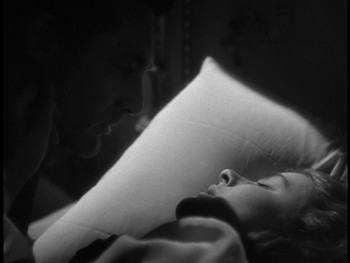


Most of the delayed gratification in Notorious comes from waiting for the fronts to crack. While Alicia pretends not to believe in love, so does Devlin like to pretend he is a hard individual. His is a professional demeanor, keep a distance, he's here for the job. There is no mistaking the white knight, however. He's very protective of Alicia in his way, lending that sympathetic ear like any decent fellow stuck babysitting the drunk girl at a party. He could take advantage, but he's trying not to. When he finally does kiss Alicia, it's only to repay her for taunting him.

That kiss unleashes a lot, too. From the moment they first lock lips, they can barely stay separated. They appear uncomfortable if their mouths are more than six inches apart, inhaling each other's exhales. Which is all by design. Hitchcock has been laying it on thick just so he can take a heavy hammer to it.

The job the government boys have for Alicia is sending her to cozy up to one of the ringleaders of the undercover Nazis down there in Rio. Send the whore to do a whore's job, essentially. Their callous attitude about what they are asking her to do is part of the male double-standard. They are more than willing to take advantage of a woman, and then they'll blame her when they get away with it. It's also the attitude of boys playing at being soldiers. If they're going to send other boys off to die, what's a woman's virtue in the bargain?

Of course, this is like a knife in the gut for Devlin. The blade gets twisted further when it's revealed the target that Alicia is supposed to seduce is Alex Sebastian (Claude Rains), a man who was once in love with her. No one ever asks if she was in love with him, as well. Does it matter? In Devlin's mind, he's sending the woman he loves into the arms of a former lover. That's gotta hurt a jealous ego.

Ironically, when Devlin returns to Alicia's apartment to tell her what is going down, she has adopted the domestic duties of a wife. She cooked dinner (albeit poorly), is wearing an apron, even refers to herself as "mama." The woman whom Devlin scoffed at when she swore to give up partying is going to prove to him she can be a wife and a mother. They punish her for being a tramp, and now they punish her for trying to go straight.

It's really a crossroads for Devlin. Send her to Sebastian or don't send her? Love of a woman or your love for your country? A product of his time, he wants to be a hero, and so he chooses that his country is more important. A lot of men in wartime movies had a bit of a martyr complex, and Devlin carries that into the post-War period, but he's not too happy about it. So, to cope, he swings all the way to the opposite side, reverting to the cold jerk that Alicia first met. To drive the point home, he hits her below the belt and makes a nasty comment about her character. It's unfair, particularly given what she is about to do in order to facilitate his martyr complex. Which of them is making the real sacrifice?

As a good friend of mine once said to me, it doesn't matter how bad it gets for everyone else, women always have it a little worse.
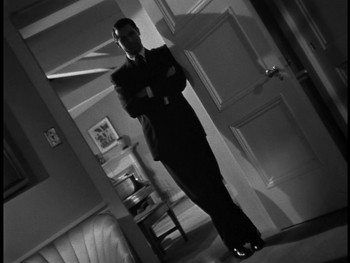


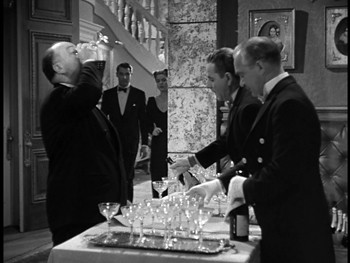
There is certainly a lot of complex psychology going on here. Moviegoers heading out to see Notorious would have been going in order to see its stars in many a passionate embrace, yet Alfred Hitchcock keeps inserting himself between them and pushing them apart--and for very dark, painful reasons, at that. The sexual tension doesn't dissipate by being shattered, it only multiplies, each new piece growing to the size of the original. Every time Alicia and Devlin meet to exchange information, it's so devastatingly present, they can barely look at each other. They want to be as close as they once were, you can feel how badly they want to rip each other's clothes off, yet it can't happen. In fact, when they have to kiss in order to fake out Sebastian, who has now become Alicia's suspicious, jealous husband, it's something they can barely put back in the bottle. Yes, just like what had spilled out of the champagne bottle, the Maguffin of Notorious, in Sebastian's secret cellar just moments before.

And yes, Alicia and Sebastian get married. That's how far she is willing to go, that's how much the traditional romantic roles are subverted. It's tougher for her, too, because Alicia is not so good at disguising her feelings. She asks Devlin multiple times to make a choice, upbraiding him for not defending her honor. Every time she brings it up, too, we're on her side. Just how hard would it be, Cary Grant? I mean, really!

Which is really the defied expectation that fascinates me most about Notorious. In what other movie are we meant to not like Cary Grant? It's really tough accepting his choosing the job over the lady, particularly since he is such a prick about it. It's not an entirely new concept in romantic fiction. Jane Austen and the Bronte Sisters regularly cast the standoffish jerk as their top candidate for love, somehow redeeming him by the end and proving that he was the right choice all along. In those instances, however, the characters are new, and they don't carry the baggage of being Cary Grant, Hollywood's top leading man. The director and his actor had discovered once before that pushing the Cary Grant persona too close to the dark edge was a difficult prospect. Their 1941 collaboration, Suspicion, originally had Grant's character trying to kill his wife by poisoning her, but ultimately, the film was rewritten to make it so that the suspicion was no more than that, because the public didn't want a Cary Grant that was a murderer.

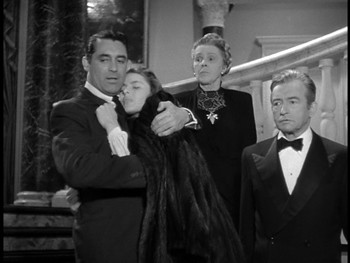
Thus, it's probably not a coincidence that Devlin's redemption uses the same elements as Suspicion, only inverted. Fans of the earlier film will recall the actor walking up a flight of stairs with a well-lit glass of poisoned milk. (There is even a visual allusion to that glass in the hangover remedy Devlin makes for Alicia after that first party.) In Notorious, it's Alicia's Nazi husband that is poisoning her drinks, and Cary Grant runs up the stairs not to finish her off, but to carry her to safety. Taking us back to the busted domestic scene at Alicia's apartment, he all but scoops her up in his arms and carries her back over the threshold of her marriage to Sebastian. Had it not been integral to the plot for the pair not to give up the game just yet, Hitch probably would have had him do so. Instead, he settles for her having to lean on him to walk. It's Devlin reclaiming his manhood in all of its chivalrous glory. It's all well and good to go off and defend your country, but you must take care of what you've left at home at the same time.


If I can make this about me for a moment (and I can), part of what lead me to return to Notorious this early in the run of reviews I'm writing exclusively for this blog is that I have a certain attraction to heroes that don't seem like heroes. This pertains to both the fiction I enjoy consuming and that I enjoy writing--though I've discovered in the latter category that this can come up even when it's not the author's inention. Almost all of my books have, at some time or other, received criticism for having protagonists who don't always make the right choice and thus some find their likeability a bit strained (and the strain is not always fairly come by, either). What interests me is that I never set out to write a complete bastard as my main character, nor did I even consciously think of the characters as flawed. I just always saw them for who they were and let them make their choices accordingly.

Now, maybe as their papa, I'm more willing to keep my eyes on the fact that some kind of redemption is on its way, but it does cause me to wonder what the difference is between a character who makes the wrong choice without knowing it, and someone like T.R. Devlin in Notorious who makes the wrong choice with full knowledge of its wrongness. Granted, there are noble intentions behind it, but at the same time, the way Ben Hecht writes Devlin, he doesn't have the character try to ease any of the blows he delivers on Alicia.

Part of this certainly comes out of a need to keep her alert and not have her distracted by going soft and gooey with romance. To me, his harsh words and sour manner are intended to remind her that this is dangerous stuff, there will be no playing around. But it's a tightrope that the writer has to walk (and the director and star; I know I shifted from them to Hecht here, but I had to give him his credit somewhere). Without the noble goal, at least a couple of the three writers who worked on Suspicion couldn't make it work, and perhaps that's the dangerous element of having flawed characters in literary fiction: the reader doesn't quite know where the hero is going the way they do in a genre star-vehicle, and may not have enough faith to follow him there.

I've been thinking about this dilemma a lot, because I have been working on a comic book script that tackles the same concept. I want a hero who doesn't appear to be acting like a hero for most of the story, who chooses a stony professionalism in order to manipulate the woman who should be the love interest into doing what is required of her. It remains to be seen if I can pull off the intentional jerk better than I do my usual accidental jerkface males, but I'm going to try. Notorious' ability to give the ladies--and some dudes like me--the vapors when the hero does finally reveal his true feelings is the highest I can aspire to, and it's a tall order. Fingers crossed.


Note: This movie is currently out of print from Criterion, and thus may be hard to find cheaply. It has some pretty awesome extras, however, and is worth the trouble and extra dollars.