Showing posts with label sturges. Show all posts

Sunday, August 18, 2019

LADIES OF LEISURE - CRITERION CHANNEL

This review was originally written for DVDTalk.com in 2013.


An early effort from director Frank Capra, Ladies of Leisure was adapted by Capra and Jo Swerling in 1930 from a popular play. Barbara Stanwyck leads a fine cast, including comedic supporting actors Lowell Sherman and Marie Provost, playing a prissy playboy and a sassy gal pal, respectively.

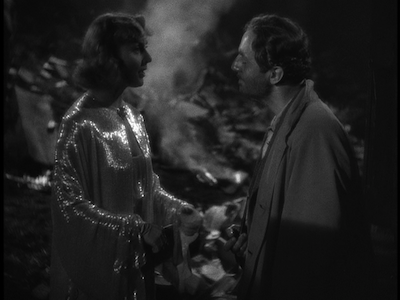
Stanwyck stars as Kay Arnold, a professional party girl who is rescued from a bad night by amateur party pooper Jerry Strong (Ralph Graves). Jerry is the son of a wealthy railroad man who is trying to buck the family business and become a painter. He hires Kay to be his model with the goal of capturing the hopeful look he saw on her face the night he picked her up. For Kay, this is a stroke of good luck, as steady employment will keep her out of trouble, but the streetwise gal has a hard time replicating the naive optimism Jerry is looking for. Plus, she feels increasingly hopeless as she begins to fall for the artist. He's already engaged to a woman more fitting his social standing.


A pre-code picture, Ladies of Leisure tackles some fairly scandalous subjects. Kay's initial career is basically being a paid escort, though the script frames both her and her roommate Dot (Prevost) as modern independents looking to get by on their own. One of the more fascinating scenes comes mid-movie when, hoping to catch Jerry's attention, Kay attempts to prove she's capable of more domestic duties, donning an apron to fry some eggs and play the wife. His failure to notice her efforts is heartbreaking. The actress was an expert at playing women with moxy whose gumption often masked true vulnerability. Kay is basically an early version of the grifter Stanwyck later portrayed in The Lady Eve [review], though without Preston Sturges' whip-smart writing.


Ladies of Leisure is an imperfect affair. Pacing is a big problem. Long chunks of the movie are dragged down by an awkward stiffness. Capra's direction seems stuck somewhere between the traditional stage and silent pictures, he hasn't yet mastered the art of the talkies. Luckily, there is plenty of comic relief from Prevost and Sherman that gooses proceedings back to life. There are also some surprisingly dark twists in the final act, when Kay is convinced that she really is bad for Jerry and makes increasingly drastic choices to free him from her and then liberate herself from her own bad decisions. There is an excellent tension building to the finale, even if the very end feels tacked on rather than organic.


Sunday, August 20, 2017

LA POISON - #891


Sacha Guitry can sure make murderous fantasies feel playful and fun.

Plowing similar territory as Preston Sturges’ Unfaithfully Yours [review] and Pietro Germi’s Divorce Italian Style, the writer/director’s 1951 film La poison is a dark comedy about a married couple so sick of each other, they’d rather see the other dead than carry on with the charade. French superstar Michel Simon (L’Atalante [review], The Two of Us [review]) plays Paul Bracconier, a middle-aged husband in a small-town who has had enough of his wife of 30 years. She drinks three bottles of wine a day and is generally unpleasant to be around. Granted, Blandine (Germaine Reuver) is pretty sick of Paul, as well, and while he’s complaining to his priest and anyone who will listen, she’s buying enough rat poison to kill him seven times over. While Guitry’s sympathies clearly lie with Paul, from the looks of things, Blandine’s going to get him long before he gets her.


It’s certainly an amusing set-up, and one with enough comedy to build the whole script around, but luckily for us, Guitry goes deeper than that. La poison isn’t just about a married couple who are at each other’s throats, but it’s also about small-town gossip, religious and political hypocrisy, and one man’s hubris. Just as things are heating up at the Bracconier household, their neighbors are begging the same priest to whom Paul confessed to fake a miracle and drive tourism from Paris. Elsewhere, a defense lawyer (Jean Debucourt, The Golden Coach) is celebrating his 100th victory by crowing about his tenuous relationship with the concept of guilt. It’s his unique views about murder that provide Paul the morally grey justification to head his wife off at the pass--though as we’ll see, even the smartest barrister can’t save Paul from himself.

Michael Simon brings his usual gregariousness to the role. An enormous screen presence whose career spanned decades, from silent films through the Nouvelle Vague, Simon has a matter-of-fact way with the comedy of the situation. He can talk about killing his wife as if it was the most natural thing in the world, but he can also twist that same reasonable delivery into a dangerous self-satisfaction. It’s hard to tell whether to love or hate him in La poison’s finale. Part of you won’t blame him for his desires, even as his proclamations paint a far less appealing portrait than we’ve seen so far.


Guitry has fun with this, cutting away from Paul to show the reaction of others. In fact, the cutaway is his most common comedic tool. What goes on behind closed doors is often juxtaposed with what is going on outside of them. In their way, the other townspeople are accomplices to Paul’s crimes. Like the woman at the start of La poison who sits in the pharmacists examining other people’s prescriptions, they concern themselves more with the illness than the cure. They prefer the drama of the scandal to preventing the potential consequences. This is behavior that Guitry hardly sees as unique to rural communities; when Paul’s crime breaks wide, the filmmaker is indicting all of French society. Paul’s lawyer even puts a fine point on it: his job is secure as long as the press keeps promoting the crimes he defends and the public keeps eating them up.


Here, Guitry himself is a little guilty of having his cake and eating it, too, and I’m sure he’d be the first to admit it. In a meta sense, he is the biggest gossip of all, and takes the most joy in the deadly machinations of La poison. The joyous tone of the picture never gives way to a serious scolding, not even in the final scenes when he jumps between Paul’s testimony and the town’s impressionable children gleefully re-enacting what they’ve overheard from their parents--who themselves head off to Paul’s trial like tourists going to see a Broadway play. Other directors would use this old trick to shock us, to say look how horrifying this behavior and at who the resulting entertainment really corrupts. Not Guitry. He’s instead undercutting our own attraction to scandal and horror by noting how silly such base impulses can really be. In that sense, he’s not necessarily excusing Paul Bracconier, but implicating us in his creation and setting him up as the hero we deserve. I mean, aren’t we really rooting for him to get away with it?


In addition to a high-definition transfer, an interview with modern filmmaker Olivier Assayas, and a pair of documentaries about Guitry, this Blu-ray edition of La poison also boasts an original cover by renowned cartoonist/caricaturist Drew Friedman. If you don’t know Friedman’s work, seek it out, beginning with his books Old Jewish Comedians and Any Similarity to Persons Living or Dead is Purely Coincidental.


This disc provided by the Criterion Collection for purposes of review.

Saturday, February 20, 2016

THE PALM BEACH STORY - #742


There is nothing sillier in love than trying to treat romance as a practical thing, yet that is exactly what the young married couple at the center of Preston Sturges’ 1942 screwball rom-com The Palm Beach Story attempt to do. Or more precisely, what Gerry (Claudette Colbert, It Happened One Night [review]) attempts to do when her marriage to Tom (Joel McCrea, Foreign Correspondent [review]) hits rocky times. It’s from such complications that  Sturges prefers to draw his laughs. He is not concerned about the paradise most other love stories promise. On the contrary, he opens where those films usually end, a title card declaring that the newlyweds lived happily ever after...followed by a second that asks, “Or did they?”


It’s not that Gerry doesn’t love her husband, she does; it’s that Tom is a dreamer with a $99K scheme to build airports suspended over major cities like tennis rackets, where planes would land on metal strips. Tom and Gerry (hey, wait a minute!) have faith in the plan, but no one else does, and Tom’s pursuit of the dream has left them broke, to the point that their landlord is renting their apartment out from under them. The potential tenant, a near-deaf sausage tycoon (Robert Dudley), takes pity and gives Gerry the money she needs to pay the bills. His gesture also gives her an idea: leave Tom and find a millionaire willing to tie the knot. She can tell him Tom won’t grant a divorce until he gets his $99 thousand, thus getting her husband everything he wants. It’s a twisted O. Henry variation.

For much of The Palm Beach Story, this cockamamie plan takes a backseat to other comedic business, the best of which is Gerry’s long train ride to Palm Beach. She is adopted by a group of besotted rich men on their way to hunt. Calling themselves the Ale and Quail Club, these fellows kill more bottles of booze than they do birds, and wreak havoc by shooting up the train. Sturges-regular William Demarest (a.k.a. Uncle Charlie from the 1960s television show “My Three Sons”) stands out as the most vocal hunter, his emphatic declarations of “Bang-bang!” providing the 1940s equivalent of an SNL catchphrase.


It’s actually when Gerry is running from these drunk gunman that she meets her would-be second husband, the mega-wealthy J.D. Hackensacker III (Rudy Vallee, also in Sturges’ darker marriage comedy, Unfaithfully Yours [review]). Hackensacker is endlessly patient and eternally pleasant, and he becomes smitten with what looks to him like a lost little girl, buying her a new wardrobe and taking her the rest of the way to her destination on his private yacht. Things get complicated once they return to dry land. Tom is waiting for them, having never signed on to Gerry’s plot, and they also run into Hackensacker’s hot-to-trot sister, the Princess Centimillia (Mary Astor, The Maltese Falcon [review]). Once Gerry insists Tom is her brother, things only get screwier from there.


Sturges has always had a light touch, but it’s also very precise. Famous for directing his movies by acting out all the dialogue for his actors, there is not a word in The Palm Beach Story out of place, nor a scenario that falls flat. The dialogue comes fast, but it’s also smooth, so the witticisms and turns of phrase ring clear. His command of language is only equaled by his command of his performers. Time and again, Sturges was able to make the most of Joel McCrea’s whitebread mannerisms, making him both the everyman and a parody of the same; Vallee is likewise uptight and strange, an early depiction of the eccentric millionaire. (Between him and the alcoholic hunters, and factoring in Tom’s aspirational endeavors, there is much we can hash out here about class and the American Dream, were we so inclined. Maybe another day....)

It’s the ladies whom the writer/director lets cut loose, which is kind of his signature (see Barbara Stanwyck in The Lady Eve [review], or Veronica Lake in Sullivan’s Travels [review]). Mary Astor is a hoot as the five-time divorcee on the prowl for her next husband. She is a gossip and a troublemaker, and though she knows she is overbearing, the Princess has absolute faith in her own charm. “I grow on people,” she tells Tom. “Like moss.”


The star of the show, though, really belongs to Colbert, who is genuinely charming and winning in all the right ways. Her earnestness often turns to devilishness, but that can also give way to genuine sympathy and concern for the man she loves. You can believe in her belief she is doing the right thing, and forgive her for being so blind.

Gerry’s misguided mission does, after all, gives us all the zany plot turns and clever gags that lead to Sturges’ preposterous ending. The conclusion of The Palm Beach Story is amusingly self-aware, and just plain funny--and once again, a kick in the crotch to all those other fairy tales. Sturges doubles the love, gives us the second happy ending, but then wonders again, “or did they?” I guess it’s up to how romantic you are whether or not you shoot back, “They did?!”


On a side note, in Criterion’s great tradition of reaching out to current artists and illustrators to design their covers, The Palm Beach Story’s cover and interior drawings are by famed Canadian cartoonist Maurice Vellekoop. Check out more of his work at his website.


Sunday, October 13, 2013

I MARRIED A WITCH (Blu-ray) - #676


Like many cinephiles, I've been indulging in my fair share of spooky films for the Halloween season. We're only a couple of weeks in, and I could end up either overdosing or becoming immune to bumps in the night.

RenĂ© Clair's 1942 comedy I Married a Witch is a nice antidote, fitting thematically with the horror holiday, but providing quite a few laughs to ease the tension.


Veronica Lake stars as the movie's title witch, Jennifer. In the amusing prologue, we learn that Jennifer and her sorcerer father (Cecil Kellaway) date back more than 200 years, when Jennifer was burned at the stake for seducing a mama's-boy pilgrim. As revenge, the man's family has been cursed to always be unlucky in love. With each successive generation, things go wrong for the men of the Wooley clan, leading up to the 20th Century and Jonathan Wooley (Fredric March), a politician running for mayor and set to be married to a wealthy heiress (Susan Hayward).

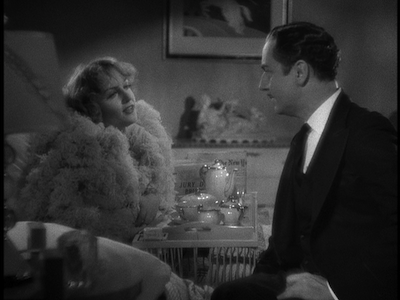
Sensing it's time once again to throw a spanner in the works, Jennifer convinces her father to let her ditch her spectral form and take on a new human body that she can use to seduce Jonathan. The old warlock agrees, knowing that the only thing more torturous than marriage itself is to not be able to marry the woman you really want. They contrive for Wooley to save Jennifer, now a blonde of some va-va and vavoom, from a burning hotel. As planned, once their paths have crossed, she invades his life with designs on invading his heart. This flirtation causes Wooley much distress, since, if he's found with her on the eve of his nuptials, there will be no way to avoid a scandal. Hell, for the first portion of the movie, post-fire, Jennifer is naked except for a fur coat--her father forgot how to cast the spell to generate clothes--and so she's difficult not to notice. The ribald jokes that rise out of this scenario alone are worth the price of the disc. I Married a Witch isn't exactly a sex comedy, but for 1942, it's certainly not afraid to be sexy.


Clair does well with the snappy, screwball pace of I Married a Witch. The style of comedy ends up closely resembling that of its producer, Preston Sturges, even if he did remove his name from the picture following creative differences with his director. The script relies on smart dialogue and an endless string of complications--including a few that you won't see coming. March is good as the man being buried in romance and innuendo, and he's ably backed up by Algonquin Round Table-alum Robert Benchley, a master wit in his own right, playing Wooley's closest advisor.

Both are eclipsed scene by scene by Veronica Lake, who I don't recall ever being funnier. The blonde beauty may best be known for playing the female lead in Alan Ladd noir vehicles, but I Married a Witch makes me want to explore more of her light comedies. Lake, of course, proved she could trade quips and barbs in Sullivan's Travels [review], but Jennifer provides a more dynamic role. The actress gets to be more active and drive the plot, much like Barbara Stanwyck in The Lady Eve [review]. She's charming and tenacious and possessed of an excellent comic timing. She also handles the switch-up well, showing an ability to adapt that is essential to this kind of comedy. To put it simply, you can believe the bad girl fell in love.


Apparently I Married a Witch was a major inspiration for Bewitched, particularly for the domestic element. Indeed, Bewitched could practically be the sequel. Jennifer is not supposed to alert mortals to her existence, and so when she confesses to Wooley, dear ol' dad has to take punitive actions. The magic stuff is clever and actually quite funny, including gags involving a witch's broom and Jennifer's old man, while still a spirit, hiding out in a liquor bottle, becoming imbibed with spirits of another kind.

The Blu-Ray restoration of I Married a Witch looks fantastic, with an excellent level of detail and nice balance between light and shadow. It's a great way to see the movie, and I imagine even moreso for fans of the film, who I assume are used to seeing it more lo-fi, in a different format, via older prints. This was my first time, and I was impressed. I Married a Witch is fun, buoyant entertainment and will likely become my new Halloween tradition.


This disc was provided by the Criterion Collection for review.


Saturday, March 16, 2013

UNFAITHFULLY YOURS - #292


Preston Sturges' 1948 release, Unfaithfully Yours, is probably his darkest comedy, but it also has a heart of pure romance.

Rex Harrison (My Fair Lady [review]) stars as Sir Alfred, a temperamental orchestra conductor who, upon returning from a trip overseas, is informed by his obnoxious brother-in-law (Rudy Vallee) that he has evidence that Sir Alfred's wife, Daphne (Linda Darnell, Fallen Angel), might be cheating on him. It seems that, as he was saying good-bye, Alfred made an off-hand comment to the other man to keep an eye on his wife for him. The other man took him literally and hired a private detective (Edgar Kennedy) to follow Daphne around when he couldn't do it himself.


Upon first hearing the news, Alfred rejects it, insisting it's impossible and not even bothering to look at the report. Once the knowledge is out there, though, it keeps coming back up, and the harder Alfred fights to not know, the more the information works its way to him. The scandal hinges on an unexplained half hour when Daphne visited Alfred's assistant, Tony (Kurt Kreuger), dressed in her nightgown. Is it possible that an illicit love affair has been blossoming right under the music man's nose the whole time?


Unfaithfully Yours is, essentially, a comedy about jealousy, with Sturges using the tricks played by one man's mind to explore the notions of fantasy and revenge and the stupid spirals we can send ourselves into when possessed of an idea we can't shake. As Alfred conducts that evening's performance, with his wife and secretary, not to mention the brother-in-law and his smart-mouthed sister-in-law (Barbara Lawrence, whose caustic delivery dominates every scene she's in), watching from boxed seats, he imagines a trio of scenarios. Sturges and director of photography Victor Milner (It's a Wonderful Life [review], The Furies [review]) push into the man's mind, zooming in on his eyeball, dissolving into his daydreams. First is an elaborate scenario where he frames Tony for Daphne's murder, and then another where he takes the high road and capitulates, and finally, a third where he challenges his rival to a game of Russian Roulette. Here even Alfred's fantasy life turns against him, in that he does not succeed. While we entered his musings via the eye, we exit in macabre fashion, peering back into the real world through the bullet wound. It's a gruesome and ingenious cross-fade.


Rex Harrison is gung-ho, giving a dastardly, high-octane comic performance as the moody, self-involved artiste. He is biting and sharp with Sturges' verbiage, but also quite agile and adept playing the klutz. When the movie shifts to Alfred trying to make these dreams real, Sturges builds an extended slapstick sequence where Alfred's every move ends in some kind of bumbling disaster. The implication is bitterly ironic: Alfred is helpless to do anything himself, but the man he wants to frame for murder is the one who usually does everything for him.


It's a clever commentary on the life of an “artistic genius,” and the culmination of a secondary theme that runs throughout Unfaithfully Yours. Arguably, the reignited passion Alfred feels as a result of his marital doubts goads him into the performance of a lifetime. As the three different daydreams play out, the music that Alfred is conducting keeps going. It rises in emotion and intensity as the imagined scenes do, and by the time we wend our way back to the symphony hall, Alfred has whipped the players--and his audience--into a frenzy of sound and excitement. It's one of the best examples I can think of where a director uses the soundtrack for both text and subtext. Unlike a standard score, which is usually there to underline and augment, Sturges uses the classical music as a practical device, making it an integral mood enhancement for his protagonist. Life, love, and art are all intertwined.


Unfaithfully Yours, unsurprisingly, ends the way most screwball comedies and romantic misadventures do. Alfred is, after all, a buffoon, not a real killer, and had he been right or successful, this would be an entirely different motion picture. The great thing about Preston Sturges is that he pulls no punches. The writer/director/producer hits the lovey-dovey stuff hard in the end, but he makes it work. He has basically added a second crescendo to the first (Alfred finally confronting Daphne), rather than a romantic coda or denouement. The climax is not the fury and the resolution is not its deflation, but rather, the true peak, and the perfect note to chime out on, is the reaffirmation that, indeed, love has come true for these two, and nothing can tear them apart.


Sunday, July 8, 2012

DESIGN FOR LIVING (Blu-Ray) - #592


The first scene of Ernst Lubitsch’s 1933 romantic comedy Design for Living is so perfectly composed, it tells you everything you need to know about the film’s trio of main characters and their relationship to one another before any of them even speak. A blonde woman enters a train car to find two men asleep, shoulder to shoulder, heads back, leaning in. She is amused by their pose, and, sitting across from them, she pulls out a sketchpad to draw them. When she is done sketching, she goes to sleep, too. She puts her feet up on the bench between the two men, her decidedly feminine shoes nestled between their masculine frames. One of them drops his hand in his slumber, and it rests on her ankle. The other fellow leans in closer. Here we have a classic love triangle.

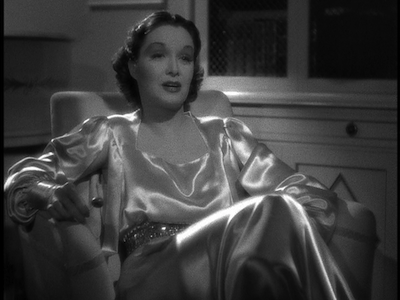
The girl is Gilda Farrell, a commercial illustrator played by the delightful Miriam Hopkins (Trouble in Paradise, Virginia City). The men are painter George Curtis (Gary Cooper, Pride of the Yankees [review], High Noon [review]) and playwright Tom Chambers (Fredric March, Nothing Sacred [review], The Best Years of Our Lives), two not entirely successful Americans living in a flop in Paris. Gilda is American, as well, but unlike the boys, has a successful career. Banter comes naturally, as does romance. On two consecutive days, Gilda has a date with each man. As she explains it, George makes her feel all heated from head to toe; Tom’s fires start stoking down at her feet and work their way up to her head. Both men fulfill something different for her (in a sense, one is brawn, the other brains), and so she proposes that she not choose between them, or ask them to sacrifice their friendship. Instead, she will date them both simultaneously.


Design for Living is based on a play by NoĂ«l Coward, and adapted for the screen by Ben Hecht (Notorious [review], His Girl Friday). Lubitsch helmed the production before the Hayes Code, and so Design for Living maintains a surprising frankness. Coward created three intelligent characters who choose an unconventional method for cohabitation, and rather than shying away from it or moralizing, he lets the love story play out. The dialogue is witty and biting, establishing believable connections between all three participants. The tone is erudite, the jokes snappy and clever, and the overall philosophy progressive. Gilda is an example of early feminism in cinema: she has her own income, and thus her independence. When she suggests the open relationship, she states quite clearly that if she were a man, she’d be allowed to sample as many partners as she liked without having to settle. Why shouldn’t a lady be afforded the same luxury?

In fact, the pact between the triangle is referred to as a “gentleman’s agreement,” though the terminology will prove troublesome. The three swear off sex. Not even kissing is allowed. Instead, Gilda will put her energy into helping the men’s careers, judging their work with a harsh critical eye until they are good enough to sell. In more conventional terms, a sort of domestic partnership is created, with the three living together, honoring the pact, keeping each other honest. Thomas is the first one to have success, with his play being picked up for a production to London. (In another example of pre-Code frankness, Gilda connects Tom with a gay producer; if his sexuality weren’t evident in his decidedly non-caricatured flamboyance, Gilda’s crack that he’d like the script because it’s “a woman’s play” is an amusing tip-off.) This leaves Gilda and George alone, with no buffer between them. As Gilda says, moments before giving in to her sexual impulse, “It’s true we have a gentleman’s agreement, but unfortunately, I am no gentleman.”


This, of course, brings complications. There is a back and forth of temptation. Gilda really does love both of them, and there is no choosing one or the other for her. Thomas’ return from London, where he finds his old friends living in luxury following George’s blossoming as a painter--in fact, George is out of town--turns into a tough display of feelings and then a randy expression of lust. Thomas’ old typewriter serves as a rather effective visual metaphor for their mutual sex drive: only Gilda can ring his bell.

Miriam Hopkins is wonderful in this scene, as she is in the entire movie. She is confident and charismatic, feisty with a cutting tongue, and also perfectly feminine. She doesn’t sacrifice beauty or glamour for career, and her nurturing of the two manchildren in her care even supports more “traditional” interpretations of male-female relations. The only thing she has to give up is sex, but that’s not to have a life denied women, it’s to have the life they all three pursue in the face of conflicting social mores. Hopkins provides Design for Living’s center, and the others all orbit around her. March and Cooper make an excellent comic team, perfectly cast in their opposing yet complementary roles. March is droll and a little smarmy, while the towering Cooper is clumsy and blunt. Their expertly timed back-and-forth absolutely sells the completeness of their friendship.


A friendship that Gilda ultimately won’t sacrifice. She leaves them rather than destroy their bond, and she ends up marrying her old boss. True domestic bliss is not to be had, however, as sublimating her will to be the dutiful wife is not in Gilda’s nature. It’s rather sly; Design for Living validates and promotes equality amongst the sexes by removing the sex. Which isn’t to say that man and woman can’t have a physical relationship and the woman not be allowed to be herself within it--Gilda could have had that with either of her suitors--because where the characters end up ultimately lends support to monogamy, as well. The three lovers here are pursuing something imperfect, but possibly more pure. A Platonic ideal, perhaps. An artistic existence. Artists tend to live outside of the norm, after all, dedicating themselves to their work in a way that is usually beyond the understanding of their friends and family. It’s that creative exuberance that Gilda is afraid to extinguish, just as much as she is afraid of destroying the men’s friendship. “Stay an artist,” she tells George when she’s leaving him. “That’s important. In fact, the most important thing.”
Gilda can’t be an artist with a man who would be her boss. She can only be who she is with men who see her as a peer.

With as much as can be read into Design for Living, its true achievement is that it’s never didactic. Though I’ve been pulling subtext up by the roots for this essay, Lubitsch is careful to make sure that it always remains exactly what it is: subtext. The up-top is important above all: the relationship and the interaction of the characters. Design for Living is a facile romantic comedy, full of hilarious one-liners and even funnier escalating, conversational jokes. One need never pause from the laughing to think about all that’s going on. The laughter on its own is enough. This, surely, is the quality that Preston Sturges wanted us to remember when he namedropped his fellow director in Sullivan’s Travels [review]. John L. Sullivan wanted to create motion pictures that mattered, and had he known Lubitsch’s work, he’d not have had to travel so far to discover that all you had to do was leave the audience smiling, and that mattered enough.


It’s amazing to think that the first time I saw Design for Living, it was buried on a cut-rate Gary Cooper boxed set, given little fanfare next to some of his historical adventure pictures. Thank goodness Criterion saw fit to rescue it and give the film its own release. The Blu-Ray restoration looks fantastic. While not all lines and scratches could be whisked away, the high-definition resolution is otherwise flawless, light years away from the banged-up, dark transfer on the old disc. If I recall, that one had a soundtrack full of hiss, as well. Criterion’s uncompressed mono has nary a crackle. 

Also of note on this disc is the inclusion of a two-minute sequence Lubitsch contributed to the anthology film If I Had a Million in 1932. “The Clerk” stars Charles Laughton as, well, a clerk who receives a check for a million dollars. While merely just a gag piece, the comedic business here is flawlessly executed, working a slow-build to lull the audience into a comfortable spot before hitting them with a rather simple, silly, and effective punchline. Even at such a short running time, Ernst Lubitsch manages to say it all!


For further reading, please visit Kim Morgan's site and her piece on Design for Living (also included in full in the disc's booklet). It should be noted that I took some of the images here from Sunset Gun.

Wednesday, November 24, 2010

SULLIVAN'S TRAVELS - #118

"There's a lot to be said for making people laugh. Did you know that that's all some people have? It isn't much, but it's better than nothing in this cockeyed caravan."
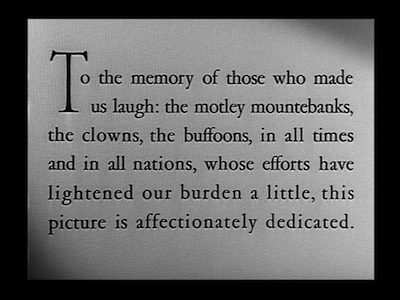


So, it seems I am developing a bit of a theme here.

It occurred to me when I wrote my piece on My Man Godfrey [review] a couple of weeks ago that if I dug through all my reviews, I probably reference Sullivan's Travels more than any other movie. The message in Preston Sturges' script had a profound effect on me. He reminds us all that, whatever else our intentions, always entertain. That is the primary objective.

I considered making Sullivan's Travels my next choice, but then Modern Times [review] came in, and though the Chaplin picture postponed my taking my kajillionth look at Sturges, it actually added to the overall exploration that has distinguished the movies I've watched this November. Even better, the delay means Sullivan's Travels lands right when we're all preparing for Thanksgiving, and despite the big swamp of family dysfunction the holiday has come to signify for most of us, the adventures of one John L. Sullivan will remind us that maybe we really should take a moment to be thankful for what he have in these troubled times.



Sturges made Sullivan's Travels in 1941, when America was still recovering from the Great Depression and WWII wasn't yet our concern. (The film premiered in January of '42, and so was in the can well before Pearl Harbor.) This meant Hollywood had several years of wrestling with the modern condition, including a host of message pictures. (If only Sturges knew the kind of propaganda Tinsel Town had waiting right around the corner!) Apparently having had his fill of the self-importance of these movies, the writer/director decided to give his moviemaking peers the what for. So, he created the character of John L. Sullivan (played by Joel McCrea), a movie director known for light comedies like Ants in the Pants of 1939, but who wants to embiggen his image by making a serious movie about the American poor: O Brother, Where Art Thou?

Unsurprisingly, this isn't good news to the ears of the studio head. They'd rather their cash cow keep milking the teats that make them money. They taunt Sullivan for being raised a rich boy. How can a man who has never had to struggle possibly make a movie about struggle? It's a fair point that backfires: Sullivan decides to dress up as a tramp and go on the road, armed with only a single thin dime, and learn about life amongst the impoverished. Naturally, this is a worse idea than sinking their money into his serious artistic endeavors, but they are forced to go along with the plan. They try to send along a marketing crew, led by Sturges perennial William Demarest, to keep tabs on the golden boy, but Sullivan makes a deal with the publicity platoon to get 'em off his back. He also shrugs off his servants, including the haughty butler (Robert Greig) who dismantles his boss' desire to caricature the poor with the utmost of skill. Sullivan will not be deterred.
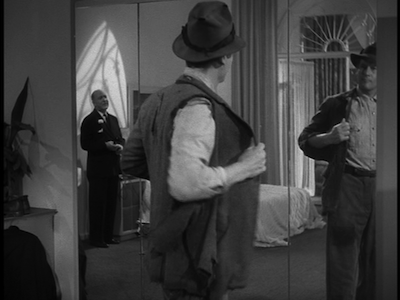


Except when he is. Over and over, too. For the first half of the movie, every road Sullivan takes out of Hollywood ends up taking him right back to where he started. On one such boomerang, he meets "the girl." I never realized we don't ever get a name for her, but she's played by Veronica Lake, so I will call her Veronica Lake. Veronica is on her way out of Hollywood, finally deciding her career as an actress isn't going to happen. Thinking Sullivan to be a bum, she buys him breakfast. When he asks how he can repay her, she asks if he can recommend her to Lubitsch. Oh, if she only knew!
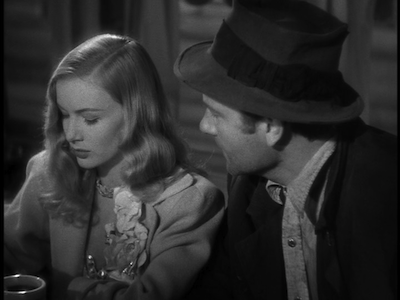


Of course, she does find out eventually, and seeing that Sullivan is entirely helpless in the real world, Veronica insists on going along with him. She's a spunky beauty with a bit of a smart mouth, a perfect sparring partner for the wisecracking know-it-all. In fact, up until this point, Sullivan's Travels has mostly distinguished itself as a vehicle for Sturges' whipsmart dialogue; however, when Veronica learns Sullivan's secret, we also learn what a wily writer Preston Sturges is. He has spent this early part of the movie distracting us, making us think that for all his noble intentions, Sullivan will never burst out of his bubble and start to really see true poverty and strife.

The movie takes a sharp turn here. Sturges crafts an elegant montage that begins with Sullivan and the girl walking through a shantytown and ends with them finally losing their nerve when they are reduced to foraging for food in a garbage can. They've seen how real it can get, and they've had enough. Right there, without breaking his stride, Sturges has buried his message smack dab in the center of our good time. We were laughing at Sullivan, but suddenly we find ourselves feeling with him.
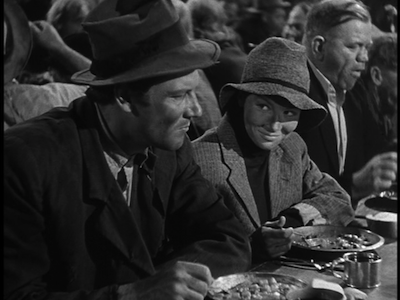


Sturges isn't done with us yet, though. His story has yet another turn to take. (Long before post-modernism, Sturges even had his character be conscious of the need for that twist. As a filmmaker, Sullivan is always aware of the structure of his own narrative, however accidental it may be.) On his last night out, Sullivan takes $1,000 in $5 bills and goes back to the streets to hand the money out to the poor and homeless. Being an optimistic man, but also a realist, Sturges sees the danger that Sullivan does not: a selfish hobo (Georges Renavent) hits Sullivan over the head and takes the money. Another turn of fate follows, and not only does everyone believe Sullivan was murdered, but he ends up on a chain gang to boot, unable to prove who he really is.
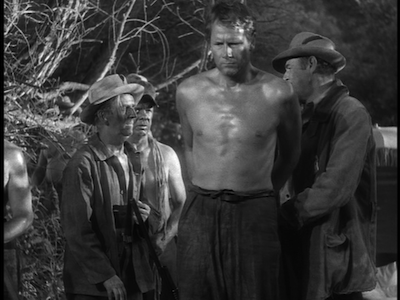


It's in this final twist that Sturges serves us with his real message. Having hit rock bottom, Sullivan's faith in himself and creativity is restored by the moving image. More precisely, by a Pluto cartoon. It turns out that on Sundays the gang boss takes his prisoners to the local African American church to watch movies with the congregation. I know some people bristle at the early slapstick scenes where the black cook is reduced to a racial stereotype, but one should consider the far more important and substantial image of the black preacher and his church. They open up their doors to the cast-off men of the chain gang, and the pastor reminds his group that they must not judge the criminals because everyone is equal before God. Think about what a powerful statement that is: here is a man who could not have been further marginalized by American society acting as the reminder that we aren't all so different from one another.

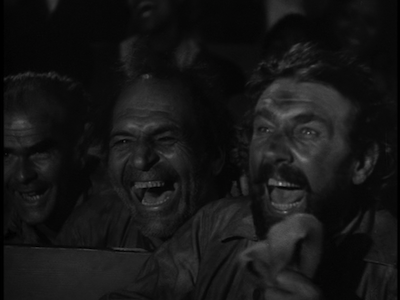
Sullivan doesn't hear any of this, though. His reminder is Pluto. As the cartoon plays on the screen in front of him, Sullivan is more interested in the reaction of the people around him. Everyone is laughing. It doesn't matter who they are, prisoner or guard, preacher or parishioner, white or black, they all forget their troubles and their differences and unite in the common bond of entertainment. There are no movies more important than the ones that transport people from their everyday lives. It's what the butler told him: poor folks don't care about seeing movies about living in poverty, they know exactly what that's like. Give them something that makes them feel good, and they'll turn out in droves.



The message of Sullivan's Travels isn't manipulative. There isn't a manipulative bone in Preston Sturges' body. That doesn't mean he doesn't lead us where he needs to go, but like My Man Godfrey and Modern Times, this movie informs our souls without ever alerting us to the fact that we're being taught a lesson. In his most important move yet, the final scenes of Sullivan's Travels, the character's rescue and redemption (this is a light comedy, you can't call that a spoiler) put this theory into practice. Think about how you feel at the end of Sullivan's Travels. Don't you feel good? Are you smiling? Didn't Preston Sturges prove his point?
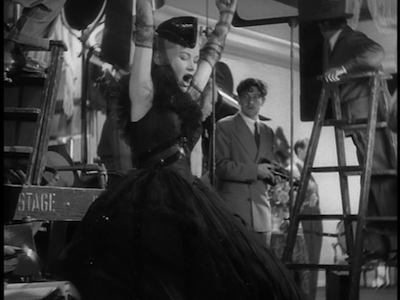


Sullivan isn't wrong. The intention of any artistic endeavor, be it heavy or light, is to show us the life we didn't live. Fiction is meant to transport us, to show us a different point of view. With this movie, Preston Sturges is reminding his fellow entertainers to remember why they do what they do. He's also reminding his audience why it matters. We need to be like John L. Sullivan in that church and pause to take a look around, to really see what the world around us is like and empathize with the people we share it with. Otherwise, what's the point? Why even share the communal experience of going to the movies at all?

Even further, though, we need to empathize because though that fellow over there's problems may not be yours, it doesn't mean you can't have some understanding of them. Is there any personal divide so wide that we can't find a way to traverse it? If we watch a Charlie Chaplin or an Ernst Lubitsch film, we don't laugh as Republicans and Democrats, we just laugh. We should solve our problems in the same manner. Beyond rhetoric, we're just citizens trying to make our way. If one of us is going hungry or is hurting because he doesn't have health care or depressed because she can't love who she wants to love, then what good is it that any of us is satiated, healthy, or cared for. In the dark of the movie theater, we all laugh and cry the same, and so, too, should we go forth in life.

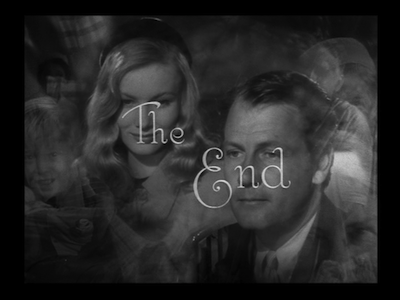
Happy Thanksgiving, one and all.


Sunday, November 14, 2010

MY MAN GODFREY - #114

"The only difference between a derelict and a man is a job."


I recently did an interview with a film student who was working on a project about how the current economic troubles in the U.S. and around the world were effecting cinema. It was hard to come up with titles for contemporary fictional films that had addressed the situation directly except for Up in the Air [review]. Hollywood has not yet pulled on its big boy pants and gotten relevant to the times. Not like in the Great Depression, when movies by the likes of Frank Capra and Preston Sturges regularly looked at America as it was in the here and now of the moment.

This hadn't come to mind when I chose to re-watch Gregory La Cava's 1936 comedy My Man Godfrey. I had picked it for this week's feature because I had seen someone else mention the title and realized I hadn't viewed it in a long time. My Man Godfrey would make for a light afternoon matinee. What with me stuck behind a deadline and a little hungover, why not laugh a little?


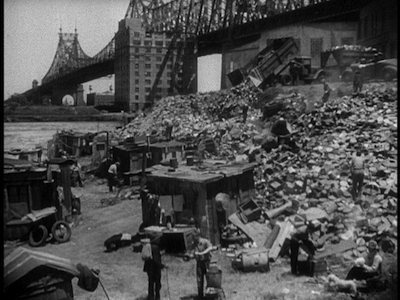
My Man Godfrey opens at the city dump. Two socialite sisters, Cornelia and Irene (Gail Patrick and Carole Lombard), are on a scavenger hunt. One of the items on the list is a "forgotten man," the euphemism for the homeless and displaced. Cornelia goes up to Godfrey (William Powell) and offers him $5 to go back to the party with her and help her win the hunt. Godfrey is rightly offended by this, and he tells Cornelia off. When he quizzes the friendlier, flightier sister, Irene explains the nature of the hunt to him. He agrees to go back with her, if only to beat Cornelia in the game. The hunters are all congregating in a hotel ballroom, and when Godfrey sees the madness and the decadence, he gives the entire party a piece of his mind. There is clearly something different and unexpected about this particular forgotten man: he's remembered to retain his dignity.

Feeling bad for dragging Godfrey into this vapid insanity, Irene attempts to make it up to him by offering this displaced fellow a job as the Bullock family butler. ("Do you butle?" she asks him.) He takes it, because a job is a job. Irene even gives him money to buy a new suit. He shows up the next day cleanly shaven and newly dressed, only to find the Bullocks in a state of disrepair following their extensive partying the night before. Mother Bullock, Angelica (Alice Brady), sees pixies in her room, Cornelia is a holy terror, and Irene barely recognizes the man she hired--though once she does, she declares him her protégé and says she will guide him in life. It will be just like the way her mother guides the young Spanish pianist (Mischa Auer) who is always around. Oh, and Irene is also falling in love with her new manservant.


It's enough to make a butler run screaming. Apparently, it did the last guy, and many before him. (Actually, the last guy also stole from them, though given later events in the movie, it's possible Cornelia framed him.) The only one in the Bullock family who seems to have his head on straight is the father (gravel-voiced character actor Eugene Pallette), and he spends most of his time chasing behind his wife and daughters and paying off their bills. He insists they are going to cause him to go broke, but they think he's fooling. He's not.

Meanwhile, Godfrey comes into his own as a butler. He masterfully glides through the chaos, finding his purpose through honest work. As he does, his story begins to emerge. He is not so much the down-on-his-luck moneyman that we suspect, he is the son of a wealthy Boston family who dropped out of society when he got a divorce. It was a rash, selfish decision, and his hooking up with the lost souls who ended up sleeping in the garbage heap for a real reason shows him how rash and selfish it was. One of his old Boston pals, Tommy Gray (Alan Mowbray), spots him at the Bullocks, and after Tommy agrees to keep his secret, they start to hatch some plans for how to rectify Godfrey's place in life.


My Man Godfrey was written by Morrie Ryskind, one of the Marx Bros.' writers, and Eric Hatch, one of the scribes on the Topper screenplay, and it was based on a novel by Hatch. It's a compact story, despite spanning a lot of time within its fictional world. In a lot of ways, the narrative progresses off screen. The scenes the writers and La Cava choose to show stand alone as individual comedic situations, and the actual plot is artfully tucked in between as connective tissue. You almost don't notice there is a story at all, the way these characters bat each other around is so funny. My Man Godfrey is full of witty dialogue and quotable lines.


William Powell is marvelous as Godfrey. He starts the movie with a hint of menace, but that turns out to be a defense mechanism. Godfrey softens as he regains his confidence. The actor is able to deliver an erudite joke with natural ease, lacing the words with amusement or withering disdain depending on what is called for. He can also be genuinely nice, something that is particularly evident in his rapport with Carole Lombard. Though they had been a real-life married couple, Powell and Lombard had divorced by the time My Man Godfrey went into production, but if there was any animosity between them, it doesn't follow them onscreen. Lombard is a brilliant comedic performer. She manages to make Irene as ridiculous as she needs to be, but you never get the feeling that she is ridiculing the character to do so.

That's because the whole of My Man Godfrey is made with compassion. Yes, it's a screwball comedy and a light romance with an ending that drops an out-of-leftfield solution on us. More importantly, though, La Cava has crafted a movie that is sensitive to what is happening all around, and it addresses the situation in a way that manages to keep the levity without forcing a message or condescending to the people whose lives it's meant to uplift. Five years before Sullivan's Travels [review] and Preston Sturges torpedoed the pomposity of socially conscious motion pictures and vindicated the effectiveness of popular entertainment, La Cava made the perfect example of how to do both. My Man Godfrey is poignant and touching, but it's also very funny and as breezy as they come. The film reminds us to put ourselves in the shoes of our fellow man, regardless of whether they live in a penthouse or in a cardboard box. Everyone has their problems, and it's just a small shift that can put us on one side or the other of the social dividing line. Going from upstairs to downstairs is just a quick tumble.


This is also why Up in the Air worked. Jason Reitman's movie isn't so much about the social condition or economic pitfalls as it is about the people it depicts. Characters living a believable life in a world that is recognizable as our own is far more effective than a contrived object lesson. The message is that there is no message, you just have to live and be human. One shudders to think what might happen were someone to decide to remake My Man Godfrey today (please, don't ever let Adam Sandler read my blog), but it really is a movie that speaks to our times. It may have felt very specific when all of these fine folks got together to make it, but what they came up with is timeless and thus eternally relevant.