Showing posts with label john schlesinger. Show all posts

Saturday, July 24, 2021

VISIONS OF EIGHT - #1081


Someone asked me this morning if I had watched any of the Olympics, and I replied “No, but that reminds me I have an Olympic documentary at home to watch and should probably give it a spin.” The fellow asking gave me what I admit was an appropriately perplexing look in response. A contradiction maybe only cinephiles understand. I won’t engage in the Thing but I’ll watch a movie about that Thing. 


Sports movies are probably high on the list for this situation. Why do I not enjoy watching or playing sports but I’ll take a boxing or football movie any given day of the week?


Criterion has re-released 1973’s Visions of Eight just in time for the delayed 2020 Olympics; now labeled 2021, the XXXII Olympiad may seem like it’s full of strife, but keep in mind, the XX games back in ’72 are the games where Palestinian terrorists killed Israeli athletes, an incident only touched upon briefly in Visions of Eight. It’s backdrop for John Schelsinger’s segment, “The Longest,” as the attack delayed the marathon by a whole day. It’s hard to imagine what gets into a runner’s head with that extra day, and how it effects his race. That’s what intrigues Schlesinger the most: what does the long-distance runner face beyond the fatigue of body?


The Midnight Cowboy director [review] is the last to go in this anthology documentary, the 8th of the 8 in the title. Producer David L. Wolper (Roots) picked this octet of international filmmakers and let them loose to shoot what interested them, and each came back with their own snapshot of the Munich Olympics. The notion is that no one film can cover the whole event, so let’s slice it up and create a collage. Naturally, some of the shorts are better than others. Kon Ichikawa, no stranger to the Olympics, having set the standard for documentaries about the games back in 1965 with Tokyo Olympiad, is perhaps the most inventive here, chronicling one 100-meter dash by filming the race at 4X slower speed, isolating each athlete so the audience can track the contortions of body and face, and then showing the whole widescreen image, finally revealing who won. Each competitor looked like the victor on their own, but only one can get the Gold.


Arthur Penn (Bonnie and Clyde [review]) also gets inventive, tightening in and abstracting high jumpers in both success and failure, creating a montage of daring and defeat. Milos Forman (One Flew Over the Cuckoo’s Nest [review]) has the most fun, matching the decathlon events to musical performances adding atmosphere during and adjacent to the competition. And I suppose it takes a French director to blithely undertake “The Losers;” Claude Lelouch (A Man and a Woman) focuses on those who miss the mark and how they react to blowing it.


The weak link in Visions of Eight is something that only likely appears as such due to the passing of time. German director Michael Pfleghar’s segment “The Women” is the only one besides Lelouch’s to give the female competitors any time, and he spends most of it highlighting their clothes and how they prepare themselves (like, you know, primping their hair). There is a noticeable focus on mostly white faces throughout the film, as well, and though Visions of Eight is a product of its era and should be judged as such, it’s worth noting that even though Wolper tells you up front you are not getting the whole story, he’s not telling you how much you really aren’t.


For those interested in the technical specs, Criterion does deliver Visions of Eight using a new 4K restoration that looks fantastic while maintaining the veneer of film stock used in 1972. Sound is also good, giving some nice punch to the occasional music by the great Henry Mancini. Extras include audio commentary by podcasters from The Ringer, a new documentary, and archival materials.


Note: This disc provided by the Criterion Collection for purposes of review.

Thursday, July 19, 2018

MIDNIGHT COWBOY - #925


Midnight Cowboy is a movie about identity and denial, but it’s primarily a movie about failed expectations, how those first two things being in confusion fosters false hope for people looking for a way out. For a way to be themselves. From Joe Buck’s first hustle in New York--he expected to be paid, she expected a younger man to see her obvious beauty (provided she’s not a con woman looking to hustle him back)--to the finale and the trip to Florida, nothing turns out as the characters would choose to believe.

Released in 1969, Midnight Cowboy caused quite a stir. Its frank views of homosexuality and New York street life earned it the first ever X-rating. It’s hard to see now what all the fuss was about, this movie is surprisingly tame by today’s standards, but even as the controversy dims, the actual character drama remains as sharp as ever. Written by one-time blacklisted screenwriter Waldo Salt (Blast of Silence [review], Serpico) and helmed by British director John Schlesinger (Billy Liar [review], Sunday Bloody Sunday), Midnight Cowboy is a film that dares to be human, making no apologies for its characters’ foibles--something that always scandalizes those who might otherwise be inclined to look at those who are different as “less than.”


Though essentially a New York story, Midnight Cowboy not only ends in Florida, but it starts in Texas. That’s where the dumb-but-handsome Joe Buck (Jon Voight, Coming Home) hails from. He is heading to the Big Apple to make his way in the world, but also to bury some bad memories. His life comes to us in a series of increasingly surreal flashbacks, including being exposed to sex at an early age, abandonment, and later, assault and arrest. When he arrives at his destination, decked out in a fancy western shirt, fringe jacket, and hat, he looks more like a movie serial version of a cowboy than a legit frontiersman and, as he soon discovers, has chosen to present himself in a way that appeals more to gay men than the wealthy women he hoped to bed. After a series of mishaps and downright screw-ups, Joe Buck has no bucks. He’s broke. The resultant desperation leads him back to “Ratso” Rizzo (Dustin Hoffman, The Graduate [review]; Tootsie [review]), the grifter who screwed him the most. Probably fearing a beating from the big guy more than displaying any real contrition or compassion, Ratso helps him out. They start pulling cons together, making quite a pair--the short and sickly dark-haired Ratso, with his club foot and rodent-like vocal patterns, and the deceptively squeaky-clean beefcake Joe Buck. No reason to look twice when they walk down the road, not at all!


Modern audiences will have an easy time seeing through this partnership. There is a lot more going on below the surface, past the mutual parasitism and bickering. Ratso’s constant railing against homosexuals suggests a man who protests too much, and while Joe Buck’s confusion about his own sexuality is likely for real, his new friend draws out some kind of empathy. The two men alternately take care of one another. When Ratso’s street smarts prove poor medicine for his failing health, Joe Buck becomes caretaker. Sure, if you wanted to, you could see it as just two men finding a mutual benefit with one another in rough times, but that’s ignoring a lot of signs and signals.


But again, let’s talk about expectations. What is it that Joe and Ratso expect from each other? It’s easy to see what Joe wants from each of his johns, and also how they in turn can’t allow themselves to follow through--be it Bob Balaban’s young student who becomes ill after going down on Joe in a movie theater (and seems to want a beating), or the older man (Barnard Hughes) that can’t even get that far (and gets a beating). It’s also clear how Brenda Vacarro’s party girl Shirley expects Joe to be an animal in bed and ravish her, only to have to take matters into her own hands and savage him instead. We also see how Ratso dreams of a better life where he is healthy and respected, and Joe is his best friend. (My favorite detail is how Ratso is so beloved by old women in those dreams. And how he is celebrated for his the cooking Joe previously criticized harshly.)


The expectation of Joe and Ratso as friends, however, is not so obvious. It takes a bit more reading between the lines. If you watch, you’ll note that their big arguments come when one slights the other--Ratso making fun of Joe’s clothes, Joe denigrating him for the winter coat Ratso stole for him--the way would-be lovers might react when they aren’t getting the proper notice from their respective objects of desire. There’s a lot of hurt and self-recrimination in there, especially in Ratso, who tears himself down by proxy. Credit where it’s due to Hoffman, who makes the oily little creep so easy to empathize with. The look on his face in the scene where he stands across the street and watches Joe try to pull a job in a women-only hotel is heartbreaking. There’s a real sense of relief when it doesn’t work out and Joe is tossed out the door. Ratso grabs him and runs him away from danger, his turn to be the protector.

As integral as they are to Midnight Cowboy, especially as they give Richardson the means to make explicit all the things that can’t be said, the pervasive dream sequences are a little dated. The psychedelic quick cuts predate Nicholas Roeg, and are about as effective, looking more ragged than controlled. (Also, shades of Ken Russell’s Tommy, particularly in Ratso’s Florida fantasy.) Though, full disclosure, I am primed not to like dream sequences, even when they are daydreams. And as a crutch, some of Joe Buck’s exhumed memories seem a little convenient and obvious. More effective to me are Richardson and cameraman Adam Holender’s on-the-street shots of New York--oh, that famous image of Joe Buck walking in the crowd, his hat high above all others!--and the way editor Hugh A. Robertson assembles the images, working with the singer Harry Nilsson, composerJohn Barry, and harmonica player Toots Thielemans’ music in a way that also prefigures MTV. The montage creates a dizzying effect akin to being a rube in the big city.


Which is what we are. Rubes. Our “innocent” laughter as the naïve Joe Buck that wanders onto 42nd Street at the start feels a little mean spirited and even dirty at the end, as we watch that same innocence drain from his eyes. And here is where Voight shines as an actor, because even as it’s clear that those eyes have seen too much, the actor also communicates that for all the distance he has traveled, the cowboy is still as lost as he ever was.


Saturday, February 28, 2009

SIDELINE: MORE REVIEWS FOR 02/09

In addition to my Criterion reviews, here are other reviews film fans of similar tastes might find of interest from the last month:

IN THEATRES...

* Coraline, the long-awaited new effort from Nightmare Before Christmas-director Henry Selick is a pretty looking dud.

* Two Lovers, a rough and often tough-going romantic tale about the ups and downs of the heart. With Joaquin Phoenix and Gwyneth Paltrow.

Also, check out the reviews in the Portland International Film Festival section of my Confessions of a Pop Fan blog. I cover many foreign movies that will hopefully be coming to a theatre or DVD shelf near you very soon...or in some cases, hopefully not.

ON DVD...

* Cannery Row, a Steinbeck adaptation that falls short of the mark thanks to a strained and hokey stylistic nostalgia. With Nick Nolte and Debra Winger.

* Far from the Madding Crowd, John Schlesinger reteams with Julie Christie in an epic, romantic adaptation of Thomas Hardy.

* A Guide to Recognizing Your Saints, an interesting but all too familiar coming-of-age tale that asks you to believe that Shia LaBeouf will become Robert Downey Jr.

* In the Electric Mist, Bertrand Tavernier tackles a James Lee Burke novel with mixed but mostly good results. Tommy Lee Jones stars as Burke's Detective Dave Robicheaux.

* Murnau, a collection of six of F.W. Murnau's silent films from Germany, including Nosferatu, Faust, and The Last Laugh

* Natalie Wood Signature Collection, a new boxed set that is mostly full of misses from the Warners back catalogue. It does contain the new edition of Splendor in the Grass, though.

* The Sidney Poitier Collection, three good movies, including Martin Ritt's Edge of the City with John Cassavetes and Something of Value with Rock Hudson, sit next to one clunker. Three out of four, still pretty good.

Wednesday, June 25, 2008

BILLY LIAR - #121


I'm working on a new short comic book story that involves the actress Julie Christie as a topic of discussion. This is a bit of a boon for me, as it gives me an excuse to spend some time reviewing some of my favorites of her films. Given that the script revolves around a brief affair and a missed opportunity at love, Billy Liar is a natural point of reference. In the film, Christie plays Liz, a free spirit who breezes in and out of Billy's life, never settling for too long, always on to something more. For him, she represents escape, and she even opens the hatch for Billy to jump through with her, but he doesn't have the bottle to step across.

Billy Liar was Julie Christie's third film, but the first role to really get her noticed by the public. It's a supporting part, barely more than a cameo, but director John Schlesinger clearly saw the star cresting over the horizon, as he gave her the final spot in the opening credits. "And JULIE CHRISTIE," it proclaims, as is normally done for a big name that doesn't get a place above the title but deserves to be singled out. Though the actress is really only in four scenes of the movie, not counting her background role in Billy's fantasies, she ends up being the thing you remember most about it. Our first introduction to her ends up completely separating us from Billy for the only time in the entire movie, following Liz around town, watching her turn heads wherever she goes--often quite real reactions, as this sequence was shot on the street, verite style. That final shot of her looking out the train window, her expression a mixture of pity, regret, and true caring, is the sort of thing that probably haunts many a man's dreams as the years grow long. In that moment, Julie Christie represents the opportunity missed, the moment we let pass that we should have grabbed. She is the girl Everett Sloane saw on the ferry and remembers fondly in Citizen Kane. She is Lady Ashley in Hemingway's The Sun Also Rises. The blue-haired girl in my own book, The Everlasting.
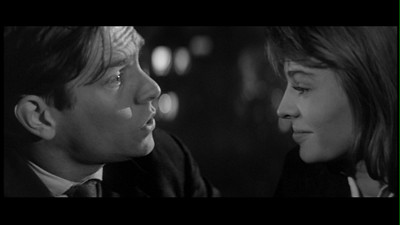


Not that I should let Liz completely overshadow poor Billy (played by the marvelous Tom Courtenay), but she does end up being the central point in the screenplay where the character has the chance to finally stop talking and actually do something. His nickname of Liar is well earned. He tells stories about sisters that don't exist, injuries his father never sustained, has two fiancées at the same time, and a host of other mistruths large and small. He's an interesting character, because though he fits in with so many other creative dreamers that we've seen in other movies, he's not always redeemable in his actions. Unlike, say, Max Fischer in Rushmore, who also dreams big and tells plenty of fibs, Billy has never stopped to think about the feelings of others. Where Max's tall tales eventually get him in over his head and he becomes careless, he's never really malicious. Selfish, sure, but not callus.

Billy is indicative of the "angry young men" who populate many of the 1960s British dramas, though he's more fanciful than a bruiser like Richard Harris in This Sporting Life or the caustic Richard Burton of Look Back in Anger. Like a lot of men of his age at that time, he feels caught between the older generation who are insistent on holding him to their oppressive values system and a future that is moving too fast for him to catch it. Choosing to shoot on location in various locations around Northern England, Schlesinger finds poignant visual representations of Billy's mental predicament. There are multiple shots of buildings being torn down while others are being rebuilt. Billy's hometown is being terraformed all around him, and yet he is the same ol' Billy Liar.


The key to our having sympathy for Billy is in Tom Courtenay's performance. Though the small-minded and obnoxious people around him--his boorish father (Wilfred Pickles), his self-important boss at the funeral home (Leonard Rossiter) with his models of plastic coffins (talk about a metaphor for a foreboding future!), the shrill Rita (Gwendolyn Watts) and the prudish Barbara (Helen Fraser)--are enough to make us understand why maybe Billy would need to retreat into his imagination, it doesn't really excuse his lack of moral consequence. He shouldn't be sympathetic, yet Courtenay manages to make the boy extremely vulnerable, always spreading a thin layer of anxiety under the braggadocio. Billy fears his own lies will collapse on top of him, and he'll be stuck going nowhere forever.

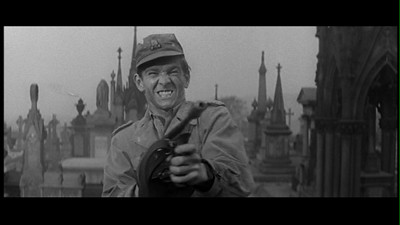
It also helps that his fantasy world, excepting the multiple times Billy guns down family and friends with a pantomime machine gun, is so tame. Novelist Keith Waterhouse, adapting his work to both stage and screen in collaboration with Willis Hall, concocts for Billy a rather quaint kingdom called Ambrosia. The very name conjures up how inoffensive and insubstantial this fantasy world is. Though the classical derivation of the word comes from the Greek and a mythical nectar of the gods, thus being named for an outdated concept in service to long-passed deities, a more modern use is for the name of a sickly sweet kind of fruit salad. Made with sour cream and Miracle Whip, it's a gooey and doesn't really stick to the ribs. It's also something your grandmother would make to take to church potluck, declaring "Everybody loves ambrosia." A kingdom of Ambrosia would thus be strangely comforting, relatively colorful, and of little nutritional value.
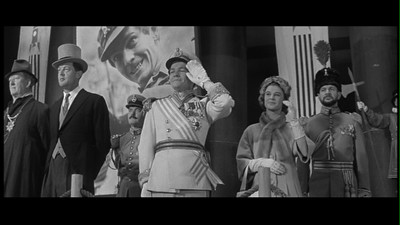


Yet, to fall backward into a pile of ambrosia, as Billy does when he disappears into his head, you'd receive a rather soft landing. There is an unspoken loneliness that comes with these daydreams, however, in that there are few other people in them. Liz stands in the background--a foreign secretary of some kind, as Billy tells her, in the one scene where he actually opens up to someone--but she never speaks. Otherwise, Billy casts himself marching in the more important roles, including, most humorously, as a black soldier in a parade. Though we might gasp at the blackface, by having the character break the fourth wall and wink at the audience, it somehow makes it all okay.

Billy's fate at the end of the picture is bittersweet. The boy who cried wolf ends up getting knocked down by the one lie he actually believed. Having thought he was going to get a job writing for a television comedian (Leslie Randall), he quit his post at the mortuary (itself stifling and symbolic of the lack of life around Billy; he also has a love scene in a cemetery) and tells everyone he is moving to London, only to discover he has misunderstood the response to his writing samples. It's on the heels of this failure, though, that Liz offers him his chance. He can go with her and they will be married, getting out of town once and for all. This should be everything that Billy could hope for, especially since, even through his two false engagements, Liz was always the girl he wanted.


So, why then, can he not go through with it? Liz knows it probably even before he does, hence how his suitcase appears on the station platform before he can conveniently miss getting back on the train, having jumped off to buy milk, that most wholesome of drinks. I suggested at the outset that it was cowardice, that Billy didn't have the guts when it counted, but as I wrote this all out, my thoughts became more clear. It's that bit about not having any sense of moral consequence. To run to London, Billy would leave behind troubles at home and the mess he's created for himself at work, as well as the broken hearts of Rita and Barbara, without actually dealing with them. It would be a true escape, a cut and run.

To stay means to accept the responsibility of what he has done, to face it and be a man. This makes way for the final fantasy, of Billy marshaling his troops and marching back to the house he grew up in, prepared for the war of his life. With this decision, Billy Liar may have let Julie Christie go, but he finally embraced himself and what it means to be a man.