Showing posts with label bertrand tavernier. Show all posts

Monday, August 28, 2017

THE MARSEILLE TRILOGY: MARIUS/FANNY - #s 882-883


The Marseille Trilogy comes with a lot of history. These early French talkies are adaptations of Marcel Pagnol’s stage plays, helmed initially by other directors, but overseen by the writer, who would go on to direct the final entry himself (the only one not taken from a play). A successful film career for Pagnol followed, only for him to fall out of fashion in the 1950s until Francois Truffaut resurrected his reputation. At least amongst cinephiles. I remember seeing The Marseille Trilogy on the shelf at the video store where I worked, its boxes faded and dusty, their old-fashioned look perhaps contributing to their never being rented. I was another of the philistines who kept passing Pagnol by.

Then again, in the DVD age, one also couldn’t be blamed for sitting back and waiting with at least some fair confidence that a restoration was on its way. Wait long enough and all these things will come back around again, right? And there is plenty to watch in the meantime.

It’s funny to put it that way now, and also to consider that, in the intervening years (more than a decade at this point), I sometimes thought about those boxes. I can see them in my head--mostly white with pinkish lettering and black-and-white photos giving very little information about who Marius and Fanny and César might be--and every once in a while, perhaps when I’d see Pagnol or the trilogy mentioned, I’d wonder what maybe I’d missed.


Luckily, I was right and these things do come around, and Criterion has a new The Marseille Trilogy boxed set struck from 4K restorations that should look light years better than those old versions, and I can make up for lost time watching them in a state that represents how Pagnol and his collaborators intended. (In his video intro on the Marius disc, director Bertrand Tavernier (Coup de torchon) reflects on the damaged prints that were all that were available back in the day.) And I must say, it was worth the wait. The Marseille Trilogy is something extraordinary, an entirely human drama, arguably more novelistic than theatrical, wide in scope but careful in focus.

The first two movies in The Marseille Trilogy, Marius and Fanny cover about a two-year span, with the biggest time jump taking place in Fanny, its beginning overlapping with the conclusion of Marius, every bit the chapter 2 of a much longer narrative.


1932’s Marius, directed by Alexander Korda (That Hamilton Woman [review]), introduces us to our cast. Bar owner César (Raimu, The Pearls of the Crown [review]) and his son Marius (Pierre Fresnay, The Man Who Knew Too Much [review]); Marius’ childhood friend, Fanny (Orane Demazis, Les misérables [review]), a street vendor; the merchant Panisse (Fernard Charpin, Pépé le moko); and many more, a colorful gathering of different peoples brought together at the port in Marseille. Marius and Fanny have grown up to fall in love, though neither would admit it. Recently widowed, Panisse is looking to marry Fanny as a way to bring some happiness back to his home, something that will end up forcing the issue between the two younger people. The only hiccup is Marius’ wanderlust. He’s not interested in running his dad’s tavern, he wants to see the world.

What follows from this set-up is a very human drama, with people both acting in their own self-interests and then rejecting the same when it means someone else maybe deserves a better turn. Fanny ends up being the one ready to give up the most: she’ll let Marius chase his passion even if it means letting him go for several years. She’d rather miss him while he explores far-off lands than be responsible for his always wondering what else is out there.


Marius ends with Marius leaving for Australia, and Fanny explores what happens once he’s gone. Released a year later and directed by Marc Allégret, Fanny takes us deeper into the characters Marius has left behind, exposing their different sides, and revealing them not to be entirely what we originally expected. Perhaps most notable is the relationship between César and Panisse, a friendship that dates back to their days in school. In Marius, we saw them bicker harmlessly the way such old friends do; in Fanny, longer-held resentments surface from that bickering, but so too do we see how generous a nature they really have. Our allegiances shift more than once, but then, life often changes that way, doesn’t it?

“Life” is a key word here. Pagnol is a writer who lets his characters truly live. Though directed by others, Pagnol is really the author of these films, casting the actors and running the rehearsals and generally setting the course for how they would go. You can see the theatrical roots showing at times, particularly with Marius, where action is mostly confined to one location (most often, the bar) and driven by dialogue. Pagnol is not afraid to let scenes run long, to let conversations follow their natural course, long enough for characters to equivocate, expose their true feelings, and double-back on them. We get to know everyone in The Marseille Trilogy by spending time with them. For Pagnol, character is plot, and what each character does in relation to another is how he builds his story. The Marseille Trilogy is a great family epic, one that grapples with time and growth, rather than focusing on one driving narrative device. If it were a TV show, it would be a soap opera. Who loves whom and why, and what will they betray to make that person they love happy?


Not that The Marseille Trilogy is cliché or hokey (and not that soap operas have to be, despite the hokey clichés about them); rather, our investment in the participants means the drama is riveting. Any cliché turn Pagnol might take is less a fault of the material and more years of cinema and television that have come since preparing us for certain twists in this kind of material. It doesn’t really matter if you can see ahead to evident developments, though, as the getting there is always surprising.

Also, the acting is so good, you might find yourself wishing this were an ongoing series. Some of the best moments in both Marius and Fanny have nothing to do with the central story, but instead are sidebar instances where other characters are just spending time together. An hilarious card game with César, Panisse, and their friends in Marius is one of the most charming things you’ll see this, or any, year. Raimu shows himself a master of gesture, and he has an easy chemistry with all of his co-stars that will make you glad when Pagnol inserts other such scenes into Fanny. Special mention should also be made of Pierre Fresnay, whose Marius returns almost two years after he originally left, and though he has been transformed by his adventures, the actor merely matures the performance rather than making a hard shift into a different gear. We can believe that the confident, hardened Marius in Fanny is the same as the anxious and often capricious young Marius we saw in his own movie. The cinematography opens up, too, breaking out of the confines of interior locations, showing more of the seaside town.

Which makes me all the more interested to see where these characters end up in César, the final installment of The Marseille Trilogy, when Marcel Pagnol takes charge of the camera himself. But that’s something for its own review...


This disc provided by the Criterion Collection for purposes of review.

Tuesday, July 13, 2010

BLACK NARCISSUS - #93

"There's something in the atmosphere that makes everything seem exaggerated."


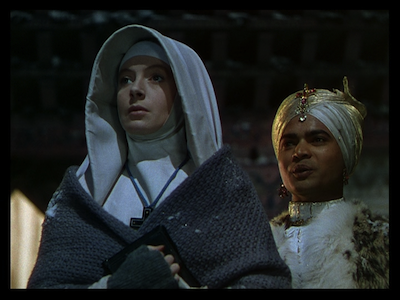
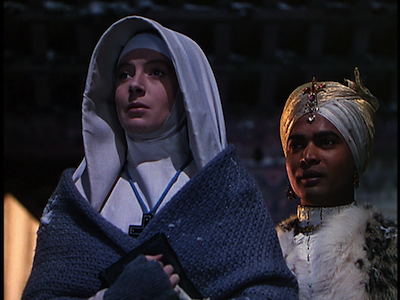
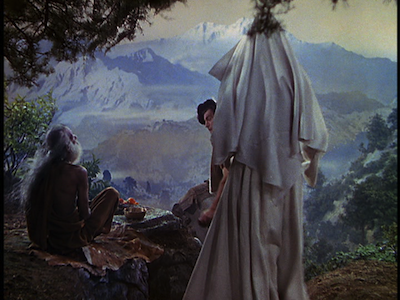
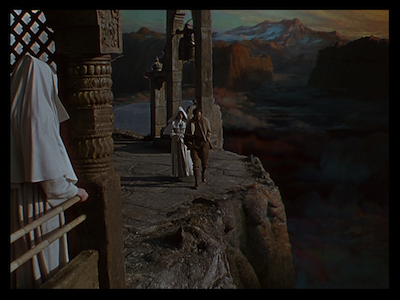
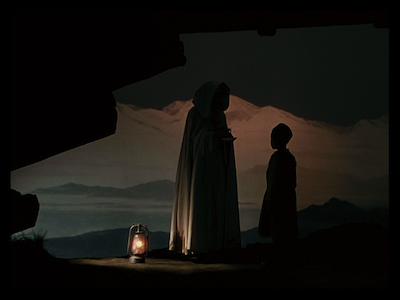
Criterion is about to re-release two of its earliest Michael Powell and Emeric Pressburger DVDs, and while the much vaunted restoration of The Red Shoes is gobbling up most of the press clippings [read my review of the theatrical print here; the DVD review here], I sincerely hope Black Narcissus won't get overlooked. Because despite the lack of pre-publicity for this particular restoration, the new DVD transfer for Black Narcissus is astounding. The storybook Technicolor has such marvelous hues and textures, it's like the Archers--alongside cinematographer Jack Cardiff--have invented a world as illusory and new as James Cameron's Avatar [review], only they did it more than 60 years ago and with a completely different spiritual message. To have a DVD that finally shows us the natural pigments and the level of detail intended by the filmmakers is a great boon.


Compare the above: top image is 2010, bottom image 2000


Released in 1947, Black Narcissus is based a novel by English author Rumer Godden, who is maybe best known for The River, her memoir about spending time in India as a child (later made into a film by Jean Renoir). For Black Narcissus, she takes readers high into the Himalayas to tell a story of an order of nuns assigned to a temple 8,000 feet in the air. They have been invited by the local ruler, a peacock they refer to as the Old General (Eamond Knight), though there is some doubt that it's the best place for a convent. A group of monks tried to set up shop the year before and barely made it through a couple of months.

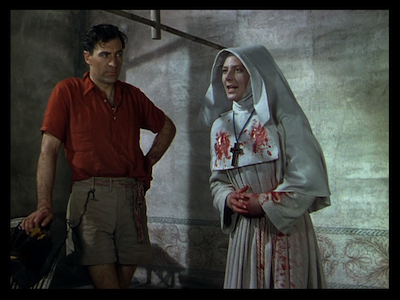
The nun put in charge of this new cloister is Sister Clodagh (Deborah Kerr), and it will be her first leadership assignment. Accompanying her are four other sisters: Philippa (Flora Robson), chosen for her gardening skills; Briony (Judith Furse), who is strong and experienced in medicine; Blanche, a.k.a. Sister Honey (Jenny Laird), popular for her kindness; and the troubled Sister Ruth (Kathleen Byron), who needs a change of pace to get her head in order. The mountain castle is the wrong place for it, however; none of the women are prepared for the way the new environs will change their lives.


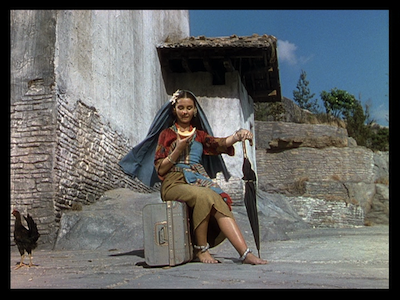
Top: 2010, bottom: 2000


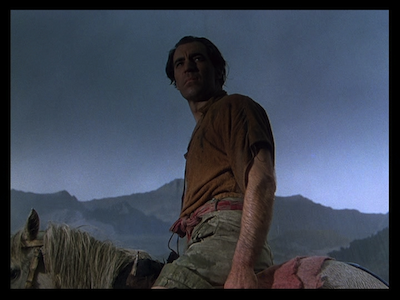
The Old General's castle--which, ironically, is where he used to keep his harem--sits above a valley, and the nunnery will serve the village below, providing a school and health clinic for the locals. The people lead simple lives, most of them work in agriculture. On one side of their moral spectrum, they have a holy man who occupies a high point near the castle, where he sits and meditates day in and day out; on the other end is the only Westerner in the area, a man named Dean (David Farrar). Mr. Dean is the one who tried to warn the sisters away, but if they are going to be there, he is going to give them a hand when he can--sometimes whether they like it or not. He's not afraid to tweak their piety for a laugh.

A story like Black Narcissus will usually go one of three ways: the nuns can either change the people they have come to help (bringing the heathen salvation/taming the savages), or the people can inspire a change in the missionaries instead. The mawkish third option is that both might happen. Powell and Pressburger go for a fourth option, choosing instead to make the locals only a small part of the story. The natives of the area are a product of their environment, and it's the environment that will change the nuns. The sisters have come from an order that believes hard work is the way to salvation. Toil distracts the mind from earthly things, leaving more brainspace for God. The culture clash is more mystical than social, as emphasized by the Archers layering Western religious music over Eastern religious imagery. The mountain retreat is isolated and magical, like a version of the fabled Xanadu, and in its nest, the nuns will surrender to their interior desire. Isolation creates distraction rather than fostering peace. Philippa, for instance, plants flowers instead of vegetables, choosing beauty over nourishment.


For Sister Clodagh, this new space brings back memories, and we see flashbacks to her life in Ireland before joining the faith. She dreams of a past that is equal parts hurt and nostalgia, and though we only see snippets of what happened, we sense that any happiness in the events are short lived. One of the flashbacks even ends with Clodagh disappearing into darkness, swallowed by the sky, an image that prefigures the final shot of Black Narcissus, when the castle disappears into the clouds.


Whatever is eating at Clodagh, it isn't helped by the presence of Dean. The rugged man of the wilderness is a most masculine figure, and his magnetism is irresistible to both Clodagh and Ruth. This central triangle forms the crux of the movie's plot. By comparison, the side story of the local girl (Jean Simmons) that Dean might have romanced and the Young General (Sabu) who stirs things up with his fancy clothes and perfumes almost seems like an afterthought. There are themes here reminiscent of the Audrey Hepburn drama The Nun's Story, in that a religious woman sent to a remote outpost has her faith challenged and her heart stirred by the man of action she meets there. Unlike that film, however, Black Narcissus offers us two examples of how different believers deal with temptation. Clodagh resists and grows stronger, whereas Ruth gives in and loses her way.

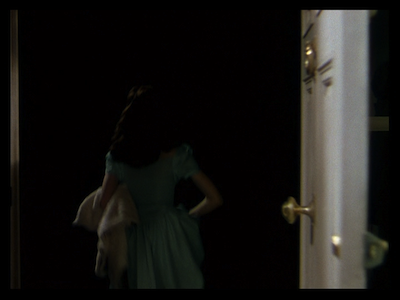
And I mean that literally. From the get-go, Ruth is presented as the one out of sorts. She belittles the village children and is so pale and sweaty, she looks like she is going to die in her habit. Her lust is presented as a literal fever, one that only increases the longer she is in the mountains. Dean shows her an early kindness, and that's all she needs to fixate on him. The fact that she's covered in blood when it happens--an early introduction of a red color scheme associated with the character--should be an indication of what kind of figure she will come to represent. Black Narcissus is a romance cross-bred with a horror film, and its melodrama has as much in common with the histrionics of Hitchcock's Rebecca [review] as it does any of Douglas Sirk's soapy tearjerkers. The women are from an order where the nuns renew their vows every year, and Ruth doesn't re-up when her time is through. Instead, she puts on a dress and make-up smuggled from the city thinking that she will be able to stay with Dean. When he refuses, she blames Clodagh for stealing him and goes after her rival.


There are intimations that the wind and the altitude have infected Ruth's sanity. There is also an understated element of magic at work. A young child's death has turned the villagers against the nuns, believing the medicine they gave her to be responsible. When Ruth goes over the brink, the local men are playing their drums, holding a ritualistic vigil...but for whom? Earlier in Black Narcissus, they did the same thing when the Old General was on his deathbed, and they only stopped when he died. At the time, the noise got on Ruth's nerves. Is it now compelling her to have this psychotic break?


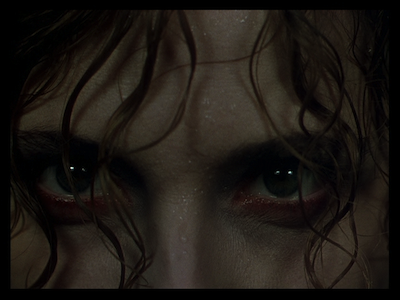
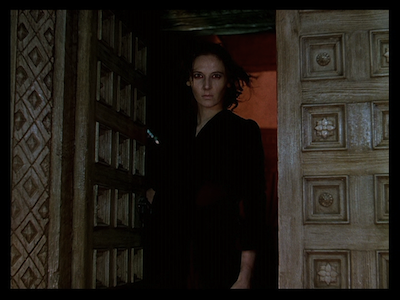
When Ruth gets dressed up for her new freedom, both her frock and her lipstick are red. She also lets her fiery hair out from under her white habit--and it's probably worth noting that Clodagh has red hair, too, making them twins after a fashion. The more deranged Ruth gets, the more red her eyes get, culminating in a close-up that shoes them rimmed with crimson and shining with insanity. She also passes out when Dean rejects her, and the shot is framed from her point of view as the entire screen goes blood red. The filmmakers use red for all its various connotations: passion, heat, life. Color is almost like an added element of nature in this opera; it signals change, hence the colorful transformations of the season. Red marks Ruth's change, but her final metamorphosis comes when she finds Clodagh alone and unprotected. Ruth is so drenched in humidity and sweat, her dress and her hair have turned as black as the shadow that surrounds her. As black as the shadow that devoured Clodagh in flashback.


The visual design of Black Narcissus is as beautiful as any the Archers ever created, rivaling even their stage-based dramas The Red Shoes and Tales of Hoffman. The vast landscapes they dream up and invent on the backlots of Pinewood Studios are glorious in their detail and realism. Using every tool at their disposal, including trompe l'oeil matte paintings, they create distance and depth. The seclusion of the nunnery is made very real by the magnitude of the mountains that surround them and the terrifying drop that awaits them at the edge of their property. When Clodagh stands at the bell tower, the cliffside goes all the way down into the valley, but we can't even see the bottom. We're too high, and there are too many obscuring clouds. It's an illusion as believable as any of the CGI cities Christopher Nolan builds in Inception [review coming Thursday]. The mind boggles at what the Archers might have done with computers at their disposal. The digital age is certainly being kind to them, as the gorgeous image quality of this DVD will attest.


Of course, in a movie of this kind, color is not just part of the background, but also part of the politics. Black Narcissus walks a fine, antiquated line between treating different ethnicities with respect and slipping into racial clichés. Seeing Jean Simmons and Esmond Knight in brown face is a little hard to get used to, and the script never quite gets past treating the villagers as "the other." Dean's description of the locals at the start of the picture is respectful, but he's typically colonialist in action. Yet, there are subtle moments where prejudiced points of view are satirized and even ridiculed. When Ruth, for instance, insists "they all look alike," there is an undertone that makes her seem ridiculous, even if no one ever comes out and says it. Even more subversive is seeing the nuns teaching the children English using symbols of imperialism. Namely, a chart of weapons! In the sly smile of the young translator Joseph Anthony (Eddie Whaley Jr.) are the early sparkles of revolution.


That said, for everything that is below the surface, the most memorable undercurrent will be the unrealized romance between Mr. Dean and Sister Clodagh. In typical movie fashion, the two are at odds from the start, trading barbs that are at turns humorous and rueful. Dean can't stand Clodagh's being clueless, she can't stand his rough manner and carousing. Yet, the stronger she grows and the more he reveals himself as capable and empathetic, the closer they become. There are some smoldering looks between them, and some heartbreaking ones, as well. Like socially restrained lovers in a Merchant Ivory picture or an Edith Wharton novel, they can't act on their feelings, and so it's all in the tone of their voice and eye contact. David Farrar, who was also in the Archers' production The Small Back Room [review], is charming and funny, but he also has an earthy gravitas. His best moments are not when he is playing the rake, but when he is having to choke on the emotion he doesn't want to admit is there.

If I had to choose, I'd say this movie has my favorite Deborah Kerr performance. I like her as Sister Clodagh even more than I do in An Affair to Remember [review] or The Innocents. There is a weird thing about art in that restrictions are often the key to inspiring the artist to stretch. Throughout Black Narcissus, Kerr is locked in her nun's habit. It leaves her with only her most essential tools: her face and her voice. Clodagh is a woman who is trying to maintain a holy image, who is always trying to look as if she is together. That in itself is easy enough, but the emphasis here should be on the word "trying." There is always more informing what she does than what we can see, and Kerr fantastically brings the nun's internal conflict to life. Her past and the things she denies are always with her. There is visible doubt in her eyes, a tremor in her voice. For as subtle as this all is, Kerr is also able to sell the more exaggerated dramatics of the final act.


Perhaps it's the quiet of the earlier bits that lends credibility to the louder technique of the later ones. It certainly sets the stage for an effective finale. Powell and Pressburger have paved the way for an exit that passes us back through the veil. We depart from the magic of the mountains back into the real world, having taken a journey with their characters to someplace beyond what is familiar. We can hit stop on the DVD and return to our normal lives, but as David Farrar's last look into the camera suggests, we will probably be forever changed by what happened on this altogether unreal plane.


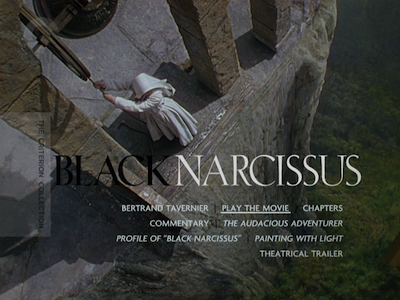
In addition to the new transfer for Black Narcissus, which was overseen by Jack Cardiff and Michael Powell's widow, the renowned film editor Thelma Schoonmaker Powell, Criterion offers up several new extras to make a new purchase worthwhile, whether you go with the standard-definition reissue or the new Blu-Ray. I believe a couple of the extras come from a French DVD edition of Black Narcissus. They both feature filmmaker Bertrand Tavernier, who is a fan of the film. He provided an introduction to the picture and also shares his thoughts of the movie and Michael Powell in a featurette entitled "The Audacious Adventurer."

Another new extra is a short documentary called "Profile of Black Narcissus," which takes a look at the picture as a whole while also covering some of the same ground and using some of the same source material as a holdover from Criterion's 2000 DVD, the Jack Cardiff tribute "Painting with Light." Also leftover from before is the excellent audio commentary featuring Powell and his biggest fan, Martin Scorsese.


This disc was provided by the Criterion Collection for purposes of review.

Thursday, February 18, 2010

MAKE WAY FOR TOMORROW - #505


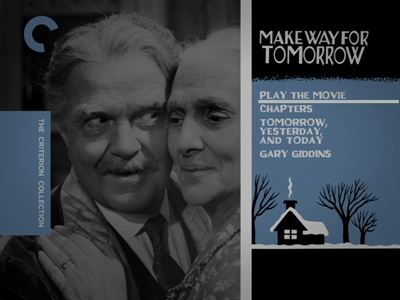
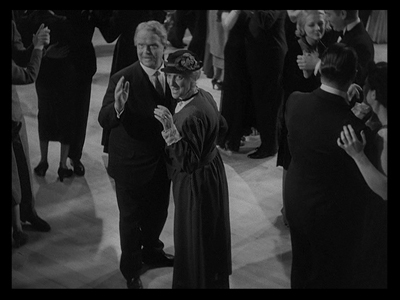
The 1937 film Make Way for Tomorrow is the story of Ma and Pa Cooper, an elderly couple who have been together for fifty years. They now find themselves as victims of their time, and Leo McCarey's sweet drama is also very much a product of that time. It reflects the economic state of the world the Coopers had aged into. Its title has an ironic double meaning: it's a hopeful looking ahead at change, but it can also be barked out like an order, telling the older people to get out of the way. Nowhere in the movie is this more sharply felt than when Ma and Pa step out on the dancefloor to waltz, only for the music to change to something faster they can't step to.

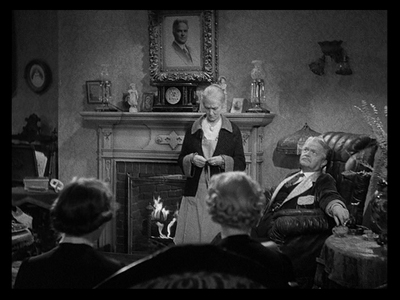
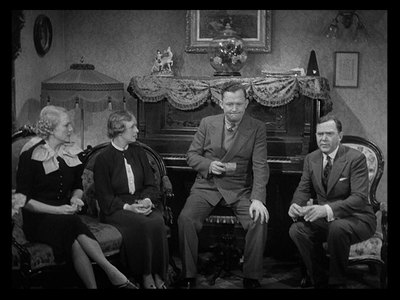
Barkley Cooper (Victor Moore) and his wife Lucy (Beulah Bondi) had five children together, and they summon the four of them that still live nearby to their childhood home to tell them that the bank is foreclosing on the house. Though they were given six months to vacate, they've waited until the last minute to tell anyone. The good son, George (Thomas Mitchell), realizes that any plans that can be made on the fly won't be ideal, they will have to split the old folks up. He will take his mother to live with his family, a three-hour drive, and his sister, the cold shrew Cora (Elisabeth Risdon), will put up their father. The plan is for the other sister, Nellie (Minna Gombell), to reunite both parents at her home in three months, something her husband (Porter Hall) quickly puts the kibosh on.


Living apart is hard on both the parents and the children. Ma is in the way in George's apartment, having to share a room with their teenaged daughter Rhoda (Barbara Read) and encroaching on how George's wife Anita (Fay Bainter) runs her household. Pa gets sick while out looking for a job, and he doesn't much like Cora's care any more than she likes giving it. Something else is going to have to be done.

Make Way for Tomorrow is a much beloved film. The DVD has testimonies from filmmakers Peter Bogdanovich and Bertrand Tavernier. Roger Ebert recently wrote about it in his Great Movies column, noting how much heart it had and how tough it was. He rightly points out that were this a movie made today, there is no way it wouldn't get stuck with a clichéd happy ending. To be honest, though, for the first 2/3 of the film, I couldn't see what all the fuss was about. I didn't dislike it, it was charming in a quaint kind of way. It moved at a slow amble, and people spoke pleasantly to one another even if the subtext was harsh. Everything about the movie was just so damned reasonable. Sure, the kids were begrudging in their charity and maybe didn't come up with the best plans for helping Ma and Pa out; at the same time, the old folks are kind of annoying.


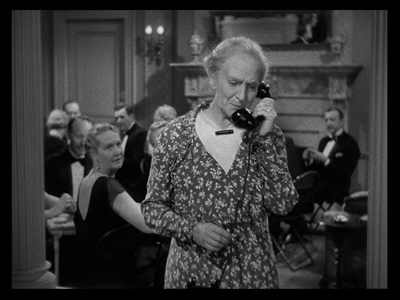
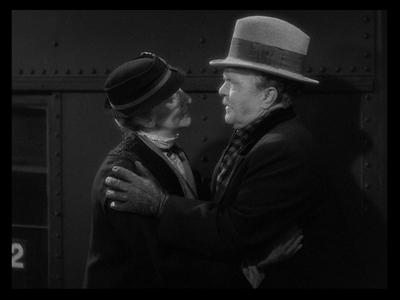
It's only in the third act that everything starts to make sense, when we see at last why everyone is so brittle. Cora decides to use her father's chest cold as an excuse to ship him off to sunnier climes. He'll stay with the absent sister out in California. Knowing she can't go with him, Ma nobly makes a plan to check into an old folk's home, but only on the condition that her husband not be told. George accepts, but he feels like a heel doing it. On the day when Pa is meant to leave, he and Cora meet in New York City for a few final hours together. They are on their own, free of their children, and they start to reminisce. Fifty years prior they had come to New York on their honeymoon. Could maybe some of the old places they visited still be there?


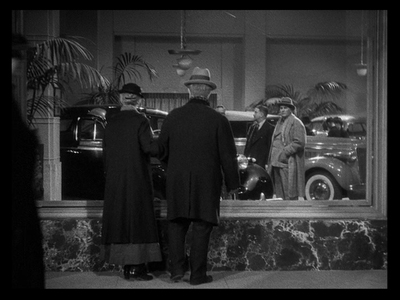
Once the Coopers are back together, Make Way for Tomorrow takes a lovely turn. The spark that has been lacking in the earlier part of the movie was intentionally left out. It's because there is no spark when Ma and Pa are apart. Together, though, oh! What charming people! They are still romantic, still impressed with what makes the other one tick, and comfortable in the way they get along together. It's not just the audience that sees how wonderful their love is, but all of New York City. An oily car salesman gives them a ride, but he has no ill will when he discovers they are broke. The old hotel they stayed at as newlyweds rolls out the red carpet when they hear that guests of such a distinguished age have returned. All the things about this wonderful pair that their offspring could not see are obvious to everyone else. You'd have to be a pretty tough customer not to have tears in your eyes when the bandleader sees that Ma and Pa are lost in his up-tempo rhythms. The part I didn't tell you up above is that he stops the faster number and goes back to a waltz to give these aged lovers more time to enjoy each other's company.


As mawkish as this all may sound, Make Way for Tomorrow stays far away from obvious melodramatic tugs or soppy sentiment. Leo McCarey, working from a screenplay by Viña Delmar (The Awful Truth), who sourced it from a novel and a play, put their faith in the material and in their audience to understand that fifty years of personal history is a long time. It would be easy to mine their story for the easy emotional peaks, but personalities are so much more interesting than plot. Of course, it helps when you have actors as insightful and empathetic as Victor Moore and Beulah Bondi. Moore had been acting in movies since 1915, and Bondi was playing a part well ahead of her years; she would act well into the 1970s, and is maybe best known as Ma Bailey in It's a Wonderful Life. Both actors pull way back for their performances here, giving themselves over to the effects of aging, moving slow, speaking softly, but never slipping into caricature. How fun it is to see Ma Cooper eventually cut loose and have a couple drinks!

Make Way for Tomorrow is a portrait of America as it was still finding its way out of the Depression. On one side, the Cooper children are doing all right and finding prosperity again, but on the other is their parents, part of an older generation that never quite found their way back to the way things were. Part of the kindness the old people find in New York is likely down to people having sympathy for them and also being impressed that they have survived this long. Leo McCarey avoids visual flash in the same way his actors avoid histrionic displays of emotion. These are dark times he is depicting, and though he isn't exactly predicting the Italian Neorealists, he does try to show the world as it was and not how Hollywood dreamed it to be. He also avoids copping out at the ending. A cheerful conclusion would have seemed hollow when there were no easy answers waiting for any moviegoers outside the theatre. It's just like how Jason Reitman left us hanging at the end of Up in the Air, one of the few movies to portray the financial hardships of contemporary times. To say it's all going to be okay would be disingenuous.


It would also probably relegate both movies to the scrap heap. Had Make Way for Tomorrow ended with money raining from the sky, I doubt we'd be talking about it today, much less watching it in a Criterion edition. Hell, this movie even makes fun of those kind of movies, the way Ma Cooper describes the predictable genre picture she saw with her granddaughter. Honesty is what resonates through the ages, what makes a story timeless and universal. I find Leo McCarey's film more hopeful because it shows us two people who can make the best of the worst times, who are resolute, and who never let go of what matters, even if they have to say goodbye to it.


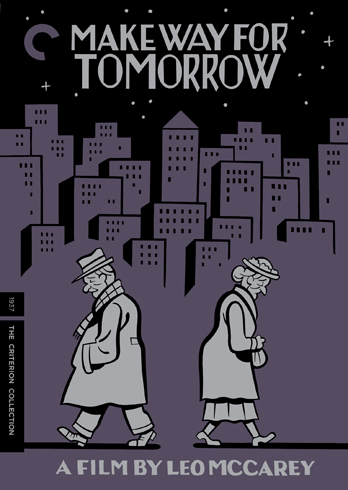
As always, Criterion has put together a great package, and the best part is that Make Way for Tomorrow has multiple new illustrations by one of my favorite cartoonists, Seth. His comic book It's a Good Life, If You Don't Weaken is all about nostalgia for things lost, and recent projects like Clyde Fans and George Sprott: (1894-1975) deal with the effects of age and reconciling the life one has lived. This makes him a perfect choice to capture the charm and emotional beauty of Make Way for Tomorrow.




For a full rundown on the special features, read the full article at DVD Talk.

Saturday, February 28, 2009

SIDELINE: MORE REVIEWS FOR 02/09

In addition to my Criterion reviews, here are other reviews film fans of similar tastes might find of interest from the last month:

IN THEATRES...

* Coraline, the long-awaited new effort from Nightmare Before Christmas-director Henry Selick is a pretty looking dud.

* Two Lovers, a rough and often tough-going romantic tale about the ups and downs of the heart. With Joaquin Phoenix and Gwyneth Paltrow.

Also, check out the reviews in the Portland International Film Festival section of my Confessions of a Pop Fan blog. I cover many foreign movies that will hopefully be coming to a theatre or DVD shelf near you very soon...or in some cases, hopefully not.

ON DVD...

* Cannery Row, a Steinbeck adaptation that falls short of the mark thanks to a strained and hokey stylistic nostalgia. With Nick Nolte and Debra Winger.

* Far from the Madding Crowd, John Schlesinger reteams with Julie Christie in an epic, romantic adaptation of Thomas Hardy.

* A Guide to Recognizing Your Saints, an interesting but all too familiar coming-of-age tale that asks you to believe that Shia LaBeouf will become Robert Downey Jr.

* In the Electric Mist, Bertrand Tavernier tackles a James Lee Burke novel with mixed but mostly good results. Tommy Lee Jones stars as Burke's Detective Dave Robicheaux.

* Murnau, a collection of six of F.W. Murnau's silent films from Germany, including Nosferatu, Faust, and The Last Laugh

* Natalie Wood Signature Collection, a new boxed set that is mostly full of misses from the Warners back catalogue. It does contain the new edition of Splendor in the Grass, though.

* The Sidney Poitier Collection, three good movies, including Martin Ritt's Edge of the City with John Cassavetes and Something of Value with Rock Hudson, sit next to one clunker. Three out of four, still pretty good.