* Blackfish, a chilling documentary about killer whales in captivity and how they turn into dangerous killers.
* Blue Jasmine, the latest ethical drama from Woody Allen features two sisters on either side of the economic line. An excellent cast led by Cate Blanchett makes good use of a great Woody script.
* Elysium. Good action flick with noble intentions, or pretentious political fable full of gore? Both!
* The Grandmaster, Wong Kar-Wai's latest potential masterpiece, butchered for the Americas, and this one dude (me) just won't shut up about it.
* We're the Millers, in which we finally see Jason Sudeikis break a comedic sweat. Also, it's Jennifer Aniston's third movie in a row where she strips so that other people can talk about how sexy she is. Is it a clause in her contract at this point? (See also: Horrible Bosses; Wanderlust)
* The World's End, the new comedic apocalypse from the team behind Hot Fuzz and Shaun of the Dead.
* You're Next, a decent slasher picture that entertains but lacks in real suspense.
My Oregonian columns...
* August 2: get In Bed With Ulysses and let James Joyce put you to sleep; or look at dramas based on real life, the human trafficking story Eden; and James Cromwell in Still Mine.
* August 9: The remarkable Brazilian film Southwest; a film festival at the Columbia Gorge; and a bunch of music-related documentaries at the Hollywood Theatre.
* August 16: Adjust Your Tracking, a documentary about VHS collectors; a couple of Tarkovsky films; and the family comedy Papadopolous & Sons.
* August 23: documentaries on photographer Gregory Crewdson and soul singer Charles Bradley; plus, Modest Reception, an absurdist Iranian drama.
* August 30: Kristen Bell cries all over her swimsuit in The Lifeguard; Low create an art movie out of their old music videos; and two documentaries from Ondi Timoner, We Live in Public and Dig!
* Penny Serenade, this "marriage is hard" drama with Cary Grant and Irene Dunne will make you cry like a baby. Though hopefully not one of the ones that dies in the movie.
* Reality, a surprising take on fame in the modern television age from the director of Gomorrah [review].
* That Touch of Mink, a May-December romance with Cary Grant where we pretend that Doris Day isn't really in August with the rest of us.
I am a little more than halfway through the 28th Eclipse box, The Warped World of Koreyoshi Kurahara, but in the meantime, here are the other films I reviewed in August...
IN THEATRES...
* Colombiana, with Zoe Saldana as an assassin kills everyone. EVERYONE!
* The Future: Miranda July is as kitten as a cat, but I'm not as smitten as that.
* Our Idiot Brother, a surprisingly genial, if slack-paced comedy bolstered by a strong cast, including Paul Rudd, Elizabeth Banks, Rashida Jones, and more.
* Rise of the Planet of the Apes. I found it really boring for about the first 2/3, but everyone else loves it. I'm right, of course, but make up your own mind. :)
* Senna: You will enjoy a documentary about car racing. No lie.
ON DVD/BD...
* Daguerreotypes, a 1975 documentary from Agnes Varda, capturing the local color in the neighborhood she still calls home.
There was no post here on the blog last week, so I have fallen a bit behind again. As you'll see in the monthly round-up, it's not for lack of work; on the contrary, it's been too much work, I've been reviewing a lot. All I need to do is double up one week, though, and I'm back on track--and that should hopefully be easy, since I have four new releases (two Louis Malle, a Satyajit Ray, and the most recent Eclipse set) waiting to be watched. Comic Con is also coming, so you may see me scrambling yet again in not too long. Who all is going to the big show this year? Be sure to stop by Tr!ckster, there is much to be done and seen, including a Criterion sponsored event celebrating Kurosawa and raising money for relief in Japan. I'll also be part of Symposium 5, a ticketed event, so plan on going to that now!
IN THEATRES...
* 13 Assassins, samurai slaughter from Takashi Miike.
* Beginners, Mike Mills' exploration of mortality, love, and depression will catch you off guard. Naturally quirky and moving, it stars Ewan McGregor, Christopher Plummer, and Melanie Laurent.
* Green Lantern. You will believe that space can be realllllly boring. And Earth. And everything else.
* Larry Crowne. This weekend, you can watch cars transform into robots, or you can let Tom Hanks transform your cold, dead heart into something living again. Your call.
* Midnight in Paris, everything old is new again in Woody Allen's delightful return to form.
* Submarine, a quirky, heartfelt coming-of-age drama set in Wales.
* The Tree of Life, in which Terrence Malick wrestles with the universe, the All Father, and all fathers.
* The Trip, Steve Coogan on a very funny roadtrip with his pal Rob Brydon. Directed by Michael Winterbottom.
* X-Men: First Class: Hey, man, that's a groovy mutation, but the movie's kind of a piece of crap.
ON DVD/BD...
* BLAST!, a science documentary about sending a telescope up into the sky on a balloon to look at the stars.
* Carancho, an Argentinian twist on crime and romance, from the people who brought us Lion's Den.
* The Cocoanuts, yuck it up with Los Bros. Marx in their 1929 debut.
* Despair, a Vladimir Nabokov adaptation from writer Tom Stoppard and director Rainer Werner Fassbender, starring Dirk Bogarde. And it's as weird as that combination would suggest.
* Eight Iron Men, a WWII variation on the "chamber room drama" that never quite takes off. From Edward Dmytryk and Stanley Kramer.
* The Goddess, Paddy Chayefsky wrote this thinly veiled portrait of a Marilyn Monroe-type actress, played by Kim Stanley. Interesting, if not entirely successful.
* Man from Del Rio, starring Antony Quinn as a Mexican sheriff in a racially progressive 1950s western.
* The Man in the Net, starring Alan Ladd, directed by Michael Curtiz. Read the review that one fan called "a classic example of...uninformed arrogance" and inspired him to suggest I "take up something else to while away your time or attend a junior college film class."
* Marriage Italian Style, a strangely dark, yet intriguing, romantic "comedy" from Vittorio De Sica, reteaming Sophia Loren and Marcello Mastroianni.
* Never Apologize, Malcolm McDowell's one-man show in remembrence of director Lindsay Anderson.
* New York, New York, Martin Scorsese's notorious 1977 musical mash-up of new and old styles, starring De Niro and Minnelli.
* Public Speaking, Martin Scorsese's documentary about author Fran Lebowitz. Engaging and funny.
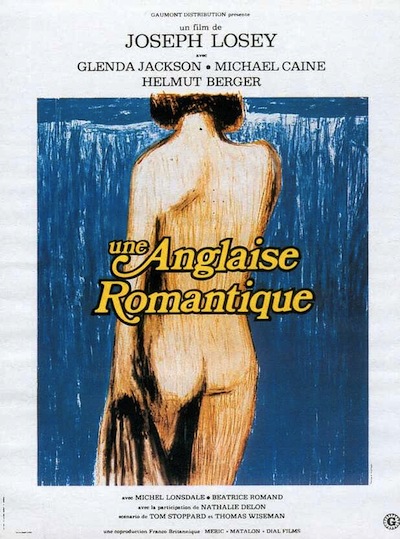
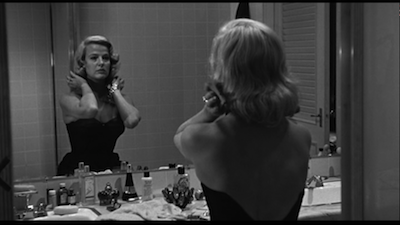
* The Romantic Englishwoman, Joseph Losey directing a Tom Stoppard script about Glenda Jackson's aching loins. And Michael Caine yells a lot.
* The Sacrifice, a beautifully remastered new edition of Andrei Tarkovsky's final film.
Lars von Trier, how do you do this to me? And why? I can't think of a single filmmaker whose films I admire this much but that I have to gear myself up to watch. Knowing what a difficult, provocative director you can be, and advance word that your new movie Antichrist was extremely harsh, I prepared myself as best I could. It wasn't enough.
Francois Truffaut had a theory that a viewer was not properly prepared to critique a film until he or she has seen in three or four times. I would agree with that in the case of Antichrist. There is a lot to sort through here. Unfortunately, I'd be lucky to sit through the movie a second time without closing my eyes at crucial moments, much less give it a third or fourth viewing. This is a movie that is profoundly unsettling by design. It is erotically charged, graphically violent, visually creepy, and disturbing in its philosophy. I can't say I loved it, I am too nauseous, but I am astonished by it. It's incredible work from von Trier, who is easily one of the most challenging filmmakers working today. He is perhaps best known for Breaking the Waves, Dancer in the Dark, Dogville--all films that feature a female protagonist that must in some way contend with madness, be it personal or societal. Antichrist boldly continues this tradition.
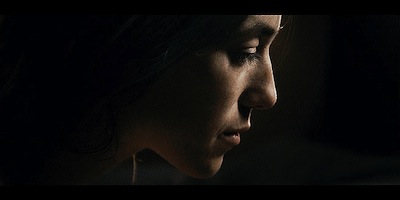
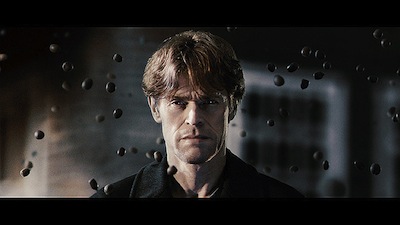
The story is simple enough to set up: a married couple, known only as "He" and "She" and played with unflinching resolve by Willem Dafoe and Charlotte Gainsbourg, lose their son when he falls out the window while they are having sex. The woman is overcome by grief, and when all her doctor does is try to medicate her pain away, the husband takes over her treatment. He is a therapist by profession, and he believes human emotion, no matter how tragic, must be explored. Realizing that the symbol of his wife's greatest anxiety is the forest cabin where she spent her last summer with their son, he takes her up there to make her face her fears head-on. The cabin is in a part of the woods referred to as Eden. Obviously, paradise this is not.
Almost immediately upon arriving in Eden, the man starts seeing the woman's madness manifest, though he's not aware that's what he is witnessing. Nature itself is reacting to her, and he is witness to sights both grotesque and ominous, some of it perfectly natural, some of it more mystically symbolic. Alone in their cabin, they ride the stages of her mourning together--she can turn cruel or horny or depressed in a heartbeat, and the film is split into three states: grief, pain, and despair--until the weirdness becomes too overwhelming and the full insanity is unleashed.
Antichrist is sure to stir up debate. The film opens with an explicit sex scene, one of many, and its climax is full of upsetting images of very real violence, including genital mutilation. Lars von Trier understands the power of both things, and Antichrist requires a balance between them. Were he to shy away from either, the impact would be lessened. The violence is sexual, the sex is violent, the physical punishment is an exertion of control on an out-of-control world. I can't even imagine what the actors must have subjected themselves to in order to give von Trier what he wanted. Both Defoe and Gainsbourg are remarkably real and frighteningly honest on screen. If they were any less, this movie would not be so excruciating. Cinematographer Anthony Dod Mantle, who is a regular von Trier collaborator and who put the gloss on the dross that was Slumdog Millionaire, captures an environment that is quite beautiful, even when it is sickening. Images of death and decay are just as lush and colorful as the life that thrives all around. Profound nightmares are enacted with a dreamy sort of peace. In this, I see parallels with the on-Earth scenes in Andrei Tarkovsky's Solaris. von Trier dedicates Antichrist to his former mentor, and from that venerated filmmaker, the Danish director has learned to demand patience both of himself and his audience.
The extremes of Antichrist are purposeful, this is not just shock for shock's sake. Lars von Trier is definitely saying something with this movie, though I am not sure everyone will agree on what that is. The writer/director has been charged with misogyny before, and Antichrist has him in hot water again, even winning a special anti-prize at Cannes. I've always found his portrayals of women to be sympathetic and, in their way, empowering. Dogville, for instance, ends with Nicole Kidman's character punishing those who had wronged her. Though many may argue that von Trier's ruthless portrayal of all those misdeeds is suggestive of diseased motives on his part, it's not a label I'm willing to hang on him. Nor am I willing to do be so quick to judge here. I think Willem Dafoe's reaction to his wife's revelations are key in interpreting the piece overall. She is a woman who has studied the history of violence against her gender, and her belief that maybe this is deserved, that there is something uncontrollable about women that must be contained, is not just a symbol of the madness she suffers, but a product of that abuse. Like a self-punishing version of Stockholm Syndrome that casts history as the captor.
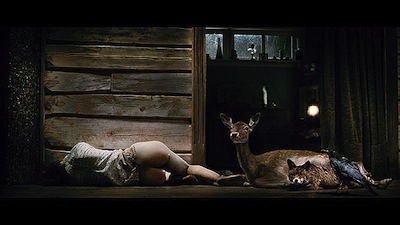
More than the Tarkovsky influence, I actually see Ingmar Bergman's fingerprints all over Antichrist. You wouldn't have to work too hard to con me into thinking this was one of his unproduced scripts. Like von Trier, Bergman always wrestled with spirituality. In their films, mankind wants there to be something greater but fears that there is nothing to be had. Nature serves as a stand-in for God, a force that operates without our input or understanding. The division between our social constructs and our base nature is tragically thin, and efforts to contain either will be fruitless. Willem Dafoe's character is the one who sees all of the supernatural visions in Eden, yet he makes no effort to engage with or understand them. His mantra for his wife is that she should not attempt to explain the irrational, just let it happen. In this way, he may be more ill than her, possessed of a kind of cultural disorder that keeps him outside of the deeper experience and in turn pushes her further into the insanity. He is outside of nature, she is within it, even subject to it. When the woman's prophecies about the "Three Beggars" come true, manifesting as a deer, a fox, and a crow, he can only say they don't exist. This leaves us to ponder what we have seen, as well. He embodies a white knight syndrome that says a woman's problems are fixable, and his drive to compartmentalize her anguish turns her into a male nightmare, the crazed female who will do everything to prevent you from leaving her.
Does this make the woman more knowable, even if her behavior is harder to understand, just because she is more open to feel and to expressing those feelings? Antichrist is ambiguous to be sure, and von Trier isn't above punching a few volatile buttons. That title alone is meant to provoke and will likely be central to any arguments that the movie is misogynist. (Though, as Roger Ebert reminds us, the literal translation of the original term is "opposed to Christ," and so a being devoid of goodness rather than a theological opposite; religion doesn't even really come up in the context of the movie.) The final image of the movie doesn't help either. It's one of the things that haunts me the most about the film, even more than the brutality. How you interpret that scene, whether you see what arrives as coming to positively reclaim their own or to destroy what has created them all, is going to be crucial to how you ultimately feel about Antichrist. Regardless, it is not a film you will soon forget.
I recommend Antichrist highly, but I do recommend it with caution. The squeamish will not fare well watching it, and it may be a strange movie to screen with a member of the opposite sex, particularly one you care about. (If someone takes you to this on a first date, don't agree to a second.) It's a film I liked, and one I'll like talking and reading about, but not one I particularly liked watching.
In fact, I chickened out with how I watched the movie this time, now that I've seen it on Blu-Ray. The above were my first impressions, written when I saw the theatrical release...goodness, it was over a year ago. I had no idea it was that long. The wounds were still fresh, and though I was going to try to pull the wool here and make an excuse about how my second impression of the movie is fueled by the conversations I have had since, and so the best way to go about it a second time was by furthering that conversation, it would be a crock. I just wasn't ready to watch the film on its face, so instead I let others lead the way. Namely, I viewed it while listening to the audio commentary with Lars von Trier and film professor Murray Smith.
It's not an approach that lacks merit. I am seeking out a fundamental understanding of what von Trier was after with Antichrist. I had hoped for more from him on the commentary, and Smith does try to engage him in a dialogue about the things that inform his script, but von Trier is, not surprisingly, recalcitrant. He is more open about discussing the technical aspects of what was achieved instead of the why of the story. Part of that is natural, I get the sense that he is an intuitive artist who trusts his impulses without having to attach an explanation to them. Another part, and probably the main reason, is revealed in the closing portion of the movie, when Murray asks him what seems to be obvious, if the finale was meant to be ambiguous. von Trier says that in Antichrist, more than any of his other films, he pushed himself to be more mysterious. I would suppose, then, he must leave the movie unexplained; now that it's out there, it's not his mystery to expose.
Film scholar Ian Christie, on the other hand, is an expert detective, and his dissection of the film in the booklet that accompanies the Criterion release is well worth diving into. His theories on the title are particularly interesting. I won't give them here, go and read for yourself. There are also multiple interview selections on the disc that help in terms of exposing the story behind the production to a fuller degree.
Antichrist, as von Trier does explain in the commentary (as I said, there is much discussion of technical filmmaking), was shot with the Red digital camera. This makes the movie particularly suitable for High-Definition, and the transfer on the Blu-Ray is remarkable. Every blade of grass is sharply rendered, each has its own particular green. The optical effects really come alive, the way the story bends under Charlotte Gainsbourg's gaze, the intentional artificiality of the "magic," and the antiseptic black-and-white of the prologue and epilogue are given an increased visual potency in this format. Every gory detail is there to be seen, fulfilling von Trier's goal that there would be nowhere for the viewer to avoid the harsh particulars of his fictional reality. Say whatever else you want about it, but Antichrist on Blu-Ray looks phenomenal.
This disc was provided by the Criterion Collection for purposes of review.
Author of prose novels and comic books like Cut My Hair, It Girl & the Atomics, You Have Killed Me, and 12 Reasons Why I Love Her. Jamie's most recent novel is the serialized book Bobby Pins and Mary Janes, and his most recent graphic novels are the sci-fi romance A Boy and a Girl with Natalie Nourigat; Madame Frankenstein with Megan Levens; and the weird crime comic Archer Coe & the Thousand Natural Shocks with Dan Christensen.



 ,
,  ,
,  --all films that feature a female protagonist that must in some way contend with madness, be it personal or societal. Antichrist boldly continues this tradition.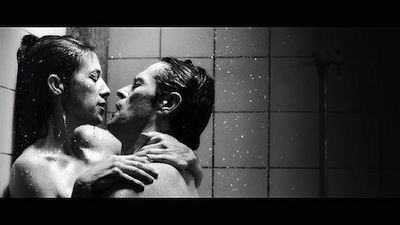
 , captures an environment that is quite beautiful, even when it is sickening. Images of death and decay are just as lush and colorful as the life that thrives all around. Profound nightmares are enacted with a dreamy sort of peace. In this, I see parallels with the on-Earth scenes in Andrei Tarkovsky's