I'm halfway tempted to forego writing a review of Alexander Korda's 1936 biography of Rembrandt and instead cut and paste my review of Bent Hamer's Charles Bukowski biopic Factotum [second review]. In Korda's hands, and as performed by Charles Laughton, the 17th-century Dutch painter is not dissimilar to the 20th-century poet. Both were passionate men with particular appetites, ahead of their time and underappreciated during it, and often too realistic in their manner of relating the seedier aspects of human existence. Laughton's Rembrandt is a bit of a bad boy, railing against authority, iconoclastic, an artist in every sense of the word.
Rembrandt is the last movie in the Eclipse box Alexander Korda's Private Lives, and it's a good note to close on. It manages the right balance of seriousness and irreverence, building a convincing facsimile of history while also managing to allow for personality. The devil is in the details, to be sure, but Rembrandt is himself a devil, and there lies the joy of this picture.
Carl Zuckmayer and June Head's script opens with a personal and professional failure. Though revered for his skills, Rembrandt has been avoiding taking paid commissions, preferring instead to paint his wife Saskia. The Civic Guard, a governing body of soldiers and politicians, ply Rembrandt with drink, money, and flattery, and so he takes on the job of a group portrait. It's ill timed, however; Saskia succumbs to a long-term illness. Worse, the painter's efforts to show the men as they are only brings disdain. The big commission--the now revered painting The Night Watch--is a failure.
Fast forward several years, and Rembrandt is struggling. His home is now run by his opportunist housekeeper (Gertrude Lawrence), and his wife's final will ties up most of the family money with their son (John Bryning). Rembrandt feels lost, and only a visit to the farm where he grew up and a new romance with Hendrickje (Elsa Lanchester), a young maid who believes in him, revives his lust for life. The rest of Rembrandt shows their struggles, another rise and fall, ending with a final act that illustrates the despair of a wayward artistic life.
The movie becomes a bit of a bummer in that last 15 minutes, but given the undulating pattern of Rembrandt's life, it makes sense. He was a man who loved deeply and who didn't recover from loss easily. Laughton digs into the role with his expected vigor, rendering both the artist's outgoing highs and his introspective shallows with equal insight. The actor had a special skill for understanding oversized personalities, and the extremes that came with them. The summation of the painter's life in the last scenes could have had a mawkish gravitas if portrayed by a lesser performer; Laughton carries the weight with ease.
Korda's direction has certainly grown more confident since The Private Lives of Henry VIII [review], and he and Laughton have a clear rapport. They know how to work a scene together, when the actor needs to really go for it, and when he should hang back. There are lots of memorable scenes in Rembrandt--the dark pallor that hangs over his conflict with the Civic Guard, the tensely funny barroom brawl with the peasants in the artist's hometown, the sweet courtship of Hendrickje--scenes that fuse performance with material in a way that only cinema can. As per usual, the sets by Vincent Korda, who of course had Rembrandt's paintings to use as inspiration, create an essential component of the film, establishing an authentic world for the rest of the crew to lose themselves in. This makes Rembrandt the best of the historical pictures represented in Alexander Korda's Private Lives, in addition to being the last. It's a big finish in every sense of the phrase.
The Private Life of Henry VIII [review] was a great success for Alexander Korda, and so it only made sense that he would continue in this vein as both a filmmaker and a producer. For his next historical feature, Korda handed the directorial reins to Paul Czinner, who had recently left Germany with his wife, the actress Elizabeth Bergner, to escape persecution from the rising Nazi powers. Czinner and Korda settled on Catherine the Great as a suitable starring vehicle for Bergner. Though Catherine had a long reign as Empress of Russia, one full of scandal and rumor, the pair decided to focus on her early life for The Rise of Catherine the Great, and her move from her home country of Germany to the court of St. Petersburg--a situation that Bergner could likely identify with.
At the start of the picture, the Empress Elisabeth (Flora Robson, the Basil Dearden-directed Saraband for Dead Lovers) is on the throne. Lacking both an Emperor and a direct heir, Elisabeth is trying to position her nephew, Grand Duke Peter (Douglas Fairbanks Jr., Little Caesar, The Prisoner of Zenda), to take over and carry on the bloodline. In classic fashion, the young monarch is not as interested in affairs of state as he is in affairs of the heart and also those of the body. Being a ladies man and a scoundrel, the idea of marrying a German princess he's never seen doesn't really appeal to the dandy. His mind changes, however, when he meets Catherine and she charms him with her naïveté and devotion.
Only, his mind is to change just as quickly on their wedding day when a valet (Gerald du Maurier) plants a doubt in his head: what if she is not as naïve as he originally believed? Feeling royally played, Peter approaches his new marriage as if it were a game. Can he carry on as he was and keep his wife in her place? He'll push her to see how clever she really is!
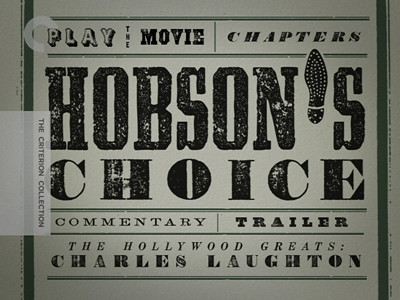
These early portions of The Rise of Catherine the Great are the best parts, with Peter acting the rake and Catherine trying to outmaneuver him, sometimes advised by Empress Elisabeth herself. Flora Robson pulls a coup on her castmates, completely dominating The Rise of Catherine the Great each and every time she appears on screen. (Hell, even Criterion chose to put her on the menu screen rather than the movie's titular star.) The actress reminds me of Helen Mirren, both in attitude and appearance. Hers is by far the most colorful role. She gets to shout and throw tantrums and even gives one of her ministers a black eye. Her showing "Little Catherine" the ropes has echoes of Choderlos de Laclos' Les liaisons dangereuses. The innocent is being trained to disarm the cad. Peter is fueled more by pride and jealousy than he is desire, and Fairbanks handles the wounded ego angle with aplomb.
Unfortunately, The Rise of Catherine the Great nearly skids to a halt when Elisabeth eventually passes on. Peter rules Russia with the same shortcomings that make him such a bad husband, and he quickly fears Catherine's popularity and her keen instincts for fair rule. Or should I say her alleged instincts. The script, which was cobbled together by three writers, gives pretty thin examples of Catherine's decision-making skills, and for most of this part of the film, she appears far from great. The political machinations are a pale replacement for the more swarthy bedroom negotiations, and Catherine is shown as weak willed and easily bested, a wilting flower beholden to a rotten man. She is only convinced to make the right choice and seize power when his insults become too much to bear. Czinner wishes to paint Catherine as the mother of the country who will fight for her children, but that portrait doesn't fit in the frame, not when, for the bulk of the picture, she is too busy pining for her sweetheart to make the bold moves to get rid of him.
While the script clearly goes wrong in sticking Catherine in the backseat for The Rise of Catherine the Great's final act, some blame must also be placed with Bergner. She's not much of an actress, and she also lacks any special screen presence. Just like Peter, the camera doesn't really love her, it's more okay with her. Even surrounded by Vincent Korda's impressive set designs and decked out in John Armstrong's costumes, Bergner can't quite marshal the charisma to make her character believable. A film about a woman coming into her own and taking control of an empire requires a much stronger personality to bring it to life.
But then that's the problem. As a whole, Paul Czinner's directorial style lacks the vitality of even Korda's, who himself wasn't exactly the most vivacious. The Rise of Catherine the Great also lacks the sheer force of a performer like Charles Laughton, or the more lusty aspects of the Henry VIII story. When the gossip and the whispers take over The Rise of Catherine the Great, one can't help but think all that cattiness is much ado about nothing at all. Maybe they were saving all the salacious details for a possible sequel? Too bad the Korda franchise was soon to go elsewhere.
It's an older, weary, yet unflappable Henry VIII who drops that chestnut on us at the conclusion of The Private Life of Henry VIII. Charles Laughton plays the notorious king in the irreverent 1933 film. He is big and loud and boisterous and he enjoys his game hens--all the things we have come to expect from our knowledge of the marriage-prone monarch. It's a high-wire act of a performance, pitching ever so slightly toward comedy, yet at the same time avoiding being a one-note cartoon version of the historical figure. Far from the evil Dr. Moreau the actor played the year before in Island of Lost Souls [review], and not nearly as bullish as the Hobson who would make his choice in twenty years time [review], this fully built portrait fits nicely somewhere in the middle. It is a spirited portrayal full of nuance, capturing the character's dark currents while also being sympathetic to his loneliness.
The Private Life of Henry VIII, part of the Eclipse boxed set Alexander Korda's Private Lives, opens on the day that Anne Boleyn (Merle Oberon), Henry's second wife, is to be executed as a punishment for her serial adultery. Once the beheading is complete, Henry will marry his third wife, Jane Seymour (Wendy Barrie). The duality of sad and happy is established from the get-go, as is the cheeky humor of the piece. The ladies of the court who are tasked with removing Anne's initial from the sheets on the marriage bed and adding a J for "Jane" gossip and titter wondering what it must be like to sleep next to the corpulent ruler. In a move similar to the one Sofia Coppola would take decades later in her fantastic biopic Marie Antoinette [review], director Alexander Korda is examining the king as a celebrity, every bit as desired and maligned and pawed over as movie stars would eventually be. His Henry is bawdy and sometimes buffoonish, a man of many desires who has every way of getting what he wants. Two of the funniest scenes in the movie are when the king discovers the league of barbers spends their meetings talking about his conjugal prospects. You know, instead of talking about cutting hair.
The movie charts wives 2 through 6, and the many reasons why the union to each failed. Henry goes from being pushed into one marriage, and then jumping into another because he's convinced he found love. Henry keeps thinking he's correcting his past mistakes--if Anne was too clever, then Jane was better because she was not, for instance--but then new faults arise and the man is never happy. My favorite of the wives is #4, Anne of Cleves, played by the very funny Elsa Lanchester (who was married to her co-star in real life, and later wed another monster, albeit a fictional one, as Bride of Frankenstein). The German princess has heard enough stories about Henry, she knows any union with him is a ticking clock. On their first night together, she wins a divorce in a card game. Fittingly, she also comes back later to give Henry advice on why he keeps getting it wrong, choosing the sixth wife (Everley Gregg), the one who will get him into old age, on his behalf. She is very funny, mugging for the camera, making silly faces in the mirror trying to decide whether or not she is attractive. (Lanchester was, but Korda dresses her frumpily, isolating her face in order to play up her exaggerated features.) She strives for self-awareness, whereas Henry VIII lacks it completely. The entirety of the pop culture endurance of this Tudor emanates from the scene in Private Life where Henry scolds his court for the decline of manners in the kingdom, all the while slurping on ale and eating a cooked bird, tossing bones and sinews over his shoulder without a second thought.
Korda's film is fancy without being flashy. The director's brother Vincent designed the sets, making them spacious and sturdy, mimicking the look of a real stone castle. He built alcoves for Georges Perinal's camera to peer down from, and corners suitable for cheating scoundrels to hide around, but also where spies like us could peek. In a way, we are like time traveling paparazzi, catching glimpses of the royal life from a peeping tom's distance. If The Private Life of Henry VIII were made today, it would probably be a mockumentary. It's only a matter for time before some British royal gets a reality show, don't you think? The sad thing is, you know they would end up being more loathsome than even a man who had his second wife's head chopped off. Because they'd have to play themselves, and there'd be no Charles Laughton to buff the edges.
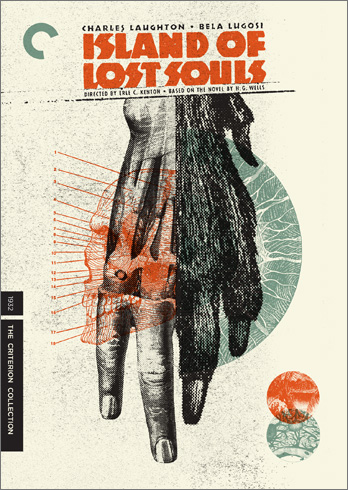
It's rather astonishing what a strange film Island of Lost Souls is. Directed by Erle C. Kenton in 1932, it's the first cinematic adaptation of H.G. Wells' The Island of Dr. Moreau. Though the story and various depictions of the titular doctor and the beasts he creates has since taken a permanent place in the pop culture lexicon--in most recent memory, the mad scientist was played by Marlon Brando, and the South Park parody of Moreau is almost as infamous as the real thing; not to mention musical tributes from quirky alternative bands like Oingo Boingo and, of course, Devo (who are featured on this Blu-Ray release)--I can't imagine what it must have been like sitting in those early audiences seeing this novel come to life for the first time.
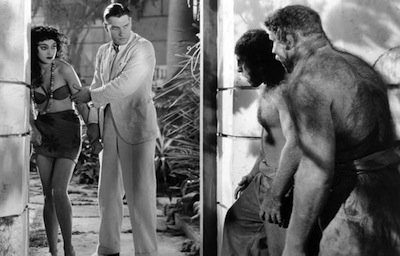
The story is pretty simple. Edward Parker (Richard Arlen) was set adrift when the ship he was sailing on sank. He is picked up by a cargo ship and cared for by Montgomery (Arthur Hohl), a disgraced doctor charged with guarding the wildlife being transported to an uncharted island. Parker runs afoul of the ship's drunken captain, and the seaman ditches him overboard with the animals when they reach their destination. This strands Parker and puts him at the mercy of Montgomery's boss, the slippery Dr. Moreau (Charles Laughton). The strange practitioner is at first concerned with what Parker might spy on his island, but then he sees an opportunity. Moreau has been creating creatures that are part human, part animal. The most perfect realization of his hybrid process is also the only female: Lota, the Panther Woman (Kathleen Burke). He doesn't trust the other aberrations around the woman, but maybe letting her mingle with Parker will reveal her true social capabilities. Can the Panther Woman love?
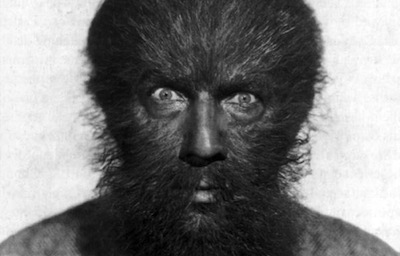
Island of Lost Souls is an impressive display of early cinematic special effects. Kenton and his team, which includes Wally Westmore on make-up and art director Hans Dreier (both of whom worked regularly with Billy Wilder and Preston Sturges), create an eerie, otherworldly environment for Moreau and his creatures. Thick foliage hides both Moreau's fancy laboratory and the village of the beast-men. They are led by the Sayer of the Law (Bela Lugosi), a bearded biped who seems slightly more evolved than his brethren, though still beholden to Moreau's strictures. The rules of the community are recited in a call and response ritual. "Are we not men?" they cry, and by way of proving it, adhere to the orders not to spill blood or to crawl on all fours like an animal. Some are closer to reverting to the old ways than others, and the least evolved are enslaved to turn the great wheel generating Moreau's power. It's a primitive fiefdom with the bad doctor as the King.
The make-up for the animal men is fantastic. They aren't just hairy beasts, different individuals represent different animals--a pig, a dog, a gorilla. Some look like Neanderthals, others look like something out of a carnival sideshow. Moreau is their ringmaster, and Laughton oozes a vile charisma. His words practically congeal into slime, and his cruel streak is satisfied through violent rule. He undergoes an almost sexual ecstasy when cracking his whip. His aptly named "House of Pain," where beast-men are taken for punishment, is like an S&M dungeon.
Parker's fate pretty much doesn't matter next to these more bizarre elements. Plus, Arlen is kind of a stiff and the character is a real heel. He makes out with the Panther Woman, something he fails to tell his fiancée (Leila Hyams) when she comes to rescue him--though she most likely suspects something when he's so eager to save the island native on their way out. By that point, their trajectory has splintered off from Moreau's, and honestly, there isn't much tension waiting to see the outcome of their flight from the madness. As with any science-gone-wrong film, the pay-off is seeing the egomaniac brought down. The implications of what might happen to Moreau in his own House of Pain are gruesome. Progress means little if you treat those around you with selfish pride, regardless if they be man or beast.
When you see a movie like Island of Lost Souls that is almost eighty years old and yet still has the power to shock, it makes you wonder why so many contemporary horror films are so ineffective at what they do. The endless parade of remakes, the plotless slasher films and torture porn--it all pales next to Erle C. Kenton's ambition and his precise storytelling. It's easy to gross someone out, it's even easier to bore them, but to elicit genuine chills, that's another talent entirely. Island of Lost Souls, like King Kong or the Universal monster films, are still the models the frightmasters should follow: human stories with human consequences, no matter how outrageous the trappings.
A few weeks ago, while I was waiting for my copy of The Night of the Hunter to ship from Barnes & Noble, my friend Scott Morse watched his. Scott is a comic book artist, as well as a staff member at Pixar. Amongst other things, he designed the end titles for Ratatouille [review] and is one of the main design guys on Cars 2. (Also, these Criterion-themed posters and a comic book about Kurosawa.) Needless to say, Scott has his bonafides when it comes to animation. Thus, when he posted the following to his Twitter, I listened:
NIGHT OF THE HUNTER is a pretty spot-on reverse "princess" story. Studios, take note of the clarity. Drink down the Love and Hate.
THE NIGHT OF THE HUNTER is seriously cut from the same cloth as every Disney flick of the 50's. Iconic, clear, and elegantly shocking.
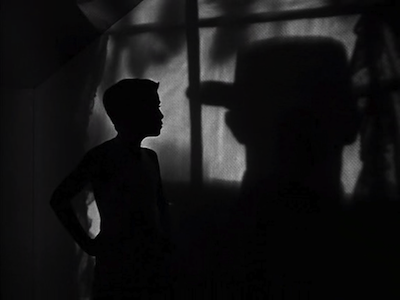
This is a fascinating theory, and one that absolutely bears out when you watch the movie. Charles Laughton's 1955 tale of menace is a contemporary fairy tale, staged like a children's play, shot like a film noir. From start to finish, it's a unique and daring film. James Agee's script flirts with innuendo, is suspicious of religion, and makes comedic hay of small-town mores. Laughton's direction is both arch and playful, employing film convention to create the safe and familiar, and then undercutting the same technique by deflating the comfortable air right out of its tires.
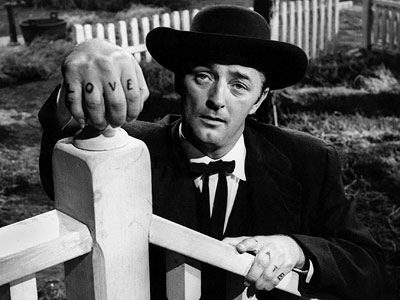
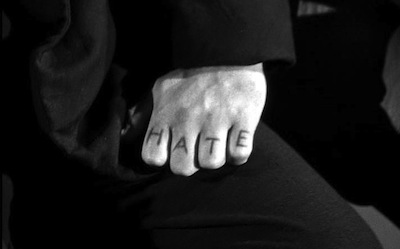
Robert Mitchum stars in the film. Preacher Harry Powell is one of his best-known roles. Though beloved by most of his fans as a hero with a hard jaw, he was a rebellious personality both on and off the screen. A few times in his career, the actor played a villain, revealing one hell of a mean streak. Harry Powell may wear a preacher's suit and hat, but this man has a twisted relationship with God. By his own admission, his version of Christianity is one he and the Supreme Being hammered out together. It's one easily explained, though. He wears his most prominent object lessons on his knuckles. On his left hand, he has tattooed the word HATE, one letter on each finger; on his right, LOVE. A man's hands are meant to work in tandem, but tangle the fingers together, and you'll find two objects at odds with one another. Every living soul is in a constant struggle between hate and love, between doing what is right and giving in to temptation.*
Every living soul except for Harry Powell, that is. Harry is a killer, though the extent of his crimes are just mysterious whispers at the start of The Night of the Hunter. He is pinched watching a burlesque show, but not for the phallic switchblade poking through his suit pocket, nor for the body we saw in an unspecified barn, but because he stole a car. He is sentenced to a month in the hoosegow, where his bunkmate is Ben Harper (Peter Graves). We met Harper when he got arrested. The Night of the Hunter is set in the Great Depression, and Harper killed two men and stole $10,000. Before he got nabbed, he gave the money to his young son John (Billy Chapin) and his even younger sister Pearl (Sally Jane Bruce) and made both of them swear not to tell where he stashed the cash. Ben Harper even goes to the gallows with the secret. The stolen bills are his children's future.
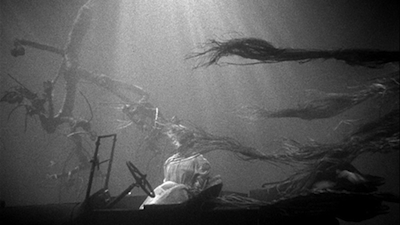
When Powell gets out of jail, he heads to the Harper homestead. There, he seduces Ben's widow (Shelley Winters), and once he is John and Pearl's stepdad, sets about trying to get them to give up the dough. When the woman gets wind of what Powell really married her for--apparently his rejection of her sex and subjugating her to his "religion" was not enough--the preacher murders her and dumps her body. It's a grizzly scene, but filmed to appear dreamy, almost idyllic. The widow Harper is dumped in the river in her Model-T Ford. The currents push her hair along with the underwater weeds, like the mythical Lady of the Lake, though her warning is darker than even that of legend.
With no one to protect them, John and Pearl go on the run. They take their father's rundown boat and set off down the Mississippi. Here, Laughton opens the door to the secret world of children. Most fiction for young readers has a quality of emphasizing the separateness of childhood. When you are small, the bigger world pays you no attention, and thus you can retreat into imagination. Disney films usually have a sense of this, too, though often, instead of kids, it's the parallel world of animals. Think about the cartoons where animals talk, and none of the humans can hear them. So it often seems to be when you are a child: you can talk, but the adults don't concern themselves with what you're saying.**
Tellingly, once the children are in the wilderness, human life fades away, and Laughton designs multiple shots that show the animal population that lives along the water. Spiders, rabbits, turtles, owls--the fugitive orphans and these woodland creatures exist in the same space, and the tiny humans pass unmolested. The animals don't shrink from them, either. This is the realm of fable. They are "other."
This is the most obvious element where the movie matches up to Morse's Disney theory, but there are many more touches throughout The Night of the Hunter that also work to remind us of classic animation. The children's journey is punctuated by songs, mostly schoolground tunes or religious hymns, but that serve to emphasize the emotional tenor of the scenes Laughton uses them in. The trek the kids go on is ostensibly a search for a home, having lost their own and, in a way, having had their identities erased. It's somewhere between Pinocchio, who is misguided by temptation, and Simba, whose birthright is threatened in The Lion King. (Or, even the exiled princesses, like Cinderella or Aurora in Sleeping Beauty.) Though Mitchum's performance as Powell can show him to be as sinister as Scar in the latter film, the more comical side is a bit like Prince John in Disney's foxy version of Robin Hood. The preacher can be petulant and downright whiney. He's a fascinating loon, often busting out dramatic gestures that recall Lon Chaney silent creepers. In one scene, after her meets the wrong end of a rifle, he runs away howling like Goofy tumbling off a cliffside. For as much as you might be scared of Powell, you also want to point and laugh.
Eventually, John and Pearl wash up on the riverbank near the home of a mother hen figure. Miz Cooper is played by legendary film actress Lillian Gish. She takes in strays and puts them to work in her garden, providing the structure and basic morals they otherwise lack. She is a kindly stepmother, not the wicked kind, and she even serves as a sort of narrative chorus. Cleverly, Agee and Laughton have one of her adopted girls make fun of how she talks to herself all the time, setting us up for the moral Miz Cooper will lay out at the end of the picture. She is both hard and soft, tough on her kids but caring. In contrast to Powell, her behavior is anything but erratic: this is someone the kids can count on. Her home is tidy and traditional; the town nearby is chaotic, lit with neon, full of temptation. Again, it brings to mind Pinocchio and the carnal delights that lead him from Gepetto. The lure of all this sin will call Miz Cooper's oldest charge, Ruby (Gloria Castilo), and Powell will trick her into revealing too much.
Gish is marvelous as the staunch caretaker. She and most of the older character actors really shine under Laughton's direction. Evelyn Garden is particularly good as the annoying busybody Icey Spoon (and she looks exactly like Madam Mim from The Sword in the Stone [review]. I have to admit, though, the child actors aren't that great. Five-year-old Sally Jane Bruce is extremely stiff, looking like she has barely enough attention span to remember what she is supposed to do. Ten-year-old Billy Chapin is quite a bit better, but his performance is actually hurt by Laughton's direction. He regularly isolates the boy for reaction shots, and the way he cuts the scenes doesn't quite connect the boy's expressions to what he is reacting to.
I know this could get me lynched, but I found Laughton's direction to be quite clumsy at other times, too. Some shots are too rigid, and the editing disjointed. Look at, for instance, Powell chasing the children up the cellar stairs. Mitchum appears to be parodying a horror movie ghoul, and it has the appropriate effect, being at once silly and menacing. Yet Laughton and editor Robert Golden don't give the moment its due. They shove a single side shot of this attack into the action, and it doesn't quite fit. For as short as the shot is, it's almost like they started it too early and cut it too soon, you can practically see the marks on either side of Mitchum's lunge. Likewise, for as lovely as those riverbank images of the forest animals can be, they always look like they've been arranged, they aren't natural. Obviously, there are shots throughout the movie that are meant to look like something out of a storybook (observe, for instance, the hangman's children asleep in his shack), and Laughton has done a good job composing them--but it's too good. The illusion bursts.
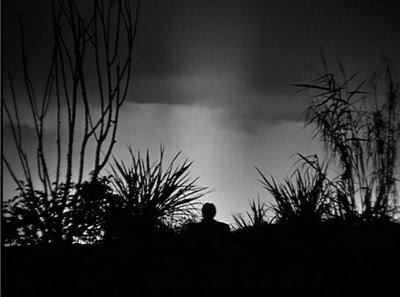
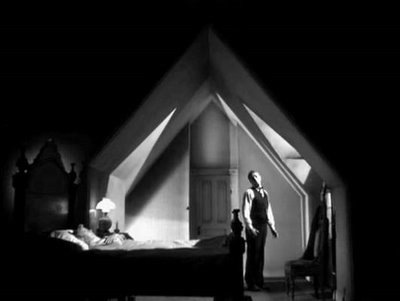
That said, when Laughton and cinematographer Stanley Cortez (who also worked with Orson Welles on The Magnificent Ambersons) are on target, they really are dead center of the bull's-eye. Laughton's use of silhouette and shadow is unmatched in its visual power. He can use light and dark to create both a sense of calm and of terror, and often in the same scene. When the children bed down in a barn, their appearing as shapes against a night sky is serene and lovely; when they awake to hear the approaching Powell singing his signature (and ironic) hymn, the vast horizon suddenly becomes unbearably huge and oppressive. The smaller silhouette in the distance is a threat, and though far away, the distance emphasizes the killer clergy's inescapable presence.
Smartly, as The Night of the Hunter winds down, so too does Laughton dial back the style. His approach has a more old-fashioned, family movie vibe in the last couple of scenes, including the amusing image of Miz Cooper leading her brood through the back alleys like a mother duck and her chicks. In these kinds of stories, the final chapter is when some kind of normalcy is restored, and the traditional Christmas scene Laughton and Agee have concocted is meant to be familiar and homey. No divisive shadows, no extreme angles or compositions, mostly just straight-on shots of Miz Cooper stirring her stew pot, musing on the plight of the wee ones as they move all around her. It's a reassuring finale, restoring the natural order, including letting us know that it's not God or His son that's gone all wrong, but the misguided people of the world that have twisted their positive message. Too much of the left hand, it would seem, and not enough of the right one.
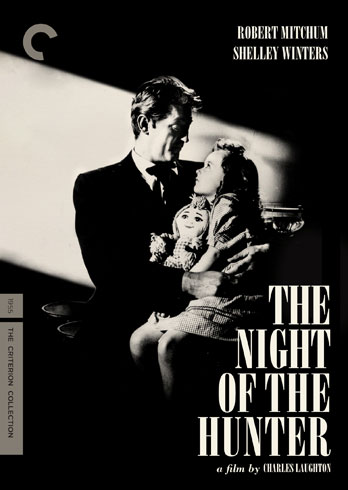
Criterion's two-disc release of The Night of the Hunter, available on standard DVD and Blu-Ray, is an outstanding package. Put together in cahoots with the UCLA Film and Television Archive, the restored print is superb and the collection of extras is a treasure trove of quality supplements, including a clip of the Peter Grave and Shelley Winters giving a live television performance of a scene that ended up cut from the film.
If you're going to watch any extra, however, you must jump over to the second disc. It is devoted to the two-and-a-half-hour documentary Charles Laughton Directs "The Night of the Hunter." This film, put together by Robert Gitt, is a compilation of outtakes and alternate footage from an unprecedented library of dailies that Laughton kept for himself. Gitt uses the raw material to create a history of the production, as well as an alternate version, working through the story in the same narrative order, giving us a glimpse of how a movie is shaped as it is filmed. Deleted shots and flubs share the screen with experiments and rehearsals, as well as curios like Laughton reading from the Bible, author Davis Grubb's sketches he made for the director to show him how he saw his novel portrayed (these also get their own feature on disc 1), and even a scene with the original Uncle Birdie. Emmett Lynn was originally meant to play the old drunk, but Laughton thought his performance was too mannered and cliché. He recast the role with James Gleason--and rightly so judging by what we see here. Gleason nails it.
* Spike Lee would, of course, update this symbolism in Do The Right Thing (another Criterion release), giving Radio Raheem gold rings spelling out each word and likening the struggle of man to something more like a boxing match.
** If you're curious to further explore this secret world of children as portrayed on film, pairing The Night of the Hunter with another Criterion disc, Rene Clement's Forbidden Games, would be a great double-feature.
Given that David Lean's career is largely characterized by epics like Lawrence of Arabia and The Bridge on the River Kwai, it's easy to forget that he was also quite capable of smaller-scale human drama. Many of his earlier films were confined to the streets of England, including his romantic masterpiece Brief Encounter and his Dickens adaptations. If one were to draw a connecting line through Lean's filmography, in fact, one would see that the depth of character of his first efforts informed the greater dramatics of his later work, which is arguably why they are a cut above other entries in the adventure/spectacle field. Likewise, whether working in an open desert or on the cramped streets of Victorian England, he was a master of setting. It didn't matter where the story took place, Lean always created a believable cinematic world.
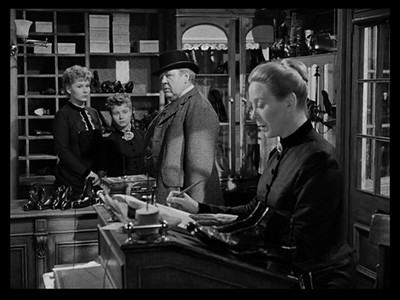
Such is the case with his 1954 comedy, Hobson's Choice, a clever tale set in the middle streets of 19th-century Manchester, somewhere between the slums and the commercial center of town. The Hobson of the title is Henry Hobson, a widower father of three and owner of a shoe shop, and played by the legendary actor Charles Laughton. The story--filmed from a screenplay by Lean, Norman Spencer, and Wynyard Browne and based on a stage production by Harold Brighouse--joins Hobson later in life. His business is moderately successful, enough so that he can leave its running to his three daughters while he spends most of the day in his cups down at the Moonraker Pub. The younger daughters (Daphne Anderson and Prunella Scales) have sweethearts and are looking to get married, but their cheapskate father doesn't want to pay the dowry it would require. He also doesn't want his older daughter, Maggie (Brenda De Banzie), to find a husband because then he'd lose the free labor. Though she’s only aged 30, Hobson has already cast Maggie as the old maid, blind to the fact that the responsibility he has put on her all these years has prepared her for life far better than he could have hoped for.
Working in Hobson's shop is one William Mossop (John Mills), a meek cobbler with a special knack for molding leather. Seeing her opportunity after a rich patron (Helen Haye) praises Will's work, Maggie bullies him through a courtship and into business and marriage. They set up a rival shop, wounding poor Hobson's pride and enflaming his bluster. Maggie's scheming extends further, and she arranges her sisters' marriages, turns Will into a man, and brings it all back around to her pop in seemingly short order. The comedy is sweet and never mean-spirited, meaning Maggie's plans work out for everyone, even Henry Hobson gets to save face and retain a little ego. The structure and the presentation have a classical feel, keeping the same basic set-up as was likely found in Brighouse's play, with the various story points coming out of character behavior as much as they are there to service the plot.
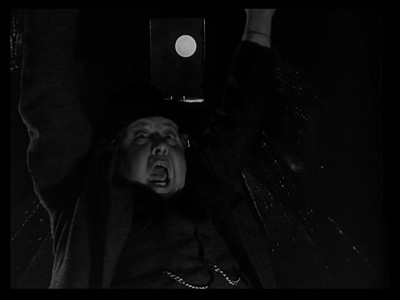
In truth, Henry Hobson is a little like a bumbling King Lear, lost in the dementia of drink and unable to see which daughter truly cares for his well-being. Though the story as much belongs to Will and Maggie on paper, on celluloid, Charles Laughton takes full command of the scene. He tears up the screen whenever Hobson goes off on one of his many puffed-up rants, and the actor is skilled enough to convey the force of the tirade while also maintaining the impotence that lays the foundation for Henry's overcompensation. One of the best scenes is when a clearly bruised Hobson, being ribbed by his friends, drunkenly retaliates with bitter insults, exposing an awareness that his position as the patriarch has been undermined. Until Maggie's revolt, he had at least been able to keep up the image of being in charge when sat in the barstool, but now all of that is gone. This scene then makes way for the best bit of comedy in the movie: Charles Laughton, soaked through and through with whiskey, chasing the moon through rain puddles. I've seen a lot of comic drunks in my time (and even been one myself more times than I can count), and this performance is up there with the best. It's utterly convincing, both hysterical and heartbreaking, and laying the groundwork for the sympathy the character will require in the film's final act.
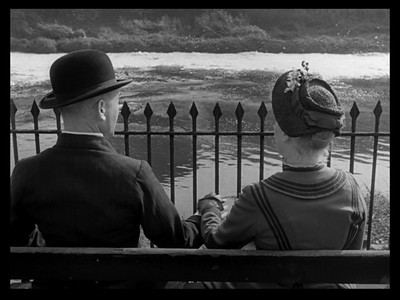
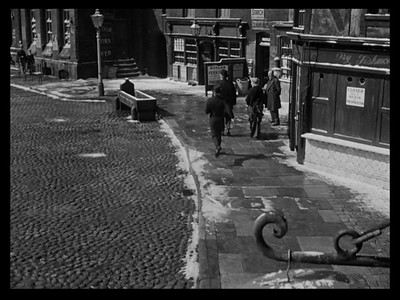
In addition to the charm of the story, Hobson's Choice has the bonus value of being full of wonderful set pieces and impressive location shooting. From the stone streets outside of Hobson's shop to the open parks and the lovers' view of the River Tame, David Lean expertly uses a combination of real environments and detailed sets to recreate a vibrant Victorian city (IMDB indicates that the film was shot both in the Salford suburb of Manchester and in Shepperton Studios). There is no obvious delineation between what may be authentic and what may have been built by a movie crew. The interiors are just as convincing and lively as the exteriors. The art direction of Wilfred Shingleton (Tunes of Glory) is lit with a smart eye for light and shade by regular Lean cameraman Jack Hildyard, creating an inclusive world that fully immerses the viewer in the filmic illusion.
This commitment to realism when combined with the quality of acting gives Hobson's Choice an unexpected air of truth even when the generally smart writing delivers some of its most contrived narrative twists. As with any great family comedy, the audience feels that they are part of the Hobson clan by the end, and thus when just about everyone comes together and gets what is best for them in the finish, it has an added punch of joyfulness. Through the rough stuff (Hobson's morning-after DTs), through the romantic stuff (Maggie and Will's patient acquiescence blossoming into love), and even through the subtle suggestions of class issues (Will's upward mobility, the family's snobbery in his direction), Lean delivers a message that it's both the good and the bad that binds family together, and faith tempered with obstinacy and even a little self-sufficiency will make any obstacle surmountable. Of the many choices that Hobson must make, it's the most important one: to let family do for him what may be best for all rather than simply what he thinks is best for numero uno. It's a quiet transformation, made partially under protest and through gritted teeth, but when it comes to Henry Hobson, one couldn't imagine it going any other way.
Author of prose novels and comic books like Cut My Hair, It Girl & the Atomics, You Have Killed Me, and 12 Reasons Why I Love Her. Jamie's most recent novel is the serialized book Bobby Pins and Mary Janes, and his most recent graphic novels are the sci-fi romance A Boy and a Girl with Natalie Nourigat; Madame Frankenstein with Megan Levens; and the weird crime comic Archer Coe & the Thousand Natural Shocks with Dan Christensen.


 ) is on the throne. Lacking both an Emperor and a direct heir, Elisabeth is trying to position her nephew, Grand Duke Peter (Douglas Fairbanks Jr.,
  ,
,  ), to take over and carry on the bloodline. In classic fashion, the young monarch is not as interested in affairs of state as he is in affairs of the heart and also those of the body. Being a ladies man and a scoundrel, the idea of marrying a German princess he's never seen doesn't really appeal to the dandy. His mind changes, however, when he meets Catherine and she charms him with her naïveté and devotion.


 ). The German princess has heard enough stories about Henry, she knows any union with him is a ticking clock. On their first night together, she wins a divorce in a card game. Fittingly, she also comes back later to give Henry advice on why he keeps getting it wrong, choosing the sixth wife (Everley Gregg), the one who will get him into old age, on his behalf. She is very funny, mugging for the camera, making silly faces in the mirror trying to decide whether or not she is attractive. (Lanchester was, but Korda dresses her frumpily, isolating her face in order to play up her exaggerated features.) She strives for self-awareness, whereas Henry VIII lacks it completely. The entirety of the pop culture endurance of this Tudor emanates from the scene in Private Life where Henry scolds his court for the decline of manners in the kingdom, all the while slurping on ale and eating a cooked bird, tossing bones and sinews over his shoulder without a second thought.


 , and the
  parody of Moreau is almost as infamous as the real thing; not to mention musical tributes from quirky alternative bands like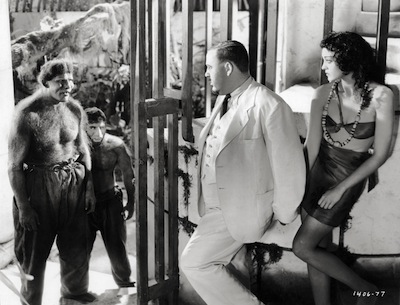
 or the
  , are still the models the frightmasters should follow: human stories with human consequences, no matter how outrageous the trappings.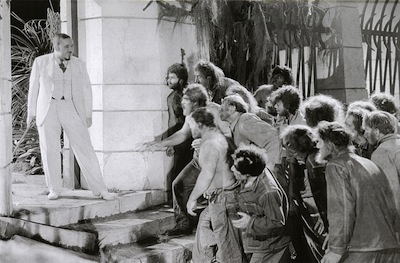

 , who is misguided by temptation, and Simba, whose birthright is threatened in
  . The preacher can be petulant and downright whiney. He's a fascinating loon, often busting out dramatic gestures that recall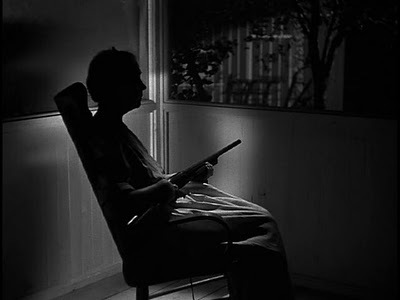
 and
and  , it's easy to forget that he was also quite capable of smaller-scale human drama. Many of his earlier films were confined to the streets of England, including his romantic masterpiece