Showing posts with label monsters and madmen. Show all posts

Monday, December 22, 2008

MONSTERS & MADMEN (#364): THE ATOMIC SUBMARINE - #366


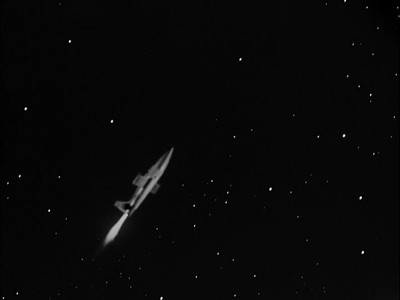
It seems backward to me that a fake rocket shooting through fake stars would look more convincing than a fake submarine drifting through a simulated Arctic sea, but comparing First Man Into Space with its companion picture, The Atomic Submarine, I'll be damned if that isn't the case. Perhaps it's the preponderance of fishbowls and all of their plastic accoutrements in real life, or perhaps it's that we all know what it looks like under the water and the fact that the U.S.S. Tiger Shark never actually gets wet that makes it hard to not see the effects in The Atomic Submarine for what they are. A plastic toy and wavy lighting makes for a tough sell, even in a campy, retro sense.

It also doesn't help that the bad guy in The Atomic Submarine has had his bizarre image supplanted by a far better known pop-cultural force.
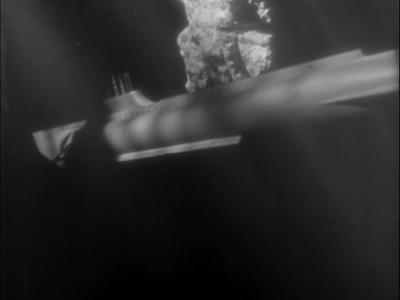


The plot of The Atomic Submarine is this: Some unknown assailant or force has been destroying U.S. subs working under the North Pole. Not just any subs, either, but nuclear subs. Intent on stopping whatever it is, the government sends their top craft, the Tiger Shark, to find out what is causing the mayhem. Armed with a couple of extra scientists, as well as a joyriding pacifist who has invented a special diving craft with his father, the men of the Tiger Shark head out to sea. Once in the Arctic Circle, they encounter a malevolent saucer with a single staring "eye," which they then dub Cyclops. Unable to shoot it out of the water, they try to ram the ship, getting the sub's prow stuck in its hull. The pacifist, Dr. Carl Neilsen (Brett Halsey), and his tough-guy nemesis, Commander Richard "Reef" Holloway (Arthur Franz), board the Cyclops with three expendable men, hoping to pull their nose out of the Cyclops' butt. Once on board, Reef encounters the thing that is piloting the killer craft and uncovers what is really going on.


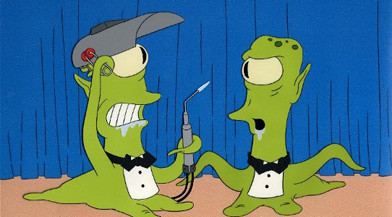
What is really going on is that aliens are looking to colonize Earth, and the single creature at the helm of the aptly named Cyclops is a one-eyed, many-tentacled extra-terrestrial. He first makes his presence known as a voice appearing in Reef's head, and upon hearing John Hilliard's dubbing, I immediately thought of Kang and Kodos, the alien invaders from The Simpsons. Little did I suspect that when I actually saw the Cyclops pilot, he would also look like Kang and Kodos. Mere coincidence? Possibly. Kang and Kodos were apparently based on an old EC sci-fi comic, and who knows? Maybe Irving Block and his team of effects men were inspired by the same comic book.
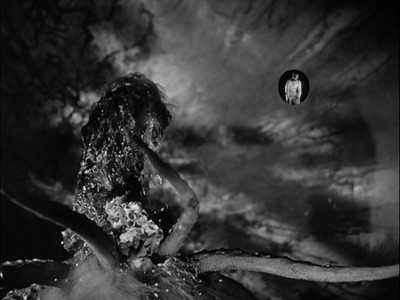


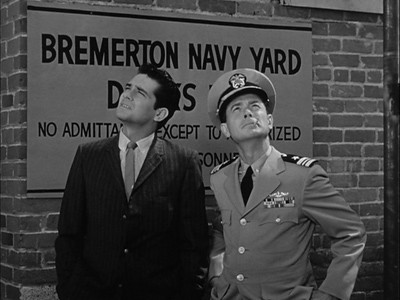
Of the four movies in the Monsters and Madmen boxed set, The Atomic Submarine is easily the bottom of the stack. I'm all for preposterous stories, but the design of the interior of the alien machine lacks any internal logic, and the way the Tiger Shark defeats the invader puts an unbearable weight on one's suspension of disbelief. Not even the ham-fisted dichotomy between the pacifist and the warrior doesn't geta its full due. Despite the final scene of the movie being a wistful moment shared by Neilsen and Reef--on land, and lit like its daytime on the ground in direct opposition to the starry sky that brings the men pause--the filmmakers don't even go for the obvious pay-off, driving home that despite Nielsen's previous distrust of the military, he now sees that there is a need for vigilance. Somewhere out there is a great threat, and it will take men like Reef to keep the planet safe from harm. Take that, you peace loving science guy!

It will also take better men than we see here to make a decent adventure movie about space-age submarines. Then again, I just may have a pitch for the guys at The Simpsons. I know how to work Kang and Kodos into the 2009 Treehouse of Horror!

Thursday, December 18, 2008

MONSTERS & MADMEN (#364): FIRST MAN INTO SPACE - #365


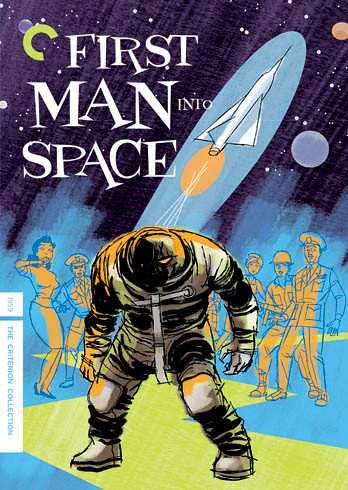
Inspired by the good time of reviewing Robinson Crusoe on Mars last week, as well as enjoying the irony of exploring the vastness of outer space while being snowed in for an especially chilly Oregon winter, I decided this week to watch another old sci-fi film, First Man Into Space. It's part of the Monsters & Madmen collection, the Darwyn Cooke cover art for which is currently featured as a limited edition print in the Criterion store.


Though during my October horror fest I had reviewed the spookier titles from Monsters & Madmen, I hadn't yet sampled the more space-age selections. Directed by Robert Day, from a story by Wyott Ordung and a screenplay by John C. Cooper and Lance Z. Hargreaves (what names these guys have!), First Man Into Space is of the same hopeful yet cautious ilk as other 1950s astronaut movies. Released in 1959, two years after Laika had gone into orbit, the movie raises the next logical question: how do we get a human being up there?

Well, it kind of asks the question. Though many of the sci-fi chillers of the 1950s carried a secret message, either about the effects of Communism or even the dangers of meddling with forces beyond our scope in the Atomic Age, one really has to force a square peg into a round hole to divine a greater meaning out of First Man Into Space. Sure, there are cursory reminders to remember the human element in our efforts to perfect machines, and one could possibly argue for a message regarding the double-edges of nature. It helps us when we need it, but not heeding its lesson could cause our downfall. Yet, to get such a lesson out of the flick is probably only possible if you really want to learn one, and I'm guessing the filmmakers aren't really expecting you to bother.


First Man Into Space is about a pair of brothers who work in an unspecified experimental technology and space-focused division of the U.S. Navy. The logical and precise Commander Charles Prescott (Marshall Thompson) works in the control tower, while his brother, Lieutenant Dan Prescott (Bill Edwards), is a test pilot, so by nature daring and prone to straying off mission. Film technology even establishes another unintentional division between the pair: for some reason, all of Edwards' dialogue was re-recorded in ADR, giving it a flat quality lacking in ambient tones, while Thompson's dialogue has the echo and cadence reflective of the natural space of the wherever he is at. Ironically, those are kind of backwards, since Charles is more the machine and Dan the unpredictable force, but then again, if we want to find a lesson, these boys do end up crossing over each other by film's end. So perhaps we it's not to be too much of one and stay open to the possibility of the other?

The movie begins with Dan taking off in a new rocket. The basic dynamic of ground control and flight mission is already in place, even in 1959, with the action jumping back and forth between the guy being shot into the sky in a tin can and the people on Earth trying to keep him alive. Dan pushes his plane to the limit, going as high as he can, and ultimately falling back to Earth and narrowly escaping death. Not one to wait for a rescue team, he hauls ass into town to hook up with his “babe,” the saucy yet oddly melancholy Italian scientist Tia Francesca (Marla Landi). Charles wants to go over the details of the mission, and Dan wants to go over the details of Tia.


Dan's derring-do gets him noticed by the media, so against Charles' wishes, his brother is put in the pilot's chair for the next mission. This time, Dan goes past the 250-mile mark, getting cut off from base and once again plummeting back to Earth--but this time bailing from the rocket in the nose cone. When the escape capsule is found, Dan is gone, and in his stead there is a strange, rocky protective coating around the shell of his craft. There are also some suspicious-looking cows slaughtered in the farmer's field Dan landed in, but until a monster starts leaving bodies in the town nearby, no connection between the crash and the bovine dead is made.

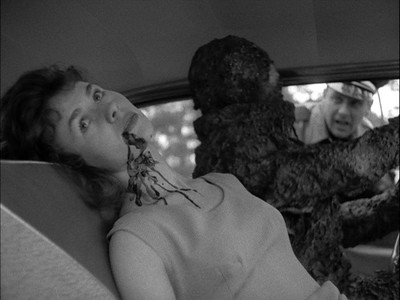
As it turns out, the protective coating not only covered the spaceship, but it has covered Dan, as well, turning him into an indestructible space vampire thirsty for blood. Since he can drive a car, Charles and Tia realize that some kind of intelligence, some semblance of the man they knew, must be left in that lumbering Golem from the cosmos, but how to stop his murder spree before the Navy and local police insist on stopping him?


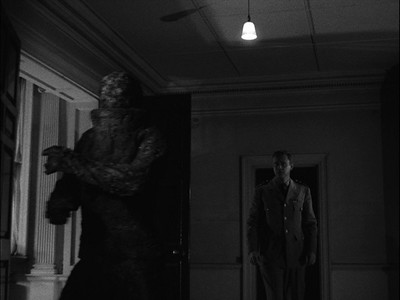
The transformed astronaut isn't much of a monster. He is just a guy in some kind of body covering suit, like he's been wrapped in a rubber recreation of the surface of the moon or something. As a creature of destruction, he's not very convincing, and if it wasn't for the explanation of the destructive power of the substance that surrounds him--on its own, it's flexible and harmless; add force, and it's hard and deadly--there'd be no reason for everyone to stay out of his way like they do. Just hit him with something heavy and knock him over!

Much more impressive are the special effects simulating outer space. Dan's rocket is a convincing model, and his tailspin at the start of the picture, with an animated planet Earth doing loop-dee-loops across the screen, is actually pretty cool. It's kind of too bad that there wasn't more of that, because I was really digging the rocket adventure. I'm sure some of this might have been budget constraints--the rampage of a man in a cheap suit costs less than rocket fuel--but then again, it fits the weird dichotomy of the times, anyway. Like so many other sci-fi movies of the early space age, First Man Into Space is both hopeful about the future but strangely naïve about what it might mean. The technology is rudimentary, the consequences still rooted in superstition. Things go bump in the night, and to expand the night to include the whole of the galaxy just means we're inviting those bumpy things back here.

Or maybe First Man Into Space is just harmless fun, with no lesson at all. Either way works for me!


Friday, October 10, 2008

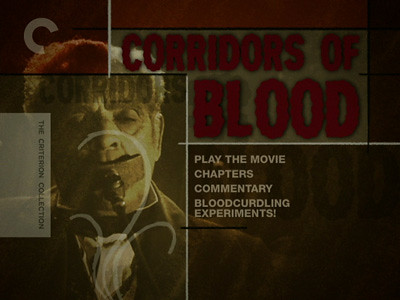
MONSTERS & MADMEN (#364): CORRIDORS OF BLOOD - #368


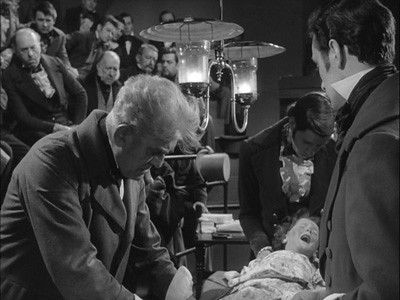
The second Boris Karloff movie in the Monsters & Madmen boxed set is not the expected monster flick, but instead a melodrama with tinges of Victorian horror and elements of morbid tragedy. 1959's provocatively titled Corridors of Blood is the story of Dr. Thomas Bolton, a surgeon in 1840s London obsessed with the idea of finding a way to perform operations without causing the patients great pain. No anesthetics had yet been invented, and so swiftness is believed to be the best way to operate with a minimum of harm. Bolton is the speediest cutter in the hospital, but the screams of those he means to help still haunt him.

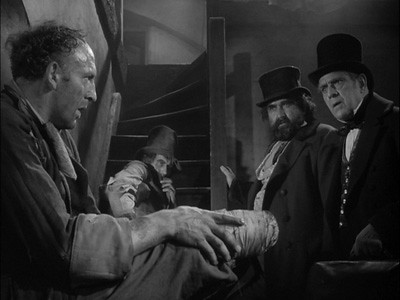
In addition to his duties at the hospital, Bolton is a humanitarian who spends his off hours providing free medical care to the poor in the Seven Dials slum, and in a movie like this, it's a fair bet that anyone this good is likely to be taken advantage of. Bolton is preyed upon by unsavory types; in particular, Black Ben (Francis De Wolff), the owner of a seedy tavern in the ghetto. Ben tricks the good doctor into signing a death certificate for a cadaver he swears died of a fever but who was really strangled by Ben's colleague, the sinister Resurrection Joe (Christopher Lee). With proof of a legal death in hand, they can sell the body to Bolton's hospital to be chopped up by eager students.


An accident with his own laughing gas concoction leaves a giggling Dr. Bolton wounded from broken glass but surprisingly free of pain. His niece, Susan (Bella St. John), points out that he must have found the formula he has been looking for if he didn't feel the cut, and so Bolton amps up his efforts. Determined to find the right combination of chemicals, he continues experimenting on himself. Huffing his dangerous gas, he goes into fevered states, wandering to Black Ben's in the middle of the night and completely forgetting everything by morning. The more he experiments, the worse it gets. His surgery begins to suffer, and he even takes a hit to perk himself up so he can face company Susan has invited over to the house. Dr. Bolton has become a full-blown addict! Suspended from work, he starts suffering withdrawals, and he makes a pact with Ben and Joe to trade more death certificates for helping him steal the chemicals he needs for his drug. Murder follows, and the doctor makes his final descent into the darkness.

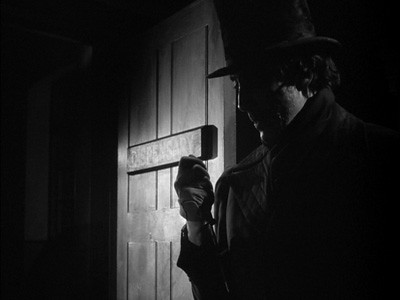
Every time Karloff would hook himself up to his gas contraption, a kind of mad scientist hookah, I kept expecting him to turn into a deformed killer like the one he played the year before, working with the same director (Robert Day) and producer (Richard Gordon), in The Haunted Strangler. No such luck. Anyone looking for more shocking thrills and chills are likely to be disappointed by Corridors of Blood. Most of that blood is confined to the hospital and the gruesome surgeries Bolton performs, and the closest we get to a monster is the menacing Resurrection Joe. Christopher Lee makes an imposing villain. Tall and thin, dressed in a long black coat and a stove pipe hat, his angular face cut by shadows and marked by scars, Joe says little but he does much. The most horrific act of violence in the movie isn't when he snuffs out the life of his victims with a filthy pillow, but when he sexually assaults the flirty waitress Rosa (Yvonne Warren), smiling at her cries of terror.


Too bad there isn't more of Resurrection Joe. I wouldn't have minded if he had been the doc's sidekick rather than Black Ben's, bringing him live test subjects to try his creations on. Unfortunately, without either of these men unleashing their darker talents, Corridors of Blood can be a little slow going. Robert Day shoots the picture in a rather straight-ahead style, relying on Karloff's panic to convey the frenzied emotions when sharper angles and exaggerated focus could have really amped up the paranoia. Even the doctor's hallucinations are rather staid, getting no crazier than simple double vision.

Perhaps it's a case of misguided expectations, I was too busy looking for what I thought would be there to see what really was, but in a boxed set called Monsters and Madmen I expect one or the other in the movies contained therein. Corridors of Blood had the potential to have both, and they could have even done it without resorting to the supernatural. (Though, why shouldn't they? It's not like Thomas Bolton was real!) A more wicked Resurrection Joe, a less scrupulous and more driven doctor--these things could have meant we'd really see some bloodstained hallways. Instead, we're safely shielded from the splatter. Dr. Thomas Bolton wanted painless surgery, and instead he got a painless movie.


Friday, October 3, 2008

MONSTERS & MADMEN (#364): THE HAUNTED STRANGLER - #367


In England in 1860, a one-armed man is hung as the Haymarket Strangler; twenty years later, a crusading novelist researching the case discovers that the dead man was not the guilty party after all--a theory proven when the killer returns!

Boris Karloff stars in The Haunted Strangler as James Rankin, a writer with an interest in curing society's ills. He intends to use his latest effort to prove that due to the fact that the impoverished can't afford proper legal aid, innocent men are often condemned. Doing just a little detective work with his assistant, Dr. McColl (Tim Turner), Rankin begins to create an alternate theory regarding the young doctor who both performed the autopsies on all of the murdered women and can be placed at the scene when the hanged man was identified. The Haymarket Strangler's modus operandi was to choke his female victims with one hand, and when that had done as much damage as it could, he would slice them up with a knife. Thus, when a dancing girl, Cora (Jean Kent), saw a one-armed man fleeing after murdering one of her co-workers, the case was apparently cracked.


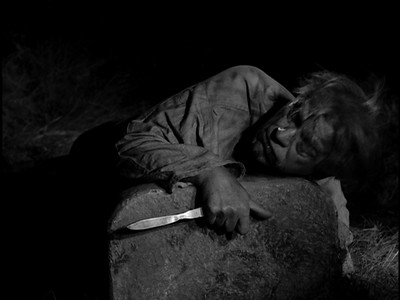
Except that there could have been other explanations for the killer only using one arm, and new clues lead Rankin to believe that the key to the case is the missing knife used by the killer. Find it, and maybe then the connection to the missing doctor will follow. Believing that the instrument of death was stashed with the corpse of the wrongfully accused, Rankin digs up the casket. Inside, amongst the dirt and bones, he finds what he seeks, but he also gets more than he bargained for. With the surgical scalpel in hand, Rankin is transformed into the Haymarket Strangler!

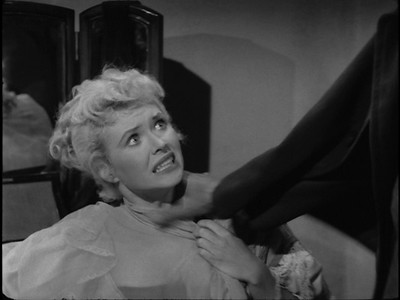
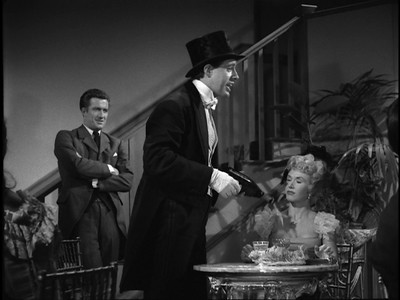
The Haunted Strangler (known as Grip of the Strangler in the UK) was the inaugural production effort of Richard Gordon, whose film background had included publicity and distribution before Boris Karloff convinced him to put up the cash for a story writer Jan Read had put together for the legendary horror actor. Made simultaneously with the sci-fi shocker Fiend Without a Face, Gordon dialed into the exploitation formula from the get-go. Though The Haunted Strangler makes pretenses of being about greater social issues, it's the luridness of the plot and the setting that dominates. Karloff's Rankin may be interested in correcting injustices, and the subtext in regards to whom the victims are, both the hanged man and the strangler's women, is that there is a segment of society that exists beyond the benefit of law and order. All such concerns are quickly set aside, however, making way for the brutal descriptions of the sexually motivated slayings and the scuffles between the possessed writer and police. Shots of whipped prisoners with bloody lashes across their backs or Karloff slicing up a guard's face with broken glass are pretty graphic for 1958, as is the twisted psychology that motivates the murders. Multiple scenes of cancan girls and a champagne spilled down Vera Day's cleavage also add to the idea that The Haunted Strangler wasn't really a high-falutin' social drama. Screams and titillation are the order of the day!


Are these shots just for cheap gawking, or are they foreshadowing of the defilement to come? Pretty soon, that pretty neck will be wrung and that porcelain skin will be stained with blood.


The picture was designed specifically for Karloff, and it's very much his vehicle. His transformation from moralistic novelist to psycho killer is done without the benefit of make-up or prosthetics. Karloff's only special effect is his body. He gnarls his hand into a claw and contorts his face so that one side looks like it's stuck in a permanent flinch, like he was punched and never recovered. Though it looks slightly comical by today's standards, Karloff gives 100% of himself to the performance. There seems to be added psychology in the fact that the malformed arm and the pinched half of his face are on two different sides of his body. He's no mere Jekyll and Hyde split in twain, but a far more twisted creature.

The story here, complete with the scenes of grave robbing and mental asylums, reminds me of two pictures Karloff made under the aegis of producer Val Lewton a decade prior: The Body Snatcher and Bedlam. As with those two movies, here Karloff and director Robert Day relied less on scare tactics and more on the overall spooky mood they were able to draw out of the settings and situations. Though not as tightly crafted as the Lewton pictures (the skeletons in the graveyard here are laughably fake), The Haunted Strangler still succeeds as pure popcorn entertainment. The Gordon Bros. (sibling Alex got into the movie game, as well) made up for a lack of budget by giving the kind of visceral sights and frights they knew audiences wanted, and the pleasures are simple and universal enough, that they still have kick half a century later.


The Haunted Strangler is part of the four-movie Monsters and Madmen boxed set, and I'd be remiss if I didn't note that the cover artwork was created by popular comic book artist Darwyn Cooke, creator of DC: The New Frontier and currently at work adapting the Richard Stark series of Parker crime novels into a series of comics. Cooke uses a style here that is both reminiscent of 1950s movie posters as well pulp and sci-fi novels, but still with enough of a personal twist that they match his own unique vision. For The Haunted Strangler, he fulfills Rankin's goal of keeping the victim front and center, but also matches the exploitation style by dressing the dead girl in a sexy cancan outfit. Karloff's mangled visage occupies the background, looming over the deceased as well as the tinier image of Rankin digging in the graveyard in the lower right corner. With its streaks of blood and muddy color palette, it's an evocative piece that makes the consumer want to see the movie and then rewards us even further after we have, when knowing what all the symbols mean gives the picture added power.