This review was originally written for DVDTalk.com in 2014.
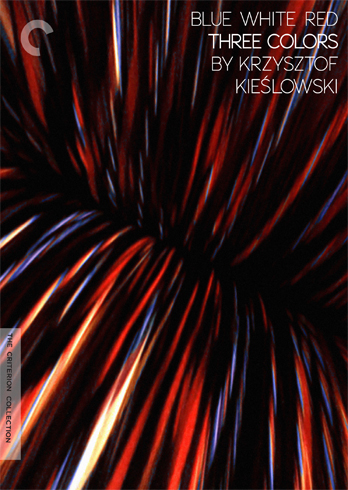
Ulrich Seidl's Paradise trilogy is a series of films connected thematically by the three different theological tenets that give them their name, as well as by the story aspect of each film being about different sisters in the same family. Their easiest comparison is to Kieslowski's Trois Coleurs [review], but Paradise has even less crossover elements than that masterwork.
Paradise: Faith is ostensibly the second part of the series, though they really can be watched in any order. (True confessions, I had yet to see Paradise: Love, the initial release, when first writing this review, but have seen it now.) Faith stars Maria Hofstätter as Anna, a middle-aged woman who has devoted her free time to bringing Catholicism back to Austria. Her chosen mode of witnessing is traveling door-to-door with a statue of the Virgin Mary and trying to convert the sinners she finds, blessing them with holy water dispensed from a spray bottle. She's terrible at the job. What she lacks in empathy she makes up for in self-righteousness. Some of the scenes of her testimony are painful to watch. A hoarder who accepts her help has difficulty kneeling, but she insists he position himself in just the right way. A drunk woman toys with her, and Anna's stubbornness nearly pushes her to violence.
By that point, we have the sense that these reactions may be just fine with Anna. She intends to suffer for her belief. When she fails, she repents through self-flagellation and a chain-link girdle. Each obstacle is just a test from Jesus.
The biggest test comes when Anna's estranged husband returns without warning. Nabil (Nabil Saleh) is an Egyptian Muslim and also a paraplegic. He is baffled and angered by his wife's conversion to Christianity, and though we never know for sure why he left, we do see him be both physically and verbally abusive. Perhaps it's his cruelty that has made Anna tone-deaf to the suffering of others. She believes God crippled Nabil to help him. His time in the wheelchair hasn't inspired personal reflection, however; not unless it's an act of faith to spend a lot of time thinking about sex. (If so, guess who has ten typing fingers and is going to Heaven? This guy!)
It's certainly to Seidl's credit that he gives no lip service to either religion in Paradise: Faith. One is not pitted against the other, and really, viewers might hazard a guess that the auteur has little regard for religion in general. What is more interesting to him is how both Anna and Nabil use their faith to cover their own shortcomings. As the old Bible verse suggests, one usually points out the splinter in another's eye while denying the massive plank in their own.
Paradise: Faith lacks an editorial point of view. Rather, the director holds his camera back, keeping his distance, letting the scenes run their natural length without unnecessary cuts. This makes the more difficult scenes even more uncomfortable. The viewer gets no chance to look away, and can't gauge when the moment will finally break. The resulting squirm factor can be excruciating.
Adding to this is the realism of the locales and, more importantly, the performances. Neither Hofstätter nor Saleh appear to ever really be acting. None of the cast looks like actors. Thus, the usual telltale signs of playing to the camera are absent, leaving only the individuals. It's one step shy of documentary. We are the omniscient observer, the God in which these people should have faith, if you will.
Seidl's drama can be tough work. Its lack of conventional plot requires that one pay absolute attention, even as the filmmaker's refusal to sugarcoat or add any adornment at all might compel you to turn away. Accept that Paradise: Faith is heading somewhere, though, and you'll be surprised by how much the film has moved you in the end. Most likely it'll be closer to depression, because uplifting it ain't. Misery is sometimes it's own reward, if not a couple hours of company.
Showing posts with label kieslowski. Show all posts
Saturday, November 11, 2017
Wednesday, December 14, 2011
THREE COLORS (Blu-Ray) - #590

It seems to me that Krzysztof Kieslowski's Three Colors should be one of those cinema experiences where how one first saw it is as important as how it affected him or her. True movie fans know what I mean. It's much the same way certain songs become tied to a particular time and place, creating a soundtrack for our memories. So too does how we interact with a movie make a difference for how meaningful it becomes in our personal library. For instance, I saw Three Colors for the first time over the course of two nights. Blue and White were the first night, Red the second. This was within the same year that Red had been released, either 1994 or 1995, and I made sure to catch them in the order of release.
That was, however, not necessary. Kieslowski built his threesome in such a way that they need not be enjoyed in any particular order. How you shuffle these cards will inform how you examine the images as a whole. Each movie stands alone, though they do cross over one another in small ways that you will recognize as you watch them all, but perhaps will be more or less meaningful depending on which of the films you have already seen. I stuck to the safe route, and have done so ever since. My second viewing was when Starz aired them in the same order over the course of three weeks, back when every Monday night was reserved for a spotlit foreign film. (I saw many important movies via that Monday night programming, including my first exposure to Bell Du Jour.) My last time watching all three was over one New Year's holiday back in 2003, when Three Colors first came to DVD. I'm a purist, what can I say? I like my routine.

Kieslowski named each of his three films for the three colors on the French flag, and thematically, he loosely touches on what those colors symbolize--liberty, equality, and fraternity--though like his infamous fableization of the Ten Commandments, The Decalogue, there is a mysteriousness to how exactly the core ideas are represented. The greater meaning of Three Colors (or Trois Coleurs depending on what side of the pretention border you live on (or, I guess, the literal geographical border)) and how it ties to these morals is in the way they blend together, how the three individual films work in concert. While you could view one or two of the three and never see the others and enjoy those films all the same, their impact as whole is easily greater than the sum of their parts. Be it the mourning of Blue or the comedic romance of White or the sweet and sad fumblings between young and old in Red, all of these films are stories of human connection, of the freedoms that bring us together and that also separate us, and what we do to try to close the divide and end the isolation and loneliness that in some way we all feel as a byproduct of the modern condition. This is end-of-the-20th-Century, pre-millennial stuff. How far apart we had grown and how we could bring it back together seemed super important back then, and while the hope of new technology was that it would make the world smaller and unite us, the sad truth is it's only made the alienation more exact.
Juliette Binoche stars in the lead film, Blue (Bleu), as Julie, a woman struggling to feel something again after surviving a car crash that claimed her husband and child. Julie's spouse was a famous composer who had been hired to compose a special symphony for the unification of Europe--an event that will be on the horizon in all three films. His death leaves the work unfinished, and Julie tries to squash it along with everything else from her past. She sells their home, discards her possessions, and attempts to drop out and forget--a particularly poignant act that takes on added emotional weight when we later discover that her mother (Emmanuelle Riva) is suffering from Alzheimer's. Julie is struggling to forget and can't, while her mother struggles to remember.
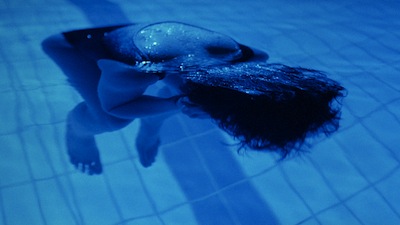
If Blue is to represent "liberty," then its central expression is Julie's search for freedom from her past, for a life where she can live as an individual with no ties or responsibilities to others. This proves impossible, however, as she becomes involved with her neighbors, her husband's assistant (Benoit Regent), and the mistress (Florence Pernel) she never knew about. In some way they all serve to remind her of what it's like to feel. The assistant, Olivier, wants to love her; Lucille (Charlotte Very), who works as a stripper and a prostitute, shows her that it's okay to enjoy pleasure. The thread running through all this is the music, the melodies that she can't deny, that come to her even in the street when a random flautist plays a song he couldn't possibly know. This symphony that is supposed to bring together all people eventually sews all of these elements together for Julie, too, unleashing the emotion she has sought to suppress.
Juliette Binoche is remarkable as Julie. Her performance is fragile, controlled, and entirely heartfelt. Though the script demands a certain cold reserve, the actress summons subtle flare-ups of anger, disappointment, and pain. Blue could have been a heavy movie, or it could have been an empty experience had the lead actress merely tried to play Julie like an unfeeling robot. Instead, Binoche gifts Kieslowski with maybe the finest and most distinctly rendered performance of her career. In return, Kieslowski and cinematographer Slawomir Idziak create a chilly, yet often dreamy, world of placid images infused with darker hues of blue and black, the colors of Julie's grief. A recurring image of a hanging mobile made of blue crystals acts as a rosary, and as a shimmering beacon for Julie to focus her muddled intentions.
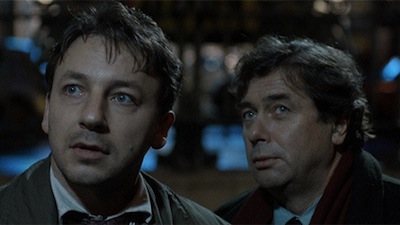
Julie's story crosses over with the estranged lovers in White (Blanc) only briefly. In Blue, she goes to see her husband's mistress at the courthouse where she works and accidentally peeks in on a divorce proceeding. That case is the opening scene of White. Beautiful French beautician Dominique (Julie Delpy, 2 Days in Paris [review]) is divorcing Polish immigrant Karol Karol (Zbigniew Zamachowski), himself a prize-winning hairdresser. Their romance was passionate before marriage, but since, Karol has been unable to perform. This is just one symptom of a greater malady, one that strikes many couples but especially here: an inability to communicate. Karol barely speaks French, Dominique doesn't speak Polish.
Destitute and living on the streets, Karol sneaks back to Poland with the help of Mikolaj (Janusz Gajos). He literally rides home as luggage, tucked into his suitcase! Once he is back on his own soil, Karol undergoes a transformation. Rather than cutting hair, he starts working for a local gangster and eventually finds information that allows him to undercut his boss and make a lot of money to start his own business with Mikolaj. His goal isn't the creature comforts money will buy, however, but to amass enough cash to enact an elaborate scheme to get Dominique back. "Get her back" as in "get back together with her," but also "get her back for what she did."
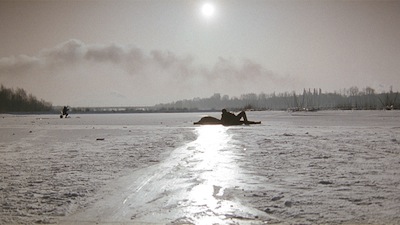
White is a subtly comic dissection of union and division. The obvious focus is marriage, but the inequality arises in other areas. There is husband and wife, man and woman, but also class. There is the difference between natives and immigrants, an interesting and troublesome complication at the time of the establishment of the European Union. (When Karol gets home, he notices his brother has added a neon sign to their salon. "We're European now," the brother explains.) This is, after all, the portion of the flag that represents "equality." Dominique holds all the cards at the start of the film, it's her country and her language. It's also more simple than that: she is the one with the upper hand in the relationship. Love is often lopsided, with one being more in love than the other, and the other tends to have the advantage.
Zbigniew Zamachowski is wholly sympathetic as Karol Karol. The actor grows the performance, letting it blossom and mature. Karol goes from destitute and impotent to powerful, yet he is warm-hearted throughout. Zamachowski remembers that, deep down, this man is a lover and, let's face it, sensitive. He does hair for a living, he is not a thug. His growth also humanizes the object of his desire. Before leaving France, he buys a porcelain figure that reminds him of Dominique's alabaster skin. Yet, that false idol breaks as soon as he gets out of the suitcase, and over the course of his mission, his image of her also shatters, revealing the tender, delicate woman he failed to understand before (she tells him of her weakness, just before she shows him her strength, in their last time together in Paris). Ironically, it is separation that has brought them together, and the consequence of Karol's conspiracy is that they are still separated, even if the exile is now shared.
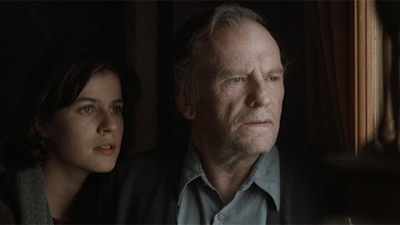
If division is a strong central theme in White, then the final film in the series, Red (Rouge), is about all the things that bring us together. The brotherhood of man is linked in inexplicable, yet heartening ways.
The film stars Irene Jacob, the luminous star of Kieslowski's previous masterwork, The Double Life of Veronique [review 1, review 2]. Jacob plays Valentine, a young model with a good heart living in Geneva. When she accidentally hits a dog with her car, she tracks down her owner to make amends. The man she finds is an aging, retired judge (Jean-Louis Trintignant, Z [review], Le combat dans l'ile [review]) who has removed himself from outside life and spends his days eavesdropping on his neighbors' cell phone calls. Valentine is at first appalled, but she enters into a moral debate with the old man and they become friends. His years wearing the robe of justice have given him a keen sense of human nature, though he is not prepared when his young companion turns the tables on him and puts together the puzzle of his life.
The judge's painful past is not the only puzzle in Red. Kieslowski's script, co-written with Krzysztof Piesiewicz (as is the entire trilogy), creates a tricky yet lithe map of doubles and parallels. The judge's experience as a young man matches that of a young law student (Jean-Pierre Lorit), and the old man's dissection of time and dreams of a future he will not be a part of has more than once made me think that Kieslowski is playing with knowable space in much the same way that he did in Veronique. These two men are the same, and they exist in time both separate and together. I don't think that was Kieslowski's intended meaning, necessarily, but it gives Red some interesting nuance.

The construction of this delicate set-up is really quite extraordinary. The young man, Auguste, lives just a few buildings down from Valentine, and his girlfriend (Frederique Feder) is one of the neighbors that the judge is listening in on. The old man predicts the failure of their relationship long before it's a reality. Kieslowski stages some wonderful scenes where the two couples move around each other without noticing, including some breathtaking choreography on the street outside of Valentine's apartment, where the camera shifts from her arriving at home and going upstairs to Auguste leaving a store and crossing her path.
Jacob is, unsurprisingly, alluring and soulful as Valentine. She avoids playing her as a mere innocent, and instead makes the character someone who feels intensely. Frivolity seems to be denied her. We see her on a photoshoot for a chewing gum ad, but the company doesn't pick the fun pictures of her blowing bubbles, instead going with a shot that is more mysterious and almost sad. A bad boyfriend who appears as a disembodied voice on the phone berates her for not being available and quizzes her over her every move. As she eventually ends up drawing the judge out of his shell, so does he encourage her to let go of certain anxieties. Trintignant makes for a nice foil to the young woman. He is brittle and unkempt to start, but slowly he reveals an empathetic soul.
Naturally, Krzysztof Kieslowski ends this personal epic on a note of hope. The final scene of Red ties all three films together in such a way that leads us to believe that all the people we've seen--Julie and Olivier, Karol and Dominique, and Valentine and Auguste, all couples with the promise of love--are going to be okay, that for all the dangerous happenstance of existence, their lives will carry on and, by extension, so can ours. Three Colors is a deft and beautiful summation of the 20th Century, of the promises for a future we hoped would be kept and of the collective fear that they may not. Kieslowski's endnote is that such fears are immaterial, they are beyond our control; yet, if we hang on to one another and listen to our hearts, everything will be fine.

For a complete rundown on the special features, read the full review at DVD Talk.
Please Note: The images used here are from promotional materials and are not taken from the Blu-ray edition under review.
Wednesday, March 16, 2011
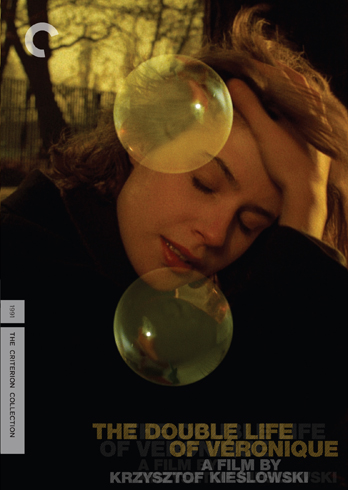
BLU REDO: THE DOUBLE LIFE OF VERONIQUE - #530

For this viewing of The Double Life of Véronique I did something I generally don't do: I read my old review. It's been over four years since the DVD of The Double Life of Véronique was first released, and so that long since I last saw it. I was curious what the me of 2006 had to say about the picture. Was I insightful? Was I way off base? Would how I thought then be a way of thinking I'd even recognize now?
These questions of intellectual identity aren't just the curiosity of a writer who sees how he writes about cinema as an ongoing process, but they are also thematically in tandem with the philosophical and metaphysical questions Krzysztof Kieślowski poses in his 1991 masterpiece. Is it possible that we are more than one person? Forget the idea of a physical double for a second. Maybe the way our thought processes evolve creates separate, parallel versions of ourselves. When we change our minds, some version of who we are splinters off and becomes its own entity.
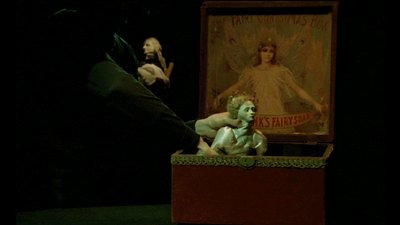
There is certainly that kind of magical thinking within Kieślowski's screenplay. One could interpret a variety of different reasons for why there is a Polish Weronika and a French Véronique (both played with a fragile intensity by Irène Jacob). Both versions wake up startled from dreams at different times, so maybe one is dreaming the other. Both fixate on an image of one version of themselves during sex, possibly creating a dissociative fantasy. Maybe they are a manifestation of the puppeteer (Philippe Volter) and the fictions he creates. His seduction of Véronique follows the outline of one of his books, and he does create two marionettes in the women's image. Or maybe the external force is the filmmaker, as it is his fiction after all, and there is no more explanation needed here than there is for the sudden change of actresses in Luis Buñuel's That Obscure Object of Desire. It is what it is, the question answers itself. For some reason, I was also reminded of Abbas Kiarostami's Certified Copy [review], particularly in the way Alexandre, the puppeteer, chased Véronique through the street; maybe we could interpret, as one could with Kiarostami's couple, that the game they are playing stops being play and becomes real.

Because up until that point, Alexandre is playing a game with Véronique. He remodels courtship as a kind of scavenger hunt, but one where the disparate pieces of the puzzle are sent to her instead of Véronique having to seek them. It's a love letter delivered as code, and like the riddle of the Sphinx, if you crack it, something remarkable awaits. When she surrenders, all kinds of things begin to happen. Exactly what...ah, well, that's still part of the mystery.
It's amazing how much one can forget about a movie in the years between viewings, and it's also amazing how much more you can notice once you have a basic idea of what you are in for. On one hand, there was so much in The Double Life of Véronique that felt new to me, I almost questioned whether I had seen it at all. Specific scenes and turns of the plot had been lost to my fading brain power. For instance, had I ever seen the Polish woman who had come to Paris, who spies Véronique and recognizes Weronika in her, thus connecting the doppelgangers? I'm not sure.
At the same time, it's interesting to note how much takes on deeper significance precisely because of what you do remember. It's like watching a murder mystery when you know who the killer is. All of that person's actions take on added meaning. Right from the start of The Double Life of Véronique, I was acutely aware of different visual cues, of small gestures or indicators, and of the surreal aura Kieślowski cloaks everything in. The storytelling here is almost episodic, even disjointed, yet one must assume everything is placed where it is for a specific purpose. For instance, the statue of a communist leader that Weronika sees being hauled away at the start of the movie could have a variety of meanings. On one hand, there is the political interpretation. In the early 1990s, European communism was failing. Symbolically, the man immortalized in stone is now the one being tied down and hauled off. He is taken away, and in his place is freedom.
Yet, if we know that later there will also be life in miniature, that the puppets will also be carved imitators of life that require their own string, then the statue is foreshadowing. Going from one to the other is going from large to small, from a universal symbol to an individual one. Our heroine complains of a feeling of not being alone in the world, and that feeling could just as easy be her connection to her fellow man. None of us are alone, we're all in this together.
It's an unknowable feeling, immutable. Like the light that lingers in Véronique's apartment even though the reflective surface is withdrawn, or the reoccurring chord that binds the women together though its origins are unknown. Or maybe it's not so unknowable, maybe it's simple. Like the removal of the dictator gives the Polish people freedom, so too does Weronika's fate make way for Véronique's blossoming. Alexandre's puppet show portrays a ballerina who breaks her leg, and yet despite the crippling injury, she wants to keep dancing. Her will is so strong, she transforms into a butterfly and flies away. Weronika is the ballerina, and Véronique the colorful insect who takes flight.
Before I wrap up, special mention should be made of the fact that this viewing was also my first time watching The Double Life of Véronique on Blu-Ray. Kieślowski's movie looks astounding in high-definition. The Double Life of Véronique is a film that is intricately designed, with specially tuned color palettes and a meticulous attention to every corner of the image frame. The light in this new digital version is warm and full of undulations, and the tiniest detail is given equal due. Take a look at the scene where Irène Jacob is bouncing the rubber ball and she dislodges dust from the ceiling. Minute particles rain down on her, and on Blu-Ray, each one is its own individual sparkle, a glittery cloud of fairy dust.
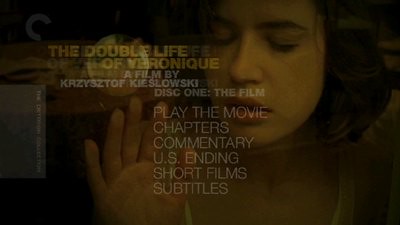
In terms of supplements, the new edition is an exact copy of the DVD release. The only thing that has changed is the packaging...which kind of sucks by comparison. I can appreciate the compact nature of the small Blu-Ray case, but I prefer the handsome box and book version, which was more like its own art object, a physical treasure chest to unfold, than it was merely functional. For that alone, I'll likely be hanging on to both versions of The Double Life of Véronique even though I'm only likely to actually watch the Blu.

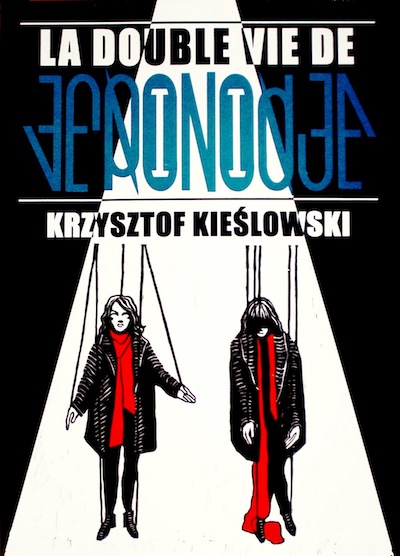
This cool poster by artist Joanna Lisowiec is something I stumbled across doing a search for, well, Double Life of Veronique posters. She made it for a contest. I hope it wins!
This disc was provided by the Criterion Collection for purposes of review.
Tuesday, November 20, 2007
THE DOUBLE LIFE OF VERONIQUE - #359
This is the second of two reviews, along with Overlord, that has a permanent link from the movie's entry at the Criterion site.
Krzysztof Kieślowski's 1991 feature, The Double Life of Véronique, is a mysterious little movie. While it does tell a story in a semblance of conventional narrative, it's also an emotional jigsaw puzzle, a feat of storytelling agility that puts a lot of trust in its audience. Kieślowski is stingy with the exposition, instead asking us to follow and not to worry about where we are going. Our belief that he will get us somewhere will be its own reward.
Irène Jacob plays Weronika (pronounced Veronika), a Polish girl whose career as a pianist was crushed along with her finger in a car door. She is now in Krakow to pursue singing and by chance ends up earning an important seat on a famous choir. Her artistic pursuit comes with a price, however: it is putting a strain on her relationship with a man she left at home, and it also takes her away from her father, increasing her feelings of anxiety. She has a pervasive sense that something is missing in her life, that she is out of place with the universe.
Cut to a random day on the street of Krakow as a tour bus from France goes through the city square. Looking at the bus, Weronika spots Véronique. Also played by Jacob, Véronique is an exact double for Weronika, something the Polish woman recognizes instantly. The French version doesn't see the other at all, but something has now clicked between them, and they go away from this encounter with a connection, even if one of the pair has not discovered it yet.
Eventually, the story shifts to France and Véronique, a music teacher who shares some of the same concerns about identity as her Polish doppelganger. These become particularly strong after certain events happen to Weronika. A phantom pain is beamed across the European borders, and Véronique is possessed with a grief she cannot put a name to. A sensitive woman, this feeling of loss and dissociation forces her eyes open to the world around her, leading to another chance meeting. While Véronique's class watches a marionette show, the teacher and the puppeteer, Alexandre (Philippe Volter), notice one another, and when the performance is over, Véronique can't get this man out of her head. Shortly after, mysterious packages begin showing up in her mailbox, objects that connect her to Weronika for the audience and Alexandre within the story, and the missing element that Véronique has been searching for begins to come into view. This, too, will have an emotional cost.
Irène Jacob is luminous in the picture. She and Kieślowski were amazing for each other. While they were both excellent apart, their other work never quite compared to their combined efforts on Véronique and, a few years later, Red. Just like other famous actor/director couplings like Gong Li and Zhang Yimou, or even De Niro and Scorsese, they draw performances out of each other that no one else can get. As both versions of Véronique, Jacob manages to make them distinctive while giving the two women enough crossover to make it clear they are of the same spirit. It extends beyond the simple change of hairstyle or langauge. It's in how she emotes, how she carries herself. Weronika starts off more eager, given over to the sheer happenstance of living, whereas Veronique is more melancholy in her search. She maybe feels the love of others more distinctly, but by a tragic turn, also feels more alone because of it.
Kieślowski plays tricks with our perceptions in Véronique. The movie opens with a cityscape that is askew, knocking the viewer off balance. As he pulls back, we discover our point of view has been from a little girl looking out either a window or a kind of skylight, and we're unsure if what we saw was a reflection or the real thing, and even if it was right-side up or upside down. Later in the movie, we look at the world as it passes us in bus windows, imperfections in the glass causing pieces of the landscape to go in and out of distortion, or peering through a clear marble that has stars inside, casting a dreamy glow on the world. Similarly, Véronique's paramour is a puppeteer. When he makes two dolls that look like her and shows her how to manipulate them, it's almost like he is giving her the key to her own destiny, showing her how to be more active in her own life; at the same time, it has ironic results, as the appearance that he may embody the unseen force that wishes to take control (bringing the two Véroniques together or keeping them apart?) has the polarizing effect of pushing Véronique away. Even here, the meaning is purely down to how it strikes you. One doll is being brought to life, the other lays dormant on the table. What does the absence of one half of the equation mean for the identity of the other? Like the many images that double and mirror one another in Véronique, would they have had the same significance if shown all alone?
Though The Double Life of Véronique revels in the unexplained, it's never pretentiously obtuse. The master's touch that Krzysztof Kieślowski gives to the film is to invoke our power of intuition. He is an expert at showing and not telling, but showing us in a way that makes us feel the events rather than intellectualize them. The final shots of The Double Life of Véronique are only a couple of snatched, silent moments. It doesn't put the entire picture into a little box and hand it back to us, telling us everything that the story meant, but yet we somehow walk away with a full sense of those things anyway. It's an experience you never forget, and it's why fans of the film have been so eager to finally see it released on DVD. Like the best memories from important times in our life, to relive and reexamine what Weronika and Véronique go through reignites those feelings and reaffirms the power of human instinct in our interactions with the people around us and, most of all, ourselves.
Originally written November 21, 2006. For technical specs and special features, read the full article at DVD Talk.

Krzysztof Kieślowski's 1991 feature, The Double Life of Véronique, is a mysterious little movie. While it does tell a story in a semblance of conventional narrative, it's also an emotional jigsaw puzzle, a feat of storytelling agility that puts a lot of trust in its audience. Kieślowski is stingy with the exposition, instead asking us to follow and not to worry about where we are going. Our belief that he will get us somewhere will be its own reward.
Irène Jacob plays Weronika (pronounced Veronika), a Polish girl whose career as a pianist was crushed along with her finger in a car door. She is now in Krakow to pursue singing and by chance ends up earning an important seat on a famous choir. Her artistic pursuit comes with a price, however: it is putting a strain on her relationship with a man she left at home, and it also takes her away from her father, increasing her feelings of anxiety. She has a pervasive sense that something is missing in her life, that she is out of place with the universe.
Cut to a random day on the street of Krakow as a tour bus from France goes through the city square. Looking at the bus, Weronika spots Véronique. Also played by Jacob, Véronique is an exact double for Weronika, something the Polish woman recognizes instantly. The French version doesn't see the other at all, but something has now clicked between them, and they go away from this encounter with a connection, even if one of the pair has not discovered it yet.
Eventually, the story shifts to France and Véronique, a music teacher who shares some of the same concerns about identity as her Polish doppelganger. These become particularly strong after certain events happen to Weronika. A phantom pain is beamed across the European borders, and Véronique is possessed with a grief she cannot put a name to. A sensitive woman, this feeling of loss and dissociation forces her eyes open to the world around her, leading to another chance meeting. While Véronique's class watches a marionette show, the teacher and the puppeteer, Alexandre (Philippe Volter), notice one another, and when the performance is over, Véronique can't get this man out of her head. Shortly after, mysterious packages begin showing up in her mailbox, objects that connect her to Weronika for the audience and Alexandre within the story, and the missing element that Véronique has been searching for begins to come into view. This, too, will have an emotional cost.
Irène Jacob is luminous in the picture. She and Kieślowski were amazing for each other. While they were both excellent apart, their other work never quite compared to their combined efforts on Véronique and, a few years later, Red. Just like other famous actor/director couplings like Gong Li and Zhang Yimou, or even De Niro and Scorsese, they draw performances out of each other that no one else can get. As both versions of Véronique, Jacob manages to make them distinctive while giving the two women enough crossover to make it clear they are of the same spirit. It extends beyond the simple change of hairstyle or langauge. It's in how she emotes, how she carries herself. Weronika starts off more eager, given over to the sheer happenstance of living, whereas Veronique is more melancholy in her search. She maybe feels the love of others more distinctly, but by a tragic turn, also feels more alone because of it.

Kieślowski plays tricks with our perceptions in Véronique. The movie opens with a cityscape that is askew, knocking the viewer off balance. As he pulls back, we discover our point of view has been from a little girl looking out either a window or a kind of skylight, and we're unsure if what we saw was a reflection or the real thing, and even if it was right-side up or upside down. Later in the movie, we look at the world as it passes us in bus windows, imperfections in the glass causing pieces of the landscape to go in and out of distortion, or peering through a clear marble that has stars inside, casting a dreamy glow on the world. Similarly, Véronique's paramour is a puppeteer. When he makes two dolls that look like her and shows her how to manipulate them, it's almost like he is giving her the key to her own destiny, showing her how to be more active in her own life; at the same time, it has ironic results, as the appearance that he may embody the unseen force that wishes to take control (bringing the two Véroniques together or keeping them apart?) has the polarizing effect of pushing Véronique away. Even here, the meaning is purely down to how it strikes you. One doll is being brought to life, the other lays dormant on the table. What does the absence of one half of the equation mean for the identity of the other? Like the many images that double and mirror one another in Véronique, would they have had the same significance if shown all alone?
Though The Double Life of Véronique revels in the unexplained, it's never pretentiously obtuse. The master's touch that Krzysztof Kieślowski gives to the film is to invoke our power of intuition. He is an expert at showing and not telling, but showing us in a way that makes us feel the events rather than intellectualize them. The final shots of The Double Life of Véronique are only a couple of snatched, silent moments. It doesn't put the entire picture into a little box and hand it back to us, telling us everything that the story meant, but yet we somehow walk away with a full sense of those things anyway. It's an experience you never forget, and it's why fans of the film have been so eager to finally see it released on DVD. Like the best memories from important times in our life, to relive and reexamine what Weronika and Véronique go through reignites those feelings and reaffirms the power of human instinct in our interactions with the people around us and, most of all, ourselves.

Originally written November 21, 2006. For technical specs and special features, read the full article at DVD Talk.
Subscribe to:
Posts (Atom)