Showing posts with label claire denis. Show all posts

Friday, September 6, 2019

35 SHOTS OF RUM - CRITERION CHANNEL

This review was originally written for DVDTalk.com in 2010.


"We have everything here. Why go looking elsewhere?"

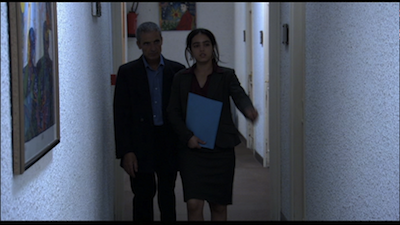
The latest film from Claire Denis, 35 Shots of Rum, trains its lens on the tenants of a French apartment building. At the center of the interpersonal drama is the old subway engineer Lionel (Alex Descas, Coffee and Cigarettes), who lives alone with his daughter Jo (Mati Diop) and who has an occasional affair with the upstairs neighbor, a taxi driver named Gabrielle (Nicole Dogué). Gabrielle pines for Lionel, but he is distant and untouchable, in charge of his own space and his emotions. It runs in the family. Another upstairs neighbor, Noé (Grégoire Colin, Nénette et Boni) has a thing for Jo, but she maybe sees a little too much of her dad in him. Ironically, the young drifter would settle down if maybe the girl would just give him the nod.


Of such simple stuff are great dramas often made, and 35 Shots of Rum observes these regular lives with an elegance and insight that ensures every small act assumes great importance. A chance encounter can alter everything, even if just for a day. A thoughtless action can break a heart, a minor gesture can invoke jealousy. The film is regularly compared to Ozu in the way it shows modern living and the schism between young and old, and that comparison couldn't be more justified. At the same time, Denis makes the genre (is Ozu a genre now?) her own by updating it. Her eye is a tad more cynical, and her character situation reversed. Rather than the older generation failing to understand the changes of the newer generation, it's Jo and Noé who are mourning lost values. Lionel may talk about stability, but outside of his homebase, he's a wanderer, tied to no one. For all his freedom, he is trapped.

Denis spent her early career working alongside Jim Jarmusch and Wim Wenders, and her films have a similar poetic laziness that draws more out of what is not said than what is. If character is action, then behavior is all that is needed to drive the plot. The way Gabrielle hangs around, nervously knocking at the door even after she has said her good-bye, or the way Lionel stares at another women across the room--these are profound moments, and in the case of the quiet man who forms the film's axis, silence is his greatest tool. As an audience, we are as compelled to watch Alex Descas as the people onscreen are compelled to watch Lionel. Some actors can draw the camera's attention just by their mere presence. Descas owns whatever space he inhabits. He doesn't have to claim it, it's just his. Yet, his most poignant moments come when he is vulnerable, playing the father realizing he could lose his daughter to another man.


Naturally, the actor is aided by the environment Claire Denis and cinematographer Agnès Godard (Golden Door) create for them. The action is staged in real locations, and the pair shoot from within the space provided. The look of 35 Shots of Rum is intimate and authentic, lending the same credibility to the performers and the story.

Keeping in line with the scale of the rest of the picture, the change that Denis and regular co-writer Jean-Pol Fargeau map out for Lionel is not a major one. Rather, it's learned and it's subtle. One of his colleagues, René (Julieth Mars Toussaint), retires early in the tale, presumably set free to enjoy life without the endless repetition of the subway routes. He doesn't go anywhere, though, he just hangs around, unsure of what to do with himself. The patterns he has established are all he knows, and he can't make a real change. His lack of purpose serves as a warning for Lionel: if you stay on the same track your entire life, you may never get to switch over to another. These are working-class versions of Ozu's salarymen: if you give your life to the job, what left do you have for yourself? The bigger life change is made by Jo, who assures her father that even though there might be other men in her life, they still will be father and daughter forever. She embraces the absolute even as she gets away from it. (Likewise, she reconnects with the past to wriggle out of its grasp.) To do otherwise is to become like Gabrielle, hung up on something she can never have.


The thirty-five shots of rum of the title is in reference to Lionel's special ritual, something he holds close and only indulges on the most special of occasions. When you consider the effects of alcohol, this too could be seen as an attempt to obliterate memories while also providing a balm that soothes one through a possibly unwanted transition. It's reckless, but so is life. We only see Lionel partake of this once, and he avoids explaining it until then, and so it's special when it happens. In a way, delving back into this drinking game suggests that maybe this is a case that the more things change, the more Lionel stays the same, and while a celebration is underway, he almost looks like he is at a wake rather than a party; at the same time, there is hope in his carriage. Acceptance. A cleansing. His head might be fuzzy in the morning--indeed, we've seen Lionel's hangovers--but once the cobwebs are clear, it's a whole new day.



Friday, April 8, 2011

WHITE MATERIAL (Blu-Ray) - #560


White Material, the latest film from French director Claire Denis, is an elusive, yet intriguing drama about social privilege, personal passion, and the delusions and myopia born out of each. The script, co-written by Denis and Marie NDiaye, uses real-world locations and timely political problems to create an otherworldly narrative, one that takes what is familiar and holds it close even as it smuggles these elements into a place totally separate from any logic we may recognize.

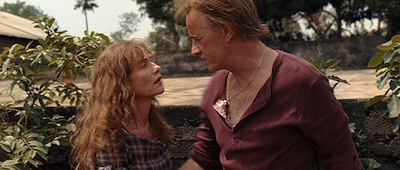
The great Isabelle Huppert stars as Maria Vial, a French citizen living in Africa. She and her husband have been running a coffee plantation for several years, and they have apparently lived on the continent for longer. It's harvest time for their struggling business, but a civil war has caused all of their workers to run off scared. The French government is also pulling out of the region and is encouraging its citizens to do the same. Maria's husband, André (Christopher Lambert), would rather cut his losses and go, even going so far as trying to strike a deal with the local "mayor," Chérif (William Nadylam), to take the land off his hands. Chérif is forming a militia to fight the incoming rebels. This ragtag bunch seems no more or less thuggish than the government soldiers. It's hard to tell which side is which.


Maria sticks to her belief that she can get through this, and much of White Material is about her resisting all urgings to stop and finding other workers to replace the ones who left. She is stubborn to any argument that doesn't jibe with her own belief of how things are going, a character flaw she extends to her son, Manuel (Nicolas Duvauchelle). Everyone sees that the teenager is a deadbeat--he spends the first half of the movie locked in his bedroom, refusing to come out--but Maria refuses to hear a negative word said about him. This is a mother's prerogative, I suppose; by extension, she is also mother of the coffee she has been growing, the matriarch of this homestead. She won't give up on her children no matter what.


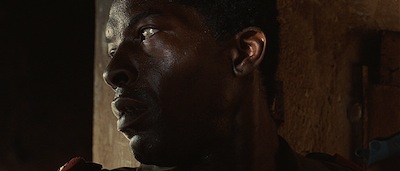
Not even when the rebellion has come through her front gate. The most notorious rebel figure is an enforcer (Isaach de Bankolé) talked about in hushed whispers, either out of fear or awe depending on who you're with. They call him the Boxer, and his wanted posters are large murals painted on the sides of buildings. He is depicted with a belt of machine gun bullets draped over his chest and posed as readying to throw a punch. The image we get of him is different: he is wounded and nearly incapacitated, seemingly only carrying on via an ice-cold determination to not be beaten. He levels no threats at Maria--he doesn't have to.


White Material unfolds according to its own internal rationale. Though not exactly plotless, it does not conform to any textbook screenplay outline. Its main drive is for its characters to beat the amorphous deadline that hangs over the war-torn region. Maria must harvest her coffee before the government army comes sweeping through the town, before the Boxer rises up with his rebel soldiers--many of whom are children--to battle for dominance. Denis cuts her film to the flow of dark, ambient rhythms. The music for White Material was composed by the Tindersticks, whose morose melodies have become a staple of her work*. These sinister soundscapes trade airtime with revolutionary-themed reggae music, records spun by a local radio DJ between coded messages to citizens and freedom fighters. He joins a tradition of cinematic AM/FM instigators that includes Super Soul in Vanishing Point [Blu-ray] and Mister Señor Love Daddy in Do the Right Thing. And, of course, real-world wartime propagandists like Tokyo Rose and Hanoi Hannah.

The more desperate the situation becomes, the more determined Maria is to finish the job. She hides threats sent to her by unseen enemies and lies to her new workforce. In direct relation to this, Manuel goes further off the deep end, though his intentions aren't clear at first and his true motives are surprising. Essentially, you can't beat them all, so you have to join somebody. The less that Maria can get others to do, the more control wrested from her hands, the harder she pushes back. It takes a tremendous emotional toll on her, and Huppert tip toes around this woman's psychosis so as not to make her seem overly crazy or even all that unreasonable. While she does possess a manic energy, there is a calmness to her single-minded mission that gives her balance. At times, we think that maybe she really can pull this off.

But, alas, good intentions disappear in the miasma. As White Material moves toward its climax, the mis-en-scene becomes more choppy, the storytelling more intentionally muddled. The whole region is losing its mind and collapsing in on itself, and so we aren't supposed to know exactly who is doing what to whom. To preserve her isolation, Maria has given over to the savagery that she has been rejecting, and there is no telling what is next for her. A fog doesn't literally roll in, but smoke from a burning fire does add a visual facet to the cloudy metaphor. The conclusion of White Material has an element of the unknowable. Denis is more concerned with the impression it will leave than your literal translation of what you have seen. The haze may not clear, and that may be exactly the point: you can flee these kinds of crises, but they will still be there, never going away.


* For those interested, a full boxed set of the Tindersticks music from Calire Denis' films is coming soon. Details here.

For a complete rundown on the special features, read the full review at DVDTalk.

Tuesday, July 27, 2010

THE SECRET OF THE GRAIN - #527


Geez, things are tough all over.

Unemployment, immigration, domestic strife--turn on any American news broadcast today, and you're likely to hear about all three of these things. These are also topics of concern in the 2007 French drama, The Secret of the Grain. The fact that such difficult problems still linger three years later--and, indeed, may be worse and more widespread--makes the film all the more potent. And even more sad.


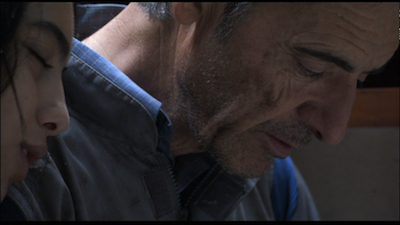
Written and directed by Abdellatif Kechiche, The Secret of the Grain is the story of a large Arabic family living in a portside town in France. The head of the clan is Slimane (Habib Boufares), a soft-spoken dock worker who has toiled in the same place for nearly 40 years. Unfortunately, the company he works for got bought out in the 1990s, and they are ignoring Slimane's service from before they took over and are trying to edge him out with a cheap pension. It's not enough to just try to make a living for one's family anymore. Every time a man turns around there is something there to cut him off. Work needs to be done faster, cheaper, and under more rules and regulations than ever before.


Slimane lives on his own in a hotel where other immigrants and older workers live. He is long since divorced from his wife, Souad (Bouraouïa Marzouk), and he is having a casual affair with the hotel owner. His daughter Karima (Faridah Benkhetache) is married to one of his co-workers, Jose (Olivier Loustau), who is also feeling the pinch from the dwindling workload--more tourists are visiting the area than fish and boats are going out. (In fact, there is too much fish around. Slimane's hook-up has overloaded everyone he knows; Souad's freezer is full of mullet.) One of Slimane's sons is a tour guide on a boat that shows people where work used to get done, and he's in a tempestuous relationship with a local woman, one who will turn out to be more important than he realizes. Majid (Sami Zitouni) is married to a Russian woman (Alice Houri), and she's constantly expected to accept his infidelities to fit in with the group.


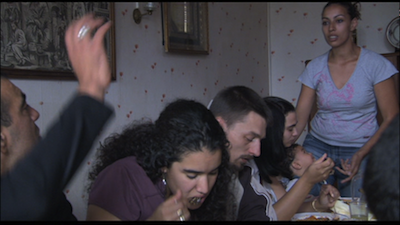
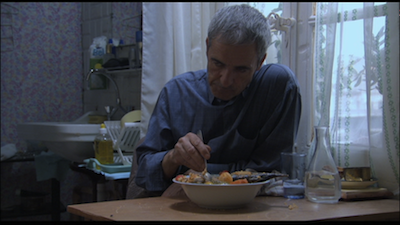
Abdellatif Kechiche has created a moving portrait of cultural identity. Language, family, employment--these are the things that define us and keep us together. At one point, Slimane's daughters stand up for the old man, noting the years of sacrifice he put in to make sure his children had a good life. This comes out during a wonderful scene at the family dinner table, where the father is notably absent. Here we see how the family connects and relates. Souad making her couscous is enough reason for everyone to get together and enjoy their common heritage. There is even a discussion of what it means that one of the husbands (Bruno Lochet) doesn't speak Arabic; is it possible he's less involved, or is that just the nature of our mixed world? Kechiche cuts from this vibrant scene to one of poor Slimane seemingly sitting all alone, eating a meal by himself.

Eventually, when it's clear that things aren't going to change for him, Slimane hatches a plan to open his own restaurant. He buys a ship in disrepair and plans to turn it into a floating eatery specializing in fish couscous (the original title of the film was La graine et le mullet)--couscous his wife will cook and his children will serve. Majid and his younger brother Riadh (Mohamed Benabdeslem) will help renovate. Slimane enlists the daughter of his mistress (Hatika Karaoui) as his confidant and spokesman. A man of few words, he needs the loquacious Rym (Hafsia Herzi) to tell people what he's after. The Secret of the Grain is as much Rym's movie as it is Slimane's. The young actress has a certain spark that lights up the screen, yet it's nothing she has to try at or force. She represents the younger generation, a girl with different ideas, and part of an extended family, not part of Slimane's main unit. All of the women in The Secret of the Grain take charge and speak out for themselves, far from the cliché of wilting Arabic women that we cling to in the U.S.


Kechiche's family album reminds me a lot of another recent portrait of mismatched immigrant families living in France, Claire Denis' 35 Shots of Rum [review]. Both Rum and The Secret of the Grain are shot in a no frills, pseudo-documentary style, with no imposed aesthetic and realistic acting. Kechiche doesn't necessarily go with long takes, but he does let conversations roll on, and his editing style creates the seamless illusion that it's all done in one go. Much of his framing is tight. If the family is packed around the table, he gets right in between them; if it's an intimate moment, he gets as close to his players as they get to each other. Dialogue is loose, and there are no standard movie mannerisms.

This doesn't mean there is no drama, however. Like Denis, Kechiche creates a strong narrative, establishing a dynamic that owes a bit to Ozu and a bit to the British Kitchen Sink school. In a way, The Secret of the Grain steals the Kitchen Sink drama back from the jokey stories of unemployment schemes that dominated British cinema in the 1990s. Whereas The Full Monty, Calendar Girls, and their ilk relied on gimmicks and thus have aged poorly, The Secret of the Grain is more timeless in that it doesn't make full use of modern convention. Kechiche's story could be set any time, really. The problems, and their solutions, are rooted in a reality that won't degrade.
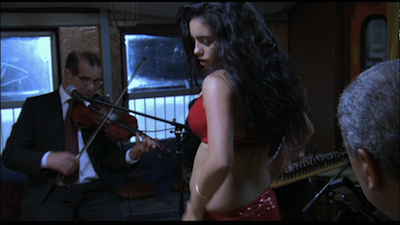
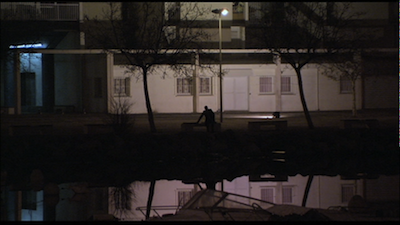
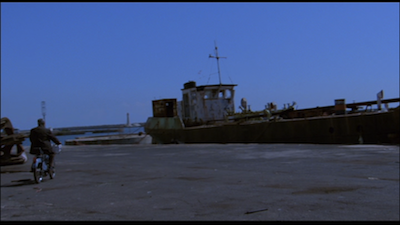
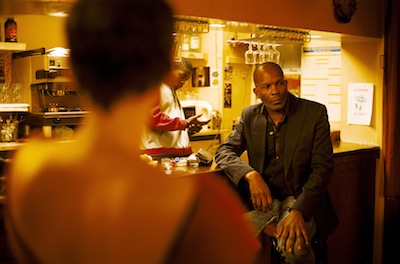
The Secret of the Grain's narrative culminates in a big party. Slimane has invited the bankers, city officials, and local restaurateurs to come out and taste his food. They haven't exactly warmed to giving him the loan and the permits he needs, so he's going to show them what he is capable of and let the couscous do the talking. Naturally, this night isn't going to go exactly as planned. Jealousies will come to the surface--the mistress resents Slimane asking his ex-wife to do the cooking, Julia finds out Majid is at it again--and there will be mishaps in the kitchen, including missing couscous. Kechiche toys with our hopes and frustrations, tugging us back and forth, offering possible ways out, leading to a surprising crescendo: Rym performs a sexy bellydance that hypnotizes angry diners into forgetting their hunger. Riding the rhythm of the music she dances to, Kechiche and editor Ghalya Lacroix cut back and forth between Rym and Slimane's search for the lost couscous, and also detouring to show us other doors as they close. In a sense, we are watching youth blossom as old age takes its last gulps of air, but in a bold move, Kechiche leaves us wondering exactly what that will mean. Will the future be in the hands of the kids who have no respect for tradition, the ones who tomcat around and steal, or will it by with Rym, who dances in an old style and inspires people to do better than they even expected of themselves? Or could this just be life as it's always been, on and on it goes?


Criterion brings The Secret of the Grain to DVD as a two-disc set, with the second disc being full of illuminating supplements. Much of these extras are interviews, new and old, with cast and crew, including Abdellatif Kechiche, Hafsia Herzi, and the musicians who played in the party scene. Naturally, some attention is paid to Herzi's memorable performance, and there is a short film called Sueur that is an extended re-edit of the movie's dazzling bellydance.


Watch the trailer for The Secret of the Grain.

This disc was provided by the Criterion Collection for purposes of review.

Monday, May 31, 2010

SIDELINE: MORE REVIEWS FOR 5/10

The summer movie season is off to a strange and rocky start. Of the movies I've seen (some I have yet to review), the comedies are killing the action movies 2-1.

IN THEATRES...

* Iron Man 2. Robert Downey Jr. is good, but he's no Scarlett Johansson.

* MacGruber, a surprise comedy hit from the SNL-factory. Somehow the thinnest sketch of all-time has become one of the show's best movie spin-offs.

* Mother and Child, the antidote to that Babies film. Starring Annette Bening and Naomi Watts.

* Prince of Persia: The Sands of Time, a not terrible but not terribly good video game adaptation with Jake Gyllenhaal. Should have been called Abs of Time. Am I right, ladies? Can I get a wut-wut?!

* Robin Hood, the 2010 reboot of the folk hero from Ridley Scott and his glowering muse, Russell Crowe. It is to Robin Hood what "Garfield Minus Garfield" is to the Jim Davis comic strip, except "Garfield without Garfield" is actually entertaining for a couple of minutes.

* The Secret in Their Eyes, this year's Best Foreign Language Oscar winner is a twisty, involving thriller.


ON DVD...

* 35 Shots of Rum, a marvelous Ozu-like drama from Claire Denis.

* The Cry of the Owl, featuring Julia Stiles in a chilled adaptation of a Patricia Highsmith novel.

* The Dukes, a genial comedy about an aging doo wop group trying to get through hard times. Part heist picture, part social commentary, it's flawed but feels good. Written, directed by, and starring character actor Robert Davi, playing alongside Chazz Palminteri.

* Five Minutes of Heaven, a revenge story that goes surprisingly intellectual on us, but not in a good way. Good performances from Liam Neeson and James Nesbitt, though.

* El Mago: Cantinflas is a legend in Mexico, but this 1949 film might make you wonder why; also, Los Tres Mosqueteros, the Cantinflas adaptation of The Three Musketeers could have been funny at about 2/3 the length.

* Mine, an alternately enraging and uplifting documentary about the plight of the pets left behind in Hurricane Katrina.

* The Sun, Russian director Alexander Sokurov's unconventional biopic of Hirohito