Showing posts with label abdellatif kechiche. Show all posts

Sunday, February 23, 2014

BLUE IS THE WARMEST COLOR - #695


The tumultuous fever of teenage love affairs is brought to vivid life in Blue is the Warmest Color, the sexy, emotional sensation of Cannes 2013.

Blue is the Warmest Color is based (somewhat loosely) on a graphic novel by Julie Maroh, who was just 19 when she began the comic. It has been adapted by Abdellatif Kechiche, a Tunisian filmmaker probably best known for The Secret of the Grain [review].


Adele Exarchopoulos, who can also currently be seen (albeit briefly) in I Used to Be Darker [review], stars as her namesake Adele, the protagonist of Maroh's narrative. At the start of the movie, Adele is 17 and studying literature in high school. Like most teen girls, she likes to sit around and gossip with her friends. Adele's peer group is particularly obsessed with boys, and Adele isn't entirely disinterested. On the contrary, she tries going out with an older classmate, but despite the mutual attraction, she finds that time alone with him leaves her feeling empty.

A couple of random encounters with attractive girls leads Adele to wonder if maybe the reason her dating life has stalled is she's not fully exploring her true sexuality. Her wanderings lead her to a lesbian bar, and the flirtatious blue-haired girl Adele has been fantasizing about since spotting her on the street. She is Emma (Lea Seydoux, Mission: Impossible - Ghost Protocol [review], Midnight in Paris [review]), an art student several years Adele's senior. The attraction is mutual, and a long-term relationship begins between them--though one where Adele is arguably at a bit of a loss. Having less education and experience than Emma, she eventually feels both intellectually and emotionally deficient, leading to some bad choices that test the boundaries of their relationship and reveal the unhealthy depths of Adele's dependence on her lover.


Blue is the Warmest Color is an expansive, personal epic, at once raw and unadorned, but also highly stylized. Kechiche favors long scenes, letting conversations run their course, but he also likes cranks up the heat on any given moment. The emotional intensity of the story is tuned to Adele's appetites. She has the ability to be both childish and adventurous. Her desire is voracious, and that makes her sloppy. (Could someone please tell her to close her mouth when she eats?!) Exarchopoulos does a nice job of differentiating the character's different stages, with subtle shifts in wardrobe and make-up used to help show the passage of years. There is a nakedness to how the girl expresses herself--both in a literal and a metaphorical sense.


Indeed, much ado has been made over the lengthy, explicit sex scenes between Exarchopoulos and Seydoux. Just as with everything else, Kechiche lets these sequence go on far past the norm, and regardless of what choreography is at play, they look spontaneous and real. Skin gets flushed, sweat and spit exchanged--the temperature definitely goes up a couple of degrees in the theater. I suppose it's not surprising that many have turned their focus on this aspect of Blue is the Warmest Color--it's rated NC-17 for a reason--but the excess here is equal to the excess throughout, it is just as indicative of Adele's approach to life as the way she attacks her gyros on a misguided date with a boy in one of the film's earlier scenes. To spotlight the sex over the more palpable and surprising intensity of the girls' courtship/seduction is to miss the full emotional scope of the picture. It's in their first few interactions that Blue is the Warmest Color really caught me off guard, and also where Lea Seydoux really shines. The eye contact and flirtatious smiles meant for Adele end up trained on the camera, and thus shine through to the audience. The nervous excitement of early romance comes across in disarming ways. Their close conversations are far more intimate than the physical coupling.

Then again, that may be Kechiche's intention, given where the love affair goes and what, ultimately, we discover that the relationship is built on. Adele's lingering dependence on Emma, and the way she rouses her physical passion, threatening the older girl's more concrete interpersonal accomplishments, ends up being toxic for them both. And perhaps how we wish Emma would give Adele another chance should cause us to question our own emotional maturity.


Tuesday, July 27, 2010

THE SECRET OF THE GRAIN - #527


Geez, things are tough all over.

Unemployment, immigration, domestic strife--turn on any American news broadcast today, and you're likely to hear about all three of these things. These are also topics of concern in the 2007 French drama, The Secret of the Grain. The fact that such difficult problems still linger three years later--and, indeed, may be worse and more widespread--makes the film all the more potent. And even more sad.


Written and directed by Abdellatif Kechiche, The Secret of the Grain is the story of a large Arabic family living in a portside town in France. The head of the clan is Slimane (Habib Boufares), a soft-spoken dock worker who has toiled in the same place for nearly 40 years. Unfortunately, the company he works for got bought out in the 1990s, and they are ignoring Slimane's service from before they took over and are trying to edge him out with a cheap pension. It's not enough to just try to make a living for one's family anymore. Every time a man turns around there is something there to cut him off. Work needs to be done faster, cheaper, and under more rules and regulations than ever before.


Slimane lives on his own in a hotel where other immigrants and older workers live. He is long since divorced from his wife, Souad (Bouraouïa Marzouk), and he is having a casual affair with the hotel owner. His daughter Karima (Faridah Benkhetache) is married to one of his co-workers, Jose (Olivier Loustau), who is also feeling the pinch from the dwindling workload--more tourists are visiting the area than fish and boats are going out. (In fact, there is too much fish around. Slimane's hook-up has overloaded everyone he knows; Souad's freezer is full of mullet.) One of Slimane's sons is a tour guide on a boat that shows people where work used to get done, and he's in a tempestuous relationship with a local woman, one who will turn out to be more important than he realizes. Majid (Sami Zitouni) is married to a Russian woman (Alice Houri), and she's constantly expected to accept his infidelities to fit in with the group.


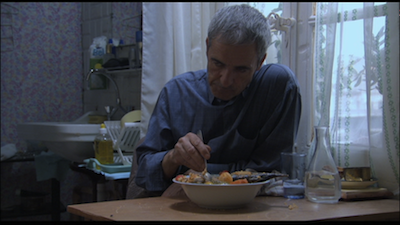
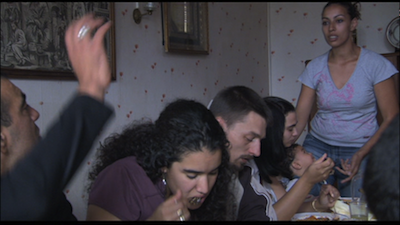
Abdellatif Kechiche has created a moving portrait of cultural identity. Language, family, employment--these are the things that define us and keep us together. At one point, Slimane's daughters stand up for the old man, noting the years of sacrifice he put in to make sure his children had a good life. This comes out during a wonderful scene at the family dinner table, where the father is notably absent. Here we see how the family connects and relates. Souad making her couscous is enough reason for everyone to get together and enjoy their common heritage. There is even a discussion of what it means that one of the husbands (Bruno Lochet) doesn't speak Arabic; is it possible he's less involved, or is that just the nature of our mixed world? Kechiche cuts from this vibrant scene to one of poor Slimane seemingly sitting all alone, eating a meal by himself.

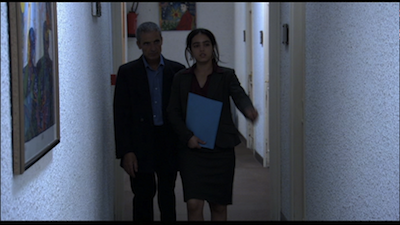
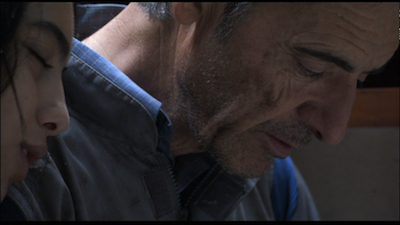
Eventually, when it's clear that things aren't going to change for him, Slimane hatches a plan to open his own restaurant. He buys a ship in disrepair and plans to turn it into a floating eatery specializing in fish couscous (the original title of the film was La graine et le mullet)--couscous his wife will cook and his children will serve. Majid and his younger brother Riadh (Mohamed Benabdeslem) will help renovate. Slimane enlists the daughter of his mistress (Hatika Karaoui) as his confidant and spokesman. A man of few words, he needs the loquacious Rym (Hafsia Herzi) to tell people what he's after. The Secret of the Grain is as much Rym's movie as it is Slimane's. The young actress has a certain spark that lights up the screen, yet it's nothing she has to try at or force. She represents the younger generation, a girl with different ideas, and part of an extended family, not part of Slimane's main unit. All of the women in The Secret of the Grain take charge and speak out for themselves, far from the cliché of wilting Arabic women that we cling to in the U.S.


Kechiche's family album reminds me a lot of another recent portrait of mismatched immigrant families living in France, Claire Denis' 35 Shots of Rum [review]. Both Rum and The Secret of the Grain are shot in a no frills, pseudo-documentary style, with no imposed aesthetic and realistic acting. Kechiche doesn't necessarily go with long takes, but he does let conversations roll on, and his editing style creates the seamless illusion that it's all done in one go. Much of his framing is tight. If the family is packed around the table, he gets right in between them; if it's an intimate moment, he gets as close to his players as they get to each other. Dialogue is loose, and there are no standard movie mannerisms.

This doesn't mean there is no drama, however. Like Denis, Kechiche creates a strong narrative, establishing a dynamic that owes a bit to Ozu and a bit to the British Kitchen Sink school. In a way, The Secret of the Grain steals the Kitchen Sink drama back from the jokey stories of unemployment schemes that dominated British cinema in the 1990s. Whereas The Full Monty, Calendar Girls, and their ilk relied on gimmicks and thus have aged poorly, The Secret of the Grain is more timeless in that it doesn't make full use of modern convention. Kechiche's story could be set any time, really. The problems, and their solutions, are rooted in a reality that won't degrade.
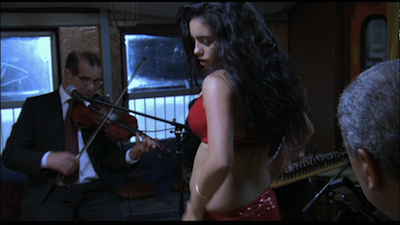
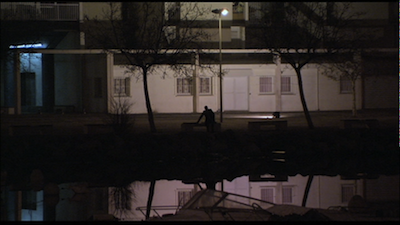
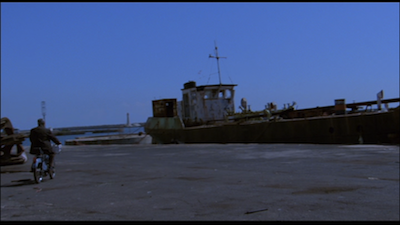


The Secret of the Grain's narrative culminates in a big party. Slimane has invited the bankers, city officials, and local restaurateurs to come out and taste his food. They haven't exactly warmed to giving him the loan and the permits he needs, so he's going to show them what he is capable of and let the couscous do the talking. Naturally, this night isn't going to go exactly as planned. Jealousies will come to the surface--the mistress resents Slimane asking his ex-wife to do the cooking, Julia finds out Majid is at it again--and there will be mishaps in the kitchen, including missing couscous. Kechiche toys with our hopes and frustrations, tugging us back and forth, offering possible ways out, leading to a surprising crescendo: Rym performs a sexy bellydance that hypnotizes angry diners into forgetting their hunger. Riding the rhythm of the music she dances to, Kechiche and editor Ghalya Lacroix cut back and forth between Rym and Slimane's search for the lost couscous, and also detouring to show us other doors as they close. In a sense, we are watching youth blossom as old age takes its last gulps of air, but in a bold move, Kechiche leaves us wondering exactly what that will mean. Will the future be in the hands of the kids who have no respect for tradition, the ones who tomcat around and steal, or will it by with Rym, who dances in an old style and inspires people to do better than they even expected of themselves? Or could this just be life as it's always been, on and on it goes?


Criterion brings The Secret of the Grain to DVD as a two-disc set, with the second disc being full of illuminating supplements. Much of these extras are interviews, new and old, with cast and crew, including Abdellatif Kechiche, Hafsia Herzi, and the musicians who played in the party scene. Naturally, some attention is paid to Herzi's memorable performance, and there is a short film called Sueur that is an extended re-edit of the movie's dazzling bellydance.


Watch the trailer for The Secret of the Grain.

This disc was provided by the Criterion Collection for purposes of review.