Showing posts with label James L. Brooks. Show all posts
Showing posts with label James L. Brooks. Show all posts
Thursday, March 31, 2011
SIDELINE: MORE REVIEWS FOR 3/11
IN THEATRES...
* The Adjustment Bureau, in which Matt Damon and Emily Blunt get entangled in a mind-warped romance. My original headline was "Like The Notebook for boys...or maybe Inception for girls?" but, you know, girls like Inception.
* Jane Eyre, yeah, yeah, Jane and Rochester really love each other. I get it. Wake me when it's over...
* Monogamy, an intriguing movie about love, relationships, obsession, growing up. You know, same old thing. Starring Chris Messina and Rashida Jones.
* The Other Woman, in which Natalie Portman gets really, really sad. Really.
* Paul, the new Simon Pegg/Nick Frost comedy takes on sci-fi as the genre of choice, and though it's funny, you will miss Edgar Wright.
* Source Code, Jake Gyllenhaal goes back in time eight minutes to stop a bomb plot--over and over until he gets it right--in the new film from Moon's Duncan Jones.
ON DVD/BD...
* Around a Small Mountain, a self-important dud from Jacques Rivette, starring Jane Birkin and some Italian guy.
* I Clowns, Federico Fellini's playful early '70s documentary about...well, clowns!
* A Film Unfinished, a haunting documentary piecing together a lost Nazi propaganda film shot in the Polish ghetto.
* Genius Within: The Inner Life of Glenn Gould, a wonderful documentary introduction to the fascinating pianist.
* Heartbreaker, a rom-com that reminds us that the French make crappy movies, too.
* How Do You Know, the romantic comedy in which the mighty James L. Brooks falls on his face and tries to throw Paul Rudd and Reese Witherspoon down first just to soften the landing. And to think they trusted you, James!
* Jackass 3: Unrated, this time, the winner takes all the smuggled plums.
* Our Hospitality: Ultimate Edition, a spiffy new release of the old Buster Keaton classic.
* Mad Men: Season Four: Like you need me to tell you it's any good.
* Sunday in New York, a flaccid 1960s romantic comedy with a very non-flaccid, sexy Jane Fonda.
* Teen A Go Go, a DIY documentary on 1960s Texas garage bands.
* Two in the Wave, a documentary about Francois Truffaut and Jean-Luc Godard that mostly preaches to the choir, but is still entertaining.
* William S. Burroughs: A Man Within, another excellent documentary, this time about the oddball author of Naked Lunch.

Wednesday, February 2, 2011
DOWNHILL RACER - #494
"How fast must a man go to get from where he's at...?"
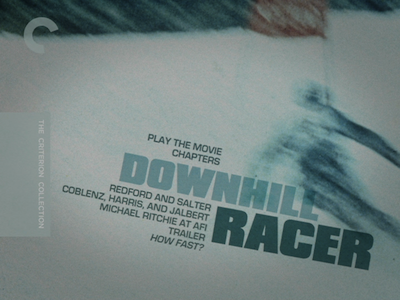
There are two parts to Downhill Racer. There is the part that is the racing, and there is the part that is the waiting for the racing. There is no in between.
The waiting for the racing is strange, incomplete, and quiet. No one says much. They do things, but at the same time, none of it is important. When it starts to get important, it distracts from the racing.
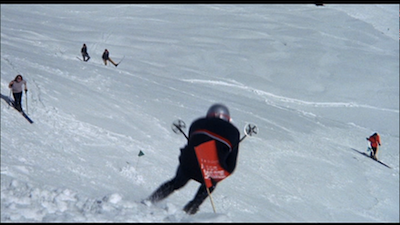
The racing is also quiet, but it's a different kind of quiet. It's isolated. Solitary. The main sound the racer hears is his skis on snow. The audio design for the movie is pretty incredible. When the skis catch air, the silence that occurs is definite. There is no other ambient noise. It's like flipping a switch to mute, and then contact activates the speakers again.
Downhill Racer is a 1969 film directed by Michael Ritchie and written by James Salter. It stars Robert Redford as David Chappellet, a contender from Idaho Falls, Colorado, a small American town that is far away from the European racing circuit that David is joining. David is one of two new members of the U.S. team, replacing another athlete whose injuries from a crash have taken him out of competition. David is an unknown, seemingly older than the other boys, and not a part of their network. His coach, Claire (Gene Hackman), apparently knows something about Chappellet that they do not. The time on his first run gives them an indication of what that is. The dude is fast.
David is confident and cocky--they are not the same thing. His confidence means he has enough belief to perform well, but the cockiness means he has the added belief that he can do anything. It makes him restless and inconsistent on the slopes, and it's the kind of thing that transfers over to his real life. He drives fast, and he chases girls just as quickly. He doesn't say much, just what he has to. This rubs his teammates the wrong way, but if they saw David going back home to the farm where he grew up the way we do, they might understand. It's a kind of American stoicism. David's father (Walter Stroud) doesn't even stop to greet him when the boy comes home, and he's not all that impressed with his Olympic aspirations. It's the only time we see David rattled. His old man's nonchalance and measured judgment clearly irritates him.
Which may also explain the appeal of skiing for Dave. His closest competition on the squad, Creech (Jim McMullan), complains to the assistant coach (Dabney Coleman) that David doesn't care about the team, and the coach replies that it doesn't really matter, it's not really a team sport anyway. It's not clear why Creech doesn't get that, it's obvious to us and we aren't up there racing. Michael Ritchie makes sure we see the action as close as possible to how the racer's see it, shooting the runs mostly from the skier's point of view. Noticeably, the first race, when we're supposed to be observing David and not yet climbing in his boots, is shot exclusively from an outside vantage point. It's exhilarating and disorienting, the way the camera rockets down the mountain. It gives the audience a glimpse of the kind of tunnel vision that can occur when descending the mountain.
Presumably, this is the sensation David is chasing. Not just the thrill of adrenaline, but the self-sufficiency and isolation. No need for small talk, and no room for the disappointment of others. It's just you and the snow. Sure, you can crash, but if you're racing just for you, who cares how that effects others? Win or lose, the time is yours.
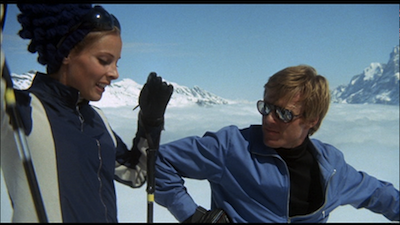
Downhill Racer is a strange film. It's certainly not like any other sports film I've ever seen. The plot tracks several seasons for the team, leading up to the Olympics, and though Ritchie depicts the jolt of the individual races, there is no real escalation from competition to competition. The opposite, in fact. The plot grows choppier and choppier, we move from peak to peak faster. If it weren't for a barely there subplot with a woman (Camilla Sparv) that David has an affair with, there would be no pause at all after that brief trip home. One can surmise that David is never going back to Colorado, so why spend any time away from the slopes.
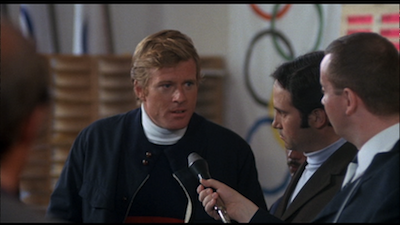
The Olympics have their own tension. Ritchie creates an amped excitement in David's big run by ingeniously jumping from TV monitor to TV monitor in the pressroom as his time is counted off, one second per television. There is also another gut wrenching use of silence, as David and Claire watch to see if his closest competitor will manage to beat him. Even then, we aren't really rooting for David. The script has a third act hiccup, where his hubris causes damage, but outside of a nice scene-grabbing monologue that Salter writes for Gene Hackman, there's no push to make it seem like this is a mistake David must bounce back from. It's just another day out in the powder.
Released at the end of the 1960s, Downhill Racer is in every way a film of that era, and also points ahead to the maverick years coming in American cinema. Aesthetically, the movie is restrained, striving for realism and not reliant on traditional storytelling. Director of photography Brian Probyn (Badlands ) worked with eight cameramen to capture the skiing, and the multiple angles lends an authenticity to the action. There are no conventional cutaways or rear projection like we might have gotten even a decade earlier. It's something more akin to actual sports documentary. The only thing that rings false is Kenyon Hopkins' music. There's something off-key about it. The horns and mandolins and overall rhythm seem more suited to a '60s cop drama on television than a movie of this kind.
Downhill Racer is also thematically in line with the dissatisfaction of 1969. This movie is about demystifying heroes. David Chappellet might ski with the letters U, S, and A printed on his helmet, but there is no patriotism to it. Indeed, the way Claire has to constantly hustle for money, it's not even like the home country is lending their skiers the full support of the national consciousness. David Chappellet is an anti-hero, a guy who only fights for himself. Ironically, I don't think anyone who wasn't as classically good looking as Robert Redford could have pulled it off. In the commentary on the recent release of Broadcast News [review], during the scene at the news director's party where William Hurt's character is seen struggling with eating a deviled egg, James L. Brooks says he believes that kind of dunderheaded gag is something that is only really funny with a handsome actor; if he was dumb and unattractive, it would veer toward being pathetic. Here, too, I think Chappellet needs a certain Hollywood charisma, the performer's inherent likability, to keep him from being just another asshole. Just like it takes a performer as down to earth as Hackman to play his foil. The same way Albert Brooks knows something is wrong with William Hurt in the Brooks movie, so too does Coach Claire know that Chappellet could blow it. In both cases, those guys also know what kind of success these flawed figures are likely to achieve.
In a lesser movie, David Chappellet would find redemption. In Downhill Racer, there is only disappointment ahead. I don't want to give away which way the movie turns, that's something for you to experience, but I will say, there is no denouement. The results come in, and that's that, and I think we are meant to be unsatisfied. How did this man get here, and how did he achieve what he achieved? Good or bad, was it right? I would posit that this is a question that the culture was asking at the time, and by this point in the social movement that defined the 1960s, the question was no longer being asked of the government in so much as the counter-culture and the activists and, really, just about every citizen with a conscience, was asking him or herself. Even fighting the power has its pitfalls. David's father says it outright when his son boasts that one day he'll be champion: "The world's full of 'em."
Downhill Racer trailer
There are two parts to Downhill Racer. There is the part that is the racing, and there is the part that is the waiting for the racing. There is no in between.
The waiting for the racing is strange, incomplete, and quiet. No one says much. They do things, but at the same time, none of it is important. When it starts to get important, it distracts from the racing.
The racing is also quiet, but it's a different kind of quiet. It's isolated. Solitary. The main sound the racer hears is his skis on snow. The audio design for the movie is pretty incredible. When the skis catch air, the silence that occurs is definite. There is no other ambient noise. It's like flipping a switch to mute, and then contact activates the speakers again.
Downhill Racer is a 1969 film directed by Michael Ritchie and written by James Salter. It stars Robert Redford as David Chappellet, a contender from Idaho Falls, Colorado, a small American town that is far away from the European racing circuit that David is joining. David is one of two new members of the U.S. team, replacing another athlete whose injuries from a crash have taken him out of competition. David is an unknown, seemingly older than the other boys, and not a part of their network. His coach, Claire (Gene Hackman), apparently knows something about Chappellet that they do not. The time on his first run gives them an indication of what that is. The dude is fast.
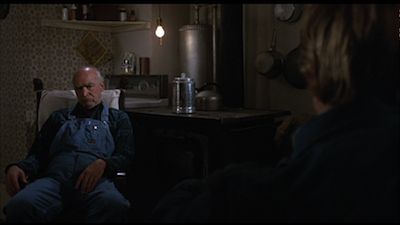
David is confident and cocky--they are not the same thing. His confidence means he has enough belief to perform well, but the cockiness means he has the added belief that he can do anything. It makes him restless and inconsistent on the slopes, and it's the kind of thing that transfers over to his real life. He drives fast, and he chases girls just as quickly. He doesn't say much, just what he has to. This rubs his teammates the wrong way, but if they saw David going back home to the farm where he grew up the way we do, they might understand. It's a kind of American stoicism. David's father (Walter Stroud) doesn't even stop to greet him when the boy comes home, and he's not all that impressed with his Olympic aspirations. It's the only time we see David rattled. His old man's nonchalance and measured judgment clearly irritates him.
Which may also explain the appeal of skiing for Dave. His closest competition on the squad, Creech (Jim McMullan), complains to the assistant coach (Dabney Coleman) that David doesn't care about the team, and the coach replies that it doesn't really matter, it's not really a team sport anyway. It's not clear why Creech doesn't get that, it's obvious to us and we aren't up there racing. Michael Ritchie makes sure we see the action as close as possible to how the racer's see it, shooting the runs mostly from the skier's point of view. Noticeably, the first race, when we're supposed to be observing David and not yet climbing in his boots, is shot exclusively from an outside vantage point. It's exhilarating and disorienting, the way the camera rockets down the mountain. It gives the audience a glimpse of the kind of tunnel vision that can occur when descending the mountain.
Presumably, this is the sensation David is chasing. Not just the thrill of adrenaline, but the self-sufficiency and isolation. No need for small talk, and no room for the disappointment of others. It's just you and the snow. Sure, you can crash, but if you're racing just for you, who cares how that effects others? Win or lose, the time is yours.
Downhill Racer is a strange film. It's certainly not like any other sports film I've ever seen. The plot tracks several seasons for the team, leading up to the Olympics, and though Ritchie depicts the jolt of the individual races, there is no real escalation from competition to competition. The opposite, in fact. The plot grows choppier and choppier, we move from peak to peak faster. If it weren't for a barely there subplot with a woman (Camilla Sparv) that David has an affair with, there would be no pause at all after that brief trip home. One can surmise that David is never going back to Colorado, so why spend any time away from the slopes.
The Olympics have their own tension. Ritchie creates an amped excitement in David's big run by ingeniously jumping from TV monitor to TV monitor in the pressroom as his time is counted off, one second per television. There is also another gut wrenching use of silence, as David and Claire watch to see if his closest competitor will manage to beat him. Even then, we aren't really rooting for David. The script has a third act hiccup, where his hubris causes damage, but outside of a nice scene-grabbing monologue that Salter writes for Gene Hackman, there's no push to make it seem like this is a mistake David must bounce back from. It's just another day out in the powder.
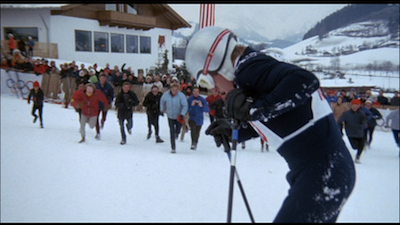
Released at the end of the 1960s, Downhill Racer is in every way a film of that era, and also points ahead to the maverick years coming in American cinema. Aesthetically, the movie is restrained, striving for realism and not reliant on traditional storytelling. Director of photography Brian Probyn (Badlands
) worked with eight cameramen to capture the skiing, and the multiple angles lends an authenticity to the action. There are no conventional cutaways or rear projection like we might have gotten even a decade earlier. It's something more akin to actual sports documentary. The only thing that rings false is Kenyon Hopkins' music. There's something off-key about it. The horns and mandolins and overall rhythm seem more suited to a '60s cop drama on television than a movie of this kind.Downhill Racer is also thematically in line with the dissatisfaction of 1969. This movie is about demystifying heroes. David Chappellet might ski with the letters U, S, and A printed on his helmet, but there is no patriotism to it. Indeed, the way Claire has to constantly hustle for money, it's not even like the home country is lending their skiers the full support of the national consciousness. David Chappellet is an anti-hero, a guy who only fights for himself. Ironically, I don't think anyone who wasn't as classically good looking as Robert Redford could have pulled it off. In the commentary on the recent release of Broadcast News [review], during the scene at the news director's party where William Hurt's character is seen struggling with eating a deviled egg, James L. Brooks says he believes that kind of dunderheaded gag is something that is only really funny with a handsome actor; if he was dumb and unattractive, it would veer toward being pathetic. Here, too, I think Chappellet needs a certain Hollywood charisma, the performer's inherent likability, to keep him from being just another asshole. Just like it takes a performer as down to earth as Hackman to play his foil. The same way Albert Brooks knows something is wrong with William Hurt in the Brooks movie, so too does Coach Claire know that Chappellet could blow it. In both cases, those guys also know what kind of success these flawed figures are likely to achieve.
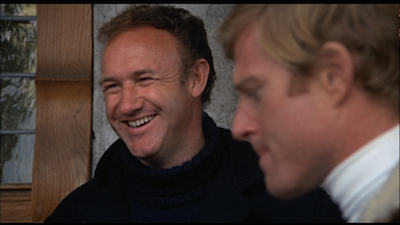
In a lesser movie, David Chappellet would find redemption. In Downhill Racer, there is only disappointment ahead. I don't want to give away which way the movie turns, that's something for you to experience, but I will say, there is no denouement. The results come in, and that's that, and I think we are meant to be unsatisfied. How did this man get here, and how did he achieve what he achieved? Good or bad, was it right? I would posit that this is a question that the culture was asking at the time, and by this point in the social movement that defined the 1960s, the question was no longer being asked of the government in so much as the counter-culture and the activists and, really, just about every citizen with a conscience, was asking him or herself. Even fighting the power has its pitfalls. David's father says it outright when his son boasts that one day he'll be champion: "The world's full of 'em."
Downhill Racer trailer
Friday, January 28, 2011
BROADCAST NEWS (Blu-Ray) - #552
"It must be nice to always believe you know better, to always think you're the smartest person in the room."
"No. It's awful."
Man, I know I liked Broadcast News when I saw it at age 15, because the exchange between the unstoppable news producer Jane Craig and her boss quoted above has always stuck with me, but thinking about it now, I know I didn't really get it. In fact, even that, my favorite quote, is one I totally misremembered. In my brain, Jane nods, agrees with her boss, and silently says, "Damn straight it's nice." It's how I reacted when my father told me similar things many times in my late teens. Here I was basing my whole philosophy on a quote I didn't have right from a movie possessing complexities far beyond me. I did have a crush on Holly Hunter, who played Jane, I know that--but geez, that just seems trivial.
Broadcast News was released in 1987, four years after writer/director James L. Brooks had transitioned from the little screen to the big one with his cinema debut, Terms of Endearment . Holly Hunter was a virtual unknown at the time, though she was having a hell of a year. 1987 was also when Raising Arizona
 was released, though I don't think to quite the same acclaim as Broadcast News. CNN and 24-hour cable news was still in its infancy at the time, and network TV still ruled--so much so that Brooks doesn't even mention that there is any alternative, despite the subtext of his romantic comedy being the changing face of television journalism.
The literal changing face is played by William Hurt. His character is Tom Grunick, a sports reporter upgraded to neophyte newsman at the Washington bureau where Jane is a segment producer. She regularly works with Aaron Altman (Albert Brooks), a fiercely intelligent reporter who isn't afraid to dig deep into the story. They have a special rapport and shared ideals: the integrity of the news is sacrosanct, never to be breached. Empty personalities reading off a teleprompter should not be valued over smart journalists who write their own copy, and fluff pieces that make people happy shouldn't come at the expense of telling the audience what's really happening in the world. The chemistry between Jane and Aaron is obvious, but naturally, like the audience and the network executives, Jane is more drawn to Tom's pretty face. She begins guiding him through his early work, culminating in an unplanned Sunday anchor slot when Libya attacks a U.S. base in Sicily. It's a marvelous scene, moving back and forth between the news desk and the control room, with Jane whispering facts--some supplied by Aaron via telephone--into Tom's ear, directing him where he should go.
The exhilaration the pair feel following the live high-wire act pretty much seals the deal between them. It's a euphoria comparable to sex, which Tom says outright. Jane was in his head, lighting up his intellectual pleasure centers, reversing traditional gender roles, filling him with everything she had to give. It was, quite literally, a mindfuck. The only problem is that Jane essentially sees Tom as brainless, and there are questions of how much she respects the eager go-getter. When Aaron admits his own feelings, both the love he has for her and his disdain for his rival, it poses quite a puzzle, one Jane has a hard time solving.
It's a traditional romantic comedy formula, and make no mistake, Broadcast News is a romantic comedy. It's one of the first things that struck me about the movie seeing it again after all these years. We're not very far into the narrative when Jane and her crew, under tremendous deadline pressure, push a story up to its very last minute, forcing Joan Cusack, playing one of Jane's support staff, to run from the editing bay to the broadcast room, dodging filing cabinets and jumping over babies. It's expertly choreographed slapstick. Broadcast News is off and running.
One could say this is James L. Brooks' true gift: balancing a very traditional sense of comedy with incisive commentary on human emotion. The first three scenes of Broadcast News are introductions to the three principle characters as schoolkids. It's sort of a hokey, Rob Reiner-ish device, exaggerating their foibles for quick guffaws--or so it seems. At different times later in the movie, all three of those scenes will be replayed. No commentary is offered, and the repetition isn't exact, but we see the behavior again--Tom's self-chastising and determination, Aaron's superiority and pushing too hard to get the last word, Jane's jumpiness and compulsions. These are people who let themselves be defined by their faults because they mistake them for virtue.
The romantic set-up is quite meaningful. Whom Jane chooses is akin to the direction television journalism will also take. Do we stick with safe, nice, and easy to look at, or do we go with unvarnished and true? In a lesser romantic comedy, the choice would be obvious, but Brooks isn't going to let his characters off the hook that easily. If this were Pretty in Pink [review], sure, we'd all be rooting for Ducky, but Broadcast News is set in an adult world where the bloom of romance has drooped a little. (And that's not a knock at Pretty in Pink, bless its teenaged soul.) Brooks is in choppy waters. Reconciling the heart and the head requires compromise, but all points on this love triangle are too rigid when it comes to their own particular angles. They are too strident in their ideals to change course for anyone else.
Surprisingly, it's Tom that gets closest to making room for someone else. I definitely wouldn't have known that as a younger moviegoer. He'd have been the villain, no question. Now, not so much. In fact, Jane and Aaron are both the kind of nerds that grow up to be bullies. Off the playground, when it's no longer viable to beat your opponent to a pulp with your fists, the nerds get their revenge by doing it with their brains. Tom is the most genuine, he accepts his weaknesses and tries to build from there. William Hurt gets the well-intentioned lunkhead to a tee, giving him an insatiable yet befuddled curiosity, seemingly borrowing Tom's body language from dogs. Notice how he always cocks his head to listen. Every canine I've ever known has looked at me just that way.
When Tom eventually tries to put it all on the line for Jane, when she's ready to call it quits, he acknowledges that they disagree and asks for some leeway to work out their differences. Jane can't accept that. Everything for her has one right way: her way. Sometimes that means not having what she wants because she must instead pursue what is correct. It's what she means about it being awful to be right. Let's face it, the joy of life is often in the mistakes. (And, as an aside, anyone else think of the end of Michael Clayton [review] during that cab ride from the airport?)
Holly Hunter is phenomenal as Jane--despite being burdened with the not-so-good clothes and the sometimes iffy hair of the late 1980s. She gets in Jane's head and stays there, much like Jane herself. Yet, it's not just a cerebral performance, it's physical, too. Many of her reactions in the movie are priceless. Jane is a bundle of kinetic energy, always moving forward, always reacting. At times, people tell her news she's not ready to hear--such as, "I love you"--and she literally flinches, like the information is a blast of bad air. The only time she is truly at rest is when she is directing the news broadcast. The director's chair is the one physical space where her mind is allowed to move at its natural speed, when the energy and her thoughts are focused in the same place. She doesn't have to keep moving just to keep up with it.
I know I am being very enthusiastic here, and I don't mean to imply that Broadcast News is without its faults. In some ways, James L. Brooks' expert construction is too slick. The storytelling can be a little quaint and even convenient, much in the same way that Albert Brooks' well-timed zingers stand out from the reality of the movie as just being too perfect. Albert is good, but sometimes he appears to know he has a great one-liner. (Ironic how much Aaron Altman absolutely abhors alliteration given his name.) Those who find romantic comedies too predictable probably won't be all that surprised by how the plot twists here, either, not even when Brooks actually breaks from convention.
To that I say so what. Let Broadcast News be flawed, let it have its merry way with genre tropes. That's the compromise enjoying a love story sometimes requires. Let go of your modern conceits, and embrace what is maybe old fashioned about romantic movies. Give your head a rest and let your heart take hold of the remote. Because, damnit, Broadcast News is just so likable, getting mad that it works too well just seems disingenuous. Surrender to the moment, and leave the lonely taxi rides to someone else.
For a complete rundown on the special features, read the full review at DVDTalk.
"No. It's awful."
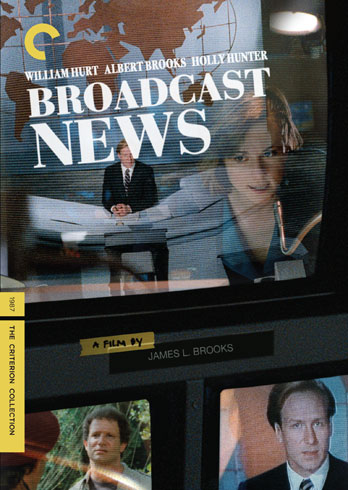
Man, I know I liked Broadcast News when I saw it at age 15, because the exchange between the unstoppable news producer Jane Craig and her boss quoted above has always stuck with me, but thinking about it now, I know I didn't really get it. In fact, even that, my favorite quote, is one I totally misremembered. In my brain, Jane nods, agrees with her boss, and silently says, "Damn straight it's nice." It's how I reacted when my father told me similar things many times in my late teens. Here I was basing my whole philosophy on a quote I didn't have right from a movie possessing complexities far beyond me. I did have a crush on Holly Hunter, who played Jane, I know that--but geez, that just seems trivial.
Broadcast News was released in 1987, four years after writer/director James L. Brooks had transitioned from the little screen to the big one with his cinema debut, Terms of Endearment
. Holly Hunter was a virtual unknown at the time, though she was having a hell of a year. 1987 was also when Raising Arizona was released, though I don't think to quite the same acclaim as Broadcast News. CNN and 24-hour cable news was still in its infancy at the time, and network TV still ruled--so much so that Brooks doesn't even mention that there is any alternative, despite the subtext of his romantic comedy being the changing face of television journalism.The literal changing face is played by William Hurt. His character is Tom Grunick, a sports reporter upgraded to neophyte newsman at the Washington bureau where Jane is a segment producer. She regularly works with Aaron Altman (Albert Brooks), a fiercely intelligent reporter who isn't afraid to dig deep into the story. They have a special rapport and shared ideals: the integrity of the news is sacrosanct, never to be breached. Empty personalities reading off a teleprompter should not be valued over smart journalists who write their own copy, and fluff pieces that make people happy shouldn't come at the expense of telling the audience what's really happening in the world. The chemistry between Jane and Aaron is obvious, but naturally, like the audience and the network executives, Jane is more drawn to Tom's pretty face. She begins guiding him through his early work, culminating in an unplanned Sunday anchor slot when Libya attacks a U.S. base in Sicily. It's a marvelous scene, moving back and forth between the news desk and the control room, with Jane whispering facts--some supplied by Aaron via telephone--into Tom's ear, directing him where he should go.
The exhilaration the pair feel following the live high-wire act pretty much seals the deal between them. It's a euphoria comparable to sex, which Tom says outright. Jane was in his head, lighting up his intellectual pleasure centers, reversing traditional gender roles, filling him with everything she had to give. It was, quite literally, a mindfuck. The only problem is that Jane essentially sees Tom as brainless, and there are questions of how much she respects the eager go-getter. When Aaron admits his own feelings, both the love he has for her and his disdain for his rival, it poses quite a puzzle, one Jane has a hard time solving.
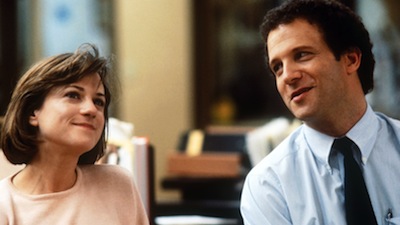
It's a traditional romantic comedy formula, and make no mistake, Broadcast News is a romantic comedy. It's one of the first things that struck me about the movie seeing it again after all these years. We're not very far into the narrative when Jane and her crew, under tremendous deadline pressure, push a story up to its very last minute, forcing Joan Cusack, playing one of Jane's support staff, to run from the editing bay to the broadcast room, dodging filing cabinets and jumping over babies. It's expertly choreographed slapstick. Broadcast News is off and running.
One could say this is James L. Brooks' true gift: balancing a very traditional sense of comedy with incisive commentary on human emotion. The first three scenes of Broadcast News are introductions to the three principle characters as schoolkids. It's sort of a hokey, Rob Reiner-ish device, exaggerating their foibles for quick guffaws--or so it seems. At different times later in the movie, all three of those scenes will be replayed. No commentary is offered, and the repetition isn't exact, but we see the behavior again--Tom's self-chastising and determination, Aaron's superiority and pushing too hard to get the last word, Jane's jumpiness and compulsions. These are people who let themselves be defined by their faults because they mistake them for virtue.
The romantic set-up is quite meaningful. Whom Jane chooses is akin to the direction television journalism will also take. Do we stick with safe, nice, and easy to look at, or do we go with unvarnished and true? In a lesser romantic comedy, the choice would be obvious, but Brooks isn't going to let his characters off the hook that easily. If this were Pretty in Pink [review], sure, we'd all be rooting for Ducky, but Broadcast News is set in an adult world where the bloom of romance has drooped a little. (And that's not a knock at Pretty in Pink, bless its teenaged soul.) Brooks is in choppy waters. Reconciling the heart and the head requires compromise, but all points on this love triangle are too rigid when it comes to their own particular angles. They are too strident in their ideals to change course for anyone else.
Surprisingly, it's Tom that gets closest to making room for someone else. I definitely wouldn't have known that as a younger moviegoer. He'd have been the villain, no question. Now, not so much. In fact, Jane and Aaron are both the kind of nerds that grow up to be bullies. Off the playground, when it's no longer viable to beat your opponent to a pulp with your fists, the nerds get their revenge by doing it with their brains. Tom is the most genuine, he accepts his weaknesses and tries to build from there. William Hurt gets the well-intentioned lunkhead to a tee, giving him an insatiable yet befuddled curiosity, seemingly borrowing Tom's body language from dogs. Notice how he always cocks his head to listen. Every canine I've ever known has looked at me just that way.
When Tom eventually tries to put it all on the line for Jane, when she's ready to call it quits, he acknowledges that they disagree and asks for some leeway to work out their differences. Jane can't accept that. Everything for her has one right way: her way. Sometimes that means not having what she wants because she must instead pursue what is correct. It's what she means about it being awful to be right. Let's face it, the joy of life is often in the mistakes. (And, as an aside, anyone else think of the end of Michael Clayton [review] during that cab ride from the airport?)
Holly Hunter is phenomenal as Jane--despite being burdened with the not-so-good clothes and the sometimes iffy hair of the late 1980s. She gets in Jane's head and stays there, much like Jane herself. Yet, it's not just a cerebral performance, it's physical, too. Many of her reactions in the movie are priceless. Jane is a bundle of kinetic energy, always moving forward, always reacting. At times, people tell her news she's not ready to hear--such as, "I love you"--and she literally flinches, like the information is a blast of bad air. The only time she is truly at rest is when she is directing the news broadcast. The director's chair is the one physical space where her mind is allowed to move at its natural speed, when the energy and her thoughts are focused in the same place. She doesn't have to keep moving just to keep up with it.
I know I am being very enthusiastic here, and I don't mean to imply that Broadcast News is without its faults. In some ways, James L. Brooks' expert construction is too slick. The storytelling can be a little quaint and even convenient, much in the same way that Albert Brooks' well-timed zingers stand out from the reality of the movie as just being too perfect. Albert is good, but sometimes he appears to know he has a great one-liner. (Ironic how much Aaron Altman absolutely abhors alliteration given his name.) Those who find romantic comedies too predictable probably won't be all that surprised by how the plot twists here, either, not even when Brooks actually breaks from convention.
To that I say so what. Let Broadcast News be flawed, let it have its merry way with genre tropes. That's the compromise enjoying a love story sometimes requires. Let go of your modern conceits, and embrace what is maybe old fashioned about romantic movies. Give your head a rest and let your heart take hold of the remote. Because, damnit, Broadcast News is just so likable, getting mad that it works too well just seems disingenuous. Surrender to the moment, and leave the lonely taxi rides to someone else.
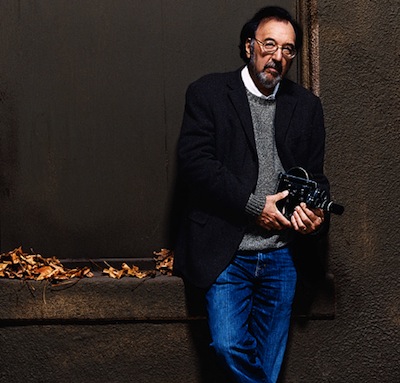
For a complete rundown on the special features, read the full review at DVDTalk.
Subscribe to:
Posts (Atom)

