Showing posts with label Dusan Makavejev. Show all posts

Saturday, April 13, 2013

PIERRE ETAIX: LAND OF MILK AND HONEY - #655


The first five tags in the keywords section of Land of Milk and Honey's IMDB section are "marriage," "transvestite," "comic relief," "hippie," and "brass band." That seems about right. Though there is much more to the film than those handful of descriptors, they do get at the scattered nature of the last film from Pierre Étaix's initial run as a director. I just wish Land of Milk and Honey had a little more of the comic relief. I'd have easily given up a few members of the brass band.

Land of Milk and Honey is an absolute departure from Étaix's narrative cinema. The 1971 documentary was made in the wake of the political and social upheaval that rocked France in May of 1968. The footage that the filmmaker gathered after these events took him the next couple of years to assemble, a plight jokingly referred to in the movie's opening skit. It's one of only two times that Étaix appears in front of the camera, and it's a bit misleading as an intro. The entirely staged segment shows Étaix in discussion with himself, buried in a self-replicating pile of celluloid. We won't see the star again until the very end of the film, when he amusingly asks his random interview subjects if they've ever heard of Pierre Étaix. Many haven't, and the ones that do definitely have an opinion about what Étaix considers humor. The movie closes with Étaix taking a bow, having just performed a song and dance number in disguise. He exits the stage, and effectively exits cinema.


What takes place between these two bookends is a sociological experiment. Over the summer of 1968, Étaix went to rural vacation spots, filming carnivals and festivals, and interviewing people he met there about different topics relevant to the times. They range from eroticism and advertising to the moon landing and famine. Land of Milk and Honey's basic thesis is that France is no paradise, and the perceptions of its unity and prosperity are false. Étaix sets out to expose how little was really affected during the protests, juxtaposing people's dissections of serious topics with images of low-rent parades, cheese-eating contests, and other bizarre vacation rituals. Opinions about sexy images are played over decidedly unsexy shots of people lounging on the beach in ill-fitting bathing suits. An extended portion of the film is spent filming a singing competition where amateurs get up and perform for other travelers. Any sense of community is undermined by the brutal catcalling that drowns out some of these performances, many of which are of protest songs. Meaning disappears in the gulf between belief and action.


The agitprop technique that Étaix uses for Land of Milk and Honey is very much of its time. His collage tactics are like the middle ground  between the heavy-duty screeds of Jean-Luc Godard and Jean-Pierre Gorin and Dusan Makavejev's WR: Mysteries of the Organism [review]. Too bad "being of its time" also means Land of Milk and Honey is somewhat dated. I found much of what I was seeing to be too specific to the era and locale to be relatable, a problem that isn't helped by the fact that Étaix belabors every topic past the point of exhaustion before moving on to the next one. Still, a few of the subjects are still relevant, particularly given recent economic troubles around the world, and the footage of average Frenchmen on summer holiday has its amusements, serving as a curious snapshot of a time and place that otherwise might not have been preserved.


Land of Milk and Honey plays today, April 13, at 5pm and 9pm, as part of the NW Film Center's Pierre Étaix retrospective. View the full schedule here.

Sunday, October 18, 2009

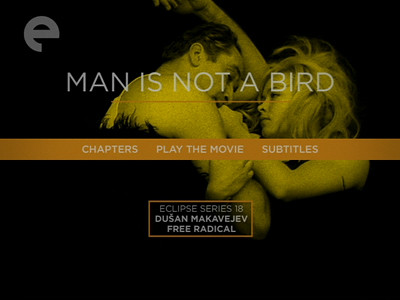
DUSAN MAKAVEJEV: FREE RADICAL - ECLIPSE SERIES 18


My first exposure to Serbian director Dušan Makavejev was reviewing his experimental 1971 feature WR: Mysteries of the Organism when Criterion released it on DVD a couple of years ago. As is immediately obvious from reading that piece, I was not altogether won over by Makavejev's style. WR was both too all over the place and too on the nose for me. Though his filmmaking was playful, it was also too heavy in its intentions. To say I wasn't all that excited when this new boxed set came around would be to put it mildly.

Well, I was wrong. I should have been excited. Dušan Makavejev: Free Radical - Eclipse Series 18 strikes me as having everything I felt WR was lacking. The three films here, representing Makavejev's earliest full-length work, are as stylistically inventive as anything out of the French New Wave and rooted enough in traditional storytelling to keep them from showing their age. If what was radical yesterday was content on being merely radical and nothing more, it can appear predictable or mundane today; if it has a solid foundation to give the experiment something firm to stand on, the material can sustain its freshness and speak to audiences regardless of the era. Such is the case here.


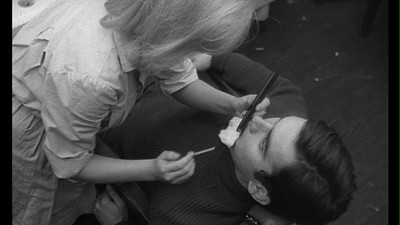
Dušan Makavejev: Free Radical showcases work the writer/director made in the former Yugoslavia over a four-year span, from 1965 to 1968. It kicks off with Man is Not a Bird, a romance wrapped up in the politics of everyday struggle. Set in a mining town near the Bulgarian border, it involves the arrival of a revered construction foreman named Jan Rudinski (Janez Vrhovec). Rudinski has been charged with updating the copper mill to be compliant with safer, more efficient modern standards. He meets Rajka (Milena Dravić, the sexy star of WR), an attractive young hairdresser who is used to turning heads in her sleepy 'burg and just as used to putting those heads back where they belong. She sets Rudinski up with a room in her parents' house, and she and the older man eventually have an affair. Perhaps it's the appeal of the new and the different, or maybe it's the attraction of the temporary that brings them together. Maybe it's the fact that they can have an intelligent conversation, or even his indifference. It's hard to say how the fires of passion are stoked, but Rajka also ends up with a local truck driver, the rapscallion Bosko (Boris Dvornik), whom she beds on the night Rudinski is honored for his good work.

Perhaps Rakja is punishing Rudinski for valuing his job over her. That would actually make it ironic that she ends up having sex with Bosko in his truck, his mobile workplace. There are a couple of thematic threads that run through Man is Not a Bird that suggest valuing one's work over one's personal relationships is not a good thing. Running parallel to this story is the tale of Barbulović (Stole Arandelovic), a boozer whose antics keep getting him in trouble. He is stepping out on his wife (Eva Ras), who makes no bones about confronting the other woman and raising a stink about how Barbulović is always moaning about having to work at the factory but then blows his money on harlots. Our introduction to the cad actually comes at the beginning of the film when he is arrested for a nightclub brawl he claims to have had no involvement in. The violence ended with the stabbing of the performing chanteuse, whose cautionary tale about the roving eye of love could have saved all of these folks a lot of trouble had they heeded her warning. The film is bookended with a more grandiose orchestral concert, the one given in Rudinski's honor. There is a subtle commentary here, of the low-culture performance for the workers vs. the high-culture performance for the boss. Both musical interludes indicate some form of betrayal.
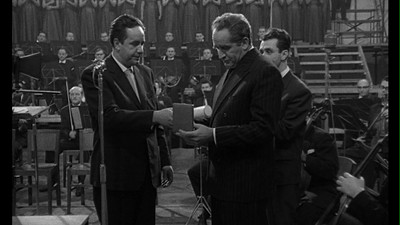


These two music numbers are interwoven into the narrative in their complete form, shot as if part of a documentary. Makavejev also shoots the factory scenes with a similar style, showing the effort of the workers in all its dirty detail, sharply contrasted against the more staged cutaways to the factory owner far away in his office. He is portrayed as corrupt and clearly in control of the communist party, dictating their policies like some kind of mobster lobbyist. There is no question where Makavejev's sympathy lies, and he clearly has affection for the working class. He doesn't believe they are perfect, but he does appear to enjoy showing them slacking off and doing whatever else it takes to get back a little of their own from those who would exploit them. Their foibles are shown with humor, whereas the higher-ups are far more sinister.


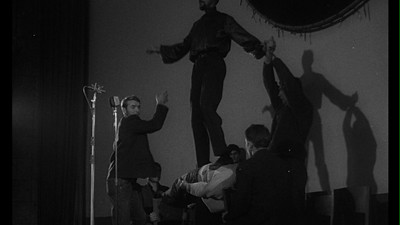
Not that it's so black-and-white. The director also has a sympathetic interest in Rudinski's predicament. He is a man who is neither one side nor the other, a sort of industrial mercenary who gets the job done when required. Makavejev shoots his encounters with Rakja in an expressionistic manner, capturing their lovemaking in tightly framed abstractions. Even in this early film, Makavejev is exhibiting a penchant for a freeform style, refusing to be locked down to any particular narrative aesthetic. The story takes many detours, seemingly going off track, but then coming back around to sew each added element into the main fabric. The most notable of these sidelines is the hypnotist (Roko Cirkovic) who provides an evening's entertainment by goading his volunteers into doing all manner of crazy things, like thinking they are birds and then watching them flail around on stage, unable to take to the air. Barbulović's wife directly references this stage act by telling her husband's lover how she believes that hypnotism is Barbulović's true talent, that all men lead women into a trance to get what they want. Man is Not a Bird extends this theory to include all social constructs. The need to work, political ideology, romance--these are all a form of social hypnosis, a great con to make us believe we are happy and that we can escape the mundane. Rakja seeks escape from love, for instance, only to have neither lover take her out of this tiny town. This is why man is not akin to birds, because man can't truly fly free.
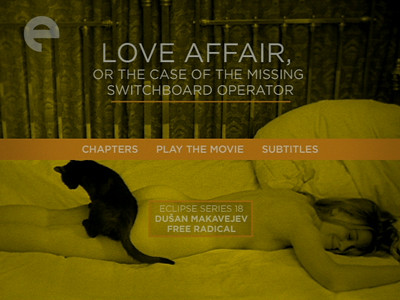


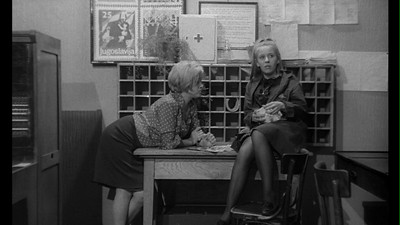
Sex, crime, science, art, nationalist politics--these all return in some form in Makavejev's 1967 feature, Love Affair, or the Case of the Missing Switchboard Operator. Once again working with a mish-mash of documentary footage and fictional narrative, Makavejev establishes an alternating formalist structure for the film. It opens with a real-life sexologist, Dr. Aleksandar Kostić, lecturing about man's fundamental needs before introducing us to Izabela (Eva Ras) and her friend (Ruzica Sokić), two switchboard operators out on the prowl for a good time. They meet a Turkish man named Ahmed (Slobodan Aligrudić), a sanitation expert, who takes Izabela home. So begins a long, loving relationship, both tender and sensual, which plays out while trading off with more educational interludes, all of which connect to the main narrative in some way. Izabela playing patriotic music is followed by footage of a real political rally, or a scene of her baking leads to a lecture about the physiology of chicken eggs. (The close-ups of Eva Ras breaking an egg into flour are later echoed in WR.)
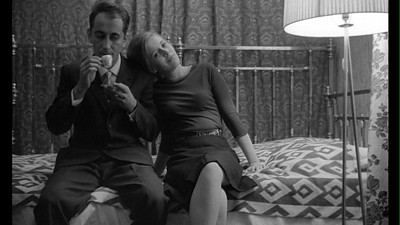


We also get a glimpse of Ahmed's job in newsreel-like footage about Yugoslavia's rat problem. He is part of the crew of exterminators who are trying to rid the country of gray rats, which themselves were allowed to enter the land so that they would get rid of the black rats. It's the nasty cycle of power, one political party coming in to oppress another. It's also meant to make us distrust Ahmed, as he is a suspect in Izabela's homicide. As if flipping the switch between fiction and documentary weren't enough, Makavejev has also worked a little murder mystery into the script. Structured like a true police drama where we know there has been a killing before we know how or why, the second interlude shows Izabela's body being retrieved from a well while we hear a criminologist, Dr. Zivojin Aleksić, explain the process of cleaning and identifying a corpse. It's a harsh, clinical lecture, and it makes us feel uneasy even though our connection to Izabela is not all that strong as of yet.
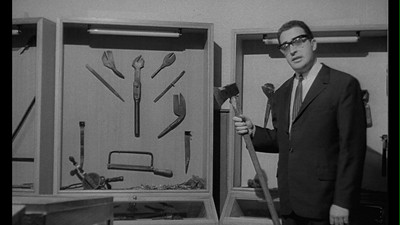


Love Affair connects back to Man is Not a Bird in that some of the tragedy is born out of infidelity. Izabela is constantly being hit on by the postman (Miodrag Andric) who delivers to her work, and she eventually relents. In a scene reminiscent of Godard, Izabela breaks the fourth wall to address the audience directly, to confess that she is weak and, as she puts it, not made of wood. It's a reasonable appeal. Makavejev seems to be saying that our social structures, our fear of sex and our subsuming our individual desires to the greater need of the State leads to unnatural reactions. Unhappy people act in unhappy ways, and once we finally see the death occur, we realize that Ahmed is not simply some cold-blooded killer. This is not a grandiose revelation, Makavejev doesn't underscore it with an ironic orchestral swell the way he does the sexual ruining of Rajka in Man is Not a Bird, but rather shows it in a very plain fashion. It's sad enough as it is. The scene perfectly illustrates the ease with which the filmmaker moves between styles. The cuts between the fact and fiction are seamless; in fact, in Love Affair, he really blurs the lines between the two. The naturalistic staging of the drama makes it almost indistinguishable from the documentary footage. It's like meta-Neorealism.
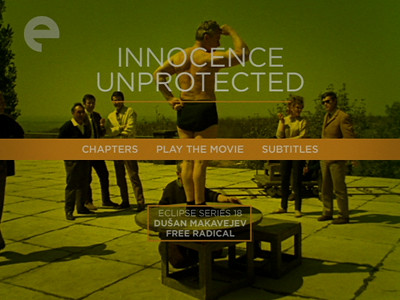


1968's Innocence Unprotected gives Dušan Makavejev a remarkable opportunity to obliterate the lines between fictional filmmaking and documentary storytelling. In this movie, Makavejev repurposes an old film that had long gone out of circulation despite being Yugoslavia's first sound picture. It was made during WWII by Dragoljub Aleksić, an acrobat and strongman. Though it was shot entirely on the sly, it was later misconstrued as a film made in collaboration with the Nazi occupiers and not just banned from being shown, but also removed from the history books.

Makavejev takes this bizarre melodrama and recontextualizes it. Having tracked down the living actors and crew members, including Aleksić, Makavejev creates a non-fiction frame around the old footage, moving back and forth between the original production and people's memories of the same. The tale is pretty fantastic, including performers hiding in a soundstage darkroom while the German propagandists shot their own footage outside. Aleksić made Innocence Unprotected in the hopes of making money, and in its original form, it's mostly a self-aggrandizing excuse to show off his freakish stunts. Breaking and bending iron with his teeth, making his muscles dance, dangling from an airplane by holding a leather bit in his mouth--Aleksić is the kind of sideshow performer that Makavejev loves (see also the circus scenes in Man is Not a Bird). He's a true original, an individual who lives his life as he wishes, and one that also ran afoul of a bureaucracy that refused to let such characters roam free.
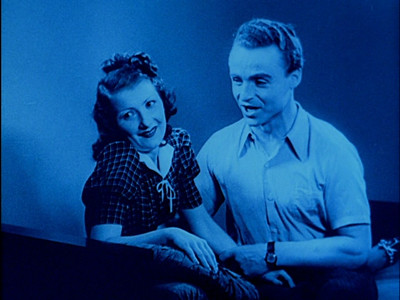


In Makavejev's hands, Innocence Unprotected becomes both propaganda for the common man's power to resist oppressive governance, but also a parody of the propaganda. I actually started watching the movie believing it to be a pitch-perfect mockumentary, right down to the bad acting in the "found" film; only midway through did I stop and read the liner notes and realize this was entirely real. An incisive social critic, Makavejev has found a greater meaning in a particular piece of art by examining its historical context. He uses newsreel footage of German atrocities and maps illustrating the warmongers' advances on his country's border to embolden Aleksić's ridiculous fictional romance with greater meaning. A wicked stepmother (Vera Jovanovic-Segvić) selling out her orphaned stepdaughter (Ana Milosavljević) to a wealthy scoundrel (Bratoljub Gligorijević), only to have her rescued by the unflappable hero makes for a wonderfully blunt allegory (complete with twist ending: Aleksić pretty much ran off with whatever money was made before the film was banned, leaving his comrades out in the cold). It illuminates the struggles of the Serbian people, first under the Nazis and then under the Socialists, as well as the personal struggles Dušan Makavejev must have gone through in order to make movies under the censoring eye of the government. Not unlike Aleksić, Makavejev would eventually be persecuted for his art. After his next film, he would be exiled from his homeland for nearly two decades.
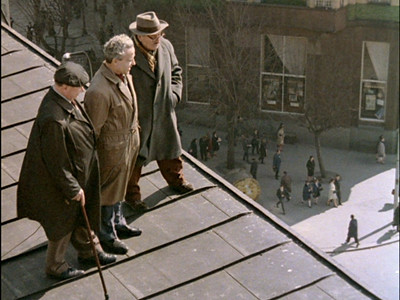


Seen as a whole, the three films collected in Dušan Makavejev: Free Radical - Eclipse Series 18 show the emergence of a new cinematic voice, a singular artist who would go on to further challenge his audience and often alienating people--including this particular stuffy critic. This trio is playful, creative, culturally rich, and full of insightful commentary on the human condition, particularly the way our personal lives become entangled with society's imposed restrictions. Dušan Makavejev proves himself to be every bit as inventive as his European contemporaries, and as full of cinematic whimsy and film knowledge as anyone who wrote for Cahiers du Cinema. This boxed set is a true treasure.


For a full rundown on the special features, read the full article at DVD Talk.

Wednesday, June 24, 2009

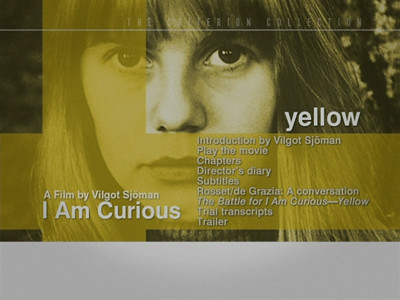
I AM CURIOUS - YELLOW - #180


The I Am Curious set has been sitting in the "next" position in my queue for a while, having come up in the sequential numbering of my personal viewing (in other words, the first 178 down with no gaps) after I covered My Life as a Dog fifteen months ago. It came to mind again after my review of In the Realm of the Senses, this movie's scandalous reputation seeming to make it a good match for Oshima's porno. I particularly considered it as a good choice after some of the mail I got regarding my opinions about Senses, partially because I expected I Am Curious to be another tempest in a teapot. My personal prudishness and my belief that it would be boring, that age would have rotted its teeth, were the main reasons I kept working around it, and maybe it was time to confront that head on.

So, I start here with the first in the set, I Am Curious - Yellow.


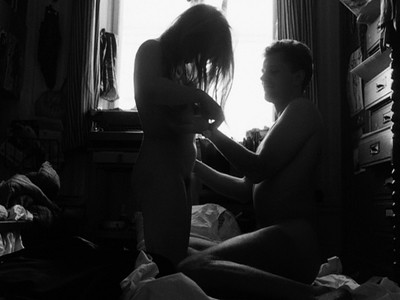
Swedish director Vilgot Sjöman's 1967 film is infamous for the protracted legal battle that its American distributor undertook in order to exhibit the picture, using I Am Curious - Yellow as his bludgeon to whack at U.S. obscenity laws. His crusade failed, then it succeeded on appeal, and then he pushed it too far and got close to a draw, but ultimately lost, and the result is that I Am Curious remained contraband. It's a film known more for its reputation than its content, and watching it now forty years on, the explicitness is incredibly tame (particularly compared to the smut of Oshima). The sex scenes comprise only a small part of the running time, and the details we see are far from gynecological. I Am Curious - Yellow isn't even about sex, it's about so much more, and the what sex there is serves a purpose. The long-dead controversy has done Sjöman's work quite a disservice.

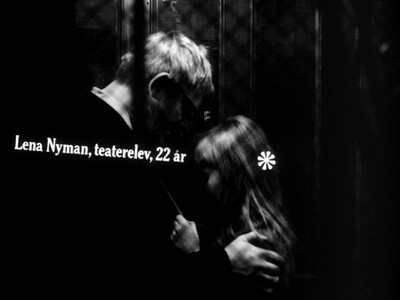
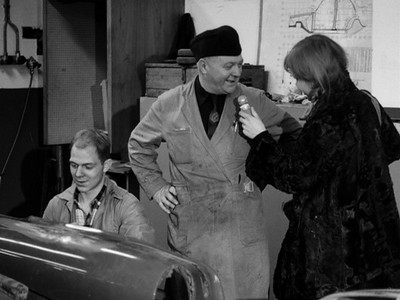
I Am Curious - Yellow is a fun, adventurous film, the Swedish extension of the French new wave, a self-reflexive slice of agitprop that would rest comfortably on a shelf next to Godard's La Chinoise in the way it satirizes trendy young idealists while also giving tribute to their marvelously misguided ideals. The focus of Sjöman's movie is Lena, a girl of 22 playing herself between the blurred lines of fact and fiction. I am sure the question of how much of I Am Curious - Yellow was documentary added to its shock value. Sjöman appears as himself making the film, and though some of the early shots are obviously staged, they are quickly offset by clips of Lena taking to the streets and interviewing her fellow citizens about the class system in Sweden. When Sjöman unceremoniously slips from this to scenes of narrative fiction, the change is imperceptible. It's only later when the film crew returns that we have cause to question what we have been seeing, when we finally see the jealous director choreographing Lena's life and demanding she redo some of her lines.


Sjöman constructs his film by balancing it between various conflicting ideals, not just fact and fiction. There is the argument of class, the haves and the have-nots, the young and the old, conservative and liberal--there is even an implicit disparity between director and star. One scene has them questioning who is using the other more. Is it Sjöman for wanting Lena to star in his film and share his bed, or is it Lena for using her sexual wiles to get the lead? It's an interpersonal clash, and also one between art and commerce that brings to mind the similar portrayal of a young woman in a money-oriented world in Steven Soderbergh's latest, The Girlfriend Experience. This dynamic is also mirrored in the lover Lena eventually takes. Depending on what point of the story we are in, Börje Ahlstedt either works in men's wear retail, sells cars, or is the last crown prince of Sweden. A divergent scene shows he and Lena ushering his father out of the castle, putting an end to the monarchy. Leading up to this, they have public sex in front of the royal palace as a barely adult guard watches. The commentary is clear. Such disrespect!

This collection of background elements makes I Am Curious - Yellow as much a portrait of the changing face of Sweden as it is of Lena. The socialist nation was at a crossroads, the youth questioning the success of the ideology as they embraced the newfound freedom that would come to define the decade. Lena is the liberated 1960s woman, free with her body, demanding of her rights, and politically motivated. She is concerned with justice and nonviolence, equal pay for equal work, and global consciousness. She wants the U.S. out of Vietnam and urges her fellow Swedes to stop taking holidays in Spain until Franco is deposed. Her father (Peter Lindgren) went to fight against Franco, but chickened out and ran back home. Ashamed for him, Lena keeps a running tally of the days he has been AWOL in her bedroom under a portrait of the Spanish dictator, surrounded by images of concentration camps and U.S. atrocities in East Asia. It's under this morbid collage that she has sex with Börje, informing him that he's her 24th lover--though the first nineteen didn't count because they were no fun. So far, that is the only price she has had to pay for her convictions; it's easy to have such strident beliefs when faced with so little opposition.


Börje isn't the smartest match for Lena. He's dishonest and unfaithful, with conservative political leanings. He has no problem with class imbalance, nor does he feel women should make as much money as men. He's all sweetness when he wants something, but he's also forceful, almost brutal, when he wants it a certain way. In other words, he's the living embodiment of the real world, as opposed to Lena's hippy-dippy idealistic one. When she retreats to her own personal commune, where she eats tiny vegetarian meals and indulges in topless yoga, he comes crashing back into her life, shattering the peace, and ultimately making her forsake her beliefs. In one comically irreverent scene, Lena apologizes to Martin Luther King, Jr., who appears in footage Sjöman had filmed the year before, telling him she is sorry, but she is going to get violent all over Börje's cheating ass. This scene is sandwiched between multiple come-ons from men passing her on the road and Lena binging on cake. The girl is a mess.


She's also a pleasure to watch. Lena Nyman does more than play herself here, she manages a complete screen character that I couldn't help but root for despite her naïveté. It made me all the more sad when Börje's abuse pushes her to forsake the little life she's cultivated for herself, and even worse when she relies on his masculine posturing. The actor gets into a tussle with the director, even attempts to hijack his control of the movie--which is really grabbing control of Lena. At one point she had gotten away from both of them, but she's back up for grabs. Her father, her director, and her co-star are all disappointments to her, as modern life apparently was for many a young Swede coming of age back then. The social experiment wasn't all it was cracked up to be, the progression wasn't progressive enough, and too many people--particularly the older ones like her dad, but the younger generation, too--were content to carry on with the status quo. The reward for those who would ask for more? VD!

For all the points he is trying to make, for all the cinematic and philosophical balls Vilgot Sjöman is juggling in I Am Curious - Yellow, he never lets the film get bogged down. His technique is facile, moving between the verite and the more formalistic scenes with determination and control. He does occasionally make a clumsy cut from one element to the next, but his style and the soul of his piece remain potent, unlike say the unmannered clutter of Dusan Makavejev's WR: Mysteries of the Organism. Sjöman's playful experimentation with sound and words on the screen recall Godard's pranks, while his sense of confined drama recalls Ingmar Bergman--whom Sjöman quotes at the outset of the movie. Given that he directed Ingmar Bergman Makes a Movie several years before I Am Curious, I think we can safely surmise that Sjöman picked up a few tricks from his countryman.


In the introduction Sjöman recorded for this disc, he explains how I Am Curious arose out of his discontent with the strictures of the Swedish studio system. He somehow convinced a producer to give him some film, some money, and the freedom to shoot whatever came to him. There was no supervision and no script. Eventually, his initial efforts proved not to be enough, and he had to return to the well for more film. Once he was done, however, he had enough footage to make two separate but compatible movies, extending the experiment further by taking Yellow in one direction, and then Blue in another (the colors being the same as on the Swedish flag). I am sorry I took so long to get around to checking out I Am Curious - Yellow, because I was definitely pleased with what I found waiting for me; whether its sibling will offer the same pleasures is a question that will have to wait just a little longer for its answer. [And here it is...the review of Blue.]


Friday, December 28, 2007

WR: MYSTERIES OF THE ORGANISM - #389


Midway into the 1971 Yugoslavian WR: Mysteries of the Organism, I started to wonder if I had been duped. Dusan Makavejev's mind-bending agitprop is a rapid cuisinart of documentary footage and staged political skits. Their basis is the questionable psychological theories of sub-Freudian Wilhelm Reich, whose initials provide the code in the movie's title. Watching the testimony of people who knew the doctor and witnessed his struggles against anti-communist groups and the American government, I started to wonder if this wasn't all a big joke, that it was really a mockumentary, an Eastern European Spinal Tap. I mean, a rogue analyst preaching the power of the human orgasm as a pathway to true, state-sponsored freedom, health, and power? Someone had to be making this up.

Except no one did. Apparently that portion is real, as real as the strange story of the sexually curious Yugoslavian woman is fake. Milena (Milena Dravic) is a young woman enamored of both rhetoric and pleasure, and she spends a lot of time trying to convince her comrades that if they practiced free love, not only would they have a much healthier Yugoslavia, but they'd be acting in line with the original Communist philosophy. I could see that Milena was Reich's teachings put into action--though, it takes her a while to practice free love herself, despite her roommate (Jagoda Kaloper) giving it away all over the place. What I couldn't tell was whether Makavejev intended Milena's situation to be ironic or not. When her fellow Party members break out into pro-Stalinist anthems (often juxtaposed with footage from an actual propaganda film about the dictator), it seems like the director is wryly bursting the Commie bubble, but Milena never wavers. She seems like she means it. (Testament to the strength of Makavejev's actress, really. Dravic's earnestness goes a long way to sell her portions of WR.)

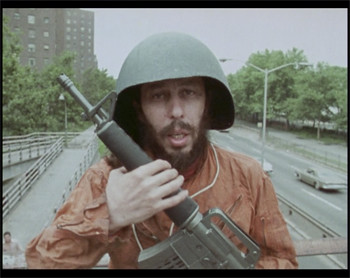
This is just one of the many things that baffled me when trying to piece together the many disparate elements of WR: Mysteries of the Organism. There are clearly two distinct halves to this movie: the material Makavejev shot in America (and in English) is the documentary stuff, and the material shot in Yugoslavia (and in Serbo-Croatian) is the fictional dramatization of the director's theories. Where it starts to get fuzzy is the second U.S. story line, where Makavejev follows a group of libertines in New York city. Interviews with transvestite and Warhol cohort Jackie Curtis seem real enough, but other pieces of the surroundings seem staged, such as the nudists arguing over revolutionary pornography in a publishing office (are they talking about Screw magazine, of all things?). The hippy dressed up as a soldier (Tuli Kupferberg) running around the streets is definitely a contrived stunt, but how connected to the rest is he? Is it Kupferberg that Curtis alleges asked her to marry him? Where exactly is that fourth wall?

Or maybe it doesn't matter. Maybe getting hung up on fact and fiction is just the easiest thing for me to dangle on because, as a whole, WR: Mysteries of the Organism puzzles me. As a formalist experiment, it reminded me a lot of Jean-Luc Godard's Sympathy for the Devil (a.k.a. 1+1) in how it has the duality of the documentary track and the Brechtian political skits. In the Godard film, the documentary elements of the Rolling Stones recording their anthem to cynicism worked, but the pedestrian, pedantic sketches were just annoying interruptions. With WR, I found it to be the opposite. The documentary elements don't really speak to me, and sometimes come off as downright silly. When the hippy soldier jumps up and down like a monkey and strokes his gun, simulating masturbation, I wondered if maybe I had sat on my remote and flipped over to a cable-access channel. It's not the deepest of intellectual connections.
The Yugoslavian story, on the other hand, has much more potential, and maybe could have benefited from standing on its own. As political melodrama, it has a lot to offer, particularly when Milena connects with a Russian figure skater (Ivica Vidovic), the top example of a Stalinist Man (he even shares the dictator's first two names), and tries to convince him of her way of thinking. Cutting away from that to seeing a woman make a plaster casting of a man's penis was too disjointed for me.

Even so, WR: Mysteries of the Organism won the Luis Bunuel Award in Cannes and has survived as a staple of underground cinema. This made me wonder if I delved deeper, maybe I could get what Dusan Makavejev was after. Since this new DVD is part of the Criterion Collection, it's got quite a few special features to go with the movie. I decided for once not to approach these as extras or side elements, but as essential components of this DVD experience. I would use them to try to get to the heart of this movie.


I first turned to the interior booklet that came with the disc, which has a four-page essay by critic Jonathan Rosenbaum. It's a good starting point, as Rosenbaum begins to decipher a lot of what we see on the screen. Beginning with more background on Wilhelm Reich, he draws greater links between Reich's theories and how Makavejev tries to show them in practice through two opposed storytelling styles in two opposed nations. He also identifies more of the players. That was Screw magazine being discussed, and it's that rag's editor, Jim Buckley, having his penis wrapped in plaster. The soldier, Tuli Kupferberg, was a member of the oddball music group the Fugs, and it's his weird folk songs that play over his street scenes, making his actions a sort of performance art.

Even better, Rosenbaum explains a little bit about Makavejev's politics, leading me to think I could be misreading WR: Mysteries of the Organism as overly political. It's not necessarily pro or anti-Communist, but more humanist than that. Reich denied Communist leanings, and even though we have things like Screw in the States, if we persecuted the doctor as we did, how much more free are we?

From the liner notes, I decided to transition to the audio commentary. Here is the true decoder ring to starting to unscramble the message of WR. Read by actor Daniel Stewart, the track is compiled from Raymond Durgnat's book-length examination of the movie. Detailed, incisive, and not always reverent, this approach uses scholarly dialectic, references the script and interviews with Makavejev, and employs historical and critical writings to place WR in its proper context. As Durgnat lays it all out, he reveals a deliberate structure to the film, each move smartly mapped. This exposes the breadth of the juxtapositions of image, information, and story, with Stalin standing tall as the glue that binds it all together, to the good or the bad.

What this lead me to realize is that not only is Makavejev examining political and personal freedom--and really, with the sexual elements, the politics of the personal--but the liberation of ideas by dismantling mis-en-scene and changing how audience and art interact. One may not enjoy it in total, as I certainly didn't, but you will be engaged. Passive viewing is not allowed. This is what makes the whole DVD thing so exciting for film fans, as a well-packaged film can actually give us the tools to get at something that we may not see right away. Viewing WR: Mysteries of the Organism - Criterion Collection twice now, once on my own and once with the help of Durgnat and Rosenbaum, I'm starting to figure it out. It may not be entirely for me, and certainly with this kind of movie, everyone's mileage may vary, but I can't dismiss it outright. Art is sometimes exploration, and as even Columbus would tell you, it often takes a couple of expeditions to find what you're looking for.

(Criterion is also releasing Dusan Makavejev's follow-up film, Sweet Movie. My understanding is that it's an even more difficult movie than WR. I will be sure to review that at some point in the future.)


Originally written June 19, 2007. For technical specs and special features, read the full article at DVD Talk.